{"cover":"Professional landscape format (1536×1024) hero image featuring bold text overlay 'Expert Witness Roles in 2026 Mortgage Valuation Disputes: RICS Guidelines Amid Recovering Buyer Demand' in extra large 72pt white sans-serif font with dark gradient shadow, positioned in upper third. Background shows modern courtroom setting with RICS-certified surveyor presenting valuation evidence, legal documents, property images on digital screens, and mortgage dispute documentation. Foreground includes gavel, professional surveyor tools, property valuation reports with RICS logo. Color scheme: deep navy blue, gold accents, white text for maximum contrast. Editorial quality, professional magazine cover aesthetic with clean composition following rule of thirds, emphasizing authority and expertise in property valuation litigation.","content":["Detailed landscape format (1536×1024) image showing RICS professional standards framework for expert witnesses in 2026. Visual composition includes open RICS Red Book with highlighted sections, expert witness oath document, tribunal setting in background, professional surveyor in business attire reviewing property valuation reports. Foreground displays conflict-of-interest disclosure forms, fee agreement templates, and independence declaration documents. Infographic overlay showing six-week consultation timeline from August 2025, with arrows pointing to key compliance requirements. Color palette: professional navy, burgundy, gold accents. Clean, authoritative aesthetic emphasizing regulatory compliance and professional standards in mortgage valuation disputes.","Detailed landscape format (1536×1024) visualization of 2026 UK housing market recovery trends affecting valuation disputes. Split-screen composition: left side shows declining market graph from 2023-2025 with downward arrows and uncertainty indicators; right side displays 2026 recovery with upward trending sales prices, increased buyer demand charts, and positive confidence indicators. Center features property valuation comparison showing disputed valuations versus actual market values. Includes visual elements: residential properties, mortgage documents, calculator, percentage increase indicators, RICS survey data overlays. Color scheme: red for declining market, green for recovery, professional blue for neutral analysis. Data-driven infographic style with clear visual hierarchy.","Detailed landscape format (1536×1024) practical guide visualization for expert witness preparation in mortgage valuation cases. Central focus on professional surveyor preparing court testimony with multiple elements: laptop displaying valuation software, property inspection photographs, comparable sales data spreadsheets, RICS compliance checklist, expert witness report template, and legal precedent documents. Background shows courtroom or tribunal setting with witness stand. Foreground includes detailed checklist overlay with tick marks showing: independence verification, disclosure requirements, evidence preparation, cross-examination readiness. Visual flow arrows connecting preparation steps. Color scheme: authoritative navy blue, trust-building green, professional grey tones. Clean, instructional design aesthetic."]"}
The UK property market in 2026 presents a complex landscape where recovering buyer confidence meets increased scrutiny of mortgage valuations. As property prices stabilize after years of volatility, mortgage lenders, buyers, and sellers find themselves embroiled in disputes over property valuations with unprecedented frequency. At the heart of these conflicts stands the expert witness—a RICS-certified professional whose testimony can determine the outcome of costly litigation.
Understanding Expert Witness Roles in 2026 Mortgage Valuation Disputes: RICS Guidelines Amid Recovering Buyer Demand has never been more critical for property professionals, legal practitioners, and stakeholders navigating today's stabilizing market. With RICS launching its first major update to expert witness standards since 2014, the profession faces renewed expectations for independence, transparency, and technical competence.[1]
This comprehensive guide examines the evolving role of expert witnesses in mortgage valuation disputes, explores the latest RICS guidelines, and provides actionable strategies for professionals operating in 2026's recovering property market.
Key Takeaways
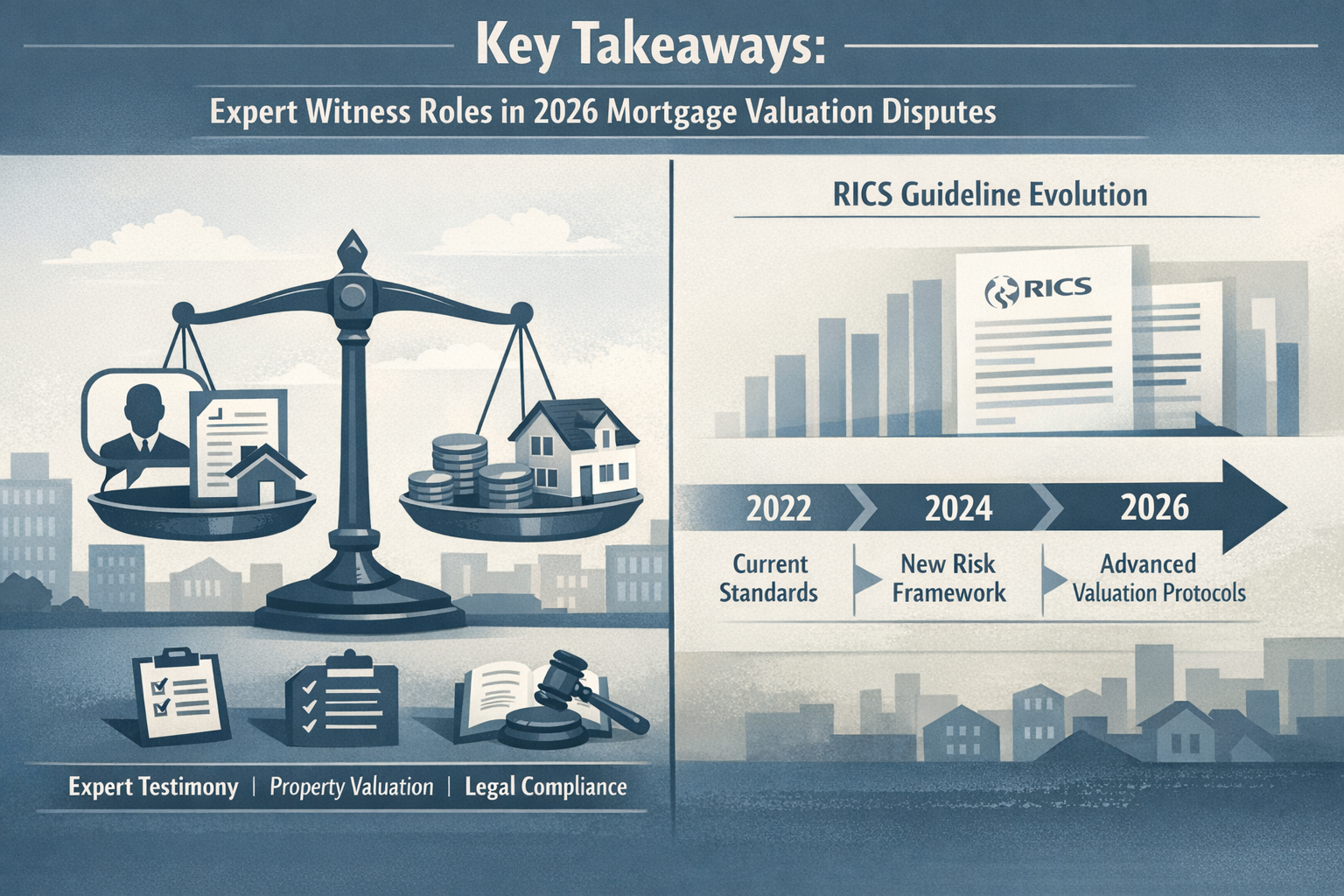
- 🏛️ RICS updated expert witness standards in 2025 with enhanced conflict-of-interest requirements and clearer disclosure obligations that apply globally while recognizing local legal differences.[1]
- ⚖️ Expert witnesses owe their primary duty to the tribunal, not the client, requiring complete independence and unbiased testimony within their genuine area of expertise.[1]
- 📈 UK housing market confidence returned by late 2025, creating increased valuation disputes as buyer demand recovers and price expectations diverge between parties.[1]
- 📋 Red Book valuations serve as admissible court evidence due to their structured transparency and compliance with internationally recognized standards.[3]
- ✅ New compliance requirements include Awaab's Law (effective October 2025) and Housing Health and Safety Rating System (HHSRS) standards for housing disrepair cases.[1]
Understanding the Expert Witness Role in Property Valuation Disputes
What Defines an Expert Witness in Mortgage Valuations?
An expert witness in mortgage valuation disputes is a qualified professional—typically a RICS-certified chartered surveyor—who provides independent, objective testimony to assist courts, tribunals, or arbitration panels in understanding technical property valuation matters. Unlike ordinary witnesses who testify only to facts they've observed, expert witnesses offer professional opinions based on specialized knowledge and experience.
The role extends far beyond simply providing a valuation figure. Expert witnesses must:
- Analyze complex property data including comparable sales, market trends, and property-specific characteristics
- Prepare detailed written reports that comply with legal and professional standards
- Withstand cross-examination in court or tribunal proceedings
- Maintain complete independence from the party instructing them
- Communicate technical concepts in language accessible to non-specialists
"The expert witness's primary duty is owed to the tribunal, not to the client who pays their fees. This fundamental principle ensures the integrity of the judicial process."[1]
The Legal Framework Governing Expert Witnesses
In the UK legal system, expert witnesses operate under strict procedural rules designed to ensure reliability and impartiality. The Civil Procedure Rules (CPR) Part 35 establishes that expert evidence should be restricted to matters genuinely requiring specialist knowledge and that experts have an overriding duty to the court.
For those seeking expert witness services, understanding this legal framework is essential. The expert's independence must be absolute—their opinion cannot be influenced by who is paying for their services or what outcome their client desires.
RICS members acting as expert witnesses must additionally comply with professional standards that often exceed legal minimums. The 5th edition of "Surveyors acting as expert witnesses," following a six-week consultation period initiated in August 2025, reinforces these obligations with enhanced clarity.[1]
The 2026 Market Context: Why Valuation Disputes Are Increasing
Recovery in Buyer Demand and Market Stabilization
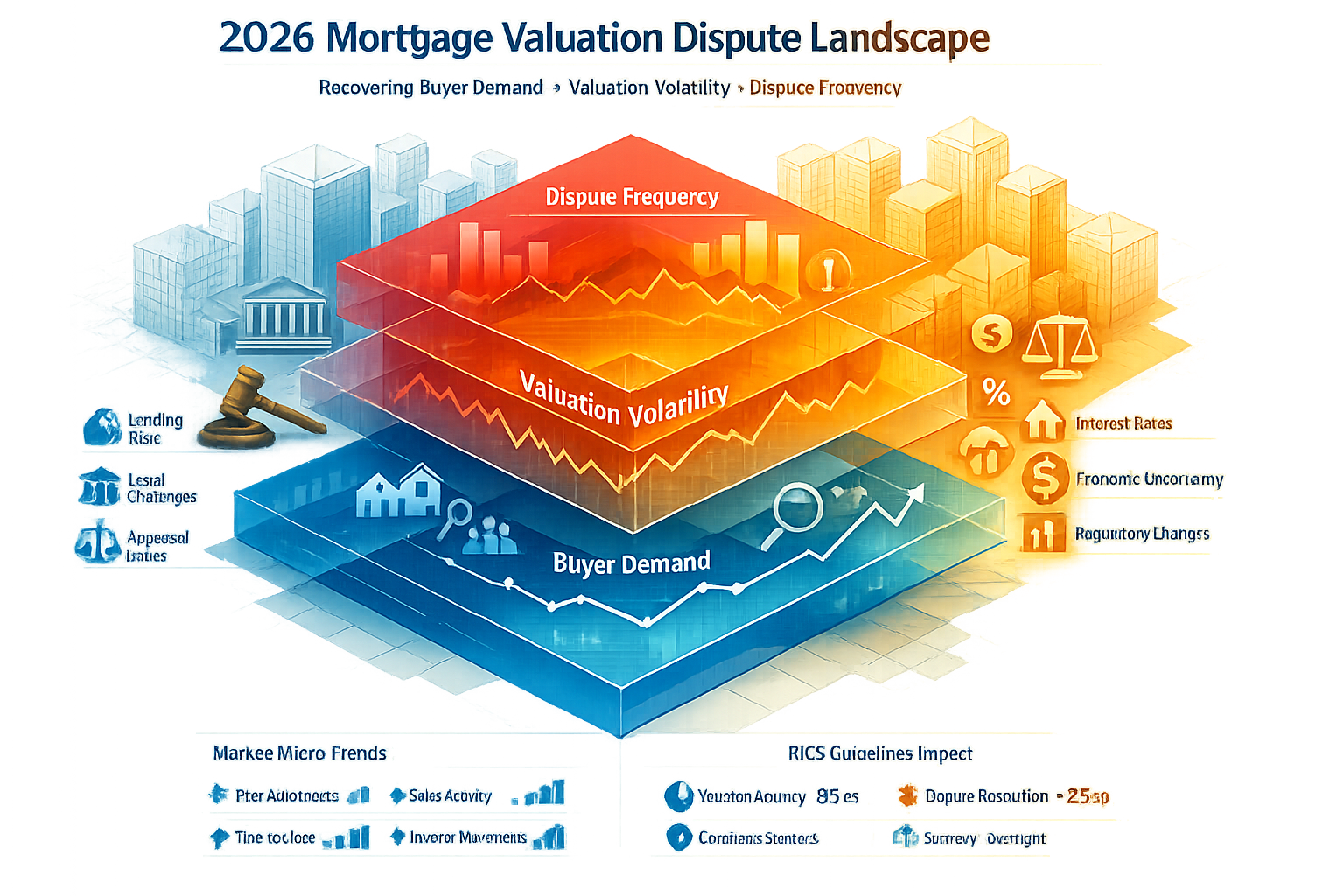
The UK housing market experienced significant turbulence from 2022 through 2024, with interest rate rises, economic uncertainty, and affordability challenges dampening activity. However, by the end of 2025, market confidence returned decisively. According to the latest RICS UK Residential Market Survey, expectations for sales and prices turned "decisively more positive" as 2025 closed.[1]
This recovery creates a perfect storm for valuation disputes:
| Market Condition | Impact on Disputes |
|---|---|
| Stabilizing prices | Disagreement over whether properties reflect peak, trough, or transitional values |
| Increased transaction volume | More opportunities for valuation discrepancies to emerge |
| Lender caution | Conservative valuations clash with seller expectations formed during recovery |
| Regional variation | Divergent recovery rates across UK regions complicate comparable analysis |
| New construction standards | Awaab's Law and HHSRS compliance affect valuations of existing properties |
Common Triggers for Mortgage Valuation Disputes in 2026
Mortgage valuation disputes typically arise in several scenarios:
1. Down-valuations by Lenders 🏦
When a lender's surveyor values a property below the agreed purchase price, buyers may struggle to secure sufficient financing. Sellers may dispute the valuation, arguing it fails to reflect true market value or comparable sales.
2. Remortgage Valuation Shortfalls
Homeowners seeking to remortgage may receive valuations lower than expected, preventing them from accessing equity or securing favorable rates. This is particularly common in areas where recovery has been slower.
3. Help to Buy and Shared Ownership Disputes
Government-backed schemes like Help to Buy and Shared Ownership require specific valuation methodologies. Disputes arise when parties disagree on staircasing valuations or redemption values.
4. New Build Premium Erosion
Properties purchased as new builds during market peaks may face significant valuation challenges when the "new build premium" erodes, leading to negative equity situations and disputes with developers or lenders.
5. Leasehold and Lease Extension Valuations
Lease extension valuations frequently result in disputes between leaseholders and freeholders over marriage value, relativity, and deferment rates.
RICS Guidelines for Expert Witness Roles in 2026 Mortgage Valuation Disputes
The Updated 5th Edition Standards
RICS launched a global consultation in August 2025 for the 5th edition of "Surveyors acting as expert witnesses"—the first major update since 2014.[1] This updated guidance addresses contemporary challenges while reinforcing fundamental principles that govern expert witness conduct.
Key Updates Include:
✅ Enhanced Conflict-of-Interest Requirements
The new standards provide clearer disclosure obligations, requiring experts to identify and declare any relationships, financial interests, or prior involvement that could compromise independence. The guidance explicitly explains legal consequences for non-compliance.[1]
✅ Clear Fee Guidance
Recognizing concerns about financial pressures compromising independence, the 5th edition provides explicit guidance on conditional and deferred fees. It establishes when such arrangements are acceptable and when they pose unacceptable risks to professional objectivity.[1]
✅ Risk Mitigation for High-Volume Cases
For experts handling multiple similar cases (common in mortgage valuation disputes), the standards introduce protocols for template usage, ensuring efficiency doesn't compromise the thoroughness required for each individual case.[1]
✅ Global Application with Local Recognition
While maintaining universal professional principles, the updated standards acknowledge different legal systems worldwide, providing flexibility for RICS members practicing internationally while upholding core ethical requirements.[1]
Core Principles: Independence and Duty to the Tribunal
The foundation of Expert Witness Roles in 2026 Mortgage Valuation Disputes: RICS Guidelines Amid Recovering Buyer Demand rests on two non-negotiable principles:
1. Primary Duty to the Tribunal
Expert witnesses must understand that their overriding obligation is to assist the court, tribunal, or arbitrator—not to advocate for the party instructing them. This means:
- Providing honest opinions even when unfavorable to the instructing party
- Acknowledging limitations in evidence or methodology
- Changing opinions when presented with new information
- Refusing instructions that compromise independence
2. Operating Within True Expertise
Experts must only provide opinions within their genuine area of competence. A surveyor specializing in residential valuations should not accept instructions for complex commercial properties without appropriate qualifications and experience.
For professionals seeking RICS valuations, these principles ensure that expert testimony is reliable and credible, regardless of which party commissions the work.
Compliance with Current Legal Standards
The April 2025 Practice Alert from RICS specifically reminded members of their expert witness obligations, particularly in housing disrepair claims.[1] This alert emphasized compliance with:
Awaab's Law (Effective October 2025)
This legislation requires landlords to investigate and remedy reported health hazards within specified timeframes. Expert witnesses in housing disrepair cases must understand these requirements and assess compliance when evaluating property conditions and valuations.
Housing Health and Safety Rating System (HHSRS)
HHSRS provides the framework for assessing housing conditions and potential hazards. Expert witnesses must apply this system correctly when valuing properties with alleged defects or when disputes involve habitability issues.
These compliance requirements are particularly relevant for chartered surveyors providing expert testimony in landlord-tenant disputes, mortgage fraud cases, and negligence claims.
Preparing Expert Witness Reports for Mortgage Valuation Disputes
The RICS Red Book Framework
RICS Valuation – Global Standards (commonly known as the Red Book) provides the internationally recognized framework for property valuations. When acting as expert witnesses, RICS members typically prepare valuations in accordance with Red Book standards, which enhances their admissibility and credibility in legal proceedings.[3]
Red Book valuations are admissible in court because they demonstrate:
- Structured methodology following internationally accepted approaches
- Transparency in assumptions, limitations, and data sources
- Professional competence through mandatory RICS qualification requirements
- Quality assurance through internal review processes
- Ethical compliance with professional conduct standards
The Red Book requires valuers to clearly state the purpose of the valuation, identify the client, specify the valuation date, and describe the property and interest being valued. These elements are equally essential in expert witness reports.[5]
Essential Components of an Expert Witness Report
A comprehensive expert witness report in a mortgage valuation dispute must include:
1. Executive Summary 📄
A concise overview of the property, valuation figure, and key conclusions that allows legal professionals and judges to quickly grasp the expert's position.
2. Instructions and Scope
Clear documentation of what the expert was asked to do, any limitations on the instruction, and confirmation of independence and compliance with expert witness duties.
3. Property Description
Detailed description of the subject property including:
- Location and surrounding area
- Construction type and age
- Accommodation and floor areas
- Condition and any defects
- Planning status and restrictions
4. Methodology and Approach
Explanation of the valuation methodology employed (comparative, investment, residual, etc.) and justification for its selection. This section demonstrates technical competence and allows opposing experts to understand and challenge the approach.
5. Market Analysis
Assessment of relevant market conditions at the valuation date, including:
- Transaction volumes and trends
- Price movements in the locality
- Demand and supply dynamics
- Economic factors affecting values
6. Comparable Evidence
Presentation of comparable sales or rental evidence, with adjustments explained for differences in size, condition, location, and timing. This is often the most scrutinized section in cross-examination.
7. Valuation Conclusion
The expert's opinion of value, clearly stated with any qualifications or assumptions. If a range is appropriate, the reasoning should be explained.
8. Statement of Truth
Confirmation that the expert understands their duty to the tribunal, that the report represents their genuine professional opinion, and that it includes all relevant matters within their knowledge.
For those commissioning RICS homebuyer surveys or building surveys, understanding these report components helps evaluate whether a surveyor's work will withstand legal scrutiny if disputes arise.
Avoiding Common Pitfalls in Expert Reports
Expert witness reports frequently fail to meet required standards due to:
❌ Advocacy rather than independence – Writing to support the client's position rather than providing objective analysis
❌ Insufficient comparable evidence – Relying on too few comparables or failing to adjust for material differences
❌ Unclear methodology – Not explaining the valuation approach or why it was selected
❌ Ignoring contrary evidence – Failing to acknowledge or address evidence that contradicts the expert's opinion
❌ Exceeding expertise – Offering opinions on matters outside the expert's genuine competence
❌ Poor presentation – Confusing structure, excessive jargon, or inadequate explanation of technical matters
The updated RICS guidance specifically addresses these issues, providing clearer expectations for report quality and content.[1]
Navigating Cross-Examination and Tribunal Testimony

Preparation for Oral Evidence
While written reports form the foundation of expert evidence, oral testimony and cross-examination often determine the weight courts give to expert opinions. Preparation for this stage is crucial.
Pre-Hearing Preparation Steps:
- Thoroughly review your own report – You must be intimately familiar with every statement, figure, and assumption
- Anticipate challenges – Identify weaknesses in your evidence and prepare honest responses
- Review opposing expert reports – Understand alternative viewpoints and where disagreements exist
- Prepare visual aids – Maps, photographs, and charts can clarify complex points
- Practice explaining technical concepts – Ensure you can communicate clearly to non-specialists
- Confirm factual accuracy – Verify all data, dates, and figures before testimony
Maintaining Professional Composure Under Challenge
Cross-examination aims to test the reliability and credibility of expert evidence. Opposing counsel may:
- Challenge the expert's qualifications and experience
- Question the methodology and assumptions used
- Present alternative comparable evidence
- Highlight inconsistencies or errors in the report
- Test whether the expert has acted independently
Best Practices for Cross-Examination:
✅ Listen carefully to each question and answer only what is asked
✅ Admit limitations honestly when you don't know something or when evidence is uncertain
✅ Maintain objectivity and avoid becoming defensive or argumentative
✅ Speak clearly and avoid excessive jargon
✅ Take time to consider questions before responding
✅ Refer to your report when needed rather than relying on memory
✅ Acknowledge valid criticisms and explain how they affect (or don't affect) your conclusions
The expert witness's credibility often depends more on how they handle challenges than on whether their initial opinion was perfect. Judges and tribunals respect experts who acknowledge uncertainties and limitations while maintaining their professional judgment.
Strategic Considerations for Expert Witness Roles in 2026 Mortgage Valuation Disputes
Selecting the Right Expert Witness
For parties involved in mortgage valuation disputes, choosing the appropriate expert witness is a critical strategic decision. The ideal expert possesses:
Technical Qualifications 🎓
- RICS membership (MRICS or FRICS)
- Relevant specialist designations (e.g., Registered Valuer)
- Experience with the specific property type and location
- Current knowledge of market conditions
Expert Witness Experience
- Prior experience providing expert testimony
- Understanding of legal procedures and requirements
- Ability to communicate complex concepts clearly
- Track record of credible, independent opinions
Specific Market Knowledge
For mortgage valuation disputes in 2026's recovering market, experts should demonstrate:
- Understanding of post-pandemic market dynamics
- Knowledge of regional recovery patterns
- Familiarity with lender valuation policies
- Awareness of regulatory changes (Awaab's Law, HHSRS, etc.)
Working with valuers registered with RICS ensures compliance with professional standards and enhances the credibility of expert evidence.
Cost-Benefit Analysis of Expert Witness Engagement
Expert witness services represent a significant cost in property disputes. Parties should consider:
When Expert Evidence Is Essential:
- Valuation differences exceed £50,000-£100,000
- Complex property types requiring specialist knowledge
- Disputes involving professional negligence claims
- Cases where settlement negotiations have failed
- High-value properties where small percentage differences matter
When Alternative Approaches May Suffice:
- Small valuation differences on straightforward properties
- Cases where liability is clear regardless of exact valuation
- Situations where negotiated settlement is likely
- Disputes that can be resolved through single joint expert appointment
The updated RICS fee guidance provides clarity on acceptable fee arrangements, helping parties understand cost structures while ensuring expert independence isn't compromised.[1]
Single Joint Expert vs. Party-Appointed Experts
Courts increasingly favor single joint expert (SJE) appointments where both parties instruct one expert, reducing costs and encouraging settlement. However, party-appointed experts remain appropriate when:
- Significant sums are at stake
- Complex technical issues require multiple perspectives
- Parties have fundamentally different positions on methodology
- One party has already obtained a valuation that the other disputes
Understanding when to agree to SJE appointments versus insisting on separate experts requires careful strategic consideration and legal advice.
Case Studies: Expert Witness Roles in 2026 Mortgage Valuation Disputes
Case Study 1: Down-Valuation in Recovering Market
Scenario:
A buyer agreed to purchase a three-bedroom semi-detached property in Greater Manchester for £325,000 in January 2026. The lender's surveyor valued the property at £295,000, creating a £30,000 shortfall. The seller disputed the valuation, arguing it failed to reflect recent comparable sales showing market recovery.
Expert Witness Role:
The seller appointed a RICS-certified expert witness who:
- Analyzed 15 comparable sales within 0.5 miles from the previous six months
- Demonstrated that the lender's surveyor had relied on older comparables from the market trough
- Adjusted for differences in property condition, garden size, and recent improvements
- Concluded that £320,000 represented fair market value
Outcome:
The lender's surveyor reviewed the expert's evidence and revised the valuation to £315,000. The parties negotiated a purchase price of £317,500, allowing the transaction to proceed without litigation.
Key Lessons:
- Timing of comparable evidence is critical in recovering markets
- Well-prepared expert evidence can facilitate settlement without court proceedings
- Independence and objectivity enhanced the expert's credibility with the lender
Case Study 2: Shared Ownership Staircasing Dispute
Scenario:
A shared ownership leaseholder sought to purchase an additional 25% stake in their property. The housing association's valuer assessed the property at £280,000, while the leaseholder's valuer concluded £245,000, creating a £8,750 difference in the staircasing cost.
Expert Witness Role:
Both parties agreed to a single joint expert appointment. The SJE:
- Inspected the property and reviewed both previous valuations
- Identified that the housing association's valuer had failed to adjust for significant service charge liabilities
- Noted that the leaseholder's valuer had used comparables from a superior location
- Concluded that £262,000 represented fair market value
Outcome:
Both parties accepted the SJE's valuation, resolving the dispute without tribunal proceedings and saving substantial legal costs.
Key Lessons:
- SJE appointments can provide cost-effective resolution
- Expert witnesses must consider all factors affecting value, including lease terms and service charges
- Independence from both parties enhances acceptance of conclusions
Case Study 3: Professional Negligence and Mortgage Fraud
Scenario:
A lender pursued a negligence claim against a surveyor who had valued a property at £450,000 for mortgage purposes in 2024. When the borrower defaulted in 2026, the property sold for only £320,000. The lender alleged the original valuation was negligently high.
Expert Witness Role:
The defendant surveyor's expert witness:
- Analyzed market conditions at the 2024 valuation date versus 2026 sale date
- Demonstrated significant market decline between the two dates
- Reviewed the original surveyor's methodology and comparable evidence
- Concluded the original valuation was within an acceptable range given market conditions and available evidence in 2024
Outcome:
The court accepted the expert's evidence that market conditions had changed substantially, and the original valuation, while at the upper end of the acceptable range, was not negligent. The claim was dismissed.
Key Lessons:
- Expert witnesses must clearly distinguish between valuation date conditions and subsequent market changes
- Hindsight bias must be avoided—valuations should be judged by information available at the time
- Thorough analysis of methodology is as important as the valuation figure itself
Future Trends in Expert Witness Roles for Mortgage Valuations
Technology and Automated Valuation Models (AVMs)
The increasing use of Automated Valuation Models by lenders creates new challenges for expert witnesses. While AVMs provide rapid, cost-effective valuations for straightforward properties, they have limitations:
- Difficulty assessing property condition and quality
- Limited ability to account for unique features or local factors
- Reliance on historical data that may not reflect rapid market changes
- Potential for algorithmic bias or errors in underlying data
Expert witnesses in 2026 and beyond must be prepared to:
📊 Evaluate AVM methodology and identify limitations in specific cases
📊 Explain when human judgment is essential for accurate valuation
📊 Reconcile differences between AVM outputs and traditional valuation approaches
📊 Assess whether AVMs appropriately reflect recovering market conditions
Climate Change and Valuation Considerations
Environmental risks are increasingly affecting property values, creating new areas for expert witness testimony:
- Flood risk and insurance availability
- Energy efficiency and EPC ratings
- Future-proofing against climate change
- Compliance with emerging environmental regulations
RICS has published guidance on valuing properties in extreme conditions, recognizing that climate-related risks require specialist consideration.[4] Expert witnesses must stay current with evolving standards in this area.
Regulatory Changes and Compliance
The implementation of Awaab's Law in October 2025 and ongoing evolution of housing standards create compliance requirements that affect valuations.[1] Expert witnesses must understand:
- How regulatory compliance (or non-compliance) affects marketability and value
- The cost of bringing properties up to required standards
- The impact of health and safety ratings on mortgage lending
- Potential stigma effects from previous compliance failures
Practical Guidance for Property Professionals
For Surveyors Considering Expert Witness Work
Chartered surveyors considering expert witness roles should:
- Obtain specialist training in expert witness procedures and legal requirements
- Start with smaller cases to develop experience before accepting high-value instructions
- Maintain comprehensive professional indemnity insurance with appropriate expert witness coverage
- Develop clear engagement letters that establish independence and scope from the outset
- Create robust quality assurance processes for report preparation and review
- Stay current with RICS standards and attend relevant CPD events
- Build relationships with legal professionals who understand the value of quality expert evidence
For those offering RICS home surveys or building surveys, expert witness work can be a natural extension of existing valuation expertise.
For Parties Involved in Valuation Disputes
Property buyers, sellers, and lenders facing valuation disputes should:
✅ Seek early legal advice to understand options and likely costs
✅ Obtain independent valuation evidence before committing to litigation
✅ Consider negotiation and mediation before formal proceedings
✅ Choose experts carefully based on qualifications, experience, and independence
✅ Provide complete instructions including all relevant documentation
✅ Be realistic about costs versus potential recovery
✅ Understand that expert opinions may not align with your preferred outcome
For Legal Practitioners
Solicitors and barristers instructing expert witnesses in mortgage valuation disputes should:
- Instruct early to allow adequate time for property inspection and research
- Provide comprehensive documentation including all previous valuations, surveys, and relevant correspondence
- Clarify the expert's role and ensure they understand their duty to the tribunal
- Avoid inappropriate pressure that could compromise the expert's independence
- Facilitate expert discussions where multiple experts are appointed
- Prepare experts thoroughly for cross-examination and tribunal procedures
Conclusion: Navigating Expert Witness Roles in 2026's Evolving Market
Expert Witness Roles in 2026 Mortgage Valuation Disputes: RICS Guidelines Amid Recovering Buyer Demand represent a critical intersection of professional competence, legal procedure, and market knowledge. As the UK property market stabilizes after years of volatility, valuation disputes are increasing—driven by divergent expectations, regional variations in recovery, and the natural tensions between conservative lender valuations and optimistic seller expectations.
The updated RICS standards launched in 2025 provide essential guidance for professionals navigating this complex landscape.[1] By reinforcing core principles of independence, transparency, and competence while addressing contemporary challenges like fee arrangements and high-volume cases, these standards enhance the credibility and reliability of expert witness testimony.
Key Actionable Steps
For Surveyors:
- Review the 5th edition RICS expert witness standards and ensure full compliance
- Invest in expert witness training and professional development
- Develop robust conflict-of-interest checking procedures
- Create template frameworks that ensure consistency while allowing case-specific analysis
- Build expertise in emerging areas like climate risk and regulatory compliance
For Property Stakeholders:
- Recognize when expert evidence is necessary versus when negotiation may suffice
- Select experts based on qualifications, experience, and demonstrated independence
- Provide complete instructions and documentation to enable thorough analysis
- Consider single joint expert appointments where appropriate to reduce costs
- Engage early with legal and valuation professionals when disputes arise
For the Industry:
- Embrace technology while recognizing the continued need for professional judgment
- Adapt to evolving regulatory requirements including Awaab's Law and HHSRS
- Develop market data and comparable evidence databases to support consistent valuations
- Foster dialogue between valuers, lenders, and legal professionals to reduce disputes
- Maintain high professional standards that preserve public confidence in property valuations
The recovering market of 2026 offers opportunities for growth and increased transaction volumes, but it also demands heightened professionalism from those providing expert witness services. By adhering to RICS guidelines, maintaining absolute independence, and delivering technically sound, clearly communicated evidence, expert witnesses play an essential role in resolving disputes fairly and efficiently.
Whether you're a chartered surveyor in Manchester or elsewhere in the UK, understanding these evolving standards and market dynamics is essential for professional success and public protection. The expert witness role, properly executed, serves not just individual clients but the broader public interest in fair, transparent property markets built on reliable valuation evidence.
As market conditions continue to evolve, professional standards will adapt accordingly. Staying informed, maintaining competence, and upholding the highest ethical standards will ensure that expert witnesses continue to serve their vital function in the property sector for years to come.
References
[1] Rics Launches Global Consultation On Updated Expert Witness Standard – https://www.rics.org/news-insights/rics-launches-global-consultation-on-updated-expert-witness-standard
[2] Expert Witness Valuations In 2026s Stabilizing Market Rics Standards For Mortgage Disputes And Property Disagreements – https://nottinghillsurveyors.com/blog/expert-witness-valuations-in-2026s-stabilizing-market-rics-standards-for-mortgage-disputes-and-property-disagreements
[3] Breaking Down The Rics Valuation What Every Valuer Should Know – https://globalvaluation.com/breaking-down-the-rics-valuation-what-every-valuer-should-know/
[4] Real Estate Valuation Extreme Conditions – https://ww3.rics.org/uk/en/journals/property-journal/real-estate-valuation-extreme-conditions.html
[5] Valuation Standards – https://www.rics.org/profession-standards/rics-standards-and-guidance/sector-standards/valuation-standards
[6] New Expert Witness Guidance For Rics Members – https://www.nmrk.com/en-gb/perspectives/new-expert-witness-guidance-for-rics-members