When a property valuation dispute reaches the courtroom in 2026, the expert witness who steps forward carries more than just professional credentials—they bear the weight of increasingly complex regional market dynamics that can make or break a case. With the UK property market experiencing unprecedented regional divergence, the role of the expert witness has evolved from simple number-crunching to sophisticated market interpretation that accounts for the stark north-south divide reshaping Britain's real estate landscape.
Expert Witness Preparation for 2026 UK Property Valuation Disputes: Navigating Regional Price Divergences has become essential as chartered surveyors and valuation professionals face mounting pressure to provide credible, defensible testimony in an environment where London properties may appreciate at double-digit rates while northern markets remain stubbornly flat. The stakes have never been higher, and the margin for error has never been smaller.
Key Takeaways
- 🎯 Regional price divergences in 2026 require expert witnesses to demonstrate deep understanding of local market conditions, with London and Southeast properties showing significantly different trajectories than Midlands and Northern regions
- 📊 RICS Red Book compliance and CPR Part 35 requirements form the foundation of credible expert witness testimony, demanding rigorous methodology and transparent assumptions
- ⚖️ Effective preparation involves comprehensive comparable evidence gathering, detailed market analysis across multiple regions, and clear communication of complex valuation principles to non-specialist audiences
- 🔍 Cautiously optimistic recovery patterns mean expert witnesses must balance historical data with forward-looking market indicators while maintaining objectivity
- 💼 Professional credibility depends on thorough documentation, adherence to professional standards, and the ability to withstand cross-examination on regional market variations
Understanding the 2026 UK Property Market Landscape
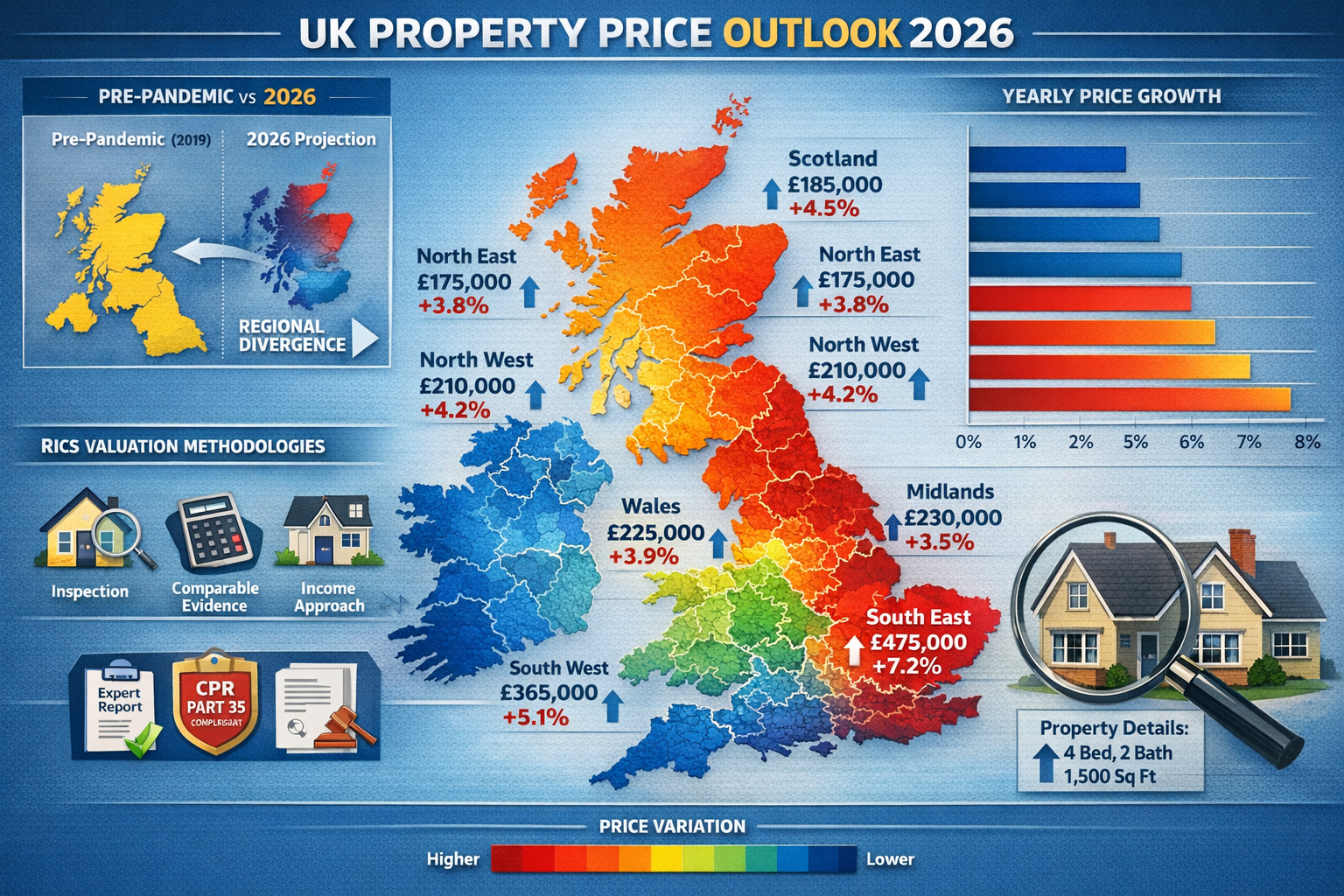
The UK property market in 2026 presents a fascinating study in contrasts. While the overall market shows signs of cautious optimism following years of uncertainty, the regional variations tell dramatically different stories. London and the Southeast continue to demonstrate resilience, with prime central London properties showing year-on-year growth of 8-12%, while northern cities like Manchester, Liverpool, and Newcastle experience more modest gains of 2-4%.
This regional price divergence creates significant challenges for expert witnesses preparing for valuation disputes. A methodology that works perfectly for a Kensington townhouse may be entirely inappropriate for a Manchester apartment block. The expert witness must demonstrate not only technical competence but also nuanced understanding of local market dynamics.
The North-South Divide in 2026
The data from early 2026 reveals stark contrasts:
| Region | Average Price Growth (YoY) | Market Characteristics |
|---|---|---|
| London | 8-12% | Strong international demand, limited supply |
| Southeast | 6-9% | Commuter belt strength, hybrid working patterns |
| Southwest | 4-7% | Lifestyle migration, second home demand |
| Midlands | 2-5% | Mixed performance, urban regeneration pockets |
| North | 2-4% | Affordability advantage, slower appreciation |
| Scotland | 3-6% | Edinburgh outperforming, Glasgow steady |
| Wales | 3-5% | Coastal areas strong, valleys weaker |
These variations mean that an expert witness must tailor their approach based on the specific geographic location of the disputed property. A RICS valuation conducted in Richmond will employ different comparables and assumptions than one in Romford or Rochdale.
Market Recovery Patterns
The cautiously optimistic recovery that characterizes 2026 stems from several factors:
- Interest rate stabilization following the volatility of 2022-2024
- Renewed buyer confidence as economic uncertainty diminishes
- Pent-up demand from buyers who delayed purchases during uncertain periods
- Supply constraints continuing to support prices in desirable areas
- Hybrid working patterns reshaping demand across regions
Expert witnesses must understand these macro trends while also drilling down into micro-market conditions that affect individual properties.
The Role of Expert Witnesses in Property Valuation Disputes
An expert witness in a property valuation dispute serves a fundamentally different function than a typical surveyor conducting a routine assessment. While both require technical expertise, the expert witness must also navigate the complex requirements of the legal system, communicate effectively with non-specialists, and withstand rigorous cross-examination.
Legal Framework and CPR Part 35
The Civil Procedure Rules (CPR) Part 35 establishes the framework for expert evidence in civil proceedings. These rules make clear that an expert's overriding duty is to the court, not to the party instructing them. This principle is foundational to credible expert witness work.
Key CPR Part 35 requirements include:
- Independence and objectivity in all opinions expressed
- Restriction to areas of expertise without straying into speculation
- Clear statement of facts versus opinions
- Disclosure of instructions received from instructing parties
- Statement of truth confirming compliance with duties
For property valuation disputes in 2026, these requirements take on additional significance given the regional market complexities. An expert witness must be able to demonstrate that their valuation methodology accounts for local conditions without cherry-picking data to support a predetermined conclusion [1].
RICS Professional Standards
Beyond legal requirements, expert witnesses must adhere to RICS professional standards, particularly the RICS Valuation – Global Standards (Red Book). The Red Book provides the framework for conducting valuations that will withstand scrutiny in dispute scenarios.
The RICS Red Book valuation standards require:
- Competence to undertake the specific valuation assignment
- Independence from conflicts of interest
- Transparency in methodology and assumptions
- Appropriate basis of value selection (market value, fair value, etc.)
- Adequate investigation and verification of facts
In 2026, with regional markets behaving so differently, the Red Book's emphasis on understanding local market conditions becomes particularly crucial. An expert witness must demonstrate familiarity with comparable transactions, market trends, and specific factors affecting the subject property's location [2].
Types of Property Valuation Disputes
Expert witnesses in 2026 encounter various dispute types, each requiring specific preparation:
Lease Extension Valuations: Disputes over lease extension valuations often hinge on differing opinions about marriage value and deferment rates, which can vary significantly by region.
Freehold Valuations: Freehold valuation disputes may involve collective enfranchisement claims where regional price trends dramatically affect outcomes.
Compulsory Purchase: Government acquisition cases require expert witnesses to navigate statutory compensation frameworks while accounting for regional market realities.
Matrimonial Disputes: Divorce proceedings involving property division demand expert opinions on current market value in rapidly changing regional contexts.
Partnership Dissolution: Commercial property disputes between business partners require expert analysis of investment value and market conditions.
Negligence Claims: Cases involving alleged surveyor negligence require expert witnesses to opine on appropriate standards of care and valuation methodology.
Expert Witness Preparation for 2026 UK Property Valuation Disputes: Navigating Regional Price Divergences
Thorough preparation separates credible expert witnesses from those whose testimony crumbles under cross-examination. In 2026, with regional markets diverging significantly, preparation must be even more rigorous and comprehensive.
Initial Case Assessment
The preparation process begins with a thorough assessment of the case:
Understanding the Instructions: Carefully review the letter of instruction to understand precisely what opinions are being sought. Clarify any ambiguities before beginning substantive work.
Conflict Checking: Ensure no conflicts of interest exist that would compromise independence. This includes checking for previous work involving the parties or the specific property.
Competence Verification: Honestly assess whether you possess the specific expertise required. A London-focused surveyor may lack the local knowledge needed for a Newcastle valuation dispute.
Scope Definition: Clearly define the scope of work, including inspection requirements, comparable research needs, and timeline constraints.
Comprehensive Property Inspection
A thorough inspection forms the foundation of credible expert testimony. In 2026, this means:
Physical Inspection: Conduct a detailed examination of the property, noting condition, layout, fixtures, and any factors affecting value. Document everything with photographs and detailed notes.
Location Analysis: Assess the immediate neighborhood, accessibility, amenities, and local market characteristics. Regional variations mean that location factors carry different weight in different markets.
Comparable Identification: During the inspection, begin identifying potential comparable properties that will support your valuation conclusion [3].
Verification of Information: Cross-check information provided by instructing parties against observable facts. Never assume accuracy without verification.
Market Research and Comparable Evidence
The heart of Expert Witness Preparation for 2026 UK Property Valuation Disputes: Navigating Regional Price Divergences lies in assembling compelling comparable evidence that accounts for regional market conditions.
Comparable Selection Criteria:
- ✅ Geographic proximity – ideally within the same postcode district
- ✅ Transaction timing – recent sales reflecting current market conditions
- ✅ Property characteristics – similar size, type, condition, and features
- ✅ Market conditions – transactions occurring under similar economic circumstances
- ✅ Arm's length transactions – excluding distressed sales or family transfers
In 2026, the geographic element becomes particularly important. A comparable from six months earlier may be outdated in a rapidly appreciating London market but perfectly relevant in a stable northern market.
Data Sources:
- Land Registry price paid data
- Rightmove and Zoopla asking prices and sold prices
- EGi PropertyLink for commercial properties
- Local estate agent market reports
- Auction results for specific property types
- Professional databases (CoStar, Radius Data Exchange)
Adjustment Methodology: Document how you've adjusted comparable evidence to account for differences. In a regional market showing 10% annual growth, a comparable from nine months ago requires significant time adjustment, while one in a flat market may need minimal adjustment.
Regional Market Analysis
Given the significant regional divergences in 2026, expert witnesses must demonstrate deep understanding of local market dynamics:
Macro Trends: Understand broader economic factors affecting the region – employment trends, infrastructure investment, demographic shifts, and policy changes.
Micro Market Conditions: Drill down into neighborhood-specific factors – school catchment areas, transport links, regeneration projects, and local amenities.
Supply and Demand Dynamics: Analyze current inventory levels, absorption rates, and buyer/seller behavior specific to the region and property type.
Price Trend Analysis: Document historical price movements and current trajectory, distinguishing between regional trends and property-specific factors.
For properties in transitional areas or regions experiencing rapid change, this analysis becomes particularly crucial. An expert witness report must clearly articulate how regional conditions affect the specific subject property [4].
Valuation Methodology Documentation
Transparency in methodology is essential for credible expert witness testimony:
Basis of Value: Clearly state whether you're opining on market value, fair value, investment value, or another basis, and explain why that basis is appropriate.
Valuation Approach: Document which approach you've employed:
- Comparable method (most common for residential properties)
- Investment method (for income-producing properties)
- Residual method (for development properties)
- Profits method (for specialized commercial properties)
- Depreciated replacement cost (for specialized properties without market comparables)
Assumptions and Special Assumptions: Clearly state all assumptions underlying your valuation. In 2026's divergent regional markets, assumptions about market trajectory, buyer behavior, and economic conditions require particular attention.
Sensitivity Analysis: Consider preparing sensitivity analyses showing how your valuation would change under different assumptions. This demonstrates thorough analysis and helps courts understand the range of reasonable opinions.
Navigating Regional Price Divergences in Expert Testimony
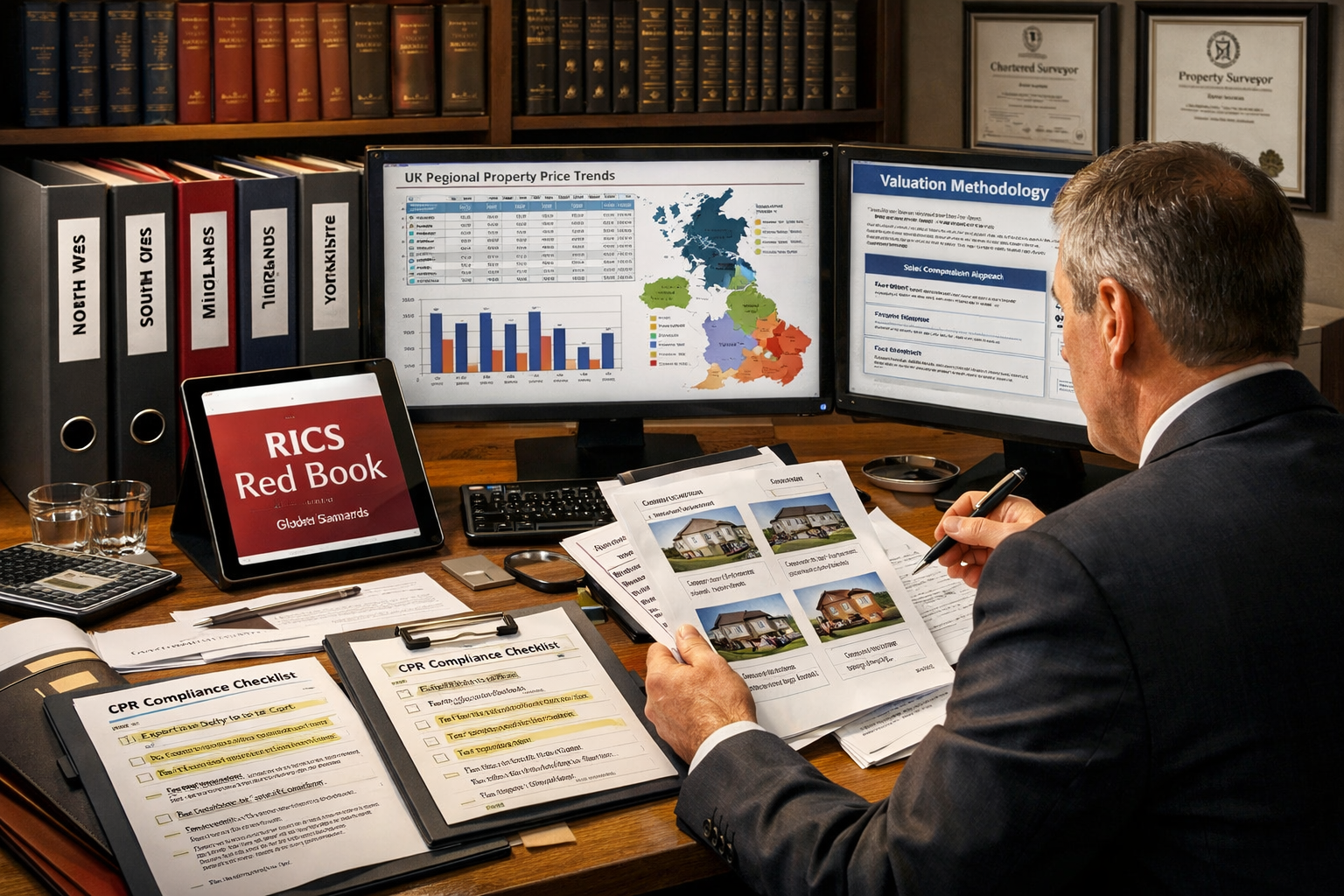
The regional variations characterizing the 2026 UK property market create both challenges and opportunities for expert witnesses. Successfully navigating these divergences requires specific strategies and approaches.
Establishing Regional Market Context
When preparing testimony for a valuation dispute, the expert witness must educate the court about regional market conditions:
Contextual Framework: Begin by establishing the broader regional context before drilling down to the specific property. Explain how the region has performed relative to national trends and why.
Comparative Regional Analysis: Where appropriate, compare the subject property's region with other UK regions to highlight specific characteristics. For example, explaining why Manchester's market behaves differently from London's helps the court understand valuation conclusions.
Local Market Drivers: Identify and explain the specific factors driving the local market:
- 🏢 Employment centers and job creation
- 🚆 Transport infrastructure and connectivity
- 🎓 Education facilities and school performance
- 🏗️ Regeneration projects and investment
- 👥 Demographic trends and population shifts
- 🏛️ Local government policies affecting property
Addressing Conflicting Expert Opinions
In many disputes, opposing parties present conflicting expert valuations. The divergence may be particularly pronounced when experts interpret regional market data differently.
Identifying Sources of Disagreement: Common sources of valuation differences include:
- Different comparable property selections
- Varying adjustment methodologies
- Divergent market trend interpretations
- Different assumptions about future market direction
- Varying weight given to specific property characteristics
Articulating Your Position: When your opinion differs from an opposing expert, clearly explain:
- Why your comparable selection is more appropriate
- How your methodology better reflects market reality
- Why your interpretation of regional trends is more accurate
- Where the opposing expert's analysis is flawed or incomplete
Professional Courtesy: Maintain professional respect for opposing experts while robustly defending your methodology. Personal attacks undermine credibility [5].
Communicating Complex Regional Data
Courts and tribunals often include non-specialists who may not understand property market intricacies. Effective expert witnesses translate complex regional market data into accessible explanations:
Visual Aids: Prepare clear charts, graphs, and maps showing:
- Regional price trend comparisons
- Geographic heat maps of price variations
- Timeline graphs showing market evolution
- Comparable property location maps
Plain Language: Avoid unnecessary jargon. When technical terms are necessary, define them clearly.
Analogies and Examples: Use relatable comparisons to explain complex concepts. For instance, comparing regional market variations to weather patterns across the UK can help non-specialists grasp the concept of geographic diversity.
Structured Presentation: Organize testimony logically:
- Establish credentials and expertise
- Explain the regional market context
- Describe the subject property
- Present comparable evidence
- Explain valuation methodology
- State conclusions
- Address alternative opinions
Handling Cross-Examination on Regional Variations
Cross-examination often focuses on challenging an expert's interpretation of regional market data. Preparation for this scrutiny is essential:
Anticipate Challenges: Before testimony, identify potential weaknesses in your analysis and prepare responses. Common challenges include:
- "Why did you select this comparable when another was more recent?"
- "How can you be certain about regional trends when the market is volatile?"
- "Isn't your valuation simply supporting your client's desired outcome?"
- "Why does your opinion differ so significantly from the opposing expert?"
Maintain Composure: Cross-examination can be confrontational. Remain calm, professional, and focused on the facts.
Admit Limitations: If you don't know something or if reasonable minds could differ, say so. Credibility depends on honesty, not omniscience.
Stick to Your Expertise: Don't be drawn into speculation outside your area of competence. If asked about legal interpretations or economic forecasts beyond your expertise, politely decline to opine.
Best Practices for Expert Witness Preparation in 2026
As the property market continues evolving and regional divergences persist, expert witnesses must adopt best practices that ensure credible, defensible testimony.
Continuous Professional Development
The 2026 market differs significantly from even two years prior. Expert witnesses must maintain current knowledge through:
Market Monitoring: Regularly review market reports, price indices, and regional analyses from reputable sources like Savills, Knight Frank, JLL, and Rightmove.
Professional Training: Attend RICS courses on expert witness duties, valuation methodology updates, and regional market trends.
Legal Updates: Stay current on changes to CPR requirements, case law affecting expert witness duties, and procedural developments.
Regional Specialization: Develop deep expertise in specific regions rather than claiming universal competence. A chartered surveyor with demonstrated local knowledge carries more weight than a generalist.
Documentation and Record-Keeping
Thorough documentation protects expert witnesses and strengthens testimony:
Inspection Records: Maintain detailed notes, photographs, and measurements from property inspections. Date-stamp all documentation.
Research Trail: Keep records of all comparable searches, data sources consulted, and market research conducted. This demonstrates thoroughness and allows you to explain your process.
Correspondence: Retain all communications with instructing parties, including clarifications of instructions and discussions of scope.
Draft Reports: Keep drafts showing the evolution of your analysis. While not typically disclosed, these can help you recall your thinking process if questioned months later.
Comparable Database: Maintain a well-organized database of comparable transactions, updated regularly, that can be quickly accessed for new instructions.
Report Writing Excellence
The expert witness report is often the most important deliverable. In 2026, with complex regional variations to explain, report quality is paramount:
Structure and Clarity:
- Executive summary with key conclusions
- Instructions received and scope of work
- Expert's qualifications and experience
- Property description and inspection findings
- Regional market analysis and context
- Comparable evidence and analysis
- Valuation methodology and calculations
- Conclusions and opinions
- Statement of truth and compliance declarations
Regional Context Section: Given 2026's market divergences, include a dedicated section explaining regional market conditions, supported by data and analysis [6].
Comparable Evidence Presentation: Present comparables in a clear table format:
| Address | Sale Date | Price | Size | £/sq ft | Adjustments | Adjusted Value |
|---|---|---|---|---|---|---|
| 123 Example St | Jan 2026 | £450,000 | 1,200 sq ft | £375 | +5% (condition) | £472,500 |
Assumptions and Limitations: Clearly state all assumptions, special assumptions, and limitations on your analysis.
Independence Statement: Include a clear statement of your independence and compliance with CPR Part 35 duties.
Collaboration and Expert Discussions
CPR encourages experts to discuss cases and narrow issues in dispute. This process requires careful handling:
Without Prejudice Discussions: Engage constructively with opposing experts to identify areas of agreement and disagreement.
Joint Statement: Prepare joint statements identifying:
- Agreed facts
- Agreed methodology points
- Remaining areas of disagreement
- Reasons for disagreement
Maintaining Independence: While collaborating professionally, never compromise your independent opinion to reach agreement.
Technology and Data Analytics
Modern expert witnesses leverage technology to enhance analysis:
Valuation Software: Use professional valuation software that documents methodology and assumptions systematically.
GIS Mapping: Geographic Information Systems can visualize regional price variations and comparable locations effectively.
Statistical Analysis: Employ statistical tools to analyze market trends, price correlations, and comparable adjustments.
Data Visualization: Create compelling charts and graphs that communicate complex regional data clearly.
Common Pitfalls and How to Avoid Them
Even experienced expert witnesses can fall into traps that undermine credibility. Awareness of common pitfalls helps avoid them:
Advocacy Instead of Independence
The Pitfall: Becoming an advocate for the instructing party rather than maintaining independence.
The Solution: Constantly remind yourself that your duty is to the court. If your analysis leads to conclusions unfavorable to your client, report them honestly. Your reputation for independence is worth more than any single instruction.
Insufficient Regional Knowledge
The Pitfall: Accepting instructions for properties in regions where you lack genuine expertise.
The Solution: Honestly assess your competence before accepting instructions. If you lack local knowledge, either decline the instruction or invest significant time in research. Consider partnering with local experts for regional insights [7].
Over-Reliance on Automated Valuations
The Pitfall: Relying too heavily on automated valuation models (AVMs) or online tools without critical analysis.
The Solution: Use AVMs as a sense-check but base your opinion on thorough comparable analysis and professional judgment. Explain why human expertise adds value beyond algorithmic calculations.
Inadequate Comparable Adjustments
The Pitfall: Failing to adequately adjust comparables for differences in location, condition, features, or timing.
The Solution: Develop a systematic adjustment methodology and document it clearly. In 2026's divergent regional markets, time adjustments are particularly important.
Poor Communication Skills
The Pitfall: Using excessive jargon, failing to explain technical concepts, or presenting information in confusing ways.
The Solution: Practice explaining complex concepts to non-specialists. Have colleagues review your reports for clarity. Invest in presentation skills training.
Inadequate Preparation for Cross-Examination
The Pitfall: Arriving at court or tribunal without thoroughly reviewing your report and anticipating challenges.
The Solution: Before testimony, re-read your report multiple times, review all comparable evidence, and prepare for likely cross-examination questions. Consider mock cross-examination practice with colleagues.
The Future of Expert Witness Work in Property Valuation
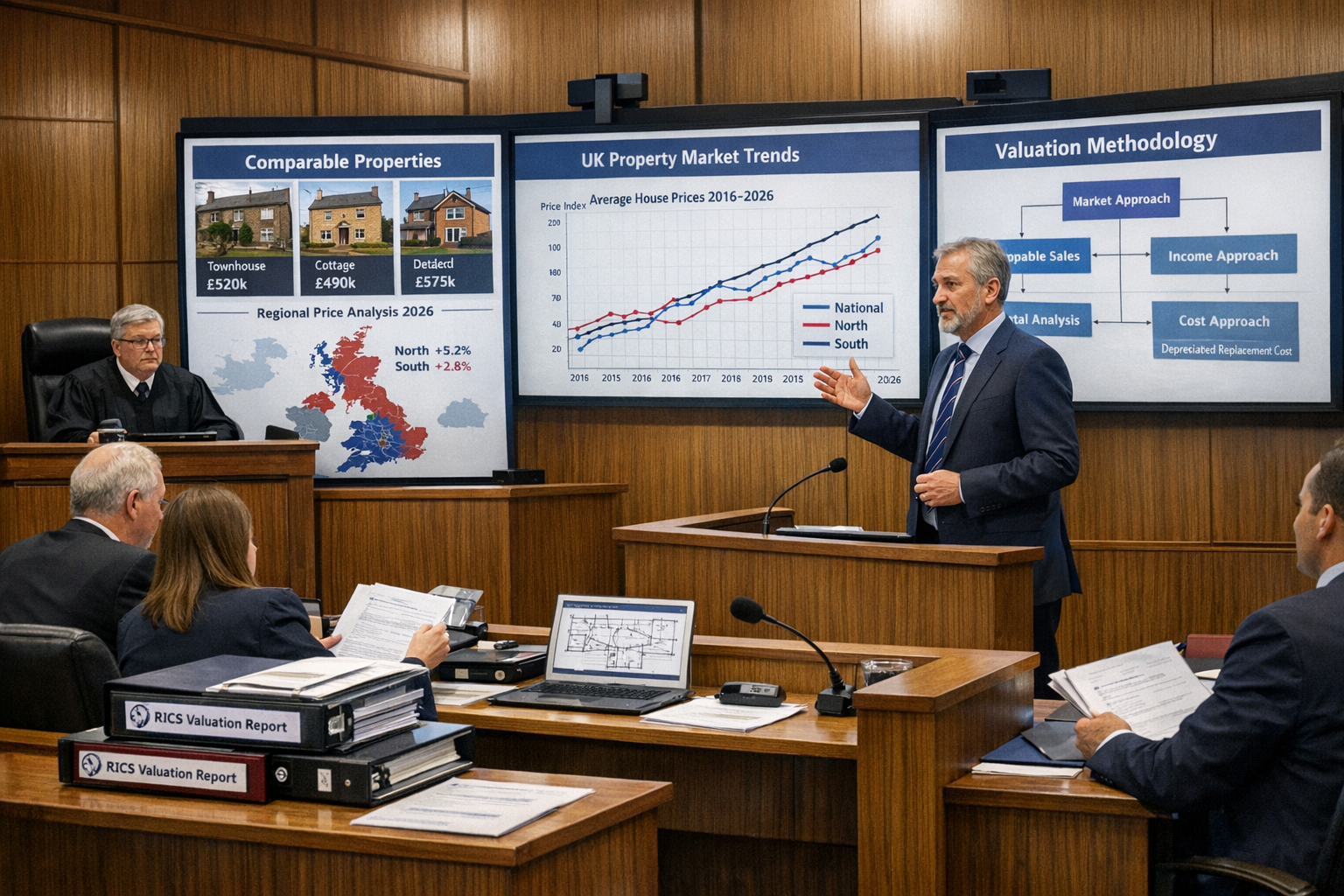
As 2026 progresses, several trends are shaping the future of expert witness work in property valuation disputes:
Increased Data Transparency
Greater availability of transaction data and market information means expert witnesses face more scrutiny. Opposing parties can more easily identify comparable transactions that an expert may have overlooked or excluded.
Implication: Expert witnesses must be even more thorough in comparable searches and transparent about selection criteria.
Climate and Sustainability Considerations
Environmental factors increasingly affect property values. Energy Performance Certificates (EPCs), flood risk, and climate resilience are becoming material valuation considerations.
Implication: Expert witnesses must understand how these factors affect value differently across regions and property types.
Technology-Enhanced Analysis
Advanced analytics, artificial intelligence, and big data are transforming property valuation.
Implication: Expert witnesses who effectively combine technological tools with professional judgment will have competitive advantages.
Regional Rebalancing
Government policies aimed at "leveling up" regions may gradually reduce north-south divergences, though significant variations will persist.
Implication: Expert witnesses must stay current on policy impacts and infrastructure investments affecting regional markets.
Conclusion
Expert Witness Preparation for 2026 UK Property Valuation Disputes: Navigating Regional Price Divergences represents one of the most challenging and important aspects of professional surveying practice. With regional markets behaving dramatically differently—from double-digit growth in prime London locations to modest appreciation in northern cities—expert witnesses must combine technical excellence with deep regional knowledge and exceptional communication skills.
The expert witness who succeeds in 2026 demonstrates:
- 📋 Rigorous methodology compliant with RICS Red Book standards and CPR Part 35 requirements
- 🗺️ Deep regional knowledge that accounts for local market dynamics and price variations
- 🎯 Unwavering independence and commitment to serving the court rather than instructing parties
- 📊 Compelling evidence presentation that makes complex regional data accessible to non-specialists
- 🛡️ Professional resilience under cross-examination and pressure
Actionable Next Steps
For chartered surveyors and valuation professionals seeking to develop or enhance expert witness capabilities:
-
Assess Your Expertise: Honestly evaluate your regional knowledge and technical competence. Focus on regions where you can demonstrate genuine expertise.
-
Invest in Training: Complete RICS expert witness training courses and stay current on CPR requirements and case law developments.
-
Build Your Database: Develop comprehensive comparable transaction databases for your regions of expertise, updated regularly with market intelligence.
-
Develop Relationships: Network with legal professionals, understand their needs, and build a reputation for independence and quality work.
-
Practice Communication: Work on explaining complex valuation concepts clearly. Consider joining Toastmasters or taking presentation skills courses.
-
Maintain Professional Standards: Ensure all work complies with RICS standards and CPR requirements. Your professional reputation is your most valuable asset.
-
Stay Current: Monitor regional market trends through regular review of market reports, price indices, and professional publications.
The property valuation disputes of 2026 demand expert witnesses who can navigate unprecedented regional divergences while maintaining the highest professional standards. Those who rise to this challenge will find rewarding opportunities to apply their expertise in service of justice and dispute resolution.
For professional assistance with expert witness services or property valuations across the UK's diverse regional markets, experienced chartered surveyors can provide the credible, independent analysis that courts and tribunals require.
References
[1] Expert Witness And Dispute Resolution – https://www.stags.co.uk/pages/expert-witness-and-dispute-resolution
[2] Expert Witness – https://legatowen.co.uk/services/expert-witness/
[3] Expert Witness – https://www.fishergerman.co.uk/services/expert-witness
[4] Expert Witness Valuation North West – https://averysurveys.co.uk/expert-witness-valuation-north-west/
[5] Dispute Resolution – https://gfwllp.co.uk/dispute-resolution/
[6] Expert Witness – https://www.masonvaluation.com/expert-witness/
[7] Expert Witness – https://www.sw.co.uk/services/expert-witness/