The rental market in 2026 faces unprecedented scrutiny as disputes over property valuations, habitability standards, and investment viability intensify. With the Royal Institution of Chartered Surveyors (RICS) noting significant shifts in tenant demand patterns and persistent supply constraints, Expert Witness Preparation for 2026 Rental Price Rises: Testifying on Tenant Demand and Supply Constraints has become essential for property professionals navigating legal proceedings. Whether testifying in rent review tribunals, landlord-tenant disputes, or investment arbitration cases, expert witnesses must now contend with a fundamentally transformed rental landscape where income growth has outpaced rent increases for the first time in years and tenant behavior has shifted dramatically toward value-consciousness and mobility.
Key Takeaways
- 📊 Rent growth is normalizing in 2026, matching historical averages rather than the volatile swings of previous years, requiring expert witnesses to contextualize pricing within stable market conditions
- 💰 Income growth now exceeds rent growth, fundamentally altering tenant negotiating power and requiring new approaches to establishing fair market rates in testimony
- 🏘️ Supply constraints stem from operational challenges rather than pure availability, with 38% of rental owners citing maintenance as their primary concern—a critical factor in valuation disputes
- 👥 Gen Z renters represent the most selective cohort in history, driving demand toward mid-market "attainable housing" rather than luxury amenities, reshaping how demand should be characterized
- ⚠️ Rental fraud has surged dramatically, with 75% of property managers reporting increased fraudulent applications, potentially distorting actual versus reported demand figures in expert analysis
Understanding the 2026 Rental Market Context
The foundation of effective expert witness testimony lies in thoroughly understanding the unique market dynamics of 2026. Unlike previous years characterized by dramatic rent fluctuations and unpredictable tenant behavior, the current rental landscape reflects a period of normalization and recalibration.
The Normalization of Rent Growth
According to economist Carl Whitaker, 2026 represents a pivotal year where rent growth is "evening out" to match historical norms, replacing the "wild rent hikes and deep concessions" that defined the post-pandemic period.[1] This stabilization fundamentally changes how expert witnesses should frame rental pricing testimony. Rather than justifying extreme increases or decreases based on recent volatility, experts must now demonstrate how proposed rents align with long-term market averages.
For chartered surveyors and valuers preparing expert testimony, this means:
- Establishing baseline historical data spanning at least 10-15 years to demonstrate typical growth patterns
- Adjusting for inflation using appropriate indices to show real versus nominal rent changes
- Contextualizing recent anomalies as temporary market disruptions rather than new norms
- Demonstrating market correction where applicable, showing how current prices reflect return to equilibrium
The Income-to-Rent Ratio Shift
Perhaps the most significant development in 2026 is that income growth has surpassed rent growth for the first time in recent memory.[2] This reversal fundamentally alters the power dynamic between landlords and tenants, giving renters increased negotiating leverage and creating new considerations for establishing defensible market rates.
Expert witnesses must now account for:
- Affordability metrics that demonstrate whether proposed rents fall within the 30% income threshold traditionally considered sustainable
- Competitive positioning relative to tenant purchasing power rather than solely comparable properties
- Tenant retention economics showing how pricing affects vacancy rates and turnover costs
- Market segmentation by income brackets, as different tenant cohorts respond differently to pricing pressures
Expert Witness Preparation for 2026 Rental Price Rises: Evidence Strategies for Demand Analysis
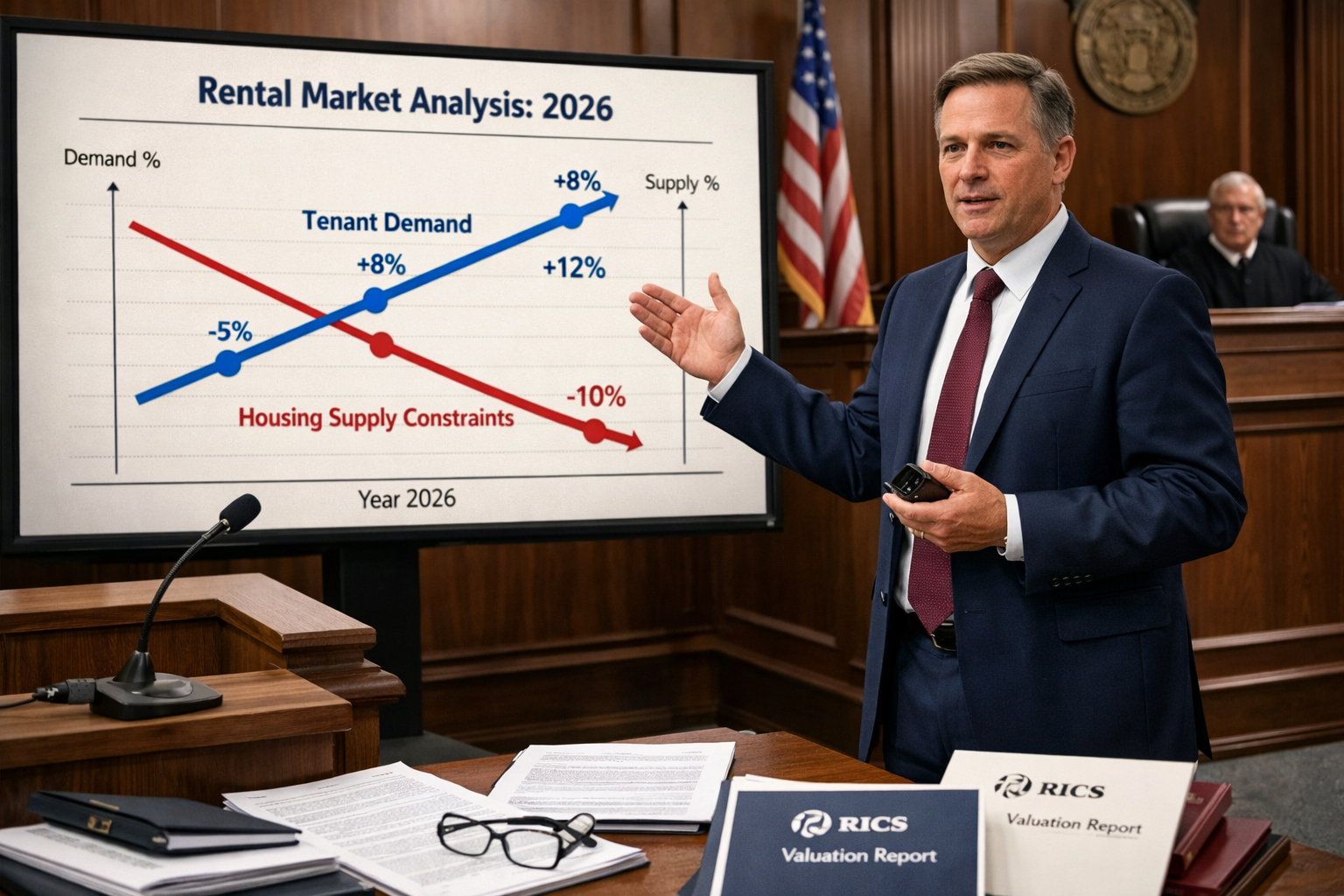
Testifying credibly about tenant demand in 2026 requires understanding fundamental shifts in renter behavior, demographics, and preferences. The traditional approach of citing vacancy rates and application volumes no longer tells the complete story.
Characterizing the New Tenant Profile
Gen Z renters now represent the most informed, selective, and transient cohort in rental history.[2] This demographic approaches rental decisions with unprecedented research capabilities, price sensitivity, and willingness to relocate when value propositions deteriorate. As Virginia Love, a 30-year industry veteran, notes: renters "will move if the math stops making sense."[2]
When preparing testimony on tenant demand, expert witnesses should:
Document demographic composition of the relevant rental market, including:
- Age distribution and generational cohort representation
- Income levels and employment sectors
- Household composition (singles, families, roommates)
- Length of tenancy patterns and turnover rates
Analyze value-consciousness indicators such as:
- Rental concession uptake rates
- Amenity utilization versus amenity premiums paid
- Tenant feedback on pricing relative to quality
- Move-out reasons related to cost versus other factors
Segment urban versus suburban demand patterns, recognizing that urban renters pay premiums for walkability and convenience while suburban renters prioritize space, comfort, and parking without unexpected fees.[2] This geographic segmentation proves critical in property valuation disputes where location-specific demand characteristics drive pricing justifications.
The Luxury Fatigue Phenomenon
A notable trend in 2026 is the emergence of "luxury market fatigue," where renters are shifting away from premium amenities like natural stone countertops and rooftop cabanas toward "attainable housing"—high-quality, well-designed communities at realistic price points.[2] This consolidation of demand in mid-market segments has profound implications for expert testimony.
When testifying about demand for higher-priced rentals, experts must:
- Distinguish between genuine luxury demand and aspirational positioning that no longer resonates with value-conscious renters
- Provide evidence of amenity utilization rates to demonstrate whether premium features justify premium pricing
- Compare pricing premiums for specific amenities against tenant willingness to pay
- Document market absorption rates for luxury versus mid-market units
For properties positioned in the luxury segment, expert witnesses may need to acknowledge demand softening while providing context about niche market segments that continue to support premium pricing.
Addressing Rental Fraud in Demand Analysis
The dramatic increase in rental fraud presents a unique challenge for expert witness testimony in 2026. With 75% of property management companies reporting increased fraudulent applications and 1 in 10 applicants providing fake documents,[1] reported demand figures may significantly overstate genuine rental interest.
Expert witnesses should:
- Adjust application-to-lease conversion rates to account for fraudulent applications that artificially inflate demand metrics
- Emphasize qualified demand over raw application volumes
- Reference industry-standard fraud detection rates when analyzing market statistics
- Distinguish between inquiry volume and creditworthy tenant demand
This consideration proves particularly important in valuation disputes where landlords may cite high application volumes as evidence of strong demand justifying rent increases.
Expert Witness Preparation for 2026 Rental Price Rises: Supply Constraint Documentation

While tenant demand analysis focuses on the market's absorption capacity, supply constraint documentation addresses the availability and quality of rental housing. In 2026, supply limitations stem as much from operational challenges as from construction shortfalls.
Maintenance-Related Supply Constraints
Research indicates that 38% of rental owners cite maintenance as their biggest concern, with over half working with property managers specifically for this issue.[1] This operational challenge effectively constrains functional supply even when vacancy rates appear low, as properties may be technically available but not truly habitable or competitive.
When preparing expert testimony on supply constraints, building surveyors should document:
Physical condition factors:
- Deferred maintenance backlogs affecting habitability
- Compliance with current safety and building codes
- Functional obsolescence (outdated layouts, systems, or finishes)
- Required capital improvements to maintain market competitiveness
Operational capacity constraints:
- Availability of qualified maintenance personnel
- Response times for repair requests
- Preventive maintenance program effectiveness
- Tenant satisfaction scores related to property upkeep
Market-ready supply versus nominal supply:
- Units requiring substantial rehabilitation before re-leasing
- Properties withdrawn from market due to maintenance costs
- Seasonal availability fluctuations
- Regulatory compliance requirements limiting marketability
For dilapidations disputes and habitability cases, this maintenance-focused supply analysis provides crucial context for rental valuation testimony.
Construction Pipeline Analysis
While construction activity has slowed in 2026, contributing to supply normalization,[1] expert witnesses must carefully analyze the development pipeline to project future supply impacts on rental pricing.
Effective supply testimony should include:
| Supply Metric | Analysis Approach | Testimony Application |
|---|---|---|
| Units Under Construction | Document completion timelines and absorption rates | Project near-term supply increases affecting pricing |
| Permitted but Not Started | Assess financing and feasibility constraints | Identify potential supply that may not materialize |
| Planned Developments | Review zoning, approvals, and market conditions | Evaluate medium-term supply trajectory |
| Conversion Projects | Track office-to-residential and adaptive reuse | Account for non-traditional supply sources |
Expert witnesses should obtain data from:
- Local planning and building departments
- Commercial real estate databases
- Developer interviews and public filings
- Chartered surveyor market reports for the relevant geography
Regulatory and Policy Constraints
Supply constraints in 2026 increasingly reflect regulatory environments that limit development, conversion, or rental operations. Expert testimony should address:
Zoning and land use restrictions:
- Density limitations affecting unit production
- Parking requirements increasing development costs
- Height restrictions limiting vertical construction
- Mixed-use requirements affecting project feasibility
Rent control and tenant protection policies:
- Jurisdictions with rent stabilization limiting new supply
- Just-cause eviction requirements affecting landlord willingness to rent
- Mandatory affordability set-asides reducing market-rate supply
- Registration and licensing requirements creating operational barriers
Building code and safety requirements:
- Retrofit mandates for existing properties
- Energy efficiency standards increasing compliance costs
- Accessibility requirements affecting unit configurations
- Inspection and certification processes delaying availability
For expert witnesses testifying in jurisdictions with significant regulatory constraints, documenting these policy impacts proves essential for explaining supply limitations that affect rental pricing.
Testifying on Habitability and Investment Viability
Beyond pure market analysis, expert witnesses in 2026 increasingly face questions about property habitability standards and landlord investment viability—two interconnected issues that fundamentally affect rental pricing justification.
Habitability Standards and Rental Valuations
Habitability disputes often center on whether property conditions justify current or proposed rental rates. Expert witnesses must establish clear connections between physical property conditions and market pricing.
Developing habitability testimony frameworks:
- Establish baseline standards using local housing codes, RICS guidelines, and industry best practices
- Document condition deficiencies through comprehensive property inspections and photographic evidence
- Quantify impact on rental value by comparing subject property to code-compliant comparables
- Calculate remediation costs and their relationship to sustainable rent levels
- Assess habitability-related vacancy and tenant retention impacts
For properties with significant habitability concerns, expert witnesses may need to testify that:
- Current rents exceed what property conditions can support
- Proposed rent increases are unjustified without corresponding improvements
- Tenant withholding of rent or rent reductions are appropriate given conditions
- Landlord investment in repairs is necessary to maintain market-rate pricing
Subsidence surveys and structural assessments provide critical evidence in habitability cases where safety concerns affect rental valuations.
Landlord Investment Viability Analysis
Conversely, landlords facing rent control challenges or tenant demands for rent reductions may require expert testimony demonstrating that proposed rents are necessary for investment viability. This analysis requires balancing tenant affordability concerns with landlord economic realities.
Key components of investment viability testimony:
Operating expense documentation:
- Property taxes and insurance premiums
- Utilities (where landlord-paid)
- Maintenance and repair costs (including the 38% of owners citing this as primary concern)[1]
- Property management fees
- Capital reserve requirements
Debt service obligations:
- Mortgage principal and interest
- Refinancing constraints in current interest rate environment
- Loan covenant requirements
- Default risks if rental income insufficient
Return on investment analysis:
- Comparison to alternative investment returns
- Risk-adjusted return expectations for rental property
- Cap rate analysis for the relevant market segment
- Cash flow projections under various rent scenarios
Market positioning trade-offs:
- Cost of maintaining competitive amenities and conditions
- Tenant retention economics versus rent optimization
- Deferred maintenance consequences for long-term viability
- Regulatory compliance costs affecting net operating income
Expert witnesses must carefully balance these landlord considerations against tenant affordability and market reality. Testimony that appears one-sided or ignores legitimate concerns from either party undermines credibility.
Building Credible Expert Testimony: Best Practices
Regardless of which party retains the expert witness, credibility remains paramount. In 2026's more balanced rental market—where neither landlords nor tenants hold overwhelming leverage—judges and arbitrators expect thorough, objective analysis.
Data Collection and Documentation Standards
Primary data sources:
- Direct property inspections with detailed photographic documentation
- Rental comparables from multiple listing services and property databases
- Tenant surveys and feedback (when available and relevant)
- Landlord financial records and operating statements
- Local market reports from RICS-certified professionals
Secondary data sources:
- Government housing statistics and census data
- Industry research from reputable organizations
- Academic studies on rental market dynamics
- Regulatory agency reports and compliance data
- Economic indicators (employment, income, inflation)
Documentation protocols:
- Maintain detailed inspection notes with timestamps and conditions
- Preserve original data sources and calculation methodologies
- Create clear audit trails for all adjustments and assumptions
- Organize evidence in logical, easily referenced formats
- Prepare visual aids (charts, graphs, photographs) for testimony clarity
Avoiding Common Expert Witness Pitfalls
❌ Advocacy versus objectivity: Expert witnesses serve as educators, not advocates. Testimony that appears biased toward the retaining party undermines credibility.
❌ Overreliance on recent data: The 2026 market represents normalization after volatility. Testimony must incorporate longer historical context.
❌ Ignoring contrary evidence: Acknowledge limitations and alternative interpretations. Judges appreciate balanced analysis over one-sided presentations.
❌ Excessive technical jargon: Testimony must be accessible to non-specialists. Explain methodologies in plain language.
❌ Inadequate comparable selection: Cherry-picking favorable comparables while ignoring relevant alternatives damages credibility.
✅ Best practices include:
- Disclosing methodology limitations and data gaps
- Providing ranges rather than false precision
- Acknowledging market uncertainty and alternative scenarios
- Explaining reasoning clearly and logically
- Remaining composed and professional during cross-examination
Preparing for Cross-Examination
Opposing counsel will challenge methodology, data selection, assumptions, and conclusions. Preparation should include:
Anticipating challenges:
- Alternative comparable selections
- Different adjustment methodologies
- Contrary market interpretations
- Credential or experience questions
- Bias or objectivity concerns
Preparation strategies:
- Review all source materials thoroughly
- Prepare concise explanations for key decisions
- Practice testimony with retaining counsel
- Develop clear, confident communication style
- Prepare visual aids that withstand scrutiny
During cross-examination:
- Listen carefully to questions before answering
- Admit limitations honestly rather than defending indefensible positions
- Maintain professional demeanor regardless of questioning tone
- Refer to documentation when appropriate
- Avoid speculation beyond expertise
Practical Frameworks for 2026 Rental Testimony
To synthesize the various elements of Expert Witness Preparation for 2026 Rental Price Rises: Testifying on Tenant Demand and Supply Constraints, expert witnesses benefit from structured analytical frameworks.
The Five-Factor Rental Valuation Framework
1. Market Positioning Analysis
- Property classification (luxury, mid-market, affordable)
- Competitive set identification
- Feature and amenity comparison
- Location and accessibility factors
2. Demand Characterization
- Target tenant demographics
- Absorption rates and vacancy trends
- Application volume and conversion rates (adjusted for fraud)
- Tenant retention and turnover patterns
3. Supply Constraint Assessment
- Available competing inventory
- Construction pipeline analysis
- Maintenance and habitability limitations
- Regulatory constraints affecting supply
4. Pricing Justification
- Comparable rent analysis with appropriate adjustments
- Income-to-rent ratio validation
- Historical rent growth context
- Market segment positioning
5. Economic Viability Validation
- Operating expense coverage
- Return on investment reasonableness
- Long-term sustainability assessment
- Capital improvement requirements
This framework ensures comprehensive analysis addressing both demand and supply factors while grounding testimony in economic reality.
Geographic Considerations for UK Markets
For expert witnesses testifying in UK rental markets, additional considerations include:
London market dynamics:
- Significant variation between boroughs requiring granular analysis
- International tenant demand factors
- Transport connectivity premiums
- Chartered surveyors in specific London areas provide localized expertise
Regional market differences:
- Economic drivers varying by region (financial services, manufacturing, education)
- Housing stock age and condition variations
- Regulatory differences between England, Scotland, and Wales
- Local authority policies affecting supply and demand
Leasehold considerations:
- Lease extension valuations affecting long-term rental viability
- Ground rent and service charge impacts on net rental income
- Freeholder-leaseholder dynamics in rental properties
- Building safety compliance costs post-Grenfell
Technology and Data Tools for Expert Analysis
Modern expert witness preparation increasingly relies on sophisticated data analysis tools and technology platforms that enhance testimony credibility and efficiency.
Market Data Platforms
Rental comparables databases:
- Rightmove, Zoopla, and OnTheMarket for UK rental listings
- CoStar and similar commercial databases for comprehensive market data
- Property management software aggregated data
- Local authority housing statistics
Economic and demographic tools:
- Office for National Statistics (ONS) data for UK markets
- Census data and projections
- Employment and income statistics by geography
- Migration and population trend analysis
Valuation software:
- Automated valuation models (AVMs) for initial screening
- Comparable adjustment calculators
- Discounted cash flow modeling tools
- Sensitivity analysis platforms
Documentation and Presentation Technology
Inspection and evidence collection:
- Digital photography with metadata preservation
- Drone surveys for property condition assessment
- 3D scanning and virtual tour technology
- Condition reporting apps with standardized checklists
Testimony preparation and presentation:
- Visual evidence organization platforms
- Chart and graph creation tools
- Interactive presentation software for courtroom use
- Document management systems for evidence tracking
Quality assurance:
- Peer review platforms for methodology validation
- Calculation verification tools
- Citation and reference management systems
- Version control for evolving analyses
Conclusion
Expert Witness Preparation for 2026 Rental Price Rises: Testifying on Tenant Demand and Supply Constraints requires a sophisticated understanding of fundamentally transformed market dynamics. The normalization of rent growth, the reversal of income-to-rent ratios, the emergence of value-conscious Gen Z renters, and the shift from luxury to attainable housing have created a rental landscape that demands nuanced, evidence-based testimony.
Successful expert witnesses in 2026 must:
🎯 Ground analysis in comprehensive market context that acknowledges both historical patterns and current shifts
📊 Document demand and supply factors rigorously, adjusting for fraud, operational constraints, and demographic changes
🏘️ Connect property conditions to rental valuations through clear habitability assessments and investment viability analysis
⚖️ Maintain objectivity and credibility by acknowledging limitations, considering alternative interpretations, and presenting balanced evidence
🔧 Leverage appropriate technology and data tools while ensuring methodology transparency and replicability
As rental disputes increasingly involve complex questions of fair pricing, habitability standards, and investment sustainability, the role of qualified expert witnesses becomes ever more critical. Professional chartered surveyors with RICS certification and specialized expertise in rental markets provide essential guidance to courts, tribunals, and arbitrators navigating these challenging cases.
Next Steps for Expert Witness Preparation
For property professionals preparing to serve as expert witnesses in 2026 rental disputes:
- Update market knowledge by reviewing current research on rental trends, tenant behavior, and supply dynamics
- Strengthen documentation practices to ensure evidence collection meets legal standards for admissibility and credibility
- Develop clear analytical frameworks that systematically address demand, supply, pricing, and viability factors
- Practice testimony skills through mock examinations and feedback from experienced legal professionals
- Maintain professional credentials including RICS certification and continuing education in valuation and market analysis
- Build relationships with legal professionals who handle rental disputes and understand expert witness requirements
For property owners, tenants, or legal professionals seeking expert witness services, contact qualified chartered surveyors with demonstrated expertise in rental market analysis, property valuation, and expert testimony experience.
The rental market of 2026 demands expert witnesses who can navigate complexity, communicate clearly, and provide objective analysis that serves the interests of justice. By mastering the evidence strategies outlined in this guide, property professionals can fulfill this essential role with confidence and credibility.
References
[1] 2026 Rental Market Predictions – https://www.buildium.com/blog/2026-rental-market-predictions/
[2] Will 2026 Be A Reckoning Year For The Rental Market – https://rentalhousingjournal.com/will-2026-be-a-reckoning-year-for-the-rental-market/