When a building surveyor's expert report contributed to a property valuation dispute being dismissed in 2024, the judge's criticism was unequivocal: the expert had "failed to maintain independence from the instructing party." This case underscores a fundamental truth for building surveyors entering the courtroom in 2026—your duty to the court must override every other obligation, including loyalty to the client paying your fees. Understanding Expert Witness Impartiality in Valuation Disputes: CPR Part 35 Protocols for Building Surveyors in Court is not merely a procedural formality; it represents the cornerstone of credible expert testimony in boundary disputes, defect claims, and property valuation litigation.
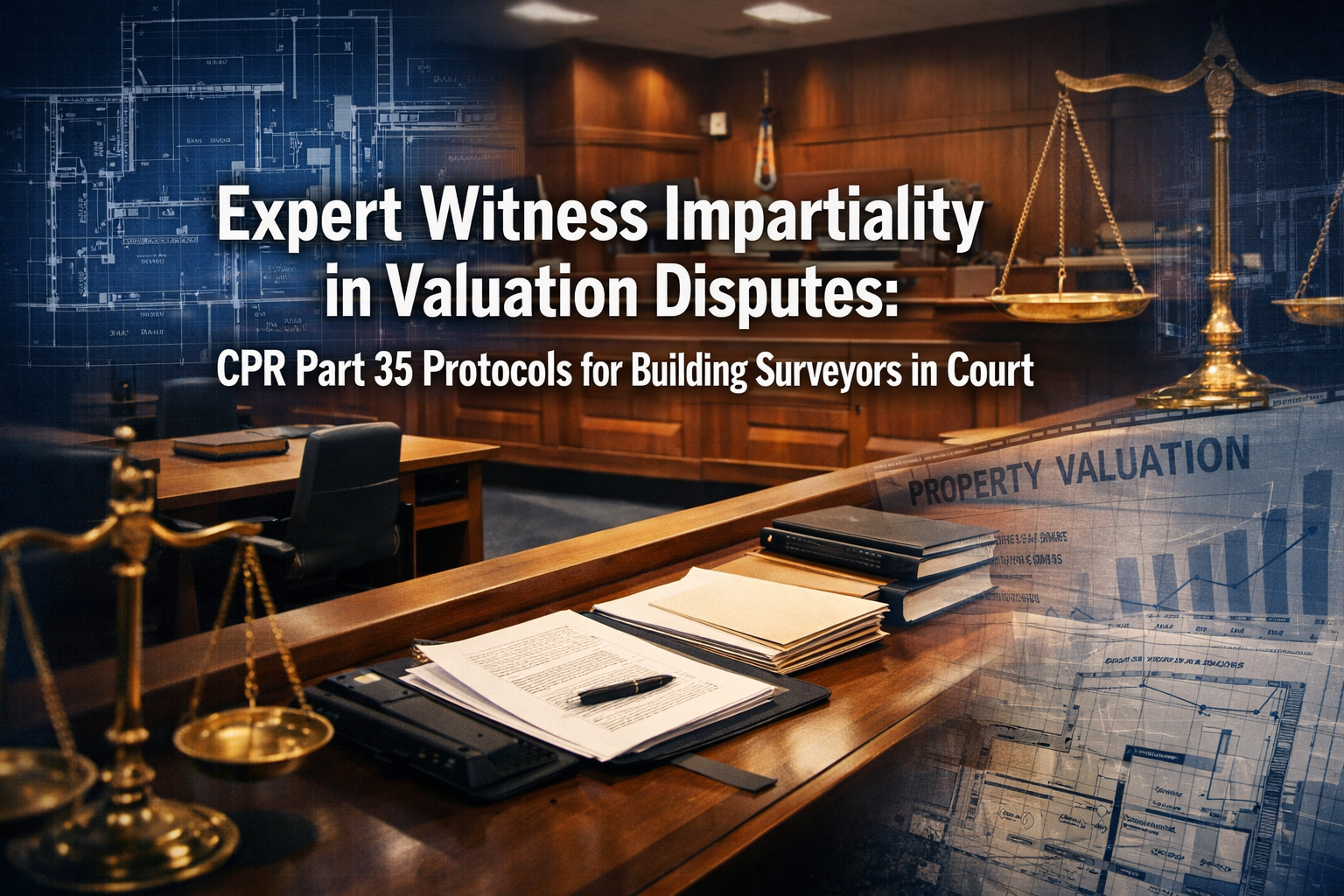
For building surveyors, the transition from technical consultant to expert witness requires a fundamental shift in mindset. While your professional expertise in property assessment remains constant, your role transforms from advocate to impartial advisor to the court. The Civil Procedure Rules (CPR) Part 35 establishes the framework that governs this transformation, setting clear protocols that every building surveyor must master before stepping into the witness box.
Key Takeaways
- Court duty supersedes client loyalty: Under CPR 35.3, experts owe their primary duty to the court, not to the party instructing or paying them[4][5]
- Independence is mandatory, not optional: Expert evidence must be the independent product of the expert, uninfluenced by litigation pressures or party interests[1]
- Formal compliance requirements: All expert reports must include specific statements confirming understanding of duties and disclosure of any conflicts of interest[3][5]
- Material facts cannot be omitted: Experts must consider and present all material facts, including those that may undermine their conclusions[1][3]
- Structured report format is essential: CPR Part 35 mandates specific content and structure for expert reports, with written evidence being the presumed format[2][7]
Understanding the Overriding Duty to the Court in Expert Witness Impartiality
The foundation of Expert Witness Impartiality in Valuation Disputes: CPR Part 35 Protocols for Building Surveyors in Court rests on a principle that many surveyors find counterintuitive: the person paying your fee is not your primary client. CPR 35.3 explicitly states that an expert's duty to help the court on matters within their expertise overrides any obligation to the instructing party or those paying them[4][5]. This represents a fundamental departure from standard commercial surveying relationships.
What the Overriding Duty Means in Practice
For building surveyors conducting expert witness services, this overriding duty manifests in several practical ways:
🔍 Objectivity Over Advocacy
Building surveyors must provide objective, unbiased opinions and explicitly avoid assuming the role of an advocate[1]. When assessing structural defects in a boundary dispute, for example, your report must present findings that support your professional opinion—even if those findings disadvantage the party who instructed you.
📋 Complete Disclosure Requirements
Expert reports must include a statement of independence confirming that opinions expressed are uninfluenced by the appointing party[3]. The International Bar Association Rules on Evidence in International Arbitration (Article 5) explicitly requires disclosure of any relationships affecting impartiality[3]. This means disclosing:
- Previous professional relationships with the instructing party
- Financial interests in the outcome
- Personal relationships with parties involved
- Any other circumstances that might reasonably affect independence
⚖️ Balanced Presentation of Evidence
Experts are required to consider all material facts, including those which might detract from their opinions[1]. When conducting a RICS valuation, this means acknowledging comparable properties that might contradict your valuation conclusion, or structural issues that complicate your assessment.
The 2014 Civil Justice Council Guidance
The Civil Justice Council issued comprehensive guidance in August 2014 titled "Guidance for the Instruction of Experts in Civil Claims," which remains the authoritative reference document for expert conduct in 2026[1][6]. This guidance emphasizes that experts must not serve the exclusive interest of those who retain them[5].
"The expert witness should provide independent, unbiased opinion on matters within their expertise, and should not assume the role of an advocate." — Civil Justice Council Guidance[1]
Common Pitfalls for Building Surveyors
Building surveyors new to expert witness work often stumble in several areas:
| Pitfall | Why It Violates CPR Part 35 | Correct Approach |
|---|---|---|
| Omitting unfavorable findings | Fails duty to consider material facts that detract from conclusions[1] | Present all material facts, explain their significance objectively |
| Using advocacy language | Violates independence requirement[1] | Use neutral, technical language throughout |
| Failing to acknowledge limitations | Doesn't make clear when questions fall outside expertise[1] | Explicitly state boundaries of competence |
| Selective use of comparables | Breaches objectivity requirement | Include all relevant comparables, explain selection criteria |
Structuring Expert Reports Under CPR Part 35 for Valuation Disputes
The formal requirements for expert reports represent a critical component of Expert Witness Impartiality in Valuation Disputes: CPR Part 35 Protocols for Building Surveyors in Court. Under CPR 35.5(1), the presumption is that expert evidence should be given in written report form unless the court directs otherwise[2]. All expert evidence in litigation, including valuation reports in restructuring plan cases, must comply with CPR Part 35 formal requirements[7].
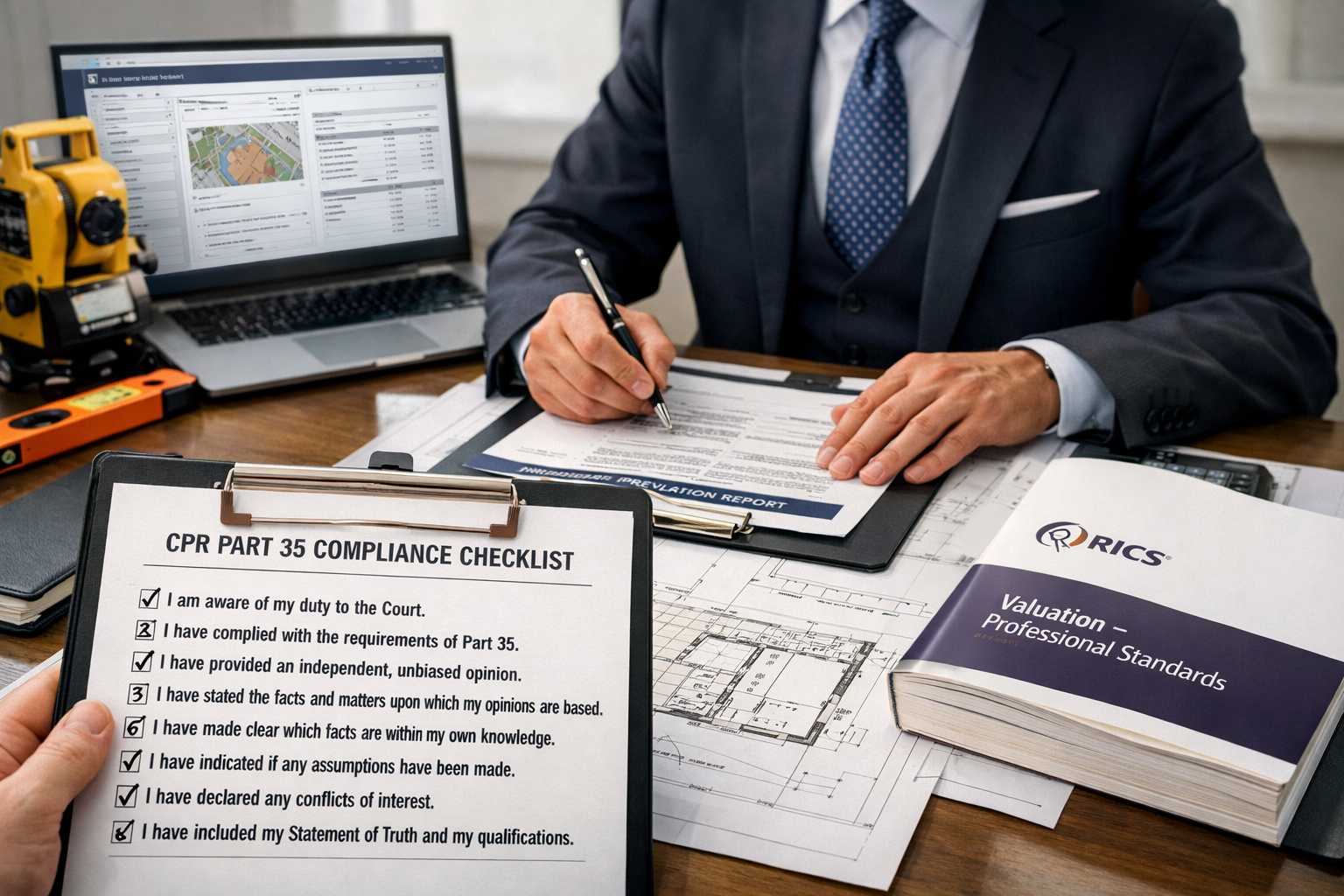
Mandatory Content Requirements
Building surveyors preparing expert reports for valuation disputes must include specific elements to satisfy CPR Part 35 protocols:
1. Statement of Truth and Duty Declaration ✍️
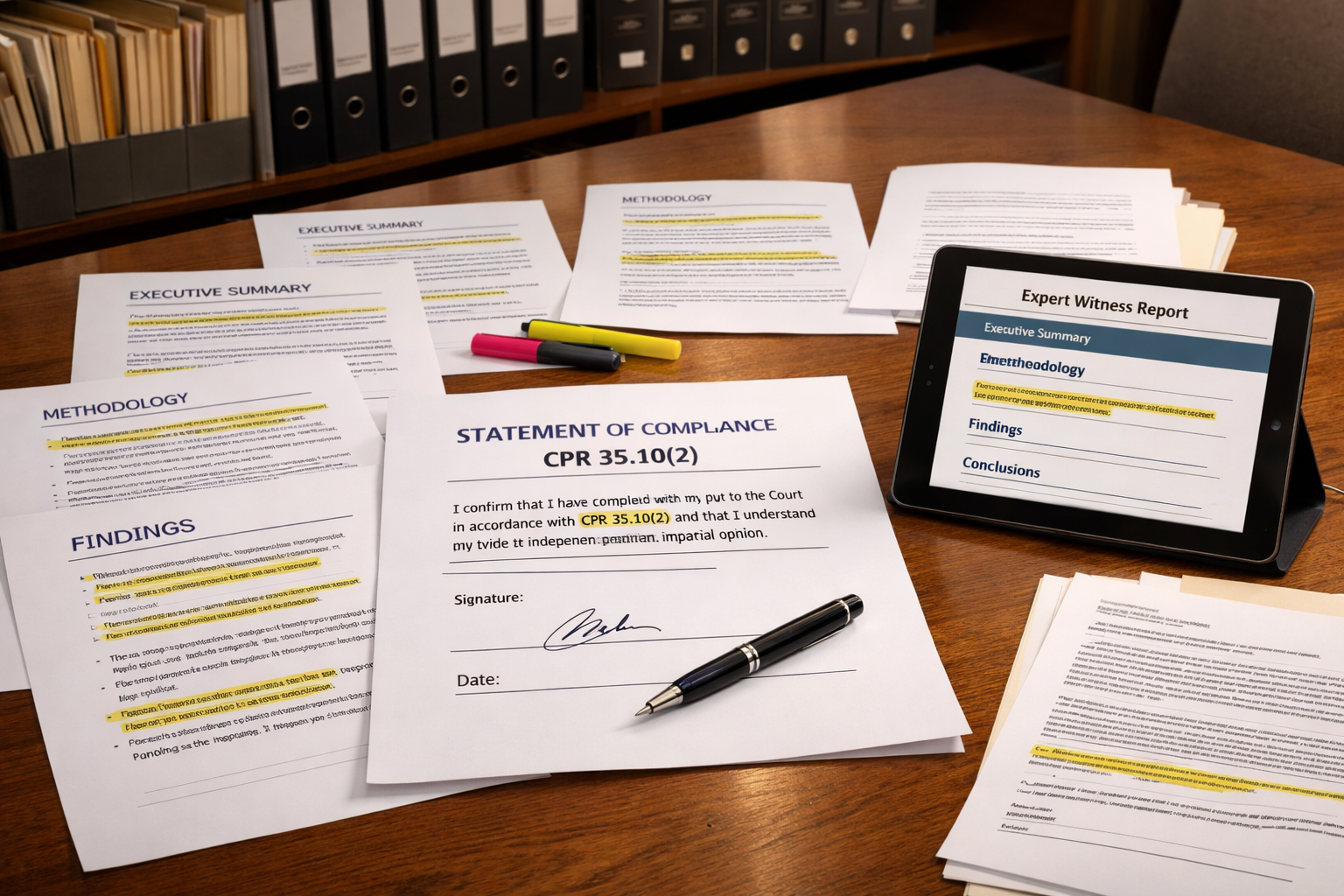
Under CPR 35.10(2), experts must include a statement at the end of their report confirming they understand and have complied with their duty to help the court under CPR 35.3[5]. This statement typically reads:
"I confirm that I understand my duty to the court and have complied with that duty. I am aware that my overriding duty is to the court and not to those instructing me or paying my fees."
2. Statement of Facts and Assumptions 📊
Experts must state the facts or assumptions upon which their opinion is based and should not omit material facts that could detract from their concluded opinion[3]. For building surveyors conducting reinstatement valuations, this means clearly documenting:
- Property inspection dates and conditions
- Documents reviewed (deeds, plans, previous surveys)
- Assumptions about construction methods or materials
- Market conditions at the valuation date
- Any limitations on inspection access
3. Range of Opinion and Material Considerations 🎯
Reports must address material facts that support alternative conclusions. When providing Red Book valuations, building surveyors should:
- Acknowledge where professional judgment involves subjective elements
- Present the range of reasonable valuations, not just a single figure
- Explain why certain factors were weighted more heavily than others
- Address counterarguments or alternative methodologies
4. Qualification and Experience Statement 🎓
The report must detail the expert's qualifications, relevant experience, and specific expertise in the subject matter. For building surveyors, this includes:
- RICS chartered status and membership details
- Years of experience in relevant property types
- Specific expertise in the dispute area (boundary issues, defects, valuations)
- Continuing professional development relevant to the case
5. Summary of Conclusions 📝
A clear, concise summary of opinions and conclusions must be provided, with each conclusion tied back to specific evidence and reasoning presented in the body of the report.
Optimal Report Structure for Building Surveyors
Based on CPR Part 35 requirements and best practice guidance, building surveyors should structure expert reports as follows:
Section 1: Introduction and Instructions
- Expert's name, qualifications, and relevant experience
- Summary of instructions received
- Documents and materials reviewed
- Site inspection details and dates
Section 2: Background and Context
- Property description and location
- Relevant history of the dispute
- Previous surveys or assessments
- Regulatory and planning context
Section 3: Methodology
- Approach taken to the assessment
- Standards and guidance followed (RICS Red Book, Building Regulations, etc.)
- Limitations or constraints on the assessment
- Assumptions made and their justification
Section 4: Findings and Analysis
- Detailed technical findings
- Supporting evidence (photographs, measurements, calculations)
- Analysis of material facts
- Consideration of alternative interpretations
Section 5: Opinion and Conclusions
- Clear statement of professional opinion
- Reasoning supporting each conclusion
- Acknowledgment of uncertainties or limitations
- Response to specific questions posed by instructing party
Section 6: Declarations
- Statement of truth
- Confirmation of understanding of duty to court
- Declaration of independence
- Disclosure of any conflicts or relationships
Restriction on Expert Evidence Scope
CPR 35.1 restricts expert evidence to that which is "reasonably required to resolve the proceedings," with no party permitted to call an expert or put in evidence an expert's report without court permission[2][4]. This means building surveyors should focus their reports narrowly on the specific technical questions in dispute, avoiding unnecessary elaboration on peripheral matters.
When courts determine whether to permit expert evidence, they consider whether it is proportionate to have separate experts for each party, particularly with reference to the amount in dispute[1]. In lower-value property disputes, courts increasingly favor single joint experts rather than adversarial expert appointments.
Preparing for Cross-Examination: Maintaining Impartiality Under Pressure
The ultimate test of Expert Witness Impartiality in Valuation Disputes: CPR Part 35 Protocols for Building Surveyors in Court comes during cross-examination. This is where building surveyors must demonstrate that their adherence to CPR Part 35 protocols extends beyond written declarations to genuine independence under adversarial questioning.
Understanding the Cross-Examination Process
Cross-examination serves to test the reliability, consistency, and impartiality of expert evidence. For building surveyors, this typically involves:
Questioning on Methodology 🔬
Opposing counsel will scrutinize your approach to property surveys and valuations, seeking to identify:
- Deviations from standard practice
- Unexplained assumptions
- Alternative methodologies you didn't consider
- Inconsistencies with previous cases or published guidance
Challenge to Factual Basis 📋
Expect detailed questioning about the facts underlying your opinion:
- Were all relevant documents considered?
- Did site conditions on inspection day affect findings?
- Are there comparable properties you overlooked?
- Did you verify information provided by the instructing party?
Testing of Independence ⚖️
Cross-examination often probes whether you maintained true independence:
- How many times have you worked for the instructing party?
- Were you involved in pre-litigation advice?
- Did you discuss your conclusions with the instructing solicitor before finalizing?
- Have you modified opinions based on party feedback?
Strategies for Maintaining Impartiality Under Cross-Examination
1. Prepare Thoroughly, But Don't Over-Rehearse 📚
Building surveyors should review their report extensively and refresh their memory on site conditions, comparable properties, and technical standards. However, avoid scripting responses or coordinating answers with instructing solicitors—this can undermine perceived independence.
2. Answer Questions Directly and Honestly 💬
The most effective way to demonstrate impartiality is through straightforward, honest answers:
- If you don't know something, say so
- If a question reveals a limitation in your analysis, acknowledge it
- If opposing counsel makes a valid point, concede it professionally
- Never attempt to defend the indefensible
3. Distinguish Between Fact and Opinion 🎯
Be explicit about what constitutes:
- Observed fact: "The crack measured 8mm at its widest point"
- Professional judgment: "In my opinion, this indicates progressive structural movement"
- Assumption: "Assuming the foundation was constructed to 1980s standards…"
- Speculation: "It's possible that… but I have no evidence to support this"
4. Maintain Professional Composure 😌
Cross-examination can be confrontational. Building surveyors should:
- Remain calm and courteous regardless of questioning style
- Avoid becoming defensive or argumentative
- Take time to consider questions before answering
- Ask for clarification if a question is unclear
5. Remember Your Duty to the Court ⚖️
Throughout cross-examination, keep in mind that your role is to assist the court in reaching the correct decision, not to help "your side" win. This mindset shift is fundamental to maintaining impartiality under pressure.
Common Cross-Examination Scenarios for Building Surveyors
Boundary Dispute Example
In party wall disputes involving boundary determinations, building surveyors often face questions like:
"Mr. Surveyor, you've concluded the boundary is at position X based on the 1952 deed plan. But isn't it true that deed plans from that era typically weren't drawn to scale and shouldn't be relied upon for precise boundary locations?"
Impartial Response: "That's a valid point. Pre-1970s deed plans often lack precision. In this case, I also considered physical features—the original fence line, the position of the party wall foundation, and witness testimony about the historical boundary. The deed plan was one factor among several, not the sole determinant of my opinion."
Defect Valuation Example
When assessing property defects for dilapidation surveys, expect challenges like:
"You've valued the remedial works at £75,000. But the defendant's contractor provided a quote for £45,000 to do the same work. How do you explain this discrepancy?"
Impartial Response: "I've reviewed the defendant's contractor quote. It appears to be based on a different scope of work—specifically, it doesn't include [specific element]. If that element is excluded, my valuation would be approximately £48,000, which is comparable. However, in my professional opinion, that element is necessary to properly remedy the defect because [technical reason]."
Part 35 Questions: Post-Report Clarification
CPR Part 35 allows parties to submit written questions to experts after reports are exchanged[2]. Building surveyors should approach these questions with the same impartiality as the original report:
✅ Do: Answer questions fully and honestly, even if answers undermine your original conclusions
✅ Do: Clarify ambiguities or correct errors in your original report
✅ Do: Provide additional analysis if genuinely helpful to the court
❌ Don't: Refuse to answer legitimate questions within your expertise
❌ Don't: Use answers to introduce new arguments supporting "your side"
❌ Don't: Coordinate answers with instructing solicitors beyond clarifying what the question is asking
The Single Joint Expert Alternative
When courts consider whether expert evidence is proportionate to the dispute, they may appoint a single joint expert rather than allowing each party their own expert[1]. For building surveyors, this appointment offers both opportunities and challenges:
Advantages:
- Reinforces independence (no perception of bias toward either party)
- Often more efficient and cost-effective
- Reduces adversarial pressure
Challenges:
- Both parties may challenge your conclusions
- Greater responsibility for getting it right
- Limited ability to revise opinions once submitted
Building surveyors appointed as single joint experts should be particularly meticulous in documenting their methodology, considering alternative interpretations, and maintaining absolute neutrality in their analysis.
Practical Compliance Checklist for Building Surveyors
To ensure full compliance with Expert Witness Impartiality in Valuation Disputes: CPR Part 35 Protocols for Building Surveyors in Court, building surveyors should use this comprehensive checklist:
Pre-Instruction Phase ✅
- Confirm you have relevant expertise for the specific technical questions
- Identify and disclose any conflicts of interest or prior relationships
- Clarify scope of instructions and specific questions to be addressed
- Establish independence from instructing party (no pre-litigation advice role)
- Agree fees that are not contingent on outcome
Investigation and Analysis Phase 🔍
- Conduct thorough site inspection with detailed photographic record
- Review all relevant documents, not just those provided by instructing party
- Consider alternative explanations and methodologies
- Identify and document all assumptions
- Note any limitations on inspection or analysis
- Research comparable properties or precedents objectively
Report Drafting Phase 📝
- Structure report according to CPR Part 35 requirements
- Include all mandatory declarations and statements
- Present facts separately from opinions
- Acknowledge material facts that detract from conclusions
- Use neutral, non-advocacy language throughout
- Provide clear reasoning for each conclusion
- Include statement of truth and duty to court declaration
- Attach relevant supporting documents and photographs
Pre-Hearing Phase 🎯
- Review report thoroughly before any hearing
- Prepare for cross-examination without over-rehearsing
- Answer Part 35 questions honestly and fully
- Participate in expert discussions in good faith
- Identify areas of agreement and disagreement with opposing experts
- Update report if new information emerges
Court Appearance Phase ⚖️
- Dress professionally and arrive early
- Bring complete file including all source documents
- Listen carefully to questions before answering
- Answer directly and honestly, even if unhelpful to instructing party
- Maintain professional composure throughout
- Acknowledge valid points made by opposing counsel
- Remember overriding duty to court at all times
Conclusion
Expert Witness Impartiality in Valuation Disputes: CPR Part 35 Protocols for Building Surveyors in Court represents far more than procedural compliance—it embodies the ethical foundation that makes expert evidence credible and valuable to the judicial process. For building surveyors in 2026, mastering these protocols is essential not only for individual cases but for maintaining the profession's reputation for integrity and objectivity.
The overriding duty to the court, as established in CPR 35.3, fundamentally transforms the building surveyor's role from technical consultant to impartial advisor[4][5]. This duty requires surveyors to present balanced, objective evidence even when it disadvantages the party paying their fees. The 2014 Civil Justice Council Guidance provides the authoritative framework for achieving this independence[1][6], while formal compliance requirements ensure that independence is documented and verifiable[3][5].
Key Action Steps for Building Surveyors
📋 Immediate Actions:
- Review the full text of CPR Part 35 and the Civil Justice Council Guidance
- Develop a standardized expert report template incorporating all mandatory elements
- Create a conflicts-of-interest disclosure protocol for your practice
- Arrange CPR Part 35 training or mentoring with experienced expert witnesses
🎓 Ongoing Professional Development:
- Attend specialized courses on expert witness duties and cross-examination techniques
- Observe court proceedings to understand the litigation environment
- Join professional networks focused on expert witness practice
- Stay current with case law developments affecting expert evidence
⚖️ Practice Integration:
- Establish clear boundaries between advisory and expert witness roles
- Implement quality assurance reviews for all expert reports
- Maintain detailed records of methodology and decision-making processes
- Develop relationships with legal professionals who understand expert independence
The building surveyor who embraces these protocols—not as burdensome requirements but as professional standards that enhance credibility—will find expert witness work both professionally rewarding and valuable to the administration of justice. Whether you're providing commercial building surveys, matrimonial valuations, or testimony in complex defect disputes, your commitment to impartiality and adherence to CPR Part 35 protocols will distinguish you as a trusted expert in the courtroom.
The courtroom is no place for advocacy disguised as expertise. Building surveyors who understand and implement Expert Witness Impartiality in Valuation Disputes: CPR Part 35 Protocols for Building Surveyors in Court serve not only their professional obligations but also the fundamental principle that justice depends on reliable, unbiased expert evidence.
References
[1] Pd Part35 – https://www.justice.gov.uk/courts/procedure-rules/civil/rules/part35/pd_part35
[2] A Guide To Part 35 Questions For Experts – https://www.stewartslaw.com/news/a-guide-to-part-35-questions-for-experts/
[3] The Importance Of Impartiality Of Expert Witnesses In International Arbitration And Litigation – https://rimkus.com/article/the-importance-of-impartiality-of-expert-witnesses-in-international-arbitration-and-litigation/
[4] Part35 – https://www.justice.gov.uk/courts/procedure-rules/civil/rules/part35
[5] fenwickelliott – https://www.fenwickelliott.com/research-insight/newsletters/insight/39
[6] Expertly Done Revised Guidance On Expert Witnesses – https://www.penningtonslaw.com/news/expertly-done-revised-guidance-on-expert-witnesses/
[7] Valuation Reports For Uk Restructuring Plans Must Comply With Formal Requirements – https://www.kirkland.com/publications/kirkland-alert/2024/11/valuation-reports-for-uk-restructuring-plans-must-comply-with-formal-requirements
[8] Experts Guidance Cjc Aug 2014 Amended Dec 8 – https://www.judiciary.uk/wp-content/uploads/2014/08/experts-guidance-cjc-aug-2014-amended-dec-8.pdf