The property surveying landscape is undergoing its most significant transformation in years. As homebuyers increasingly demand clarity, transparency, and technology-driven insights, the Royal Institution of Chartered Surveyors (RICS) is responding with a comprehensive overhaul of its home survey framework. The Evergreen RICS Home Survey Standard 2nd Edition: Key Updates for 2026 Building Assessments represents a pivotal shift in how residential properties are evaluated, bringing enhanced consumer protection, technological integration, and unprecedented clarity to the surveying process.
With over 1,000 consultation responses analyzed and consumer research involving approximately 1,400 recent homebuyers, this updated standard reflects real-world needs and modern market realities[1][3]. The changes promise to reshape how RICS Chartered Building Surveyors conduct assessments and how property buyers understand the services they're purchasing.
Key Takeaways
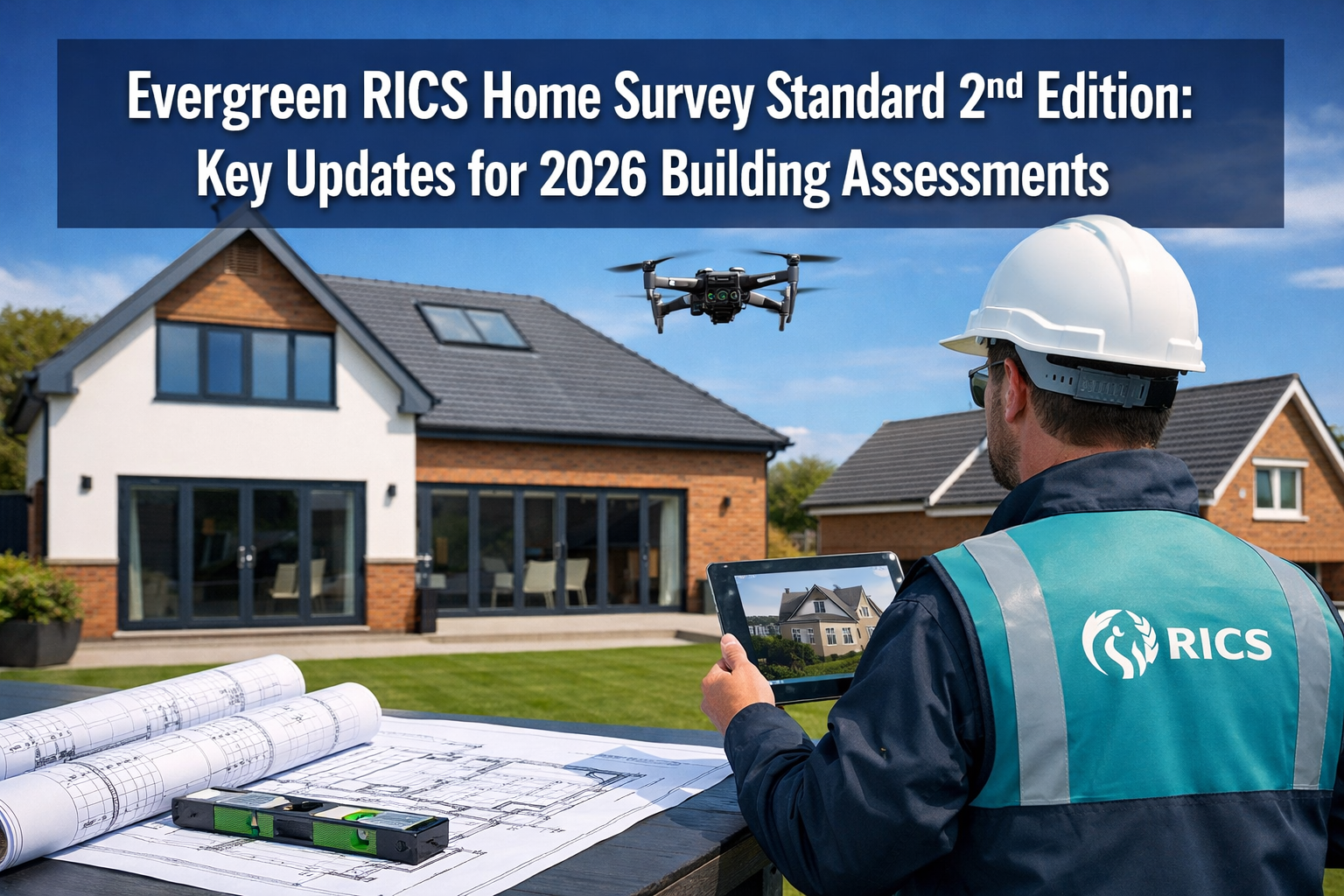
- 🔍 Simplified Survey Levels: The three survey levels are being redesigned with clearer descriptions—'basic' (Level 1), 'intermediate' (Level 2), and 'advanced' (Level 3)—to improve consumer understanding[3]
- 🤖 Technology Integration: The 2nd edition incorporates AI, drones, and camera poles, reflecting surveying advancements since the 2019 first edition[2]
- 🏡 Additional Risk Dwellings: New frameworks provide specific guidance for historic buildings, new-build snagging, and retrofit homes[2]
- 🌱 Environmental Focus: Enhanced emphasis on climate change, energy efficiency, and retrofit assessments aligns with evolving homebuyer priorities[2]
- ⚖️ Regulatory Clarity: Refined distinction between mandatory requirements and recommended practices based on extensive consultation feedback[1]
Understanding the Evergreen RICS Home Survey Standard 2nd Edition Development Process
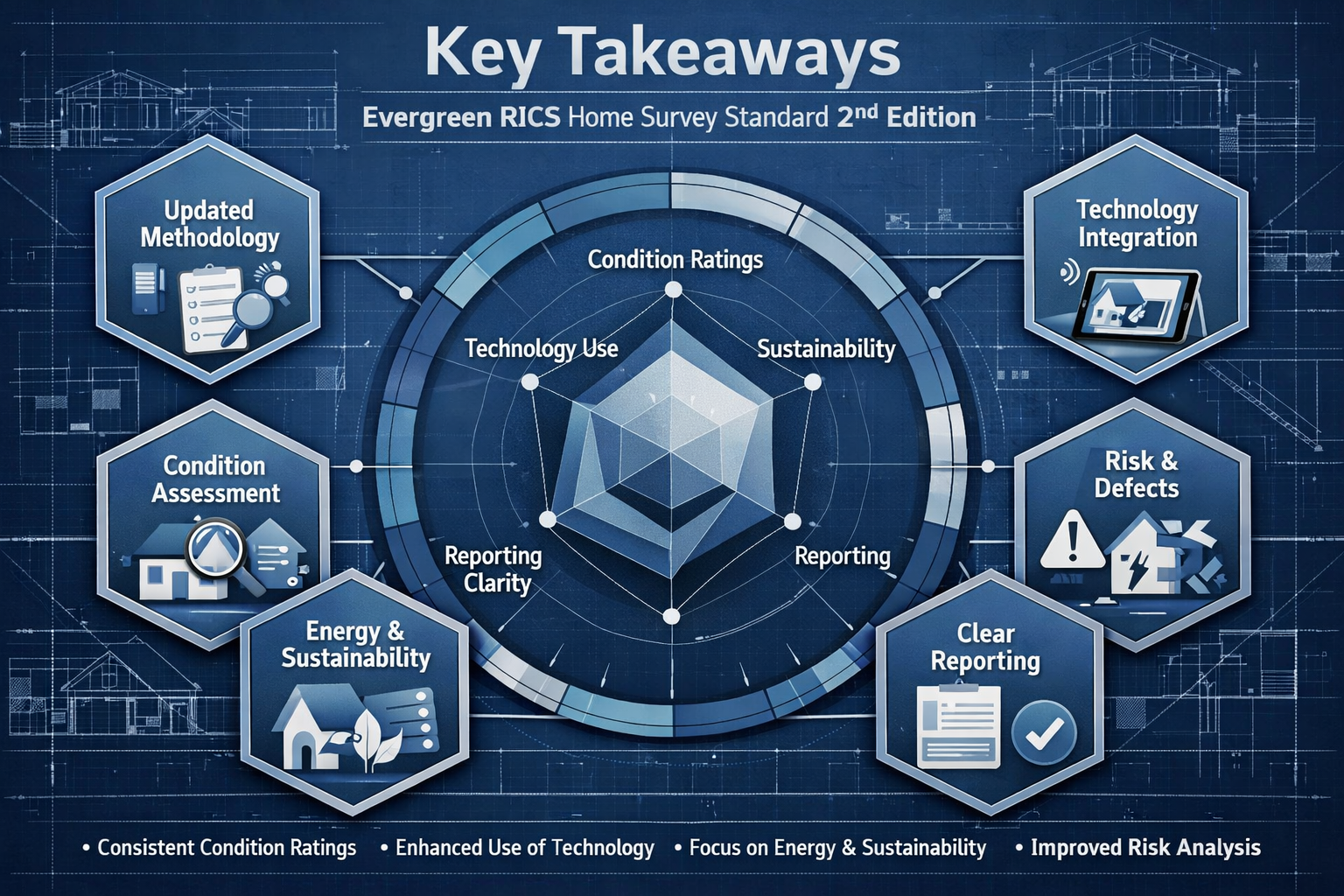
The journey toward the Evergreen RICS Home Survey Standard 2nd Edition: Key Updates for 2026 Building Assessments has been methodical and consultation-driven. RICS launched a comprehensive public consultation that generated more than 1,000 detailed comments from surveyors, consumers, and industry stakeholders[1]. This unprecedented level of engagement highlighted consistent themes: the need for clearer requirements, more concise guidance, and better consumer comprehension.
Current Timeline and Development Phase
As of February 2026, the standard is in its critical analysis phase. RICS appointed a Chartered Surveyor with two decades of industry experience as project lead in December 2025 to guide the standard through its complex development stages[1]. The organization is conducting a line-by-line review of consultation responses before advancing to member-led professional panel reviews.
Key Development Milestones:
| Phase | Status | Timeline |
|---|---|---|
| Public Consultation | ✅ Completed | 2025 |
| Response Analysis | 🔄 In Progress | January-March 2026 |
| Professional Panel Review | ⏳ Upcoming | Q2 2026 |
| Regulatory Approval | ⏳ Pending | Late 2026 |
| Implementation | ⏳ Scheduled | 2027 |
RICS has committed to sharing progress updates and next steps by the end of March 2026, demonstrating their commitment to transparency throughout this process[1]. This timeline ensures that the final standard benefits from thorough expert review while maintaining momentum toward implementation.
Consumer Research Foundation
Unlike previous standards developed primarily through professional consensus, the 2nd edition is deeply rooted in consumer insights. RICS commissioned Savanta to survey approximately 1,400 people who had purchased homes or commissioned surveys within the past five years[3]. This research revealed critical gaps in consumer understanding and highlighted areas where survey terminology confused rather than clarified.
The findings directly influenced the decision to redesign survey level descriptions, making them more intuitive for non-technical audiences while maintaining professional rigor for practitioners conducting homebuyer surveys.
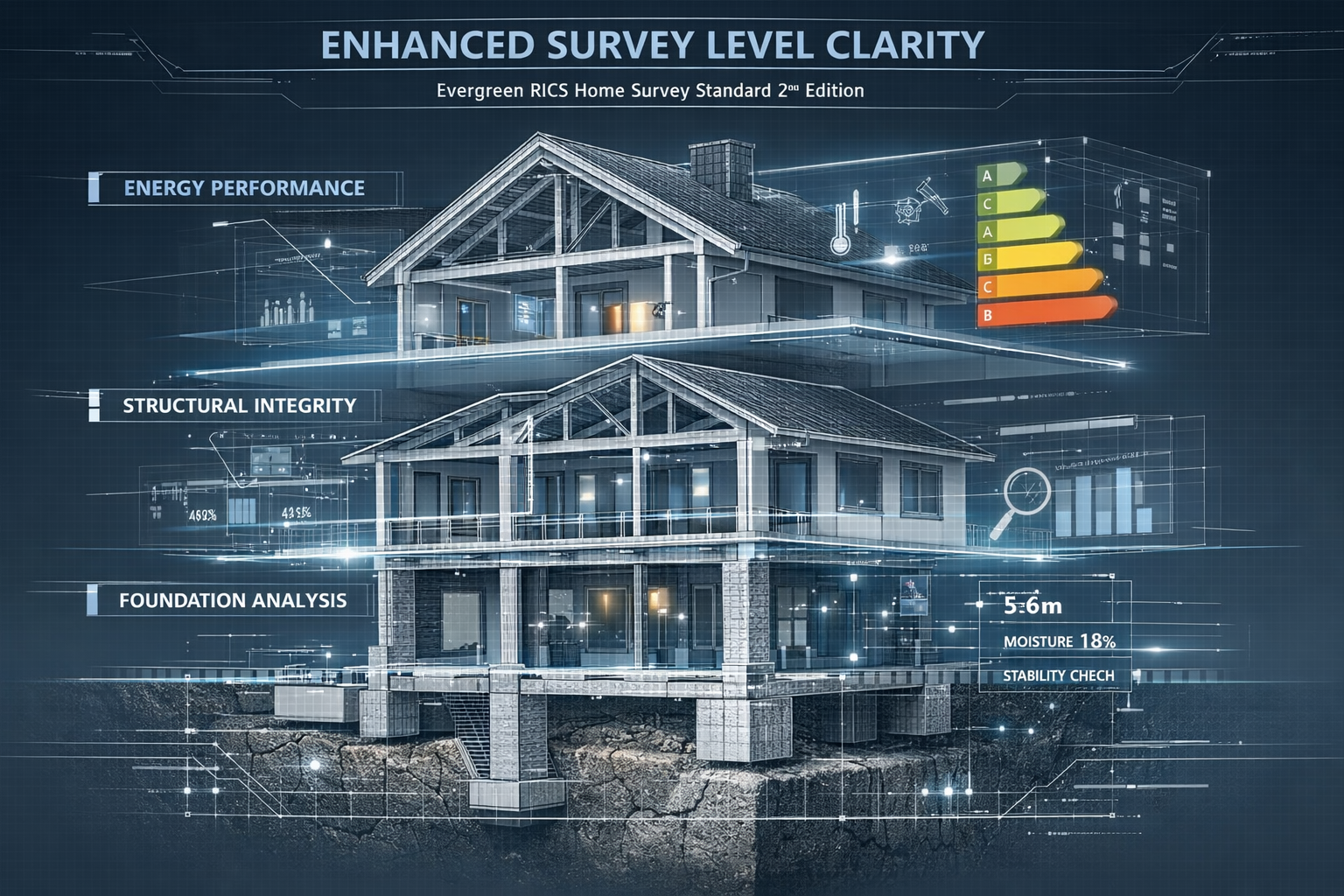
Evergreen RICS Home Survey Standard 2nd Edition: Enhanced Survey Level Clarity
One of the most transformative aspects of the Evergreen RICS Home Survey Standard 2nd Edition: Key Updates for 2026 Building Assessments is the complete redesign of how survey levels are described and communicated to consumers.
The Three-Level Framework Reimagined
The existing three-tier system remains structurally intact, but each level now features clearer, more accessible descriptions[3]:
Level 1 – Basic Survey
- Previously known simply as "Level 1" or "Condition Report"
- Provides a fundamental assessment of property condition
- Suitable for newer properties in good condition
- Most affordable option for budget-conscious buyers
- Does not include valuation unless specifically requested
Level 2 – Intermediate Survey
- The most popular choice for conventional residential properties
- Formerly "Level 2" or "HomeBuyer Report"
- Comprehensive inspection with detailed condition ratings
- Includes market valuation and insurance rebuild costs
- Ideal for properties in reasonable condition built with standard construction methods
- Learn more about RICS HomeBuyer Surveys Level 2
Level 3 – Advanced Survey
- Previously "Level 3" or "Building Survey"
- Most detailed and comprehensive assessment available
- Recommended for older properties, unusual construction, or significant alterations
- Provides in-depth analysis of structure, fabric, and defects
- Essential for properties requiring renovation or with known issues
Expanded Valuation Services Across All Levels
A significant enhancement in the 2nd edition is the clarification that VRS-regulated surveyors can undertake valuations across all survey levels—from Level 1 through Level 3[2]. This expansion provides greater flexibility for consumers who may need RICS valuations alongside their survey reports.
The updated standard provides clearer requirements for each level's valuation component, ensuring consistency while allowing professional judgment where appropriate. This is particularly valuable for properties requiring specialized valuations, such as reinstatement build cost valuations for insurance purposes.
Mandatory vs. Recommended: Clarifying Professional Obligations
Based on consultation feedback emphasizing the need for clarity, RICS is refining the distinction between mandatory requirements ('musts') and recommended practices ('shoulds')[1]. This clarification helps surveyors understand their professional obligations while maintaining flexibility for professional judgment in complex situations.
"The feedback consistently emphasized the need for clearer and more concise requirements, with particular focus on distinguishing what surveyors must do versus what they should consider." – RICS Consultation Summary
This distinction is particularly important when conducting property inspections where site-specific circumstances may require professional adaptation while maintaining core standards.
Technology Integration in the Evergreen RICS Home Survey Standard 2nd Edition
The Evergreen RICS Home Survey Standard 2nd Edition: Key Updates for 2026 Building Assessments represents a watershed moment for technology adoption in residential surveying. Since the first edition's publication in 2019, technological capabilities have advanced dramatically, and the updated standard reflects these developments[2].

AI-Powered Assessment Tools
Artificial intelligence is transforming how surveyors analyze property data, identify defects, and generate insights. The 2nd edition cross-references AI applications including:
- Automated defect recognition through image analysis
- Predictive maintenance algorithms that forecast potential issues
- Data pattern recognition identifying common problems in specific property types
- Report generation assistance ensuring consistency and completeness
While AI enhances efficiency and accuracy, the standard emphasizes that professional judgment remains paramount. Technology serves as a tool to support—not replace—the expertise of qualified surveyors.
Drone Technology and Aerial Inspection
Drones have revolutionized how surveyors assess roofs, chimneys, and other difficult-to-access areas. The updated standard provides guidance on:
- Safe and legal drone operation within UK regulations
- Image quality standards for aerial photography
- Documentation requirements for drone-assisted inspections
- Limitations and supplementary inspection needs
This technology is particularly valuable for structural surveys of larger properties or those with complex roof structures, where traditional access methods may be hazardous or impractical.
Camera Poles and Enhanced Visual Documentation
High-resolution camera poles enable surveyors to inspect roof spaces, cavities, and elevated areas without scaffolding or ladders. The 2nd edition acknowledges these tools as standard practice, providing guidance on:
- Appropriate use cases and limitations
- Image capture standards ensuring adequate documentation
- Reporting requirements when using remote inspection tools
- Client communication about inspection methodology
Digital Reporting and Data Standards
The standard addresses the shift toward digital-first reporting, including:
- Standardized data formats for easier comparison and analysis
- Interactive report elements with hyperlinked sections and images
- Mobile-friendly formats for client accessibility
- Data security and privacy requirements for digital transmission
These technological enhancements align with consumer expectations for modern, accessible information delivery while maintaining professional standards.
Additional Risk Dwellings: Specialized Guidance in the 2nd Edition
One of the most significant expansions in the Evergreen RICS Home Survey Standard 2nd Edition: Key Updates for 2026 Building Assessments is the inclusion of comprehensive frameworks for 'additional risk' dwellings[2]. These properties require specialized knowledge and assessment approaches beyond standard residential surveys.
Historic Buildings and Heritage Properties
Historic properties present unique challenges requiring specialized expertise. The updated standard provides:
- Heritage impact assessments considering conservation requirements
- Traditional construction methods evaluation
- Listed building considerations and regulatory compliance
- Specialist materials identification and condition assessment
- Preservation vs. modernization guidance
Surveyors working with historic properties must balance modern performance expectations with heritage preservation, requiring deep understanding of traditional building techniques and materials.
New-Build Snagging Inspections
Despite being newly constructed, modern homes often contain defects requiring identification before completion. The 2nd edition addresses:
- Pre-completion snagging lists identifying builder defects
- Building regulations compliance verification
- Warranty coverage assessment (NHBC, Premier Guarantee, etc.)
- Quality standards for finishes and installations
- Developer remediation documentation requirements
New-build assessments require different expertise than older property surveys, focusing on construction quality, regulatory compliance, and warranty implications rather than deterioration and maintenance needs.
Retrofit and Energy Efficiency Assessments
With increasing focus on climate change and energy performance, retrofit assessments have become critical. The updated standard provides guidance on:
- Insulation installations and thermal performance
- Heating system upgrades including heat pumps and renewable technologies
- Ventilation requirements preventing condensation and air quality issues
- Building fabric modifications and their structural implications
- Energy Performance Certificate (EPC) improvement potential
This guidance reflects evolving homebuyer priorities around environmental performance and operating costs[2]. Surveyors must understand both traditional building performance and modern retrofit technologies to provide comprehensive advice.
Non-Standard Construction
Properties built with unconventional methods or materials require specialized assessment. The 2nd edition addresses:
- Concrete construction (PRC, Airey, Wimpey, etc.)
- Timber frame buildings and moisture management
- Steel frame structures and corrosion risks
- Alternative materials (hemp, straw bale, etc.)
- Mortgage and insurance implications of non-standard construction
Understanding non-standard construction is essential for accurate risk assessment and client advice, as these properties often face financing and insurability challenges.
Environmental and Energy Considerations
The Evergreen RICS Home Survey Standard 2nd Edition: Key Updates for 2026 Building Assessments reflects the growing importance of environmental performance in property valuation and assessment. Climate change concerns and energy cost considerations have fundamentally shifted homebuyer priorities[2].
Climate Change Resilience
The updated standard encourages surveyors to consider:
- Flood risk assessment and mitigation measures
- Overheating potential in increasingly warm summers
- Storm resilience of roofs, chimneys, and external elements
- Drainage capacity for intense rainfall events
- Coastal erosion for properties near shorelines
These considerations help buyers understand long-term risks and adaptation requirements, informing purchase decisions and future planning.
Energy Efficiency and Performance
Energy performance has moved from peripheral concern to central consideration. The 2nd edition emphasizes:
- Current energy efficiency ratings and improvement potential
- Heating system condition and replacement timelines
- Insulation standards in walls, roofs, and floors
- Window and door performance affecting heat loss
- Renewable energy installations (solar panels, heat pumps, etc.)
Accurate assessment of energy performance helps buyers understand operating costs and potential improvement investments, particularly important as energy prices remain volatile.
Retrofit Assessment Frameworks
The standard provides structured approaches to evaluating retrofit work:
- Quality of installation for insulation and heating upgrades
- Building regulations compliance for alterations
- Ventilation adequacy preventing condensation issues
- Structural implications of fabric modifications
- Cost-benefit analysis of further improvements
This guidance ensures surveyors can competently assess the growing number of properties undergoing energy efficiency improvements.
Professional Standards and Regulatory Framework
The Evergreen RICS Home Survey Standard 2nd Edition: Key Updates for 2026 Building Assessments operates within RICS's broader regulatory framework, ensuring professional accountability and consumer protection.
Multi-Stage Review Process
After consultation analysis, the standard will undergo rigorous review by:
- Member-led professional panel groups comprising practicing surveyors
- Technical boards with specialized expertise
- Regulatory approval bodies ensuring compliance with RICS governance
- Consumer representatives validating accessibility and clarity
This multi-stage process ensures the standard balances professional rigor with consumer accessibility[1].
Continuing Professional Development (CPD)
Implementation of the 2nd edition will require surveyors to:
- Update technical knowledge on new requirements
- Learn new technologies incorporated into the standard
- Understand additional risk dwelling frameworks
- Adapt reporting practices to new formats and requirements
RICS will provide comprehensive CPD resources supporting surveyors through the transition, ensuring consistent implementation across the profession.
Quality Assurance and Compliance
The updated standard strengthens quality assurance through:
- Clearer performance metrics for survey quality
- Enhanced documentation requirements ensuring thorough records
- Client communication standards improving transparency
- Complaints and dispute resolution frameworks
These measures protect both consumers and surveyors, establishing clear expectations and accountability mechanisms.
Practical Implications for Property Buyers and Sellers
The Evergreen RICS Home Survey Standard 2nd Edition: Key Updates for 2026 Building Assessments will have tangible impacts on property transactions throughout the UK.
For Property Buyers
Homebuyers will benefit from:
- Clearer survey options with intuitive level descriptions
- More comprehensive reporting on energy and environmental issues
- Better technology-enabled insights from drone and AI-assisted inspections
- Specialized assessments for unique property types
- Improved transparency on mandatory vs. recommended survey elements
Understanding survey pricing and options becomes easier with clearer level descriptions and standardized requirements.
For Property Sellers
Sellers can expect:
- More thorough buyer inspections potentially identifying more issues
- Greater focus on energy performance affecting property appeal
- Technology-enabled assessments accessing previously difficult areas
- Specialized scrutiny for historic or non-standard properties
- Clearer remediation requirements when issues are identified
Proactive sellers may benefit from commissioning pre-sale surveys to identify and address issues before marketing.
For Mortgage Lenders
Lenders will see:
- More consistent valuation practices across survey levels
- Enhanced risk assessment for non-standard properties
- Better energy performance data informing lending decisions
- Improved documentation standards supporting underwriting
- Clearer professional standards reducing valuation disputes
The distinction between mortgage valuations and surveys becomes clearer under the updated framework.
Comparing Survey Types Under the New Standard
Understanding which survey level suits specific property circumstances remains essential. The Evergreen RICS Home Survey Standard 2nd Edition: Key Updates for 2026 Building Assessments provides clearer guidance on appropriate selection.
Decision Framework
| Property Characteristic | Recommended Level | Rationale |
|---|---|---|
| New-build (under 10 years) | Level 1 or 2 | Generally good condition, warranty coverage |
| Standard construction (10-50 years) | Level 2 | Most common choice, balances detail and cost |
| Older property (over 50 years) | Level 2 or 3 | Depends on condition and alterations |
| Listed or historic building | Level 3 | Requires specialist knowledge |
| Non-standard construction | Level 3 | Specialist assessment essential |
| Significant alterations/extensions | Level 3 | Detailed structural assessment needed |
| Known defects or concerns | Level 3 | Comprehensive investigation required |
For detailed comparison of different survey types, see our guide on comparing different types of survey.
Cost vs. Value Considerations
While Level 3 surveys cost more than Level 2, the investment often proves worthwhile for:
- Older properties where hidden defects are more likely
- Complex buildings with multiple extensions or alterations
- High-value purchases where thorough due diligence justifies cost
- Properties requiring renovation where detailed defect analysis informs planning
- Non-standard construction where specialist knowledge is essential
The clearer level descriptions in the 2nd edition help buyers make informed decisions about appropriate survey investment.
Implementation Timeline and Transition Planning
As the Evergreen RICS Home Survey Standard 2nd Edition: Key Updates for 2026 Building Assessments progresses toward implementation, surveyors and consumers should prepare for the transition.
Expected Implementation Schedule
Based on current progress, the likely timeline is:
- March 2026: RICS progress update and next steps announcement[1]
- Q2 2026: Professional panel review completion
- Q3 2026: Final regulatory approval
- Q4 2026: Implementation planning and CPD resource development
- Early 2027: Phased implementation begins
- Mid 2027: Full implementation across RICS membership
Transition Period Considerations
RICS typically provides transition periods allowing:
- Gradual adoption of new requirements
- CPD completion for practicing surveyors
- System updates for digital reporting platforms
- Client communication about standard changes
- Quality assurance monitoring during transition
Surveyors and firms should begin planning for implementation, ensuring they understand new requirements and can adapt practices accordingly.
Resources and Support
RICS will provide:
- Detailed guidance documents explaining requirements
- CPD courses and webinars on new standard elements
- Template updates for reporting formats
- Technology guidance on acceptable tools and methods
- Q&A forums addressing implementation questions
Staying informed through RICS communications ensures smooth transition and compliance.
Conclusion: Embracing the Future of Property Surveying
The Evergreen RICS Home Survey Standard 2nd Edition: Key Updates for 2026 Building Assessments represents a significant evolution in residential property surveying. By incorporating consumer insights, embracing technological advancement, and providing clearer guidance on specialized property types, the updated standard positions the profession to meet modern market demands while maintaining rigorous professional standards.
For property buyers, the changes promise greater clarity, more comprehensive assessments, and better value from survey investments. The redesigned level descriptions—basic, intermediate, and advanced—make selecting appropriate surveys more intuitive, while enhanced guidance on energy efficiency and environmental factors addresses contemporary priorities.
For surveyors, the 2nd edition provides clearer professional frameworks, technology integration guidance, and specialized assessment protocols for additional risk dwellings. The distinction between mandatory and recommended practices reduces ambiguity while preserving professional judgment.
Next Steps for Stakeholders
Property Buyers:
- Stay informed about implementation timelines
- Understand the three survey levels and their appropriate applications
- Consider energy efficiency and environmental factors in property decisions
- Work with RICS Chartered Building Surveyors for professional assessments
Surveyors:
- Monitor RICS communications for progress updates
- Begin planning for CPD requirements
- Evaluate technology investments (drones, AI tools, camera poles)
- Review practice procedures for alignment with new requirements
Industry Professionals:
- Engage with consultation processes for future updates
- Prepare client communication materials explaining changes
- Update systems and templates for new reporting standards
- Invest in training and technology to maintain competitive advantage
The Evergreen RICS Home Survey Standard 2nd Edition: Key Updates for 2026 Building Assessments demonstrates RICS's commitment to evolving professional standards that serve both consumers and practitioners. As implementation approaches, staying informed and prepared ensures all stakeholders benefit from these important improvements to residential property assessment.
References
[1] Home Survey Standard 2nd Edition A Progress Update – https://www.rics.org/news-insights/home-survey-standard-2nd-edition-a-progress-update
[2] Understanding The Rics Home Survey Standard Proposal – https://www.rics.org/news-insights/understanding-the-rics-home-survey-standard-proposal
[3] Home Survey Standards – https://www.rics.org/profession-standards/rics-standards-and-guidance/sector-standards/building-surveying-standards/home-surveys/home-survey-standards