
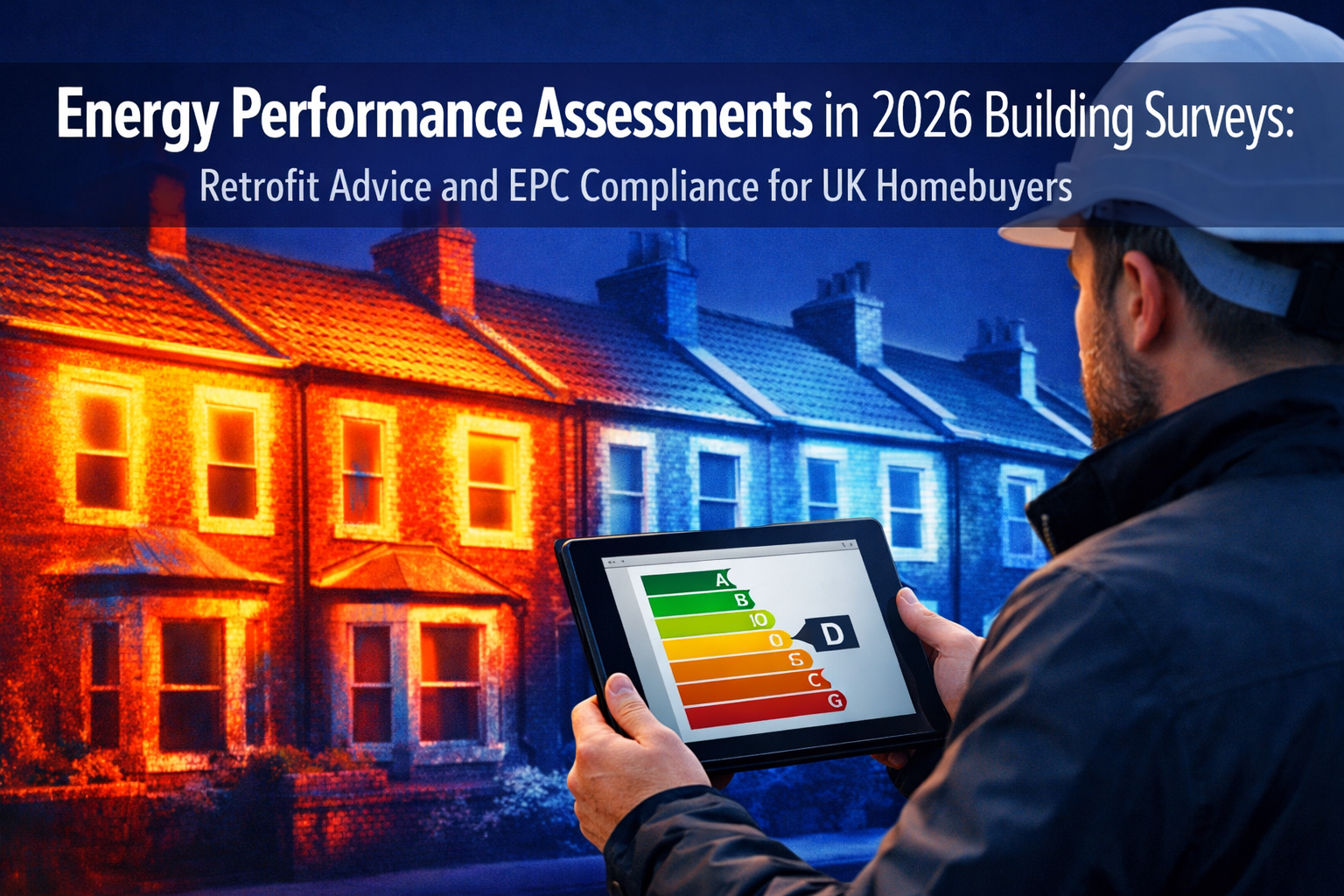
With energy bills soaring and climate targets tightening, UK homebuyers in 2026 face a property market transformed by new Energy Performance Certificate (EPC) regulations. Energy Performance Assessments in 2026 Building Surveys: Retrofit Advice and EPC Compliance for UK Homebuyers has evolved from a simple compliance checkbox into a sophisticated analysis combining thermal imaging, laser scanning, and energy modeling to deliver actionable retrofit recommendations that boost property values and reduce running costs.
The October 2026 launch of reformed domestic EPCs marks a fundamental shift in how properties are assessed and marketed. Gone are the simple A-to-G ratings; in their place, multi-metric reporting provides granular insights into fabric performance, heating efficiency, running costs, and smart technology readiness. For homebuyers, this means comprehensive building surveys now integrate detailed energy performance assessments that reveal not just what's wrong, but precisely how to fix it—and what it will cost.
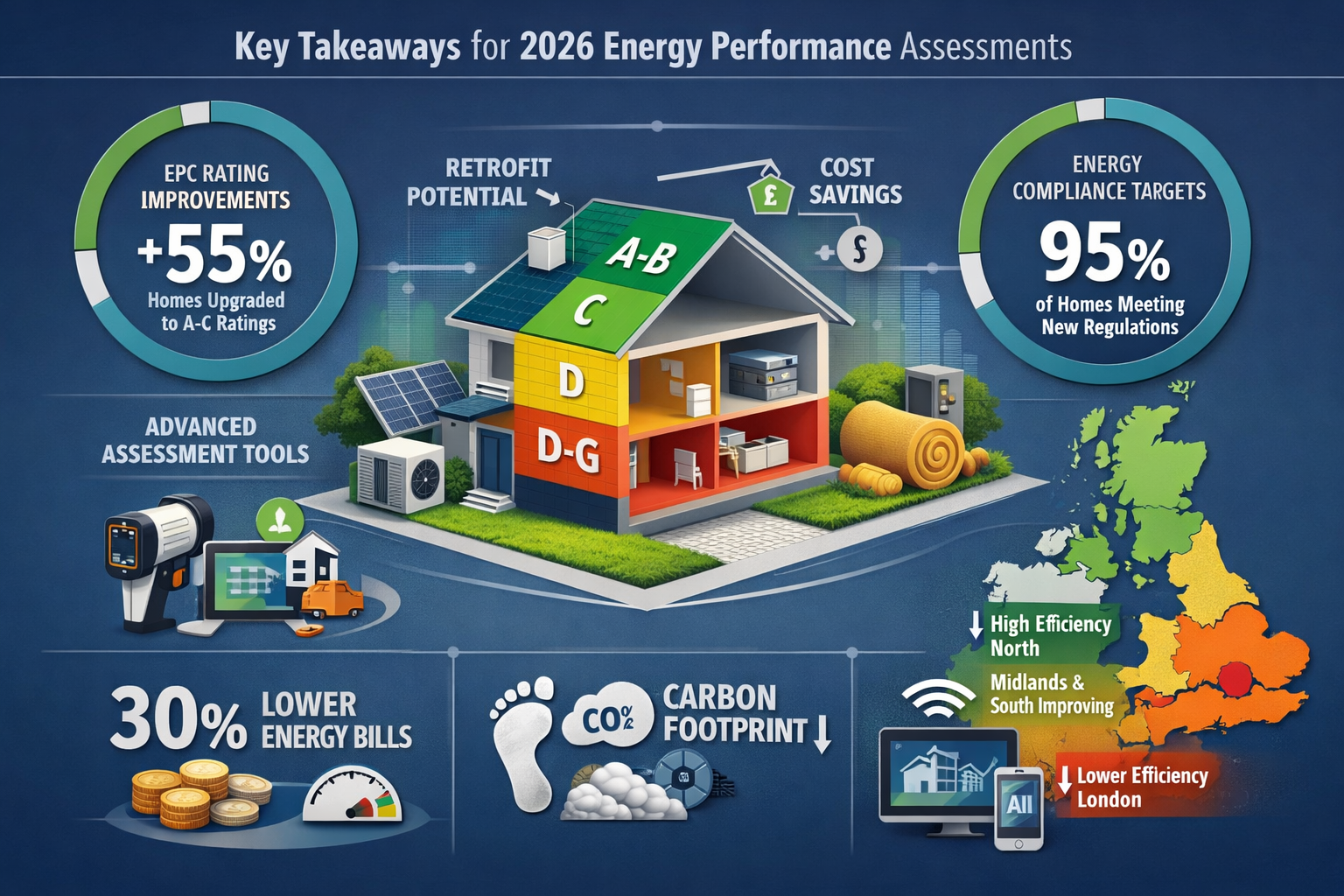
Key Takeaways
- 🏠 October 2026 EPC reforms replace single ratings with four headline metrics: Fabric Performance, Heating System, Energy Cost, and Smart Readiness
- 📊 New assessment methodology (HEM) replaces the Standard Assessment Procedure (SAP) for more accurate energy performance calculations
- 💷 Rental properties must achieve EPC C rating by October 2030, with a £10,000 investment cap per property including VAT
- 🔍 Modern building surveys now incorporate thermal imaging, laser scanning, and energy modeling to provide detailed retrofit roadmaps
- ⏰ EPC validity reduced to 5 years for certificates obtained after October 1, 2029, requiring more frequent assessments
Understanding the 2026 EPC Reform: What's Changed for UK Homebuyers
The October 2026 implementation of reformed domestic Energy Performance Certificates represents the most significant overhaul of energy assessment standards in over a decade. The government has confirmed that the new-style EPCs will fundamentally change how properties are evaluated, marketed, and improved.[1]
Four New Headline Metrics Replace Single Rating System
Instead of relying on a single A-to-G rating, the reformed EPCs display four distinct headline metrics that provide comprehensive insights into different aspects of property performance:[1]
| Metric | What It Measures | Why It Matters |
|---|---|---|
| Fabric Performance | Building envelope efficiency (walls, roof, windows, floors) | Shows insulation quality and heat retention capability |
| Heating System | Heat source efficiency and carbon intensity | Indicates running costs and environmental impact |
| Energy Cost | Estimated annual running cost in pounds | Provides clear financial implications for buyers |
| Smart Readiness | Integration capacity with smart meters and flexible tariffs | Reveals potential for future energy savings |
This granular approach allows homebuyers to understand exactly where a property performs well and where improvements are needed. A Victorian terrace might have excellent fabric performance due to solid walls but poor heating system ratings due to an aging boiler—information that directly informs retrofit priorities.
Home Energy Module (HEM) Replaces SAP Methodology
The Standard Assessment Procedure (SAP) that has historically calculated energy efficiency will be replaced with the Home Energy Module (HEM), designed to provide more accurate and reliable energy performance assessments.[2] The HEM methodology better accounts for real-world usage patterns, occupancy variations, and modern heating technologies like air source heat pumps.
For surveyors conducting RICS building surveys, this means updated training, new software tools, and enhanced data collection protocols to ensure compliance with HEM calculation requirements.
Tightened Marketing and Compliance Triggers
Valid EPCs are now required strictly at the point of marketing a property for sale or rent, rather than prior to exchange or completion.[1] This tightening of regulatory timing requirements means sellers and landlords must obtain updated certificates before listing properties, preventing last-minute scrambles and ensuring buyers have energy performance information from their first viewing.
Additionally, previously exempt heritage properties and listed buildings must now produce valid EPCs when marketed, sold, or let, ending their exemption status.[1] This change affects thousands of period properties across the UK, requiring sensitive retrofit solutions that balance energy efficiency with conservation requirements.
Energy Performance Assessments in 2026 Building Surveys: Advanced Technology and Retrofit Planning
Modern building surveys in 2026 integrate sophisticated technology to deliver precise energy performance assessments that go far beyond basic EPC compliance. Surveyors now employ thermal imaging cameras, laser scanning equipment, and energy modeling software to create comprehensive retrofit roadmaps tailored to each property's unique characteristics.
Thermal Imaging: Revealing Hidden Heat Loss
Thermal imaging has become standard practice in comprehensive building surveys, allowing surveyors to visualize heat loss patterns invisible to the naked eye. Infrared cameras detect temperature variations across building surfaces, revealing:
- ❄️ Cold bridging at structural junctions where heat escapes
- 🌬️ Air leakage around windows, doors, and service penetrations
- 🧱 Missing or inadequate insulation in walls, roofs, and floors
- 💧 Moisture ingress that compromises thermal performance
For homebuyers, thermal imaging reports provide visual evidence of energy efficiency issues and help prioritize retrofit investments. A thermal survey might reveal that replacing single-glazed windows would deliver less benefit than improving loft insulation—saving thousands in misdirected upgrades.
Laser Scanning and 3D Energy Modeling
Advanced surveyors now use laser scanning technology to create precise 3D models of properties, capturing exact dimensions, volumes, and surface areas. These digital twins serve as the foundation for sophisticated energy modeling software that simulates:
- 🔥 Heat flow patterns throughout the building
- 💨 Ventilation rates and air change calculations
- ☀️ Solar gain through windows and orientation
- 🏗️ Impact of proposed retrofit measures on overall performance
Energy modeling allows surveyors to test multiple retrofit scenarios virtually, comparing costs and benefits before any physical work begins. Buyers can see exactly how installing cavity wall insulation, upgrading to a heat pump, or adding solar panels would affect their EPC rating and annual energy bills.
Integrated Retrofit Recommendations in Survey Reports
The most valuable building surveys in 2026 don't just identify problems—they provide actionable retrofit recommendations with cost estimates, payback periods, and predicted EPC improvements. A comprehensive survey report might include:
- Priority 1 (Essential): Repairs affecting safety or structural integrity
- Priority 2 (Urgent): Energy efficiency measures required for EPC compliance
- Priority 3 (Recommended): Cost-effective upgrades with short payback periods
- Priority 4 (Optional): Long-term improvements for maximum performance
This structured approach helps buyers plan renovation budgets realistically and negotiate purchase prices based on required energy efficiency investments. When combined with survey pricing information, buyers can make fully informed decisions about property affordability.
EPC Compliance Requirements and Rental Property Regulations in 2026
For landlords and property investors, understanding EPC compliance requirements has become critical to avoiding penalties and maintaining rental income. The regulatory landscape has tightened significantly, with new minimum standards, investment caps, and enforcement mechanisms coming into force.
Minimum EPC C Rating by October 2030
All privately rented properties in England and Wales will be required to meet at least an EPC C rating by October 1, 2030, upgraded from the current minimum of Band E.[3] This represents a substantial improvement threshold that will require significant investment in many older properties.
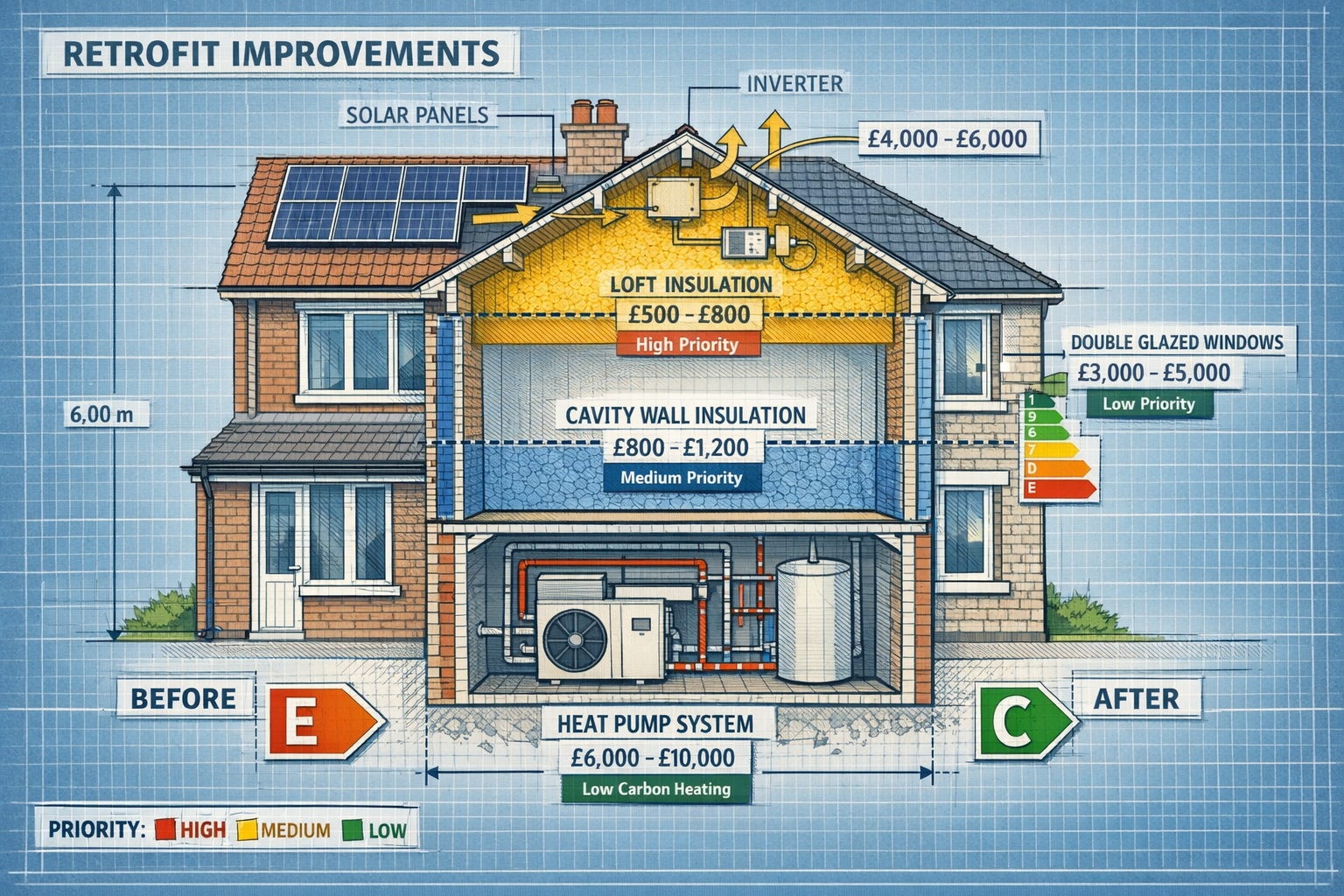
The phased implementation timeline gives landlords four years to plan and execute necessary upgrades, but the scale of required improvements should not be underestimated. Properties currently rated E, F, or G may need comprehensive retrofit packages including:
- 🏠 Cavity wall or solid wall insulation (£4,000-£13,000)
- 🔥 Heat pump installation replacing gas boilers (£8,000-£14,000 after grants)
- 🪟 Double or triple glazing throughout (£4,000-£8,000)
- ☀️ Solar PV panels for electricity generation (£5,000-£8,000)
- 💡 LED lighting and smart controls (£500-£1,500)
£10,000 Investment Cap Provides Cost Ceiling
Recognizing the financial burden on landlords, the government has capped required investment at £10,000 per property (including VAT).[2] This represents a reduction from originally proposed higher thresholds and provides important cost certainty.
However, the cap includes certain grants like the Warm Homes Local Grant, though Boiler Upgrade Scheme vouchers do not count toward the £10,000 limit.[2] This means landlords can potentially invest more than £10,000 in total improvements while remaining compliant with the cap requirement.
Landlords who can demonstrate they have spent £10,000 without achieving EPC C can claim exemption from the minimum standard requirement, though they must provide detailed evidence of expenditure and improvements attempted.
Tax Deductibility and Funding Schemes
The government has confirmed that qualifying energy efficiency upgrade investments can be treated as allowable expenses and may be tax deductible, helping offset upfront landlord costs.[3] This tax treatment significantly improves the financial case for proactive investment in property improvements.
Multiple funding schemes support landlord compliance:
- 💰 Government-backed loans allowing gradual repayment over extended periods
- 🎁 Targeted grant schemes prioritizing low-income and fuel-poor households
- 🏦 Private self-funding options with potential tax relief benefits
- 🔄 Green mortgages offering preferential rates for energy-efficient properties
For landlords managing multiple properties, strategic planning across portfolios can optimize funding access and minimize out-of-pocket costs. RICS home surveys conducted on rental properties should explicitly address EPC compliance pathways and funding eligibility.
HMO and Short-Term Let Requirements
Properties rented as Houses in Multiple Occupation (HMOs) must now have valid EPCs for the whole building when even a single room is rented out, rather than individual room certificates.[1] This change significantly affects student accommodation and shared housing providers.
Short-term and holiday lets now require valid EPCs regardless of who pays energy bills,[1] closing a previous loophole that exempted many vacation rentals. Property owners operating Airbnb rentals or holiday cottages must obtain certificates before marketing, adding compliance costs to these business models.
Enforcement Powers and Penalties
Local authorities have received expanded enforcement powers, including the ability to:
- 📋 Issue compliance notices requiring updated EPCs
- 📄 Demand current tenancy agreements and improvement evidence
- 💷 Impose financial penalties for non-compliance
- 🚫 Prohibit letting of non-compliant properties
Penalties for non-compliance can reach £5,000 per property for serious or repeated violations,[2] making proactive compliance far more cost-effective than reactive responses to enforcement action.
Reduced EPC Validity Period: Planning for More Frequent Assessments
A significant change affecting long-term property planning is the reduction in EPC validity periods. Certificates obtained after October 1, 2029 will only remain valid for five years (down from the current 10-year validity period), though certificates obtained before that date maintain 10-year validity under existing methodology.[2]
This change has important implications:
- 🔄 More frequent assessment costs for property owners
- 📈 Opportunity to capture improvement value sooner through updated certificates
- 🏗️ Incentive for continuous improvement rather than one-time compliance efforts
- 📊 Better reflection of actual property condition as buildings age and systems degrade
For homebuyers purchasing properties in 2026, checking the EPC issue date reveals how long the current certificate remains valid and when reassessment will be required. Properties with certificates issued in 2024-2025 retain 10-year validity, while those assessed from late 2029 onward require renewal every five years.
Strategic Advice for UK Homebuyers: Maximizing Value Through Energy Performance
For buyers navigating the 2026 property market, energy performance assessments provide powerful negotiation leverage and investment planning tools when properly understood and utilized.
Negotiating Purchase Price Based on Retrofit Requirements
When a comprehensive building survey reveals significant energy efficiency deficiencies, buyers have strong grounds to negotiate price reductions reflecting required improvement costs. A property rated EPC E requiring £8,000 in upgrades to reach EPC C represents a genuine cost burden that should be reflected in the purchase price.
Effective negotiation strategies include:
- Obtain detailed retrofit cost estimates from qualified contractors
- Reference comparable properties with better EPC ratings at similar prices
- Highlight rental regulation impact if property may be let in future
- Request seller contribution toward specific improvements
- Negotiate completion timeline allowing improvement works before occupation
Prioritizing Cost-Effective Improvements
Not all energy efficiency improvements deliver equal value. Surveyors can help buyers identify quick wins with short payback periods versus longer-term investments:
High-Value Quick Wins:
- ✅ Loft insulation (payback 2-3 years)
- ✅ Cavity wall insulation (payback 3-5 years)
- ✅ LED lighting upgrades (payback 1-2 years)
- ✅ Smart heating controls (payback 2-4 years)
Longer-Term Strategic Investments:
- 🔄 Heat pump installation (payback 8-15 years)
- 🔄 Solar PV panels (payback 10-15 years)
- 🔄 Triple glazing (payback 15-25 years)
- 🔄 External wall insulation (payback 15-30 years)
Strategic buyers prioritize improvements that deliver immediate comfort and bill savings while planning longer-term investments that increase property value and future-proof against tightening regulations.
Understanding Regional Variations and Property Types
Energy performance challenges vary significantly by property type and location. Victorian terraced houses in Manchester face different issues than 1960s semi-detached properties in Surrey or modern apartments in London.
Period Properties (Pre-1919):
- Solid wall construction requires expensive external or internal insulation
- Single-glazed sash windows need sensitive replacement or secondary glazing
- Lack of cavity spaces limits insulation options
- Heritage considerations may restrict improvement methods
Interwar Properties (1919-1945):
- Often have uninsulated cavity walls suitable for cost-effective injection insulation
- Suspended timber floors allow underfloor insulation installation
- Original windows typically replaceable without planning restrictions
Post-War Properties (1945-1980):
- May have partial insulation requiring completion rather than full installation
- Flat roofs present waterproofing challenges when adding insulation
- Concrete construction can create thermal bridging issues
Modern Properties (Post-1990):
- Already meet basic insulation standards but may benefit from heating system upgrades
- Well-suited to heat pump installation with existing radiator systems
- Smart technology integration typically straightforward
Understanding these property-specific challenges helps buyers set realistic improvement budgets and timelines. Specific defect surveys can investigate particular concerns in greater detail when energy performance issues are identified.
Working with Qualified Surveyors: What to Expect from Modern Energy Assessments
The quality of energy performance assessment varies significantly between basic EPC-only evaluations and comprehensive building surveys that integrate detailed retrofit analysis. Buyers should understand what to expect from different service levels.
Basic EPC Assessment vs. Comprehensive Energy Survey
A basic EPC assessment (£60-£120) provides:
- ✓ Regulatory compliance certificate
- ✓ Basic energy efficiency rating
- ✓ Generic improvement recommendations
- ✓ Estimated energy costs
A comprehensive energy survey integrated with building survey (£400-£800+) delivers:
- ✓ Thermal imaging analysis
- ✓ Detailed fabric performance assessment
- ✓ Specific retrofit recommendations with costs
- ✓ Energy modeling and improvement scenarios
- ✓ Funding and grant eligibility advice
- ✓ Structural integration considerations
- ✓ Planning and building regulation guidance
For buyers serious about understanding property performance and planning improvements, the additional investment in comprehensive assessment typically pays for itself through better-informed decisions and avoided mistakes.
Questions to Ask Your Surveyor
When commissioning building surveys with energy performance assessment, buyers should ask:
- What technology do you use? (thermal imaging, laser scanning, energy modeling software)
- Are your assessors qualified for HEM methodology? (post-2026 requirement)
- Do you provide retrofit cost estimates? (or just generic recommendations)
- Can you advise on funding and grant eligibility? (maximizing financial support)
- Will you coordinate with contractors? (ensuring survey recommendations are properly implemented)
- Do you offer post-improvement verification? (confirming predicted EPC improvements achieved)
Qualified surveyors should demonstrate up-to-date knowledge of 2026 EPC reforms, HEM methodology, current building regulations, and available funding schemes.
Coordinating Survey Timing with Purchase Process
Strategic timing of energy performance assessments within the purchase process maximizes their value:
Pre-Offer Stage:
- Review existing EPC certificate
- Note rating, issue date, and validity period
- Identify obvious deficiencies from listing photos
- Factor potential improvement costs into offer price
Post-Offer, Pre-Exchange Stage:
- Commission comprehensive building survey with energy assessment
- Obtain detailed retrofit recommendations and cost estimates
- Renegotiate price if significant issues revealed
- Plan improvement timeline and budget
Post-Purchase Stage:
- Implement priority improvements before occupation
- Apply for available grants and funding
- Commission post-improvement EPC to capture rating increase
- Plan longer-term strategic upgrades
This phased approach ensures energy performance considerations inform every stage of the purchase decision while maintaining transaction momentum.
Future-Proofing Property Investments: Beyond 2026 Compliance
While meeting 2026 EPC requirements represents an immediate priority, forward-thinking buyers and investors should consider longer-term regulatory trajectories and market trends.
Anticipated Future Regulatory Tightening
The October 2030 EPC C requirement for rental properties likely represents an interim target rather than final destination. Government climate commitments suggest further tightening toward EPC B or even A ratings by 2035-2040, particularly for rental properties.
Properties improved to EPC C through minimal compliance measures may require additional investment within 5-10 years, while properties upgraded to EPC B or A through comprehensive retrofit remain compliant for decades and command premium rental yields and sale prices.
Heat Pump Readiness and Low-Carbon Heating
The phase-out of gas boiler installations from 2025 and anticipated gas grid decommissioning in coming decades makes heat pump readiness a critical consideration for property assessment.
Properties well-suited to heat pump installation feature:
- 🏠 Good insulation reducing heat demand
- 🔥 Underfloor heating or oversized radiators
- 🌡️ Space for heat pump outdoor unit
- ⚡ Adequate electrical supply capacity
- 💧 Compatible hot water cylinder
Buyers should ask surveyors to explicitly assess heat pump suitability and identify any preparatory works required before installation becomes necessary.
Smart Home Integration and Energy Management
The Smart Readiness metric in reformed EPCs reflects growing importance of technology integration for energy management. Properties with or easily adapted for:
- 📱 Smart thermostats and zone controls
- 🔌 Smart plugs and energy monitoring
- ☀️ Solar PV with battery storage
- 🚗 Electric vehicle charging infrastructure
- 🏠 Home energy management systems
…will command premium values as buyers increasingly prioritize running cost control and environmental performance.
Conclusion: Making Energy Performance Work for You
Energy Performance Assessments in 2026 Building Surveys: Retrofit Advice and EPC Compliance for UK Homebuyers has evolved from a regulatory checkbox into a sophisticated analytical tool that reveals exactly how properties perform, where they fall short, and what improvements deliver the best return on investment.
The October 2026 EPC reforms—with four headline metrics replacing single ratings, HEM methodology replacing SAP, and tightened compliance requirements—fundamentally change how properties are assessed, marketed, and improved. For homebuyers, this creates both challenges and opportunities.
Challenges include:
- More complex assessment criteria requiring expert interpretation
- Significant retrofit costs for older or poorly performing properties
- Reduced EPC validity periods requiring more frequent reassessment
- Tighter rental regulations affecting investment property viability
Opportunities include:
- Detailed retrofit roadmaps enabling cost-effective improvement planning
- Negotiation leverage based on quantified energy efficiency deficiencies
- Access to government funding and tax relief for qualifying improvements
- Premium values for high-performing properties in increasingly energy-conscious market
Actionable Next Steps for Homebuyers
- Commission comprehensive building surveys that integrate thermal imaging and energy modeling, not just basic EPC assessments
- Request detailed retrofit recommendations with specific costs, payback periods, and predicted EPC improvements
- Factor energy efficiency into purchase price negotiations, using survey evidence to justify reductions reflecting required improvement costs
- Research available funding schemes including grants, loans, and tax relief before planning improvement works
- Prioritize cost-effective quick wins (loft and cavity wall insulation) before longer-term strategic investments (heat pumps, solar panels)
- Choose qualified surveyors with up-to-date HEM methodology training and experience with 2026 EPC reforms
- Plan improvements strategically considering both immediate compliance requirements and longer-term regulatory trajectories
The property market in 2026 increasingly rewards energy efficiency and penalizes poor performance. Buyers who understand energy performance assessments, work with qualified surveyors, and plan strategic improvements position themselves to minimize running costs, maximize property values, and future-proof investments against tightening regulations.
Whether purchasing a Victorian terrace requiring comprehensive retrofit or a modern apartment needing only heating system upgrades, comprehensive energy performance assessment integrated with professional building surveys provides the insights needed to make informed decisions and create comfortable, efficient, valuable homes.
References
[1] 2026 Epc Reform Technical Update – https://buildingenergyexperts.co.uk/resources/2026-epc-reform-technical-update/
[2] 2026 Changes Epc Rules Rental – https://anthonyjones.com/2026-changes-epc-rules-rental/
[3] New Epc Regulations – https://blog.goodlord.co/new-epc-regulations