Do I Need a Survey on a New Build? A Complete Guide for 2026

Picture this: you’ve just signed the contract for your dream new-build home. The walls are pristine, the fixtures gleam, and everything smells of fresh paint and possibility. But beneath that perfect surface, could there be hidden problems that even a reputable developer might have missed? The question “do I need a survey on a new build” is one that many homebuyers dismiss too quickly, often assuming that new construction means problem-free living. The reality, however, is far more complex—and the answer could save you thousands of pounds in unexpected repairs.
In 2026, with updated industry standards and increasing awareness of construction quality issues, understanding whether you need a survey on a new build has never been more important. This comprehensive guide will walk you through everything you need to know to make an informed decision about protecting your investment.
Key Takeaways
- New build warranties are not a substitute for independent surveys – they have significant limitations and exclusions that may leave you vulnerable to costly defects
- Snagging surveys and structural surveys serve different purposes – understanding which type you need depends on your property’s construction stage and your concerns
- Mortgage lenders rarely require surveys on new builds – but this doesn’t mean you shouldn’t get one for your own protection
- The cost of a new build survey is minimal compared to the potential expense of undiscovered defects that could cost tens of thousands to repair
- 2026 brings updated survey standards – ensuring greater precision and transparency in property assessments[1][2]
Understanding New Build Warranties and Their Limitations
What New Build Warranties Actually Cover
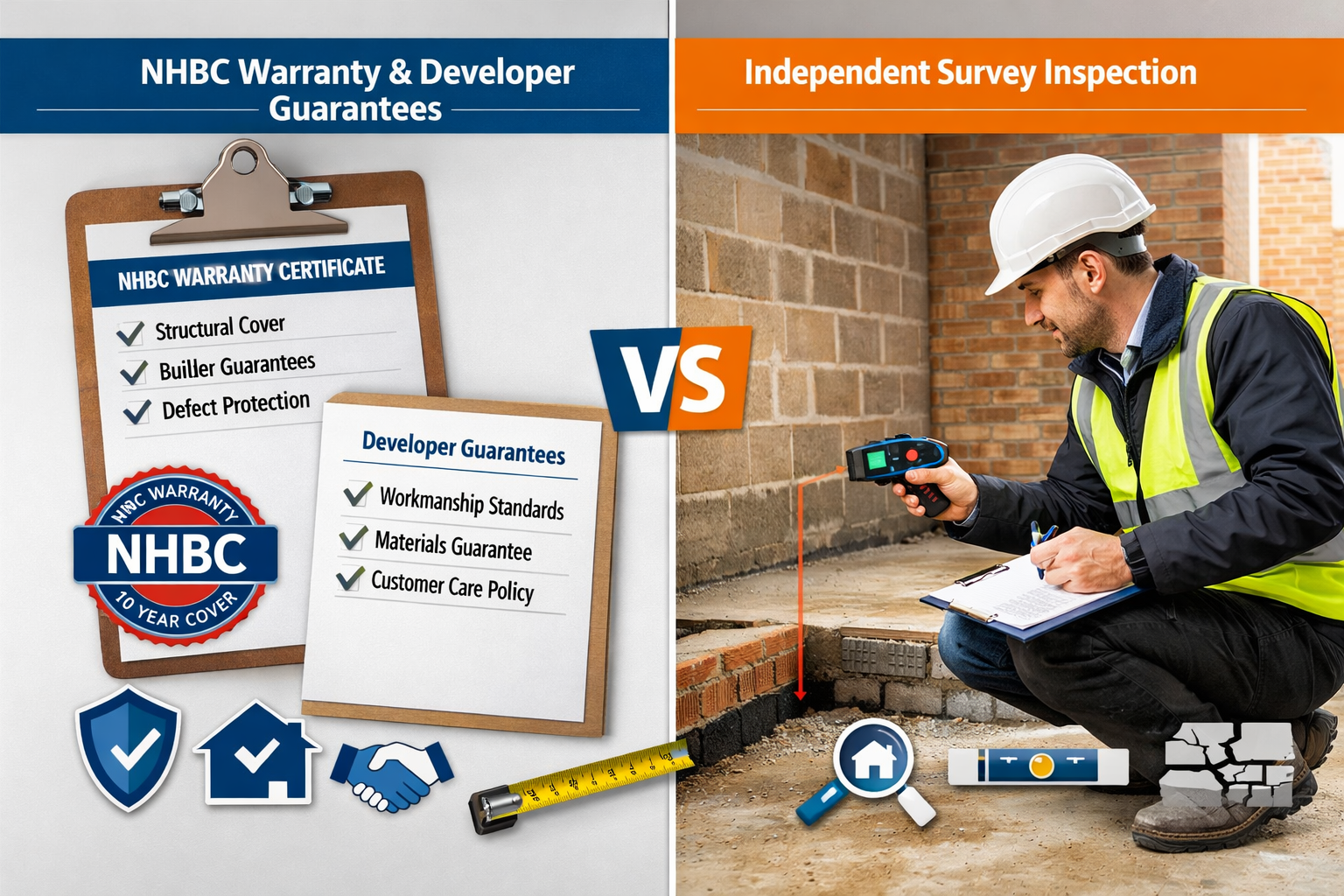
Most new build properties in the UK come with a 10-year warranty from organizations like the National House Building Council (NHBC), Premier Guarantee, or similar providers. These warranties typically offer:
- Years 1-2: Full coverage for defects in materials and workmanship
- Years 3-10: Coverage for major structural defects only
- Insurance protection: If the builder goes bankrupt
While this sounds comprehensive, these warranties have significant limitations that many buyers don’t discover until it’s too late.
Critical Gaps in New Build Protection
New build warranties often exclude:
- ❌ Cosmetic defects discovered after the initial period
- ❌ Design flaws that don’t constitute structural failure
- ❌ Poor workmanship that doesn’t breach building regulations
- ❌ Issues you should have noticed during the pre-completion inspection
- ❌ Consequential damage from defects (like damaged furnishings from a leak)
“A warranty is not the same as a guarantee of quality. It’s an insurance policy with strict terms and conditions that may not cover many common defects buyers encounter in new homes.”
This is where understanding which survey do you need becomes crucial for protecting your investment.
Do I Need a Survey on a New Build? The Honest Answer
Why the Answer Is Usually “Yes”
Despite what developers might suggest, getting an independent survey on a new build property is strongly recommended for several compelling reasons:
1. Construction Quality Varies Significantly
Even reputable developers can have quality control issues. Common problems found in new builds include:
- Inadequate drainage systems
- Poor plastering and finishing work
- Incorrectly installed windows and doors
- Electrical and plumbing issues
- Foundation settlement problems
- Inadequate insulation
2. Building Regulations Approval Isn’t Enough
Just because a property has passed building control inspections doesn’t mean it’s defect-free. Building control officers:
- Only inspect at specific stages
- Check compliance with minimum standards
- Don’t assess overall build quality
- May miss issues between inspection visits
3. Your Lender’s Valuation Isn’t a Survey
If you’re getting a mortgage, your lender will arrange a basic valuation. However, this is not a survey. The valuation only confirms the property is worth the loan amount—it doesn’t assess condition or quality.
When You Might Skip a Survey
There are limited circumstances where you might reasonably forgo a survey on a new build:
- You’re purchasing a property still under construction and can arrange multiple site visits during the build process
- You have professional construction knowledge yourself
- The property is from a highly reputable developer with an excellent track record, AND you’re arranging a comprehensive snagging inspection
Even in these cases, many property experts still recommend getting professional advice through a RICS building survey.
Types of Surveys for New Build Properties
Snagging Surveys
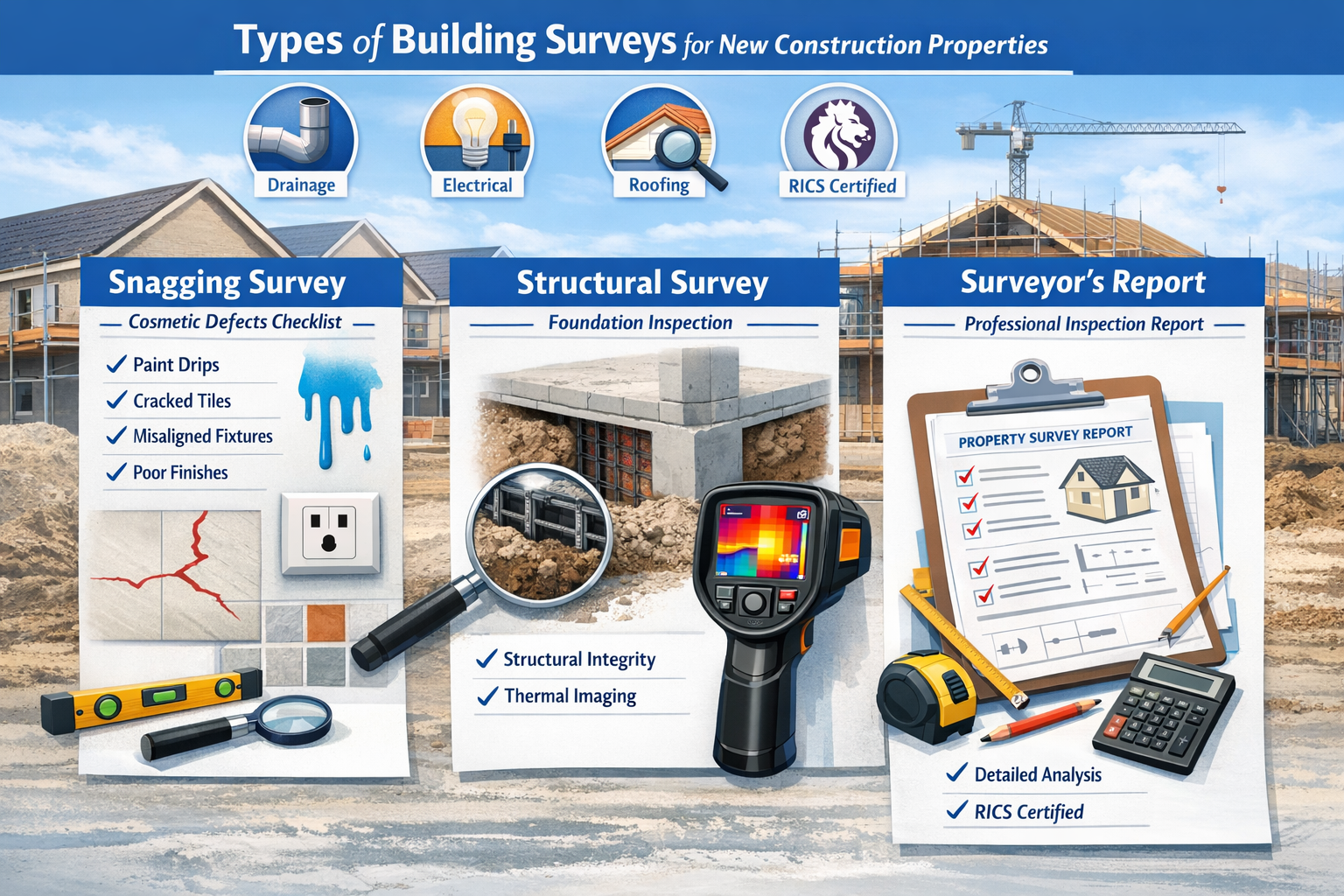
A snagging survey (also called a snagging inspection) identifies minor defects and finishing issues in a new build property. This type of inspection typically costs between £300-£600 and covers:
✅ Paint and decoration quality
✅ Door and window alignment
✅ Flooring issues
✅ Kitchen and bathroom fitting quality
✅ External finishes
✅ Minor plumbing and electrical concerns
Best timing: Before completion or during your warranty period
Limitation: Snagging surveys focus on cosmetic and minor issues, not structural integrity.
Professional Building Surveys
For comprehensive protection, a RICS Building Survey Level 3 provides the most thorough assessment. This detailed inspection examines:
- Structural elements: foundations, walls, roof structure
- Building services: electrical, plumbing, heating systems
- Drainage and damp: proper installation and functionality
- Energy efficiency: insulation and thermal performance
- Future maintenance: anticipated repairs and costs
Cost range: £500-£1,500 depending on property size and location
Best for: Buyers who want complete peace of mind and a detailed understanding of their property’s condition.
Specific Defect Surveys
If you have concerns about particular aspects of a new build, you might commission a specific defect survey focusing on:
- Drainage systems
- Roof construction
- Foundation integrity
- Damp and waterproofing
These targeted surveys typically cost £250-£500 and provide expert analysis of specific concerns.
What Professional Surveyors Look for in New Builds
Structural Concerns
When conducting surveys on new construction, qualified surveyors pay particular attention to:
Foundation and Ground Issues
- Proper foundation depth and construction
- Ground preparation and compaction
- Drainage around foundations
- Signs of settlement (even in new properties)
Wall Construction
- Cavity wall ties installed correctly
- Proper damp-proof course installation
- Brick and blockwork quality
- Insulation placement and quality
Roof Structure
- Timber treatment and quality
- Rafter spacing and support
- Roof covering installation
- Ventilation adequacy
Building Services Assessment
Modern new builds have complex building services that require expert evaluation:
| System | Common Issues Found | Potential Cost to Fix |
|---|---|---|
| Electrical | Incorrect wiring, insufficient sockets | £500-£3,000 |
| Plumbing | Poor pipe installation, inadequate pressure | £800-£5,000 |
| Heating | Undersized systems, poor controls | £1,000-£8,000 |
| Drainage | Incorrect falls, poor connections | £2,000-£10,000 |
| Ventilation | Inadequate airflow, condensation issues | £500-£3,000 |
Understanding what chartered surveyors look for in a property inspection can help you appreciate the value of professional assessment.
Compliance and Documentation
Professional surveyors also verify:
- Building regulation compliance certificates are complete
- Warranty documentation is properly registered
- Energy Performance Certificate (EPC) accuracy
- Planning permission was obtained for all work
- Adoption agreements for roads and sewers are in place
The 2026 Survey Standards Update
What’s Changing in 2026
The property surveying industry has introduced updated standards that take effect February 23, 2026. While these primarily affect land title surveys in the United States, they reflect a broader industry trend toward enhanced precision and transparency[2][3].
The 2026 ALTA/NSPS standards emphasize:
- Clearer documentation requirements for all survey types
- Improved precision standards for measurements and boundaries
- Enhanced transparency regarding easements, utilities, and access rights
- Better disclosure of encroachments and potential issues[1][2]
What This Means for UK Property Buyers
While the ALTA/NSPS standards are US-specific, UK surveying standards continue to evolve with similar goals:
🔍 Greater detail in survey reports
📊 More comprehensive data about property conditions
📋 Clearer explanations of findings for non-technical readers
⚡ Faster turnaround times with improved technology
Working with RICS chartered building surveyors ensures you benefit from the latest professional standards and best practices.
Cost-Benefit Analysis: Is a New Build Survey Worth It?
The Real Cost of Skipping a Survey
Consider these actual scenarios from new build properties:
Case Study 1: Drainage Disaster
- Issue: Inadequate drainage causing garden flooding
- Discovery: 18 months after purchase
- Repair cost: £8,500
- Survey cost that would have identified it: £600
- Net loss: £7,900
Case Study 2: Heating System Undersized
- Issue: Heating system inadequate for property size
- Discovery: First winter
- Replacement cost: £6,200
- Survey cost that would have identified it: £750
- Net loss: £5,450
Case Study 3: Structural Movement
- Issue: Foundation settlement causing cracks
- Discovery: 3 years after purchase (outside warranty)
- Repair cost: £15,000+
- Survey cost that would have identified risk: £900
- Net loss: £14,100+
Investment Protection Calculation
Let’s break down the numbers:
Average new build survey costs (2026):
- Basic snagging survey: £400
- Comprehensive building survey: £800
- Specialist surveys (if needed): £300-£500
Average cost of major defects:
- Structural repairs: £5,000-£50,000
- Drainage issues: £3,000-£15,000
- Electrical rewiring: £4,000-£8,000
- Roof repairs: £2,000-£20,000
The mathematics is clear: Spending £800 on a comprehensive survey provides protection against potential costs that are 10 to 60 times higher.
Mortgage Lender Requirements for New Build Surveys
What Lenders Typically Require
Most mortgage lenders have minimal survey requirements for new build properties, usually just:
- A basic valuation (arranged by the lender)
- Confirmation of NHBC or equivalent warranty
- Building regulation completion certificates
Why Lender Requirements Aren’t Enough
Lenders are primarily concerned with:
✓ Property value matching the loan amount
✓ Adequate security for their investment
✓ Basic structural soundness
They are not concerned with:
✗ Your long-term maintenance costs
✗ Minor to moderate defects
✗ Quality of finishes and fittings
✗ Your satisfaction with the property
This is why arranging your own independent building survey remains essential, regardless of lender requirements.
Legal and Regulatory Considerations
Building Regulations and Certification
New build properties must comply with current Building Regulations. However, compliance certificates only confirm:
- Minimum legal standards were met
- Inspections were passed at specific stages
- Work was notified to building control
They do not guarantee:
- Overall build quality
- Absence of defects
- Long-term performance
- Value for money
Consumer Protection Rights
Under the Consumer Rights Act 2015, new build properties must be:
- Of satisfactory quality
- Fit for purpose
- As described by the developer
However, proving a breach of these rights can be challenging without professional survey evidence documenting defects.
Planning Permission and Compliance
A professional survey can verify:
- All work has proper planning permission
- Construction matches approved plans
- No unauthorized modifications have been made
- Boundary positions are correct
These factors can significantly affect property value and future sale prospects.
When to Arrange Your New Build Survey
Optimal Timing Strategies
Pre-Exchange Survey
- Best for: Maximum negotiating power
- Timing: Before exchanging contracts
- Advantage: Can withdraw or negotiate price reductions
- Challenge: May delay purchase process
Pre-Completion Inspection
- Best for: Identifying snagging issues
- Timing: 1-2 weeks before completion
- Advantage: Developer can fix issues before you move in
- Challenge: Limited time for major concerns
Post-Completion Survey
- Best for: Comprehensive assessment
- Timing: Within first 2 months of ownership
- Advantage: Full access to property
- Challenge: Limited leverage for negotiations
Warranty Period Survey
- Best for: Catching issues before warranty expires
- Timing: Month 23 (before 2-year warranty ends)
- Advantage: Still covered by warranty
- Challenge: May have lived with issues unknowingly
Multiple Inspection Strategy
For maximum protection, consider:
- Pre-completion snagging survey (£400-£600)
- Full building survey within 6 months (£800-£1,200)
- Pre-warranty expiry inspection at 23 months (£300-£500)
Total investment: £1,500-£2,300
Protection value: Potentially £50,000+ in identified and rectified defects
Choosing the Right Surveyor for Your New Build
Essential Qualifications to Look For
When selecting a surveyor for your new build property, ensure they have:
✅ RICS (Royal Institution of Chartered Surveyors) accreditation
✅ Specific new build experience
✅ Professional indemnity insurance
✅ Local market knowledge
✅ Clear, detailed reporting standards
Questions to Ask Potential Surveyors
Before commissioning a survey, ask:
- How many new build surveys have you conducted in the past year?
- What specific issues do you commonly find in new construction?
- How detailed will the report be?
- What’s included in your fee?
- How long will the survey take?
- When will I receive the report?
- Will you explain the findings in person or by phone?
- Do you provide follow-up advice if I have questions?
Red Flags to Avoid
Be cautious of surveyors who:
❌ Offer significantly lower prices than competitors
❌ Can’t provide references or examples of reports
❌ Aren’t RICS qualified
❌ Promise to “pass” or “fail” properties
❌ Rush the inspection process
❌ Don’t have adequate insurance
Regional Variations and Local Requirements
England and Wales
New build survey requirements are generally consistent across England and Wales, though local planning authorities may have specific requirements for:
- Conservation areas
- Listed building conversions
- Flood risk zones
- Areas with mining history
Scotland
Scotland has different property law and typically requires:
- Home Report (including survey) for all properties
- This applies to new builds over 4 months old
- Sellers usually commission this, but buyers can arrange independent surveys
Northern Ireland
Northern Ireland follows similar patterns to England and Wales, with:
- No mandatory survey requirements
- Strong recommendation for independent assessment
- NHBC or equivalent warranty standard
Common New Build Defects Surveys Uncover
Top 10 Issues Found in New Build Surveys
Based on industry data, the most common defects found in new build properties include:
- Drainage problems (35% of new builds)
- Incorrect falls and gradients
- Poor connection to mains drainage
- Inadequate surface water management
- Plumbing issues (32% of new builds)
- Leaking pipes and connections
- Inadequate water pressure
- Poor installation of fixtures
- Electrical concerns (28% of new builds)
- Insufficient socket provision
- Incorrect wiring
- Poor earthing and bonding
- Finishing defects (45% of new builds)
- Poor plastering and painting
- Misaligned doors and windows
- Flooring issues
- Insulation inadequacies (22% of new builds)
- Gaps in insulation coverage
- Incorrect installation
- Below-specification materials
- Damp and waterproofing (18% of new builds)
- Inadequate damp-proof courses
- Poor sealing around windows
- Roof penetration issues
- Heating system problems (25% of new builds)
- Undersized boilers
- Poor radiator placement
- Inadequate controls
- Structural movement (12% of new builds)
- Foundation settlement
- Cracking in walls
- Door and window frame distortion
- Roof defects (20% of new builds)
- Missing or damaged tiles
- Poor flashing installation
- Inadequate ventilation
- External works (30% of new builds)
- Poor drainage around property
- Inadequate boundary treatments
- Unfinished landscaping
Hidden Issues Only Professionals Spot
Experienced surveyors identify problems that untrained eyes miss:
- Thermal imaging reveals insulation gaps and heat loss
- Moisture meters detect hidden damp before visible signs appear
- Drainage testing identifies problems before they cause flooding
- Structural calculations verify load-bearing adequacy
Making the Decision: Your New Build Survey Checklist
Factors to Consider
Use this checklist to decide whether you need a survey on your new build:
Developer Reputation
- Research developer’s track record
- Check online reviews and complaints
- Verify previous project quality
- Confirm warranty provider reputation
Property Characteristics
- Construction complexity (simple or complex design?)
- Property size (larger properties = more potential issues)
- Build method (traditional vs. modern methods)
- Site conditions (sloping ground, flood risk, etc.)
Financial Considerations
- Your budget for unexpected repairs
- Property purchase price (higher value = more to protect)
- Survey cost vs. potential defect costs
- Insurance and warranty coverage gaps
Personal Circumstances
- Your construction knowledge level
- Time available for property inspections
- Risk tolerance
- Long-term ownership plans
Risk Assessment
- How much can you afford to lose?
- What’s your tolerance for stress and disputes?
- Do you have time to manage defect rectification?
- Can you afford to move if serious issues arise?
Decision Framework
HIGH PRIORITY for survey if:
- Property value over £300,000
- Complex or unusual construction
- Developer has mixed reviews
- You have limited DIY/construction knowledge
- Property is in a challenging location (slope, flood risk, etc.)
MEDIUM PRIORITY for survey if:
- Standard construction from reputable developer
- Property value £200,000-£300,000
- You have some construction knowledge
- Standard site conditions
CONSIDER snagging survey only if:
- Very reputable developer with excellent track record
- Simple, standard construction
- You have professional construction knowledge
- Budget is extremely tight
- Property value under £200,000
Conclusion: Protecting Your New Build Investment
The question “do I need a survey on a new build” has a clear answer for most buyers: yes, you do. While new build warranties provide some protection, they have significant limitations that leave many buyers vulnerable to costly defects. The relatively modest cost of a professional survey—typically £400 to £1,200—provides invaluable protection against potential repair costs that can reach tens of thousands of pounds.
In 2026, with enhanced survey standards and increasing awareness of construction quality issues, arranging an independent professional survey on your new build property is simply good financial sense. Whether you opt for a comprehensive RICS Building Survey or a targeted snagging inspection, professional assessment provides:
✅ Peace of mind about your property’s condition
✅ Negotiating leverage to address defects
✅ Documentation for warranty claims
✅ Protection against hidden problems
✅ Expert advice on maintenance priorities
Your Next Steps
- Research surveyors in your area with new build experience
- Request quotes from at least three RICS-qualified professionals
- Schedule your survey at the optimal time (ideally pre-completion)
- Review the report carefully and ask questions about any concerns
- Use findings to negotiate with your developer or plan for future maintenance
- Keep documentation for warranty claims and future sale purposes
Don’t let the excitement of buying a new home cloud your judgment about protecting this significant investment. A professional survey is not an optional extra—it’s an essential safeguard that could save you from financial disaster and years of stress dealing with defects.
The small investment in a professional survey today could save you from discovering costly problems tomorrow. Make the smart choice and protect your new build investment with expert professional assessment.
References
[1] Understanding The 2026 Alta Nsps Land Survey Standards Whats New And Why It Matters – https://millmanland.com/company-news/understanding-the-2026-alta-nsps-land-survey-standards-whats-new-and-why-it-matters/
[2] New 2026 Minimum Standard Detail 3684174 – https://www.jdsupra.com/legalnews/new-2026-minimum-standard-detail-3684174/
[3] 20251125 Key Updates To The 2026 Altansps Land Title Survey Standards – https://www.alta.org/news-and-publications/news/20251125-Key-Updates-to-the-2026-ALTANSPS-Land-Title-Survey-Standards
SEO Meta Title and Description
Meta Title: Do I Need a Survey on a New Build? Expert Guide 2026
Meta Description: Discover if you need a survey on a new build property. Expert advice on costs, types of surveys, warranty limitations, and protecting your investment in 2026.
{“@context”:”https://schema.org”,”@type”:”Article”,”headline”:”do i need a survey on a new build”,”description”:”Discover if you need a survey on a new build property. Expert advice on costs, types of surveys, warranty limitations, and protecting your investment in 2026.”,”image”:”https://zsxkvszxbhpwnvzxdydv.supabase.co/storage/v1/object/public/generated-images/kie/360f53f2-7429-4bef-8b89-10315548ef98/slot-0-1769817541515.png”,”datePublished”:”2026-01-30T23:55:55.244507+00:00″,”dateModified”:”2026-01-30T23:59:41.608Z”,”author”:{“@type”:”Organization”,”name”:”Manchester Surveyors”},”publisher”:{“@type”:”Organization”,”name”:”Manchester Surveyors”}}