
Dilapidations Survey: The Complete Guide for Landlords and Tenants in 2026

When a commercial lease ends, the financial stakes can be enormous. Property owners and tenants often find themselves locked in disputes over repair obligations, with costs potentially reaching hundreds of thousands of pounds. A dilapidations survey serves as the critical tool that documents property condition, establishes repair responsibilities, and provides the evidence needed to resolve these disputes fairly. Whether you’re a landlord protecting your investment or a tenant managing lease obligations, understanding this specialized property assessment can save significant time, money, and legal headaches.
Key Takeaways
- 📋 A dilapidations survey is a specialized property inspection that documents breaches of lease covenants and calculates repair costs for commercial properties
- ⏰ Three main types exist: interim dilapidations (during the lease), terminal schedules (at lease end), and Schedules of Condition (at lease commencement)
- 💰 Professional surveys help landlords recover legitimate repair costs and protect tenants from excessive or unjustified claims
- 🏗️ The dilapidations process involves detailed property inspection, legal covenant analysis, cost quantification, and often negotiation between parties
- 🔍 Engaging qualified RICS chartered surveyors ensures compliance with professional standards and increases the credibility of claims or defenses
What Is a Dilapidations Survey?
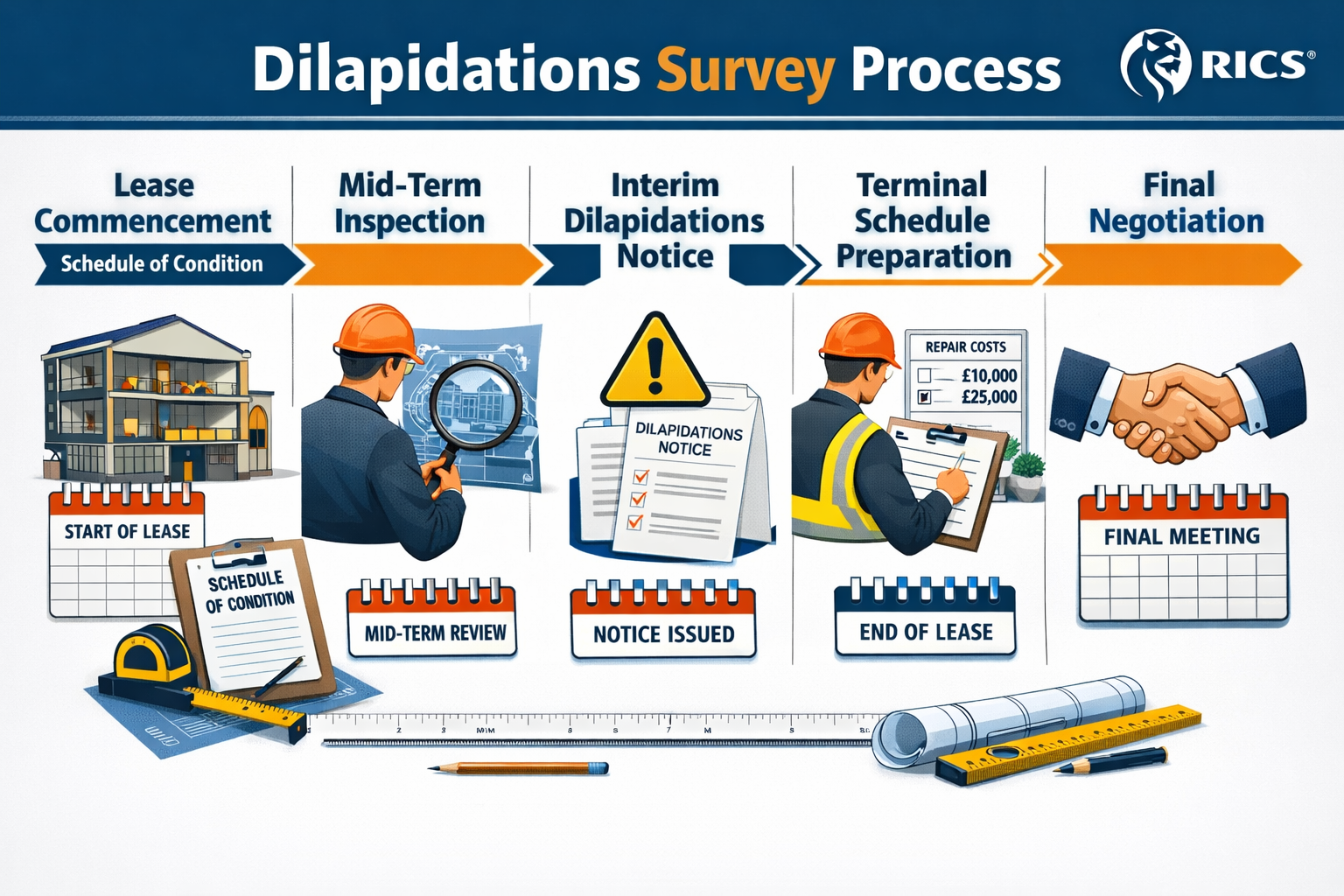
A dilapidations survey is a comprehensive property inspection conducted by qualified chartered surveyors to assess the condition of a leased commercial property and identify breaches of lease covenants.[4] Unlike residential property surveys that focus on structural integrity for purchase decisions, dilapidations surveys specifically examine whether a tenant has fulfilled their contractual obligations to maintain, repair, and reinstate the property according to lease terms.
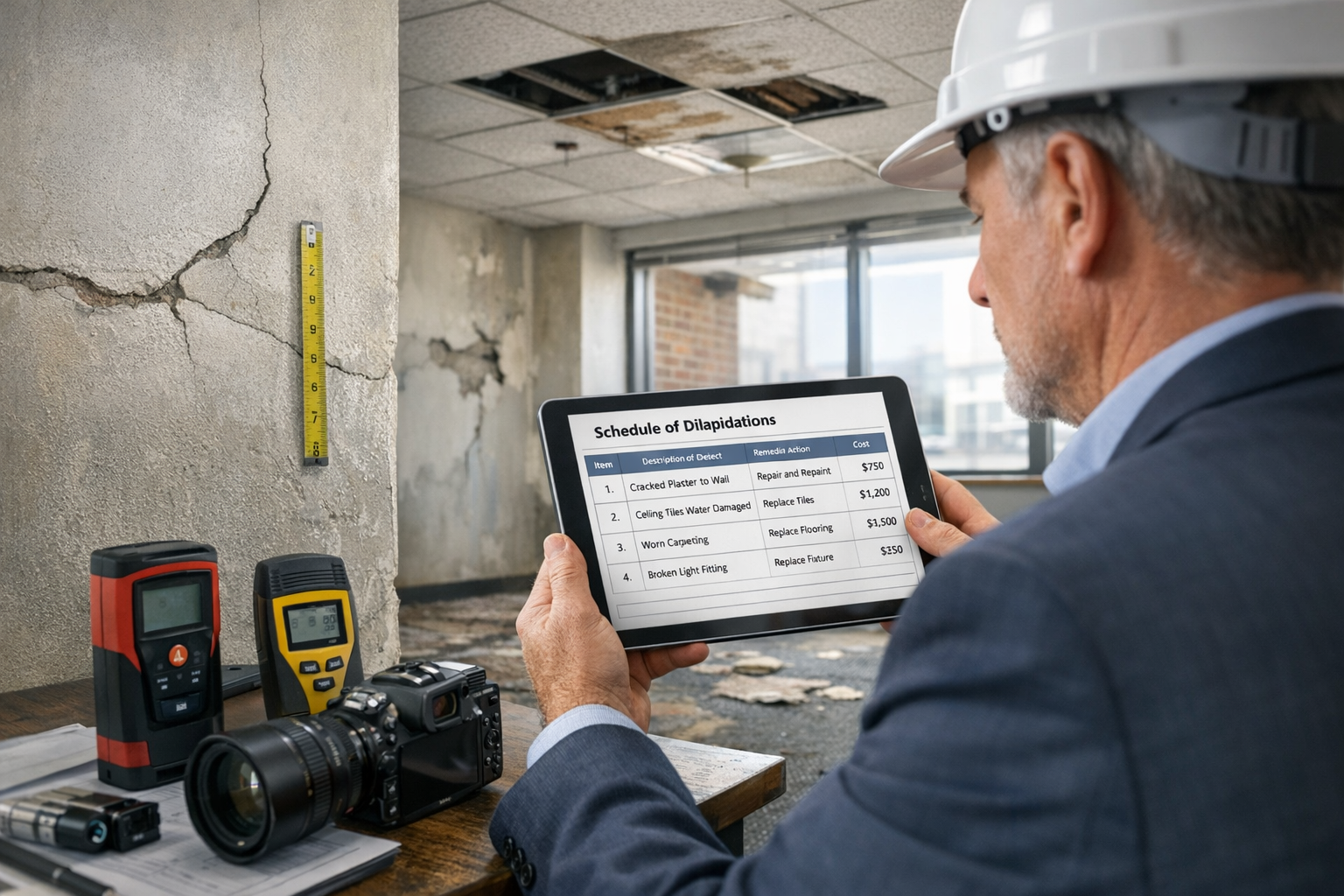
The survey produces a detailed document—typically called a Schedule of Dilapidations—that lists every breach of covenant, describes the required remedial works, and quantifies the associated costs.[7] This schedule becomes the foundation for financial claims and negotiations between landlords and tenants.
The Legal Framework
Dilapidations claims are governed by complex property law principles, including:
- Lease covenants: Specific repair and maintenance obligations detailed in the lease agreement
- Section 18 of the Landlord and Tenant Act 1927: Caps damages at the diminution in property value
- Dilapidations Protocol: Pre-action protocol that guides the claims process and encourages early settlement
- Quantified demand requirements: Landlords must provide detailed cost breakdowns and supporting evidence
Professional surveyors conducting these assessments must understand both building pathology and legal principles to produce defensible schedules that withstand scrutiny.[3]
Types of Dilapidations Surveys
Understanding the different types of dilapidations assessments helps property stakeholders know when and why each is required.
Schedule of Condition
Created at the start of a lease, a Schedule of Condition is a comprehensive photographic and written record documenting the property’s existing state.[2] This baseline assessment protects tenants from being held responsible for pre-existing defects when the lease ends.
Key features include:
- Detailed room-by-room descriptions
- Extensive photographic evidence
- Documentation of existing damage, wear, and defects
- Reference to specific lease clauses limiting tenant liability
When properly prepared and incorporated into the lease, this document significantly reduces disputes at lease termination by establishing clear evidence of the property’s original condition.
Interim Dilapidations Survey
Conducted during the lease term, interim surveys allow landlords to identify accumulating breaches before they become extensive and costly.[4] These mid-term assessments serve as early warnings and provide opportunities for remediation while the tenant still occupies the property.
Benefits include:
✅ Early intervention preventing minor issues from escalating
✅ Relationship preservation through collaborative problem-solving
✅ Cost control by addressing repairs when less expensive
✅ Lease compliance ensuring ongoing covenant fulfillment
Landlords typically serve interim schedules when they notice maintenance concerns or at predetermined review points specified in the lease agreement.
Terminal Schedule of Dilapidations
Prepared at or near lease expiration, the terminal schedule represents the landlord’s formal claim for breaches that existed when the tenant vacated.[7] This comprehensive document forms the basis for financial settlement negotiations.
A professional Schedule of Dilapidations typically includes:
| Component | Description |
|---|---|
| Property Details | Address, lease dates, parties involved |
| Inspection Methodology | Survey date, areas accessed, limitations |
| Breach Items | Detailed descriptions of each covenant breach |
| Specification of Works | Technical requirements for remedial repairs |
| Cost Quantification | Itemized repair costs with supporting evidence |
| Legal Analysis | Reference to specific lease clauses breached |
| Photographic Evidence | Comprehensive visual documentation |
| Diminution Valuation | Assessment of impact on property value |
Why Dilapidations Surveys Are Essential
The importance of professional dilapidations assessments extends far beyond simple documentation—they serve critical functions for both landlords and tenants in commercial property relationships.
For Landlords: Asset Protection and Cost Recovery
Property owners rely on dilapidations surveys to protect their investments and recover legitimate costs associated with tenant breaches.[3] Without professional documentation, landlords face significant challenges:
Financial recovery: A properly prepared terminal schedule provides the evidence necessary to pursue claims for repair costs, lost rent during remediation periods, and diminution in property value.
Legal defensibility: Courts and arbitrators expect schedules prepared according to RICS standards with accurate cost quantification and appropriate legal analysis. Amateur or poorly prepared schedules often fail under scrutiny.
Negotiation leverage: Comprehensive professional surveys demonstrate seriousness and establish credible baselines for settlement discussions, often resulting in faster resolutions and better outcomes.
Future lettings: Ensuring properties are returned in appropriate condition maintains asset value and marketability for subsequent lettings.[3]
For Tenants: Defense Against Excessive Claims
Tenants benefit equally from engaging qualified dilapidations surveyors to review landlord claims and prepare robust defenses:
Challenge unjustified items: Professional review identifies claims for pre-existing conditions, betterment (improvements beyond original specification), and works outside lease covenant scope.
Cost verification: Expert quantity surveyors assess whether claimed repair costs are reasonable, identifying inflated estimates and unnecessary specifications.
Legal compliance: Ensuring landlord schedules comply with the Dilapidations Protocol and statutory limitations protects tenants from improper claims.
Settlement optimization: Professional representation typically reduces settlement amounts significantly compared to accepting landlord schedules without challenge.[4]
Risk Mitigation for Both Parties
Beyond partisan interests, dilapidations surveys serve important risk management functions:
🛡️ Dispute avoidance: Clear documentation reduces misunderstandings and provides objective evidence
🛡️ Budget planning: Early assessments allow financial preparation for end-of-lease obligations
🛡️ Relationship preservation: Professional third-party involvement depersonalizes potentially contentious issues
🛡️ Compliance assurance: Proper procedures protect against regulatory and legal challenges
The Dilapidations Survey Process
Understanding how professional surveyors conduct these specialized assessments helps stakeholders prepare effectively and maximize value from the process.
Step 1: Instruction and Documentation Review
The process begins when a surveyor receives instructions from either the landlord or tenant. Professional RICS chartered surveyors immediately review critical documents:
- Lease agreement: Identifying specific repair, decoration, and reinstatement covenants
- Previous schedules: Reviewing any Schedule of Condition or interim assessments
- Correspondence: Understanding the history of maintenance issues and communications
- Plans and specifications: Obtaining original fit-out drawings and building specifications
This documentary foundation ensures the subsequent inspection focuses on relevant covenant obligations rather than general building condition.
Step 2: Comprehensive Property Inspection
The surveyor conducts a detailed physical inspection of the entire demised premises, examining:
Building fabric: Walls, floors, ceilings, structural elements, external envelope
Services: Heating, ventilation, air conditioning, electrical, plumbing, fire safety systems
Finishes: Decorations, floor coverings, fixtures, fittings
External areas: Car parks, landscaping, signage, boundaries (if within lease scope)
Modern surveyors increasingly utilize technology during inspections, with over half of industry professionals planning technology investments in their dilapidations practice.[1] Digital tools include:
- Tablet-based survey software for real-time documentation
- High-resolution photography and videography
- Laser measurement devices for accurate quantification
- Thermal imaging for hidden defects
- Drone technology for roof and elevation inspections
Step 3: Covenant Analysis and Breach Identification
Following inspection, the surveyor analyzes findings against specific lease covenants to identify breaches. This critical step requires both technical building knowledge and legal understanding.
The surveyor must distinguish between:
- Tenant responsibilities versus landlord obligations
- Repairing covenants versus reinstatement requirements
- Fair wear and tear (typically excluded) versus actionable breaches
- Inherent defects versus maintenance failures
This analysis determines which identified defects constitute legitimate dilapidation claims.[7]
Step 4: Specification and Cost Quantification
For each identified breach, the surveyor prepares:
Technical specifications: Detailed descriptions of required remedial works following industry standards and best practices
Cost estimates: Accurate pricing based on current market rates, often prepared by specialist quantity surveyors or using industry-standard pricing databases
Supporting evidence: Photographs, measurements, contractor quotations, and technical references
The 2026 dilapidations landscape continues to emphasize quality and consistency in this quantification process, addressing ongoing industry challenges with Schedule preparation standards.[1]
Step 5: Diminution Valuation
Section 18 of the Landlord and Tenant Act 1927 caps dilapidations damages at the reduction in property value caused by breaches. Surveyors must therefore assess whether proposed works would actually add value to the property.
This valuation considers:
- Landlord’s intended use of the property
- Market conditions and letting prospects
- Whether repairs would be undertaken before reletting
- Impact of breaches on rental value and capital value
In many cases, particularly where landlords plan substantial refurbishment, the diminution value falls well below the cost of specified repairs, significantly reducing legitimate claims.
Step 6: Schedule Preparation and Service
The final deliverable—whether a landlord’s terminal schedule or tenant’s response—is prepared according to RICS guidance and Dilapidations Protocol requirements. Professional schedules demonstrate credibility and facilitate efficient resolution.
For landlords, the schedule is typically served within 56 days of lease end, accompanied by a quantified demand for settlement.
For tenants, a detailed response challenges unjustified items, disputes costs, and presents counter-arguments within prescribed timeframes.
Current Trends Shaping Dilapidations Practice in 2026
The dilapidations sector continues evolving rapidly, with several significant developments affecting how surveys are conducted and claims are resolved.
Technology Integration and AI Tools
Following substantial discussion at the RICS Dilapidations Conference in March 2025, where nearly 400 industry experts gathered, technology adoption has accelerated throughout 2026.[5] However, as industry leaders emphasize, “surveyors are not at risk of being replaced by technology, but those who fail to adapt may risk becoming irrelevant.”[1]
Current technological applications include:
AI-powered defect identification: Machine learning algorithms assist in identifying and categorizing building defects from photographic evidence
Automated cost estimation: Software platforms integrate inspection data with pricing databases for faster, more consistent quantification
Digital collaboration platforms: Cloud-based systems enable real-time sharing of survey data between landlords, tenants, and their respective advisors
Building Information Modeling (BIM): Advanced 3D modeling helps visualize required works and assess their impact
Despite these advances, professional judgment remains paramount. Technology serves as a tool to enhance efficiency and consistency, not replace the expertise of qualified surveyors.[1]
Sustainability and Circular Economy Considerations
The upcoming RICS Dilapidations Conference 2026 will feature new sessions exploring how circular economy principles and sustainable fit-out design are reshaping repair obligations and negotiation strategies.[5] This reflects growing industry recognition that traditional “make good” approaches may conflict with environmental objectives.
Key sustainability considerations now include:
🌱 Material reuse: Assessing whether removed fixtures and fittings can be repurposed rather than disposed
🌱 Energy efficiency: Balancing reinstatement obligations against opportunities for environmental improvements
🌱 Waste reduction: Considering whether full reinstatement serves environmental goals
🌱 ESG pressures: Responding to increasing corporate sustainability commitments affecting property decisions
These evolving considerations create both challenges and opportunities in dilapidations negotiations, requiring surveyors to understand sustainability principles alongside traditional building pathology.[1]
Market Conditions and Budget Pressures
The dilapidations landscape in 2026 continues facing turbulent market conditions and tightening budgets.[1] Economic pressures affect both the volume of claims and settlement strategies:
- Reduced commercial activity in some sectors decreases lease turnover
- Financial constraints encourage more aggressive negotiation positions
- Property market uncertainty affects diminution valuations
- Increased vacant possession provides landlords greater flexibility in pursuing or compromising claims
These conditions make professional survey evidence even more critical for achieving fair outcomes when financial stakes are high and parties face competing pressures.
Choosing the Right Dilapidations Surveyor
The quality of your dilapidations survey directly impacts financial outcomes, making surveyor selection a critical decision.
Essential Qualifications and Experience
Look for surveyors with:
✓ RICS membership: Chartered status ensures adherence to professional standards and ethical requirements
✓ Dilapidations specialism: General building surveyors may lack specific expertise in lease covenant analysis
✓ Relevant experience: Track record with similar property types and claim values
✓ Local knowledge: Familiarity with regional construction costs and market conditions
✓ Expert witness capability: Experience providing evidence in disputes if negotiation fails
Many property stakeholders benefit from engaging firms offering comprehensive surveying services, from commercial property surveying to specialized dilapidations expertise.
Questions to Ask Potential Surveyors
Before engaging a dilapidations surveyor, consider asking:
- How many dilapidations schedules have you prepared in the past year?
- What is your experience with properties similar to mine?
- Do you have quantity surveying expertise in-house for cost quantification?
- What technology do you use in your survey process?
- Can you provide references from recent clients?
- What is your fee structure and typical timeline?
- Have you provided expert witness testimony in dilapidations disputes?
Professional surveyors should provide clear, confident answers demonstrating their expertise and approach.
Understanding Fee Structures
Dilapidations survey fees typically reflect:
- Property size and complexity: Larger buildings with extensive services require more inspection time
- Schedule preparation scope: Terminal schedules generally cost more than interim assessments
- Urgency: Expedited timelines may incur premium fees
- Additional services: Negotiation support, expert witness work, and dispute resolution assistance
While cost is a consideration, the potential financial impact of dilapidations claims—often six or seven figures for substantial commercial properties—makes professional expertise a worthwhile investment. A well-prepared schedule or robust defense typically delivers returns many times the survey fee.
Common Dilapidations Survey Challenges
Understanding typical challenges helps stakeholders anticipate and address potential issues proactively.
Access and Timing Issues
Challenge: Coordinating property access, particularly when tenants have vacated or relationships are strained, can delay surveys and complicate documentation.
Solution: Establish clear access protocols early, ideally specified in the lease. For terminal surveys, conduct inspections before complete vacation when possible to address questions while tenant representatives remain available.
Scope Disputes
Challenge: Disagreements about what constitutes a breach versus fair wear and tear, or whether specific items fall within tenant covenants, frequently arise.
Solution: Engage surveyors early to provide advisory opinions on ambiguous lease terms. Consider obtaining legal counsel on particularly contentious covenant interpretation issues before finalizing schedules.
Cost Quantification Disagreements
Challenge: Landlords and tenants often dispute whether claimed repair costs are reasonable, with disagreements about specifications, methodologies, and pricing.
Solution: Ensure quantity surveyors with current market knowledge prepare cost estimates. Support pricing with contractor quotations, industry pricing databases, and comparable project evidence. Consider joint expert appointments to resolve technical pricing disputes.
Quality and Consistency Concerns
Industry leaders continue identifying quality and consistency of Schedules of Condition as a key challenge.[1] Poor-quality baseline documentation creates disputes when terminal schedules are later prepared.
Solution: Invest in comprehensive, professionally prepared Schedules of Condition at lease commencement. Ensure photographic evidence is extensive, descriptions are detailed, and documents are properly incorporated into lease terms.
Dilapidations Surveys vs. Other Property Assessments
Understanding how dilapidations surveys differ from other property inspections helps stakeholders select appropriate services.
While comparing different types of survey reveals various options for property assessment, dilapidations surveys serve a distinct purpose:
Building Surveys: Focus on structural condition and defects for purchase decisions, without reference to lease covenants or legal obligations. Learn more about RICS building surveys for property purchases.
Homebuyer Surveys: Designed for residential property purchases, examining condition and value rather than lease compliance.
Specific Defect Reports: Investigate particular building problems (damp, subsidence, structural issues) rather than comprehensive lease covenant compliance.
Commercial Building Surveys: May examine commercial property condition but without the legal covenant analysis central to dilapidations work.
The specialized nature of dilapidations surveys requires surveyors with specific expertise beyond general building inspection skills—they must understand property law, lease interpretation, and the dilapidations claims process.
Negotiating Dilapidations Claims
Most dilapidations disputes settle through negotiation rather than litigation, making effective negotiation strategies essential.
The Dilapidations Protocol Process
The pre-action Dilapidations Protocol establishes a structured framework encouraging early settlement:
- Landlord serves Schedule of Dilapidations with detailed breach descriptions and quantified costs
- Tenant responds within 56 days, challenging unjustified items and disputing costs
- Parties exchange information and attempt to narrow areas of disagreement
- Diminution assessment clarifies the Section 18 cap on recoverable damages
- Settlement negotiations proceed based on refined positions
- Alternative dispute resolution (mediation or expert determination) if negotiation fails
- Litigation only as a last resort when other approaches prove unsuccessful
Following this protocol demonstrates reasonableness and can affect cost awards if disputes ultimately reach court.
Effective Negotiation Strategies
For landlords:
- Present comprehensive, professionally prepared schedules demonstrating claim credibility
- Provide clear cost justification with supporting evidence
- Consider commercial realities beyond strict legal entitlements
- Evaluate settlement offers against litigation costs and delays
- Maintain professional relationships to facilitate productive discussions
For tenants:
- Engage professional advisors early to assess claim validity
- Challenge items systematically with evidence-based arguments
- Obtain independent cost assessments to counter inflated pricing
- Consider commercial settlement even when technical defenses exist
- Document all settlement discussions and agreements carefully
The RICS Dilapidations Conference 2026 will feature dedicated sessions on negotiation strategies, reflecting the critical importance of these skills in achieving optimal outcomes.[5]
When to Consider Alternative Dispute Resolution
If direct negotiation reaches impasse, consider:
Mediation: A neutral mediator facilitates settlement discussions, helping parties find mutually acceptable compromises. This approach preserves relationships and typically resolves disputes faster and cheaper than litigation.
Expert determination: Parties agree to have a qualified expert (often a senior surveyor) make binding decisions on technical disputes about scope of works or cost quantification.
Arbitration: A more formal process where an arbitrator makes binding decisions after hearing evidence from both sides, offering privacy and expertise but at higher cost than mediation.
These alternatives typically deliver better outcomes than court proceedings for dilapidations disputes, which often involve highly technical building and valuation issues.
Preparing for Your Dilapidations Survey
Whether you’re a landlord or tenant, proper preparation maximizes the value and effectiveness of dilapidations surveys.
For Landlords
During the lease:
- Conduct regular property inspections to identify emerging issues
- Maintain comprehensive records of communications about repairs
- Consider interim schedules if significant breaches accumulate
- Review lease covenants to understand your rights and obligations
- Keep original fit-out specifications and approved alteration records
At lease end:
- Engage qualified surveyors well before lease expiration
- Provide complete lease documentation and relevant correspondence
- Facilitate comprehensive property access for inspection
- Consider your intended use of the property (affects diminution valuation)
- Prepare for negotiation with realistic settlement expectations
For Tenants
During the lease:
- Understand your specific repair and maintenance covenants
- Keep records of all maintenance work and expenditure
- Address landlord concerns raised in interim schedules promptly
- Document property condition regularly with dated photographs
- Maintain communication with landlords about repair issues
At lease end:
- Conduct pre-vacation inspections to identify potential claims
- Consider undertaking obvious repairs before vacation
- Engage professional advisors to review anticipated claims
- Gather evidence of property condition and completed maintenance
- Prepare financially for potential settlement obligations
Upon receiving a Schedule of Dilapidations:
- Engage professional surveyors immediately to review claims
- Respond within protocol timeframes to preserve negotiating position
- Challenge items systematically with evidence-based arguments
- Obtain independent cost assessments for disputed items
- Consider commercial settlement strategies balancing costs and risks
The Future of Dilapidations Practice
Looking ahead through 2026 and beyond, several trends will continue shaping how dilapidations surveys are conducted and claims are resolved.
Continued Technology Evolution
While technology investment alone won’t drive change without proper implementation and professional judgment,[1] ongoing developments will enhance survey efficiency and accuracy:
- Advanced AI analysis improving defect identification and cost estimation
- Virtual reality enabling remote property inspections and collaborative reviews
- Blockchain documentation providing tamper-proof records of property condition
- Integrated platforms connecting surveyors, lawyers, and clients in real-time collaboration
Growing Sustainability Focus
The circular economy and sustainable fit-out considerations featured in the 2026 RICS conference program[5] represent an evolving practice area that will increasingly influence dilapidations negotiations:
- Reinstatement alternatives that reduce waste and environmental impact
- Green lease provisions incorporating environmental obligations
- Embodied carbon considerations in repair specifications
- Material reuse protocols balancing legal obligations with sustainability goals
Enhanced Professional Standards
Industry recognition of quality and consistency challenges[1] will likely drive:
- Standardized Schedule formats improving clarity and comparability
- Enhanced training requirements for dilapidations specialists
- Quality assurance protocols ensuring consistent professional standards
- Technology-assisted consistency reducing human error and variation
Market Adaptation
Ongoing economic pressures and market uncertainty will continue influencing dilapidations practice:
- Flexible negotiation approaches reflecting financial constraints
- Creative settlement structures including staged payments and alternative arrangements
- Increased focus on early resolution to minimize costs and delays
- Greater emphasis on commercial pragmatism over strict legal positions
Conclusion
A dilapidations survey represents far more than a simple property inspection—it’s a specialized assessment combining building expertise, legal knowledge, and commercial acumen to resolve complex disputes about lease obligations. Whether you’re a landlord seeking to protect your property investment or a tenant managing end-of-lease liabilities, professional dilapidations surveys provide the foundation for fair, evidence-based outcomes.
The dilapidations landscape in 2026 continues evolving with technological advances, sustainability considerations, and changing market conditions. However, the fundamental principles remain constant: comprehensive documentation, accurate cost quantification, proper legal analysis, and professional negotiation deliver optimal results for all parties.
Next Steps
If you’re a landlord:
- Review your commercial leases to understand repair covenants and your rights
- Engage qualified RICS chartered surveyors experienced in dilapidations work
- Consider interim surveys if you have concerns about property maintenance
- Prepare comprehensive terminal schedules at lease end with professional support
- Approach negotiations with realistic expectations based on expert advice
If you’re a tenant:
- Understand your specific lease obligations and potential exposure
- Maintain detailed records of all property maintenance and repairs
- Engage professional advisors immediately upon receiving a Schedule of Dilapidations
- Challenge unjustified claims with evidence-based responses
- Consider commercial settlement balancing costs, risks, and business priorities
For both parties:
- Prioritize early engagement with qualified professionals
- Invest in quality documentation from lease commencement through termination
- Follow the Dilapidations Protocol to demonstrate reasonableness
- Consider alternative dispute resolution before costly litigation
- Maintain professional relationships to facilitate productive negotiations
The financial stakes in dilapidations disputes can be substantial, often reaching hundreds of thousands of pounds for significant commercial properties. Professional survey expertise typically delivers returns many times the advisory fees through better-prepared claims, robust defenses, and optimized settlements. Don’t navigate this complex area without qualified support—the cost of amateur approaches far exceeds the investment in professional expertise.
For comprehensive dilapidations survey services from experienced RICS chartered surveyors, contact qualified professionals who understand both the technical and commercial aspects of these specialized assessments. The right expertise makes the difference between costly disputes and efficient, fair resolutions.
References
[1] Dilapidations In 2025 – https://goreport.com/dilapidations-in-2025/
[2] Surveys – https://www.dilapsolutions.com/services/surveys/
[3] 5 Reasons Why Dilapidation Surveys Are Important – https://www.giromax.co.uk/blog/5-reasons-why-dilapidation-surveys-are-important/
[4] Commercial Tenants What Is A Dilapidations Survey When Is One Required – https://fourthwallbc.com/blog/commercial-tenants-what-is-a-dilapidations-survey-when-is-one-required/
[5] Dilapidations Conference – https://www.rics.org/training-events/conferences/dilapidations-conference
[6] What 2026 Alta Nsps Updates Mean For Cre Professionals – https://www.partneresi.com/resources/articles/what-2026-alta-nsps-updates-mean-for-cre-professionals/
[7] Dilapidations Explained A Strategic Guide For Landlords Tenants And Property Managers – https://hfwjsurveyors.com/advice-insights/dilapidations-explained-a-strategic-guide-for-landlords-tenants-and-property-managers/
SEO Meta Title and Description
Meta Title: Dilapidations Survey Guide 2026: What Landlords & Tenants Need
Meta Description: Complete guide to dilapidations surveys for commercial properties. Learn types, costs, processes & how professional surveys protect landlords and tenants in 2026.
{“@context”:”https://schema.org”,”@type”:”Article”,”headline”:”dilapidations survey”,”description”:”Complete guide to dilapidations surveys for commercial properties. Learn types, costs, processes & how professional surveys protect landlords and tenants in 202″,”image”:”https://zsxkvszxbhpwnvzxdydv.supabase.co/storage/v1/object/public/generated-images/kie/3bad1f66-60fe-4820-9975-64ec348d25e9/slot-0-1769817585006.png”,”datePublished”:”2026-01-30T23:55:55.220538+00:00″,”dateModified”:”2026-01-31T00:00:31.757Z”,”author”:{“@type”:”Organization”,”name”:”Manchester Surveyors”},”publisher”:{“@type”:”Organization”,”name”:”Manchester Surveyors”}}