nn

The UK property market stands at the threshold of its most significant transformation in decades. As the government's consultation on homebuying and selling reform concluded in December 2025, chartered surveyors face a landscape of unprecedented opportunity and challenge. Building Surveys Under Proposed Homebuying Reforms: What Surveyors Need to Know for 2026 encompasses understanding mandatory upfront property condition assessments, navigating capacity constraints, and preparing for a fundamental shift in when and how surveys are conducted in the property transaction process.
The proposed reforms could revolutionize surveying workflows, transforming surveys from optional buyer-initiated services into mandatory seller obligations completed before properties even reach the market. For RICS professionals, this represents both a substantial increase in demand and a pressing need to prepare infrastructure, capacity, and service delivery models for a new era of property assessment.[1]
Key Takeaways
- 🏛️ Government consultation closed December 29, 2025, with feedback currently under review and a roadmap expected in winter 2025-2026, though no definitive implementation timeline has been announced yet
- 📊 Survey costs projected to increase from £38 to £380 average per property, representing a tenfold increase in market value but placing greater upfront costs on sellers
- ⏰ RICS recommends minimum 24-month implementation period to allow adequate time for capacity building, standards development, and guidance preparation across the industry
- 🔍 Mandatory upfront property condition assessments would become standard requirements before listing, fundamentally changing the timing and nature of survey work
- 💼 Capacity concerns and technology integration are critical challenges that surveyors must address to meet projected demand increases while maintaining professional standards
Understanding the Proposed Homebuying Reforms and Their Timeline
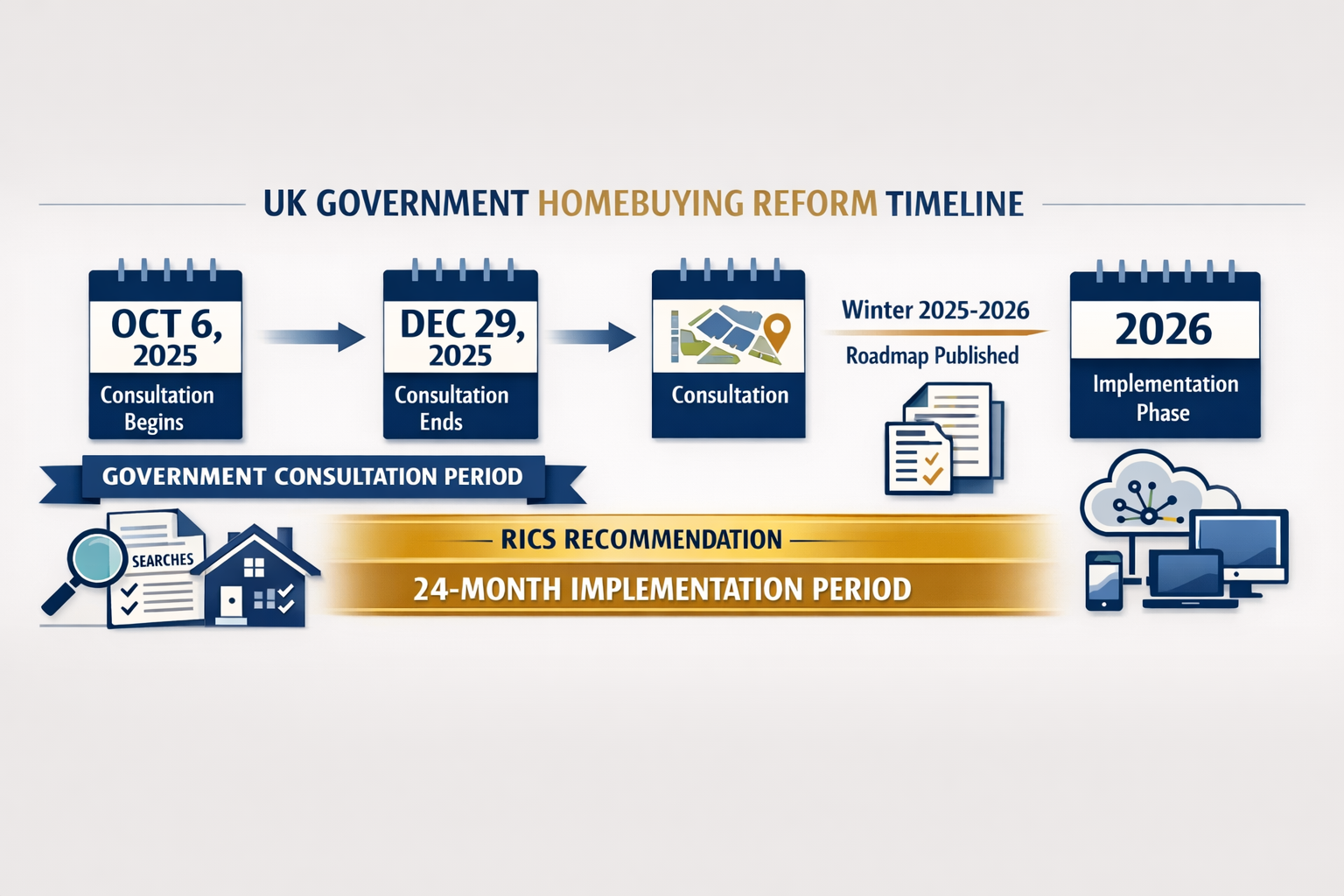
The journey toward reforming the UK's homebuying and selling process has been years in the making, but 2026 marks a critical inflection point. The government's 12-week consultation period, which ran from October 6 to December 29, 2025, gathered extensive feedback from professionals, consumers, and the general public.[2] This consultation represents the most comprehensive examination of property transaction processes in recent memory.
Current Status of Reform Implementation
As of February 2026, the UK Government has not released a formal timeframe for when the proposed reforms will be introduced.[3] This uncertainty creates both challenges and opportunities for surveying professionals who must balance immediate business planning with longer-term strategic preparation.
The government is currently reviewing consultation feedback and has indicated that a roadmap will be published in winter 2025 to 2026.[2] However, industry experts anticipate that further consultations or primary legislation may be required before full implementation can proceed.[3]
RICS Position on Implementation Timeline
The Royal Institution of Chartered Surveyors has taken a proactive stance, formally advising the government that a 24-month lead time is essential to allow sufficient time for:
- Capacity building across the surveying profession
- Standards development for new assessment methodologies
- Guidance preparation for members and consumers
- Technology infrastructure deployment
- Training and certification programs for existing and new surveyors
RICS has also offered to conduct further research with government to understand industry capacity and resourcing requirements, stressing the importance of a clear, realistic timetable so surveyors and businesses can effectively plan and prepare.[3] This collaborative approach demonstrates the profession's commitment to successful reform implementation while acknowledging practical constraints.
Key Milestones for Surveyors to Monitor
| Timeline | Milestone | Surveyor Action Required |
|---|---|---|
| Winter 2025-2026 | Government roadmap publication | Review proposed timelines and assess business impact |
| Spring 2026 | Potential secondary consultation | Provide feedback on implementation details |
| 2026-2027 | Standards development period | Participate in RICS working groups and training programs |
| 2027-2028 | Anticipated implementation (if 24-month timeline accepted) | Full operational readiness for mandatory assessments |
Understanding these timelines is crucial for RICS chartered building surveyors who need to make strategic decisions about capacity, technology investments, and service offerings.
Core Elements of Building Surveys Under Proposed Homebuying Reforms: What Surveyors Need to Know for 2026
The proposed reforms fundamentally restructure when, how, and why property surveys are conducted. Understanding these core elements is essential for surveyors preparing for the transformed marketplace.
Mandatory Pre-Listing Property Condition Assessments
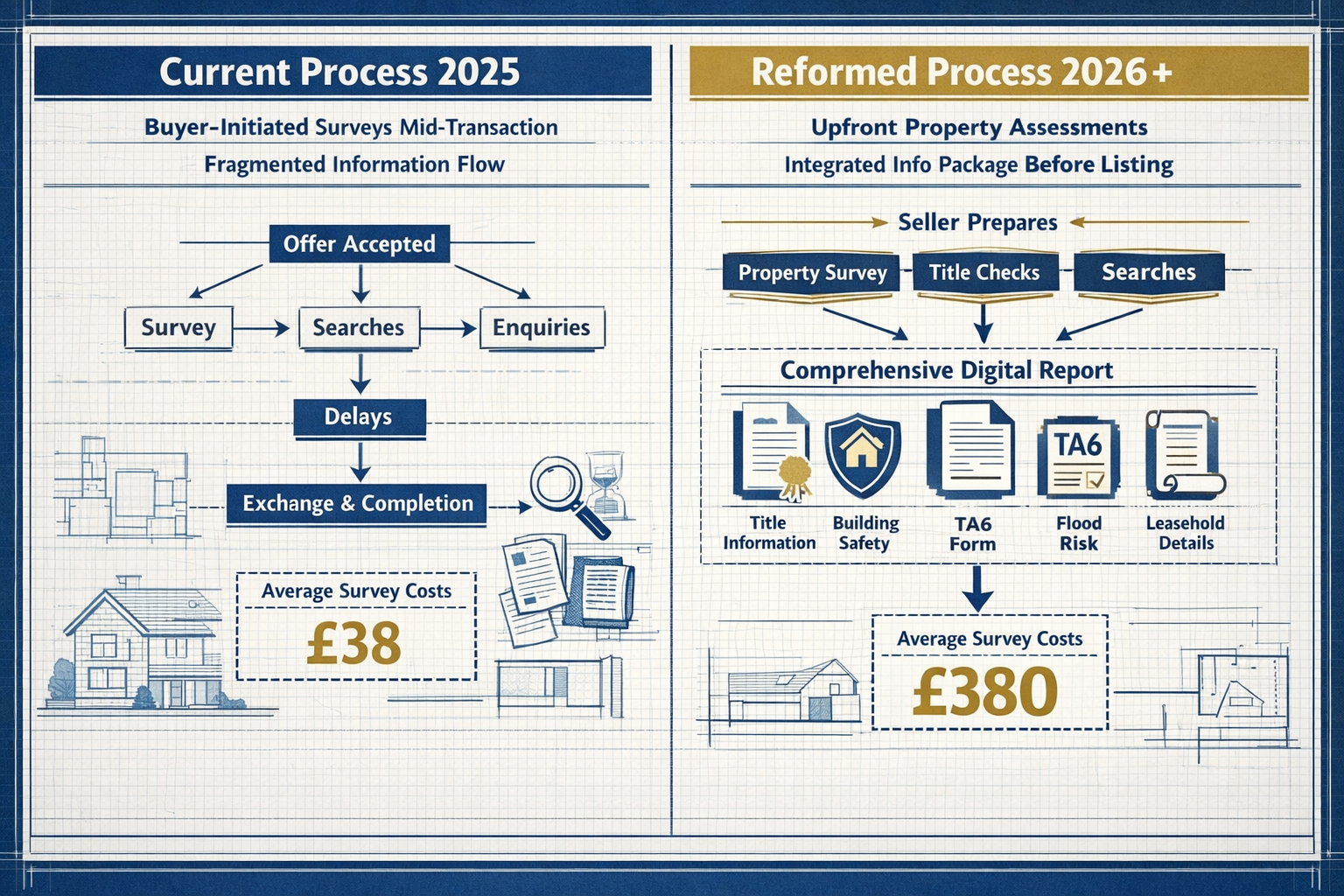
The most significant change proposed is making property condition assessments a standard requirement conducted before property listing.[1][2] This represents a dramatic shift from the current system where surveys are typically buyer-initiated and occur mid-transaction.
Under the proposed framework:
- Sellers and estate agents would be required to conduct property condition assessments prior to listing properties for sale
- These assessments would form part of a comprehensive property information package
- The timing shift moves surveys from the middle of the transaction process to the very beginning
- All prospective buyers would have access to the same baseline property condition information
This change transforms the surveyor's role from serving primarily buyers to serving sellers and the broader market. The implications for building surveys and homebuyer surveys are profound.
Comprehensive Property Information Package Requirements
The reforms propose that sellers and estate agents provide an integrated property information package including:[2]
✅ Title information and legal documentation
✅ Seller ID verification for transparency
✅ Leasehold terms and ground rent details
✅ Building safety data (particularly relevant post-Grenfell)
✅ Standard searches (local authority, drainage and water, environmental, and locality-specific)
✅ Property information forms (such as TA6 forms)
✅ Condition assessments from qualified surveyors
✅ Service charges and management company information
✅ Planning consents and building regulation approvals
✅ Flood risk details and environmental factors
For surveyors, the condition assessment component becomes a critical piece of this larger information ecosystem. The assessment must integrate seamlessly with other data sources and provide clear, actionable information for buyers.
Pre-Listing Search Requirements
Beyond the property condition assessment itself, the reforms require sellers to conduct comprehensive property searches before listing.[2] While searches are typically handled by conveyancers, surveyors should understand how their assessments complement search information:
- Local authority searches may reveal planning restrictions that affect property value
- Drainage and water searches can identify issues surveyors should investigate further
- Environmental searches highlighting contamination or flooding risks require surveyor expertise
- Locality-specific searches may uncover mining, radon, or other regional concerns
The integration of survey findings with search results creates opportunities for surveyors to provide more comprehensive advisory services, particularly when offering specific defect surveys to investigate issues identified in searches.
Technology and Data Standards
A critical component of the proposed reforms is the emphasis on consistent, trusted data and digital tools underpinning the entire process.[2] The government proposals specify that:
- Common data standards will be introduced across the home buying and selling sector
- Digital tools must allow consumers to complete tasks and track progress in real time
- Information must be accessible, standardized, and interoperable across platforms
- Technology should reduce friction and increase transparency throughout the transaction
For surveyors, this means investing in digital survey platforms, standardized reporting formats, and systems that can integrate with broader property information ecosystems. Traditional paper-based survey reports may become insufficient in the reformed landscape.
Cost Implications and Market Impact
Perhaps the most striking statistic from the consultation is the projected cost increase: survey spending is expected to rise from an average of £38 to £380 per property.[2] This tenfold increase reflects:
- The shift from optional to mandatory assessments
- More comprehensive survey requirements
- Higher professional standards and liability
- Technology and integration costs
Overall fixed costs for sellers are estimated to reach around £710 when including all pre-listing requirements.[2] While this represents a significant upfront cost burden on sellers, it also indicates a substantial expansion of the surveying market.
The question for professionals is whether the industry has sufficient capacity to meet this increased demand while maintaining quality standards—a concern we'll explore in detail in the next section.
Capacity, Standards, and Preparation Strategies for Surveyors in 2026
As the surveying profession stands on the cusp of potentially transformative reforms, the practical questions of capacity, standards, and preparation become paramount. Can the industry scale to meet dramatically increased demand? What standards will govern mandatory assessments? How should individual surveyors and firms prepare?
Industry Capacity Concerns and Workforce Challenges
The Royal Institution of Chartered Surveyors has raised significant concerns about industry capacity to deliver mandatory pre-listing assessments across the entire property market.[3] These concerns are well-founded when considering:
Current workforce constraints:
- Limited number of qualified RICS chartered surveyors
- Geographic distribution challenges in rural and underserved areas
- Aging workforce with many experienced surveyors approaching retirement
- Training pipeline insufficient to meet projected demand increases
Projected demand increases:
- If all property sales require mandatory pre-listing assessments, demand could increase by 300-500% compared to current voluntary survey uptake
- Peak transaction periods (spring and summer) could create severe capacity bottlenecks
- Sellers may face delays listing properties if surveyor availability is constrained
"RICS has offered to conduct further research with government to understand industry capacity and resourcing requirements, stressing the importance of a clear, realistic timetable so surveyors and businesses can effectively plan and prepare."[3]
This collaborative approach between RICS and government is essential for ensuring reforms don't inadvertently create market disruptions due to capacity constraints.
Standards Development and Clarification Needs
The RICS January 2026 report highlighted that feedback from members and stakeholders emphasized the need to strengthen areas of home surveys and provide further clarification to reflect consumer insights and technological changes.[5] Several standards-related questions require resolution:
Assessment scope and depth:
- What level of survey will satisfy mandatory requirements—equivalent to current Level 2 Homebuyer surveys, Level 3 Building surveys, or a new standardized format?
- How will assessments handle specialized issues like damp, structural concerns, or roof conditions?
- Will a single assessment suffice or will buyers still commission additional surveys?
Reporting standards:
- What format and structure will mandatory assessment reports follow?
- How will condition ratings be standardized for consumer clarity?
- What disclosure requirements will apply to identified defects?
Liability and insurance considerations:
- Who bears liability if the mandatory assessment misses significant defects?
- How will professional indemnity insurance adapt to the new risk profile?
- What recourse do buyers have if assessments prove inadequate?
These questions require clear answers before mandatory assessments can be successfully implemented. Surveyors should actively participate in RICS consultations and working groups to help shape these standards.
Technology Integration and Digital Transformation
Technology represents both a challenge and an opportunity for surveyors preparing for reform implementation. The government's emphasis on consistent, trusted data and digital tools[2] requires significant investment in:
Digital survey platforms:
- Cloud-based inspection and reporting systems
- Mobile applications for on-site data collection
- Integration with property information platforms
- Automated report generation with standardized formats
Data standardization:
- Consistent terminology and condition ratings
- Interoperable data formats for sharing with conveyancers, lenders, and buyers
- APIs for integration with broader property transaction systems
- Machine-readable data for analytics and trend analysis
Emerging technologies:
- Drone surveys for roof and exterior assessments
- Thermal imaging for identifying insulation and moisture issues
- 3D scanning for accurate property documentation
- AI-assisted defect identification and risk assessment
Surveyors who invest early in appropriate technology will be better positioned to handle increased volumes efficiently while maintaining quality standards. However, technology should enhance rather than replace professional expertise and judgment.
Practical Preparation Strategies for Surveying Practices
Individual surveyors and surveying firms should consider these actionable preparation strategies:
1. Capacity Planning and Workforce Development
- Assess current capacity: Calculate how many additional assessments your practice could handle with existing resources
- Recruit strategically: Begin hiring and training additional surveyors ahead of implementation
- Develop associate networks: Build relationships with qualified associates who can handle overflow work
- Geographic expansion: Consider expanding service areas to underserved markets with high demand potential
2. Skills Enhancement and Training
- Stay current with RICS guidance: Monitor updates to survey standards and best practices
- Technology training: Ensure all team members are proficient with digital tools and platforms
- Specialized expertise: Develop capabilities in high-demand areas like building safety, energy efficiency, and sustainability
- Customer service: Enhance communication skills for dealing with sellers rather than buyers
3. Business Model Adaptation
- Pricing strategies: Develop competitive pricing for mandatory assessments while maintaining profitability
- Service packages: Create tiered offerings that meet mandatory requirements plus optional enhanced assessments
- Partnerships: Build relationships with estate agents, conveyancers, and property platforms
- Marketing repositioning: Shift marketing messages to target sellers and estate agents rather than primarily buyers
4. Quality Management Systems
- Standardized processes: Develop consistent methodologies for conducting and reporting assessments
- Quality control: Implement peer review and quality assurance procedures
- Risk management: Review professional indemnity insurance and liability exposure
- Compliance frameworks: Ensure all work meets RICS standards and regulatory requirements
5. Technology Investment Roadmap
- Short-term (2026): Adopt basic digital reporting and mobile inspection tools
- Medium-term (2027): Integrate with property information platforms and develop API connections
- Long-term (2028+): Explore AI, automation, and advanced analytics capabilities
Understanding which survey you need will become even more important as the market differentiates between mandatory baseline assessments and optional enhanced surveys.
Market Opportunities in the Reformed Landscape
Despite challenges, the proposed reforms create significant opportunities for well-prepared surveyors:
Expanded market size:
- Mandatory assessments mean every property sale generates survey work
- Market value increases from £38 to £380 average per property[2]
- Consistent demand reduces feast-or-famine cycles
Professional recognition:
- Surveys become central to the transaction process rather than optional
- Greater public awareness of surveyor value and expertise
- Enhanced professional status and influence
Service diversification:
- Opportunities for pre-listing consultation services
- Ongoing monitoring and re-assessment work
- Advisory services interpreting assessments for buyers and sellers
- Commercial building surveys may follow similar reform patterns
Technology-enabled efficiency:
- Digital tools allow handling higher volumes without proportional cost increases
- Standardization reduces time per assessment
- Data analytics reveal market trends and opportunities
The surveying sector is already experiencing positive momentum, with many lenders forecasting increased volumes and a strong start to 2026.[1] Professional and institutional landlords in the buy-to-let sector continue to invest and understand the value of proper surveys, creating consistent demand.[1]
Navigating Uncertainty and Positioning for Success in 2026 and Beyond
While the proposed reforms offer a compelling vision for transforming property transactions, the path from consultation to implementation remains uncertain. Surveyors must navigate this ambiguity while positioning themselves for success regardless of the exact form reforms ultimately take.
Scenario Planning for Different Reform Outcomes
Prudent surveyors should consider multiple scenarios and develop contingency plans for each:
Scenario 1: Full Implementation by 2028
- Government accepts RICS 24-month implementation timeline
- Mandatory pre-listing assessments become universal requirement
- Comprehensive standards and technology infrastructure deployed
- Surveyor action: Aggressive capacity building, technology investment, and workforce expansion
Scenario 2: Phased Implementation Starting 2027
- Reforms introduced gradually, perhaps starting with higher-value properties
- Pilot programs in specific regions before national rollout
- Iterative standards development based on early experience
- Surveyor action: Moderate investment with flexibility to scale as implementation progresses
Scenario 3: Voluntary Framework with Incentives
- Mandatory assessments replaced with strong incentives for voluntary adoption
- Market-driven uptake rather than regulatory requirement
- Government-backed quality standards but seller choice
- Surveyor action: Competitive positioning to capture voluntary market share
Scenario 4: Delayed or Substantially Modified Reforms
- Implementation timeline extends beyond 2028
- Significant modifications to proposed framework based on consultation feedback
- Continued evolution of current voluntary system
- Surveyor action: Maintain current operations while monitoring developments
By preparing for multiple scenarios, surveyors can make flexible investments that provide value regardless of the ultimate reform trajectory.
Building Resilience Through Diversification
Rather than betting entirely on reform implementation, successful surveying practices should diversify revenue streams and service offerings:
Residential survey diversity:
- Continue offering full range from basic valuations to comprehensive Level 3 Building Surveys
- Develop specialized services like stock condition surveys for landlords
- Expand into emerging areas like energy efficiency assessments and retrofit surveys
Commercial and specialized work:
- Commercial building surveys provide stable institutional demand
- Dilapidations surveys for commercial lease end assessments
- Specialized technical services like structural engineering
Valuation services:
- RICS Red Book valuations for various purposes
- Probate, tax, and matrimonial valuations
- Expert witness services for dispute resolution
Ancillary services:
- Project management and contract administration
- Building safety and compliance assessments
- Sustainability and energy performance consulting
This diversification ensures practice sustainability regardless of reform implementation timelines.
Staying Informed and Engaged with Reform Developments
Active engagement with the reform process provides competitive intelligence and influence opportunities:
Monitor official channels:
- Government consultation responses and roadmap publications
- RICS policy updates and member communications
- Industry publications and professional journals
Participate in professional forums:
- RICS working groups and consultation responses
- Local professional networks and regional surveyor associations
- Industry conferences and continuing professional development events
Engage with stakeholders:
- Estate agent partnerships to understand seller perspectives
- Lender relationships to understand financing implications
- Consumer groups to understand buyer expectations
Track market indicators:
- Transaction volumes and seasonal patterns
- Survey uptake rates and pricing trends
- Technology adoption and innovation developments
Surveyors who remain actively engaged will spot opportunities early and adapt strategies proactively rather than reactively.
Maintaining Professional Standards During Transition
Regardless of reform timelines, maintaining the highest professional standards remains paramount. The transition period presents particular risks:
⚠️ Pressure to cut corners as demand increases and capacity constraints emerge
⚠️ Technology over-reliance without maintaining professional judgment
⚠️ Competitive pricing pressure potentially compromising assessment quality
⚠️ Scope creep as clients request additional services within standard fees
RICS members must resist these pressures and uphold professional ethics and standards. The long-term reputation of the profession depends on maintaining quality even during periods of rapid change and growth.
Positive Market Outlook for Prepared Professionals
Despite uncertainties, the overall outlook for surveying in 2026 remains positive. The sector is expected to experience an uplift in volumes across both lending and surveys, with many lenders forecasting increased volumes and a strong start to the year.[1]
Key positive indicators include:
📈 Market recovery momentum following recent economic challenges
📈 Increased demand for institutional expertise from professional landlords
📈 Growing public awareness of survey value and property risk
📈 Technology enabling efficiency gains and service improvements
📈 Regulatory focus elevating professional standards and recognition
Surveyors who invest in capacity, technology, and professional development while maintaining quality standards will be well-positioned to capitalize on these positive trends.
Collaboration and Knowledge Sharing
The surveying profession benefits when practitioners collaborate and share knowledge rather than competing in isolation. Consider:
Peer learning networks:
- Share best practices for technology implementation
- Discuss capacity management strategies
- Exchange insights on emerging client needs
Industry advocacy:
- Support RICS policy positions with government
- Contribute to standards development consultations
- Advocate for realistic implementation timelines
Consumer education:
- Help buyers and sellers understand survey value
- Explain differences between assessment types
- Build public trust in professional expertise
The reforms present challenges too large for any individual practice to navigate alone. Collective professional action will ensure successful implementation that benefits surveyors, consumers, and the broader property market.
Conclusion: Embracing Transformation While Managing Uncertainty

Building Surveys Under Proposed Homebuying Reforms: What Surveyors Need to Know for 2026 encompasses far more than understanding new regulations. It requires strategic thinking, operational preparation, and professional commitment to quality during a period of significant transformation.
The government's consultation has concluded, but the journey toward implementation has only begun. With no definitive timeline announced and RICS recommending a 24-month implementation period,[3] surveyors face an extended period of uncertainty requiring both patience and proactive preparation.
The proposed shift to mandatory pre-listing property condition assessments represents a fundamental restructuring of when and how surveys occur in property transactions. Survey costs projected to increase from £38 to £380 average per property[2] signal both opportunity and responsibility. The profession must build capacity, develop standards, integrate technology, and maintain quality to successfully deliver on this expanded mandate.
Actionable Next Steps for Surveyors
Immediate actions (Next 3 months):
- Assess current capacity and identify constraints in your practice
- Review technology infrastructure and identify gaps in digital capabilities
- Monitor government roadmap publication expected in winter 2025-2026
- Engage with RICS communications and consultation opportunities
- Evaluate professional indemnity insurance coverage and adequacy
Short-term preparation (2026):
- Develop business case for capacity expansion and technology investment
- Begin recruitment or associate network development if capacity expansion warranted
- Invest in digital tools for inspection and reporting
- Build estate agent relationships to position for seller-focused work
- Participate in standards development through RICS working groups
Medium-term positioning (2027-2028):
- Scale operations based on confirmed implementation timelines
- Implement quality management systems for standardized assessments
- Integrate with property information platforms and transaction systems
- Diversify service offerings beyond mandatory baseline assessments
- Measure and optimize efficiency and quality metrics
Long-term strategy (Beyond 2028):
- Establish market leadership in reformed transaction landscape
- Leverage data and technology for competitive advantage
- Expand into emerging services related to building safety, sustainability, and retrofit
- Contribute to profession through mentoring, training, and standards development
- Adapt continuously as market and regulatory environment evolves
Final Thoughts
The proposed homebuying reforms represent the most significant opportunity for the surveying profession in decades. While challenges around capacity, standards, and implementation timelines remain, well-prepared professionals will thrive in the transformed marketplace.
Success requires balancing immediate operational realities with longer-term strategic positioning. It demands investment in technology and capacity while maintaining unwavering commitment to professional standards. Most importantly, it requires active engagement with the reform process rather than passive waiting for implementation.
For chartered surveyors willing to embrace change, invest strategically, and maintain professional excellence, the future is bright. The reforms will elevate surveys from optional add-ons to essential transaction components, recognizing the critical value professional expertise brings to property markets.
The journey from consultation to implementation will be complex, but surveyors who navigate it thoughtfully will emerge stronger, more valued, and better positioned to serve consumers and support efficient, transparent property markets for years to come.
Whether you're conducting homebuyer surveys, comprehensive building surveys, or specialized assessments, the principles remain constant: professional expertise, ethical practice, and commitment to serving clients and the public interest.
The reforms are coming. The question is not whether to prepare, but how comprehensively and strategically to position your practice for the opportunities ahead.
References
[1] Surveying In 2026 Reform Recovery And Renewed Demand – https://www.lrg.co.uk/news-and-insights/surveying-in-2026-reform-recovery-and-renewed-demand/
[2] Home Buying And Selling Reform – https://www.gov.uk/government/consultations/home-buying-and-selling-reform/home-buying-and-selling-reform
[3] Home Buying And Selling Reform Hub – https://www.rics.org/news-insights/current-topics-campaigns/home-buying-and-selling-reform-hub
[4] Home Buying Selling Reforms – https://www.lawsociety.org.uk/topics/property/home-buying-selling-reforms
[5] Uk Resi Survey Jan 2026 Report Shows Early Signs Market Recovery Despite Caution – https://www.rics.org/news-insights/uk-resi-survey-jan-2026-report-shows-early-signs-market-recovery-despite-caution
[6] What Sort Of Survey Should I Have – https://hoa.org.uk/advice/guides-for-homeowners/i-am-buying/what-sort-of-survey-should-i-have/
[7] Home Buying And Selling Reforms Can The Government Really Fix A Broken System – https://www.ube.ac.uk/whats-happening/articles/home-buying-and-selling-reforms-can-the-government-really-fix-a-broken-system/