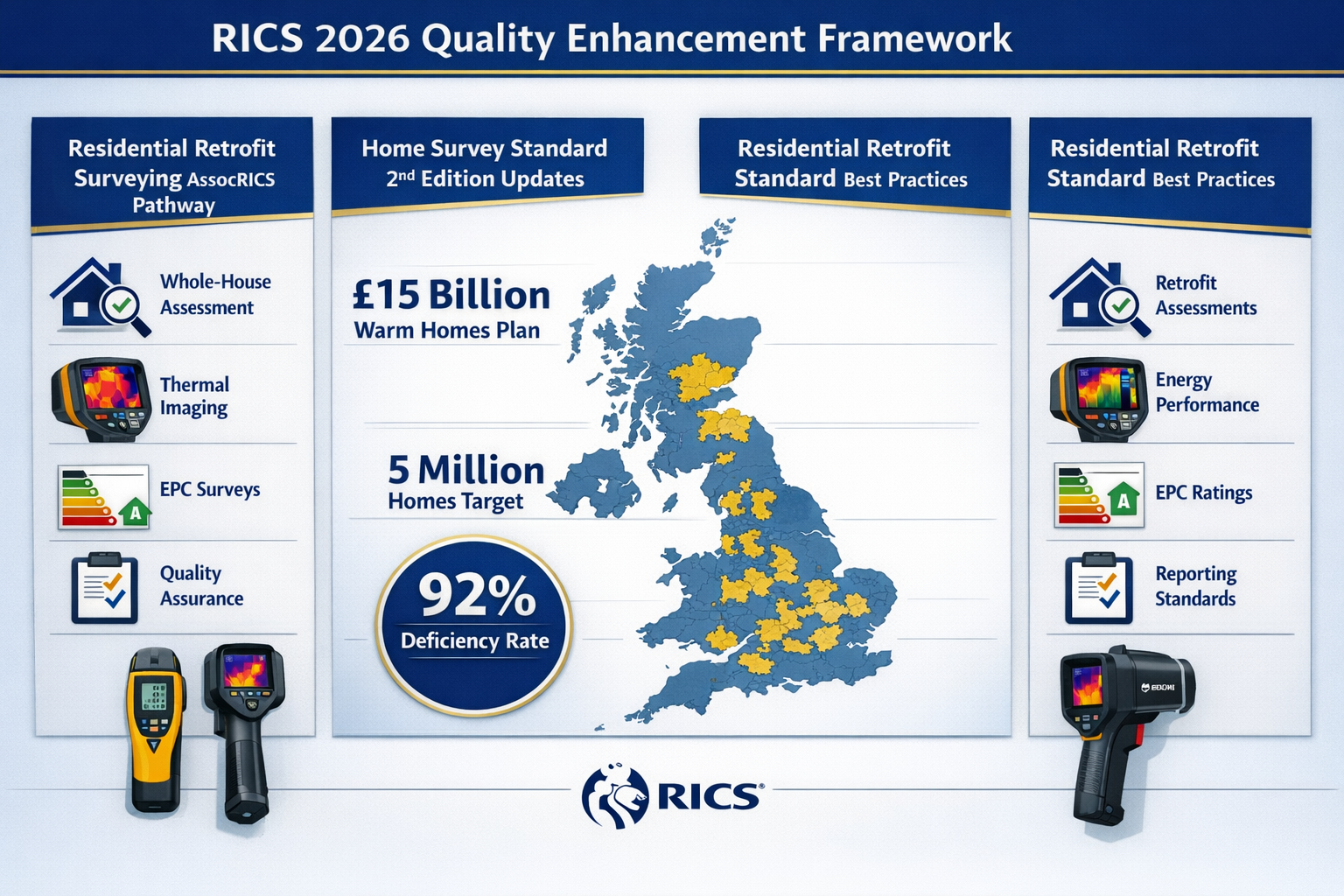
The UK's ambitious journey toward net-zero carbon emissions has placed retrofit projects at the forefront of national housing strategy. With the government's £15 billion Warm Homes Plan committed to upgrading 5 million homes over five years, the demand for professional building surveys has never been more critical.[5] Yet beneath this transformative opportunity lies a concerning reality: the National Audit Office recently revealed that 92% of installations under ECO4 and GBIS schemes have major issues requiring immediate remediation, with 6% presenting immediate health and safety risks.[5]
This quality crisis has catalysed significant changes in how Building Surveys for UK Retrofit Projects: Ensuring Compliance with RICS 2026 Quality Enhancements and Energy Efficiency Standards are conducted. The Royal Institution of Chartered Surveyors (RICS) has responded with strengthened standards, new professional pathways, and enhanced guidance that positions chartered surveyors as essential gatekeepers of retrofit quality. As the UK construction market shows early signs of recovery in 2026, surveyors have a unique opportunity to identify retrofit opportunities that maximize both energy savings and property value while ensuring compliance with evolving standards.[2]
Key Takeaways
- 🏠 RICS has launched a new Residential Retrofit Surveying (AssocRICS) pilot pathway to address quality deficiencies and establish professional competence standards for retrofit assessments
- 📊 The Warm Homes Plan's £15 billion investment creates unprecedented demand for whole-house assessments, stock condition surveys, and quality assurance activities conducted by chartered surveyors
- ⚠️ Quality remains the sector's critical challenge, with 92% of recent retrofit installations requiring immediate remediation, highlighting the essential role of independent professional surveys
- 🔍 Enhanced Home Survey Standard 2nd edition incorporates consumer insights and technological advances, strengthening best practices for identifying retrofit opportunities during property inspections
- ✅ Professional independence and chartered status are positioned as fundamental solutions to retrofit's "trust problem," ensuring projects are delivered in the public interest
Understanding the 2026 Retrofit Landscape and Quality Imperatives
The Scale of the UK's Retrofit Challenge
The United Kingdom faces an enormous task in transforming its housing stock to meet climate commitments. Approximately 29 million homes require energy efficiency improvements, with many properties constructed before modern building regulations introduced thermal performance requirements. The government's Warm Homes Plan represents the most significant investment in residential energy efficiency to date, structured around three core pillars: targeted support for low-income households, universal offers for households able to invest, and stronger protections for renters.[1]
This massive undertaking requires a fundamental shift in how retrofit projects are planned, executed, and verified. Traditional approaches that focused narrowly on single measures—such as installing cavity wall insulation without considering ventilation or moisture management—have contributed to the quality crisis now evident across the sector.
The Quality Crisis Driving Standards Reform
The statistics are sobering. Recent analysis of installations under the Energy Company Obligation (ECO4) and Great British Insulation Scheme (GBIS) revealed systemic quality failures that undermine both energy performance and occupant safety.[5] These findings have galvanised industry leaders to recognise that retrofit's fundamental challenge is not primarily technical or financial—it is a trust problem.[4]
When homeowners cannot trust that retrofit work will be completed to acceptable standards, market growth stalls. When installations create unintended consequences such as condensation, mould growth, or structural issues, the entire sector's reputation suffers. This context explains why RICS and industry partners convened the Quality in Retrofit Summit on January 20, 2026, at RICS' Surveyor's House in London—a sell-out event bringing together built environment professionals to address these critical quality concerns.[5]
Why Building Surveys Are Central to Quality Assurance
Professional building surveys serve multiple essential functions in the retrofit ecosystem:
Pre-Retrofit Assessment: Identifying existing defects, understanding construction methods, evaluating structural capacity, and establishing baseline conditions before any work begins
Retrofit Planning: Determining appropriate measures based on actual building fabric, occupancy patterns, and performance requirements rather than generic assumptions
Quality Verification: Conducting independent inspections during and after installation to ensure compliance with specifications and standards
Risk Management: Identifying potential unintended consequences such as interstitial condensation, thermal bridging, or moisture accumulation that could result from poorly designed retrofit interventions
The enhanced standards introduced by RICS in 2026 strengthen each of these functions, positioning chartered surveyors as essential professionals throughout the retrofit journey.
RICS 2026 Quality Enhancements: New Standards and Professional Pathways
The Residential Retrofit Surveying (AssocRICS) Pathway
Recognising that existing qualifications were insufficient—often consisting of only 3-5 day courses for Domestic Energy Assessor and Retrofit Assessor roles—RICS launched a groundbreaking Residential Retrofit Surveying (AssocRICS) pilot pathway developed in collaboration with The Retrofit Academy.[5]
This new qualification pathway establishes rigorous competence requirements specifically designed for retrofit surveying, including:
| Competence Area | Key Requirements |
|---|---|
| Building Pathology | Understanding defect diagnosis, moisture dynamics, thermal performance, and structural behaviour in existing buildings |
| Energy Assessment | Conducting whole-house energy evaluations, understanding heat loss mechanisms, and modelling retrofit scenarios |
| Retrofit Design Principles | Applying fabric-first approaches, managing unintended consequences, and integrating building services |
| Quality Assurance | Inspection methodologies, compliance verification, and defect identification during installation |
| Regulatory Knowledge | Building regulations, planning requirements, listed building considerations, and energy efficiency standards |
| Professional Ethics | Independence, public interest obligations, and conflict of interest management |
This pathway represents a significant advancement beyond previous qualifications, establishing retrofit surveying as a distinct professional specialism requiring comprehensive knowledge and demonstrated competence.
Home Survey Standard 2nd Edition Enhancements
RICS has strengthened the Home Survey Standard 2nd edition based on extensive consumer insight research and recognition of technological advances transforming survey practice.[6] These enhancements directly support the identification of retrofit opportunities during standard property inspections.
Key improvements include:
Enhanced Energy Efficiency Reporting: Surveyors conducting RICS Level 3 building surveys must now provide more detailed commentary on thermal performance, identifying specific opportunities for improvement and potential challenges
Technology Integration Guidance: The updated standard acknowledges tools such as thermal imaging cameras, moisture meters, and drone inspections that enable more accurate assessment of building fabric performance
Damp and Mould Risk Assessment: Reflecting requirements under Awaab's Law, the standard emphasises thorough evaluation of moisture-related risks—particularly important when planning retrofit interventions that could affect ventilation and condensation patterns[1]
Whole-House Perspective: Rather than treating energy efficiency as a separate consideration, the enhanced standard integrates it throughout the survey process, encouraging surveyors to consider how different building elements interact
These changes ensure that even standard homebuyer surveys can identify retrofit potential, creating opportunities for property owners to understand improvement possibilities early in the ownership journey.
The Residential Retrofit Standard
RICS developed the Residential Retrofit Standard to promote best practices across the industry, aligning with national frameworks while placing consumers at the centre of delivery.[1] This standard provides comprehensive guidance on:
- Pre-retrofit assessment methodologies that go beyond energy modelling to understand building fabric, occupant needs, and heritage considerations
- Quality assurance frameworks establishing inspection points throughout the retrofit process
- Performance verification protocols ensuring that completed work delivers promised energy savings
- Consumer protection measures including clear documentation, realistic performance expectations, and complaint resolution procedures
The standard emphasises that retrofit must be led by chartered professionals acting in the public interest, with independence as a fundamental principle to "make sure it is right from start to end."[4]
Building Surveys for UK Retrofit Projects: Ensuring Compliance with RICS 2026 Quality Enhancements and Energy Efficiency Standards in Practice
Conducting Comprehensive Pre-Retrofit Building Surveys
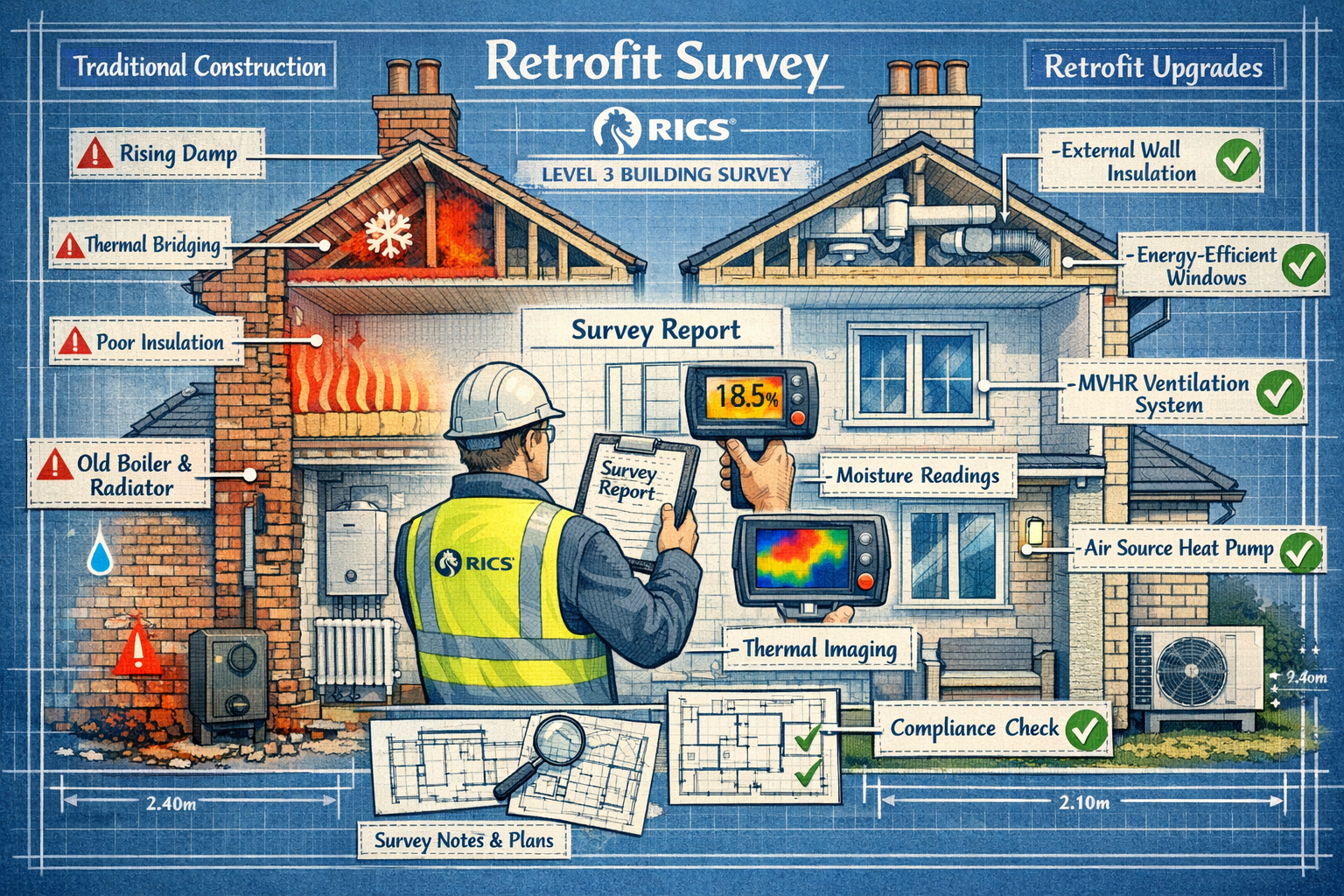
A thorough pre-retrofit survey forms the foundation for successful project delivery. Unlike standard property inspections, retrofit-focused surveys must evaluate multiple additional factors:
Construction Method and Materials Analysis
Understanding how a building is constructed determines which retrofit measures are appropriate and safe. A RICS chartered building surveyor must identify:
- Wall construction type (solid masonry, cavity wall, timber frame, non-standard construction)
- Foundation type and condition
- Roof structure and covering materials
- Floor construction and insulation status
- Window and door types, ages, and performance characteristics
This information is critical because retrofit measures suitable for one construction type may be entirely inappropriate for another. For example, external wall insulation applied to a building with existing moisture issues could trap water within the fabric, accelerating deterioration.
Existing Defects and Moisture Investigation
Pre-existing defects must be identified and remediated before retrofit work proceeds. This principle is fundamental to quality outcomes but frequently overlooked in poorly managed projects. Comprehensive surveys should include:
- Visual inspection for damp penetration, condensation, and mould growth
- Drainage surveys to identify water ingress risks
- Moisture meter readings at key locations
- Thermal imaging to identify hidden moisture and thermal bridging
- Assessment of ventilation adequacy
Surveyors must document these findings thoroughly, as they directly inform retrofit design decisions. Installing insulation over damp walls or reducing ventilation in properties with existing condensation problems creates serious health and safety risks.
Structural Capacity Assessment
Some retrofit measures impose additional loads on building structures. Adding external wall insulation increases wall thickness and weight. Installing solar panels adds roof loading. Internal wall insulation reduces floor bearing area. A proper structural survey component evaluates whether the existing structure can safely accommodate proposed measures.
For older properties, this assessment may reveal the need for structural strengthening before retrofit work proceeds—an additional cost that must be factored into project planning.
Heritage and Conservation Considerations
Many UK properties requiring retrofit improvements are located in conservation areas or have listed building status. Surveyors must identify heritage constraints early in the planning process, as they significantly affect available retrofit options.
Traditional buildings often require specialist approaches that respect historic fabric while improving energy performance. Breathable insulation materials, secondary glazing rather than replacement windows, and careful detailing around historic features require additional expertise and typically higher costs.
Identifying Optimal Retrofit Opportunities
Beyond documenting existing conditions, surveys should actively identify cost-effective improvement opportunities prioritised by impact and feasibility.
Fabric-First Approach
The most effective retrofit strategies prioritise building fabric improvements before considering heating system upgrades. Surveyors should evaluate and recommend:
- Loft insulation enhancement (often the most cost-effective measure)
- Wall insulation (external, internal, or cavity fill depending on construction type)
- Floor insulation where accessible
- Window and door upgrades to reduce air leakage and improve thermal performance
- Draught-proofing around service penetrations and building junctions
Each recommendation should include realistic cost estimates, expected energy savings, and any potential complications identified during the survey.
Heating and Hot Water System Evaluation
Once fabric improvements are identified, surveyors should assess heating system suitability. The survey should document:
- Current heating system type, age, and efficiency
- Hot water system configuration
- Radiator sizing and distribution
- Control systems and zoning capability
- Suitability for low-temperature heat sources (essential for heat pump compatibility)
Properties with oversized heating systems designed to compensate for poor insulation may require smaller, more efficient systems after fabric improvements. Conversely, properties considering heat pump installation may need larger radiators to work effectively with lower flow temperatures.
Renewable Energy Integration Potential
Surveyors should evaluate opportunities for renewable energy generation:
- Roof orientation and shading analysis for solar photovoltaic or thermal panels
- Available space for ground or air source heat pumps
- Electrical infrastructure capacity for additional loads
- Planning constraints that might limit installations
These assessments help property owners understand the full range of available improvements and plan phased implementation if budget constraints prevent comprehensive retrofit in a single project.
Technology-Enhanced Survey Methodologies
The 2026 RICS standards acknowledge that technology significantly enhances survey accuracy and client value. Modern retrofit surveys increasingly incorporate:
Thermal Imaging
Infrared thermography reveals heat loss patterns invisible to the naked eye, identifying:
- Insulation gaps and defects
- Thermal bridging at junctions
- Air leakage paths
- Hidden moisture (which appears as cold spots)
- Heating system distribution issues
Thermal imaging conducted during heating season provides compelling visual evidence of energy efficiency opportunities, helping property owners understand where improvements will deliver maximum benefit.
Moisture Mapping
Advanced moisture detection equipment enables surveyors to:
- Identify hidden dampness within building fabric
- Differentiate between condensation, penetrating damp, and rising damp
- Monitor moisture levels over time
- Verify that fabric is dry before insulation installation
This technology is particularly valuable for properties with solid wall construction, where moisture dynamics are complex and conventional visual inspection may miss developing problems.
Drone Inspections
Unmanned aerial vehicles enable safe, detailed inspection of:
- Roof coverings and condition
- Chimney stacks
- High-level masonry
- Solar panel installation suitability
Drone surveys reduce access costs, improve safety, and provide high-resolution imagery documenting pre-retrofit conditions.
Quality Assurance During Retrofit Implementation
Professional building surveyors play a crucial monitoring role during retrofit work, conducting inspections at critical stages to verify compliance with specifications and standards.
Installation Verification Inspections
Key inspection points include:
Before insulation installation: Confirming that substrate is sound, dry, and properly prepared
During installation: Verifying correct materials, proper detailing at junctions, and continuous insulation layers without gaps
Before covering: Documenting installation quality before finishes conceal the work
After completion: Confirming that ventilation, services, and finishes are correctly integrated
These inspections identify problems when they can still be corrected economically, preventing the quality failures that have plagued recent retrofit schemes.
Performance Testing and Verification
Post-retrofit verification should include:
- Air tightness testing to confirm that draught-proofing measures are effective
- Thermal imaging to verify continuous insulation and identify any installation defects
- Heating system commissioning ensuring controls and distribution work as designed
- Ventilation performance testing confirming adequate air quality
Professional surveyors provide independent verification that work has been completed to specification, protecting both property owners and installers from future disputes.
Compliance with Building Regulations and Standards
Retrofit projects must comply with current Building Regulations, which have specific requirements for energy efficiency improvements. Surveyors must understand:
Part L (Conservation of Fuel and Power): Requirements for U-values, air tightness, and system efficiency when undertaking renovation work
Part F (Ventilation): Ensuring adequate ventilation after air tightness improvements to prevent condensation and maintain indoor air quality
Part C (Resistance to Moisture): Preventing moisture penetration and condensation in improved building fabric
Approved Document 7: Guidance on material changes of use and compliance triggers
RICS commercial building surveys for non-domestic retrofit projects must also consider additional regulations including Part L2B and specific requirements for commercial ventilation and services.
The Surveyor's Role in the Warm Homes Plan Delivery
The government's £15 billion Warm Homes Plan creates unprecedented demand for professional surveying services across multiple delivery mechanisms.[1][5]
Whole-House Assessments for Low-Income Households
The plan's first pillar provides fully funded whole-house upgrades for low-income households. This approach requires comprehensive assessments that:
- Evaluate complete building fabric and systems
- Identify all cost-effective improvement measures
- Prioritise interventions for maximum impact
- Consider occupant health, comfort, and affordability
- Ensure measures work together as an integrated package
These assessments demand the holistic perspective and technical expertise that chartered surveyors provide, going far beyond simple energy calculations to understand how buildings actually perform.
Stock Condition Surveys for Social Housing
Social housing providers require detailed stock condition surveys to plan retrofit programmes across their portfolios. These surveys must:
- Categorise properties by construction type and retrofit suitability
- Identify properties requiring urgent remediation before retrofit
- Assess compliance with Awaab's Law requirements for damp and mould management
- Prioritise properties based on energy performance, tenant vulnerability, and building condition
- Develop neighbourhood-level retrofit strategies that achieve economies of scale
The scale of this work creates significant opportunities for surveying practices with capacity to deliver systematic assessment programmes.
Universal Offer Support and Advice
The plan's second pillar provides support for households able to invest in improvements. Professional surveys help these property owners by:
- Identifying the most cost-effective improvement opportunities
- Providing independent advice free from installer bias
- Ensuring proposed work is appropriate for the specific building
- Verifying quality during installation
- Documenting improvements for future property transactions
This advice function positions surveyors as trusted advisors, addressing the sector's fundamental trust problem through professional independence.[4]
Rental Sector Compliance and Enforcement
Stronger protections for renters include minimum energy efficiency standards that landlords must meet. Surveyors support compliance through:
- Energy Performance Certificate assessments
- Improvement recommendations tailored to rental properties
- Compliance verification for enforcement purposes
- Dispute resolution when tenants and landlords disagree about required work
As enforcement mechanisms strengthen, demand for independent professional assessment will increase substantially.
Addressing Common Retrofit Survey Challenges
Managing Client Expectations
Property owners often have unrealistic expectations about retrofit costs, disruption, and energy savings. Professional surveyors must:
✅ Provide realistic cost estimates based on actual building conditions rather than generic assumptions
✅ Explain the limitations of energy modelling, which relies on standardised assumptions that may not reflect actual occupant behaviour
✅ Clarify that some properties have inherent constraints limiting achievable improvements
✅ Recommend phased approaches when comprehensive retrofit exceeds available budget
✅ Document heritage or structural constraints that increase costs or limit options
Clear, honest communication prevents disappointment and builds the trust essential for sector growth.
Balancing Heritage Conservation and Energy Efficiency
Traditional buildings present particular challenges requiring specialist knowledge. Surveyors working with historic properties must understand:
- Breathability requirements: Traditional construction relies on moisture movement through permeable materials; impermeable insulation can trap moisture and cause decay
- Reversibility principles: Listed building consent often requires that interventions can be reversed without damaging historic fabric
- Appropriate materials: Modern materials may be incompatible with traditional construction methods
- Secondary glazing alternatives: Where window replacement is prohibited, secondary glazing can improve thermal performance while preserving historic windows
Specialist knowledge prevents well-intentioned improvements from causing irreversible harm to heritage assets.
Identifying and Mitigating Unintended Consequences
Poorly designed retrofit can create serious problems. Surveyors must anticipate potential issues including:
Condensation and Mould: Improving air tightness without adequate ventilation creates condensation risks, particularly in bathrooms and kitchens
Thermal Bridging: Incomplete insulation creates cold spots where condensation forms and heat escapes
Moisture Trapping: Impermeable insulation installed over damp substrates prevents drying and accelerates deterioration
Overheating: Excessive insulation without adequate ventilation or shading can cause summer overheating, particularly in properties with large south-facing windows
System Incompatibility: Installing low-temperature heating systems without appropriately sized heat emitters results in inadequate heating
Identifying these risks during survey and design stages prevents costly remediation later.
Navigating Regulatory Complexity
Retrofit projects may require multiple approvals and consents:
- Building Regulations approval for notifiable work
- Planning permission for external alterations in some cases
- Listed building consent for works affecting historic buildings
- Conservation area consent for certain external changes
- Party wall agreements where work affects shared structures
Surveyors familiar with these requirements help clients navigate regulatory processes efficiently, preventing delays and compliance issues.
Future Trends in Retrofit Surveying
Digital Survey Tools and Building Information Modelling
The profession is rapidly adopting digital technologies that enhance survey quality and client value:
Digital survey platforms enable real-time data capture, photo annotation, and collaborative reporting
Building Information Modelling (BIM) creates 3D digital representations of buildings, supporting retrofit design and coordination
Energy modelling software integrated with survey data provides more accurate performance predictions
Cloud-based reporting allows clients to access interactive survey reports with embedded photos, thermal images, and improvement recommendations
These tools improve efficiency while enhancing the depth and clarity of survey deliverables.
Whole-Life Carbon Assessment
As the UK progresses toward net-zero targets, retrofit surveys increasingly consider embodied carbon alongside operational energy. This holistic approach evaluates:
- Carbon emissions associated with manufacturing and transporting materials
- Carbon impact of demolition and disposal versus retention and improvement
- Whole-life carbon balance of different retrofit strategies
This perspective sometimes favours retention and modest improvement over comprehensive retrofit using carbon-intensive materials.
Integration with Property Transactions
Energy efficiency is becoming a more significant factor in property values and marketability. Forward-thinking surveyors are integrating retrofit advice into standard homebuyer surveys, helping buyers understand:
- Current energy performance and running costs
- Improvement potential and estimated costs
- Impact of improvements on property value and marketability
- Available grants and financial support
This integration normalises energy efficiency considerations in property decisions, accelerating market transformation.
Professional Specialisation and Collaboration
Retrofit projects increasingly require multidisciplinary collaboration between:
- Building surveyors assessing fabric and structure
- Mechanical and electrical engineers designing heating and ventilation systems
- Energy assessors modelling performance
- Architects designing interventions sensitive to building character
- Quantity surveyors providing cost estimates and procurement advice
Professional surveyors coordinate these specialists, ensuring that different aspects of retrofit work together effectively.
Conclusion: Ensuring Quality Through Professional Expertise

The UK's retrofit challenge represents both an enormous opportunity and a significant quality risk. The National Audit Office's findings that 92% of recent installations require immediate remediation demonstrate what happens when retrofit proceeds without adequate professional oversight.[5]
Building Surveys for UK Retrofit Projects: Ensuring Compliance with RICS 2026 Quality Enhancements and Energy Efficiency Standards are not optional extras—they are essential safeguards protecting property owners, occupants, and the sector's reputation. The enhanced standards introduced by RICS in 2026, including the new Residential Retrofit Surveying pathway, the strengthened Home Survey Standard 2nd edition, and the comprehensive Residential Retrofit Standard, position chartered surveyors as the professionals who can restore trust to retrofit delivery.[1][5][6]
As the construction market shows early signs of recovery and the Warm Homes Plan begins delivering at scale, surveyors have a unique opportunity to demonstrate their value throughout the retrofit journey—from initial assessment through design, installation monitoring, and performance verification.[2]
Actionable Next Steps
For Property Owners:
- Commission a comprehensive Level 3 building survey before planning retrofit work
- Ensure your surveyor has specific retrofit competence and RICS chartered status
- Request thermal imaging and moisture surveys to identify hidden issues
- Obtain independent quality verification during and after installation
For Surveyors:
- Consider pursuing the new Residential Retrofit Surveying (AssocRICS) qualification
- Invest in technology including thermal imaging and moisture detection equipment
- Develop expertise in specific building types (e.g., traditional construction, social housing)
- Build collaborative relationships with retrofit designers and installers
- Stay current with evolving standards and regulatory requirements
For Social Housing Providers:
- Commission comprehensive stock condition surveys to inform retrofit programmes
- Engage chartered surveyors for quality assurance throughout delivery
- Ensure compliance with Awaab's Law through professional damp and mould assessments
- Document improvements systematically to demonstrate regulatory compliance
For Policymakers and Industry Leaders:
- Continue strengthening professional standards and competence requirements
- Support the development of retrofit-specific qualifications and pathways
- Require independent professional oversight for publicly funded retrofit programmes
- Invest in research documenting retrofit performance and quality outcomes
The path to successful retrofit at scale runs through professional expertise, independent oversight, and rigorous quality standards. RICS's 2026 enhancements provide the framework; chartered surveyors provide the expertise; and property owners benefit from improvements that deliver promised energy savings without unintended consequences.
The retrofit revolution can succeed—but only if quality is embedded from the start. Professional building surveys ensuring compliance with enhanced RICS standards are the foundation upon which that quality is built.
References
[1] Retrofit Leaders Meet Rics Hq Discuss Importance Transformative Projects – https://www.rics.org/news-insights/retrofit-leaders-meet-rics-hq-discuss-importance-transformative-projects
[2] Uk Resi Survey Jan 2026 Report Shows Early Signs Market Recovery Despite Caution – https://www.rics.org/news-insights/uk-resi-survey-jan-2026-report-shows-early-signs-market-recovery-despite-caution
[4] Sparks Of 2026 9 Rics And The Return Of Professional Trust In Retrofit – https://www.refurbandretrofit.com/sparks-of-2026-9-rics-and-the-return-of-professional-trust-in-retrofit/
[5] Quality In Retrofit Summit 2026 – https://retrofitacademy.org/quality-in-retrofit-summit-2026/
[6] Home Survey Standard 2nd Edition A Progress Update – https://www.rics.org/news-insights/home-survey-standard-2nd-edition-a-progress-update