The construction industry stands at a pivotal moment in 2026. With the UK government's Future Homes Standard (FHS) regulations now in force, building surveyors face an unprecedented challenge: ensuring new developments meet ambitious carbon reduction targets while maintaining quality, affordability, and practicality. Building Surveys for Sustainable New Builds 2026: Integrating Future Homes Standard Compliance represents more than a regulatory checkbox—it's a fundamental transformation in how professionals assess, verify, and certify the next generation of housing.
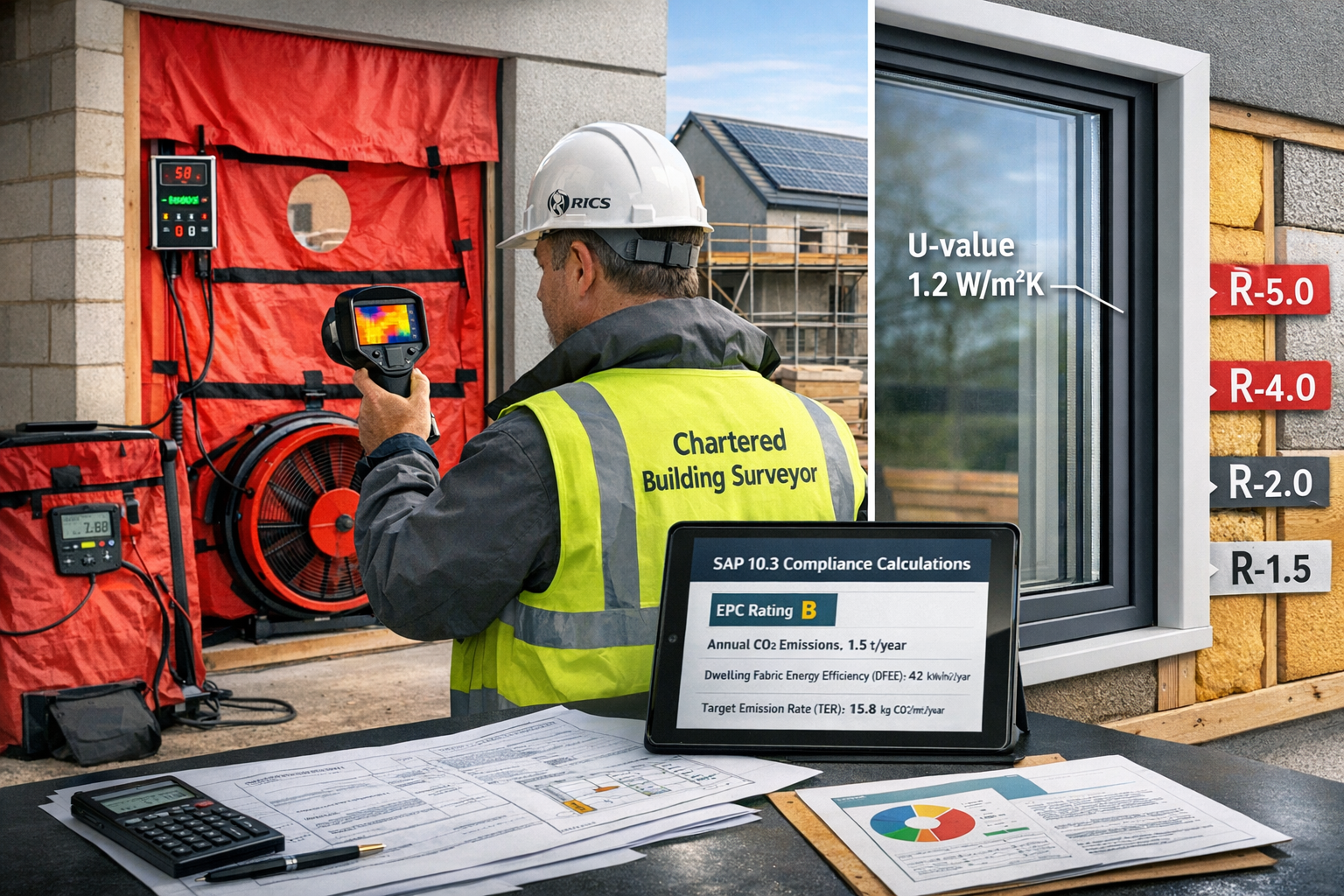
For RICS chartered surveyors, developers, and construction professionals, understanding how to integrate FHS compliance into building survey methodologies is no longer optional. The regulations demand that new homes produce 75-80% fewer carbon emissions compared to 2013 standards[1], creating an immediate need for enhanced survey protocols that can accurately assess low-carbon features and energy efficiency measures.
Key Takeaways
- Regulatory Timeline: Final Future Homes Standard regulations were published in Spring 2026, with projects lacking existing planning permission required to meet FHS requirements by December 2026[1]
- Emissions Target: New builds must achieve 75-80% carbon emissions reduction compared to 2013 Building Regulations, supporting the UK's net zero commitment by 2050[1]
- Dual Assessment Systems: Both SAP 10.3 and the Home Energy Model (HEM) are used during the transition period, with HEM designed to provide more comprehensive energy analysis[2][3]
- Quality Assurance Priority: Government guidance explicitly addresses the performance gap between design intent and as-built reality, making consistent inspections and traceable compliance evidence critical[4]
- Mandatory Low-Carbon Features: Solar PV panels, triple-glazed windows (U-value ≤1.2 W/m²K), mechanical ventilation systems, and enhanced building fabric are now standard requirements rather than optional upgrades[1][2]
Understanding the Future Homes Standard Framework in 2026
The Future Homes Standard represents the most significant overhaul of UK building regulations in decades. Implemented to accelerate the construction industry's contribution to national climate goals, the FHS establishes stringent performance requirements that fundamentally alter how RICS chartered building surveyors approach new build assessments.
Core Regulatory Requirements
The FHS framework encompasses several interconnected regulatory updates across multiple Building Regulation parts:
Part L (Conservation of Fuel and Power) now mandates:
- Windows achieving U-values of 1.2 W/m²K or lower[1]
- Triple-glazed units becoming standard practice
- Enhanced thermal bridging calculations
- Significantly improved airtightness targets
Part F (Ventilation) requires:
- Mechanical extract ventilation (MEV) or mechanical ventilation with heat recovery (MVHR) systems as standard[1]
- Continuous ventilation rates calculated based on dwelling size
- Integration with heating systems to minimize energy waste
Part O (Overheating Mitigation) introduces:
- Mandatory assessment of excessive solar gains[5]
- Demonstration of suitable airflow for cooling during hot periods
- Design-phase analysis of passive cooling strategies
Timeline and Compliance Deadlines
Understanding the implementation timeline is crucial for Building Surveys for Sustainable New Builds 2026: Integrating Future Homes Standard Compliance:
| Milestone | Date | Implication |
|---|---|---|
| Final regulations published | Spring 2026 | Regulations confirmed and available[1] |
| Compliance deadline (new projects) | December 2026 | Projects without existing planning permission must comply[1] |
| Full implementation | December 2027 | Transition period ends; all new homes must fully comply[1] |
This compressed timeline creates urgency for surveyors to update their assessment methodologies and familiarize themselves with new compliance verification procedures.
Regional Climate-Based Compliance
A significant innovation in the FHS is the introduction of regional climate-based compliance metrics[2]. Unlike previous one-size-fits-all approaches, compliance calculations now incorporate local climate data, meaning identical house designs may perform differently depending on geographic location.
This regional approach requires surveyors to:
- ✅ Understand local climate zone classifications
- ✅ Apply location-specific performance multipliers
- ✅ Assess designs against regionally appropriate benchmarks
- ✅ Verify that heating and cooling systems are sized correctly for local conditions
RICS Standards for Assessing Low-Carbon Features in New Builds
The Royal Institution of Chartered Surveyors (RICS) has established comprehensive guidance for professionals conducting Building Surveys for Sustainable New Builds 2026: Integrating Future Homes Standard Compliance. These standards ensure consistent, reliable assessment of the complex low-carbon technologies now mandatory in new developments.
Building Fabric Efficiency Assessment
Advanced insulation and airtightness form the foundation of FHS compliance. Surveyors must now verify:
Insulation Performance:
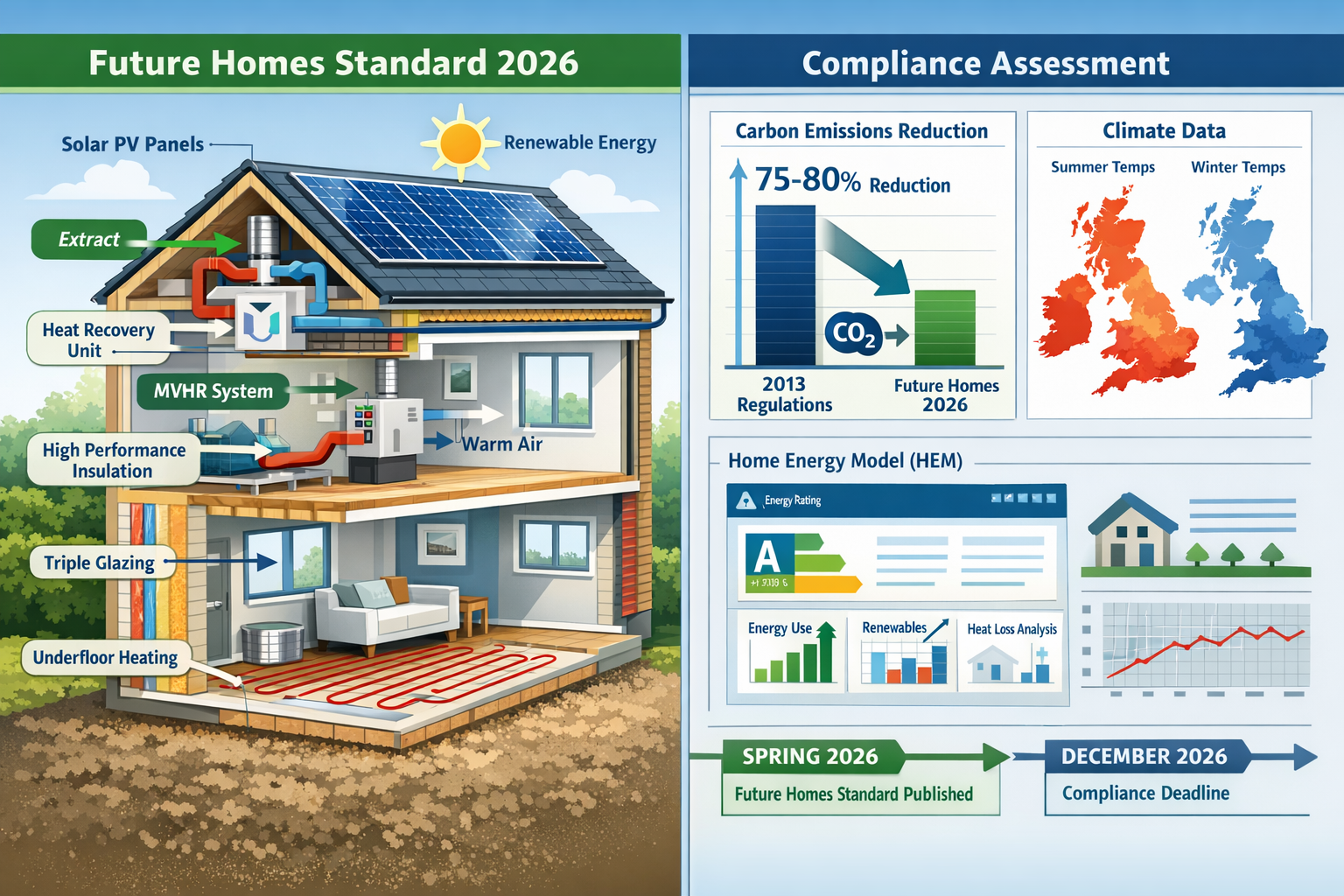
- R-value calculations demonstrating heat loss elimination in walls, floors, and roofs[3]
- Thermal bridging analysis at junctions and penetrations
- Continuity of insulation layers across the building envelope
- Quality of installation through visual inspection and thermal imaging
Airtightness Verification:
- Blower door testing achieving target air permeability rates
- Identification and remediation of air leakage paths
- Verification of sealing around service penetrations
- Documentation of test results for compliance records
When conducting a RICS commercial building survey or residential assessment, surveyors should employ thermal imaging cameras to identify thermal bridges and air leakage points that compromise building fabric performance.
Renewable Energy Systems Evaluation
Solar photovoltaic (PV) panels are now mandatory for most new homes[2], with flexibility only for shaded or physically constrained sites. Survey protocols must include:
Installation Assessment:
- Panel orientation and tilt angle optimization
- Shading analysis throughout the year
- Electrical system integration and safety
- Inverter sizing and placement
- Battery storage provision (where applicable)
Performance Verification:
- Expected annual energy generation calculations
- Comparison with design specifications
- Monitoring system functionality
- Grid connection compliance
Mechanical Ventilation Systems
The mandatory inclusion of MEV or MVHR systems[1] requires specialized survey competencies:
System Design Verification:
- Adequate air change rates for dwelling size
- Ductwork routing and insulation
- Heat recovery efficiency ratings (for MVHR)
- Filter accessibility and maintenance provisions
Installation Quality:
- Airtight duct connections
- Balanced airflow in supply and extract
- Noise level compliance
- Control system functionality
Surveyors should cross-reference ventilation assessments with damp surveys to ensure adequate moisture control without excessive energy consumption.
Window and Glazing Specifications
With mandatory U-values of 1.2 W/m²K or lower[1], window assessment becomes critical:
Performance Verification:
- U-value certification review
- Frame material and thermal performance
- Glazing unit specifications (typically triple-glazed)
- Spacer bar thermal efficiency
- Installation quality and weatherproofing
Quality Indicators:
- 🔍 Manufacturer certification documents
- 🔍 Thermal performance test results
- 🔍 Condensation risk analysis
- 🔍 Acoustic performance ratings
Overheating Risk Assessment
Part O requirements necessitate thorough overheating mitigation analysis[5]:
Assessment Components:
- Solar gain calculations for all orientations
- Window-to-floor area ratios
- Shading device effectiveness
- Natural ventilation potential
- Thermal mass evaluation
- Night cooling strategies
Surveyors must verify that design-phase overheating assessments align with as-built conditions, particularly regarding window sizes, shading installations, and ventilation provisions.
Energy Efficiency Compliance Assessment Methodologies
The transition to Building Surveys for Sustainable New Builds 2026: Integrating Future Homes Standard Compliance requires surveyors to master new assessment tools and methodologies that go beyond traditional survey approaches.
SAP 10.3 and Home Energy Model (HEM) Integration
During the 2026-2027 transition period, compliance is assessed using both SAP 10.3 and the Home Energy Model (HEM)[2][3]. Understanding the differences is essential:
SAP 10.3 (Standard Assessment Procedure):
- Established methodology familiar to most surveyors
- Monthly calculation timestep
- Standardized occupancy assumptions
- Primary compliance metric: Target Emissions Rate (TER)
Home Energy Model (HEM):
- More sophisticated hourly calculation timestep
- Enhanced overheating risk assessment
- Regional climate data integration
- Improved accuracy for complex building designs
"The Home Energy Model represents a significant step forward in accurately predicting real-world energy performance, addressing the persistent performance gap that has undermined previous regulatory frameworks."
Surveyors conducting compliance assessments should verify that energy calculations have been performed using the appropriate methodology and that input assumptions reflect actual building specifications rather than idealized design values.
Performance Gap Mitigation Strategies
Government guidance explicitly acknowledges the performance gap between design intent and as-built reality[4], making quality assurance during construction paramount. Survey protocols should include:
Design Stage Verification:
- Review of energy modeling assumptions
- Specification review for buildability
- Identification of high-risk details
- Value engineering impact assessment
Construction Stage Inspections:
- Progressive inspection at key construction milestones
- Photographic documentation of concealed elements
- Material specification verification
- Installation quality assessment
Completion Stage Testing:
- Airtightness testing with remediation verification
- Thermal imaging surveys
- Ventilation commissioning verification
- Renewable energy system performance testing
For projects requiring enhanced scrutiny, monitoring surveys can provide ongoing verification of building performance post-occupation.
Documentation and Traceability Requirements
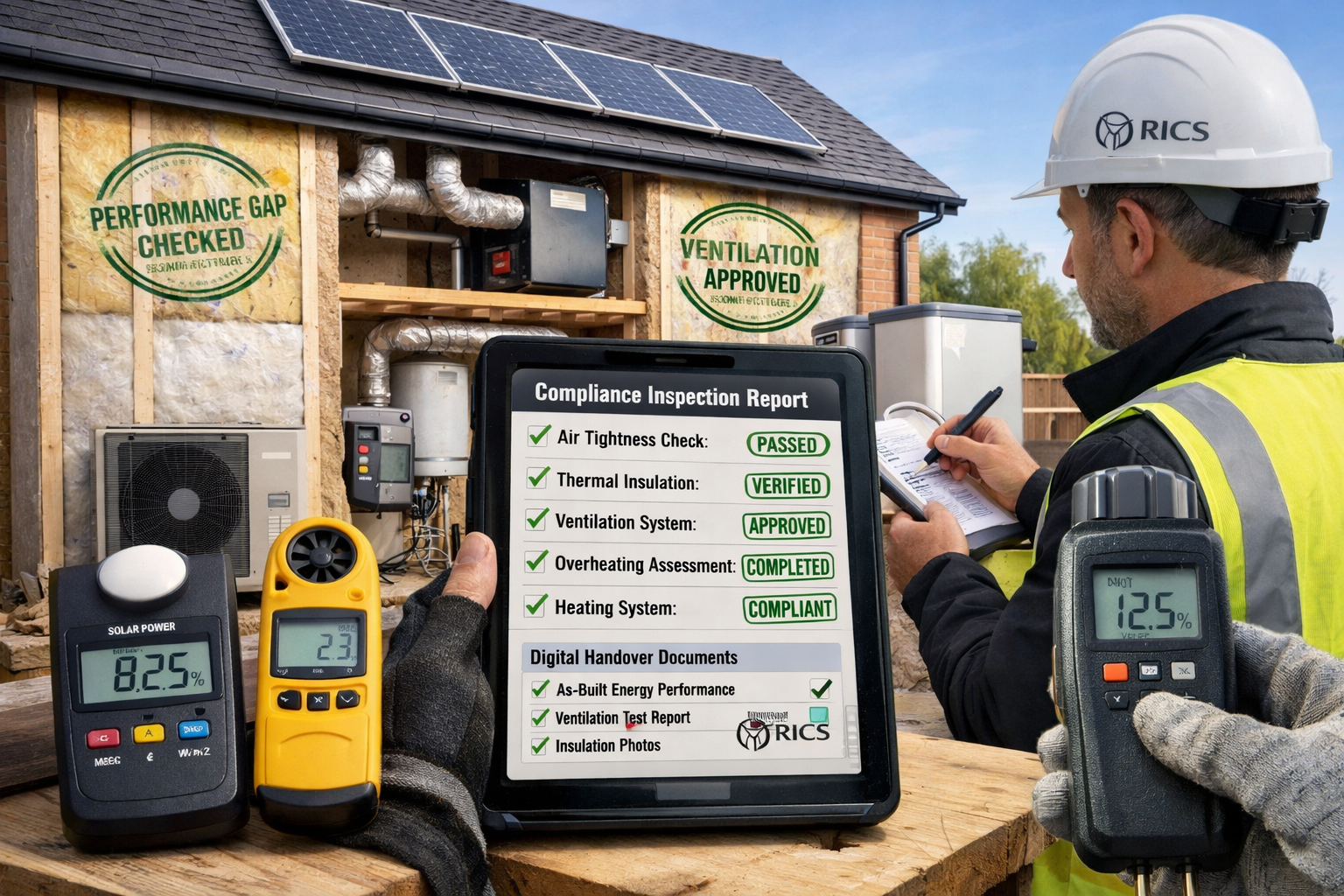
FHS compliance demands traceable evidence throughout the construction process[4]. Surveyors must ensure comprehensive documentation including:
Mandatory Documentation:
- ✏️ Energy performance calculations (SAP/HEM)
- ✏️ U-value calculations and product certifications
- ✏️ Airtightness test certificates
- ✏️ Ventilation commissioning records
- ✏️ Overheating risk assessments
- ✏️ Solar PV installation certificates
- ✏️ As-built drawings reflecting actual construction
Digital Handover Packages:
Modern compliance verification increasingly relies on digital documentation platforms that provide:
- Centralized document repositories
- Version control and audit trails
- Mobile access for on-site verification
- Integration with Building Information Modeling (BIM)
- Automated compliance checking
When conducting specific defect surveys, surveyors should reference this comprehensive documentation to identify whether defects stem from design inadequacies or construction quality issues.
Practical Survey Protocols for FHS Compliance Verification
Implementing Building Surveys for Sustainable New Builds 2026: Integrating Future Homes Standard Compliance requires structured survey protocols that systematically verify all regulatory requirements.
Pre-Construction Survey Checklist
Before construction commences, surveyors should conduct comprehensive design reviews:
Energy Performance Review:
- Verify SAP 10.3/HEM calculations against design drawings
- Confirm 75-80% carbon emissions reduction target achievement[1]
- Review renewable energy system sizing
- Assess regional climate data application[2]
Specification Verification:
- Confirm window U-values ≤1.2 W/m²K[1]
- Review insulation specifications and R-values[3]
- Verify ventilation system design adequacy
- Check overheating mitigation measures[5]
Buildability Assessment:
- Identify complex details requiring enhanced supervision
- Review thermal bridging details for practicality
- Assess airtightness strategy feasibility
- Confirm material availability and lead times
Construction Stage Inspection Protocol
Systematic inspections during construction are critical to preventing the performance gap:
Foundation and Ground Floor Stage:
- Insulation continuity and thickness
- Damp-proof membrane installation
- Service penetration sealing strategy
- Underfloor heating installation (if applicable)
Wall Construction Stage:
- Cavity insulation installation quality
- Thermal bridging detail execution
- Airtightness barrier continuity
- Window installation and sealing
Roof Construction Stage:
- Insulation thickness and continuity
- Airtightness layer integrity
- Ventilation system ductwork routing
- Solar PV panel installation preparation
Services Installation Stage:
- Heating system installation and sizing
- Ventilation system commissioning
- Solar PV electrical integration
- Smart controls installation
For complex projects, structural surveys may be required alongside energy compliance assessments to ensure structural adequacy of enhanced insulation systems.
Post-Completion Verification Testing
Final compliance verification requires comprehensive testing:
Mandatory Testing:
- Airtightness Testing: Blower door test confirming air permeability targets
- Ventilation Commissioning: Airflow measurement and system balancing
- Thermal Imaging Survey: Identification of thermal bridges and insulation defects
- Solar PV Performance Testing: Generation verification against predictions
Optional Enhanced Testing:
- Co-heating tests for whole-building heat loss verification
- In-situ U-value measurements for critical elements
- Indoor air quality monitoring
- Overheating risk monitoring during summer months
Common Non-Compliance Issues and Remediation
Surveyors should be alert to frequently encountered compliance failures:
Airtightness Failures:
- ⚠️ Unsealed service penetrations
- ⚠️ Poorly installed windows and doors
- ⚠️ Discontinuous airtightness barriers
- ⚠️ Inadequate sealing at junctions
Thermal Performance Issues:
- ⚠️ Compressed or missing insulation
- ⚠️ Thermal bridging at structural elements
- ⚠️ Incorrect window specifications
- ⚠️ Cold bridging at balconies and canopies
Ventilation System Problems:
- ⚠️ Undersized systems for dwelling size
- ⚠️ Poorly insulated ductwork
- ⚠️ Unbalanced airflow
- ⚠️ Excessive noise levels
Early identification through systematic surveys allows cost-effective remediation before final completion.
Integration with Broader Survey Services
Building Surveys for Sustainable New Builds 2026: Integrating Future Homes Standard Compliance doesn't exist in isolation. Effective surveyors integrate FHS compliance assessment with comprehensive survey services:
Coordination with Other Survey Types
Homebuyer Surveys:
For buyers of new builds, standard homebuyer surveys should now incorporate FHS compliance verification, ensuring purchasers understand the energy performance and low-carbon features of their new property.
Defect Surveys:
When defects emerge post-completion, comparing different types of survey helps determine whether specialized energy performance assessments are required alongside traditional defect identification.
Drainage and Services:
Enhanced airtightness requirements increase the importance of proper drainage surveys to prevent moisture accumulation that could compromise building fabric performance.
Developer and Contractor Responsibilities
Developers commissioning surveys should ensure:
- 📋 Early engagement of qualified surveyors during design stages
- 📋 Progressive inspection schedules aligned with construction programs
- 📋 Clear quality assurance protocols for subcontractors
- 📋 Comprehensive documentation systems for compliance evidence
- 📋 Post-completion performance monitoring provisions
Future-Proofing Beyond 2026
While December 2027 marks the end of the transition period[1], forward-thinking developers and surveyors should anticipate further regulatory tightening:
Anticipated Future Requirements:
- Further carbon emissions reductions beyond 75-80%
- Mandatory embodied carbon assessments
- Enhanced circular economy provisions
- Stricter performance verification requirements
- Expanded renewable energy mandates
Surveyors who develop expertise in Building Surveys for Sustainable New Builds 2026: Integrating Future Homes Standard Compliance now will be well-positioned for future regulatory evolution.
Conclusion
The Future Homes Standard represents a transformative shift in UK construction, fundamentally altering how building surveyors assess and verify new developments. Building Surveys for Sustainable New Builds 2026: Integrating Future Homes Standard Compliance is no longer a specialized niche—it's an essential competency for all professionals involved in new build assessment.
With final regulations published in Spring 2026 and the December 2026 compliance deadline for new projects[1], the time for preparation has passed. Surveyors must now demonstrate mastery of:
- ✅ Advanced building fabric assessment including thermal imaging and airtightness testing
- ✅ Renewable energy system evaluation and performance verification
- ✅ Mechanical ventilation system commissioning and quality assurance
- ✅ SAP 10.3 and Home Energy Model compliance calculations[2][3]
- ✅ Overheating risk assessment and mitigation verification[5]
- ✅ Comprehensive documentation and traceability protocols[4]
The 75-80% carbon emissions reduction target[1] demands rigorous quality assurance throughout design, construction, and completion stages. The performance gap between design intent and as-built reality can only be bridged through systematic inspection protocols and traceable compliance evidence.
Next Steps for Building Professionals
For Surveyors:
- Invest in thermal imaging equipment and airtightness testing capabilities
- Complete CPD training on SAP 10.3 and HEM methodologies
- Develop systematic inspection protocols for FHS compliance
- Establish digital documentation systems for compliance evidence
For Developers:
- Engage qualified RICS chartered surveyors early in the design process
- Implement robust quality assurance systems throughout construction
- Budget adequately for compliance testing and verification
- Establish post-completion monitoring programs
For Homebuyers:
- Request comprehensive FHS compliance documentation
- Understand the energy performance features of your new home
- Verify that appropriate testing has been conducted
- Consider engaging independent surveyors for verification
The construction industry's contribution to the UK's net zero commitment by 2050 depends on successful implementation of the Future Homes Standard. By integrating rigorous compliance assessment into building survey methodologies, RICS chartered surveyors play a pivotal role in ensuring that new homes deliver genuine, verified carbon emissions reductions.
For expert guidance on Building Surveys for Sustainable New Builds 2026: Integrating Future Homes Standard Compliance, contact qualified RICS professionals who understand both traditional survey methodologies and the specialized requirements of low-carbon construction assessment.
References
[1] The Impact Of The Future Homes Standard In 2026 – https://www.sbhonline.co.uk/news/the-impact-of-the-future-homes-standard-in-2026/
[2] Future Homes Standard What It Means For Your Projects And How To Stay Ahead – https://www.gsap.co.uk/blog/future-homes-standard-what-it-means-for-your-projects-and-how-to-stay-ahead/
[3] Our Guide To The Future Homes Standard – https://www.enconassociates.com/blog-insights/our-guide-to-the-future-homes-standard/
[4] Future Homes Standard 2025 What 2026 Means For Housebuilders On Qa Documentation Handover – https://www.planradar.com/gb/future-homes-standard-2025-what-2026-means-for-housebuilders-on-qa-documentation-handover/
[5] What Is The Future Homes Standard – https://aessc.co.uk/knowledge-hub/what-is-the-future-homes-standard