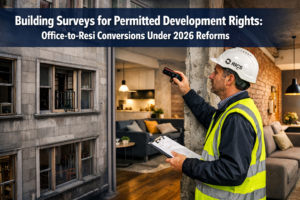
Empty shop windows line British high streets like missing teeth in a once-proud smile. Yet beneath peeling "To Let" signs and dusty display cases lies an extraordinary opportunity. Building Surveys for Retail-to-Residential Conversions: Uncovering Opportunities in 2026 High Street Revivals represents one of the most significant transformations in urban regeneration, particularly across northern England's resilient property markets. As retail construction is projected to fall 37% in 2026[2], the conversion of redundant commercial spaces into desperately needed housing offers both economic revival and practical solutions to the housing crisis.
The transformation from shop to home isn't simply a matter of adding a kitchen and bathroom. These conversions demand rigorous technical assessment, specialized building surveys, and deep understanding of structural, regulatory, and financial complexities. For property developers, investors, and local authorities, professional RICS building surveys form the essential foundation for successful conversion projects.
Key Takeaways
- Comprehensive building surveys are critical for identifying structural defects, outdated building services, and compliance issues before retail-to-residential conversion projects begin
- Government incentives and permitted development rights in 2026 are accelerating conversion opportunities, particularly in northern markets where retail vacancy rates remain elevated
- Technical challenges including floor-to-ceiling heights, natural light requirements, fire safety upgrades, and aging MEP (mechanical, electrical, plumbing) systems require specialist surveyor assessment
- Market fundamentals show housing demand—not just policy incentives—drives successful conversions, with over 55,300 units in the national conversion pipeline as of 2024[1]
- Location factors such as walkability, transit proximity, and neighborhood amenities determine conversion viability more than building characteristics alone
Understanding the 2026 Retail-to-Residential Conversion Landscape
The Scale of Opportunity
The commercial-to-residential conversion movement has gained remarkable momentum. Since 2016, 133 office-to-multifamily conversions have created over 22,000 apartments across the United States, with 169 projects currently planned or underway forecast to produce an additional 31,000 units[1]. In the UK, similar patterns are emerging as retail spaces struggle with changing consumer behaviors and the acceleration of online shopping.
Northern England presents particularly compelling opportunities for retail-to-residential conversions in 2026. Cities like Manchester, Leeds, Liverpool, and Sheffield combine:
- 🏢 Abundant Victorian and Edwardian commercial buildings with conversion potential
- 📈 Strong rental demand driven by university populations and young professionals
- 💷 More favorable acquisition costs compared to southern markets
- 🚇 Established transport infrastructure and urban amenities
- 🏛️ Supportive local planning authorities encouraging town center regeneration
Market Drivers Beyond Policy Incentives
While government programs provide valuable support, research shows that market demand for housing—rather than policy incentives alone—serves as the primary driver of successful conversions, particularly in high-demand markets[3]. This fundamental truth shapes how building surveyors must approach conversion feasibility assessments.
Grocery-anchored and neighborhood shopping centers continue experiencing strong performance with vacancy rates around 5%[4], but traditional high street retail faces persistent challenges. This creates a bifurcated market where location-specific surveys become essential for determining conversion viability.
Critical Building Survey Protocols for Retail-to-Residential Conversions: Uncovering Opportunities in 2026 High Street Revivals
Structural Assessment Fundamentals
When conducting commercial building surveys for conversion projects, chartered surveyors must evaluate structural capacity through a fundamentally different lens than traditional retail assessments.
Key structural considerations include:
| Survey Element | Retail Requirements | Residential Requirements | Survey Focus Areas |
|---|---|---|---|
| Floor Loading | 4-5 kN/m² typical | 1.5-2.0 kN/m² | Beam capacity, joist spacing, foundation adequacy |
| Ceiling Heights | Variable, often 3m+ | Minimum 2.3m (ideally 2.5m+) | Floor-to-floor dimensions, services accommodation |
| Natural Light | Minimal requirements | 10% floor area glazing | Window positions, light wells, courtyard options |
| Sound Insulation | Not critical | Building Regs Part E compliance | Party wall construction, floor separation |
| Fire Separation | Single occupancy focus | Multiple dwelling requirements | Compartmentation, escape routes, protected stairways |
Foundation and Load-Bearing Analysis
Victorian and Edwardian retail buildings typically feature solid masonry construction with generous structural capacity. However, surveyors must verify:
- Foundation adequacy for altered loading patterns and potential additional floors
- Structural wall integrity where new openings or modifications are planned
- Floor joist condition in timber-framed buildings, checking for rot, beetle infestation, or deflection
- Beam and column capacity for redistributed loads when removing internal walls
Professional structural surveys should include non-destructive testing methods, trial pit excavations where necessary, and detailed calculations by structural engineers.
Building Services and MEP Infrastructure
Outdated building services represent the most commonly underestimated challenge in retail-to-residential conversions. Empty shops typically feature:
- ⚡ Electrical systems designed for commercial lighting loads, not residential circuits
- 🚰 Plumbing infrastructure limited to staff toilets, inadequate for multiple dwellings
- 🔥 Heating systems (if present) configured for large open spaces, not individual apartments
- 📡 Telecommunications lacking fiber connectivity and modern digital infrastructure
Electrical System Assessment
Chartered surveyors should document:
- Main service capacity and distribution board condition
- Cable types, routing, and compliance with current BS 7671 wiring regulations
- Emergency lighting and fire alarm systems requiring upgrade
- Consumer unit locations and accessibility for individual metering
- Three-phase supply availability for larger conversion schemes
Plumbing and Drainage Evaluation
Critical survey elements include:
- Water supply capacity for multiple residential units
- Drainage system adequacy, particularly for upper-floor conversions
- Soil stack positioning and potential for new vertical service risers
- Hot water provision options (individual vs. communal systems)
- Existing pipe materials and replacement requirements
Many retail buildings feature asbestos-containing materials in pipe lagging, ceiling tiles, and floor coverings. Specialist damp surveys and asbestos assessments form essential components of comprehensive conversion surveys.
Environmental and Energy Performance
2026 building regulations demand significantly higher energy performance standards than most existing retail buildings provide. Survey protocols must assess:
Thermal Performance Gaps:
- Single-glazed shopfronts requiring complete replacement
- Uninsulated solid walls needing internal or external insulation
- Roof spaces lacking adequate insulation (minimum 270mm currently required)
- Thermal bridging at junctions and penetrations
Ventilation Requirements:
- Natural ventilation adequacy for habitable rooms
- Mechanical ventilation with heat recovery (MVHR) installation feasibility
- Background ventilation provision in existing window openings
- Extract ventilation for kitchens and bathrooms
Renewable Energy Integration:
- Roof structural capacity for photovoltaic panels
- Space heating options including air source heat pumps
- Solar thermal hot water system viability
- Battery storage accommodation
Identifying Defects and Compliance Issues in Building Surveys for Retail-to-Residential Conversions
Common Hidden Defects in Retail Properties
Experienced surveyors conducting Level 3 RICS building surveys on conversion candidates frequently encounter:
Damp and Water Penetration
Rising damp affects many older retail buildings, particularly where:
- Original damp-proof courses have failed or are absent
- Ground levels have been raised over decades
- Modern impermeable renders trap moisture in walls
- Inadequate sub-floor ventilation exists
Penetrating damp commonly occurs through:
- Failed flat roof coverings over rear extensions
- Defective rainwater goods and blocked gutters
- Cracked render and pointing deterioration
- Leaking valley gutters between properties
Structural Movement and Subsidence
High street buildings often exhibit:
- Differential settlement where extensions meet original structures
- Historic movement from adjacent demolitions or excavations
- Ongoing subsidence in clay soil areas, particularly following dry summers
- Lintel failures above shopfronts and display windows
Professional subsidence surveys should include crack monitoring over appropriate periods before committing to conversion projects.
Roof Condition and Longevity
Retail building roofs frequently suffer from deferred maintenance:
- Aging slate or tile coverings nearing end of serviceable life
- Lead flashings suffering from fatigue cracking
- Timber roof structures with beetle infestation or rot
- Inadequate roof pitch for modern waterproofing standards
Detailed roof surveys using drone technology and thermal imaging can reveal defects invisible from ground level.
Regulatory Compliance Challenges
Planning and Permitted Development Rights
The UK's permitted development rights framework allows certain retail-to-residential conversions without full planning permission, but significant conditions apply:
- Class MA permits conversion of shops (Use Class E) to residential (Use Class C3)
- Prior approval required for transport impacts, contamination risks, flooding, and adequate natural light
- Local authority Article 4 directions may remove permitted development rights in specific areas
- Building Regulations approval remains mandatory regardless of planning status
Survey reports should clearly identify any planning constraints affecting conversion viability.
Fire Safety and Means of Escape
Building Regulations Approved Document B sets stringent requirements for residential conversions:
- Protected escape routes with 30-minute or 60-minute fire resistance
- Compartmentation between dwellings preventing fire spread
- Smoke detection and alarm systems meeting current standards
- Emergency escape windows from habitable rooms
- Travel distances to final exits within prescribed limits
Complex buildings may require fire engineering assessments and specialist consultancy input beyond standard surveying scope.
Party Wall Considerations
Retail-to-residential conversions in terraced high street properties inevitably trigger party wall procedures:
- Party Wall Act 1996 notices required for structural alterations
- Building owner obligations to serve notices and appoint surveyors
- Schedule of condition surveys documenting adjacent properties before works
- Party wall awards specifying permitted works and protection measures
Failure to follow proper party wall procedures can result in costly delays and legal disputes.
Government Incentives and Market Opportunities Driving 2026 Conversions
Policy Framework Supporting Conversions
The UK government has implemented several initiatives encouraging retail-to-residential conversions:
Permitted Development Rights Expansion:
- Streamlined approval processes reducing planning barriers
- Extended rights covering larger floor areas and building types
- Faster determination periods for prior approval applications
Financial Incentives:
- Reduced VAT rates on qualifying conversion works
- Business rates relief during conversion periods
- Potential grant funding through local authority regeneration schemes
- Brownfield Land Release Fund supporting infrastructure improvements
Regional Variations:
Northern local authorities have proven particularly supportive, with Manchester, Leeds, and Liverpool offering:
- Pre-application advice services for conversion projects
- Relaxed parking standards in town center locations
- Proactive engagement with developers and investors
- Strategic planning policies favoring residential intensification
Investment Return Considerations
Building surveys must inform financial viability assessments considering:
Capital Cost Components:
- Acquisition price reflecting retail values (typically lower than residential)
- Conversion construction costs (£800-£1,500 per m² typical range)
- Professional fees including surveyors, architects, engineers, and planning consultants
- Statutory fees for building control, party wall procedures, and utilities connections
- Contingency allowances (15-20% recommended for older buildings)
Revenue Projections:
- Rental yields in northern markets (5-7% gross yields achievable)
- Sales values for completed apartments
- Affordable housing requirements and Section 106 obligations
- Service charge recovery for communal areas and facilities
Risk Factors:
- Construction program delays from unforeseen defects
- Planning or building control complications
- Market demand fluctuations
- Interest rate changes affecting financing costs
Professional RICS valuations provide essential input for investment decision-making.
Location-Specific Success Factors for Building Surveys for Retail-to-Residential Conversions
Urban Amenity Requirements
Research consistently shows that successful conversion sites require specific location characteristics[1]:
Essential Proximity Factors:
- 🚶 Walkability scores above 70 (Walk Score methodology)
- 🚉 Public transport access within 400m walking distance
- 🛒 Grocery stores and essential services within 800m
- 🏫 Schools and childcare facilities for family-oriented developments
- 🏥 Healthcare services accessible without car dependency
Safety and Environment:
- Low crime rates and perception of safety
- Active street frontages maintaining natural surveillance
- Quality public realm and green space provision
- Minimal air and noise pollution
Building surveys should assess these contextual factors alongside physical building characteristics, as location fundamentally determines conversion viability.
Parking and Transportation Constraints
Outside dense urban cores, parking availability becomes a critical constraint[1]. Survey reports should address:
- On-street parking capacity and restrictions
- Potential for rear yard or undercroft parking provision
- Cycle storage requirements and feasible locations
- Electric vehicle charging infrastructure provision
- Disabled parking and accessible entrance routes
Northern city centers generally benefit from established public transport networks reducing parking demands compared to suburban locations.
Competitive Market Analysis
Surveyors should provide clients with market context including:
- Comparable conversion schemes in the locality
- Rental and sales evidence for similar residential units
- Vacancy rates indicating demand strength
- Competing new-build developments affecting pricing
- Demographic trends supporting long-term demand
This market intelligence ensures building survey findings align with commercial reality.
Specialist Survey Techniques for Conversion Assessment
Non-Destructive Testing Methods
Modern surveying technology enables comprehensive assessment without damaging buildings:
Thermal Imaging:
- Heat loss identification through building envelope
- Hidden moisture detection behind finishes
- Insulation continuity verification
- Thermal bridging location
Moisture Meters:
- Capacitance meters for surface moisture detection
- Deep-wall probes for internal moisture assessment
- Relative humidity monitoring in enclosed spaces
Ground Penetrating Radar:
- Concrete slab thickness and reinforcement location
- Buried services identification
- Void detection beneath floor slabs
- Foundation depth assessment
Drone Surveys:
- High-level roof condition inspection
- Chimney stack assessment
- Rainwater goods examination
- Photographic records of inaccessible areas
Invasive Investigation Requirements
Comprehensive conversion surveys often require:
Opening-Up Works:
- Removal of ceiling panels exposing structural elements
- Lifting floor finishes to assess substrate condition
- Exposing wall construction at strategic locations
- Inspection chambers for drainage systems
Sample Extraction:
- Mortar analysis for repointing specifications
- Timber samples for species identification and treatment assessment
- Paint samples for lead content testing
- Material samples for asbestos analysis
Trial Pits:
- Foundation exposure and assessment
- Drainage system investigation
- Ground condition evaluation
- Contamination sampling where industrial uses existed
Surveyors must coordinate invasive works with building owners and ensure proper reinstatement.
Project Management and Professional Coordination
Multi-Disciplinary Team Requirements
Successful retail-to-residential conversions demand coordinated input from:
- Chartered Building Surveyors providing comprehensive condition assessment
- Structural Engineers analyzing load capacity and designing interventions
- MEP Engineers specifying building services installations
- Architects developing compliant residential layouts
- Planning Consultants navigating regulatory requirements
- Quantity Surveyors preparing cost estimates and managing budgets
- Party Wall Surveyors administering statutory procedures
The building surveyor often serves as the initial professional advisor, identifying issues requiring specialist input and coordinating the wider team.
Survey Report Deliverables
Professional conversion survey reports should include:
Executive Summary:
- Conversion feasibility conclusion
- Critical defects requiring immediate attention
- Estimated remediation costs
- Regulatory compliance pathway
- Risk assessment and recommendations
Detailed Findings:
- Systematic room-by-room condition description
- Photographic evidence of defects and features
- Technical drawings and annotated plans
- Services infrastructure assessment
- Environmental performance evaluation
Appendices:
- Specialist consultant reports
- Laboratory test results
- Regulatory correspondence
- Cost estimates and schedules
- Recommended specification notes
Reports should be tailored to client sophistication, balancing technical accuracy with accessibility for non-specialist readers.
Case Study Applications: Northern Market Conversions
Manchester High Street Transformation
A typical Manchester high street conversion project illustrates survey importance:
Building Profile:
- Victorian three-story retail building (1880s construction)
- Ground floor shop with two upper floors previously used as storage
- Solid brick construction with timber floors
- 450m² gross internal area
Survey Findings:
- Structurally sound masonry with minor historic movement stabilized
- Extensive rising damp requiring new damp-proof course installation
- Roof covering nearing end of serviceable life (15 years remaining estimated)
- Complete absence of thermal insulation
- Single-phase electrical supply requiring upgrade
- Inadequate drainage for multiple residential units
Conversion Solution:
- Ground floor retained as commercial unit (Use Class E)
- Two upper floors converted to four one-bedroom apartments
- New vertical service risers installed in existing stairwell
- Internal wall insulation maintaining external character
- Rear yard development providing cycle storage and bin stores
Financial Outcome:
- Acquisition cost: £185,000
- Conversion costs: £425,000
- Completed value: £720,000
- Developer profit: £110,000 (18% on costs)
The comprehensive building survey identified critical issues early, preventing costly mid-construction surprises and enabling accurate financial modeling.
Leeds City Center Mixed-Use Scheme
A larger-scale example demonstrates complexity:
Building Profile:
- Edwardian department store (1910 construction)
- Four stories plus basement
- Steel frame with brick cladding
- 2,400m² gross internal area
- Grade II listed building status
Survey Challenges:
- Heritage constraints limiting external alterations
- Asbestos-containing materials throughout
- Structural modifications requiring listed building consent
- Complex ownership with multiple freeholders
- Contaminated land from previous industrial uses
Resolution Approach:
- Early engagement with conservation officers
- Phased asbestos removal program
- Retention of significant heritage features (staircase, shopfront, decorative ceilings)
- Sympathetic internal layouts respecting historic floor plans
- 18 apartments created across upper floors
- Ground floor commercial space preserved
This project required specialist survey expertise beyond standard conversion assessments, demonstrating the value of RICS-qualified professionals with heritage experience.
Future Outlook: Building Surveys for Retail-to-Residential Conversions Beyond 2026
Emerging Trends and Technologies
The conversion market continues evolving with:
Digital Survey Methods:
- Building Information Modeling (BIM) for existing buildings
- 3D laser scanning creating accurate as-built records
- Augmented reality visualization of conversion proposals
- Artificial intelligence defect detection from photographic surveys
Sustainability Focus:
- Net-zero carbon targets influencing conversion specifications
- Circular economy principles favoring reuse over demolition
- Embodied carbon assessments comparing conversion versus new-build
- Whole-life costing methodologies
Modular Construction Integration:
- Prefabricated bathroom pods reducing on-site complexity
- Modular MEP systems accelerating installation
- Factory-finished internal partitions improving quality
- Hybrid approaches combining retention and new construction
Regulatory Evolution
Anticipated changes affecting conversion surveys include:
- Enhanced energy performance standards requiring deeper retrofits
- Stricter fire safety requirements following building safety legislation
- Accessibility improvements mandating inclusive design approaches
- Biodiversity net gain obligations affecting site development
Surveyors must maintain continuous professional development staying current with regulatory changes.
Market Sustainability
The long-term viability of retail-to-residential conversions depends on:
Supply-Side Factors:
- Continued retail sector rationalization releasing buildings
- Building owner willingness to accept residential values
- Construction industry capacity for conversion projects
- Professional expertise availability in regional markets
Demand-Side Drivers:
- Housing shortage persistence maintaining conversion economics
- Demographic preferences for urban living
- Rental market strength supporting investment returns
- Affordability pressures favoring conversion over new-build
Northern markets appear particularly well-positioned, combining available stock, strong demand fundamentals, and supportive policy environments.
Conclusion
Building Surveys for Retail-to-Residential Conversions: Uncovering Opportunities in 2026 High Street Revivals represents a critical intersection of technical expertise, market understanding, and urban regeneration vision. As retail construction declines 37% in 2026[2] and conversion pipelines expand nationally, professional building surveys form the essential foundation for successful transformation projects.
The complexity of converting commercial buildings to residential use demands rigorous assessment protocols addressing structural capacity, building services adequacy, regulatory compliance, and environmental performance. Hidden defects—from rising damp to outdated electrical systems—can derail projects lacking comprehensive survey investigation. Northern England's strong market fundamentals, combined with supportive policy frameworks, create exceptional opportunities for informed investors and developers.
Actionable Next Steps
For property professionals considering retail-to-residential conversions:
- Commission comprehensive RICS Level 3 building surveys before committing to acquisitions, ensuring all significant defects are identified and costed
- Engage multi-disciplinary teams early including structural engineers, MEP consultants, and planning advisors to assess feasibility holistically
- Investigate government incentives and local authority support programs available in your target market
- Conduct thorough location analysis verifying walkability, transport access, and neighborhood amenities supporting residential demand
- Develop detailed financial models incorporating realistic conversion costs, contingencies, and market-appropriate revenue assumptions
- Consider heritage and sustainability as value-adding opportunities rather than constraints, particularly in northern markets with rich architectural heritage
The transformation of empty shops into vibrant homes offers more than financial returns—it revitalizes communities, preserves architectural heritage, and addresses housing needs sustainably. Professional building surveys provide the technical foundation making these transformations possible, uncovering both challenges and opportunities hidden behind vacant shopfronts.
For expert guidance on conversion projects, consult RICS chartered building surveyors with specific experience in commercial-to-residential transformations and regional market knowledge.
References
[1] Commercial Residential Real Estate Conversion – https://www.morganstanley.com/ideas/commercial-residential-real-estate-conversion
[2] 11 Retail Real Estate Predictions For 2026 – https://www.icsc.com/news-and-views/icsc-exchange/11-retail-real-estate-predictions-for-2026
[3] Understanding Office To Residential Conversion – https://www.brookings.edu/articles/understanding-office-to-residential-conversion/
[4] Commercial Real Estate Outlook For 2026 – https://www.pbmares.com/commercial-real-estate-outlook-for-2026/