{"cover":"Professional landscape format (1536x1024) hero image featuring bold text overlay 'Building Surveys for Permitted Development Rights: Office-to-Resi Conversions Under 2026 Reforms' in extra large 72pt white sans-serif font with dark shadow and semi-transparent navy overlay box, positioned in upper third. Background shows split composition: left side displays vintage office building exterior with large windows being converted, right side shows modern residential apartment interior with exposed brick. RICS chartered surveyor in high-visibility vest examining structural elements with clipboard and laser measure. Color scheme: deep navy blue, white, orange safety accents. Urban regeneration theme, editorial quality, magazine cover aesthetic, professional construction documentation style, high contrast for text readability.","content":["Landscape format (1536x1024) detailed cutaway architectural illustration showing office building cross-section during permitted development conversion assessment. Left half displays original office layout with suspended ceilings, fluorescent lighting, open-plan desks, raised floors, and commercial HVAC systems. Right half shows proposed residential conversion with individual apartment units, domestic plumbing stacks, sound insulation layers, and natural light requirements highlighted. RICS surveyor figure with measuring equipment examining structural walls. Annotations pointing to critical survey areas: asbestos locations in ceiling tiles, structural load capacity concerns, fire separation requirements, and damp penetration risks. Color-coded overlay showing compliant vs non-compliant spaces against National Space Standards. Professional technical drawing style with blueprint aesthetic, clear labels, measurement indicators, and regulatory compliance markers.","Landscape format (1536x1024) infographic-style composition showing comprehensive building survey checklist for office-to-residential PDR conversions. Central image features modern urban office building facade with transparent overlay grid dividing into assessment zones. Surrounding the building are six detailed circular callout sections showing: 1) Structural engineer examining load-bearing walls with crack monitoring equipment, 2) Asbestos surveyor in protective gear sampling ceiling materials, 3) Damp meter readings on external walls with moisture level indicators, 4) Natural light assessment diagram with lux meter and window-to-floor ratio calculations, 5) Contamination testing of industrial site soil samples, 6) Acoustic testing equipment measuring noise levels from adjacent roads. Each callout connected by professional lines to specific building areas. Color scheme: professional grey, safety orange, regulatory blue. Clean modern design with icons, measurement data overlays, and RICS certification badges visible.","Landscape format (1536x1024) professional comparison layout showing before-and-after office-to-residential conversion success and failure scenarios. Top half displays successful conversion: well-lit apartment with adequate ceiling heights (2.5m+ annotation), proper ventilation systems, compliant room sizes overlaid with National Space Standard measurements, modern kitchen and bathroom installations, structural survey approval stamps. Bottom half shows problematic conversion: cramped units with inadequate natural light (lux readings in red), visible structural defects circled in warning orange, asbestos hazard markers, damp stains on walls, non-compliant room dimensions highlighted. Center divider shows RICS building survey report document with key findings checklist. Side panels display Article 4 Direction map of restricted zones and prior approval application flowchart. Professional documentary photography style with technical annotations, measurement overlays, regulatory compliance indicators, and expert surveyor consultation imagery."]
}
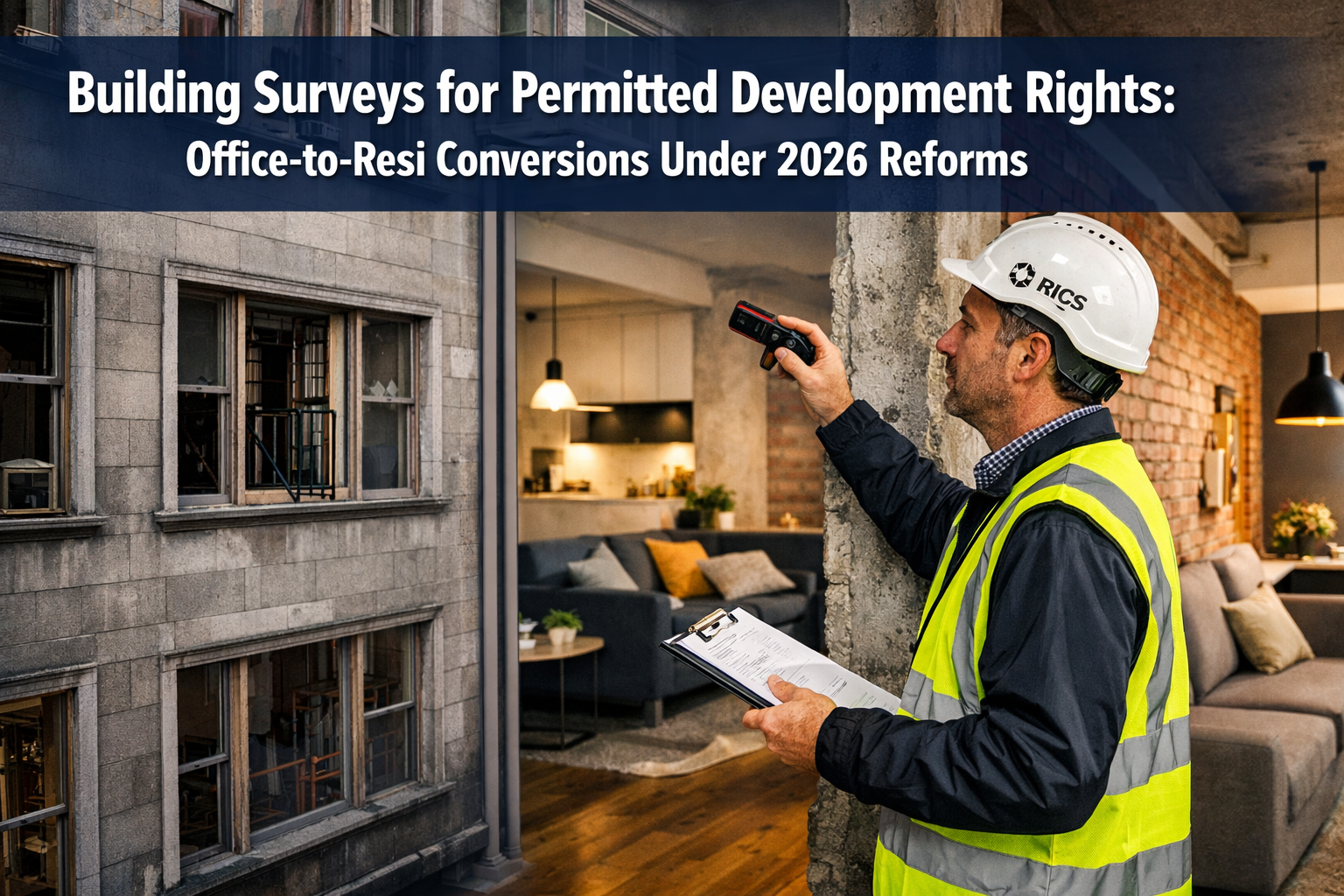
The transformation of vacant office buildings into residential homes has become one of the most significant opportunities in urban regeneration. With the 2026 reforms to Permitted Development Rights (PDR) removing previous size restrictions and vacancy requirements, property developers and investors now face unprecedented possibilities—and equally significant risks. Building Surveys for Permitted Development Rights: Assessing Office-to-Resi Conversions Under 2026 Reforms requires meticulous due diligence to identify structural defects, hazardous materials, and compliance challenges that could derail conversion projects before they begin.
The expanded PDR framework has opened the door to converting office buildings of any size without traditional planning permission, but this streamlined process doesn't eliminate the need for rigorous technical assessment. From asbestos-laden ceiling tiles in 1970s office blocks to inadequate natural light in deep-plan buildings, the physical realities of older commercial structures present formidable obstacles to creating compliant, habitable residential spaces.
Key Takeaways
- 🏢 2026 reforms eliminated the 1,500 sq m size limit and three-month vacancy requirement, making office buildings of any scale eligible for residential conversion under PDR
- 📋 Prior approval applications still demand comprehensive documentation including transport impact, contamination risks, flood assessments, and noise studies
- 🔍 RICS building surveys are essential for identifying structural defects, asbestos, damp penetration, and layout constraints before committing to conversion projects
- 📏 National Space Standards and natural light requirements remain mandatory, creating significant challenges for deep-plan office buildings with limited fenestration
- ⚠️ Article 4 Directions can still block conversions in designated areas, making local planning authority research critical before proceeding
Understanding the 2026 Permitted Development Rights Reforms
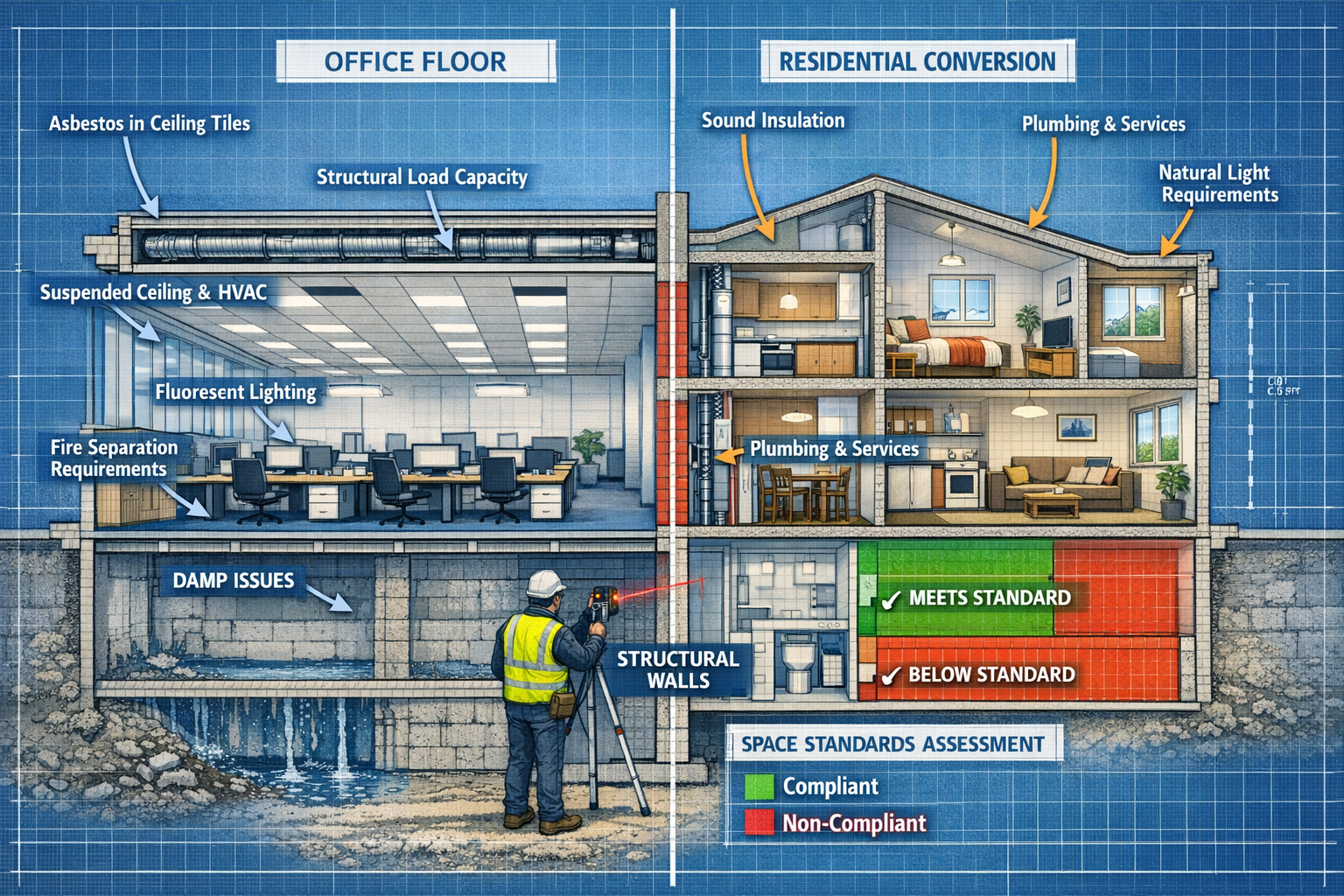
The regulatory landscape for office-to-residential conversions underwent substantial changes in 2026, fundamentally altering the feasibility calculations for developers and investors. These reforms represent the government's continued commitment to addressing housing shortages through adaptive reuse of underutilized commercial property.
What Changed in 2026?
The most significant transformation came through the removal of the cumulative floorspace limit. Previously, PDR conversions were capped at 1,500 square metres, effectively restricting the programme to smaller office buildings. This constraint has been completely abolished, meaning that multi-storey office blocks and large commercial complexes can now proceed under the streamlined PDR process[3].
Equally important, the three-month continuous vacancy requirement has been eliminated. Developers no longer need to demonstrate that a building sat empty for a qualifying period before submitting prior approval applications, removing a significant administrative hurdle and timeline constraint[3].
However, these liberalizations don't mean conversions have become straightforward. The reforms maintained stringent technical requirements:
- National Space Standards continue to apply to all habitable rooms
- Adequate natural light must be demonstrated in every living space
- Full documentation on transport impacts, contamination, flooding, and noise remains mandatory[1][2]
The Prior Approval Process in 2026
While PDR conversions bypass full planning permission, they still require prior approval from the Local Planning Authority. This process demands comprehensive supporting documentation that addresses specific technical and environmental concerns.
Applications must include complete architectural drawings showing proposed layouts, detailed assessments of transport and highways impacts, contamination land surveys, flood risk evaluations, and noise impact studies[1][2]. This documentation requirement underscores why thorough RICS building surveys form the foundation of successful conversion projects.
| Requirement | Pre-2026 | Post-2026 Reforms |
|---|---|---|
| Maximum floorspace | 1,500 sq m | No limit |
| Vacancy period | 3 continuous months | Not required |
| Space standards | National Space Standards | National Space Standards (unchanged) |
| Natural light | Required in habitable rooms | Required in habitable rooms (unchanged) |
| Prior approval documentation | Full technical assessments | Full technical assessments (unchanged) |
Article 4 Directions: The Local Authority Override
Despite the expanded PDR framework, Local Planning Authorities retain the power to block conversions in specific areas through Article 4 Directions. These designations remove permitted development rights in locations where councils believe conversions would harm local character, reduce employment space, or create other planning concerns[3].
Before investing in any office-to-residential project, developers must verify whether an Article 4 Direction applies to the target property. This research forms a critical preliminary step alongside commissioning professional building surveys.
Critical Building Survey Requirements for Office-to-Resi Conversions Under 2026 Reforms
The physical condition and structural characteristics of office buildings determine whether conversion projects are technically feasible and financially viable. Building Surveys for Permitted Development Rights: Assessing Office-to-Resi Conversions Under 2026 Reforms must address specific risk factors that distinguish commercial-to-residential transformations from standard property assessments.
Structural Integrity and Load-Bearing Capacity
Office buildings were designed for fundamentally different loading conditions than residential properties. Commercial structures typically feature:
- Open-plan layouts with minimal internal walls
- Suspended ceilings concealing services and structural elements
- Raised access floors for cable management
- Different live load requirements than residential use
A comprehensive structural survey must evaluate whether existing floor slabs, beams, and columns can accommodate residential loading patterns, particularly when introducing new partition walls, bathrooms with water-filled fixtures, and kitchen equipment[4]. Many post-war office buildings utilized construction methods that create challenges for residential subdivision.
RICS chartered surveyors conducting conversion assessments should specifically investigate:
✅ Load-bearing wall locations and structural grid patterns
✅ Floor slab thickness and reinforcement adequacy
✅ Beam and column capacity for altered loading
✅ Foundation conditions and settlement history
✅ Structural movement indicators and crack patterns
Asbestos and Hazardous Materials Assessment
Office buildings constructed between the 1950s and 1990s frequently contain asbestos-containing materials (ACMs) that pose significant health risks and remediation costs. Common locations include:
- Ceiling tiles and suspended ceiling systems
- Pipe and boiler insulation
- Floor tiles and adhesives
- Textured coatings and decorative finishes
- Fire protection materials on structural steel
An asbestos survey compliant with HSE regulations must be completed before any conversion work begins. The survey should identify ACM locations, assess their condition, and provide remediation cost estimates that feed into project feasibility calculations[5].
Beyond asbestos, older office buildings may contain lead paint, PCB-containing electrical equipment, and other hazardous substances requiring specialist removal. These investigations form an essential component of comprehensive building surveys for conversion projects.
Damp, Waterproofing, and Building Envelope Performance
Commercial buildings often exhibit different weatherproofing standards than residential properties, creating potential damp penetration risks when converted to homes. Critical assessment areas include:
External envelope condition: Curtain walling systems, window seals, and cladding assemblies designed for office use may not provide adequate weather protection for residential occupation. Recent cladding safety concerns have heightened scrutiny of external wall systems[7].
Basement and below-ground spaces: Many office buildings feature basement levels that were never intended for habitable use. Converting these spaces to residential accommodation requires comprehensive waterproofing, which may prove economically unviable.
Roof condition and drainage: Flat roofs common on commercial buildings require regular maintenance and may need complete replacement to achieve residential building standards. Professional roof surveys identify defects, remaining service life, and upgrade requirements.
Specialized damp surveys using moisture meters, thermal imaging, and invasive investigation techniques provide the detailed intelligence needed to price remediation works accurately.
Natural Light and Spatial Layout Challenges
The 2026 reforms retained the requirement that all habitable rooms must receive adequate natural light—a constraint that proves particularly challenging for deep-plan office buildings[2][3]. Many commercial structures feature floor plates extending 15-20 metres from external walls, creating central zones that receive insufficient daylight for residential use.
Building surveys must assess:
- Window-to-floor area ratios in proposed residential units
- Room depths and distances from natural light sources
- Obstructions from adjacent buildings reducing light penetration
- Orientation and seasonal variation in daylight availability
"The requirement for adequate natural light in all habitable rooms represents one of the most significant technical barriers to office-to-residential conversions, particularly in buildings designed with deep floor plates for open-plan office use."
Where natural light proves inadequate, developers face difficult choices: reduce the number of residential units, redesign layouts to create smaller rooms closer to windows, or abandon the conversion entirely. Early-stage building surveys prevent costly discoveries late in the design process.
National Space Standards Compliance
Converted residential units must comply with Nationally Described Space Standards, which specify minimum floor areas, bedroom sizes, and storage provision[2][3]. These requirements often conflict with the structural grid and column spacing of office buildings.
A detailed survey should map:
📐 Structural column locations and spacing
📐 Achievable room dimensions between structural elements
📐 Circulation space requirements and corridor widths
📐 Bathroom and kitchen layout constraints
📐 Storage provision opportunities
The interaction between structural constraints and space standards frequently determines the optimal unit mix and overall project viability.
RICS Standards and Due Diligence Protocols for Conversion Projects
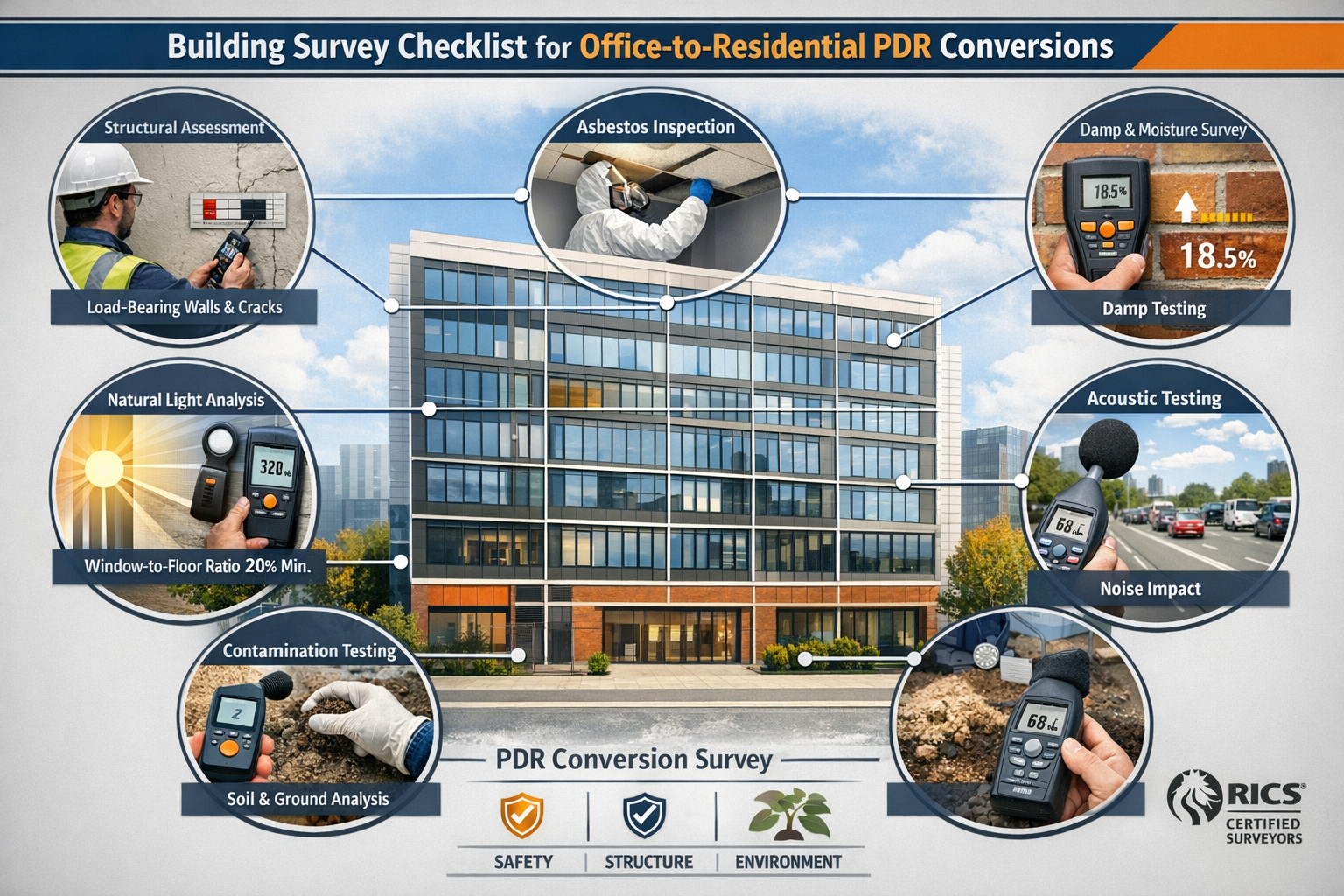
Professional building surveys for office-to-residential conversions demand adherence to RICS standards and best practice protocols that ensure comprehensive risk identification and accurate cost forecasting.
RICS Building Survey Methodology
The Royal Institution of Chartered Surveyors provides definitive guidance on building survey standards through the RICS Home Survey Standard and related professional statements. While these documents primarily address residential property surveys, their principles apply equally to conversion feasibility assessments.
A properly executed conversion survey should incorporate:
Non-invasive inspection: Visual examination of all accessible building elements, including roofs, external walls, internal spaces, basements, and service installations. Limitations on access must be clearly documented.
Invasive investigation: Where significant defects are suspected, targeted invasive investigation using borescopes, moisture meters, and material sampling provides definitive evidence of condition and extent.
Services assessment: Evaluation of existing electrical, plumbing, heating, and ventilation systems to determine reusability versus replacement requirements. Office buildings typically feature centralized systems incompatible with individual residential units.
Regulatory compliance review: Assessment against current Building Regulations, fire safety requirements, accessibility standards, and energy performance obligations.
Engaging RICS chartered building surveyors ensures adherence to professional standards and provides insurance-backed assurance of survey quality.
Specific Defect Identification for Conversion Feasibility
Beyond standard building pathology, conversion surveys must identify defects and characteristics that specifically impact residential transformation:
🔍 Ceiling height constraints: Many office buildings feature floor-to-ceiling heights of 2.4-2.6 metres. After installing new suspended ceilings to conceal services, habitable room heights may fall below acceptable residential standards.
🔍 Acoustic separation challenges: Office buildings rarely incorporate sound insulation between floors or vertical separations. Creating compliant acoustic separation between residential units requires substantial additional construction.
🔍 Fire compartmentation: Residential fire safety standards differ significantly from commercial requirements, necessitating new fire doors, compartment walls, and protected escape routes.
🔍 Accessibility and means of escape: Residential buildings require compliant stairways, corridor widths, and emergency egress routes that may not align with existing office circulation patterns.
Professional specific defect surveys provide targeted investigation of these conversion-critical issues.
Cost Planning and Budget Risk Management
Accurate cost forecasting separates successful conversion projects from financial disasters. Building surveys must provide sufficient detail to enable quantity surveyors to price:
- Structural alterations and strengthening works
- Asbestos and hazardous material removal
- Complete mechanical and electrical services installation
- New internal partitions and acoustic separation
- External envelope repairs and upgrades
- Accessibility improvements and fire safety measures
Contingency allowances for unforeseen conditions should reflect the age and construction type of the building. Pre-1980s office buildings typically warrant 15-20% contingencies, while more recent structures may justify 10-15% provisions.
The survey report should explicitly identify areas where invasive investigation was limited, highlighting residual risks that may emerge during construction. This transparency enables informed decision-making and appropriate risk allocation in development appraisals.
Integration with Prior Approval Documentation
Building survey findings directly inform the technical documentation required for prior approval applications. Survey outputs should be structured to support:
Contamination assessments: Identification of potential land contamination from previous industrial uses, fuel storage, or hazardous materials[1][2].
Flood risk evaluations: Assessment of basement flooding vulnerability, surface water drainage adequacy, and flood resilience measures.
Transport and highways impacts: Evaluation of site access, parking provision, and servicing arrangements for residential use.
Noise assessments: Measurement of ambient noise levels from adjacent roads, commercial activities, or transport infrastructure affecting residential amenity[1].
Coordinating building surveys with these specialist assessments creates a comprehensive due diligence package that streamlines the prior approval process and reduces application rejection risks.
Schedule of Condition and Dilapidations Considerations
For leasehold office properties being acquired for conversion, a detailed schedule of condition documents the existing state before works commence. This baseline record protects against future dilapidations claims and clarifies responsibility for pre-existing defects.
Similarly, where office buildings are subject to existing leases, dilapidations surveys identify tenant obligations for reinstatement or repair that may impact acquisition negotiations and conversion timelines.
Common Risks and Red Flags in Office-to-Residential Conversions
Experience with conversion projects reveals recurring risk factors that warrant particular scrutiny during building surveys. Recognizing these red flags early prevents costly project failures.
Layout and Configuration Challenges
Deep-plan buildings with limited external wall area relative to floor space struggle to achieve adequate natural light and ventilation in all habitable rooms. Buildings with floor plate depths exceeding 12-14 metres from external walls typically face significant design constraints[2].
Irregular structural grids with inconsistent column spacing create difficulties achieving regular room layouts and compliant space standards. Post-war concrete frame buildings often feature structural patterns optimized for office use that resist residential subdivision.
Limited vertical circulation: Office buildings designed for commercial occupation may lack sufficient stairwell and lift capacity for residential use, particularly where conversions create high unit densities.
Building Services Obsolescence
Commercial buildings feature centralized heating, cooling, and ventilation systems incompatible with individual residential control. Complete services replacement typically represents 20-30% of conversion costs, yet surveys sometimes underestimate this requirement.
Particular concerns include:
⚠️ Inadequate electrical capacity for residential loads
⚠️ Absence of individual gas or heating connections
⚠️ Centralized hot water systems requiring complete replacement
⚠️ Ventilation systems unsuitable for residential kitchens and bathrooms
⚠️ Telecommunications infrastructure requiring comprehensive upgrade
External Envelope and Cladding Issues
Recent building safety legislation has intensified scrutiny of external wall systems, particularly on buildings exceeding 18 metres height. Combustible cladding or inadequate fire breaks in external wall construction may require complete replacement at substantial cost[7].
Curtain walling systems common in 1970s-1990s office buildings frequently exhibit:
- Thermal bridging and condensation risks
- Failed seals and water penetration
- Single glazing requiring replacement
- Structural movement damage
- Inadequate thermal performance for residential standards
External envelope remediation often emerges as the largest unforeseen cost in conversion projects, emphasizing the importance of thorough facade surveys.
Contamination and Environmental Liabilities
Office buildings on previously industrial sites may harbor ground contamination requiring remediation before residential use. Phase 1 desk studies and Phase 2 intrusive investigations identify contamination risks that impact project viability[1][4].
Former industrial uses creating particular concern include:
- Manufacturing facilities with chemical storage
- Fuel distribution and storage sites
- Dry cleaning operations using chlorinated solvents
- Printing works with heavy metal contamination
- Vehicle repair facilities with hydrocarbon pollution
Remediation costs for contaminated sites can reach hundreds of pounds per square metre, fundamentally altering project economics.
Article 4 Direction and Planning Constraints
Despite PDR eligibility, Article 4 Directions remove permitted development rights in designated areas. These restrictions typically apply in:
- Conservation areas with employment protection policies
- Town centers where councils seek to retain commercial uses
- Areas with specific housing mix or affordability concerns
- Locations with infrastructure capacity constraints[3]
Early verification of Article 4 Direction status prevents wasted survey and design expenditure on projects that cannot proceed under PDR.
Conclusion: Strategic Approach to Building Surveys for Permitted Development Rights Under 2026 Reforms
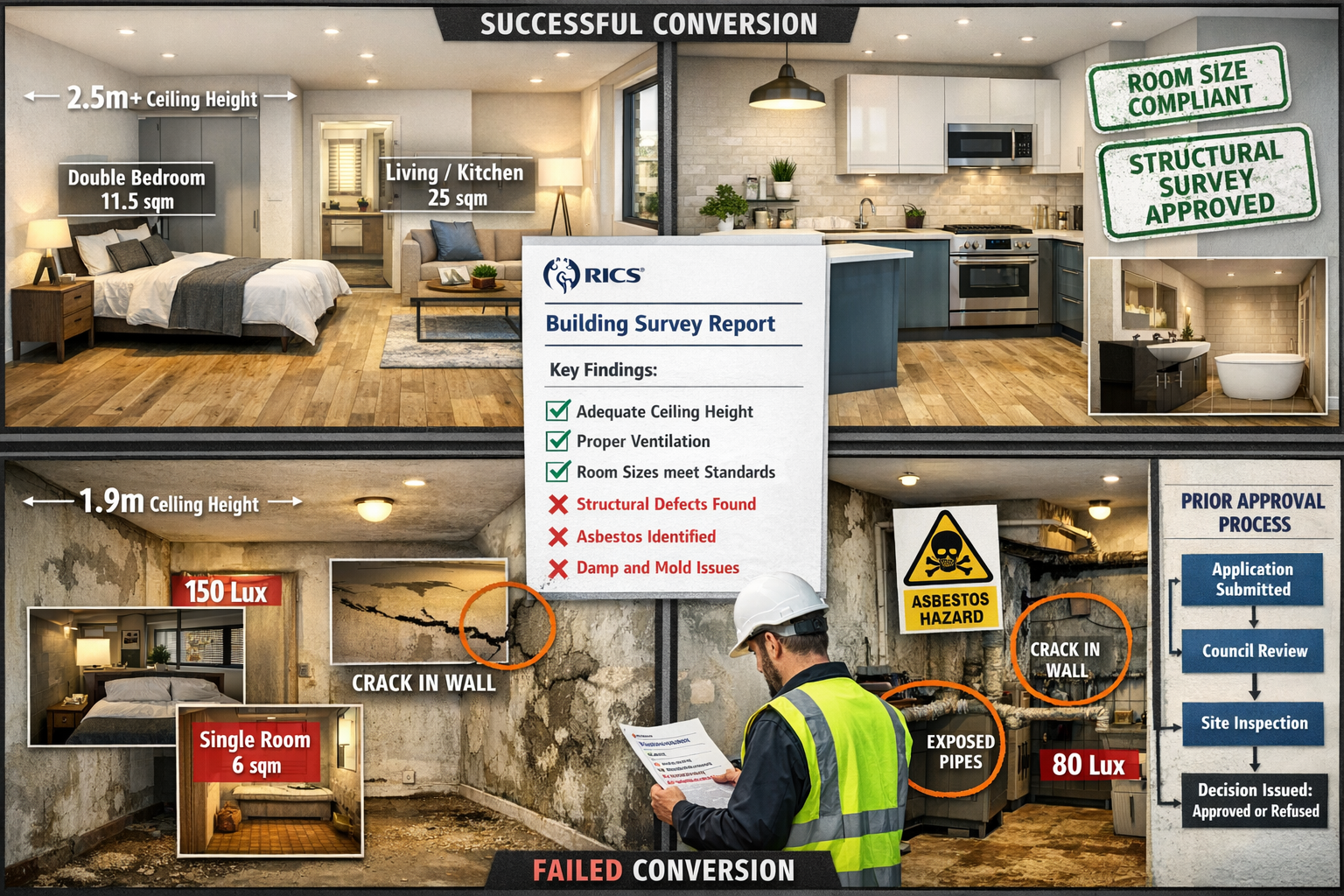
The 2026 reforms to Permitted Development Rights have created substantial opportunities for office-to-residential conversions, removing size limitations and vacancy requirements that previously constrained the sector. However, the expanded PDR framework has simultaneously increased the importance of comprehensive building surveys that identify technical risks before financial commitments are made.
Building Surveys for Permitted Development Rights: Assessing Office-to-Resi Conversions Under 2026 Reforms must address the unique challenges of transforming commercial structures into compliant residential homes. From asbestos-laden materials in aging office blocks to inadequate natural light in deep-plan buildings, the physical realities of older commercial property create formidable obstacles that only rigorous technical assessment can reveal.
Successful conversion projects begin with RICS-compliant building surveys that evaluate structural integrity, identify hazardous materials, assess building envelope performance, and determine compliance with National Space Standards and natural light requirements. These investigations provide the foundation for accurate cost forecasting, realistic project programming, and informed risk management.
Actionable Next Steps
For developers, investors, and property owners considering office-to-residential conversions under the 2026 PDR framework:
-
Verify PDR eligibility by confirming the absence of Article 4 Directions and reviewing local planning authority guidance on prior approval requirements
-
Commission comprehensive building surveys from RICS chartered surveyors with specific experience in commercial-to-residential conversion projects
-
Conduct specialist assessments including asbestos surveys, contamination investigations, and structural engineering evaluations to supplement general building surveys
-
Evaluate natural light and space standards compliance early in the feasibility process, as these constraints frequently determine project viability
-
Develop detailed cost plans incorporating survey findings, with appropriate contingencies for unforeseen conditions in older buildings
-
Coordinate survey outputs with prior approval documentation requirements on transport, contamination, flooding, and noise impacts
-
Engage early with Local Planning Authorities to clarify interpretation of requirements and identify potential approval obstacles
The removal of size and vacancy constraints under the 2026 reforms has expanded the universe of potential conversion opportunities, but technical due diligence remains the critical success factor. Buildings that appear superficially suitable for residential conversion may harbor structural defects, hazardous materials, or layout constraints that render projects unviable. Only through comprehensive building surveys can developers distinguish genuine opportunities from costly mistakes.
The urban regeneration potential of office-to-residential conversions continues to grow as commercial property markets evolve and housing demand persists. Those who invest in thorough technical assessment and professional survey expertise position themselves to capitalize on this opportunity while managing the substantial risks inherent in transforming aging office buildings into modern homes.
References
[1] How To Successfully Convert Offices Into Homes – https://www.garnessjones.co.uk/news/how-to-successfully-convert-offices-into-homes
[2] How To Convert Offices Into Homes Without Planning Permission – https://urbanistarchitecture.co.uk/how-to-convert-offices-into-homes-without-planning-permission/
[3] Office To Residential Permitted Development – https://www.lsh.co.uk/explore/research-and-views/view-points/2024/june/office-to-residential-permitted-development
[4] Convert Comercial Property – https://www.legalclarity.co.uk/blog/convert-comercial-property
[5] Convert Commercial To Residential – https://osbournepinner.com/blog/convert-commercial-to-residential/
[6] Office To Residential Conversion What To Know – https://www.jpmorgan.com/insights/real-estate/community-development-banking/office-to-residential-conversion-what-to-know
[7] Converting Commercial To Residential What You Need To Know – https://www.cooperparry.com/news/converting-commercial-to-residential-what-you-need-to-know/