
The landscape of property compliance in the UK rental market has transformed dramatically in 2026, with landlords and property professionals facing unprecedented challenges in meeting new energy performance standards. Building Surveys for EPC Retrofit Mandates 2026: Identifying Defects and Unlocking Incentives has become a critical concern for surveyors, landlords, and property investors navigating the evolving regulatory framework. With the government confirming on 21 January 2026 that private landlords must achieve an EPC rating of C by 1 October 2030[3], the pressure is on to identify defects, plan strategic retrofits, and maximize available financial incentives.
The recovery of rental markets post-pandemic, combined with the RICS Quality Summit's emphasis on professional standards, has elevated the role of chartered surveyors in ensuring compliance while maintaining property value. This comprehensive guide explores how Building Surveys for EPC Retrofit Mandates 2026: Identifying Defects and Unlocking Incentives can help property professionals navigate the complex intersection of defect detection, energy efficiency upgrades, and financial planning.
Key Takeaways
🔑 EPC C Deadline Confirmed: Private landlords must achieve EPC rating C by 1 October 2030, with a reduced cost cap of £10,000 per property for energy efficiency improvements[2][3].
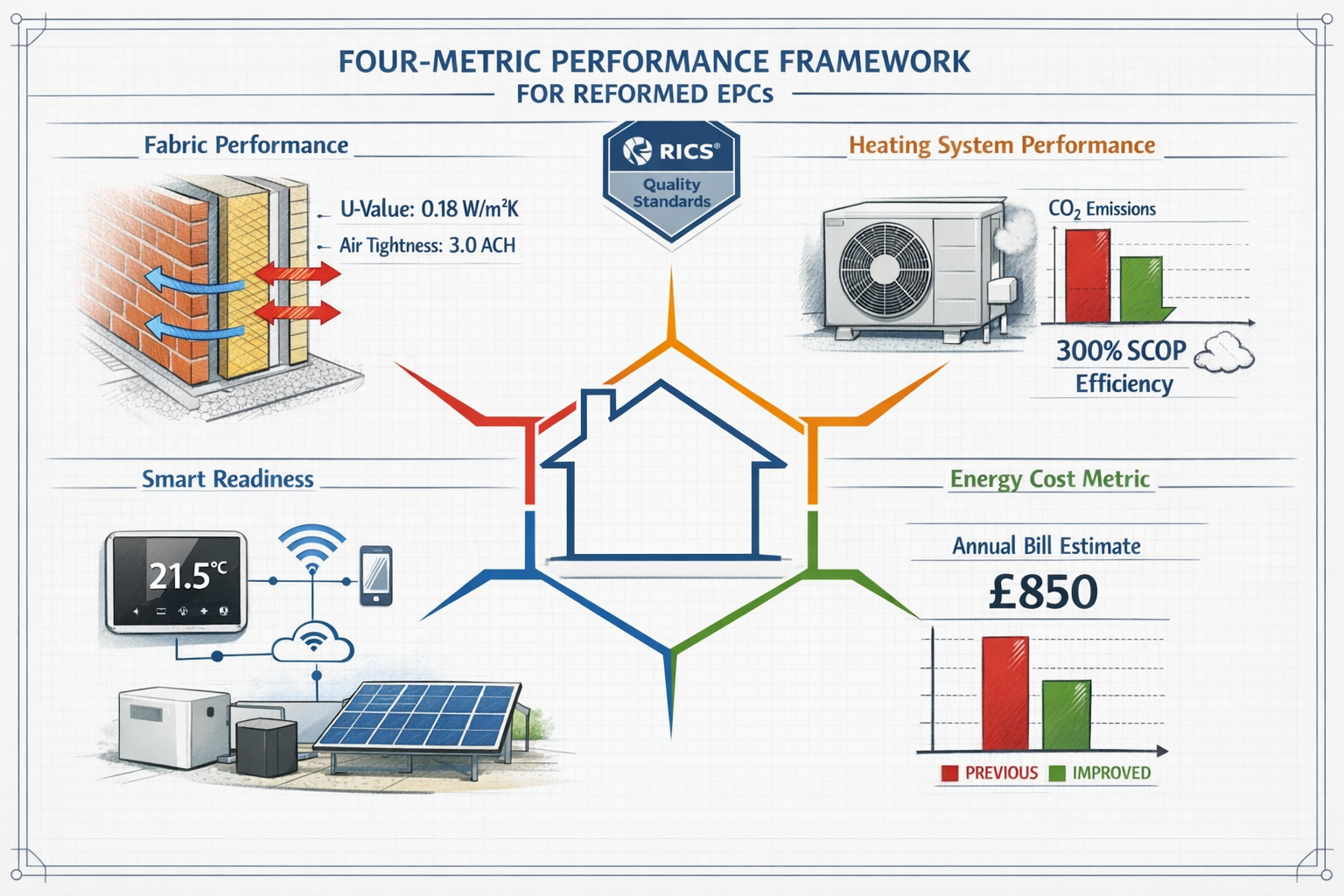
🔍 Four-Metric Framework: Reformed EPCs will replace single ratings with four performance metrics: fabric performance, heating system performance, smart readiness, and energy cost[2][5].
💰 Financial Incentives Available: Targeted grants prioritize households earning below £36,000 annually, with tax deductibility options for self-funded improvements[2].
🏗️ Defect Detection Critical: Professional building surveys identify retrofit-related defects before they compromise compliance or property value.
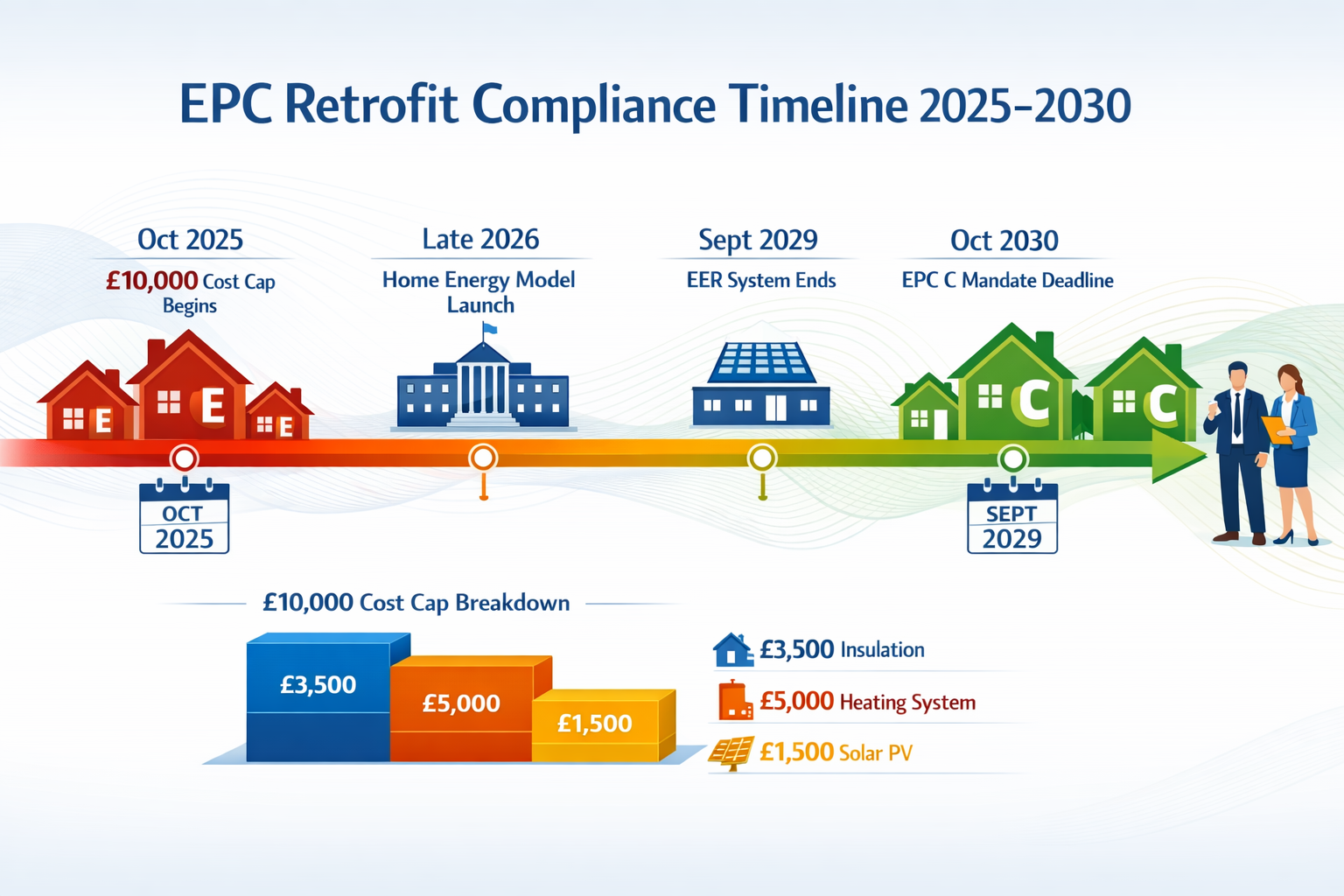
⏰ Dual System Transition: The Home Energy Model (HEM) launches in late 2026, running parallel with the current EER system until 30 September 2029[3].
Understanding the 2026 EPC Retrofit Landscape
The Regulatory Framework Driving Change
The UK government's commitment to reducing carbon emissions has resulted in a comprehensive overhaul of energy performance requirements for rental properties. The Building Surveys for EPC Retrofit Mandates 2026: Identifying Defects and Unlocking Incentives framework represents a fundamental shift in how property professionals approach compliance and property improvement.
The January 2026 Warm Homes Plan introduced several key changes that directly impact landlords and surveyors:
Cost Cap Reduction: The maximum expenditure burden for energy efficiency upgrades has been set at £10,000 per property[2], significantly lower than initially proposed thresholds. This cap applies to all improvements made from 1 October 2025 onwards[3], meaning landlords who began early compliance efforts can count those costs toward their limit.
Timeline Clarity: With the EPC C requirement confirmed for 1 October 2030[3], landlords have approximately four years to complete necessary upgrades. However, the transition to the new Home Energy Model (HEM) system in late 2026 adds complexity to planning decisions.
Validity Period Maintained: Despite significant reforms, EPCs will retain their current ten-year validity period[5], providing some stability for property owners who achieve compliance early.
The Four-Metric Performance Framework
The reformed EPC system represents a paradigm shift from simplistic letter ratings to a nuanced, multi-dimensional assessment. Understanding these four metrics is essential for surveyors conducting RICS building surveys focused on retrofit planning:
| Metric | Focus Area | Impact on Retrofit Planning |
|---|---|---|
| Fabric Performance | Heat retention and insulation quality | Prioritizes wall, roof, and floor insulation upgrades |
| Heating System Performance | Carbon impact and efficiency | Drives heat pump and renewable heating installations |
| Smart Readiness | Capacity for smart technologies | Encourages smart thermostats, battery storage, and monitoring systems |
| Energy Cost | Estimated annual energy bill | Provides tangible financial impact for tenants |
This framework means that achieving EPC C under the new system will likely require either solar PV or heat pump installation[3], whereas the current system permits various combinations of measures. This specificity makes comprehensive building surveys more critical than ever.
Funding Models and Financial Incentives
The government has structured financial support through three primary channels:
1. Government-Backed Loans: These allow landlords to spread the cost of improvements over time, making the £10,000 cap more manageable[2].
2. Targeted Grant Schemes: Priority access is given to:
- Households with annual income below £36,000[2]
- Properties with residents having long-term health conditions verified by a GP[2]
- Properties rated D, E, F, or G (those already rated A, B, or C are excluded)[2]
- Homes using oil, LPG, coal, wood, or electric heating (mains gas properties may only qualify for insulation)[2]
3. Tax Deductibility: Self-funded qualifying improvements can be treated as allowable expenses, providing tax relief for landlords who invest privately[2].
Building Surveys for EPC Retrofit Mandates 2026: Strategic Defect Identification
The Critical Role of Pre-Retrofit Surveys
Before embarking on any energy efficiency improvements, landlords and property investors need comprehensive defect identification through professional RICS Level 3 building surveys. The Building Surveys for EPC Retrofit Mandates 2026: Identifying Defects and Unlocking Incentives approach recognizes that retrofit measures can exacerbate existing defects or create new problems if underlying issues aren't addressed first.
Why Defect Detection Matters for EPC Compliance:
✅ Prevents Retrofit Failure: Installing insulation over damp walls or upgrading heating systems in poorly ventilated properties can lead to condensation, mold growth, and system inefficiency.
✅ Maximizes Cost-Effectiveness: The £10,000 cost cap means every pound must deliver maximum performance improvement. Addressing defects first ensures retrofit measures perform as intended.
✅ Protects Property Value: Poorly executed retrofits can diminish property value and marketability, particularly if they create new problems or fail to achieve the intended EPC rating.
✅ Ensures Compliance Longevity: EPCs remain valid for ten years[5], so retrofits must deliver sustained performance without degradation from unaddressed defects.
Common Defects That Compromise Retrofit Performance
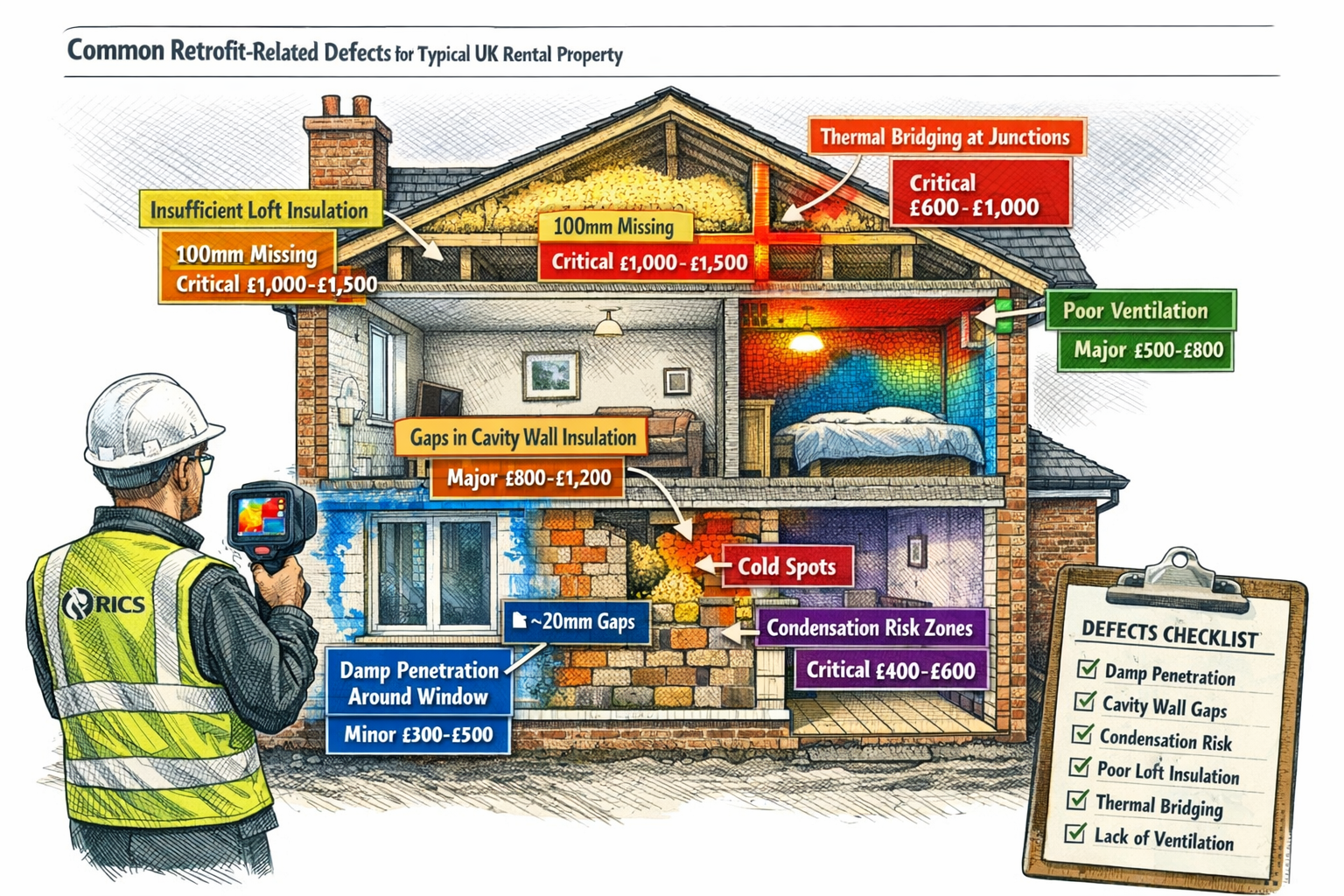
Chartered surveyors conducting specific defect surveys for EPC retrofit planning should focus on these critical areas:
1. Moisture and Damp Issues 🌧️
Moisture problems are the most common defect that undermines energy efficiency improvements:
- Rising Damp: Compromises floor and wall insulation effectiveness
- Penetrating Damp: Often worsened by external wall insulation if not properly addressed
- Condensation: Exacerbated by improved airtightness without adequate ventilation
- Roof Leaks: Must be resolved before loft insulation upgrades
Professional damp surveys should be conducted before any insulation work, particularly in older properties where moisture management is complex.
2. Structural Movement and Cracking
Structural issues can prevent proper installation of retrofit measures:
- Subsidence: Affects foundation insulation and ground floor thermal performance
- Wall Tie Failure: Compromises cavity wall insulation installation
- Lintel Deterioration: Creates thermal bridging and installation challenges
- Settlement Cracks: May worsen with added weight of external insulation systems
3. Ventilation Deficiencies
Inadequate ventilation becomes critical when properties are made more airtight:
- Blocked Airbricks: Prevent underfloor ventilation
- Inadequate Trickle Vents: Insufficient for improved airtightness
- Bathroom/Kitchen Extraction: Often undersized for post-retrofit moisture loads
- Chimney Ventilation: Requires careful management when fireplaces are sealed
4. Roof and Loft Defects
Roof surveys are essential before loft insulation upgrades:
- Roof Covering Deterioration: Must be addressed before adding insulation weight
- Rafter Rot or Decay: Compromises insulation installation
- Inadequate Loft Ventilation: Creates condensation risk with increased insulation
- Vermin Infestation: Must be resolved before insulation installation
5. Heating System Inefficiencies
Existing heating systems often have hidden defects that affect upgrade planning:
- Undersized Radiators: Inadequate for heat pump operation
- Corroded Pipework: Contaminates new high-efficiency systems
- Poor System Balance: Reduces efficiency of new heating technologies
- Inadequate Electrical Supply: Prevents heat pump or solar PV installation
Survey Methodologies for EPC Retrofit Planning
Professional surveyors should employ a multi-faceted approach when conducting Building Surveys for EPC Retrofit Mandates 2026: Identifying Defects and Unlocking Incentives assessments:
Thermal Imaging Surveys: Identify heat loss patterns, insulation gaps, thermal bridging, and air leakage points that impact fabric performance metrics.
Moisture Meter Testing: Quantify moisture levels in walls, floors, and timbers to assess damp risks before insulation installation.
Air Tightness Testing: Establish baseline air leakage rates to plan ventilation requirements for post-retrofit conditions.
Structural Assessment: Evaluate load-bearing capacity for external insulation systems, solar panel installations, and roof upgrades.
Electrical Inspection: Confirm supply capacity for heat pumps, solar PV systems, and smart home technologies.
Drainage Survey: Ensure proper water management before external insulation that may affect drainage patterns.
Unlocking Financial Incentives Through Strategic Survey Planning
Maximizing Grant Eligibility
Professional building surveys play a crucial role in accessing available funding by:
Documenting Current Performance: Detailed surveys establish baseline EPC ratings, confirming eligibility for grants limited to properties rated D, E, F, or G[2].
Identifying Priority Measures: Surveys highlight which improvements deliver maximum rating improvement within the £10,000 cost cap[2].
Supporting Grant Applications: Comprehensive defect reports strengthen applications by demonstrating professional planning and realistic cost estimates.
Verifying Heating System Type: Surveys confirm whether properties use oil, LPG, coal, wood, or electric heating, which receive priority for grants[2].
Cost-Effective Retrofit Pathways
The £10,000 cost cap requires strategic prioritization of improvements. Survey findings should inform a phased approach:
Phase 1: Essential Defect Remediation (£2,000-£3,000)
- Address damp issues
- Repair structural defects
- Upgrade inadequate ventilation
- Fix roof leaks
Phase 2: Fabric Improvements (£3,000-£4,000)
- Loft insulation upgrade to 300mm
- Cavity wall insulation (if suitable)
- Floor insulation
- Window upgrades (if budget permits)
Phase 3: Heating System Upgrade (£4,000-£5,000)
- Heat pump installation, OR
- High-efficiency boiler with smart controls
- Radiator upgrades
- System balancing
Phase 4: Smart and Renewable Technologies (£1,000-£2,000)
- Smart thermostats and controls
- Solar PV (if budget permits)
- Battery storage (if applicable)
This phased approach ensures the £10,000 cap delivers maximum EPC improvement while addressing underlying defects that could compromise performance.
Tax Planning Considerations
For landlords self-funding improvements, professional surveys provide essential documentation for tax deductibility claims:
Qualifying Expenditure Documentation: Detailed survey reports establish the necessity and nature of improvements, supporting tax relief claims[2].
Capital vs. Revenue Expenditure: Survey findings help distinguish between capital improvements and revenue repairs, affecting tax treatment.
Compliance Evidence: Professional surveys demonstrate due diligence in meeting regulatory requirements, supporting tax positions.
Valuation Impact: Pre- and post-retrofit valuations quantify property value enhancement, relevant for capital gains calculations.
Building Surveys for EPC Retrofit Mandates 2026: Implementation Strategies
Timing Considerations for the HEM Transition
The launch of the Home Energy Model (HEM) in late 2026, running parallel with the existing EER system until 30 September 2029[3], creates strategic timing considerations:
Early Adoption Benefits:
- Lock in current EPC rating under existing system before 30 September 2029[3]
- Ten-year validity provides compliance until 2039
- Avoid uncertainty of new HEM assessment methodology
Late Adoption Benefits:
- Better understanding of HEM requirements
- Potential for more favorable rating under new system
- Access to improved technology and installer expertise
Strategic Recommendation: Properties close to EPC C under the current system should prioritize completion before September 2029. Properties requiring extensive work may benefit from waiting to optimize for the new four-metric framework[2][5].
Choosing the Right Survey Type
Different property scenarios require different survey approaches:
| Property Scenario | Recommended Survey Type | Key Focus Areas |
|---|---|---|
| Pre-Purchase Assessment | RICS Level 2 HomeBuyer Survey | EPC rating, obvious defects, retrofit cost estimates |
| Retrofit Planning | RICS Level 3 Building Survey | Comprehensive defect identification, structural suitability, detailed specifications |
| Specific Issue Investigation | Specific Defect Report | Targeted investigation of damp, structural, or heating issues |
| Portfolio Assessment | Multiple targeted surveys | Prioritization across properties, budget allocation, compliance timeline |
Working with RICS Chartered Surveyors
The RICS Quality Summit emphasized the importance of professional standards in building surveys. When selecting a surveyor for Building Surveys for EPC Retrofit Mandates 2026: Identifying Defects and Unlocking Incentives assessments, consider:
RICS Accreditation: Ensures adherence to professional standards and ethical practice. Learn more about why choosing an RICS chartered building surveyor matters for your property.
Energy Efficiency Expertise: Look for surveyors with specific experience in retrofit planning and EPC compliance.
Thermal Imaging Capability: Modern surveys should include thermal imaging to identify heat loss patterns.
Comprehensive Reporting: Reports should provide actionable recommendations with cost estimates and prioritization.
Local Market Knowledge: Understanding regional construction types, common defects, and local contractor costs improves planning accuracy.
Technology Integration in Modern Surveys
Advanced survey technologies enhance defect detection and retrofit planning:
Thermal Imaging Cameras: Identify insulation gaps, thermal bridging, air leakage, and moisture problems invisible to visual inspection.
Moisture Meters: Quantify moisture content in building materials, distinguishing between surface condensation and penetrating damp.
Drone Surveys: Enable safe, detailed inspection of roofs, chimneys, and high-level building elements. Explore how drone surveys can enhance property assessments.
3D Scanning: Creates detailed property models for retrofit planning and contractor briefing.
Air Leakage Testing: Measures building airtightness to inform ventilation and insulation planning.
Common Retrofit Challenges and Survey Solutions
Challenge 1: Cavity Wall Insulation in Non-Standard Construction
Problem: Many UK properties feature non-standard construction that complicates cavity wall insulation.
Survey Solution:
- Detailed wall construction assessment
- Moisture risk evaluation
- Alternative insulation pathway identification (external or internal wall insulation)
- Cost-benefit analysis of different approaches
Challenge 2: Listed Buildings and Conservation Areas
Problem: Planning restrictions limit retrofit options in protected properties.
Survey Solution:
- Heritage-sensitive improvement identification
- Planning permission requirement assessment
- Alternative compliance pathways
- Conservation officer consultation support
Challenge 3: Solid Wall Properties
Problem: Solid wall insulation is expensive and may exceed the £10,000 cost cap[2] when combined with other necessary improvements.
Survey Solution:
- Prioritization of most cost-effective measures
- Internal vs. external insulation cost comparison
- Grant eligibility maximization
- Phased implementation planning
Challenge 4: Communal Heating Systems
Problem: Flats with communal heating face unique challenges in individual EPC improvement.
Survey Solution:
- Individual property improvement opportunities identification
- Communal system upgrade feasibility assessment
- Leaseholder consultation requirements
- Alternative compliance pathways
Challenge 5: Asbestos in Older Properties
Problem: Retrofit work may disturb asbestos-containing materials in pre-2000 properties.
Survey Solution:
- Asbestos surveys before retrofit planning
- Safe removal cost integration into budget
- Contractor notification requirements
- Compliance with Control of Asbestos Regulations
Portfolio Management and Compliance Prioritization
Strategic Portfolio Assessment
Landlords with multiple properties need systematic approaches to Building Surveys for EPC Retrofit Mandates 2026: Identifying Defects and Unlocking Incentives:
Risk-Based Prioritization:
- High Risk: Properties currently rated E, F, or G requiring extensive work
- Medium Risk: D-rated properties needing moderate improvements
- Low Risk: Properties close to C rating requiring minor upgrades
Financial Prioritization:
- Properties eligible for grants (heating type, tenant income, current rating)[2]
- Properties where tax-deductible improvements deliver maximum benefit[2]
- Properties where early compliance locks in favorable EER ratings before HEM transition[3]
Tenancy Prioritization:
- Vacant properties (easier access for extensive work)
- Properties approaching lease renewal (coordinate with tenant changeover)
- Occupied properties (require careful tenant liaison and phased work)
Budget Allocation Across Portfolios
With the £10,000 per-property cost cap[2], portfolio landlords must allocate resources strategically:
Scenario 1: 10-Property Portfolio
- Total available budget: £100,000
- Prioritize properties furthest from compliance
- Leverage grants for eligible properties
- Consider selling non-compliant properties if retrofit costs exceed value enhancement
Scenario 2: Mixed-Use Portfolio
- Residential properties face October 2030 deadline[3]
- Commercial properties may have different timelines
- Prioritize residential compliance first
- Consider cross-subsidization where financially viable
Monitoring and Verification
Post-retrofit verification ensures compliance achievement:
New EPC Assessment: Obtain updated EPC certificate to confirm C rating achievement.
Performance Monitoring: Track actual energy consumption against predicted performance.
Defect Warranty: Ensure retrofit work includes appropriate warranties and guarantees.
Maintenance Planning: Establish maintenance schedules to preserve EPC rating throughout ten-year validity period[5].
Future-Proofing Beyond 2030 Compliance
Anticipating Further Regulatory Tightening
While the current mandate targets EPC C by October 2030[3], property professionals should anticipate future requirements:
Potential EPC B Requirement: Industry speculation suggests EPC B may become mandatory by 2035-2040.
Net Zero Alignment: The UK's 2050 net-zero commitment will likely drive further property performance requirements.
Smart Technology Integration: The smart readiness metric[2][5] signals increasing importance of technology integration.
Survey Recommendation: Design retrofit programs with upgrade pathways to EPC B, even if initially targeting C rating.
Building Resilience Through Quality Surveys
Building Surveys for EPC Retrofit Mandates 2026: Identifying Defects and Unlocking Incentives should incorporate resilience planning:
Climate Adaptation: Consider overheating risk, flood resilience, and extreme weather protection.
Technology Flexibility: Ensure electrical and structural capacity for future technology upgrades.
Maintenance Accessibility: Design retrofits with long-term maintenance requirements in mind.
Tenant Wellbeing: Prioritize improvements that enhance comfort, health, and satisfaction.
Regional Variations and Local Considerations
Construction Type Variations
Different UK regions feature distinct construction types affecting retrofit approaches:
Northern Industrial Areas: Solid brick terraces requiring external or internal wall insulation.
Victorian London Properties: Complex construction with heritage considerations.
Post-War Estates: Cavity wall construction often suitable for insulation but may have structural issues.
Modern Developments: May already approach EPC C but require targeted improvements.
Climate Considerations
Regional climate affects retrofit priorities:
Scotland and Northern England: Heating performance and insulation critical.
Southern England: Increasing focus on overheating prevention and cooling.
Coastal Areas: Moisture management and weather resistance paramount.
Urban Heat Islands: Ventilation and smart cooling technologies important.
Local Contractor Availability
Survey recommendations should consider local contractor capacity:
Heat Pump Installers: Limited availability in some regions affects costs and timelines.
Insulation Specialists: Varying expertise with different insulation types.
Heritage Specialists: Essential for listed buildings and conservation areas.
Survey Recommendation: Include contractor availability assessment in retrofit planning.
Case Studies: Successful Retrofit Implementations
Case Study 1: Victorian Terrace Upgrade (EPC E to C)
Property: Three-bedroom Victorian terrace, solid brick construction, gas central heating
Initial Survey Findings:
- Rising damp in ground floor
- No loft insulation
- Single-glazed sash windows
- Inefficient boiler (15 years old)
- Poor ventilation
Retrofit Strategy:
- Damp-proof course installation (£1,200)
- Loft insulation to 300mm (£800)
- Internal wall insulation to living areas (£3,500)
- Secondary glazing to front windows (£2,000)
- High-efficiency combi boiler with smart controls (£2,500)
Total Cost: £10,000 (within cap)
Result: EPC rating improved from E (42) to C (72)
Grant Support: £3,000 (eligible due to property rating and heating type)
Case Study 2: 1960s Semi-Detached (EPC D to C)
Property: Three-bedroom semi-detached, cavity wall construction, gas central heating
Initial Survey Findings:
- Partial cavity wall insulation
- Inadequate loft insulation (100mm)
- Double glazing (original, poor condition)
- Inefficient boiler
- No smart controls
Retrofit Strategy:
- Complete cavity wall insulation (£1,500)
- Loft insulation upgrade to 300mm (£600)
- High-efficiency boiler replacement (£2,500)
- Smart thermostat and TRVs (£400)
- Solar PV installation (4kW) (£5,000)
Total Cost: £10,000 (within cap)
Result: EPC rating improved from D (62) to C (78)
Additional Benefit: Feed-in tariff income and reduced energy bills
Case Study 3: Portfolio Approach (10 Properties)
Portfolio: Mixed Victorian and Edwardian properties, current ratings D-F
Survey-Led Strategy:
- Comprehensive surveys of all properties
- Prioritization by current rating and tenant eligibility
- Phased implementation over 3 years
- Grant maximization for eligible properties
- Tax planning for self-funded improvements
Results:
- 7 properties achieved EPC C within budget
- 2 properties sold (retrofit costs exceeded value enhancement)
- 1 property deferred pending HEM system clarity
- Total grant support: £18,000 across eligible properties
- Tax relief: £15,000 through allowable expenses
Professional Standards and Quality Assurance
RICS Professional Standards
The RICS Quality Summit reinforced professional standards for building surveys:
Competence Requirements: Surveyors must demonstrate specific competence in energy efficiency assessment and retrofit planning.
Continuing Professional Development: Regular training on evolving EPC regulations, retrofit technologies, and defect identification.
Professional Indemnity Insurance: Adequate coverage for retrofit planning advice and defect identification.
Ethical Practice: Transparent fee structures, conflict of interest management, and client-focused advice.
Quality Assurance in Survey Reporting
High-quality Building Surveys for EPC Retrofit Mandates 2026: Identifying Defects and Unlocking Incentives reports should include:
✅ Executive Summary: Clear overview of findings, recommendations, and cost estimates
✅ Defect Identification: Comprehensive catalogue of existing defects with severity ratings
✅ Retrofit Recommendations: Prioritized improvement measures with performance impact predictions
✅ Cost Estimates: Realistic budget projections based on local market rates
✅ Grant Eligibility Assessment: Analysis of available funding opportunities
✅ Timeline Planning: Phased implementation schedule aligned with compliance deadlines
✅ Risk Assessment: Identification of potential complications or challenges
✅ Photographic Evidence: Detailed images of defects and areas requiring improvement
✅ Technical Specifications: Sufficient detail for contractor quotations and work planning
Conclusion: Strategic Action for EPC Compliance Success
The Building Surveys for EPC Retrofit Mandates 2026: Identifying Defects and Unlocking Incentives framework represents a critical intersection of regulatory compliance, property improvement, and financial planning. With the October 2030 deadline confirmed[3] and the £10,000 cost cap in place[2], landlords and property professionals must act strategically to achieve compliance while maximizing property value and minimizing costs.
Professional building surveys conducted by RICS chartered surveyors form the foundation of successful retrofit planning. By identifying defects before they compromise improvement measures, prioritizing cost-effective upgrades, and accessing available financial incentives, property owners can navigate the transition to higher energy performance standards with confidence.
Actionable Next Steps
For Landlords with Single Properties:
- Obtain Current EPC: Establish baseline rating and identify improvement requirements
- Commission Professional Survey: Engage RICS chartered surveyor for comprehensive defect assessment
- Assess Grant Eligibility: Determine qualification for targeted grant schemes[2]
- Develop Phased Plan: Create realistic timeline and budget within £10,000 cap[2]
- Monitor HEM Transition: Track Home Energy Model developments for strategic timing decisions[3]
For Portfolio Landlords:
- Portfolio-Wide Assessment: Survey all properties to establish compliance risk profile
- Prioritize Strategically: Focus on properties furthest from compliance and grant-eligible
- Budget Allocation: Distribute resources across portfolio for maximum compliance achievement
- Consider Disposals: Evaluate whether some properties should be sold rather than retrofitted
- Tax Planning: Engage accountant to maximize tax relief on qualifying improvements[2]
For Property Professionals and Surveyors:
- Enhance Competence: Develop expertise in retrofit planning and energy efficiency assessment
- Invest in Technology: Acquire thermal imaging and diagnostic equipment
- Build Networks: Establish relationships with specialist contractors and energy assessors
- Stay Informed: Monitor regulatory developments, particularly HEM implementation[3][5]
- Quality Standards: Maintain RICS professional standards and continuing professional development
The Path Forward
The transformation of the UK rental market through energy performance requirements represents both challenge and opportunity. Properties that achieve EPC C rating will benefit from enhanced marketability, improved tenant satisfaction, reduced void periods, and future-proofed compliance. Those that fail to meet the October 2030 deadline face rental prohibition and potential property devaluation.
Building Surveys for EPC Retrofit Mandates 2026: Identifying Defects and Unlocking Incentives provides the strategic framework for navigating this transition successfully. By combining professional survey expertise, strategic planning, and financial optimization, property owners can transform regulatory compliance from burden to competitive advantage.
The recovery of rental markets in 2026, combined with increased tenant awareness of energy costs and environmental impact, makes energy efficiency a critical differentiator. Properties with strong EPC ratings command premium rents, attract quality tenants, and demonstrate responsible property management.
As the Home Energy Model launches in late 2026[3] and the industry transitions toward the four-metric performance framework[2][5], the role of professional building surveys will only increase in importance. Early action, informed by comprehensive defect identification and strategic retrofit planning, positions property owners for long-term success in an increasingly regulated and environmentally conscious market.
The £10,000 cost cap[2], while challenging, encourages focused, high-impact improvements that deliver genuine performance enhancement. Combined with available grants, tax relief, and professional survey guidance, achieving EPC C compliance is both achievable and financially viable for the vast majority of UK rental properties.
The time to act is now. With approximately four years until the October 2030 deadline[3], strategic planning and early implementation provide the best pathway to compliance, value preservation, and market competitiveness in the evolving landscape of UK property regulation.