
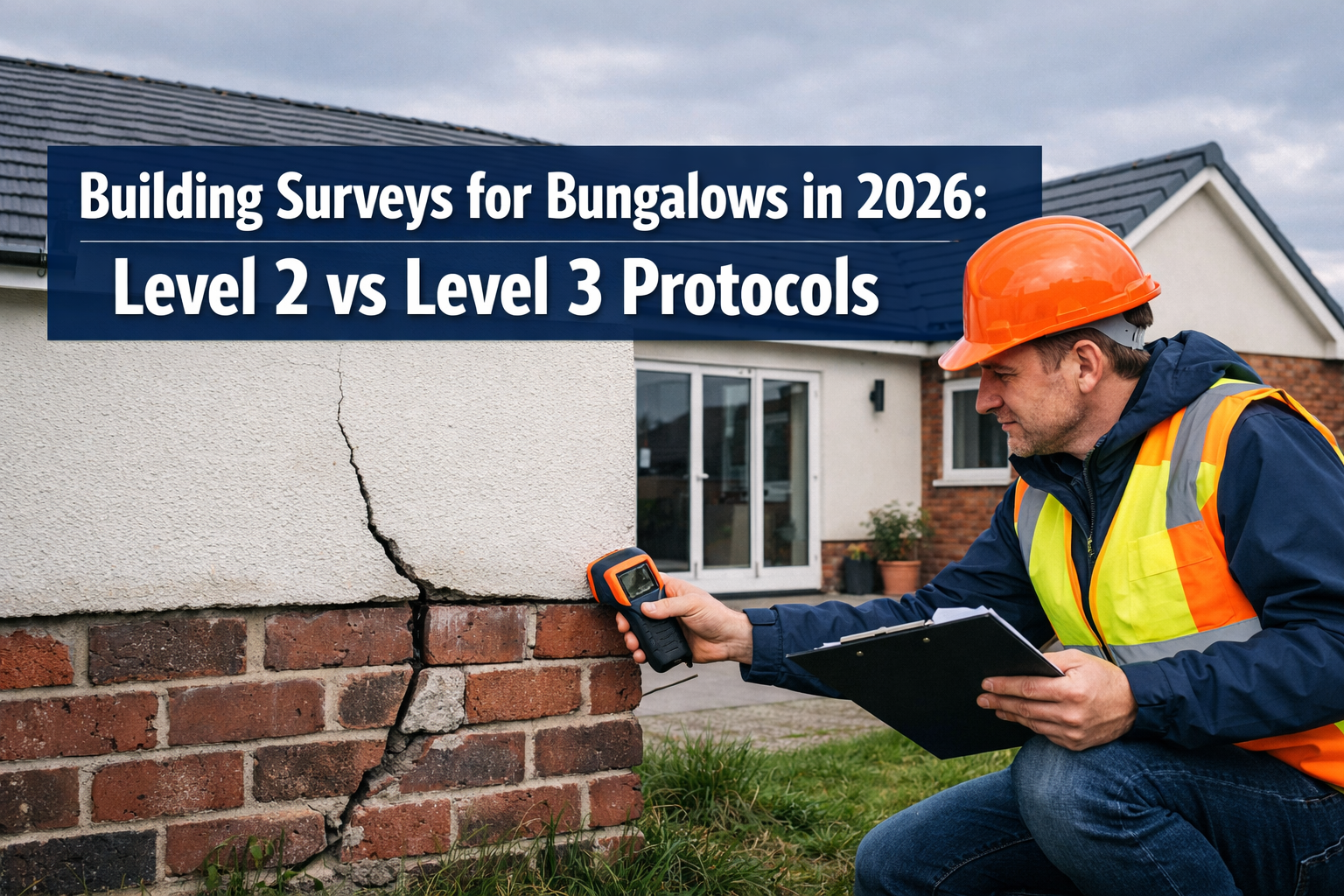
Bungalows now represent the fastest-growing segment of the UK housing market, with downsizers driving a 23% increase in bungalow valuations since 2024. Yet these single-storey properties harbour unique structural vulnerabilities that standard surveys often miss. Understanding Building Surveys for Bungalows in 2026: Level 2 vs Level 3 Protocols for Subsidence, Damp and Roof Spread Risks has become essential for buyers navigating a market where older bungalows frequently conceal costly defects beneath their deceptively simple exteriors.
The RICS Home Survey Standards distinguish between Level 2 (formerly HomeBuyer Report) and Level 3 (formerly Building Survey) inspections, but choosing the wrong protocol for a bungalow purchase can prove financially catastrophic. With bungalows typically built between 1920-1970 featuring shallow foundations, solid wall construction, and ageing roof structures, the difference between survey levels directly impacts whether subsidence, penetrating damp, or roof spread gets identified before exchange of contracts.
Key Takeaways
- Level 2 surveys suit post-1960 bungalows in good condition, taking 2-4 hours with 15-30 page reports, but provide limited structural analysis[1][3]
- Level 3 surveys are essential for pre-1920 bungalows and properties with visible defects, delivering 30-80 page comprehensive reports over 4-8 hours[1][3]
- Bungalows face heightened risks of subsidence (shallow foundations), damp (solid walls, low ground clearance), and roof spread (wide spans without intermediate support)
- Neither survey type involves invasive investigation like lifting floorboards, limiting detection of concealed defects[1][3]
- Survey selection should prioritize property age, construction type, visible condition, and intended renovation plans
Understanding Building Survey Protocols for Bungalows in 2026
The RICS (Royal Institution of Chartered Surveyors) standardized building survey protocols into three distinct levels in 2020, with Level 2 and Level 3 remaining the primary options for residential purchases in 2026. For bungalow buyers, understanding these protocols prevents costly mistakes.
What Level 2 Surveys Cover
Level 2 surveys provide a visual inspection of accessible areas without specialist equipment or invasive investigation. These surveys typically include:
- Visual assessment of main structural elements
- Identification of urgent defects requiring immediate attention
- General condition ratings using a traffic light system (red/amber/green)
- Basic commentary on services (heating, electrics, drainage)
- Market valuation and insurance reinstatement costs
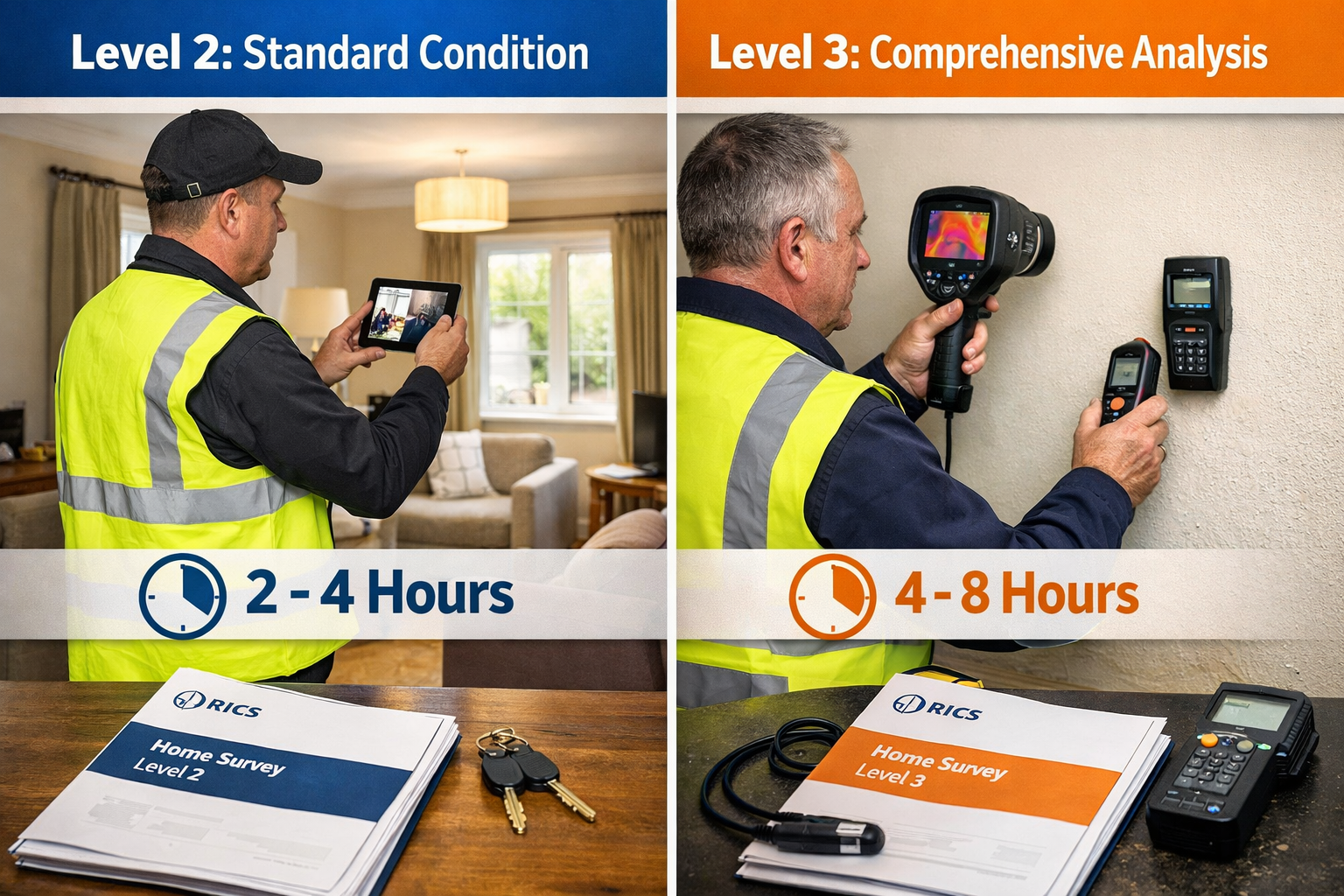
The inspection takes 2-4 hours and produces a 15-30 page report structured around RICS templates[1][3]. Surveyors do not move furniture, lift carpets, or access secured areas like loft spaces with locked hatches.
What Level 3 Surveys Deliver
Level 3 surveys offer comprehensive analysis suited to older or altered properties. These detailed inspections provide:
- Extensive structural assessment with technical analysis
- Detailed defect descriptions with repair cost estimates
- Investigation of construction methods and materials
- Assessment of alterations and their building regulation compliance
- Specific identification of subsidence, structural movement, damp penetration, timber decay, and masonry damage[3]
Level 3 surveys require 4-8 hours on-site and generate 30-80 page reports with photographs, diagrams, and technical commentary[1][3]. While still non-invasive, surveyors access all available areas and may recommend specialist investigations for concerning findings.
Building Surveys for Bungalows in 2026: Level 2 vs Level 3 Comparison
Selecting between survey levels depends on multiple factors specific to bungalow construction and condition. The following comparison clarifies when each protocol suits bungalow purchases.
| Factor | Level 2 Survey | Level 3 Survey |
|---|---|---|
| Suitable Property Age | Post-1960 bungalows | Pre-1920 bungalows, any age with concerns |
| Property Condition | Standard condition, no visible defects | Any condition, especially with visible issues |
| Inspection Duration | 2-4 hours | 4-8 hours |
| Report Length | 15-30 pages | 30-80 pages |
| Structural Analysis | Basic visual assessment | Comprehensive technical evaluation |
| Defect Detail | Traffic light ratings, brief descriptions | Detailed descriptions with repair guidance |
| Cost Range (2026) | £450-£850 | £800-£1,500+ |
| Subsidence Detection | Major visible movement only | Detailed crack analysis and monitoring advice |
| Damp Investigation | Surface moisture signs | Moisture meter readings, penetration routes |
| Roof Spread Assessment | Visible sagging or distortion | Detailed structural analysis with measurements |
When to Choose Level 2 for Bungalows
Level 2 surveys suit bungalow purchases when:
✅ The property was built after 1960 using cavity wall construction
✅ No visible cracks, damp patches, or structural distortion appear
✅ The bungalow has been regularly maintained with recent updates
✅ No significant alterations or extensions have been added
✅ The buyer seeks standard mortgage lending confirmation
For modern bungalows in standard condition, Level 2 provides adequate assurance while controlling survey costs. Properties built to post-1960 building regulations typically feature deeper foundations, damp-proof courses, and engineered roof structures that reduce inherent risks[2][4].
When Level 3 Becomes Essential for Bungalows
Level 3 surveys become necessary when:
🔴 The bungalow was built before 1920 with solid wall construction
🔴 Visible cracks, damp staining, or roof sagging are apparent
🔴 Extensions or loft conversions have altered the original structure
🔴 The property has been empty or neglected for extended periods
🔴 The buyer plans significant renovation or remodeling work
🔴 Previous survey reports or seller disclosures mention defects
For older bungalows or those showing distress signs, the additional cost of Level 3 surveys proves worthwhile. The comprehensive analysis identifies repair requirements before purchase, enabling accurate budgeting and informed negotiation[3][4].
Buyers should also consider comparing different types of survey options to understand the full spectrum of available assessments beyond Level 2 and Level 3 protocols.
Bungalow-Specific Defect Risks: Subsidence, Damp and Roof Spread
Bungalows exhibit unique structural vulnerabilities stemming from their single-storey design, construction era, and typical building methods. Understanding these defect patterns helps buyers appreciate why Building Surveys for Bungalows in 2026: Level 2 vs Level 3 Protocols for Subsidence, Damp and Roof Spread Risks requires specialized knowledge.
Subsidence Risks in Bungalow Foundations
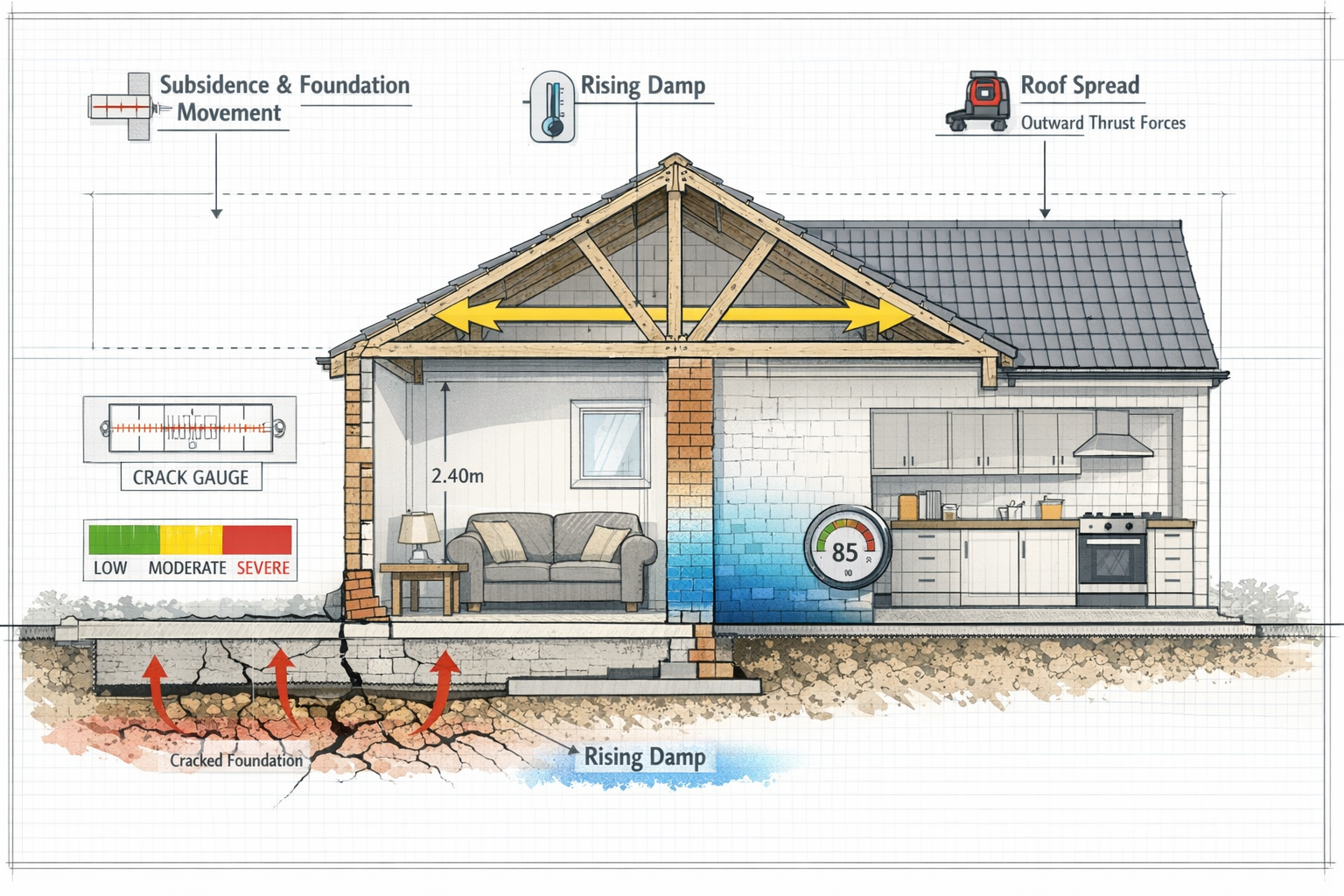
Subsidence occurs when ground beneath foundations moves downward, causing structural settlement and cracking. Bungalows face elevated subsidence risk due to:
- Shallow foundations: Pre-1960 bungalows often have foundations just 450-600mm deep, insufficient for clay soils
- Wide footprints: Single-storey layouts create extensive foundation perimeters vulnerable to differential movement
- Mature vegetation: Established trees near older bungalows extract soil moisture, causing clay shrinkage
- Drainage issues: Low-level construction makes bungalows susceptible to water accumulation affecting foundation stability
Warning signs include:
- Diagonal cracks wider than 3mm, especially near doors and windows
- Cracks tapering from wide (bottom) to narrow (top)
- Doors and windows sticking or not closing properly
- Gaps appearing between walls and ceilings or floors
- External cracks in brickwork following mortar joints
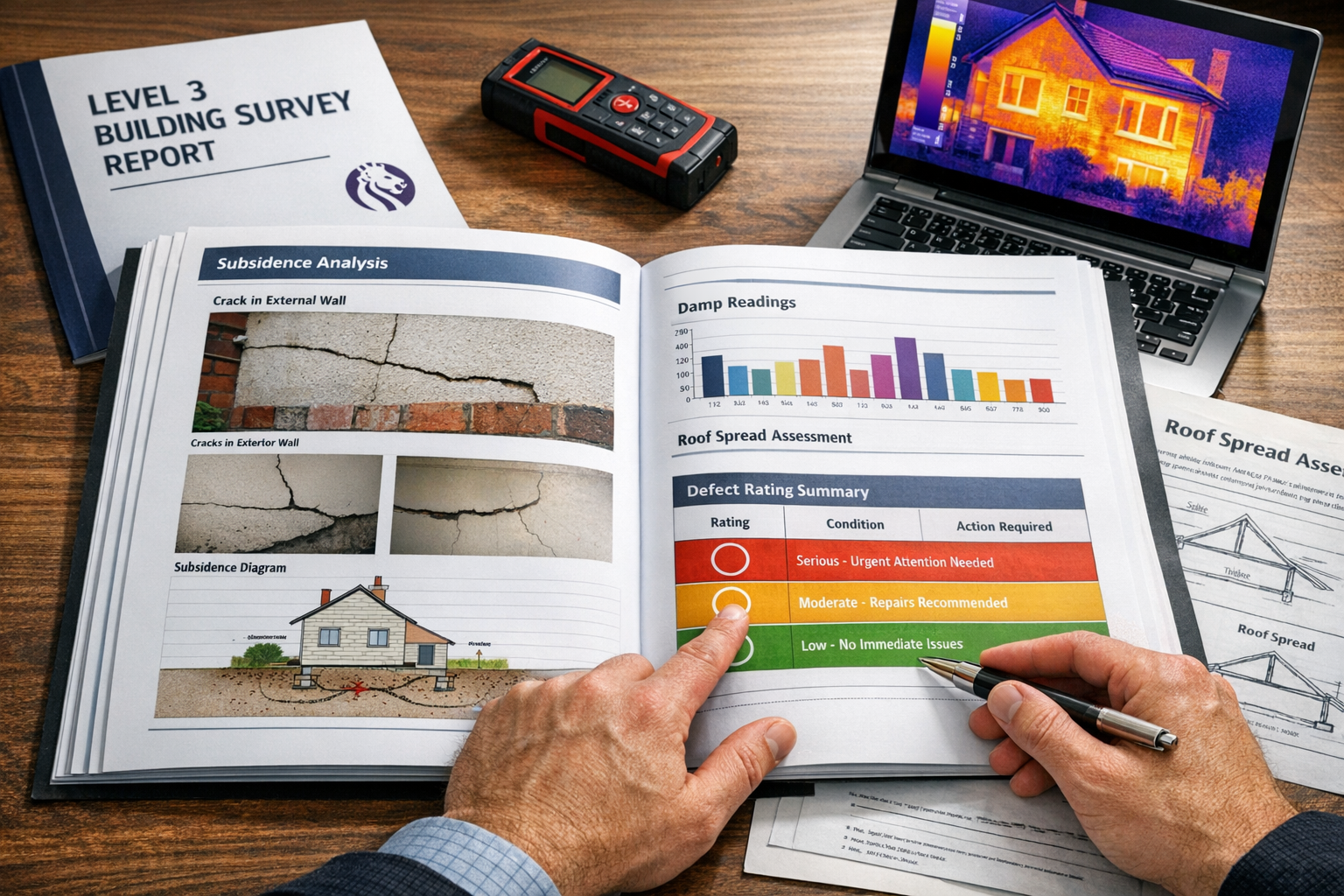
Level 3 surveys provide detailed crack analysis, measuring widths and patterns to distinguish subsidence from normal settlement. Surveyors may recommend monitoring with tell-tales or specialist structural engineer assessments. For properties showing active movement, specific defect reports or monitoring surveys become necessary.
Damp Penetration and Moisture Problems
Damp in bungalows manifests as rising damp, penetrating damp, or condensation, each requiring different remediation approaches. Bungalows are particularly vulnerable because:
- Solid wall construction: Pre-1960 bungalows lack cavity walls, allowing direct moisture penetration
- Low ground clearance: Minimal height between ground level and floor increases rising damp risk
- Ageing damp-proof courses: Original slate or bitumen DPCs deteriorate after 50-70 years
- Poor ventilation: Single-storey layouts with limited airflow promote condensation
Damp indicators include:
- Tide marks on internal walls at skirting level (rising damp)
- Damp patches appearing after rainfall (penetrating damp)
- Mould growth on walls, especially in corners (condensation)
- Peeling wallpaper or flaking plaster
- Musty odours in rooms
- Decaying timber skirting boards or floor joists
Level 2 surveys identify visible damp signs and recommend further investigation. Level 3 surveys use moisture meters to quantify dampness levels, trace penetration routes, and specify remediation requirements. For comprehensive moisture assessment, surveyors may suggest specialist damp reports beyond standard survey protocols.
Roof Spread and Structural Movement
Roof spread occurs when roof structures push outward at wall plate level, causing walls to lean and roofs to sag. This defect particularly affects bungalows due to:
- Wide roof spans: Bungalow roofs often span 8-10 meters without intermediate support
- Lightweight construction: Single-storey buildings lack the weight to resist outward thrust
- Ageing timber: Original roof timbers lose strength over 60-80 years
- Inadequate bracing: Older bungalows may lack collar ties or proper rafter connections
Roof spread symptoms include:
- Visible outward lean in external walls
- Gaps between ceiling and walls
- Sagging roof ridge lines
- Cracked or displaced roof tiles
- Distorted door frames in rooms below roof level
Level 3 surveys specifically assess roof structures, measuring wall verticality and roof geometry to detect spread. Surveyors examine loft spaces for inadequate bracing, undersized timbers, or failed connections. Remediation typically requires structural ties, wall plate strapping, or complete roof reconstruction.
For bungalows showing roof concerns, roof surveys provide focused assessment beyond general building surveys.
Level 2 vs Level 3 Survey Protocols for Detecting Bungalow Defects
The practical difference between survey levels becomes apparent when examining how each protocol addresses bungalow-specific defects.
Level 2 Detection Capabilities
Level 2 surveys identify obvious defects through visual inspection:
Subsidence detection: Surveyors note visible cracks and their approximate widths, flagging concerns that require monitoring or specialist investigation. However, subtle movement patterns or concealed foundation issues may go undetected[2].
Damp identification: Surface moisture signs like staining, mould, or peeling decoration get recorded with traffic light ratings. Surveyors typically don't use moisture meters, relying on visual and tactile assessment[1].
Roof spread recognition: Obvious sagging or wall lean gets noted, but precise measurements and structural analysis remain limited. Loft access may be restricted if hatches are secured or insulated[3].
Level 2 reports provide sufficient warning for major defects but lack the technical detail needed for repair planning or cost estimation. Buyers receive general recommendations like "seek specialist advice" without specific guidance.
Level 3 Detection Capabilities
Level 3 surveys deliver comprehensive defect analysis:
Subsidence investigation: Surveyors measure crack widths precisely, photograph all structural movement, analyze crack patterns to determine causes, and recommend monitoring periods or structural engineer involvement. Reports explain foundation types, soil conditions, and vegetation impacts[3].
Damp assessment: Moisture meters quantify dampness levels in affected areas. Surveyors trace penetration routes, identify failed damp-proof courses, distinguish between damp types, and specify appropriate remediation methods with approximate costs[4].
Roof spread evaluation: Detailed loft inspection examines timber sizes, connections, bracing adequacy, and structural integrity. Surveyors measure wall verticality, roof geometry, and spread extent. Reports specify whether remedial ties, strapping, or reconstruction are necessary[3].
Level 3 reports enable informed decision-making with technical detail supporting negotiation, budgeting, and project planning. For buyers intending renovation, this information proves invaluable.
Those seeking the most thorough assessment should consider RICS Building Surveys Level 3 conducted by experienced chartered surveyors.
Cost Considerations and Survey Selection Strategy
Survey costs represent a small percentage of purchase price but significantly impact financial outcomes through defect discovery.
2026 Survey Pricing for Bungalows
Level 2 survey costs typically range:
- Small bungalows (under 100m²): £450-£600
- Medium bungalows (100-150m²): £600-£750
- Large bungalows (over 150m²): £750-£850
Level 3 survey costs generally span:
- Small bungalows: £800-£1,000
- Medium bungalows: £1,000-£1,250
- Large bungalows: £1,250-£1,500+
Prices vary by location, property complexity, and surveyor qualifications. Properties in London and the South East command premium rates. For detailed pricing information, review survey pricing guidance from qualified professionals.
Return on Investment Analysis
Consider a £300,000 bungalow purchase:
Scenario 1 – Level 2 Survey (£700):
- Survey identifies "possible subsidence – seek specialist advice"
- Buyer proceeds without further investigation
- Post-purchase structural engineer identifies active subsidence requiring £25,000 underpinning
- Net loss: £24,300 (repair cost minus survey cost)
Scenario 2 – Level 3 Survey (£1,200):
- Survey identifies active subsidence with detailed analysis
- Buyer negotiates £20,000 price reduction
- Buyer completes necessary repairs for £25,000
- Net benefit: £18,800 (price reduction minus survey and repair costs, compared to no reduction)
The £500 difference between survey levels becomes insignificant when detecting major defects. For older bungalows or those showing concerns, Level 3 surveys deliver substantial ROI through informed negotiation and accurate budgeting.
Strategic Survey Selection Framework
Apply this decision framework:
Choose Level 2 when:
- Property built post-1960 ✅
- No visible defects present ✅
- Standard construction methods ✅
- Regular maintenance evident ✅
- Limited renovation plans ✅
Choose Level 3 when:
- Property built pre-1960 🔴
- Visible cracks, damp, or distortion 🔴
- Solid wall construction 🔴
- Extensions or alterations present 🔴
- Significant renovation intended 🔴
- Seller disclosure mentions issues 🔴
One or more red flags justifies Level 3 investment. For borderline cases, consult chartered surveyors who can assess specific circumstances and recommend appropriate protocols.
Working with Surveyors: Maximizing Survey Value
Survey effectiveness depends on proper preparation and surveyor communication.
Pre-Survey Preparation
Inform surveyors about:
- Specific concerns noticed during viewings
- Seller disclosures or previous survey findings
- Intended renovation or alteration plans
- Known neighbourhood issues (subsidence, flooding, mining)
- Property age and construction type
Request access to:
- All rooms including loft spaces and outbuildings
- Service areas like boiler rooms and meter cupboards
- External areas around the full perimeter
- Any available property documentation
Better information enables more focused inspection and relevant commentary.
Understanding Survey Reports
Survey reports use standardized formats but require interpretation:
Traffic light ratings (Level 2):
- Green (1): No repair currently needed
- Amber (2): Repairs or replacement needed but not urgent
- Red (3): Urgent repairs or serious defects requiring immediate attention
Condition ratings don't always correlate with repair costs. Some amber-rated items prove expensive while certain red-rated issues require modest intervention.
Technical terminology may confuse non-specialists. Request clarification calls with surveyors to discuss findings, understand priorities, and explore remediation options. Most surveyors provide brief post-report consultations included in fees.
Follow-Up Actions
Survey reports often recommend:
- Specialist investigations: Structural engineers for subsidence, damp specialists for moisture issues, roofing contractors for spread assessment
- Monitoring periods: Installing crack monitors for 12 months to determine whether movement remains active
- Further surveys: Drainage surveys, electrical inspections, or asbestos testing
Budget for these additional assessments when planning purchases. Specialist reports typically cost £300-£800 each but provide essential information for major defects.
For properties requiring ongoing assessment, monitoring surveys track defect progression over time.
Regulatory Context and Industry Standards in 2026
Building survey protocols operate within established regulatory frameworks that protect consumers and maintain professional standards.
RICS Home Survey Standards
The Royal Institution of Chartered Surveyors mandates survey protocols through its Home Survey Standard (updated 2020, current in 2026). This standard:
- Defines Level 1, 2, and 3 survey scopes
- Specifies minimum inspection requirements
- Establishes reporting formats and terminology
- Sets professional conduct expectations
- Requires appropriate professional indemnity insurance
Only RICS-qualified surveyors (MRICS or FRICS) can conduct surveys under these standards. Unqualified inspectors offering "building surveys" lack professional oversight and insurance protection.
Consumer Protection Measures
Survey clients receive protection through:
Professional indemnity insurance: RICS members maintain minimum £1 million coverage for negligence claims. If surveyors miss significant defects through inadequate inspection, clients can pursue compensation.
Complaints procedures: RICS operates formal complaints processes for professional misconduct or substandard work. Serious cases may result in disciplinary action or membership removal.
Standardized reporting: Consistent report formats enable comparison and reduce ambiguity. Buyers understand what surveys cover and their limitations.
Survey Limitations and Exclusions
Both Level 2 and Level 3 surveys remain non-invasive, meaning:
❌ Floorboards are not lifted
❌ Secured panels remain in place
❌ Furniture is not moved
❌ Services are not tested
❌ Specialist equipment (thermal imaging, borescopes) is not standard
Surveyors report on visible and accessible elements only. Concealed defects behind finishes, under floors, or within walls may go undetected[1][3]. Reports include disclaimers explaining these limitations.
For comprehensive property assessment beyond standard surveys, consider commercial building surveys methodologies that employ more invasive techniques.
Regional Considerations for Bungalow Surveys
Geographic factors influence defect risks and survey priorities across the UK.
High-Risk Subsidence Areas
Clay soil regions experience significant seasonal movement:
- London and the South East
- Essex and Kent
- Parts of the Midlands
Bungalows in these areas require particular attention to subsidence risks, especially properties near mature trees. Level 3 surveys prove essential for pre-1960 bungalows on clay soils.
Coastal and High-Rainfall Areas
Penetrating damp affects bungalows in:
- Coastal regions with salt-laden winds
- Western Scotland and Wales with high rainfall
- Exposed rural locations
Solid wall bungalows in these areas need thorough damp assessment. Surveyors should examine render condition, pointing quality, and window seals carefully.
Former Mining Areas
Ground movement from historical mining affects:
- South Wales valleys
- Yorkshire and Nottinghamshire coalfields
- Cornwall tin mining areas
Bungalows in former mining regions may experience subsidence unrelated to foundation depth or soil type. Specialist mining surveys supplement building surveys in affected postcodes.
For location-specific expertise, regional practices like chartered surveyors in North London or chartered surveyors in Essex provide local knowledge alongside technical competence.
Conclusion
Building Surveys for Bungalows in 2026: Level 2 vs Level 3 Protocols for Subsidence, Damp and Roof Spread Risks represents a critical decision point for property buyers in today's competitive market. While Level 2 surveys suit modern bungalows in standard condition, the unique vulnerabilities of single-storey construction—particularly subsidence from shallow foundations, damp penetration through solid walls, and roof spread across wide spans—often justify the comprehensive analysis that Level 3 protocols deliver.
The modest cost difference between survey levels pales against potential repair expenses for undetected defects. A £25,000 underpinning project or £15,000 roof reconstruction dramatically outweighs the £500-800 premium for Level 3 assessment. For pre-1960 bungalows, properties showing visible distress, or those requiring renovation, Level 3 surveys provide essential technical detail supporting informed decisions and effective negotiation.
Actionable Next Steps
- Assess your bungalow's characteristics: Determine construction date, building methods, visible condition, and alteration history
- Apply the decision framework: Count red flags (pre-1960, visible defects, solid walls, extensions) to guide survey level selection
- Engage RICS-qualified surveyors: Verify professional credentials and appropriate insurance coverage
- Communicate specific concerns: Share observations and intentions with surveyors for focused inspection
- Budget for follow-up investigations: Allocate funds for specialist reports recommended in survey findings
- Review reports thoroughly: Request clarification calls to understand priorities and remediation approaches
The downsizer-driven bungalow boom continues reshaping the UK property market in 2026, but structural realities remain unchanged. Shallow foundations still settle, solid walls still absorb moisture, and wide-span roofs still spread. Choosing appropriate survey protocols protects investments and prevents costly post-purchase surprises.
For comprehensive assessment of your bungalow purchase, contact qualified professionals who understand both RICS protocols and single-storey construction vulnerabilities. The right survey at the right time transforms property decisions from gambles into informed investments.
References
[1] Difference Between Level 2 And Level 3 Survey – https://marshalllaurencesurveyors.com/residential-property-surveys/difference-between-level-2-and-level-3-survey/
[2] What Is The Difference Between A Level 2 Level 3 Building Survey – https://fourthwallbc.com/blog/what-is-the-difference-between-a-level-2-level-3-building-survey/
[3] Level 2 Vs Level 3 Survey Complete Comparison Guide – https://www.surveymerchant.com/blog/level-2-vs-level-3-survey-complete-comparison-guide
[4] Level 2 Vs Level 3 Survey Comparison Table Which Report Is Right For Your Property – https://lloyddixongroup.com/level-2-vs-level-3-survey-comparison-table-which-report-is-right-for-your-property/