Construction defect litigation has reached unprecedented complexity in 2026, with the Supreme Court's recent rejection of the "voluntariness principle" fundamentally reshaping liability frameworks for developers and contractors. This landmark ruling means that developers can now recover repair costs for structural defects even after selling properties, extending the chain of accountability across multiple parties[1]. For building surveyors stepping into the expert witness arena, understanding the complete journey from initial site inspection to courtroom testimony has become essential for delivering credible, tribunal-ready evidence.
The role of a Building Surveyor as Expert Witness in Defective Works Litigation: From Site Inspection to Court Report demands far more than standard surveying skills. It requires mastery of legal procedures, evidence standards, and the ability to translate complex technical findings into clear, persuasive documentation that withstands cross-examination. With the Building Safety Act extending limitation periods to 30 years for certain defect claims[1], the stakes have never been higher.
Key Takeaways
- Supreme Court rulings in 2025 have extended developer liability for structural defects, creating increased demand for expert witness services in construction litigation
- Independence and objectivity are non-negotiable requirements, with courts scrutinizing any potential conflicts between advisory and expert witness roles[2]
- Evidence gathering must follow RICS standards and include comprehensive documentation, from thermal imaging to photographic records with proper metadata
- Expert reports require clear methodology, transparent assumptions, and conclusions that stay within the surveyor's area of expertise[2]
- 2026 Building Safety Act compliance demands specific evidence standards for fire safety and cladding defect disputes[4]
Understanding the Expert Witness Role in Construction Defect Cases
What Distinguishes Expert Witness Work from Standard Surveys
A specific defect report prepared for a property transaction differs fundamentally from expert witness evidence in litigation. While both require technical competence, the expert witness role carries a primary duty to the court rather than to the instructing party[2].
Standard building surveys focus on:
- Identifying defects for property purchase decisions
- Assessing repair costs for negotiation purposes
- Providing recommendations for maintenance
Expert witness work requires:
- ✅ Complete independence from litigation outcomes
- ✅ Rigorous methodology that can withstand cross-examination
- ✅ Clear chain of reasoning from evidence to conclusions
- ✅ Transparency about limitations and assumptions
- ✅ Compliance with Civil Procedure Rules Part 35
The Legal Framework Shaping Expert Evidence in 2026
Recent legal developments have transformed the landscape for building surveyors acting as expert witnesses. The Supreme Court's June 2025 ruling clarified that the 30-year retrospective limitation period under section 135 of the Building Safety Act applies broadly to claims dependent on Defective Premises Act time limits[1]. This means:
Extended accountability: Developers can pursue contribution claims against contractors and designers for defects discovered decades after construction completion.
Onward claims framework: Negligence claims brought by developers against subcontractors now fall under extended limitation periods, increasing the volume of historical defect litigation.
Fire safety and cladding disputes: RICS-accredited surveyors must prepare evidence specifically addressing Building Safety Act compliance, particularly for mid-rise and high-rise residential blocks[4].
Three Pillars of Expert Witness Credibility
According to RICS guidance, evidence credibility rests on three critical factors[2]:
| Pillar | Requirements | Common Pitfalls |
|---|---|---|
| Independence | No financial interest in outcome; clear separation from advisory roles | Acting as both project advisor and expert witness |
| Credibility | Relevant qualifications (RICS chartered status); sound methodology; logical reasoning | Overstepping expertise boundaries; inadequate testing |
| Clarity | Language appropriate to forum; well-structured reports; defensible conclusions | Technical jargon without explanation; ambiguous opinions |
The Site Inspection Process: Building the Evidential Foundation
Pre-Inspection Planning and Documentation Requirements
Before setting foot on site, expert witnesses must establish a robust framework for evidence gathering. This begins with understanding the allegations of defective work and the relevant construction standards applicable at the time of building.
Essential pre-inspection steps:
- Review all available documentation including original specifications, building control approvals, and any previous survey reports
- Identify the relevant standards (Building Regulations, British Standards, manufacturer specifications) that applied during construction
- Prepare inspection checklists tailored to the specific defect allegations
- Arrange appropriate access with clear protocols for photography and sampling
- Notify all parties of inspection dates to allow attendance if required
A chartered building surveyor conducting expert witness inspections must maintain meticulous records from the outset. Unlike standard building surveys, every observation may face legal scrutiny.
Comprehensive Evidence Gathering Techniques
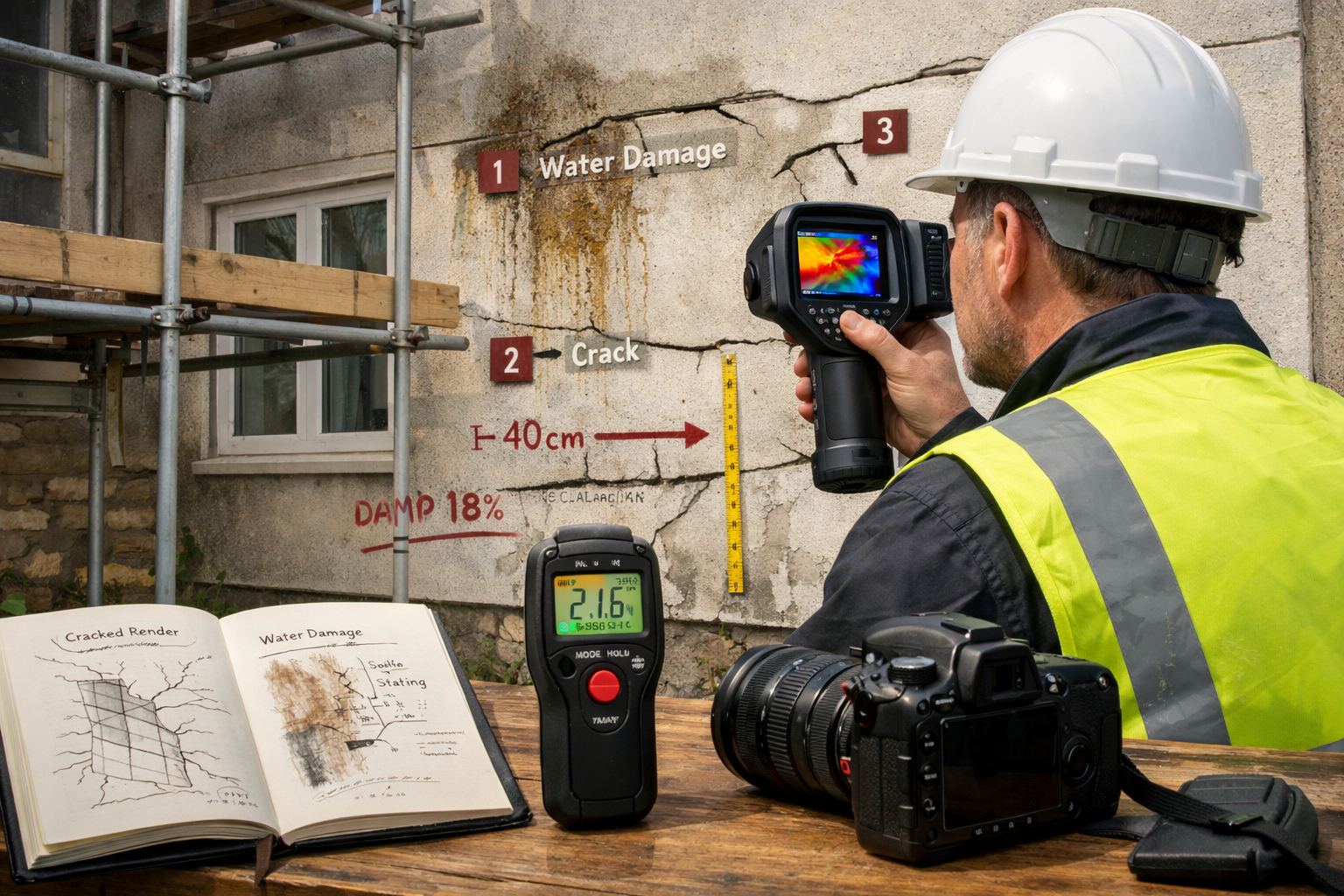
Modern defect investigations demand sophisticated diagnostic tools beyond visual inspection:
🔍 Visual Documentation:
- High-resolution photography with metadata (date, time, location)
- Video walkthroughs showing context and relationships between defects
- Annotated site plans marking defect locations
- Comparison photographs showing progression over time
🌡️ Technical Investigations:
- Moisture meters for detecting water ingress and dampness
- Thermal imaging cameras revealing insulation defects and thermal bridging
- Endoscopes for inspecting concealed spaces without destructive opening-up
- Laser measuring devices for precise dimensional verification
- Crack monitoring with datums and graduated scales
🔬 Material Sampling and Testing:
When allegations involve material failures or non-compliance, expert witnesses may need to arrange:
- Concrete core samples for strength testing
- Mortar analysis for composition and durability assessment
- Timber moisture content and decay analysis
- Cladding material fire performance testing (critical for Building Safety Act disputes[4])
Maintaining the Chain of Evidence
Courts require assurance that evidence has not been contaminated or altered. Building surveyors must:
- Photograph defects before any intrusive investigation
- Document sampling locations with precise measurements and site plans
- Use tamper-evident seals for material samples sent to laboratories
- Maintain custody records showing who handled evidence and when
- Preserve original site notes even when preparing formal reports
From Raw Data to Expert Report: The Building Surveyor as Expert Witness in Defective Works Litigation Process
Structuring the Expert Report
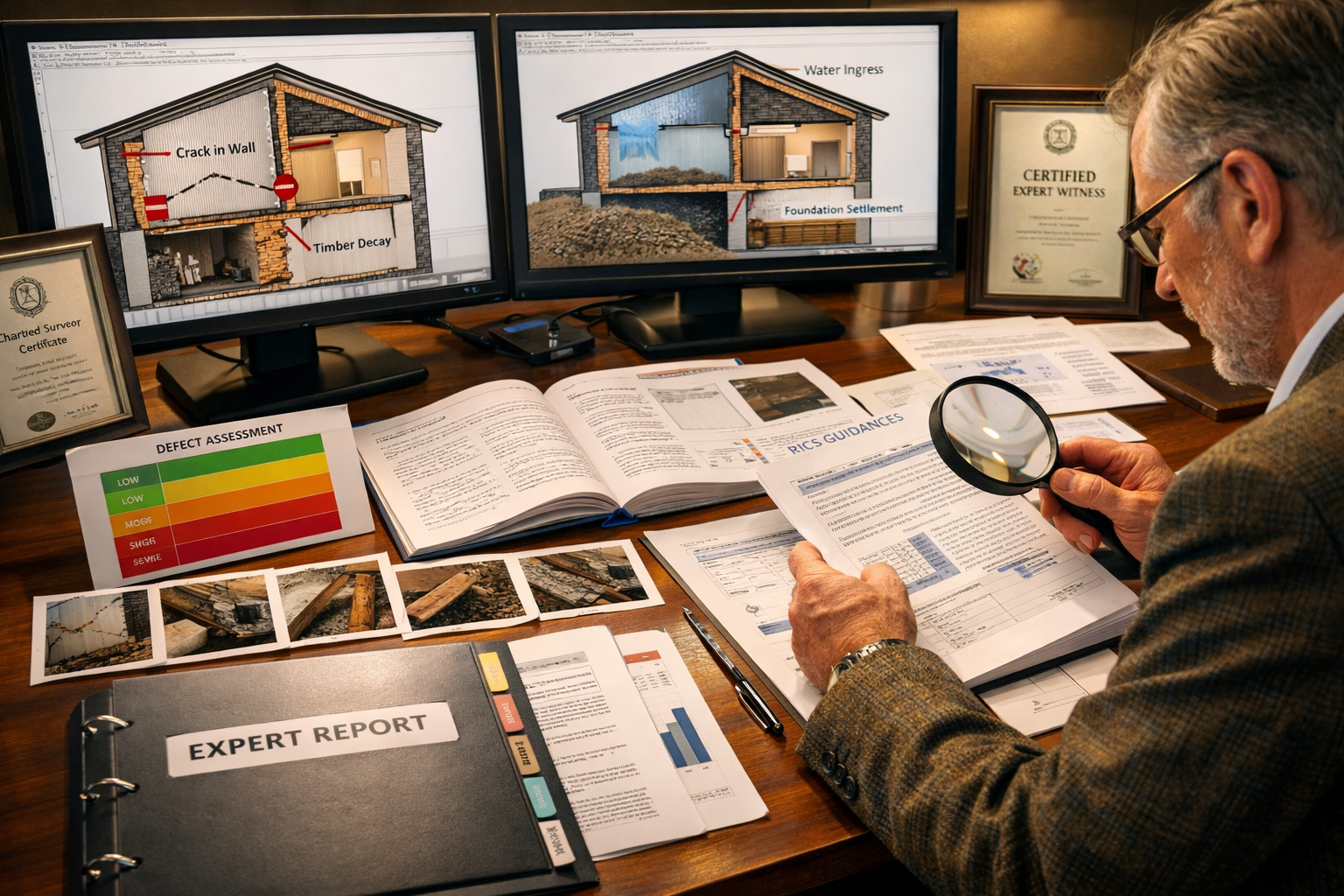
An effective expert report follows a logical structure that guides readers from facts through analysis to conclusions. RICS standards emphasize that experts must remain within their area of competence and clearly identify any limitations[2].
Standard expert report structure:
1. Introduction and Instructions
- Identity and qualifications of the expert
- Summary of instructions received
- Documents and evidence reviewed
- Site inspection dates and attendees
2. Executive Summary
- Brief overview of key findings
- Principal conclusions (typically 1-2 pages maximum)
3. Background and Context
- Description of the property and construction
- Relevant construction standards and regulations
- Timeline of events leading to dispute
4. Methodology
- Inspection approach and techniques employed
- Testing methods and equipment used
- Standards applied for assessment
- Limitations of the investigation
5. Findings and Analysis
- Detailed description of observed defects
- Technical analysis of causes
- Assessment against applicable standards
- Photographic evidence with annotations
6. Opinions and Conclusions
- Expert opinion on whether work is defective
- Causation analysis
- Scope of remedial works required
- Cost implications (if instructed to provide)
7. Declaration of Truth
- Confirmation of compliance with expert duties
- Statement of independence
- Acknowledgment that duty is to the court
Writing for Legal Audiences: Clarity Without Oversimplification
Building surveyors must bridge the gap between technical precision and legal accessibility. The challenge lies in maintaining accuracy while ensuring judges, barristers, and lay clients understand complex construction issues.
Effective techniques include:
Use analogies carefully: "The wall tie failure acts like removing buttons from a coat—the two layers of fabric can no longer work together effectively."
Define technical terms on first use: "Spalling (the breaking away of concrete surface layers due to corrosion of embedded reinforcement) was evident across 40% of the balcony soffits."
Employ visual aids: Annotated photographs, diagrams, and comparison tables communicate more effectively than lengthy descriptions.
Avoid advocacy: Replace "The contractor clearly failed to follow specifications" with "The installed insulation thickness of 50mm does not comply with the specified 100mm requirement."
Addressing Limitations and Uncertainties Transparently
Courts value honesty about what cannot be determined. Expert witnesses strengthen credibility by acknowledging[2]:
- Access limitations: "Full assessment of the cavity wall construction was not possible without destructive opening-up works, which were not authorized."
- Concealed conditions: "While surface evidence suggests water ingress from defective pointing, the exact pathway cannot be confirmed without removal of internal finishes."
- Multiple potential causes: "The cracking pattern is consistent with either differential settlement or thermal movement; further monitoring would be required to determine the primary mechanism."
Preparing for Cross-Examination and Court Proceedings
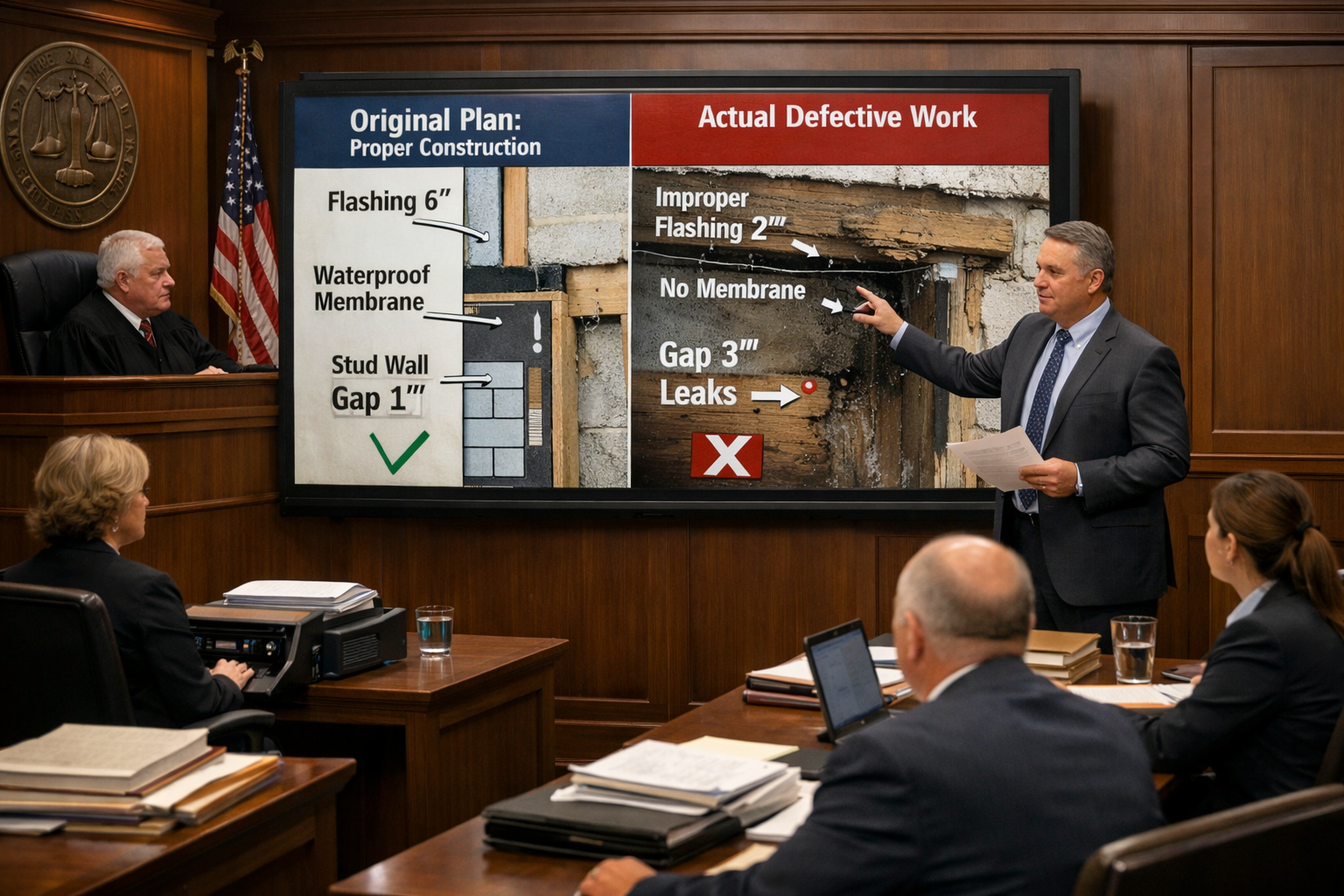
Understanding the Adjudication and Court Process
Expert witnesses may provide evidence in various forums, each with distinct procedures:
Adjudication: Fast-track dispute resolution (typically 28 days) where natural justice standards require adjudicators to address defenses that "go to the heart of the dispute"[1]. Expert reports must be concise and focused on key technical issues.
Mediation: Less formal process where experts may provide technical input to facilitate settlement discussions without formal cross-examination.
Arbitration: Private tribunal process with procedures similar to court litigation, including expert witness conferences and concurrent evidence sessions.
Court proceedings: Full litigation with formal procedures governed by Civil Procedure Rules Part 35, including potential for experts to meet and produce joint statements identifying agreed and disputed matters.
The Art of Giving Evidence Under Cross-Examination
Cross-examination tests the robustness of expert opinions and the credibility of the witness. RICS-chartered surveyors can prepare by understanding common tactics:
⚖️ Key principles for effective testimony:
Listen carefully to questions: Answer only what is asked; avoid volunteering additional information that may open new lines of attack.
Admit limitations: "That falls outside my area of expertise" is a perfectly acceptable response and enhances credibility.
Refer to your report: "As I stated in paragraph 4.7 of my report…" grounds answers in documented evidence.
Maintain composure: Cross-examination may become adversarial; remain professional and objective regardless of questioning style.
Avoid speculation: If you don't know, say so clearly rather than guessing.
Acknowledge reasonable alternative views: "While I consider X more likely, Y remains a possible explanation" demonstrates balanced analysis.
Common Challenges and How to Address Them
Challenge: "You were instructed by the claimant, so your evidence favors their position."
Response: "My duty is to the court, not to the party instructing me. My opinions are based on the physical evidence and applicable standards, regardless of which party benefits from those conclusions."
Challenge: "Your inspection was limited; how can you reach definitive conclusions?"
Response: "I clearly identified the limitations in section 3.2 of my report. Within those constraints, the evidence I did observe is sufficient to form the opinions expressed. Where uncertainty exists, I have stated so explicitly."
Challenge: "Another expert has reached a different conclusion."
Response: "I have reviewed Mr. Smith's report. We agree on the factual observations but differ in our interpretation of causation. My opinion is based on [specific reasoning], which I consider more consistent with the observed defect pattern."
Distinguishing Expert Witness Work from Advisory Roles
The Independence Imperative
Courts increasingly scrutinize potential conflicts between advisory and expert witness roles[2]. A building surveyor cannot credibly act as an expert witness on defects in a project where they previously provided design advice or project management services.
Clear boundaries must be maintained:
❌ Prohibited dual roles:
- Acting as project manager during construction, then expert witness in defect litigation
- Providing pre-litigation advice on defect remediation strategy, then serving as expert
- Having financial interest in litigation outcome (contingency fees)
✅ Acceptable scenarios:
- Providing initial specific defect report for property purchase, then later acting as expert if defects emerge (provided no advisory role in remediation)
- Conducting commercial building survey for different party, then expert witness role for another party in same building (with full disclosure)
When to Decline Instructions
Professional integrity requires recognizing when expert witness instructions should be declined:
🚫 Decline when:
- Previous involvement in the project creates actual or perceived bias
- Insufficient expertise in the specific defect type alleged
- Instructing party seeks advocacy rather than objective analysis
- Time constraints prevent thorough investigation
- Access limitations prevent formation of reliable opinions
Building Safety Act 2026: New Evidence Standards
The Building Safety Act has introduced specific requirements for expert evidence in fire safety and cladding disputes[4]. Building surveyors must now demonstrate competence in:
🔥 Fire safety assessment:
- External wall system fire performance evaluation
- Compliance with Building Regulations Approved Document B
- Assessment of fire stopping and compartmentation
- Evaluation of means of escape provisions
🏢 Cladding defect analysis:
- Material testing for reaction to fire classification
- Assessment of cavity barriers and fire breaks
- Evaluation of insulation material combustibility
- Review of original design compliance with guidance current at construction date
📋 Documentation requirements:
- Evidence must reference specific Building Safety Act provisions
- Reports must address whether defects constitute "relevant defects" under the Act
- Cost assessments must distinguish between fire safety remediation and other defects
- Limitation period analysis (15 or 30 years depending on defect type)[1]
Cost Considerations and Fee Structures
Expert witness work commands premium fees reflecting the additional responsibilities and potential time commitment:
Typical fee structures:
| Service Component | Typical Range | Notes |
|---|---|---|
| Initial case review | £500-£1,500 | Assessment of whether to accept instruction |
| Site inspection (half day) | £1,200-£2,500 | Plus travel and accommodation if required |
| Expert report preparation | £3,000-£8,000 | Depends on complexity and defect scope |
| Supplementary reports | £1,500-£4,000 | Responding to opposing expert's report |
| Court attendance (per day) | £2,000-£4,000 | Includes preparation and waiting time |
| Conference with counsel | £800-£1,500 | Pre-trial preparation meetings |
Important considerations:
- Fees should be time-based, never contingent on litigation outcome
- Clear terms of engagement should be established in writing before commencing work
- Disbursements (laboratory testing, specialist sub-consultants) should be identified separately
- Regular fee updates should be provided to instructing parties to avoid disputes
Best Practices for Building Surveyors Entering Expert Witness Work
Professional Development and Accreditation
While RICS chartered status provides foundational credibility, additional qualifications enhance expert witness effectiveness:
📚 Recommended training:
- RICS Expert Witness Certificate
- Civil Procedure Rules Part 35 training courses
- Cross-examination skills workshops
- Building pathology specialist qualifications
- Fire safety and Building Safety Act compliance courses
🔄 Continuing professional development:
- Regular review of case law developments
- Attendance at construction law seminars
- Peer review of expert reports
- Participation in expert witness forums
Building an Expert Witness Practice
Transitioning from standard surveying to expert witness work requires strategic development:
1. Establish credibility:
- Publish technical articles on defect analysis
- Present at industry conferences
- Develop specialist expertise in particular defect types
- Build relationships with construction law firms
2. Create systems and templates:
- Standardized inspection checklists
- Report templates compliant with CPR Part 35
- Photographic documentation protocols
- Evidence management systems
3. Manage risk:
- Maintain appropriate professional indemnity insurance (expert witness work requires higher limits)
- Keep detailed time records and file notes
- Implement robust conflict checking procedures
- Document all communications with instructing parties
Ethical Considerations and Professional Standards
The RICS guidance on expert witness responsibilities emphasizes that experts must[2]:
- Provide objective advice regardless of which party benefits
- Avoid advocacy or becoming partisan
- Remain within expertise bounds and clearly identify limitations
- Be transparent about assumptions and alternative explanations
- Maintain independence from litigation outcomes
- Update opinions if new evidence emerges that changes conclusions
Conclusion
The role of a Building Surveyor as Expert Witness in Defective Works Litigation: From Site Inspection to Court Report has evolved into a highly specialized discipline requiring technical expertise, legal knowledge, and communication skills. With Supreme Court rulings extending liability periods and the Building Safety Act introducing new compliance frameworks, demand for credible expert evidence continues to grow.
Success in this field depends on maintaining unwavering independence, conducting thorough evidence-based investigations, and presenting findings with clarity and confidence. From the initial site inspection through to cross-examination in court, every step must withstand legal scrutiny while remaining accessible to non-technical audiences.
Actionable Next Steps
For building surveyors considering expert witness work:
- Assess your expertise: Identify specific defect types where you have deep technical knowledge and practical experience
- Invest in training: Complete RICS Expert Witness Certificate and CPR Part 35 courses
- Build relationships: Connect with construction law firms and establish your credentials
- Start small: Accept initial instructions for straightforward defect cases to develop experience
- Seek mentorship: Learn from experienced expert witnesses through peer review and shadowing opportunities
- Stay current: Monitor legal developments affecting construction defect litigation, particularly Building Safety Act implementation
For parties instructing expert witnesses:
- Verify independence: Ensure no conflicts exist between advisory and expert witness roles
- Check qualifications: Confirm RICS chartered status and relevant specialist expertise
- Review methodology: Assess whether proposed investigation approach is comprehensive and appropriate
- Establish clear terms: Agree fee structures, timescales, and scope of work in writing
- Facilitate access: Provide complete documentation and unrestricted site access for thorough investigation
The journey from site inspection to court report demands meticulous attention to detail, professional integrity, and commitment to objective analysis. Building surveyors who master this process provide invaluable service to the justice system while advancing professional standards across the construction industry.
References
[1] Legal Developments In Construction Law June 2025 – https://www.mayerbrown.com/en/insights/publications/2025/06/legal-developments-in-construction-law-june-2025
[2] Role Responsibilities Expert Witnesses Built Environment – https://www.rics.org/news-insights/role-responsibilities-expert-witnesses-built-environment
[3] Construction Expert Witness – https://seakexperts.com/specialties/construction-expert-witness
[4] Expert Witness Roles In 2026 Building Safety Act Disputes Evidence Standards For Mid Rise Residential Blocks – https://nottinghillsurveyors.com/blog/expert-witness-roles-in-2026-building-safety-act-disputes-evidence-standards-for-mid-rise-residential-blocks