The London and South East property markets are experiencing a notable shift in 2026. After several challenging years, renewed buyer interest in lower-priced flats signals early recovery signs across urban centres. This market transformation demands that chartered building surveyors adapt their inspection protocols to address the unique complexities of flat ownership, from shared structural responsibilities to leasehold complications that can significantly impact property values.
Building Survey Standards for Flats in Recovering Urban Markets: Adapting RICS Protocols for London and South East Properties in 2026 requires surveyors to navigate an increasingly complex landscape. Traditional survey approaches designed for freehold houses simply don't capture the full picture when assessing flats with communal areas, shared building insurance, and service charge obligations that can run into thousands of pounds annually.
Key Takeaways
✅ Flat-specific surveys require enhanced focus on shared structures, leasehold terms, and service charge liabilities beyond standard building defect identification
✅ RICS protocols are evolving in 2026 with updated Home Survey Standards emphasizing clarity between mandatory requirements and recommended practices for flat assessments
✅ Market recovery indicators in London and South East regions demand surveyors adapt valuation methodologies for lower-priced properties with complex ownership structures
✅ Service charge analysis and building insurance reviews now form critical components of comprehensive flat surveys in urban markets
✅ Cladding and fire safety compliance remain paramount concerns requiring specialist assessment protocols following regulatory changes
Understanding the 2026 RICS Framework for Flat Surveys
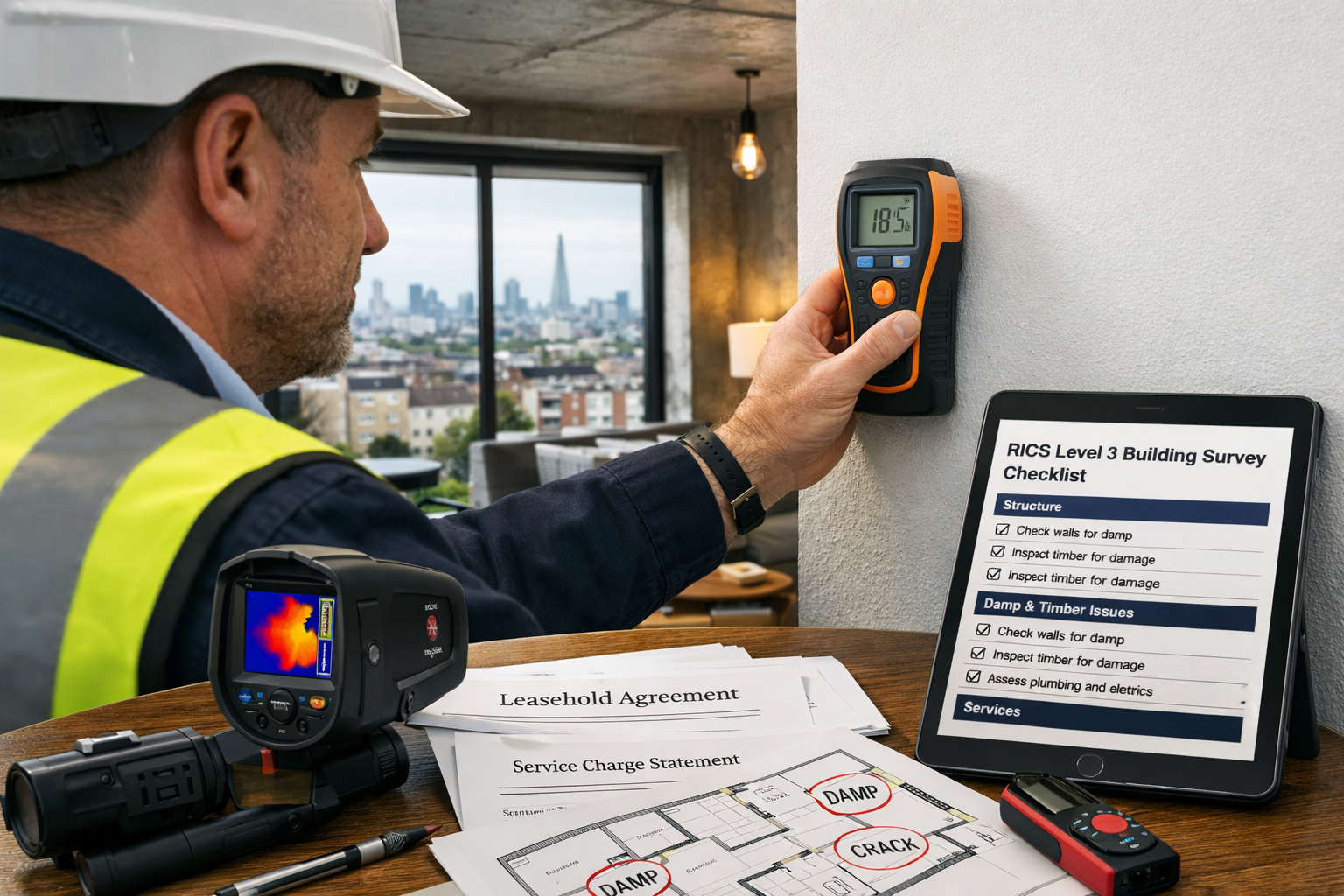
The Royal Institution of Chartered Surveyors (RICS) continues to refine survey standards specifically for flat assessments in 2026. Following extensive consultation that gathered over 1,000 comments from industry professionals, the updated RICS Home Survey Standard addresses long-standing concerns about clarity and consistency in flat inspections.
Evolution of RICS Survey Levels for Flats
The RICS Building Surveys Level 3 remains the gold standard for comprehensive flat assessments, particularly for older conversions or properties with visible defects. However, surveyors must now incorporate additional flat-specific considerations that weren't emphasized in previous iterations:
Key RICS Survey Adaptations for Flats:
- 🏢 Shared structure assessment – Evaluation of communal roofs, foundations, and external walls
- 📋 Leasehold documentation review – Analysis of lease terms, ground rent, and restrictions
- 💰 Service charge scrutiny – Historical expenditure patterns and reserve fund adequacy
- 🔥 Fire safety compliance – Cladding assessments, compartmentation, and escape routes
- 🏗️ Building insurance verification – Coverage adequacy and claims history
- 👥 Management company evaluation – Governance structure and financial health
The distinction between "must" requirements and "should" recommendations has become clearer in 2026 protocols. Surveyors conducting building surveys for flats must now explicitly identify mandatory inspection elements versus advisory best practices.
Mandatory vs. Recommended Survey Elements
| Survey Component | Mandatory (Must) | Recommended (Should) |
|---|---|---|
| External envelope inspection | ✓ | |
| Communal area assessment | ✓ | |
| Lease term verification | ✓ | |
| Service charge review | ✓ | |
| Reserve fund analysis | ✓ | |
| Management company audit | ✓ | |
| Future liability projection | ✓ |
The South East London Context
Properties across South East London present unique challenges that require adapted survey protocols. Victorian conversions in areas like Bexley and Bromley demand different assessment criteria compared to modern developments in Canary Wharf or Stratford.
Chartered surveyors in Bexley frequently encounter period properties converted into flats during the 1980s and 1990s, often with inadequate sound insulation, shared heating systems, and unclear structural responsibilities. These properties require enhanced scrutiny of conversion quality and compliance with current building regulations.
Flat-Specific Survey Considerations in Building Survey Standards for Flats in Recovering Urban Markets
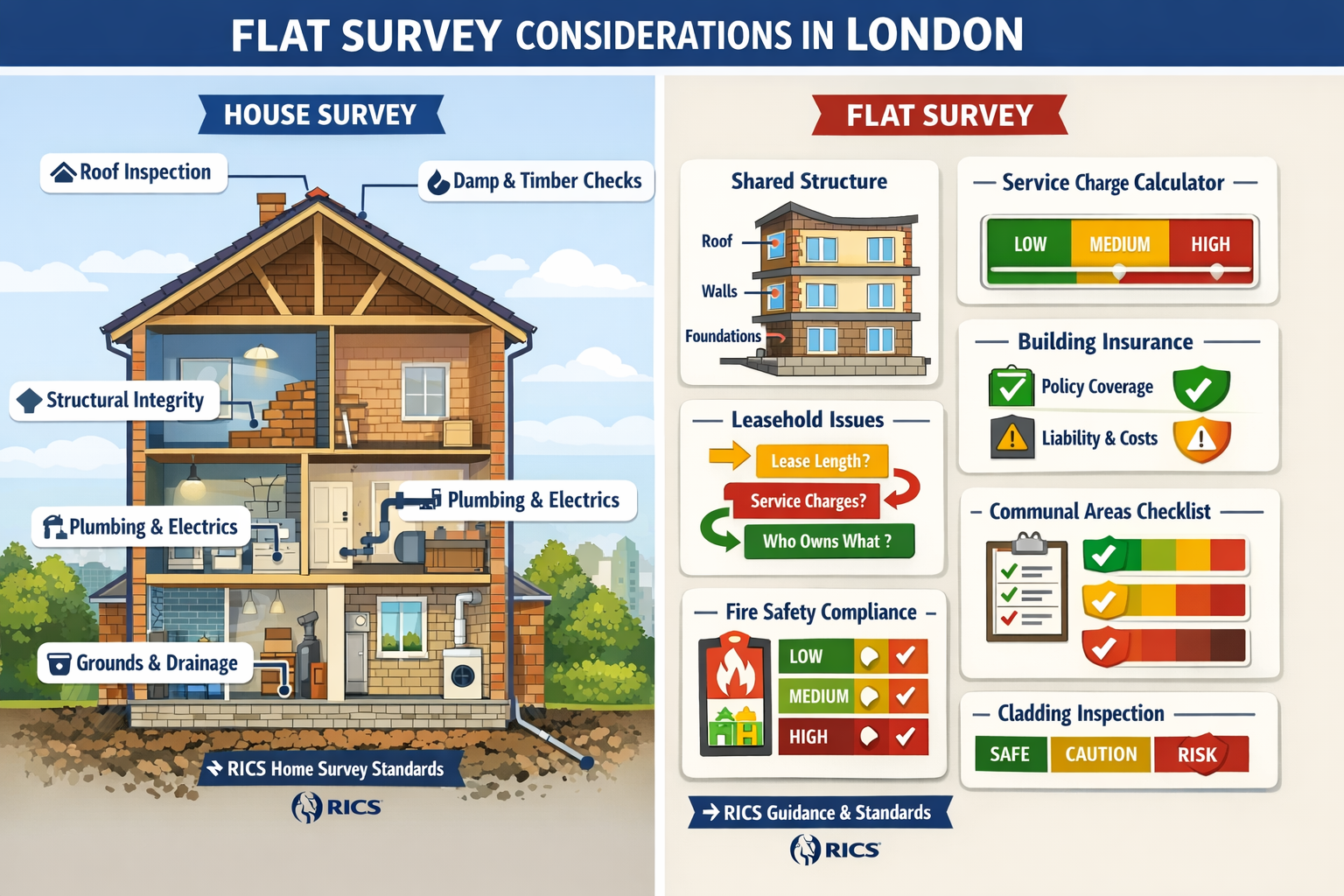
Adapting RICS Protocols for London and South East Properties in 2026 means recognizing that flats are fundamentally different from freehold houses. The interdependencies between individual units and communal elements create layers of complexity that standard survey templates often overlook.
Shared Structural Elements
When conducting surveys in locations like West London or Hertfordshire, surveyors must assess both the individual flat and the building's overall condition. A property might have an immaculate interior while the building faces significant structural issues requiring costly remediation.
Critical Shared Structure Assessments:
- Roof condition and maintenance – Flat roofs on mansion blocks, pitched roofs on conversions, and their impact on top-floor units
- External walls and cladding – Post-Grenfell scrutiny remains essential, with EWS1 forms still affecting valuations
- Foundation stability – Settlement affecting the entire building, not just individual units
- Drainage systems – Shared waste pipes and potential for cross-contamination
- Structural frame – Load-bearing walls and beams serving multiple units
"A comprehensive flat survey must evaluate the building as a complete system, not just the four walls of the individual unit. Service charge liabilities can transform an apparently affordable property into a financial burden." – Senior RICS Surveyor
Leasehold Complications and Financial Obligations
The leasehold structure introduces financial risks that significantly impact property value and buyer decisions. Surveyors must now incorporate detailed leasehold analysis into their reports, particularly for properties in high-demand areas like Chiswick, Hammersmith, and Ealing.
Essential Leasehold Considerations:
- Remaining lease term – Properties under 80 years require immediate attention and potential extension costs
- Ground rent escalation – Doubling clauses or percentage-based increases that create mortgage difficulties
- Service charge trends – Five-year historical analysis revealing management efficiency
- Major works provisions – Reserve funds and potential Section 20 consultation notices
- Restrictions and covenants – Limitations on alterations, subletting, or pet ownership
- Right to manage status – Whether leaseholders control building management
Service Charge Impact Analysis
Service charges represent an ongoing financial commitment that can equal or exceed mortgage payments in some London developments. Building Survey Standards for Flats in Recovering Urban Markets must incorporate thorough service charge analysis to provide buyers with realistic ownership cost projections.
Service Charge Evaluation Framework:
| Component | Assessment Criteria | Red Flags |
|---|---|---|
| Annual charges | Comparison with similar developments | Charges exceeding £3,000/year for standard flats |
| Reserve fund | Minimum 25% of annual expenditure | Depleted funds with major works pending |
| Management fees | Reasonable proportion of total charges | Management fees exceeding 30% of total |
| Historical increases | Average annual escalation rate | Increases above inflation without justification |
| Planned works | Forward maintenance plan existence | No long-term maintenance schedule |
Cladding and Fire Safety Compliance
Post-Grenfell building safety remains a critical concern in 2026. Surveyors must assess fire safety compliance and identify potential remediation costs that could devastate flat values. Properties in Ilford, Romford, and Watford have seen significant value fluctuations based on cladding issues.
Fire Safety Assessment Checklist:
✓ EWS1 form status and findings
✓ Cladding material composition
✓ Fire door compliance in communal areas
✓ Compartmentation integrity
✓ Sprinkler system presence
✓ Evacuation strategy (stay put vs. simultaneous evacuation)
✓ Fire alarm and detection systems
✓ Building height and regulatory implications
Surveyors should recommend specialist structural surveys when fire safety concerns arise, as remediation costs can reach six or seven figures for affected buildings.
Market Recovery Indicators and Survey Adaptation for London and South East Properties in 2026

The London and South East property markets show distinct recovery patterns in 2026, with lower-priced flats experiencing renewed demand after several years of stagnation. This market shift requires surveyors to adapt their approach, balancing thorough defect identification with realistic market context.
Regional Market Dynamics
Different areas within the South East exhibit varying recovery trajectories. Hertfordshire locations like St Albans, Watford, and Hemel Hempstead benefit from improved transport links and hybrid working patterns, while inner London boroughs face different challenges.
Regional Recovery Indicators by Area:
🏘️ Outer London Boroughs (Harrow, Hounslow, Ealing)
- First-time buyer activity increasing 15-20% year-on-year
- Flats under £400,000 seeing multiple offers
- Service charge sensitivity remains high
🌆 Inner London (Islington, Camden, Hammersmith)
- Premium flats stabilizing after corrections
- Leasehold reform uncertainty affecting transactions
- Build quality and management reputation critical
🌳 Commuter Belt (Buckinghamshire, Essex, Sussex)
- Strong demand for flats with outdoor space
- Ex-London buyers seeking value
- Buckinghamshire, Essex, and Sussex seeing sustained interest
Valuation Challenges in Recovering Markets
Surveyors must navigate valuation complexity when comparable evidence remains limited or distorted by recent market volatility. Properties in areas like Putney, Hampstead, and Kilburn require nuanced assessment that considers both current condition and market positioning.
Valuation Adjustment Factors for Flats:
- Lease length impact – Deductions increasing exponentially below 80 years
- Service charge burden – High charges reducing achievable prices by 10-15%
- Cladding issues – Properties without EWS1 forms facing 20-40% discounts
- Building insurance costs – Post-cladding crisis increases affecting affordability
- Management quality – Well-managed blocks commanding premiums
- Parking provision – Single space adding £20,000-50,000 in urban areas
Buyer Expectations in 2026
Today's flat buyers demonstrate heightened awareness of leasehold complexities and building safety issues. Surveyors must provide clear, accessible reporting that addresses these concerns while maintaining professional standards.
Modern buyers typically request:
- Plain English summaries of technical findings
- Cost projections for identified defects and future liabilities
- Service charge analysis with benchmarking data
- Lease extension calculations when applicable
- Building safety certification status and implications
- Management company assessment including financial health
The RICS Homebuyer Surveys Level 2 has evolved to incorporate many of these elements, though comprehensive flat assessments still typically require Level 3 surveys.
Technology Integration in Survey Delivery
Surveyors in 2026 increasingly utilize advanced technology to enhance flat inspections and reporting:
Technological Enhancements:
- 📱 Digital reporting platforms – Interactive reports with embedded photos and videos
- 🚁 Drone surveys – External envelope inspection for tall buildings (drone survey capabilities)
- 🌡️ Thermal imaging – Identifying insulation defects and moisture ingress
- 📊 Data analytics – Service charge benchmarking and trend analysis
- 🔍 3D scanning – Accurate spatial documentation and defect recording
- 💻 Cloud collaboration – Real-time client access to survey progress
These tools prove particularly valuable for commercial building surveys and mixed-use developments where complexity demands enhanced documentation.
Best Practices for Surveyors Assessing Flats in Urban Markets
Implementing Building Survey Standards for Flats in Recovering Urban Markets requires surveyors to adopt systematic approaches that ensure comprehensive coverage while maintaining efficiency.
Pre-Inspection Preparation
Thorough preparation distinguishes exceptional flat surveys from basic assessments:
Essential Pre-Survey Activities:
✓ Lease document review – Obtain and analyze full lease, not just summary
✓ Service charge history – Request 3-5 years of accounts and budgets
✓ Building insurance documentation – Verify coverage and premium trends
✓ Planning and building control – Check for approved and unapproved alterations
✓ EWS1 form status – Establish fire safety certification position
✓ Management company research – Investigate reputation and financial stability
✓ Section 20 notices – Identify pending major works consultations
Inspection Methodology
A systematic inspection approach ensures no critical elements are overlooked:
- External envelope assessment – Starting from ground level, working upward
- Communal areas inspection – Entrance halls, stairs, corridors, plant rooms
- Individual flat survey – Following standard room-by-room protocol
- Shared services evaluation – Heating, hot water, ventilation systems
- Fire safety compliance – Doors, alarms, escape routes, compartmentation
- Defect documentation – Photographic evidence with clear location references
Surveyors should consider monitoring surveys for properties showing signs of movement or settlement, particularly in areas with clay subsoils or historical mining activity.
Reporting Standards for Flat Surveys
Reports must communicate findings clearly to diverse audiences including buyers, solicitors, and mortgage lenders. The structure should facilitate easy navigation and decision-making:
Recommended Report Structure:
- Executive Summary – Key findings and priority issues
- Property Overview – Flat and building description
- Leasehold Analysis – Terms, obligations, and financial implications
- Building Condition – Systematic defect identification
- Service Charge Review – Historical analysis and projections
- Fire Safety Assessment – Compliance status and concerns
- Maintenance Recommendations – Prioritized action plan with cost estimates
- Appendices – Supporting documentation and technical data
Common Pitfalls to Avoid
Even experienced surveyors can overlook critical flat-specific issues:
⚠️ Failing to inspect communal areas – Assuming they're not relevant to the individual unit
⚠️ Inadequate lease analysis – Missing onerous terms or escalating obligations
⚠️ Superficial service charge review – Not identifying unsustainable cost trends
⚠️ Ignoring building insurance – Overlooking premium increases that affect affordability
⚠️ Incomplete fire safety assessment – Missing cladding or compartmentation issues
⚠️ Poor communication – Using excessive jargon without plain English explanations
Regulatory Landscape and Compliance Requirements
The regulatory environment governing flat surveys continues evolving in 2026, with implications for both surveyors and property owners.
Building Safety Act Implementation
The Building Safety Act's ongoing implementation affects survey protocols, particularly for buildings over 18 meters or containing seven or more storeys. Surveyors must understand Accountable Person responsibilities and how they impact flat ownership.
Key Regulatory Considerations:
- Building Assessment Certificates – New documentation requirements
- Safety Case Reports – Mandatory for higher-risk buildings
- Resident engagement – Enhanced information provision obligations
- Golden thread – Digital record-keeping requirements
- Gateway processes – Impact on alterations and refurbishment
Leasehold Reform Progress
Proposed leasehold reforms continue progressing through Parliament in 2026, with potential implications for survey recommendations:
- Ground rent abolition – Impact on existing leases and valuations
- Lease extension standardization – Simplified processes and calculations
- Right to manage – Enhanced leaseholder control provisions
- Commonhold promotion – Alternative ownership structure development
Surveyors should stay informed about legislative changes that might affect property values and buyer decisions. Resources like comparing different types of survey help clients understand which assessment level suits their needs.
Specialist Assessments for Complex Flat Issues
Certain flat-specific issues require specialist expertise beyond standard building survey competency.
Subsidence and Structural Movement
Older conversions and buildings on reactive clay soils may exhibit movement requiring specialist assessment. Subsidence surveys provide detailed analysis of crack patterns, movement causes, and remediation options.
Damp and Condensation Issues
Flats face unique moisture challenges from shared plumbing, inadequate ventilation, and thermal bridging. Damp surveys utilizing moisture meters and thermal imaging identify sources and recommend solutions.
Dilapidations and Lease End Obligations
Commercial flat conversions and mixed-use buildings may involve dilapidations considerations. Understanding what a dilapidations surveyor does helps address lease-end repair obligations.
Cost Considerations and Survey Investment
Buyers frequently question survey costs versus potential savings from defect identification and negotiation leverage.
Survey Pricing in 2026
Flat survey costs vary based on property value, size, location, and complexity:
Typical Survey Costs (London and South East):
- RICS Level 2 Homebuyer Survey – £400-800 for standard flats
- RICS Level 3 Building Survey – £600-1,200 for flats under £500,000
- Premium Building Survey – £1,000-2,000 for high-value or complex properties
- Specialist assessments – £300-600 additional for subsidence, damp, or structural concerns
Return on Investment
Professional surveys regularly identify issues worth thousands or tens of thousands of pounds:
Common Survey Findings and Financial Impact:
| Issue Identified | Typical Repair Cost | Negotiation Potential |
|---|---|---|
| Major roof defects | £15,000-50,000 | High – shared cost but immediate |
| Cladding remediation | £10,000-30,000 per flat | Variable – depends on funding |
| Damp penetration | £2,000-8,000 | Medium – clear defect |
| Electrical rewiring needed | £3,000-6,000 | Medium – safety issue |
| Heating system replacement | £4,000-10,000 | Medium – end of life |
| Window replacement | £5,000-15,000 | Low – gradual deterioration |
Beyond price negotiation, surveys provide peace of mind and inform maintenance planning, helping buyers budget for ownership costs.
Future Trends in Flat Survey Standards
Building Survey Standards for Flats in Recovering Urban Markets will continue evolving as the property landscape changes.
Emerging Considerations
Surveyors must prepare for new assessment requirements:
🌱 Sustainability and EPC ratings – Energy efficiency becoming critical to value
🔌 EV charging infrastructure – Provision affecting desirability
🏗️ Modern Methods of Construction – Modular and off-site builds requiring new assessment protocols
📡 Smart building technology – Connected systems and their maintenance implications
🌍 Climate resilience – Flood risk, overheating, and adaptation measures
Professional Development Requirements
Surveyors must invest in continuing professional development to maintain competency:
- RICS training on updated standards and protocols
- Building safety legislation understanding
- Leasehold law and reform developments
- Technology proficiency for enhanced survey delivery
- Market knowledge specific to recovering urban areas
Choosing RICS chartered building surveyors ensures access to professionals committed to maintaining current expertise.
Conclusion
Building Survey Standards for Flats in Recovering Urban Markets: Adapting RICS Protocols for London and South East Properties in 2026 represents a critical evolution in surveying practice. As urban property markets show early recovery signs, surveyors must deliver comprehensive assessments that address the unique complexities of flat ownership while providing clear, actionable guidance to buyers navigating these challenging transactions.
The integration of thorough leasehold analysis, service charge scrutiny, building safety assessment, and shared structure evaluation distinguishes modern flat surveys from traditional building inspections. Surveyors who master these elements while maintaining clear communication and leveraging technology will provide exceptional value to clients making significant financial commitments.
Actionable Next Steps
For property buyers considering flats in London and South East markets:
- ✅ Commission appropriate surveys – Don't rely on basic valuations for complex flat purchases
- ✅ Request comprehensive leasehold analysis – Understand all financial obligations before committing
- ✅ Review service charge history – Identify trends and potential future liabilities
- ✅ Verify fire safety status – Ensure EWS1 certification where applicable
- ✅ Engage qualified professionals – Select RICS chartered surveyors with flat-specific expertise
- ✅ Budget for ongoing costs – Factor service charges, ground rent, and reserve contributions into affordability calculations
The recovering urban property market offers opportunities for buyers willing to navigate complexity with professional guidance. Comprehensive building surveys following adapted RICS protocols provide the foundation for confident decision-making in these dynamic markets.
Whether purchasing in Hertfordshire, Buckinghamshire, Essex, Sussex, or anywhere across the London and South East region, investing in thorough professional surveys protects against unforeseen liabilities and ensures informed property decisions in 2026's evolving market landscape.