Institutional and professional landlords are rapidly expanding their buy-to-let portfolios across the UK in 2026, driving unprecedented demand for specialized survey protocols. As these sophisticated investors acquire multiple properties simultaneously, the traditional approach to Building Survey Defect Reporting in Institutional Buy-to-Let Portfolios: RICS Standards for Professional Landlord Due Diligence has evolved into a complex, portfolio-level discipline. Unlike individual homebuyers, institutional landlords require comprehensive defect assessment frameworks that balance tenant safety, regulatory compliance, and long-term investment returns across dozens or even hundreds of properties.
The stakes have never been higher. With RICS strengthening quality initiatives throughout 2026 and regulatory scrutiny intensifying on landlord responsibilities, professional property investors need robust systems for identifying, categorizing, and prioritizing building defects [1]. This article explores the specialized protocols that chartered surveyors must employ when conducting due diligence for institutional buy-to-let acquisitions, ensuring compliance with RICS standards while protecting portfolio value.
Key Takeaways
- Portfolio-scale assessment: Institutional landlords require standardized defect reporting frameworks that enable comparison and prioritization across multiple properties simultaneously
- RICS compliance is mandatory: Professional landlords must ensure all building surveys meet enhanced RICS standards introduced in 2026, including comprehensive defect identification and rectification guidance [1]
- Tenant-facing defect prioritization: Defects must be categorized not only by severity but also by tenant impact, legal compliance, and rental income risk
- Due diligence integration: Building survey defect reports form a critical component of institutional acquisition processes, directly influencing purchase decisions and negotiation strategies
- Long-term portfolio management: Effective defect reporting establishes baseline property conditions that inform maintenance planning, capital expenditure forecasting, and asset performance tracking
Understanding RICS Building Survey Standards for Institutional Portfolios
The Evolution of RICS Survey Standards in 2026
The Royal Institution of Chartered Surveyors (RICS) has significantly strengthened building survey standards throughout 2026, responding to increased professionalization within the buy-to-let sector [1]. These enhanced standards directly impact how chartered surveyors approach institutional portfolio assessments.
RICS building surveys fall into three primary categories, with Level 3 Building Surveys representing the most comprehensive option suitable for institutional due diligence [4]:
| Survey Level | Scope | Suitability for Institutional Portfolios |
|---|---|---|
| Level 1 (Condition Report) | Basic visual inspection, traffic light system | ❌ Insufficient for professional landlord acquisitions |
| Level 2 (HomeBuyer Report) | Standard properties in reasonable condition | ⚠️ Limited use for portfolio-scale assessment |
| Level 3 (Building Survey) | Comprehensive inspection, detailed defect analysis | ✅ Essential for institutional due diligence |
For institutional buy-to-let portfolios, RICS Building Surveys provide the depth of analysis required to make informed acquisition decisions. These comprehensive assessments examine property structure, fabric, services, and site conditions while identifying defects that could impact tenant safety, rental income, or long-term asset value [3].
RICS Defect Identification and Classification Framework
The RICS guidance on defects and rectifications establishes clear protocols for identifying, documenting, and categorizing building defects [2]. Professional surveyors conducting institutional portfolio assessments must apply this framework consistently across all properties to enable meaningful comparison.
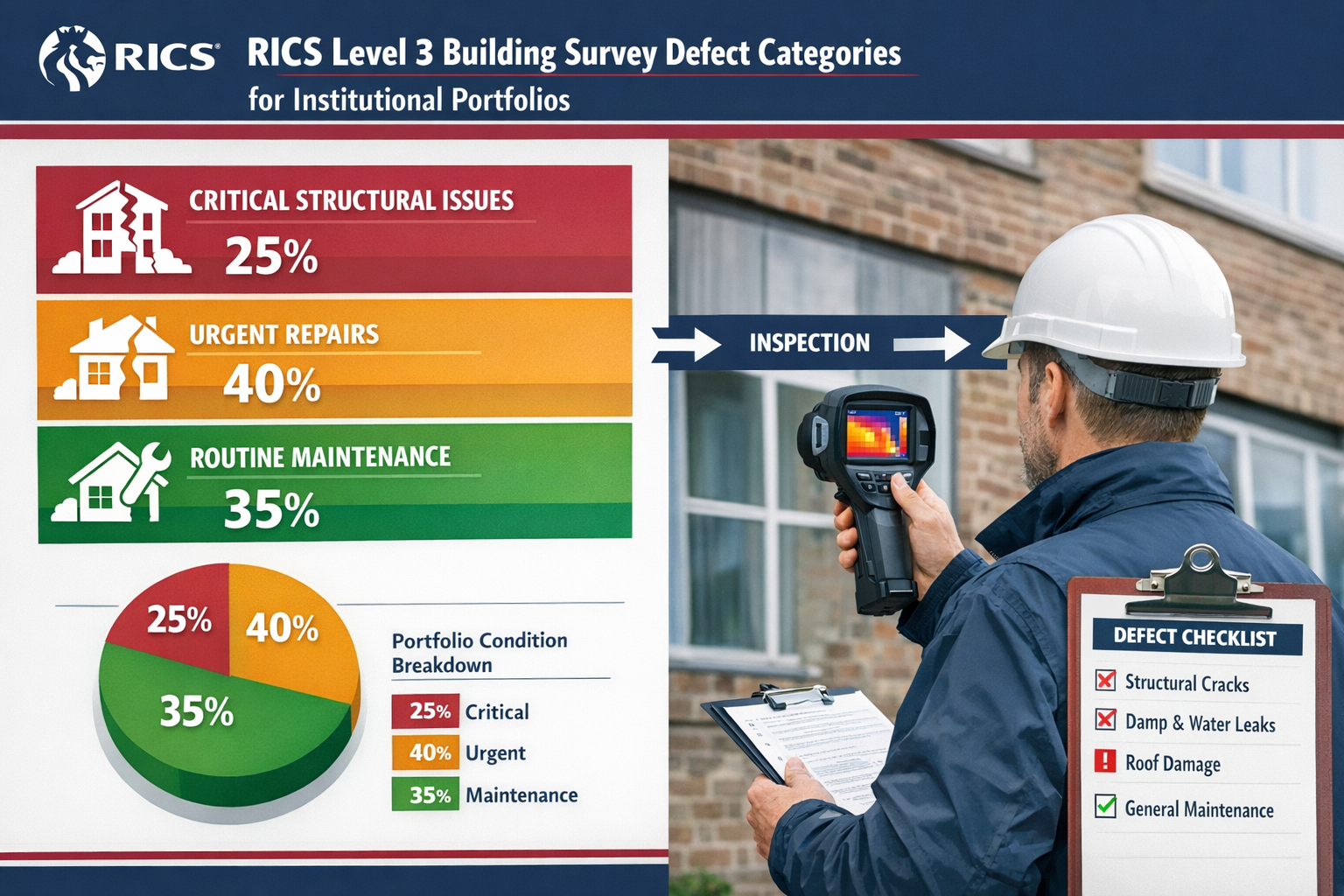
Key defect categories include:
🔴 Category 1 – Critical Structural Defects: Issues affecting structural integrity, safety, or immediate habitability (e.g., foundation movement, roof collapse risk, dangerous electrical installations)
🟠 Category 2 – Urgent Repairs Required: Defects requiring attention within 12 months to prevent deterioration or tenant impact (e.g., significant damp penetration, heating system failures, water ingress)
🟡 Category 3 – Maintenance and Minor Defects: Issues requiring routine maintenance or cosmetic attention (e.g., decoration, minor plumbing leaks, garden maintenance)
🟢 Category 4 – Future Considerations: Anticipated maintenance or replacement within 5-10 years (e.g., roof covering lifespan, boiler replacement, window renewal)
This classification system enables institutional landlords to prioritize capital expenditure across portfolios, allocating resources to properties with the most critical defects first.
Building Survey Defect Reporting in Institutional Buy-to-Let Portfolios: Specialized Protocols
Portfolio-Scale Survey Methodology
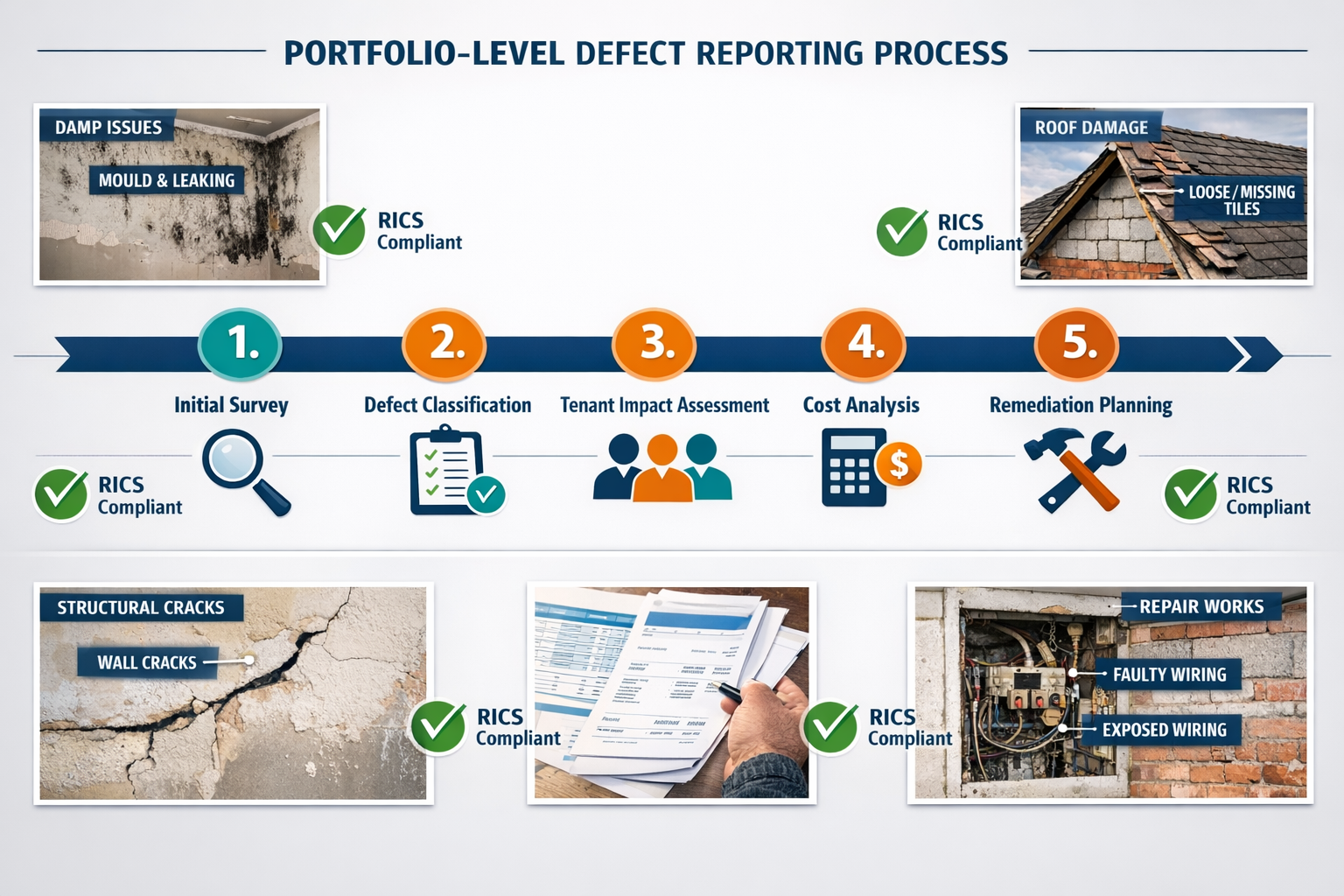
When conducting building surveys for institutional buy-to-let acquisitions, chartered surveyors must adapt traditional methodologies to accommodate portfolio-scale assessment requirements. This involves developing standardized inspection protocols that maintain RICS compliance while enabling efficient evaluation of multiple properties.
Essential components of portfolio-scale survey methodology:
Standardized Inspection Checklists 📋
Consistent evaluation criteria across all properties ensure comparable data. Surveyors should develop property-type-specific checklists (e.g., Victorian terraces, modern apartments, semi-detached houses) that capture common defect patterns while allowing for unique issues.
Digital Reporting Systems 💻
Institutional landlords require survey data in formats that integrate with portfolio management systems. Digital survey platforms enable real-time defect logging, photographic evidence capture, and automated report generation that feeds directly into acquisition decision-making processes.
Risk-Weighted Defect Scoring ⚖️
Beyond simple categorization, institutional surveys should assign risk scores considering defect severity, rectification costs, tenant impact, and regulatory compliance implications. This enables portfolio managers to calculate aggregate risk exposure across acquisitions.
Comparative Analysis Frameworks 📊
Survey reports should include benchmarking data that positions each property's condition relative to portfolio averages, local market standards, and property-type norms. This contextual information supports strategic acquisition decisions.
Tenant-Facing Defect Prioritization
Unlike owner-occupied properties, buy-to-let investments require defect assessment through the lens of tenant experience and landlord legal obligations. Professional landlords face significant regulatory requirements under the Homes (Fitness for Human Habitation) Act and other tenant protection legislation.
Tenant-impact defect prioritization considers:
-
Health and Safety Compliance 🏥
Defects affecting tenant health (damp, mold, heating adequacy) or safety (electrical hazards, structural risks) must be identified as highest priority regardless of rectification costs. Chartered surveyors should explicitly flag compliance risks in defect reports. -
Rental Income Impact 💷
Defects that could justify tenant rent reductions, trigger break clauses, or prevent re-letting should be clearly identified. Surveyors should provide estimated rental impact assessments for significant defects. -
Complaint and Dispute Risk ⚠️
Properties with defects likely to generate tenant complaints or legal disputes represent higher management costs. Survey reports should highlight these risk factors to inform acquisition pricing. -
Void Period Implications 📅
Defects requiring vacant possession for rectification impact rental yield calculations. Institutional landlords need clear guidance on which defects can be addressed with tenants in situ versus those requiring void periods.
Integration with Professional Landlord Due Diligence
Building survey defect reports form just one component of comprehensive institutional acquisition due diligence. Professional surveyors must ensure their defect reporting integrates seamlessly with broader assessment processes.
Due diligence integration requirements:
Financial Modeling Compatibility 💰
Defect rectification cost estimates must align with institutional financial modeling standards. This includes detailed cost breakdowns, phasing recommendations, and contingency allowances that feed directly into acquisition appraisal models. RICS valuation surveyors often work alongside building surveyors to ensure defect costs are properly reflected in property valuations.
Legal and Compliance Cross-Referencing ⚖️
Survey defect reports should explicitly reference relevant building regulations, planning requirements, and landlord legal obligations. This enables legal advisors to assess compliance risks and negotiate appropriate warranties or indemnities.
Portfolio Risk Aggregation 📈
When institutional landlords acquire multiple properties simultaneously, survey data must enable portfolio-level risk assessment. Surveyors should provide summary reports that aggregate defect exposure, identify common issues across properties, and highlight concentration risks (e.g., multiple properties with similar structural defects).
Acquisition Negotiation Support 🤝
Defect reports should clearly distinguish between pre-existing issues that justify price reductions and routine maintenance that forms part of normal ownership costs. Professional landlords use this information to negotiate purchase prices and secure retention funds for major repairs.
RICS Standards for Professional Landlord Due Diligence: Compliance and Best Practices
Enhanced RICS Quality Requirements in 2026
RICS has implemented strengthened quality assurance measures throughout 2026, raising the bar for building survey standards [1]. These initiatives directly impact surveyors conducting institutional portfolio assessments, requiring enhanced documentation, peer review processes, and ongoing professional development.
Key 2026 RICS quality requirements include:
Mandatory Competency Frameworks 🎓
Surveyors conducting institutional portfolio work must demonstrate specialized competency in commercial property assessment, landlord-tenant legislation, and portfolio-scale reporting. RICS now requires evidence of continuing professional development (CPD) in these specialized areas.
Enhanced Inspection Standards 🔍
RICS building surveying standards mandate comprehensive inspection protocols covering all accessible areas [3]. For institutional portfolios, this includes common areas, external grounds, shared facilities, and building services infrastructure that may be overlooked in residential surveys.
Detailed Defect Documentation 📸
Survey reports must include comprehensive photographic evidence, precise defect locations (using floor plans or grid references), and detailed descriptions that enable third-party verification. This documentation standard protects both surveyors and institutional clients in subsequent disputes.
Professional Indemnity Requirements 🛡️
Given the higher values involved in institutional portfolio acquisitions, RICS members must maintain appropriate professional indemnity insurance levels. Survey reports should clearly state insurance coverage limits to ensure institutional clients understand liability protections.
Defect Rectification Guidance and Cost Estimation
RICS guidance on defects and rectifications provides detailed frameworks for assessing repair options and estimating costs [2]. For institutional landlords, accurate cost estimation is critical to acquisition pricing and portfolio financial planning.
Best practice defect rectification reporting includes:
Multiple Remediation Options 🔧
Rather than prescribing single solutions, surveyors should present alternative rectification approaches with associated costs, timescales, and performance implications. This enables institutional landlords to make informed decisions based on portfolio strategy (e.g., minimal intervention for short-term holdings versus comprehensive refurbishment for long-term assets).
Phased Repair Strategies 📆
Large portfolios benefit from phased rectification programs that spread capital expenditure over multiple years. Survey reports should identify which defects require immediate attention versus those that can be scheduled for future maintenance cycles.
Lifecycle Cost Analysis 💡
Beyond immediate rectification costs, institutional landlords need guidance on long-term maintenance implications. Surveyors should provide lifecycle cost assessments for major building elements (roofs, heating systems, windows) to inform capital expenditure forecasting.
Contractor Specification Guidance 📋
Defect reports should include sufficient technical detail to enable institutional landlords to obtain competitive contractor quotations. This includes specification of appropriate materials, workmanship standards, and relevant building regulations or standards compliance requirements.
Portfolio-Level Risk Assessment and Reporting
Institutional buy-to-let portfolios require risk assessment at both individual property and aggregate portfolio levels. RICS-compliant surveyors must develop reporting frameworks that enable sophisticated risk analysis across multiple properties.
Portfolio risk reporting components:
-
Aggregate Defect Exposure Metrics 📊
Summary reports should quantify total defect rectification costs across the portfolio, categorized by urgency, property type, and defect category. This enables institutional landlords to assess overall acquisition risk exposure. -
Concentration Risk Identification 🎯
Surveyors should highlight common defects affecting multiple properties (e.g., widespread roof issues, systemic damp problems, aging heating systems). Concentration risks may justify bulk rectification programs or influence acquisition decisions. -
Geographic and Property-Type Analysis 🗺️
Portfolio reports should analyze defect patterns by location and property type, identifying whether certain areas or building types present elevated risk profiles. This information supports strategic portfolio composition decisions. -
Regulatory Compliance Dashboard ✅
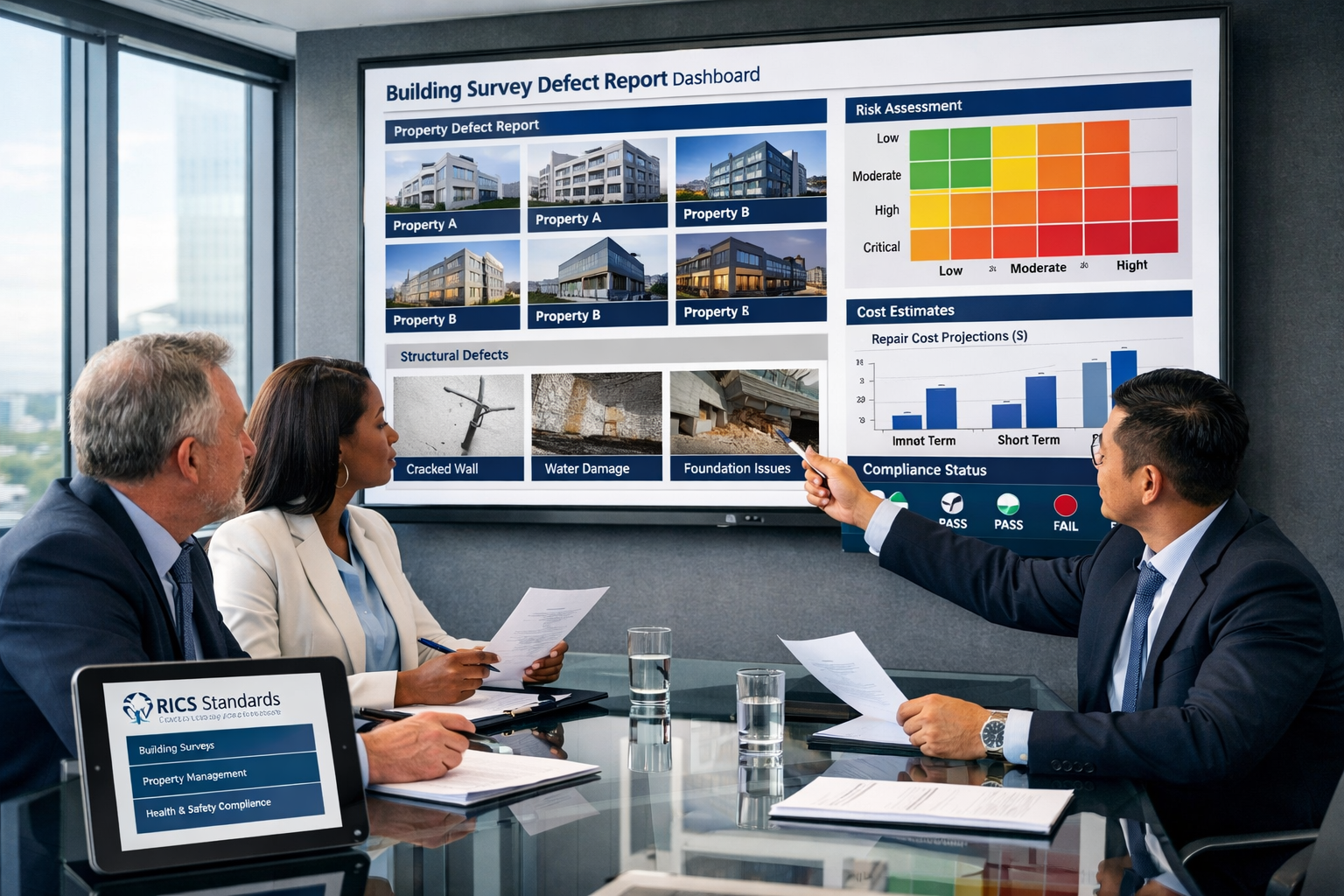
Institutional landlords need clear visibility of compliance status across portfolios. Survey reports should include summary dashboards showing properties meeting all regulatory requirements versus those requiring remedial work to achieve compliance. -
Performance Benchmarking 📈
Comparing survey findings against industry benchmarks and portfolio historical data enables institutional landlords to assess whether acquisition targets represent good value or elevated risk relative to market norms.
Specialized Survey Considerations for Institutional Buy-to-Let
Multi-Unit Building Assessments
Institutional portfolios often include multi-unit buildings such as apartment blocks or houses in multiple occupation (HMOs). These properties require specialized survey approaches that address shared building elements, communal facilities, and complex building services.
Multi-unit survey considerations include:
Common Area Inspections 🏢
Comprehensive assessment of entrance halls, stairwells, corridors, lift installations, and shared external areas. Defects in common areas affect all tenants and may represent significant rectification costs.
Building Services Infrastructure ⚙️
Institutional properties often feature centralized heating systems, communal hot water provision, fire alarm systems, and emergency lighting. Structural engineering assessments may be required for complex building services installations.
Fire Safety Compliance 🔥
Following regulatory changes, fire safety assessment forms a critical component of multi-unit building surveys. Surveyors must identify fire door deficiencies, compartmentation breaches, inadequate escape routes, and non-compliant fire detection systems.
Lease and Management Structure Implications 📜
Survey reports should consider how building defects interact with lease structures, service charge arrangements, and management responsibilities. This is particularly important for mixed-tenure buildings where institutional landlords own some but not all units.
Period and Non-Standard Construction Properties
Institutional portfolios frequently include Victorian and Edwardian properties or buildings featuring non-standard construction methods. These properties require specialized survey expertise to identify characteristic defects and appropriate rectification approaches.
Period property survey focus areas:
-
Structural Movement and Settlement 🏚️
Historic properties commonly exhibit structural movement that may be historic and stable or ongoing and progressive. Surveyors must distinguish between cosmetic cracking and active structural defects requiring intervention. -
Damp and Moisture Issues 💧
Period properties built without damp-proof courses or with solid wall construction present characteristic moisture-related defects. Damp surveys may be required to determine moisture sources and appropriate remediation strategies. -
Historic Building Fabric Deterioration 🧱
Traditional building materials (lime mortar, timber lath and plaster, cast iron gutters) require specialized knowledge to assess condition and specify appropriate repairs that respect historic construction methods. -
Energy Efficiency Challenges 🌡️
Period properties often present poor thermal performance, creating tenant comfort issues and elevated energy costs. Survey reports should identify opportunities for sympathetic energy efficiency improvements that don't compromise building character.
Regulatory Compliance and Landlord Obligations
Professional landlords face extensive regulatory requirements that building surveys must explicitly address. RICS-compliant defect reporting should clearly identify compliance risks across multiple regulatory frameworks.
Key regulatory compliance areas:
Electrical Safety Standards ⚡
All rental properties require valid Electrical Installation Condition Reports (EICRs) every five years. Building surveys should identify visible electrical defects and recommend full EICR testing where installations appear aged or non-compliant.
Gas Safety Requirements 🔥
Annual gas safety certificates are mandatory for rental properties. Surveyors should note gas appliance age, condition, and any visible safety concerns requiring immediate attention.
Energy Performance Certificates (EPCs) 🏷️
Minimum EPC ratings (currently E or above) apply to rental properties. Survey reports should identify properties likely to fall below minimum standards and recommend improvement measures.
Homes (Fitness for Human Habitation) Act Compliance 🏠
This legislation requires rental properties to be fit for human habitation throughout tenancies. Surveys must identify defects affecting the 29 hazards covered by the Housing Health and Safety Rating System (HHSRS).
Licensing Requirements 📋
Properties in selective licensing areas or HMOs subject to mandatory licensing must meet specific standards. Survey reports should explicitly address licensing compliance where relevant.
Technology and Innovation in Portfolio Survey Management
Digital Survey Platforms and Data Integration
Institutional landlords increasingly demand digital survey solutions that integrate with portfolio management systems, enabling real-time defect tracking and data-driven decision-making.
Technology-enabled survey innovations include:
Mobile Survey Applications 📱
Surveyors use tablet-based applications to capture defect data, photographs, and measurements on-site, with automatic synchronization to cloud-based reporting systems. This accelerates report production and improves data accuracy.
Building Information Modeling (BIM) Integration 🏗️
Advanced institutional clients may require survey data in BIM-compatible formats, enabling three-dimensional visualization of defects and integration with facilities management systems.
Automated Defect Recognition 🤖
Emerging artificial intelligence technologies can analyze building photographs to identify common defects such as cracking, damp staining, or vegetation growth, supporting surveyor assessments with automated screening.
Portfolio Dashboard Reporting 📊
Digital platforms aggregate survey data across portfolios, providing institutional landlords with interactive dashboards showing defect profiles, compliance status, and capital expenditure requirements across all properties.
Predictive Maintenance and Lifecycle Planning
Forward-thinking institutional landlords use building survey data to develop predictive maintenance programs that optimize long-term portfolio performance.
Predictive maintenance applications:
Building Element Lifecycle Tracking ⏳
Survey reports should document the age and condition of major building elements (roofs, heating systems, windows, external decorations), enabling portfolio managers to forecast replacement requirements and budget accordingly.
Defect Trend Analysis 📈
Analyzing defect patterns across portfolios over time identifies systemic issues requiring strategic intervention, such as widespread roof covering failures or heating system obsolescence affecting multiple properties.
Preventive Maintenance Scheduling 🗓️
Survey findings inform preventive maintenance programs that address minor defects before they escalate into major failures, reducing overall lifecycle costs and minimizing tenant disruption.
Capital Expenditure Forecasting 💰
Comprehensive survey data enables institutional landlords to develop accurate 5-10 year capital expenditure forecasts, supporting financial planning and investor reporting requirements.
Cost Implications and Investment Decision-Making
Defect Cost Estimation for Acquisition Pricing
Accurate defect rectification cost estimation directly influences institutional acquisition pricing and investment returns. RICS-compliant surveyors must provide reliable cost guidance that enables sophisticated financial modeling.
Cost estimation best practices:
Detailed Cost Breakdowns 📋
Rather than single lump-sum estimates, institutional landlords require itemized cost breakdowns showing professional fees, materials, labor, access equipment, and contingencies separately. This enables detailed financial modeling and value engineering.
Regional Cost Variations 🗺️
Rectification costs vary significantly by location, with London and Southeast properties typically commanding premium pricing. Survey reports should reflect regional cost norms relevant to property locations.
Phasing and Cashflow Implications 💷
Institutional financial models require clarity on when rectification costs will be incurred. Surveyors should indicate which defects require immediate attention versus those that can be deferred, enabling accurate cashflow forecasting.
VAT and Tax Considerations 🧾
Some rectification works may qualify for reduced VAT rates or capital allowances. While surveyors should not provide tax advice, flagging potentially qualifying works enables institutional landlords to optimize tax positions.
Risk-Adjusted Return Analysis
Building survey defect reports enable institutional landlords to calculate risk-adjusted investment returns that account for rectification costs, void periods, and ongoing maintenance requirements.
Investment analysis integration:
Yield Impact Assessment 📉
Defects requiring significant capital expenditure or causing extended void periods directly impact investment yields. Survey reports should provide sufficient information to enable yield recalculation based on rectification scenarios.
Exit Strategy Implications 🚪
Institutional investors with defined hold periods need to understand how current defects will affect future disposal values. Surveyors should indicate which defects are likely to deteriorate over typical hold periods (5-10 years) and impact resale values.
Refinancing Considerations 🏦
Lenders may require defect rectification as conditions of institutional portfolio financing. Survey reports should identify defects likely to trigger lender concerns, enabling proactive resolution or retention fund negotiations.
Portfolio Diversification Benefits 🎲
Acquiring properties with known defects at discounted prices may enhance overall portfolio risk-adjusted returns if rectification costs are accurately estimated and efficiently managed. Survey data enables sophisticated risk-return optimization across portfolios.
Conclusion
Building Survey Defect Reporting in Institutional Buy-to-Let Portfolios: RICS Standards for Professional Landlord Due Diligence represents a specialized discipline requiring expertise beyond traditional residential survey practice. As institutional and professional landlords continue expanding portfolios throughout 2026, the demand for sophisticated, portfolio-scale defect assessment frameworks will only intensify.
RICS-compliant surveyors must adapt their methodologies to meet institutional requirements, delivering standardized defect reporting that enables portfolio-level risk assessment, tenant-focused prioritization, and integration with sophisticated acquisition due diligence processes. The enhanced RICS quality standards introduced in 2026 provide a robust framework for professional practice, ensuring building surveys meet the elevated expectations of institutional clients [1].
Key success factors for surveyors serving institutional landlords include:
✅ Standardized inspection protocols that enable meaningful comparison across multiple properties
✅ Digital reporting systems that integrate with portfolio management platforms
✅ Comprehensive regulatory compliance assessment addressing landlord legal obligations
✅ Accurate cost estimation supporting acquisition pricing and financial modeling
✅ Risk-weighted defect prioritization balancing tenant impact, compliance requirements, and investment returns
For institutional landlords, investing in comprehensive RICS-compliant building surveys represents essential risk management that protects portfolio value, ensures tenant safety, and supports informed acquisition decisions. The upfront cost of professional survey work is invariably outweighed by the risks of acquiring properties with undisclosed defects that could trigger regulatory action, tenant disputes, or unexpected capital expenditure.
Actionable Next Steps
For institutional landlords expanding buy-to-let portfolios in 2026:
- Engage RICS-qualified chartered surveyors with demonstrable institutional portfolio experience – review their survey services and credentials carefully
- Develop standardized defect reporting templates that align with your portfolio management systems and financial modeling requirements
- Implement portfolio-level risk dashboards that aggregate survey data and enable strategic capital expenditure planning
- Establish relationships with specialist contractors capable of delivering portfolio-scale rectification programs efficiently
- Review all survey reports through the lens of tenant impact and regulatory compliance, not just structural condition
- Consider obtaining RICS valuations alongside building surveys to ensure defect costs are properly reflected in acquisition pricing
The institutional buy-to-let sector continues to mature, with professional landlords increasingly adopting corporate governance standards and sophisticated asset management practices. Building survey defect reporting that meets RICS standards while addressing the unique requirements of portfolio-scale acquisition represents a critical component of professional landlord due diligence in 2026 and beyond.
References
[1] Building Survey Standards Evolution How Rics Quality Strengthening Initiatives Impact Surveyor Practice In 2026 – https://nottinghillsurveyors.com/blog/building-survey-standards-evolution-how-rics-quality-strengthening-initiatives-impact-surveyor-practice-in-2026
[2] Defects And Rectifications 2nd Edition – https://www.rics.org/profession-standards/rics-standards-and-guidance/sector-standards/construction-standards/black-book/defects-and-rectifications-2nd-edition
[3] Building Surveying Standards – https://www.rics.org/profession-standards/rics-standards-and-guidance/sector-standards/building-surveying-standards
[4] What Is A Rics Survey 2025 – https://surveymatch.co.uk/what-is-a-rics-survey-2025/