As housing affordability improves across northern England and Scotland, families are increasingly turning to multi-generational living arrangements as a practical solution to rising elder care costs and changing family dynamics. Recent research reveals that 39% of Americans prefer in-home multi-generational living over assisted living facilities [3], a trend mirroring patterns emerging across UK markets. For property surveyors working in these northern recovery markets, this shift creates urgent demand for specialized Building Survey Checklists for Multi-Generational Homes in 2026: Assessing Adaptability in Northern Recovery Markets that can evaluate extension potential, accessibility features, and long-term value uplift opportunities.
The stabilizing property prices across Manchester, Liverpool, Leeds, Newcastle, and Scottish cities present unique opportunities for families seeking larger homes capable of accommodating multiple generations. However, not all properties offer the adaptability required for successful multi-generational living. Surveyors must now assess properties through a different lens—one that prioritizes functional separation over square footage and evaluates potential for future modifications.
Key Takeaways
✅ Functional separation matters more than size: Split-bedroom layouts, main-level bedrooms, and private entrances reduce household friction and increase property value in multi-generational contexts
✅ Accessibility features drive adaptability: Zero-threshold entries, wider doorways (900mm minimum), and walk-in showers are essential checklist items for aging-in-place potential
✅ Northern markets offer value opportunities: Stabilizing prices in recovery markets create ideal conditions for families to invest in adaptable properties with extension potential
✅ Comprehensive surveys prevent costly mistakes: Specialized checklists identify structural capacity for conversions, planning permission viability, and compliance requirements before purchase
✅ Policy and financing support is growing: Streamlined ADU permitting and expanded financing options make multi-generational adaptations more feasible in 2026 [8]
Understanding Multi-Generational Housing Demand in Northern Recovery Markets
The landscape of family housing has shifted dramatically across northern England and Scotland. What was once considered an unconventional living arrangement has become a mainstream housing solution driven by economic pressures, cultural changes, and demographic shifts.
The Economic Drivers Behind Multi-Generational Living
Housing affordability improvements in northern recovery markets have created a window of opportunity for families. Cities like Manchester, Leeds, Liverpool, Newcastle, and Glasgow are experiencing price stabilization after years of volatility, making larger properties more accessible to families pooling resources across generations.
The financial mathematics are compelling:
- Combined purchasing power allows families to access properties in better locations with more space
- Shared housing costs reduce individual financial burden for utilities, maintenance, and property taxes
- Elder care savings eliminate or reduce expensive assisted living facility fees (averaging £35,000-50,000 annually in the UK)
- Childcare support from grandparents reduces nursery costs while strengthening family bonds
Regional Market Characteristics
Northern recovery markets present distinct advantages for multi-generational housing:
| Market Feature | Northern England/Scotland | Southern England Comparison |
|---|---|---|
| Average Property Price | £180,000-£280,000 | £450,000-£650,000+ |
| Space Per Pound | Higher square footage for investment | Limited space at premium prices |
| Extension Potential | More properties with gardens/land | Constrained urban plots |
| Planning Approval | Generally more accommodating | Stricter conservation rules |
| Renovation Costs | Lower labor and material costs | Premium contractor rates |
These market conditions make northern regions particularly attractive for families seeking properties that can be adapted for multi-generational living. A comprehensive RICS Building Survey Level 3 becomes essential to identify properties with genuine adaptability potential.
Demographic and Cultural Shifts
Beyond economics, cultural attitudes toward family living arrangements are evolving. The stigma previously associated with adult children living with parents has diminished, replaced by recognition of practical benefits:
- 🏠 Aging-in-place preferences: Seniors increasingly prefer remaining in family homes rather than institutional care
- 👨👩👧👦 Childcare collaboration: Young families benefit from grandparent involvement in childcare
- 💼 Career flexibility: Remote work arrangements make shared living spaces more viable
- 🌍 Cultural diversity: Growing populations from cultures with multi-generational traditions normalize the arrangement
Builders are responding to this demand with purpose-designed floor plans featuring semi-detached units with separate entrances and independently controlled spaces [2]. However, the existing housing stock—particularly Victorian and Edwardian properties common in northern cities—requires careful assessment to determine adaptation feasibility.
Essential Components of Building Survey Checklists for Multi-Generational Homes in 2026
Creating effective Building Survey Checklists for Multi-Generational Homes in 2026: Assessing Adaptability in Northern Recovery Markets requires understanding the specific features that enable successful multi-generational living. Standard building surveys must be enhanced with specialized assessment criteria.
Accessibility and Universal Design Features
Accessibility forms the foundation of any multi-generational home assessment. Properties must accommodate current needs while providing flexibility for future mobility changes.
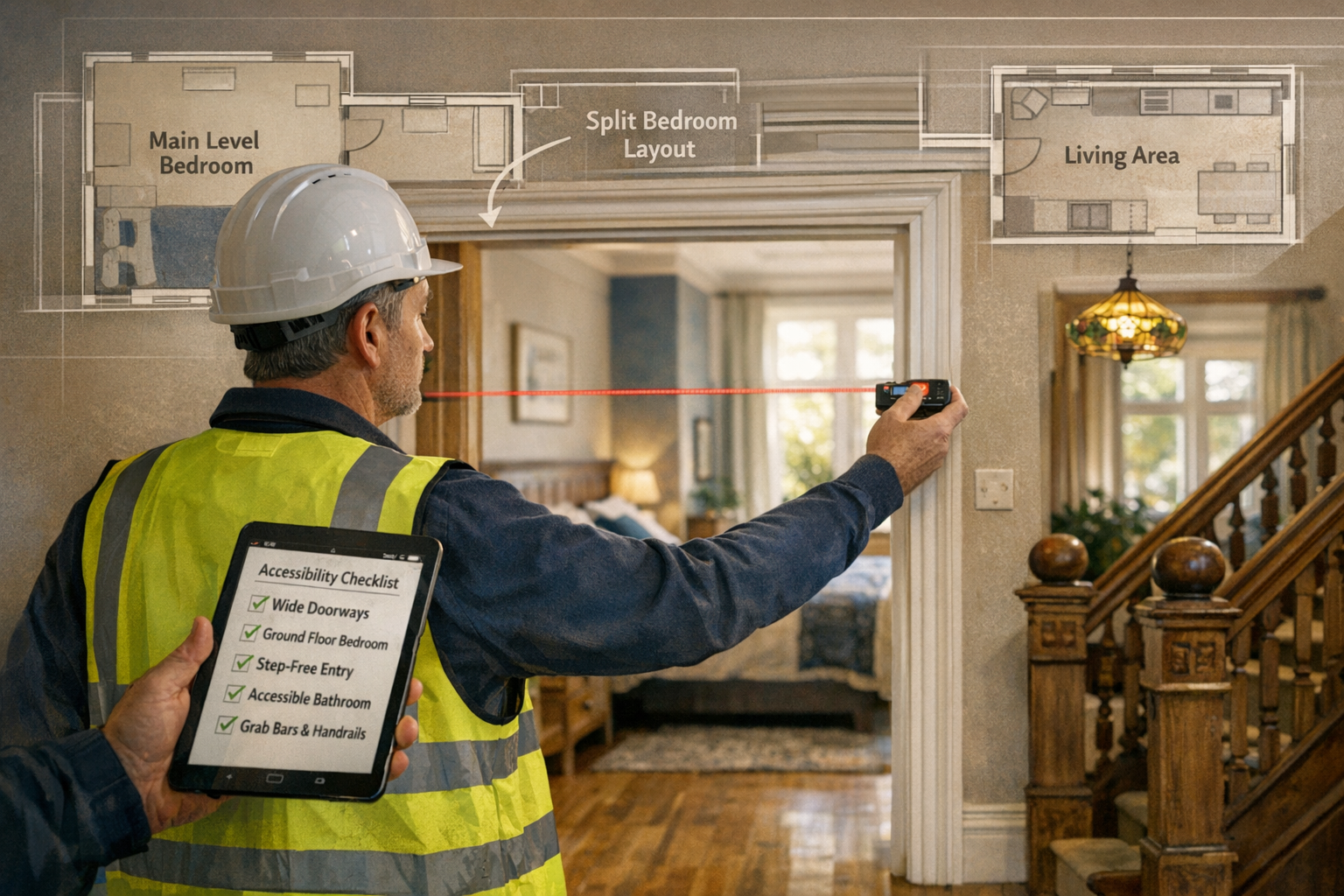
Critical Accessibility Checklist Items:
Entrance and Access Points:
- ✓ At least one zero-threshold entrance (step-free access) [8]
- ✓ Covered entrance area protecting from weather during entry/exit
- ✓ Adequate exterior lighting with motion sensors
- ✓ Potential for ramp installation (1:12 gradient minimum)
- ✓ Doorway width minimum 850-900mm for wheelchair access
- ✓ Level threshold transitions throughout ground floor
Internal Circulation:
- ✓ Hallway width minimum 1200mm for wheelchair turning circles
- ✓ Staircase width minimum 900mm with potential for stairlift installation
- ✓ Straight staircase runs preferred over winding stairs
- ✓ Adequate landing space at staircase top and bottom
- ✓ Structural capacity for future lift installation (if multi-story)
Bathroom Adaptations:
- ✓ Ground-floor bathroom or potential for installation
- ✓ Space for walk-in shower with level access (minimum 1200mm x 900mm)
- ✓ Reinforced walls for grab bar installation
- ✓ Adequate space for assisted bathing (minimum 2.5m x 2.0m)
- ✓ Lever-style taps and door handles throughout
- ✓ Slip-resistant flooring materials
Bedroom Placement:
- ✓ At least one main-level bedroom suitable for elderly or mobility-impaired residents [6]
- ✓ Adequate bedroom size for hospital bed and mobility equipment (minimum 3.6m x 3.0m)
- ✓ Proximity to accessible bathroom
- ✓ Natural light and ventilation meeting building regulations
These accessibility features align with AARP HomeFit standards and ensure properties can accommodate aging-in-place needs [8]. When conducting structural surveys, surveyors must assess whether these modifications are structurally and financially feasible.
Functional Separation and Privacy Zones
Research consistently shows that functional separation is more important than total square footage for multi-generational success [6]. Properties must provide distinct zones allowing different generations to maintain privacy and independence while sharing common spaces.
Privacy and Separation Assessment:
Layout Configuration:
- ✓ Split-bedroom floor plans separating master suite from additional bedrooms
- ✓ Multiple bathrooms (minimum 2, ideally 2.5-3 for three generations)
- ✓ Separate living areas or potential for creation
- ✓ Private entrance options for annexe or converted spaces
- ✓ Sound insulation between generational zones
Kitchen and Living Spaces:
- ✓ Open-plan areas facilitating shared family time
- ✓ Potential for kitchenette installation in annexe/conversion
- ✓ Multiple dining areas for flexible meal arrangements
- ✓ Separate utility spaces reducing household friction
Outdoor Space:
- ✓ Private garden areas for different generations
- ✓ Accessible outdoor space for mobility-impaired residents
- ✓ Potential for garden room or outbuilding conversion
Properties with Victorian or Edwardian layouts common in northern cities often provide excellent separation potential through their cellular room arrangements, though they may require accessibility modifications.
Extension and Conversion Potential
The ability to expand or reconfigure existing space represents critical value in multi-generational properties. Surveyors must assess both the physical feasibility and planning probability of various adaptation options.
Extension Feasibility Checklist:
Structural Capacity:
- ✓ Foundation condition and capacity for additional loading
- ✓ Wall construction type and suitability for extension attachment
- ✓ Roof structure and potential for loft conversion
- ✓ Ground conditions and drainage capacity
- ✓ Existing structural defects requiring remediation
Planning Considerations:
- ✓ Available plot space within permitted development rights
- ✓ Conservation area restrictions
- ✓ Listed building constraints
- ✓ Neighbor proximity and right-to-light issues
- ✓ Local authority planning history and attitudes
Common Adaptation Options:
| Conversion Type | Typical Cost (Northern Markets) | Planning Requirements | Suitability Assessment |
|---|---|---|---|
| Loft Conversion | £25,000-£45,000 | Often permitted development | Check head height, roof structure, stair space |
| Rear Extension | £30,000-£60,000 | May be permitted development | Assess garden depth, drainage, access |
| Garage Conversion | £15,000-£25,000 | Usually permitted development | Verify structural integrity, damp issues |
| Annexe/Granny Flat | £50,000-£100,000 | Often requires planning permission | Check plot size, access, utilities |
| Basement Conversion | £60,000-£120,000 | Building control approval | Assess water table, underpinning needs |
A detailed RICS Commercial Building Survey approach can be adapted for residential properties requiring extensive conversion assessment.
Building Systems and Services Capacity
Multi-generational homes place increased demands on building systems. Standard residential services may be inadequate for additional occupants and modified spaces.
Systems Capacity Assessment:
Heating and Ventilation:
- ✓ Boiler capacity for increased hot water demand
- ✓ Heating system zoning capability for separate temperature control
- ✓ Ventilation adequacy in converted spaces
- ✓ Energy efficiency ratings and upgrade potential
Electrical Systems:
- ✓ Consumer unit capacity for additional circuits
- ✓ Socket provision in all habitable rooms
- ✓ Emergency lighting in circulation areas
- ✓ Potential for separate metering in annexe spaces
Plumbing and Drainage:
- ✓ Water pressure adequate for multiple bathrooms
- ✓ Drainage capacity for additional fixtures
- ✓ Hot water cylinder size or combi boiler capacity
- ✓ Accessibility of pipework for modifications
Technology Infrastructure:
- ✓ Broadband connectivity for remote work/learning
- ✓ Mobile signal strength throughout property
- ✓ Potential for smart home/assistive technology installation
- ✓ Security system capability
Properties requiring significant systems upgrades may need specialist defect surveys to accurately cost remediation work.
Implementing Building Survey Checklists for Multi-Generational Homes in 2026: Regional Considerations
Northern recovery markets present unique opportunities and challenges when assessing multi-generational adaptability. Regional building characteristics, planning environments, and market dynamics all influence survey priorities.
Victorian and Edwardian Property Assessment
The housing stock across Manchester, Liverpool, Leeds, and other northern cities consists heavily of Victorian and Edwardian terraced and semi-detached properties. These buildings offer both advantages and challenges for multi-generational adaptation.
Advantages of Period Properties:
Spatial Characteristics:
- 🏛️ High ceilings (typically 2.7-3.2m) providing excellent loft conversion potential
- 📐 Cellular layouts naturally creating separate zones for different generations
- 🪟 Large windows providing good natural light and ventilation
- 🏡 Garden access common in terraced properties with rear yards
Structural Benefits:
- 💪 Solid wall construction (brick) providing good sound insulation between rooms
- 🏗️ Robust foundations often capable of supporting extensions
- 📏 Generous room sizes in better-quality Victorian/Edwardian builds
- 🔨 Modification history showing previous successful adaptations
Common Challenges:
Accessibility Barriers:
- ⚠️ Multiple floor levels with steep staircases
- 🚪 Narrow doorways (typically 750-800mm) requiring widening
- 🪜 External steps to front and rear entrances
- 🚽 Upstairs-only bathrooms in many terraced properties
Building Defects:
- 💧 Damp issues from solid wall construction and aging damp-proof courses
- 🪟 Single-glazed windows requiring replacement
- ⚡ Outdated electrical systems needing complete rewiring
- 🔥 Inadequate insulation affecting energy efficiency and comfort
Structural Concerns:
- 🏚️ Settlement cracks requiring monitoring or remediation
- 🪵 Timber decay in floors, joists, and roof timbers
- 🧱 Chimney instability in properties with removed fireplaces
- 🌧️ Roof deterioration requiring replacement or extensive repair
Surveyors conducting RICS Building Surveys on period properties must balance the adaptation potential against remediation costs to provide clients with realistic investment projections.
Modern Property Considerations
Post-war and contemporary properties in northern markets offer different assessment priorities. While they typically provide better baseline accessibility, they may have less expansion potential.
Modern Property Advantages:
- ✅ Ground-floor bathrooms standard in many designs
- ✅ Wider doorways meeting modern building regulations
- ✅ Better insulation reducing running costs
- ✅ Modern services requiring less immediate investment
- ✅ Open-plan layouts facilitating shared family spaces
Modern Property Limitations:
- ❌ Smaller plot sizes limiting extension options
- ❌ Lower ceilings (2.3-2.5m) constraining loft conversions
- ❌ Lightweight construction providing poor sound insulation
- ❌ Estate covenants restricting modifications
- ❌ Less character potentially affecting resale appeal
Planning Environment in Northern Recovery Markets
Understanding the local planning context is essential when assessing multi-generational adaptability. Northern local authorities generally take more accommodating approaches than southern counterparts, but significant variation exists.
Permitted Development Opportunities:
Under current regulations, many adaptations can proceed without full planning permission:
Rear Extensions:
- Single-story extensions up to 6 meters (terraced/semi-detached) or 8 meters (detached)
- Two-story extensions up to 3 meters (detached properties only)
- Height restrictions and boundary setback requirements apply
Loft Conversions:
- Volume increase up to 40 cubic meters (terraced) or 50 cubic meters (detached)
- No dormer on principal elevation
- Materials similar to existing property
Outbuilding Conversions:
- Buildings within 5 meters of main house may be converted
- Maximum height restrictions apply
- Cannot create separate dwelling without permission
Surveyors should verify whether properties fall within conservation areas or Article 4 directions that remove permitted development rights—common in historic northern city centers.
Value Uplift Assessment in Recovery Markets
A critical component of Building Survey Checklists for Multi-Generational Homes in 2026: Assessing Adaptability in Northern Recovery Markets involves projecting potential value increases from adaptations.
Value Drivers:
Bedroom Count Impact:
- Converting 3-bed to 4-bed: typically 10-15% value increase
- Converting 4-bed to 5-bed: typically 8-12% value increase
- Diminishing returns beyond 5 bedrooms in most northern markets
Accessibility Improvements:
- Ground-floor bedroom/bathroom addition: 5-8% value increase
- Wheelchair accessibility throughout: 3-5% premium in aging population areas
- Future-proofing features: increasingly valued by buyers planning long-term ownership
Annexe/Granny Flat:
- Self-contained unit with separate entrance: 15-25% value increase
- Rental income potential: £400-700/month in northern markets
- Flexibility for home office, teen space, or elderly relative accommodation
Quality of Execution:
- Professional conversions with building control approval command premium pricing
- DIY or substandard work may actually reduce value despite added space
- Matching materials and sympathetic design crucial for period properties
Market data from northern recovery areas shows that well-executed multi-generational adaptations are outperforming standard properties in terms of sale speed and achieved prices [6]. Properties offering genuine functional separation and accessibility features attract multiple competing offers from families seeking exactly these characteristics.
Regional Surveyor Expertise
Selecting surveyors with regional knowledge proves essential for accurate multi-generational assessments. Local expertise includes:
- 🔍 Understanding typical construction methods in regional housing stock
- 📋 Familiarity with local authority planning approaches
- 💷 Accurate cost projections based on regional contractor rates
- 🏘️ Knowledge of neighborhood demographics and buyer preferences
- 📊 Access to comparable sales data for adapted properties
Firms offering chartered surveyor services across northern regions can provide this specialized local knowledge while maintaining professional standards.
Practical Implementation: Survey Process and Client Communication
Effective implementation of Building Survey Checklists for Multi-Generational Homes in 2026: Assessing Adaptability in Northern Recovery Markets requires structured processes and clear communication with clients seeking these specialized assessments.
Pre-Survey Client Consultation
Before conducting the survey, surveyors should understand the client's specific multi-generational requirements:
Key Questions to Address:
-
Who will occupy the property?
- Number of generations and household members
- Current and anticipated mobility needs
- Timeline for occupancy changes
-
What level of separation is required?
- Complete independence (separate entrance, kitchen, bathroom)
- Semi-independence (shared main spaces, private sleeping areas)
- Integrated living with accessibility features
-
What is the budget for adaptations?
- Purchase price flexibility vs. renovation budget
- Phased implementation possibilities
- Financing arrangements (savings, loans, grants)
-
What is the intended ownership duration?
- Long-term family home (10+ years)
- Medium-term solution (5-10 years)
- Investment with resale considerations
This consultation allows surveyors to prioritize assessment areas and provide targeted advice rather than generic survey reports.
Enhanced Survey Methodology
Multi-generational surveys require additional time and specialized assessment techniques:
Extended Site Time:
- Standard survey: 2-4 hours
- Multi-generational assessment: 4-6 hours
- Additional time for measuring adaptation spaces, photographing key areas, and testing access routes
Specialized Equipment:
- Laser measuring devices for precise doorway and hallway widths
- Moisture meters for damp assessment in potential conversion areas
- Thermal imaging cameras for insulation evaluation
- Drone surveys for roof condition and extension planning
Documentation Requirements:
- Detailed floor plans with measurements
- Photographic evidence of adaptation opportunities and constraints
- Annotated drawings showing potential modifications
- Comparative examples from similar successful conversions
Report Structure and Recommendations
Multi-generational survey reports should provide actionable insights beyond standard defect identification:
Recommended Report Sections:
1. Executive Summary
- Overall suitability rating for multi-generational use
- Critical adaptations required
- Estimated total investment (purchase + adaptations)
- Timeline for achieving desired configuration
2. Accessibility Assessment
- Current accessibility features and deficiencies
- Priority modifications for immediate occupancy
- Long-term aging-in-place considerations
- Compliance with relevant standards
3. Adaptation Feasibility Analysis
- Structural capacity for extensions/conversions
- Planning permission requirements and likelihood
- Phased implementation options
- Cost-benefit analysis of various approaches
4. Building Systems Evaluation
- Capacity for increased occupancy
- Upgrade requirements and costs
- Energy efficiency improvements
- Smart home/assistive technology potential
5. Value Projection
- Current market value
- Post-adaptation value estimate
- Comparison with purpose-built multi-generational properties
- Resale considerations and market appeal
6. Risk Assessment
- Structural concerns requiring immediate attention
- Planning risks (conservation, neighbors, precedent)
- Cost overrun potential
- Timeline risks
7. Prioritized Action Plan
- Phase 1: Essential pre-occupancy work
- Phase 2: Medium-term improvements
- Phase 3: Long-term enhancements
- Estimated costs and timelines for each phase
Cost Estimation and Budget Planning
Accurate cost projections are critical for clients making purchase decisions. Northern market rates differ significantly from national averages:
Typical Northern Market Costs (2026):
Accessibility Modifications:
- Ramp installation: £2,000-£5,000
- Doorway widening (per opening): £800-£1,500
- Walk-in shower installation: £3,500-£6,000
- Stairlift installation: £2,500-£5,000
- Ground-floor bathroom addition: £8,000-£15,000
Space Adaptations:
- Loft conversion (basic): £25,000-£35,000
- Loft conversion (with ensuite): £35,000-£45,000
- Single-story rear extension: £30,000-£50,000
- Two-story rear extension: £50,000-£80,000
- Garage conversion: £15,000-£25,000
- Annexe/granny flat (new build): £60,000-£100,000
Building Systems:
- Complete rewiring: £3,500-£6,000
- New boiler and heating system: £3,000-£5,000
- Insulation upgrades: £4,000-£8,000
- Window replacement (whole property): £6,000-£12,000
Professional Fees:
- Architect/design services: 8-12% of construction costs
- Structural engineer: £500-£2,000
- Planning application: £206 (householder) + consultant fees
- Building control: £800-£1,500
- Project management: 5-10% of construction costs
These costs should be presented with contingency allowances (typically 15-20%) to account for unforeseen issues common in older properties.
Coordinating with Other Professionals
Multi-generational property assessment often requires multi-disciplinary input:
Key Professional Collaborations:
- 🏗️ Structural Engineers: For extension feasibility and load-bearing assessments
- 📐 Architects: For design options and planning application support
- ⚡ Specialist Contractors: For accurate pricing of complex works
- 🏛️ Planning Consultants: For challenging planning situations
- ♿ Occupational Therapists: For specialized accessibility requirements
- 💷 Mortgage Brokers: For financing adapted properties
Surveyors should maintain professional networks enabling rapid consultation when specialized expertise is required. This collaborative approach ensures clients receive comprehensive advice supporting informed decisions.
Client Education and Expectation Management
Many clients lack understanding of the complexities involved in multi-generational adaptations. Effective surveyors educate clients about:
Realistic Timelines:
- Planning permission: 8-13 weeks (if required)
- Building control approval: 2-4 weeks
- Construction work: 3-6 months (depending on scope)
- Total timeline: 6-12 months for major adaptations
Disruption Considerations:
- Living in property during work may not be feasible
- Phased approaches can minimize disruption but extend timelines
- Temporary accommodation costs should be budgeted
Regulatory Compliance:
- Building regulations apply to most adaptations
- Planning permission may be required despite initial assumptions
- Party wall agreements necessary for attached properties
- Retrospective approval challenges for unpermitted work
Market Realities:
- Not all adaptations increase value proportionally to cost
- Over-customization may limit buyer pool at resale
- Quality of execution significantly impacts value impact
- Regional market preferences vary considerably
This education helps clients make informed decisions aligned with their financial capacity and lifestyle requirements.
Conclusion: Positioning for Success in Northern Multi-Generational Markets
The convergence of demographic shifts, economic pressures, and cultural changes has created unprecedented demand for multi-generational housing solutions across northern England and Scotland. As property markets stabilize in these recovery regions, families are recognizing the opportunity to invest in adaptable homes that can accommodate changing household compositions over decades rather than years.
For property surveyors, this trend demands evolution beyond traditional assessment approaches. Building Survey Checklists for Multi-Generational Homes in 2026: Assessing Adaptability in Northern Recovery Markets must integrate accessibility evaluation, conversion feasibility analysis, systems capacity assessment, and value projection into comprehensive reports that guide clients toward sound investment decisions.
The properties best positioned for multi-generational success share common characteristics: functional separation potential, accessibility features or modification capacity, robust building systems, and extension opportunities. Victorian and Edwardian properties dominating northern housing stock often provide excellent foundations for adaptation, though they require careful assessment of structural condition and remediation costs.
Actionable Next Steps for Property Professionals
For Surveyors:
- Develop specialized expertise in multi-generational assessment through continuing professional development and case study analysis
- Build professional networks with architects, structural engineers, and accessibility specialists for collaborative assessments
- Create standardized checklists adapted to regional building types and local planning environments
- Invest in technology including laser measuring equipment, thermal imaging, and drone capabilities for comprehensive assessments
- Market specialized services to estate agents, financial advisors, and directly to families seeking multi-generational homes
For Prospective Buyers:
- Commission comprehensive surveys using professionals experienced in multi-generational assessment rather than standard homebuyer reports
- Consult before purchasing to understand adaptation feasibility and total investment requirements
- Prioritize adaptability over perfect current condition when comparing properties
- Budget realistically including 15-20% contingency for unforeseen issues in older properties
- Consider phased implementation allowing occupancy while completing non-essential adaptations over time
For Property Developers:
- Recognize market demand for purpose-designed multi-generational properties in northern markets
- Incorporate accessibility features as standard rather than optional upgrades
- Design functional separation into floor plans through split-bedroom layouts and flexible spaces
- Emphasize adaptability in marketing materials targeting family buyers
- Seek planning permission for annexe or granny flat options adding significant value
The northern recovery markets of 2026 present exceptional opportunities for families seeking multi-generational housing solutions. Properties offering genuine adaptability—whether through existing features or realistic modification potential—command premium prices and sell significantly faster than comparable standard homes. With comprehensive survey assessment, realistic budget planning, and quality execution of necessary adaptations, families can create homes serving multiple generations while building long-term value in strengthening markets.
The surveyors who develop expertise in this specialized assessment area will position themselves as essential advisors in one of the most significant housing trends of the decade. By combining technical building knowledge with understanding of multi-generational living requirements, accessibility standards, and regional market dynamics, these professionals provide invaluable guidance helping families make what may be the most important property decision of their lives.
References
[1] Building Surveys For Co Living And Multi Generational Homes Assessing Compliance In 2026 Tenant Demand Surge – https://nottinghillsurveyors.com/blog/building-surveys-for-co-living-and-multi-generational-homes-assessing-compliance-in-2026-tenant-demand-surge
[2] 136686 Multi Gen Floor Plans And More How Builders Are Responding Multigenerational – https://www.planetizen.com/news/2026/01/136686-multi-gen-floor-plans-and-more-how-builders-are-responding-multigenerational
[3] More Families Look Multigenerational Living – https://www.floridarealtors.org/news-media/news-articles/2026/02/more-families-look-multigenerational-living
[6] Does Multigenerational Living Affect Home Resale Value – https://www.reallistingagent.com/blog/2026/1/9/does-multigenerational-living-affect-home-resale-value
[8] Experts Multigenerational Housing Needs More Support – https://www.nar.realtor/magazine/real-estate-news/sales-marketing/experts-multigenerational-housing-needs-more-support