Court injunctions halting construction projects increased by 34% between 2023 and 2025, with party wall notice failures cited as the primary cause in over 60% of cases. As renovation volumes surge across the UK in 2026, surveyors face mounting pressure to ensure procedural compliance that prevents costly legal intervention.
Understanding how to properly draft and serve party wall notices while following RICS protocols has never been more critical. The stakes are high: a single procedural misstep can trigger an injunction that stops work indefinitely, damages client relationships, and generates substantial legal costs. This comprehensive guide provides surveyors with a step-by-step framework for avoiding party wall injunctions through meticulous notice preparation and proactive dispute prevention strategies.
Key Takeaways
- Timing is non-negotiable: Serve party wall notices at least 1 month before work on party structures or 2 months before excavation work to avoid grounds for injunction
- Planning permission does not equal party wall compliance: The Party Wall Act 1996 is mandatory and separate from planning approval processes
- Schedule of Condition documentation is your legal protection: Without independent pre-work condition records, disputes over damage become nearly impossible to resolve fairly
- Early neighbour communication prevents 70%+ of disputes: Informal discussions before formal notice service dramatically reduce conflict escalation
- Award preparation requires 4-8 weeks minimum: Budget sufficient time for the full dispute resolution process to prevent project delays
Understanding Party Wall Injunctions and Their Consequences in 2026
A party wall injunction is a court order that prohibits a building owner from continuing construction work due to procedural non-compliance with the Party Wall Act 1996. When neighbours believe their rights have been violated—typically through improper notice or failure to follow statutory procedures—they can apply to the County Court for an injunction to halt work immediately.[1]
The consequences of an injunction extend far beyond simple project delays:
- Immediate work stoppage affecting contractor schedules and labour costs
- Legal fees ranging from £5,000 to £25,000+ for both parties
- Reputational damage to surveyors and building professionals
- Client relationship breakdown and potential professional negligence claims
- Extended project timelines adding months to completion dates
Why Injunctions Are Rising in 2026
Several factors contribute to the surge in party wall injunctions:
📈 Increased renovation activity: Post-pandemic property improvements continue at record levels, creating more opportunities for procedural errors
🏘️ Higher property density: Urban infill development means more shared boundaries and complex party wall scenarios
⚖️ Greater legal awareness: Adjoining owners are better informed about their rights under the Act
💻 Digital information access: Online resources make it easier for neighbours to identify non-compliance and seek legal remedies
The good news? Nearly all injunctions are preventable through proper procedures. Understanding what is a party wall dispute and how conflicts escalate provides essential context for prevention strategies.
Essential Surveyor Checklist for Valid Party Wall Notices and Dispute Prevention
The foundation of avoiding party wall injunctions lies in meticulous notice preparation and service. This comprehensive checklist ensures compliance with statutory requirements while minimizing dispute risk.
Pre-Notice Phase: Early Communication and Assessment
Before drafting formal notices, complete these critical preliminary steps:
1. Conduct Thorough Site Assessment 🔍
- Identify all party walls, party structures, and boundary lines
- Determine whether work falls under Section 1, 2, or 6 of the Act
- Assess excavation proximity using the 3 metre rule
- Document existing conditions with photographs and measurements
2. Initiate Informal Neighbour Dialogue
Research confirms that early, informal communication prevents most disputes entirely.[2] Before serving formal notices:
- Explain the proposed work in plain language
- Share preliminary drawings or sketches
- Address concerns proactively
- Establish positive rapport and trust
3. Verify Property Ownership and Addresses
- Confirm current owners through Land Registry searches
- Obtain correct postal addresses for all adjoining owners
- Identify any leasehold arrangements requiring additional notices
- Document tenant occupancy if relevant
4. Assess Work Classification Accurately
Determine which section of the Act applies:
| Work Type | Act Section | Notice Period |
|---|---|---|
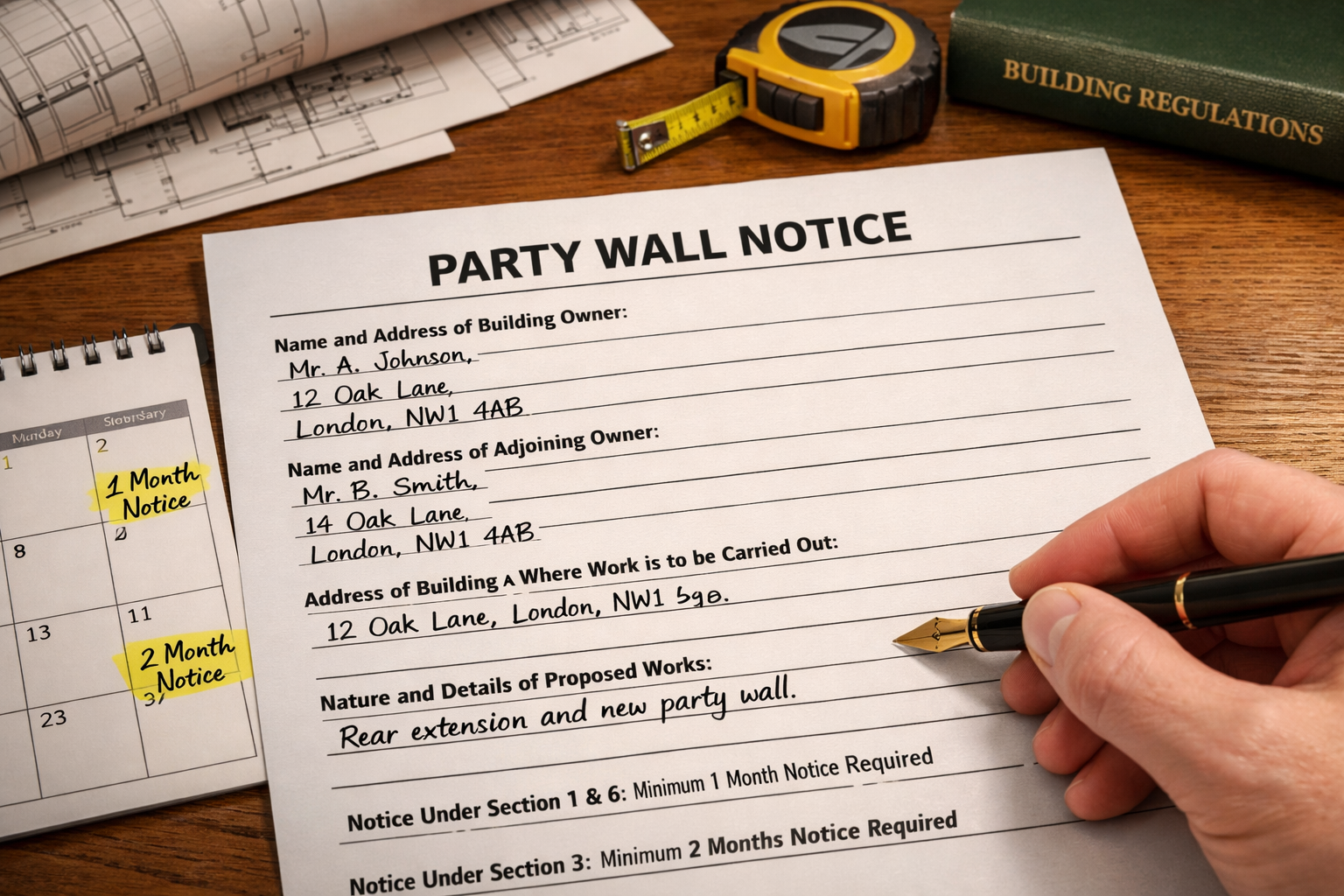
| Work directly to party wall | Section 1 | 1 month |
| New building on boundary line | Section 1 | 1 month |
| Excavation within 3m (below foundation level) | Section 6 | 2 months |
| Excavation within 6m (within 45° line) | Section 6 | 2 months |
Notice Drafting: Critical Content Requirements
Valid party wall notices must contain specific statutory information. Missing elements provide grounds for neighbours to seek injunctions.[1]
Essential Notice Components ✅
-
Building Owner Details
- Full legal name(s)
- Complete property address
- Contact information
-
Adjoining Owner Details
- Full legal name(s) as per Land Registry
- Complete property address
-
Work Description
- Detailed explanation of proposed works
- Specific reference to party wall involvement
- Clear indication of which Act section applies
-
Commencement Date
- Proposed start date (minimum 1-2 months from service)
- Realistic timeline allowing for response and Award preparation
-
Statutory Rights Information
- Clear statement of adjoining owner's right to consent or dissent
- Explanation of 14-day response period
- Surveyor appointment procedures if dispute arises
-
Supporting Documentation
- Relevant drawings showing party wall location
- Specifications of work methodology
- Any structural calculations if applicable
Notice Service: Timing and Delivery Methods
Proper service timing is non-negotiable for avoiding party wall injunctions. The Act mandates specific advance notice periods:[2]
Minimum Notice Periods:
- 1 month for work on existing party structures (Section 1 or 2)
- 2 months for excavation work or new walls on boundary (Section 6)
⚠️ Critical Timing Error: Many surveyors count from the date they prepare the notice rather than the date the neighbour receives it. Always calculate from the receipt date to ensure compliance.
Acceptable Service Methods:
- Hand delivery with signed acknowledgment
- Recorded delivery postal service
- Email (if previously agreed in writing)
- Service through solicitor or agent
Service Documentation:
Keep comprehensive records proving service:
- Signed receipt acknowledgments
- Royal Mail tracking numbers and delivery confirmations
- Email read receipts
- Witness statements for hand delivery
Understanding the consequences when no party wall notice is served reinforces why proper service documentation matters.
Post-Notice Phase: Response Management
After serving notice, surveyors must manage the 14-day response period carefully.[2]
Possible Neighbour Responses:
-
Written Consent ✅
- Work may proceed without Award
- Retain consent letter permanently
- Still recommend Schedule of Condition for protection
-
Written Dissent ⚠️
- Triggers dispute resolution process
- Requires surveyor appointments
- Proceed to Award preparation
-
No Response 🔕
- Legally treated as dissent after 14 days
- Triggers dispute resolution process
- Document all communication attempts
Surveyor Appointment Protocol:
When dissent occurs (express or deemed), the Act provides three surveyor appointment options:
| Option | Description | Advantages |
|---|---|---|
| Agreed Surveyor | Single surveyor acts for both parties | Faster, more economical |
| Two Surveyors | Each party appoints own surveyor | Greater independence, checks and balances |
| Three Surveyors | Two party-appointed plus third surveyor | Rarely used, highest cost |
Professional Standards: Only appoint qualified Party Wall Surveyors with demonstrated expertise and RICS membership. Using general surveyors significantly increases dispute risk.[2]
Schedule of Condition: Your Primary Defense Against Injunction Claims
A comprehensive Schedule of Condition serves as critical evidence preventing disputes that lead to injunctions. Without independent pre-work documentation, establishing causation for damage becomes nearly impossible.[3]

Why Schedules of Condition Prevent Disputes
When neighbours claim building work damaged their property, the burden of proof centres on establishing:
- What condition existed before work commenced
- What changes occurred during the work period
- Whether work activities caused the changes
Without a professional Schedule of Condition, these questions become contentious disputes often resolved only through costly litigation or injunction applications.
Essential Schedule of Condition Components
1. Comprehensive Photographic Documentation 📸
- High-resolution images of all relevant areas
- Multiple angles for each room and exterior elevation
- Close-ups of existing defects, cracks, or damage
- Dated and geo-tagged photographs
- Minimum 100-200 photos for typical residential property
2. Detailed Written Descriptions
- Room-by-room condition narratives
- Precise measurements of existing cracks or defects
- Material and finish specifications
- Structural element conditions
- Drainage and services status
3. Technical Measurements
- Crack width measurements using precision gauges
- Level readings for floors and ceilings
- Plumb measurements for walls
- Door and window operation functionality tests
4. Video Documentation
- Walkthrough videos showing overall conditions
- Focused videos of areas at highest risk
- Narrated commentary explaining observations
Timing and Access for Schedules
Optimal Timing:
- Complete Schedule immediately after notice service
- Minimum 2-4 weeks before work commencement
- Allow time for neighbour review and agreement
Access Rights:
Building owners have statutory rights to access adjoining property for Schedule preparation, provided they give 14 days' written notice.[1] However, practical considerations suggest:
- Negotiate convenient access times cooperatively
- Offer flexible scheduling options
- Bring independent witnesses if tensions exist
- Document any access refusals carefully
Refusal to grant reasonable access after proper notice constitutes an offense and strengthens the building owner's position if disputes arise.[1]
Schedule Review and Agreement
After completion:
- Provide copies to all parties within 7 days
- Allow 14 days for review and comments
- Address any factual disputes before work starts
- Obtain signed acknowledgments where possible
- Retain original records securely for minimum 6 years
The Party Wall Award Process: Avoiding Delays That Trigger Injunctions
When dissent occurs, the Party Wall Award becomes the legal document authorizing work to proceed. Understanding the Award timeline and requirements prevents delays that frustrate neighbours and prompt injunction applications.
Award Preparation Timeline
The full Award process typically requires 4-8 weeks minimum:[2]
Week 1-2: Surveyor Appointments
- Building owner appoints surveyor
- Adjoining owner appoints surveyor or agrees to Agreed Surveyor
- Surveyors exchange contact information and credentials
Week 2-3: Site Inspections and Information Gathering
- Surveyors inspect both properties
- Review construction drawings and specifications
- Conduct Schedule of Condition
- Assess potential risks and protective measures
Week 3-5: Award Drafting
- Surveyors negotiate Award terms
- Draft protective measures and working hours
- Establish cost allocation principles
- Address access requirements
Week 5-6: Award Review and Finalization
- Parties review draft Award
- Address any concerns or modifications
- Surveyors finalize and sign Award
- Serve Award on both parties
Week 6-8: Appeal Period
- Both parties have 14 days to appeal to County Court[3]
- Work cannot commence until appeal period expires (unless parties waive)
- Address any appeals if filed
Critical Award Content Elements
A comprehensive Party Wall Award must include:[4]
✅ Scope of Authorized Works
- Detailed description of permitted activities
- Specific reference to drawings and specifications
- Any limitations or prohibited methods
✅ Protective Measures
- Structural protection requirements
- Dust and noise control measures
- Vibration monitoring protocols
- Temporary support specifications
✅ Working Hours and Access
- Permitted working days and times
- Access routes and restrictions
- Notice requirements for specific activities
- Emergency contact procedures
✅ Schedule of Condition Reference
- Incorporation of pre-work condition records
- Agreement on existing defects
- Monitoring and inspection protocols
✅ Cost Allocation
- Responsibility for surveyor fees
- Cost-sharing principles for shared benefits
- Security for expenses provisions
✅ Dispute Resolution
- Procedures for addressing issues during work
- Surveyor authority and limitations
- Appeal rights and timeframes
Understanding party wall award guidance ensures Awards meet statutory requirements and withstand legal scrutiny.
Common Notice Failures That Lead to Injunctions
Despite clear statutory requirements, certain errors repeatedly cause injunction applications. Awareness of these pitfalls enables proactive prevention.
Timing Failures ⏰
Insufficient Notice Period
The most common error: serving notices too close to intended commencement dates. Remember:
- Count from neighbour's receipt date, not preparation date
- Add buffer time for postal delays
- Account for Award preparation if dissent likely
- Consider holiday periods affecting response times
Backdated Notices
Attempting to serve notices after work has commenced invalidates the entire process and virtually guarantees injunction success for neighbours.
Content Deficiencies 📄
Vague Work Descriptions
Generic descriptions like "renovation work" or "structural alterations" fail statutory requirements. Notices must specify:
- Exact nature of party wall involvement
- Structural elements affected
- Construction methodology
- Materials and finishes
Missing Statutory Information
Omitting adjoining owners' rights information or surveyor appointment procedures creates grounds for claiming invalid notice.
Incorrect Property Identification
Using incorrect addresses, outdated owner names, or failing to identify all affected parties invalidates notices.
Service Failures 📬
Inadequate Proof of Service
Without documented proof of service (tracking numbers, signed receipts, email confirmations), building owners cannot demonstrate compliance if challenged.
Service to Wrong Parties
Serving notice to tenants instead of freeholders, or missing co-owners, creates fatal procedural defects.
Planning Permission Confusion 🏗️
A persistent misconception causes significant problems: planning permission does not satisfy Party Wall Act requirements.[2] These are entirely separate legal regimes:
| Planning Permission | Party Wall Act |
|---|---|
| Local authority approval | Private rights between neighbours |
| Concerns land use and development | Concerns shared structures and boundaries |
| Public interest considerations | Property rights protection |
| Optional for some works | Mandatory when Act applies |
Proceeding with planning permission but without proper party wall procedures provides clear grounds for injunction applications.
Proactive Dispute Prevention Strategies for 2026 Projects
Beyond technical compliance, successful surveyors employ relationship-focused strategies that prevent conflicts from escalating to legal action.
Early Engagement Communication Framework
Pre-Notice Informal Discussion
Before serving formal notices:
- Schedule face-to-face meetings when possible
- Bring preliminary drawings and visual aids
- Listen actively to neighbour concerns
- Document discussions in writing (without creating legal obligations)
- Offer to answer questions as they arise
Transparent Information Sharing
Neighbours fear the unknown. Proactively share:
- Project timelines and phasing
- Working hours and noise expectations
- Dust and disruption mitigation measures
- Contact information for concerns
- Progress updates throughout work
Professional Surveyor Selection
The surveyor's role extends beyond technical compliance to diplomatic mediation. When appointing surveyors, prioritize:[2]
🎯 Party Wall Specialization
- Dedicated party wall practice (not general building surveying)
- Current RICS membership and CPD compliance
- Minimum 5+ years party wall experience
- Local area knowledge and reputation
🎯 Independence and Impartiality
- No prior relationship with building owner's design team
- Clear conflict of interest policies
- Reputation for fairness with adjoining owners
- Willingness to impose reasonable protective measures
🎯 Communication Skills
- Clear explanation abilities for lay clients
- Diplomatic conflict resolution approach
- Responsive communication practices
- Documented track record of dispute prevention
Ongoing Monitoring and Compliance
Once work commences, maintain compliance through:
Regular Inspections
- Appointed surveyor site visits at key stages
- Monitoring compliance with Award conditions
- Early identification of emerging issues
- Documentation of work progress
Neighbour Communication
- Advance notice of particularly disruptive activities
- Prompt response to concerns or complaints
- Regular progress updates
- Immediate notification of any incidents
Documentation Discipline
- Daily site diaries recording activities
- Photographic records of work stages
- Correspondence files with all parties
- Incident reports for any issues
Understanding what happens when neighbours carry out works without party wall agreement illustrates the importance of maintaining compliance throughout the project.
When Disputes Arise: Rapid Response to Prevent Injunction Applications
Despite best efforts, disputes sometimes emerge. Swift, appropriate responses prevent escalation to injunction applications.
Early Warning Signs of Potential Injunction Action
Recognize these indicators that neighbours may seek legal intervention:
🚨 Formal Legal Correspondence
- Letters from solicitors rather than direct communication
- Specific allegations of Act breaches
- Demands for immediate work cessation
- Mention of "injunctive relief" or court action
🚨 Escalating Complaints
- Repeated complaints about same issues
- Emotional or aggressive communication tone
- Refusal to engage with surveyors
- Social media posts about the dispute
🚨 Access Obstruction
- Refusal of reasonable access requests
- Physical barriers to site access
- Threats of police involvement
- Documentation of trespassing allegations
Immediate Response Protocol
When warning signs appear:
1. Stop and Assess (Within 24 Hours)
- Immediately review compliance with notice requirements
- Verify Award conditions are being followed
- Document current work status comprehensively
- Consult with appointed surveyor urgently
2. Engage Legal Counsel (Within 48 Hours)
If injunction threat is explicit:
- Instruct solicitors experienced in party wall litigation
- Provide complete documentation file
- Obtain advice on procedural position
- Prepare defense strategy if application filed
3. Attempt Resolution (Ongoing)
- Request urgent surveyor-mediated meeting
- Offer reasonable accommodations for concerns
- Propose enhanced protective measures if appropriate
- Document all resolution attempts thoroughly
4. Prepare Court Response (If Required)
If injunction application proceeds:
- File timely defense with supporting evidence
- Demonstrate procedural compliance
- Show good faith efforts to address concerns
- Present Schedule of Condition evidence
Understanding party wall consent requirements and obtaining proper agreements prevents many disputes from reaching this critical stage.
Technology and Documentation Tools for 2026 Compliance
Modern surveyors leverage technology to enhance compliance documentation and reduce injunction risk.
Digital Notice Management Systems
Specialized software platforms offer:
- Template notices with statutory content
- Automated timing calculations and reminders
- Electronic service with proof of delivery
- Response tracking and deadline monitoring
- Document version control and audit trails
Condition Recording Technology
Advanced documentation tools include:
360° Photography Systems
- Complete room capture in single images
- Interactive viewing for all parties
- Timestamped and location-verified
- Cloud storage with access controls
Drone Survey Capabilities
- Exterior elevation documentation
- Roof and chimney condition records
- Boundary and excavation proximity verification
- Before/after comparison imagery
Crack Monitoring Devices
- Digital crack gauges with automated readings
- Continuous monitoring during work
- Alert systems for movement thresholds
- Objective evidence of stability
Mobile Inspection Apps
- Standardized inspection checklists
- Real-time photo annotation
- GPS and timestamp verification
- Instant report generation and distribution
Communication Platforms
Transparent communication tools reduce misunderstandings:
- Project portals providing neighbours with progress updates
- Shared document repositories for drawings and specifications
- Messaging systems with read receipts and response tracking
- Video conferencing for remote meetings and inspections
RICS Protocols and Professional Standards for 2026
The Royal Institution of Chartered Surveyors (RICS) provides professional guidance that supplements statutory requirements and reduces injunction risk.
RICS Party Wall Guidance Note
The current RICS guidance emphasizes:[4]
Proportionality
- Protective measures should match actual risks
- Avoid excessive or unreasonable requirements
- Balance both parties' interests fairly
Professional Conduct
- Independence from design and construction teams
- Transparent fee arrangements
- Timely communication with all parties
- Clear reasoning for decisions
Technical Competence
- Current knowledge of construction methods
- Understanding of structural behavior
- Awareness of case law developments
- Continuing professional development
Best Practice Standards
RICS members should:
✅ Maintain professional indemnity insurance adequate for party wall work
✅ Declare any conflicts of interest immediately
✅ Provide clear fee estimates before appointment
✅ Issue Awards within reasonable timeframes
✅ Respond to queries within 5 working days
✅ Keep detailed file notes of all decisions
✅ Participate in regular CPD on party wall matters
Surveyors who consistently follow RICS protocols demonstrate professional competence that courts recognize when defending against injunction applications.
Case Studies: Injunctions Avoided Through Proper Procedures
Real-world examples illustrate how meticulous compliance prevents legal intervention.
Case Study 1: Basement Excavation in Terraced Property
Scenario: Building owner planned deep basement excavation within 3 metres of adjoining Victorian terraced properties requiring Section 6 notices.
Risk Factors:
- Complex structural considerations
- Elderly adjoining owners concerned about damage
- Previous neighbourhood disputes over other projects
- High-value properties with significant damage exposure
Prevention Measures:
- Served notices 10 weeks before intended commencement (well beyond 2-month minimum)
- Conducted detailed pre-notice meetings with visual aids and structural engineer present
- Appointed highly experienced Agreed Surveyor acceptable to all parties
- Commissioned comprehensive Schedule of Condition with 250+ photographs
- Installed vibration monitoring equipment before work commenced
- Provided weekly progress updates to neighbours
- Offered temporary accommodation during noisiest phases
Outcome: Work completed without disputes, no damage claims, positive neighbour relationships maintained. Understanding excavation notice requirements for party walls proved essential.
Case Study 2: Loft Conversion with Party Wall Works
Scenario: Semi-detached property loft conversion requiring party wall beam installation.
Risk Factors:
- Initial neighbour dissent to notice
- Concerns about structural integrity
- Previous relationship tensions between owners
- Tight project timeline for building owner
Prevention Measures:
- Immediately appointed qualified Party Wall Surveyor upon dissent
- Surveyor conducted joint inspection with adjoining owner present
- Explained structural methodology in accessible language
- Agreed enhanced protective measures including temporary propping
- Established clear working hours respecting neighbour's work-from-home schedule
- Created communication protocol for daily updates
- Completed Award within 5 weeks
Outcome: Neighbour concerns addressed through Award process, work proceeded smoothly, relationship improved through transparent communication.
Conclusion: Building a Culture of Compliance and Prevention
Avoiding party wall injunctions in 2026 requires more than technical knowledge—it demands a comprehensive approach combining statutory compliance, professional excellence, and relationship management. The surge in renovation activity and increased legal awareness among property owners makes procedural precision non-negotiable.
The surveyor's checklist for valid notices and dispute prevention centres on these fundamental principles:
🎯 Timing Precision: Serve notices with generous advance periods (1 month for party structures, 2 months for excavation) calculated from receipt date, not preparation date.
🎯 Content Completeness: Include all statutory information in notices—property details, work descriptions, commencement dates, and adjoining owner rights.
🎯 Documentation Excellence: Create comprehensive Schedules of Condition with extensive photography, measurements, and written descriptions before work commences.
🎯 Professional Expertise: Appoint qualified, independent Party Wall Surveyors with specialized experience and RICS membership.
🎯 Proactive Communication: Engage neighbours informally before formal processes, maintain transparency throughout, and address concerns promptly.
🎯 Award Diligence: Allow 4-8 weeks for Award preparation, ensure comprehensive protective measures, and respect appeal periods.
🎯 Ongoing Compliance: Monitor work continuously, maintain communication, document progress, and respond immediately to emerging issues.
Actionable Next Steps for Surveyors
To implement these principles in your 2026 projects:
- Audit your current notice templates against statutory requirements and update any deficiencies
- Establish relationships with qualified Party Wall Surveyors in your practice areas before projects arise
- Invest in documentation technology including 360° cameras, crack monitoring devices, and inspection apps
- Create standardized communication protocols for neighbour engagement at each project stage
- Schedule RICS CPD training on party wall procedures and recent case law developments
- Review your professional indemnity insurance to ensure adequate coverage for party wall work
- Develop project timeline templates that incorporate proper notice periods and Award preparation time
The cost of prevention—measured in time, communication effort, and professional fees—pales compared to the expense, delay, and reputational damage of injunction proceedings. By making compliance and dispute prevention central to your practice, you protect your clients, your professional standing, and the smooth delivery of construction projects across the UK.
For complex scenarios or when disputes emerge despite best efforts, don't hesitate to seek specialist advice. Consult our party wall FAQ for additional guidance, or contact experienced professionals who can provide project-specific support.
The foundation of successful party wall practice in 2026 remains unchanged: respect for neighbours' rights, meticulous procedural compliance, and commitment to preventing conflicts before they escalate. Master these principles, and injunctions become the rare exception rather than the growing threat they represent for less diligent practitioners.
References
[1] Party Walls Checklist – https://www.woodfords.co.uk/party-walls-checklist/
[2] Party Walls Limited Checklist For Homeowners – https://www.partywallslimited.com/party-walls-limited-checklist-for-homeowners
[3] Party Wall Agreement – https://hoa.org.uk/advice/guides-for-homeowners/i-am-improving/party-wall-agreement/
[4] Drafting Party Wall Awards For Basement Conversions 2026 Protocols For Deep Excavations Near Boundaries – https://nottinghillsurveyors.com/blog/drafting-party-wall-awards-for-basement-conversions-2026-protocols-for-deep-excavations-near-boundaries