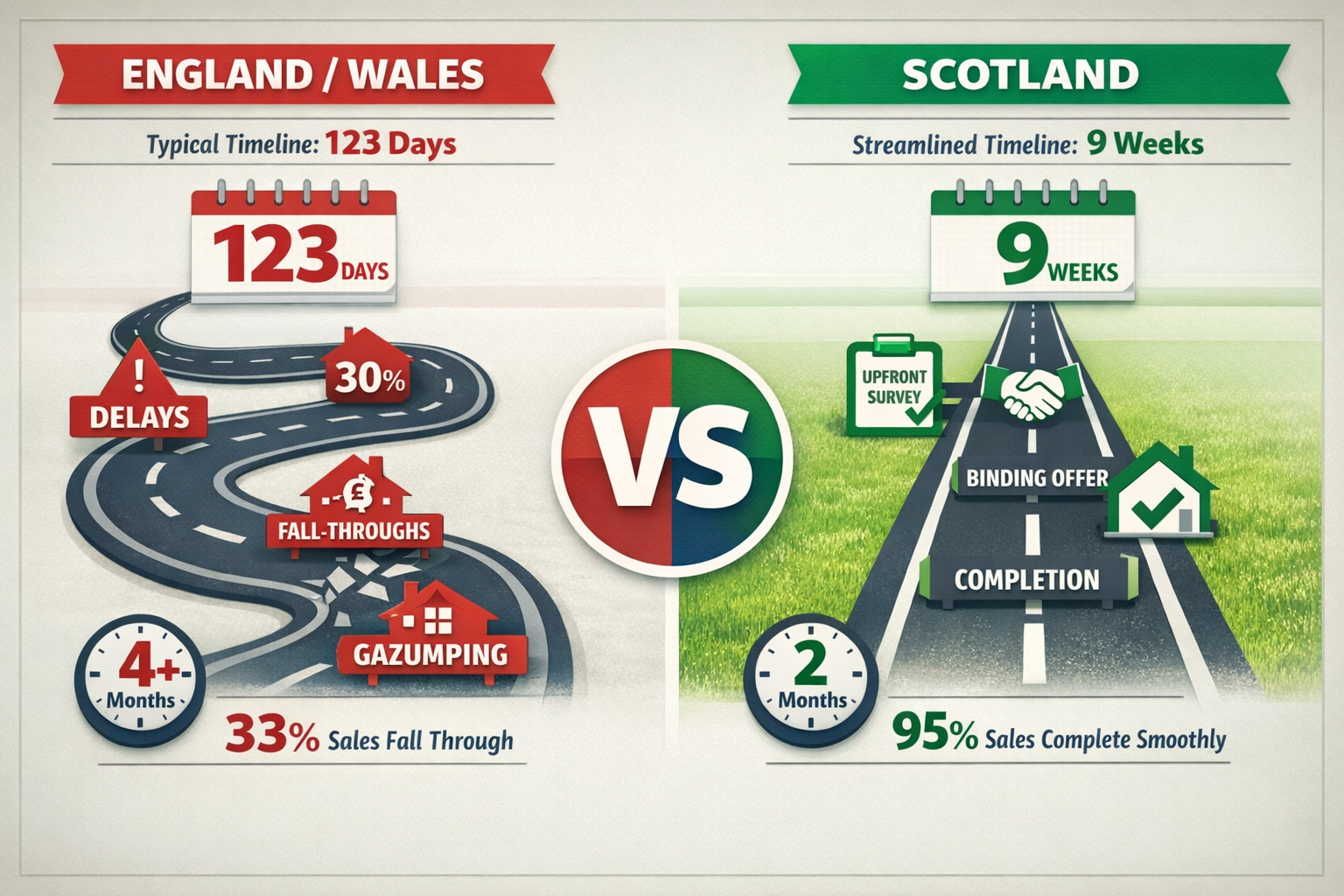
The average property transaction in England and Wales takes 123 days to complete—a frustrating timeline that leaves buyers and sellers in limbo while costs mount and deals collapse. Meanwhile, just across the border, Scottish homebuyers complete transactions in approximately nine weeks with significantly fewer fall-throughs. The difference? Scotland's upfront information model requires sellers to provide comprehensive property details, including surveys, before marketing begins. As 2026 ushers in renewed momentum for adopting Scottish upfront survey models for England and Wales: accelerating transactions in 2026's push for certainty, the property industry stands at a crossroads between maintaining outdated practices and embracing transformative reform.
Key Takeaways
- 52% of homeowners in England and Wales support mandatory seller surveys before listing, with 76% believing it would provide clearer understanding of property condition [1]
- Scotland's upfront model achieves only 9% transaction fall-through rates compared to significantly higher failure rates in England and Wales [2]
- Early property searches could accelerate transactions by approximately 4 weeks, delivering substantial efficiency gains through upfront information requirements [2]
- Less than 2% of home movers receive sufficient information before making offers under current England and Wales systems [2]
- Implementation requires minimum 24-month preparation period to build surveyor capacity and establish clear professional standards [3]
Understanding the Scottish Home Report System: A Proven Framework
Scotland's Home Report system, introduced in 2008, fundamentally restructured property transactions by shifting information disclosure from reactive to proactive. Under this framework, sellers must commission a comprehensive property survey before listing, creating transparency that benefits all parties.
Components of Scotland's Home Report
The Scottish model comprises three essential elements:
- Single Survey – A detailed property condition report prepared by a qualified surveyor
- Energy Report – An Energy Performance Certificate (EPC) assessing thermal efficiency
- Property Questionnaire – Seller-completed disclosure of known issues and alterations
This upfront approach ensures prospective buyers access critical information before making offers, eliminating the uncertainty that plagues England and Wales transactions. The single survey provides standardized condition assessments, reducing the need for multiple buyers to commission duplicate inspections on the same property.
Transaction Efficiency in Scotland vs. England and Wales
The statistical contrast between systems reveals compelling evidence:
| Metric | Scotland | England & Wales |
|---|---|---|
| Average Transaction Time | ~9 weeks | ~123 days (17.5 weeks) |
| Fall-Through Rate | 9% | Significantly higher |
| Buyers Receiving Sufficient Information | Majority | Less than 2% |
| Binding Contract Point | At offer acceptance | After exchange |
Scotland's binding missives system creates legal commitment immediately upon offer acceptance, contrasting sharply with England and Wales where agreements remain non-binding until formal exchange—often weeks or months later [2].
The Case for Adopting Scottish Upfront Survey Models for England and Wales
The momentum behind adopting Scottish upfront survey models for England and Wales: accelerating transactions in 2026's push for certainty stems from widespread dissatisfaction with current processes. Recent government polling revealed that less than 2% of home movers received adequate information before making offers, highlighting a fundamental market failure [2].
Public Support for Reform
Consumer sentiment strongly favors Scottish-style reforms:
- 52% of homeowners support mandatory seller surveys before listing properties [1]
- Among supporters, 76% believe upfront surveys provide clearer understanding of property condition before committing [1]
- 22% prefer formal offers made via solicitors rather than estate agents, mirroring Scotland's professional oversight approach [1]
This groundswell reflects frustration with gazumping, where sellers accept higher offers after initial agreements, and gazundering, where buyers reduce offers at the last moment. Scotland's binding contract system virtually eliminates these practices.
Financial Impact of Transaction Failures
Failed property transactions impose substantial costs on all parties. Currently, average failed transactions cost sellers around £800 in wasted fees, surveys, and legal work [2]. Buyers face similar losses when deals collapse after commissioning surveys and legal searches.
The emotional toll compounds financial damage. Homebuyers invest months in transactions only to see them evaporate due to information discovered late in the process—information that could have been disclosed upfront through comprehensive RICS building surveys or RICS Homebuyer surveys.
Projected Time Savings
Government analysis indicates that early property searches in English pilots could accelerate transactions by approximately 4 weeks [2]. This represents a 23% reduction in average completion times, delivering benefits throughout the property chain:
✅ Faster moves for families coordinating school terms and employment
✅ Reduced holding costs for buyers maintaining two properties during transition
✅ Lower anxiety from shortened uncertainty periods
✅ Increased market liquidity as properties cycle faster
How Upfront Survey Models Would Transform England and Wales Transactions in 2026

The practical implementation of adopting Scottish upfront survey models for England and Wales: accelerating transactions in 2026's push for certainty would fundamentally restructure the homebuying journey.
Proposed Upfront Information Requirements
Government consultations have outlined potential mandatory disclosures at listing stage:
- Property type and construction (detached, semi-detached, terraced, flat)
- Tenure details (freehold, leasehold, share of freehold)
- Council tax band and annual charges
- Energy Performance Certificate (EPC) rating and recommendations
- Material defects identified through professional survey
- Planning permissions and building regulation approvals for alterations
- Utilities and services connections and responsibilities
These standardized disclosures would appear in property listings, enabling buyers to make informed decisions before viewing properties [2].
The Role of Professional Surveyors
Professional surveyors would become central to transaction initiation rather than mid-process consultants. Sellers would commission comprehensive property surveys before marketing, similar to obtaining an EPC.
The survey types most relevant for upfront disclosure include:
RICS Building Surveys (Level 3) – Comprehensive inspections suitable for older, altered, or non-standard properties requiring detailed condition assessments
RICS Home Surveys – Standardized reports providing condition ratings and essential information for conventional properties
Specific Defect Surveys – Targeted investigations of known issues requiring specialist assessment
Professional surveyors would need to adapt reporting formats to serve dual purposes: informing sellers of necessary repairs and disclosing conditions to prospective buyers. This shift requires standardization of reporting frameworks and clear guidance on disclosure thresholds.
Cost Redistribution and Market Impact
The financial implications of upfront surveys involve cost shifting rather than net increases:
Current System:
- Buyers commission individual surveys: ~£400-£1,500 each
- Multiple buyers may survey the same property
- Sellers bear minimal upfront costs
- Failed transactions waste all invested survey costs
Proposed Upfront System:
- Survey costs expected to increase from average £38 to £380 per transaction as sellers commission comprehensive reports [2]
- Conveyancing costs projected to fall with variable costs reducing by £340 for buyers and £250 for sellers [2]
- Single survey serves all prospective buyers
- Survey costs potentially recoverable through sale price
The net effect creates greater cost efficiency by eliminating duplicate surveys and reducing transaction failures that waste professional fees.
Addressing Gazumping and Gazundering
Scotland's binding missives system provides the most effective solution to opportunistic behavior. When buyers submit formal offers through solicitors, acceptance creates immediate legal commitment from both parties.
Recent polling shows 18% of homeowners support blind bidding systems where sellers set minimum prices and buyers submit confidential offers. Among blind bidding supporters, 73% believe it effectively reduces gazumping risk [1]. This Scottish practice prevents sellers from leveraging competing offers to renegotiate after initial acceptance.
Implementation Challenges and Professional Preparation for 2026
While benefits appear compelling, successful implementation of adopting Scottish upfront survey models for England and Wales: accelerating transactions in 2026's push for certainty requires addressing substantial practical challenges.
Surveyor Capacity and Training Requirements
The Royal Institution of Chartered Surveyors (RICS) has advised government that minimum 24-month implementation period is essential to build capacity, develop standards, and create clear guidance [3]. This timeline reflects several capacity constraints:
Workforce Expansion 📊
The surveying profession must scale to accommodate significantly increased demand. Currently, buyers commission surveys selectively—often only for properties where offers are accepted. Mandatory seller surveys would require inspections for every listed property, multiplying demand substantially.
Standardization of Reporting
Unlike Scotland's established Home Report format, England and Wales lack standardized survey templates for upfront disclosure. Professional bodies must develop:
- Consistent condition rating systems
- Clear materiality thresholds for defect disclosure
- Standardized terminology accessible to non-professionals
- Digital formats for integration with property portals
Professional Indemnity Considerations
Surveyors face increased liability exposure when reports serve multiple parties over extended periods. Insurance frameworks must adapt to cover:
- Extended liability periods as surveys remain valid during marketing
- Multiple relying parties beyond the commissioning seller
- Potential claims from buyers who rely on seller-commissioned reports
Organizations offering structural surveys and specialized assessments like subsidence surveys will need updated professional indemnity policies reflecting new risk profiles.
Property Market Dynamics

Market participants have raised concerns about implementation effects:
Seller Reluctance
Some sellers may resist upfront survey costs, particularly if properties require significant repairs. Mandatory disclosure could depress asking prices for properties with material defects, though this arguably creates fairer price discovery rather than market distortion.
Survey Validity Periods
Properties remaining on market for extended periods raise questions about survey currency. Scotland addresses this through validity guidelines, but England and Wales would need clear frameworks for:
- Maximum survey age before requiring updates
- Protocols for material changes during marketing
- Buyer rights to commission supplementary inspections
New Build Properties
New construction presents unique considerations. Developers typically provide warranties and guarantees, but upfront surveys could identify construction defects before completion. Snagging reports already serve this function for new builds, suggesting integration pathways for upfront disclosure.
Technology and Digital Integration
Modern property portals must evolve to accommodate upfront information requirements. Rightmove, Zoopla, and OnTheMarket would need to:
- Display standardized survey summaries alongside listings
- Provide downloadable full survey reports
- Integrate EPC data and property questionnaires
- Enable comparison tools for buyers reviewing multiple properties
Digital transformation could accelerate adoption by making upfront information more accessible and user-friendly than current fragmented disclosure systems.
Strategic Recommendations for Surveyors and Conveyancers
Professional service providers should begin preparing now for potential reforms, positioning themselves to capitalize on structural market changes.
For Chartered Surveyors
Develop Standardized Upfront Survey Products
Create survey packages specifically designed for seller commissioning, with clear pricing and turnaround commitments. These should balance comprehensiveness with cost-effectiveness, recognizing that sellers will resist excessive expenses.
Consider tiered offerings:
- Essential Disclosure Survey – Basic condition assessment meeting minimum regulatory requirements
- Enhanced Property Report – Comprehensive inspection comparable to RICS Building Surveys Level 3
- Premium Package – Full structural assessment with specialist investigations for complex properties
Invest in Digital Reporting Platforms
Transition from PDF-based reports to interactive digital formats enabling:
- Mobile-friendly viewing for buyers researching properties
- Photographic evidence integrated with condition descriptions
- Interactive floor plans with defect locations marked
- Downloadable summary sheets for quick comparison
Build Seller Relationships
Shift marketing focus from reactive buyer inquiries to proactive seller engagement. Estate agents will become key referral partners as they guide sellers through pre-listing preparation. Organizations with established presence in areas like chartered surveyors in Hampstead or chartered surveyors in Chelsea should leverage local networks.
Expand Capacity Strategically
Anticipate demand increases by:
- Recruiting and training additional surveyors
- Developing associate networks for overflow capacity
- Investing in efficiency tools (digital measurement, AI-assisted defect identification)
- Establishing partnerships with specialists for complex assessments
For Conveyancers and Solicitors
Prepare for Earlier Legal Engagement
Upfront information requirements will shift legal work earlier in the transaction timeline. Solicitors should:
- Develop fixed-fee packages for pre-listing legal preparation
- Create standardized property questionnaire templates
- Establish protocols for early title investigation
- Build systems for managing longer client relationships from listing through completion
Embrace Scottish-Style Offer Processes
The 22% of homeowners preferring formal offers via solicitors [1] signals appetite for professional oversight. Conveyancers should position themselves as transaction managers rather than document processors, offering:
- Formal offer submission services
- Bid strategy advice based on survey findings
- Contract negotiation incorporating survey-identified defects
- Protection against gazumping through binding agreements
Leverage Technology for Efficiency
Reduced conveyancing costs projected under upfront systems [2] will compress margins. Maintain profitability through:
- Automated document generation and checking
- Digital identity verification and anti-money laundering compliance
- Client portals providing transaction transparency
- Integration with Land Registry digital services
The Government Consultation Timeline and Next Steps
The government consultation on upfront property information closed at the end of December 2025, with authorities currently reviewing stakeholder feedback on material information requirements in property listings [3]. While no definitive implementation timeframe has been announced, the consultation process provides insight into potential reform trajectories.
Key Consultation Questions
Government sought input on:
- Mandatory vs. voluntary upfront information provision
- Specific information categories requiring disclosure
- Enforcement mechanisms and penalties for non-compliance
- Implementation timelines and transitional arrangements
- Cost-benefit analysis and market impact assessments
Responses from professional bodies, consumer groups, and industry participants will shape final policy decisions expected in mid-2026.
RICS Position and Recommendations
The Royal Institution of Chartered Surveyors has actively engaged with reform proposals, emphasizing:
✅ Support for upfront information principles to improve transparency
✅ Need for adequate implementation periods (minimum 24 months) [3]
✅ Importance of professional standards and consistent reporting frameworks
✅ Capacity building requirements across the surveying profession
⚠️ Concerns about mandatory survey requirements without proper infrastructure
RICS advocates for phased implementation beginning with voluntary upfront information provision, followed by mandatory requirements once professional capacity and standards are established [3].
Realistic Implementation Timeline
Based on consultation timelines and professional preparation requirements, realistic implementation might follow this trajectory:
2026 – Government publishes consultation response and draft regulations
2027 – Professional standards development and pilot programs
2028 – Voluntary upfront information schemes launch
2029 – Mandatory requirements phase in for new listings
2030 – Full implementation with enforcement mechanisms active
This extended timeline reflects the complexity of restructuring England and Wales' property transaction system to match Scotland's established framework.
Lessons from Scotland's Implementation Experience
Scotland's 2008 Home Report introduction provides valuable lessons for England and Wales reform efforts.
Initial Challenges Scotland Faced
Market Resistance
Early implementation encountered seller pushback against upfront costs, particularly during the 2008 financial crisis when property values declined. Many sellers questioned paying for surveys when sales were uncertain.
Surveyor Capacity Constraints
Demand surges created backlogs as the surveying profession scaled to meet requirements. Some transactions experienced delays waiting for Home Report availability.
Quality Variations
Initial surveys showed inconsistency in reporting standards and condition assessments. Professional bodies responded with enhanced training and quality assurance programs.
Long-Term Benefits Realized
Despite initial friction, Scotland's system delivered substantial benefits:
- Reduced transaction times from several months to approximately nine weeks
- Lower fall-through rates (9%) compared to pre-reform levels [2]
- Improved price accuracy as buyers make informed offers based on known conditions
- Enhanced consumer confidence in property transactions
- Professional market conduct with reduced gazumping and opportunistic behavior
These outcomes demonstrate that short-term implementation challenges yield long-term market improvements when reforms are properly structured and supported.
Adaptations for England and Wales Context
England and Wales should not simply copy Scotland's model but adapt it to local market characteristics:
Larger Market Scale
England and Wales process significantly more transactions annually than Scotland, requiring proportionally greater surveyor capacity and digital infrastructure.
Different Legal Frameworks
England and Wales' registered land system differs from Scotland's, necessitating tailored approaches to binding contracts and legal commitments.
Regional Variations
Property markets vary dramatically between regions—from rural areas to London's high-value market. Flexible implementation accommodating regional differences may prove more effective than uniform mandates.
Existing Professional Infrastructure
England and Wales already have established surveying and conveyancing professions with different organizational structures than Scotland's. Reform should leverage existing capabilities rather than creating parallel systems.
Conclusion: Preparing for Certainty in Property Transactions
Adopting Scottish upfront survey models for England and Wales: accelerating transactions in 2026's push for certainty represents more than regulatory reform—it signals fundamental transformation of how properties change hands. The evidence supporting change is compelling: 52% public support [1], 4-week potential time savings [2], and dramatic reduction in fall-through rates demonstrated by Scotland's 9% failure rate [2].
For property professionals, the question is not whether reform will occur, but when and how to position for success. Surveyors who develop upfront survey expertise, conveyancers who embrace early legal engagement, and estate agents who facilitate transparent information disclosure will thrive in the reformed market.
Actionable Next Steps
For Homeowners Planning to Sell:
- Research comparing different types of survey to understand options
- Consider commissioning voluntary upfront surveys to differentiate listings
- Engage solicitors early to prepare property questionnaires and title documentation
- Address known defects before marketing to maximize sale prices
For Prospective Buyers:
- Request upfront information from sellers even before formal requirements
- Commission independent RICS home surveys when seller reports are unavailable
- Work with solicitors offering Scottish-style formal offer services
- Understand the difference between mortgage valuations and surveys
For Property Professionals:
- Monitor government announcements following December 2025 consultation closure
- Invest in training and capacity building for upfront survey delivery
- Develop digital platforms supporting transparent information disclosure
- Engage with professional bodies shaping implementation standards
- Build partnerships across the transaction chain (surveyors, conveyancers, estate agents)
The path toward certainty in property transactions requires collective commitment from all market participants. As 2026 progresses and government responses emerge, those who prepare proactively will lead the transformation toward faster, fairer, and more transparent property transactions that benefit everyone involved. The Scottish model proves that better systems are possible—England and Wales now have the opportunity to build on that success and create their own version of transaction certainty. 🏠
References
[1] More Than Half Of Homeowners In England And Wales Want Scottish Style Rule Regarding House Moving Surveys – https://www.scottishhousingnews.com/articles/more-than-half-of-homeowners-in-england-and-wales-want-scottish-style-rule-regarding-house-moving-surveys
[2] Home Buying And Selling Reform – https://www.gov.uk/government/consultations/home-buying-and-selling-reform/home-buying-and-selling-reform
[3] Home Buying And Selling Reform Hub – https://www.rics.org/news-insights/current-topics-campaigns/home-buying-and-selling-reform-hub