Fewer than one in three landlords who face a formal rent challenge at tribunal arrive with evidence that meets the standard required to rebut a tenant's case. That gap has widened sharply since the Renters' Rights Act 2026 created a structured, tribunal-based rent review process in which unsupported assertions carry almost no weight. Expert witness valuations in rent review disputes under the Renters' Rights Act 2026 are now the primary instrument through which landlords can defend a proposed rent level when tenants challenge it — and the evidence standards applied when landlords challenge tenant-proposed reductions are more demanding than many property owners expect.
Key Takeaways
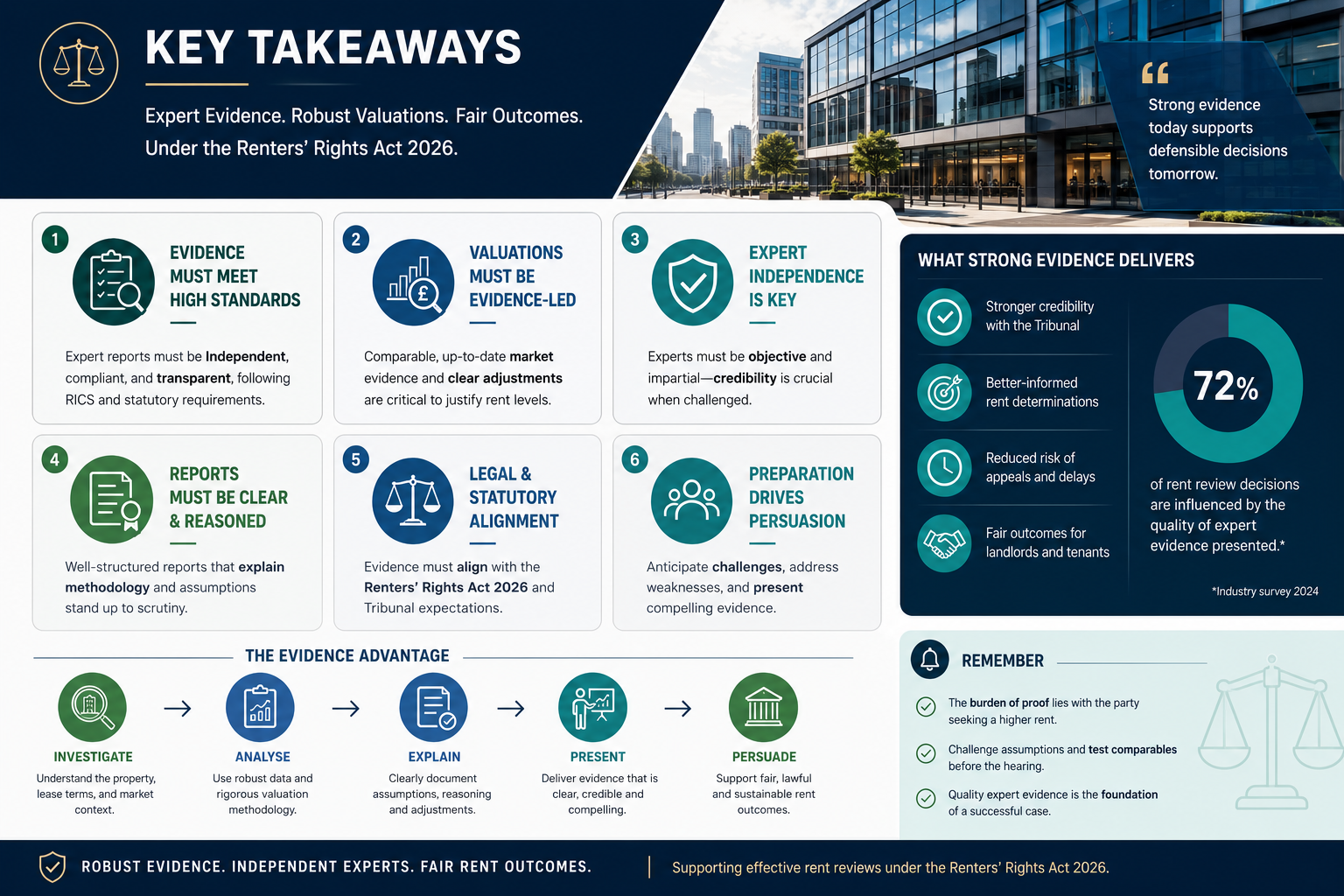
- The Renters' Rights Act 2026 gives tenants a formal route to challenge rent increases at the First-tier Tribunal (Property Chamber), shifting the burden of proof toward market-based evidence.
- Expert witnesses owe their primary duty to the tribunal, not to the landlord who instructs them, and must comply with CPR Part 35 requirements on objectivity and proportionality.
- Comparable rental evidence drawn from within 0.25 miles and let within the preceding six months carries the greatest weight in tribunal proceedings.
- Expert reports must be proportionate to the value of the dispute — a £50 per month rent difference does not justify a £5,000 valuation report.
- Awaab's Law expansion in 2026 has introduced five new hazard categories that expert witnesses must now integrate into their valuation methodology.
How the Renters' Rights Act 2026 Reshaped Rent Review Disputes
The Renters' Rights Act 2026 abolished assured shorthold tenancies and replaced them with Assured Periodic Tenancies (APTs). Under this structure, landlords wishing to increase rent must serve a valid Section 13 notice. Tenants who dispute that increase can refer the matter to the First-tier Tribunal (Property Chamber), which then determines the open market rent for the property.
This is a fundamental shift. Previously, most rent review disagreements were resolved informally or through negotiation. Now, a formal adjudication process exists, and both parties are expected to support their positions with credible market evidence. For landlords challenging a tenant-proposed reduction — or defending a Section 13 notice against a tenant's counter-argument — the quality of expert witness valuations in rent review disputes under the Renters' Rights Act 2026 directly determines the outcome.
The tribunal considers three core questions:
- What is the open market rent for a comparable property in the local area?
- Does the landlord's proposed rent reflect that market level?
- Is the tenant's proposed reduction supported by evidence, or is it speculative?
Answers to all three questions depend on properly prepared expert valuation evidence [7].
The Shift to Tribunal-Based Resolution
Tribunal proceedings emphasise accessibility, clarity, and proportionality. Unlike High Court litigation, these hearings are designed to be navigable by parties without legal representation. That does not mean standards are lower — it means that expert evidence must be clear and well-structured rather than dense and technical [1].
Landlords who instruct a qualified expert witness surveyor early in the process gain a significant advantage. An expert who understands tribunal expectations can frame valuation evidence in a way that directly addresses the questions the panel will ask, rather than producing a report that answers different questions entirely.
Evidence Standards When Landlords Challenge Tenant-Proposed Reductions
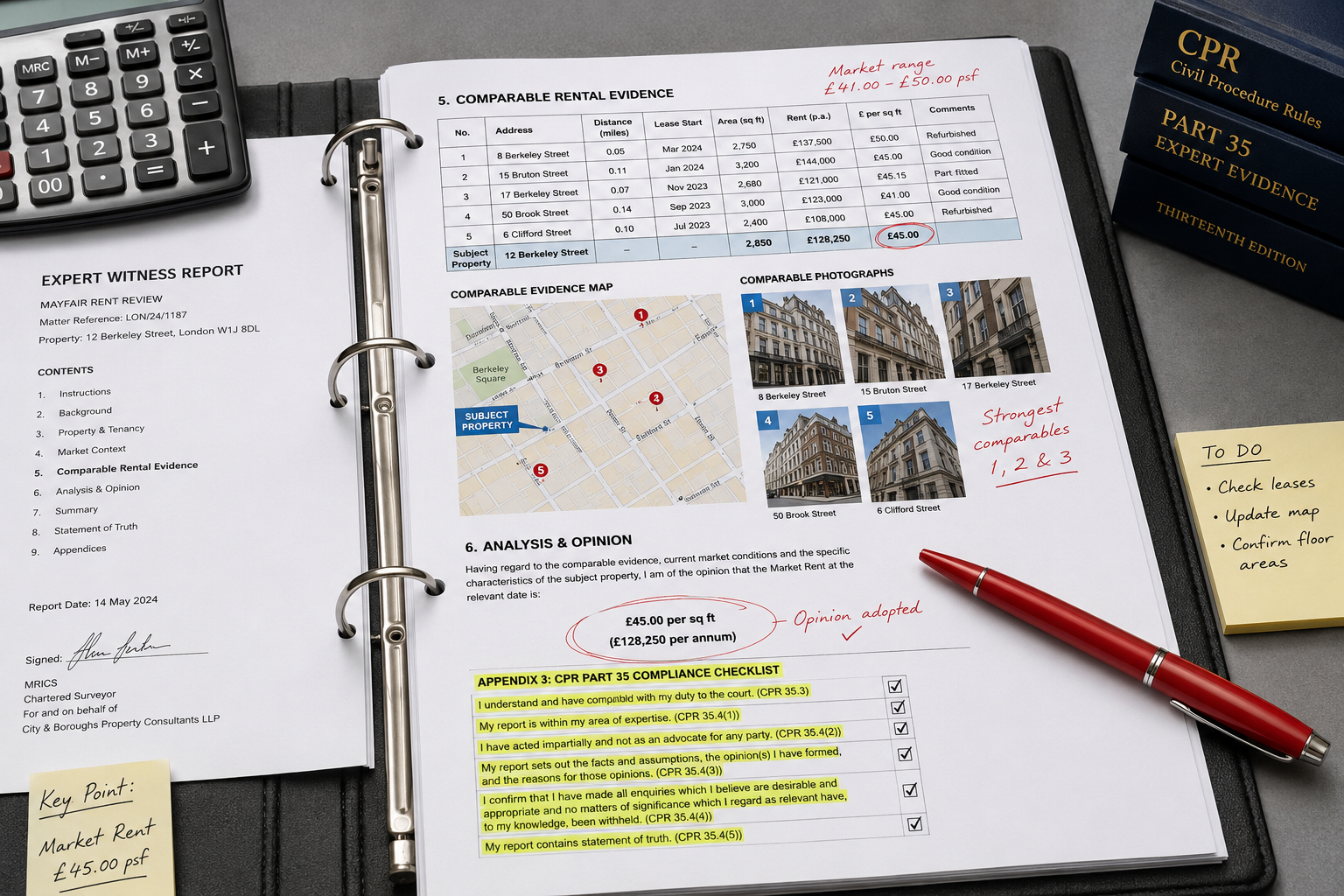
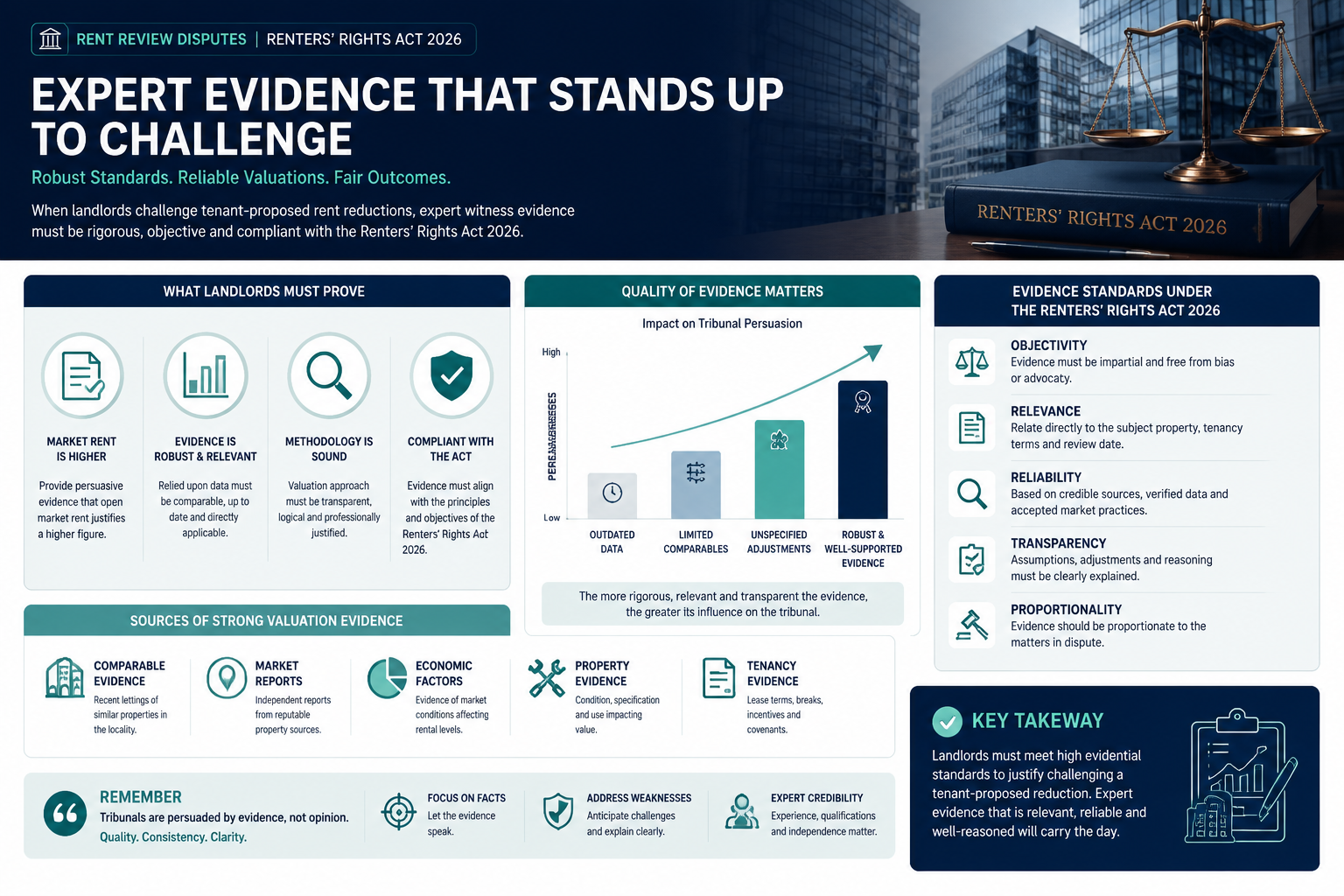
The evidence standards applied in rent review disputes are governed by a combination of statutory requirements under the Renters' Rights Act 2026, CPR Part 35 on expert evidence, and RICS professional guidance. Understanding each layer is essential before instructing an expert.
CPR Part 35 Compliance
Expert witnesses in tribunal proceedings must comply with CPR Part 35, which mandates that reports be:
- Objective — the expert's duty is to the tribunal, not to the instructing landlord
- Complete — all material facts, including those that undermine the landlord's case, must be disclosed
- Clear — technical language must be explained in accessible terms
- Proportionate — the scope and cost of the report must reflect the value of the dispute [3]
The proportionality requirement is frequently misunderstood. A rent review dispute involving a £50 per month difference should not generate a £5,000 expert report. Tribunals will question the credibility of an expert whose fees appear disproportionate to the matter at hand [1].
Expert Witness Independence
One of the most important principles governing expert witness valuations in rent review disputes under the Renters' Rights Act 2026 is independence. An expert who appears to be an advocate for the landlord will lose credibility with the tribunal rapidly.
This means the expert must:
- Present findings that are supported by evidence, even where those findings are unfavourable to the instructing party
- Be willing to concede points under cross-examination where the opposing evidence is stronger
- Disclose any conflicts of interest before accepting the instruction [2]
Landlords sometimes resist this principle, viewing the expert as part of their legal team. That approach is counterproductive. A credible, independent expert who acknowledges complexity is far more persuasive than one who appears to have reached a predetermined conclusion.
For landlords seeking a properly structured expert witness report that meets tribunal standards, the starting point is always independence — not advocacy.
Comparable Evidence: Selection and Presentation
The weight given to comparable rental evidence depends heavily on how it is selected and presented. Tribunals apply a clear hierarchy:
| Evidence Type | Weight | Notes |
|---|---|---|
| Recent lets within 0.25 miles, same property type | Highest | Ideally within preceding six months |
| Recent lets within 0.5 miles, similar property type | High | Adjustments required for differences |
| Wider area comparables | Moderate | Must explain why local evidence is insufficient |
| Asking rents from portals | Low | Not actual achieved rents |
| Pre-Act comparables | Limited | Legal environment has changed significantly |
For landlords, prioritising recent, higher-rent comparables from the same micro-location strengthens the case considerably [6]. The expert must explain any adjustments made for differences in size, condition, specification, or location.
Pre-Act comparable evidence presents a particular challenge. Standard comparable evidence from transactions completed before the Renters' Rights Act 2026 came into force is of limited value because the legal environment — specifically the absence of APT structures and the associated possession risk premium — was materially different [4].
Multiple Valuation Bases
Experienced expert witnesses prepare valuations on multiple bases rather than a single figure. This approach allows the tribunal to understand the range of outcomes depending on which legal assumptions apply. The four most common bases are:
- Market value with vacant possession — assumes the property is unoccupied
- Investment value with a sitting tenant — reflects the APT structure and possession risk
- Open market rent assessment — the primary figure for Section 13 disputes
- Restricted rent value — relevant where statutory controls apply [1]
Presenting multiple bases demonstrates methodological rigour and shows the tribunal that the expert has considered the full picture rather than cherry-picking a figure that favours the landlord.
Practical Preparation: What Landlords Need Before Tribunal
Preparation before a dispute reaches tribunal is as important as the quality of the expert report itself. Landlords who commission a professional rent review valuation before issuing a Section 13 notice are better positioned to set a rent level that is supportable by market evidence from the outset [2].
Documentation Checklist
Tribunals expect comprehensive documentation. The following list covers the core requirements:
- Title documents confirming ownership and any encumbrances
- Current tenancy agreement and any addenda
- Full rent payment history for the tenancy
- Section 13 notice (correctly served and dated)
- Comparable rental evidence with full details of each transaction
- Property condition photographs (dated and geotagged where possible)
- Compliance certificates (gas safety, electrical installation, EPC)
- Any correspondence between landlord and tenant regarding the rent review
Missing documentation creates gaps that the opposing party will exploit. A tribunal that cannot verify basic facts about the property or the tenancy history is unlikely to find in the landlord's favour on contested points.
Awaab's Law Integration
The expansion of Awaab's Law in 2026 introduced five new hazard categories, resulting in an estimated 40% increase in landlord-tenant disputes [1]. For expert witnesses, this creates a new obligation: hazard assessments must now be integrated into valuation work.
Where a property has known hazard issues — damp, mould, inadequate heating, or structural defects — the expert must address how those issues affect the open market rent. A tenant who argues that the rent should be reduced because of a Category 1 hazard will present evidence of that hazard. The landlord's expert must either rebut that evidence or explain how it has been factored into the valuation.
This integration of condition assessment and market valuation is a relatively new requirement. Chartered surveyors who combine expertise in both areas — such as those qualified to prepare RICS Red Book valuations — are best placed to provide the combined evidence that tribunals now expect.
Pre-Dispute Valuation Strategy
The most effective approach is to commission a surveyor's valuation report before issuing the Section 13 notice. This allows the landlord to:
- Set a rent increase that is supportable by market evidence
- Identify any property condition issues that could be used against them at tribunal
- Demonstrate good faith in the review process [2]
A landlord who arrives at tribunal with a pre-dispute valuation report, a full documentation bundle, and an independent expert witness is in a fundamentally stronger position than one who has simply asserted that the market supports a higher rent.
RICS Guidance on Vacant Possession
The Royal Institution of Chartered Surveyors advises that using a vacant possession assumption remains reasonable in most cases, given the Section 8 grounds for repossession available to landlords under the Renters' Rights Act 2026. However, this assumption must be applied with professional judgment on a case-by-case basis [5].
Where there is a realistic prospect that the tenancy will continue for an extended period — for example, where the tenant has a strong track record of payment and the landlord has no grounds to seek possession — the investment value with a sitting tenant may be the more appropriate basis. Expert witnesses must be prepared to justify whichever assumption they apply.
Landlords in Manchester and the wider North West can access chartered surveyor expertise that covers both the valuation and condition assessment dimensions of these disputes.
Common Errors That Undermine Landlord Cases
Understanding what weakens a landlord's position at tribunal is as valuable as knowing what strengthens it. The following errors appear repeatedly in unsuccessful cases:
Relying on asking rents rather than achieved rents. Portal listings show what landlords hope to achieve, not what the market actually delivers. Tribunals give little weight to asking rent evidence [7].
Using geographically distant comparables without explanation. A comparable from a different neighbourhood requires detailed adjustment evidence. Without it, the tribunal will discount it heavily.
Failing to address the tenant's evidence. An expert who ignores the comparables presented by the tenant appears evasive. The expert must engage with opposing evidence and explain why it is less reliable or less relevant.
Producing a report that is disproportionate to the dispute. A lengthy, expensive report for a modest rent difference signals poor judgment and may prompt the tribunal to question the expert's independence.
Ignoring property condition. Where the property has maintenance issues, an expert who fails to address them will face damaging cross-examination. The condition of the property is directly relevant to the open market rent [1].
Landlords who want to understand the full range of factors that affect a property valuation should review the key factors of valuation that RICS-qualified surveyors apply in formal assessments.
Conclusion
Expert witness valuations in rent review disputes under the Renters' Rights Act 2026 have become a specialised and technically demanding area of practice. The evidence standards applied when landlords challenge tenant-proposed reductions require independence, methodological rigour, proportionate reporting, and a thorough understanding of both market conditions and the changed legal environment created by the Act.
Actionable next steps for landlords facing a rent review dispute:
- Commission a pre-dispute valuation report from a RICS-qualified surveyor before issuing or defending a Section 13 notice.
- Instruct an expert witness who understands CPR Part 35 requirements and tribunal expectations — not one who will simply advocate for your preferred figure.
- Gather a complete documentation bundle early, including comparable evidence from within 0.25 miles let within the preceding six months.
- Ensure the expert addresses property condition and any Awaab's Law hazard categories that may be raised by the tenant.
- Review the proportionality of the expert's proposed fees against the value of the dispute before committing to instruction.
For landlords in Manchester and across the UK seeking specialist support, working with a firm that offers both expert witness services and comprehensive rent review advice provides the integrated expertise that tribunal proceedings now demand.
References
[1] Expert Witness Valuations In Renters Rights Act Disputes Building Cases When Periodic Tenancies And Rent Controls Create Valuation Conflicts – https://www.canterburysurveyors.com/blog/expert-witness-valuations-in-renters-rights-act-disputes-building-cases-when-periodic-tenancies-and-rent-controls-create-valuation-conflicts/
[2] Rent Review Disputes Under Renters Rights Act 2026 Building Surveyor Roles In Valuation Evidence For Landlord Tenant Challenges – https://princesurveyors.co.uk/blog/rent-review-disputes-under-renters-rights-act-2026-building-surveyor-roles-in-valuation-evidence-for-landlord-tenant-challenges/
[3] Expert Witness Roles In Private Rented Sector Ombudsman Disputes Preparing For Renters Rights Act 2026 Cases – https://kingstonsurveyors.com/expert-witness-roles-in-private-rented-sector-ombudsman-disputes-preparing-for-renters-rights-act-2026-cases/
[4] Valuing Rental Properties Post Renters Rights Act 2026 Impact Of Periodic Tenancies And Pet Permissions – https://wimbledonsurveyors.com/valuing-rental-properties-post-renters-rights-act-2026-impact-of-periodic-tenancies-and-pet-permissions/
[5] Valuation Challenges Under The Renters Rights Act 2026 How Surveyors Assess Properties With New Tenant Protections And Rent Controls – https://princesurveyors.co.uk/blog/valuation-challenges-under-the-renters-rights-act-2026-how-surveyors-assess-properties-with-new-tenant-protections-and-rent-controls/
[6] Rent Review Challenges In Periodic Tenancies Valuation Surveyor Tactics Post Renters Rights Act 2026 – https://wimbledonsurveyors.com/rent-review-challenges-in-periodic-tenancies-valuation-surveyor-tactics-post-renters-rights-act-2026/
[7] How The Tribunal Decides The Rent – https://england.shelter.org.uk/professional_resources/practical_resources/tools_and_guides/how_to_challenge_a_rent_increase_in_the_tribunal/how_the_tribunal_decides_the_rent
[8] Expert Witness In Dilapidations For Residential Leases Valuation Evidence For 2026 Expiries – https://kingstonsurveyors.com/expert-witness-in-dilapidations-for-residential-leases-valuation-evidence-for-2026-expiries/