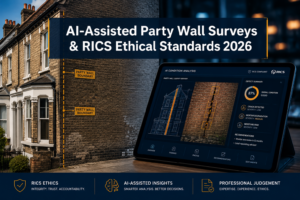
Nearly one-third of party wall disputes in England and Wales escalate because pre-works condition records are disputed after construction begins. When those records are now being generated — at least in part — by artificial intelligence tools, the stakes for accuracy, accountability, and professional ethics rise considerably. The arrival of Schedules of Condition for AI-Assisted Party Wall Surveys: RICS Ethical Integration Post-March 2026 Standard marks a pivotal shift in how chartered surveyors must govern, disclose, and validate AI-generated outputs in party wall practice.
This article examines what the new RICS standard demands of practitioners, how it reshapes the production of pre-works schedules of condition, and what liability safeguards must be embedded into every AI-assisted workflow.
Key Takeaways
- Effective 9 March 2026, all RICS members globally must comply with the "Responsible Use of Artificial Intelligence in Surveying Practice" standard, which directly governs party wall surveys.
- AI tools may assist with condition reporting, damage causation summaries, and award drafting, but final professional judgment must always rest with a qualified surveyor.
- Clients must receive written disclosure about how AI is used in their case, including the right to opt out.
- Firms must maintain quarterly-reviewed risk registers documenting AI systems, potential biases, and governance decisions.
- Liability for AI-assisted schedules of condition remains with the surveyor, not the technology.
What the March 2026 RICS AI Standard Means for Party Wall Practice
Effective 9 March 2026, RICS made its "Responsible Use of Artificial Intelligence in Surveying Practice" standard mandatory for all members and regulated firms worldwide [1]. This is not guidance or best practice — it is a binding professional standard. For party wall surveyors, its implications are immediate and practical.
The standard applies wherever AI outputs have a material impact on the delivery of surveying services [2]. In party wall practice, this covers a broad range of activities:
- AI-generated summaries of schedule of condition findings
- Automated damage causation opinions used to establish pre-works baseline defects
- Draft party wall award clauses produced by large language models or specialist legal AI tools
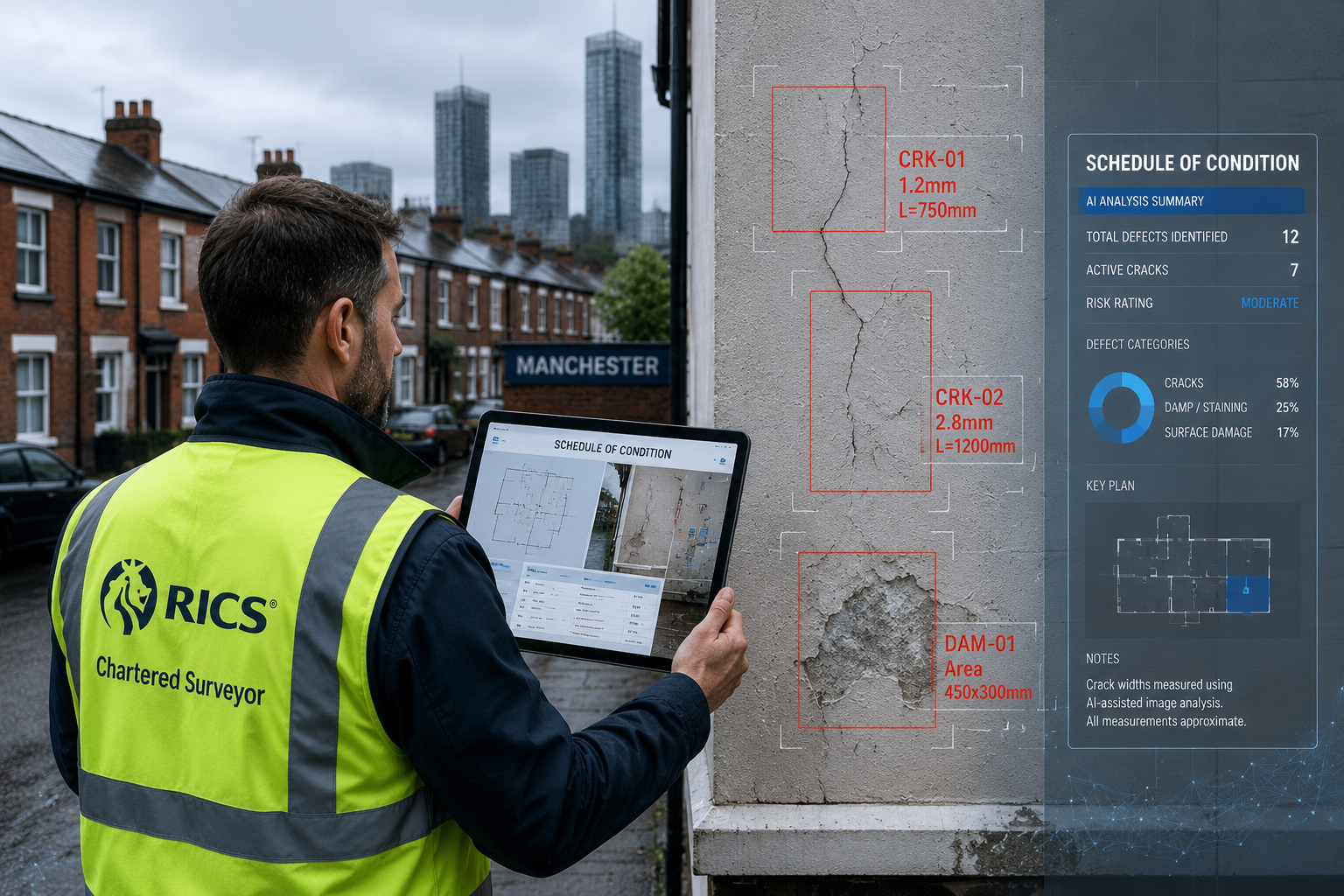
- Photographic analysis tools that identify and classify cracks, damp patches, or structural movement
A schedule of condition report is the foundational document in any party wall dispute. It records the existing state of an adjoining owner's property before notifiable works begin. If that document is produced or informed by AI, the March 2026 standard applies in full.
RICS has framed the standard as a global framework, but its practical application in England and Wales is particularly significant given the volume of party wall activity in urban areas and the increasing adoption of AI-assisted inspection tools by surveying firms of all sizes [3].
Why Schedules of Condition Are High-Stakes Documents
A schedule of condition is not simply a record — it is often the decisive piece of evidence in a party wall dispute. If a neighbour claims that works caused a crack to their wall, the schedule of condition either confirms or contradicts that claim. Errors, omissions, or biased AI outputs in that document can expose both the building owner and the appointed surveyor to significant liability.
For context on what happens when works proceed without proper documentation, see the guidance on damage to property in party wall situations, which illustrates how disputes escalate when pre-works baselines are unclear or contested.
Core Ethical Requirements Under the RICS AI Standard
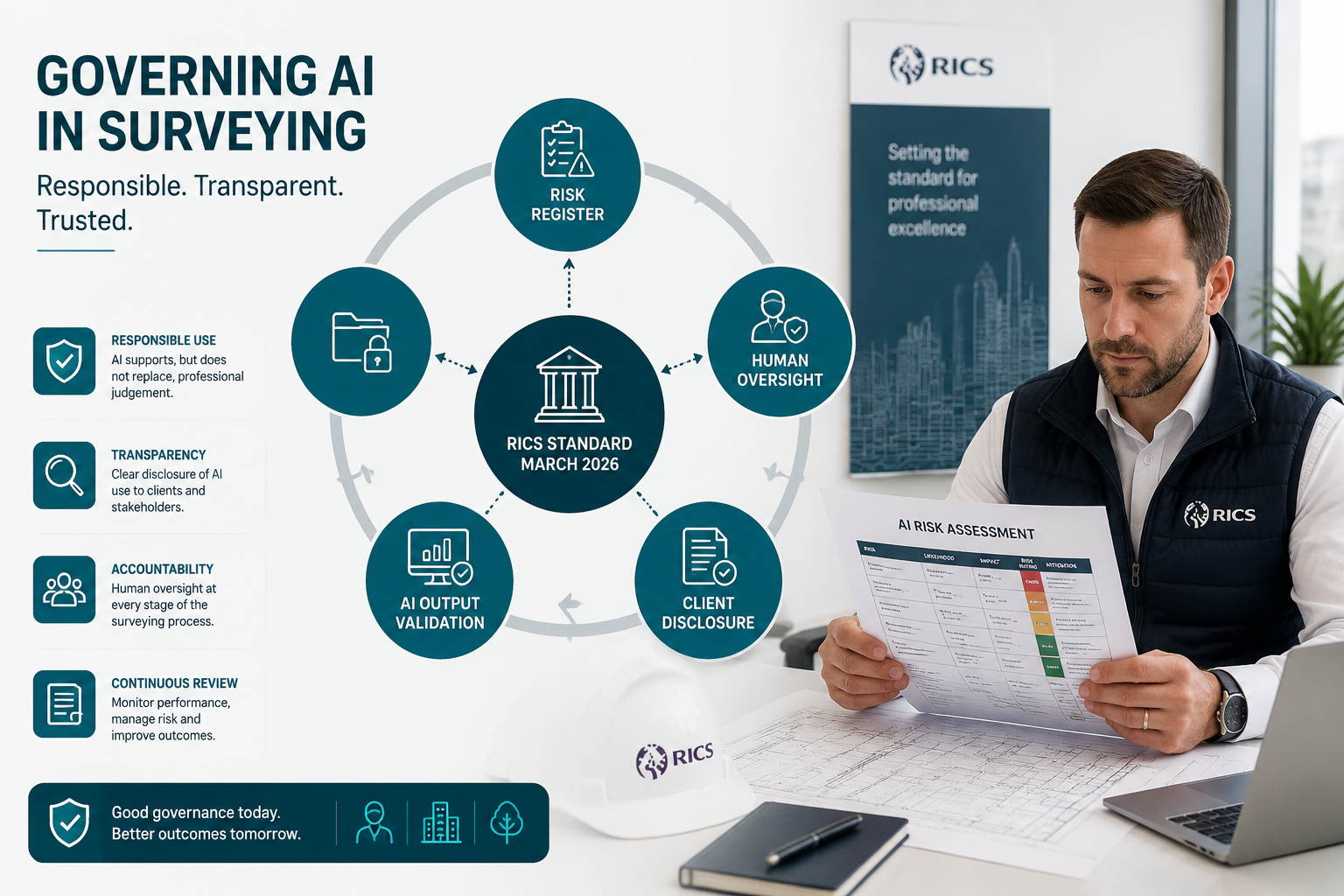
The RICS standard is built around five interconnected ethical principles that directly shape how AI may be used in producing schedules of condition for AI-assisted party wall surveys: RICS ethical integration post-March 2026 standard compliance is non-negotiable for regulated firms.
1. Professional Judgment Cannot Be Delegated to AI
The standard is unambiguous: surveyors must assess the reliability of every AI output and remain personally accountable for all work product [3]. This means that even if an AI tool produces a polished, well-structured schedule of condition, the surveyor must independently verify its content against their physical inspection findings.
Professional skepticism is explicitly required. A surveyor who accepts AI-generated crack classifications without cross-referencing them against their own observations is in breach of the standard — regardless of how sophisticated the AI tool appears.
"Final decision-making cannot be delegated to automated systems. The surveyor's expertise and professional judgment are the non-negotiable core of compliant AI-assisted practice."
2. Transparency and Written Client Disclosure
Clients must be informed in writing about how AI is used in their case [4]. This disclosure must be clear and accessible — not buried in terms and conditions. It should explain:
- Which AI tools are being used and for what purpose
- What limitations those tools have
- The client's right to opt out of AI-assisted processes
For party wall surveyors, this disclosure obligation applies both to building owners commissioning surveys and to adjoining owners whose properties are being assessed. Clients also have the right to request detailed information about the AI systems used, including their known limitations and the surveyor's assessment of their reliability [6].
3. Governance, Risk Registers, and Due Diligence
Firms must implement written governance assessments before deploying any AI system [5]. These assessments must evaluate:
| Governance Area | What Must Be Documented |
|---|---|
| System governance | Who controls the AI tool and how it is updated |
| Procurement due diligence | How the tool was selected and tested |
| Sustainability impacts | Data storage, energy use, environmental considerations |
| Risk appetite | What level of AI reliance the firm considers acceptable |
Beyond the initial assessment, firms must maintain risk registers that document AI use, potential biases, and alternative approaches [4]. These registers must be reviewed at least quarterly. For party wall practices handling high volumes of schedule of condition work, this means building AI governance into standard operating procedures rather than treating it as a one-off compliance exercise.
4. Explainability of AI Outputs
Surveyors must be able to explain how an AI tool reached its conclusions — not just what those conclusions are [6]. If an AI system identifies a crack as pre-existing and classifies it as Category 2 (slight damage), the surveyor must understand the basis for that classification well enough to defend or challenge it.
This requirement has practical implications for tool selection. AI systems that operate as "black boxes" — producing outputs without traceable reasoning — are inherently difficult to use in compliance with the March 2026 standard. Firms should prioritise tools that offer explainable outputs and audit trails.
5. Bias Detection and Ongoing Monitoring
AI systems trained on historical data can perpetuate or amplify biases. In the context of party wall surveys, this could manifest as systematic under-reporting of defects in certain property types, or over-attribution of damage to pre-existing causes in particular building ages or construction methods [4].
The RICS standard requires firms to actively identify and mitigate such biases, rather than assuming that AI outputs are neutral. This connects directly to the monitoring surveys framework, where ongoing data collection and review are already embedded in professional practice.
Practical Integration: AI Tools in Pre-Works Schedule Production
Understanding the ethical framework is essential, but practitioners also need clarity on how AI tools can be legitimately integrated into the workflow for producing schedules of condition under the new standard.
Permitted Uses of AI in Schedule of Condition Work
The RICS standard does not prohibit AI — it regulates it. The following applications are consistent with compliant practice, provided all governance and oversight requirements are met:
- Photographic analysis: AI tools that automatically identify and annotate defects in survey photographs can accelerate the documentation process and improve consistency. However, the surveyor must review and validate every annotation before it is included in the final schedule.
- Report structuring and drafting assistance: AI can assist in organising findings and generating initial draft text for schedules of condition. The surveyor must review, edit, and take ownership of the final document.
- Historical comparison: AI tools that compare current condition photographs against baseline images from previous inspections can support the identification of changes. This is particularly relevant for dilapidation surveys where condition trends over time are material.
- Crack classification support: AI systems trained on structural defect databases can suggest crack classifications, but these must always be verified against the surveyor's physical assessment and professional judgment.
What AI Must Not Do Without Qualified Supervision
The standard is explicit that AI tools must never operate without qualified surveyor supervision, particularly in dispute prediction and award drafting [5]. In the context of party wall practice, this means:
- AI must not independently determine whether a defect was caused by notifiable works
- AI must not produce a final party wall award without surveyor review and sign-off
- AI must not communicate directly with clients or adjoining owners about condition findings
For surveyors handling excavation notices under the Party Wall Act, where the three-metre and six-metre rules create specific obligations around pre-works surveys, the accuracy of the schedule of condition is particularly critical. AI tools that misclassify foundation proximity or soil conditions could generate materially incorrect outputs with serious legal consequences.
Liability Safeguards for AI-Assisted Schedules
The question of liability is central to the March 2026 standard. The answer is straightforward: liability remains with the surveyor. AI tools are instruments, not professionals. A surveyor who relies on an AI-generated schedule of condition without adequate verification cannot use the AI tool's limitations as a defence in a negligence claim.
Practical liability safeguards include:
- Document the verification process: Keep records showing that AI outputs were reviewed, challenged where appropriate, and validated against physical inspection findings.
- Retain AI output logs: Store the raw AI outputs alongside the final schedule of condition so that any discrepancies can be demonstrated.
- Include AI disclosure in the schedule itself: Note within the document which elements were AI-assisted and the nature of the surveyor's verification.
- Maintain professional indemnity coverage: Confirm with insurers that AI-assisted work is covered under existing professional indemnity policies, and update coverage if necessary.
For complex cases involving structural concerns, the structural surveys framework provides a useful parallel for understanding how surveyors document and defend their professional judgment in high-stakes situations.
Implementing Compliant AI Workflows: A Firm-Level Checklist
RICS has provided implementation guidance to support members in meeting the new standard [7]. For party wall practices, translating that guidance into operational reality requires structured internal processes.
Before Deploying Any AI Tool
- Conduct and document a written governance assessment
- Evaluate the tool's explainability, data sources, and known limitations
- Assess procurement due diligence — who built it, how is it maintained, what are the terms of use?
- Establish the firm's risk appetite for AI reliance in schedule of condition work
- Create a risk register entry for the tool
For Each AI-Assisted Schedule of Condition
- Provide written client disclosure before commencing the survey
- Record which AI tools were used and for which specific tasks
- Document the surveyor's independent verification of all AI outputs
- Retain raw AI outputs as part of the project file
- Include AI use disclosure within the final schedule of condition document
Ongoing Compliance
- Review risk registers at least quarterly
- Monitor AI tools for updates that may alter their outputs or introduce new biases
- Train all staff who use AI tools in the requirements of the March 2026 standard
- Engage with RICS implementation guidance and peer practice updates as they develop [7]
Surveyors working across different property types — from residential terraces to commercial buildings — should also consider how AI tool performance may vary by building type. The RICS commercial building survey context, for example, involves different defect categories and structural considerations than a residential party wall survey, and AI tools trained primarily on one dataset may perform less reliably on the other.
Industry Perspectives on AI Integration in Surveying
Surveyors have expressed both optimism and caution about AI integration. The efficiency gains are real: AI-assisted photographic analysis can reduce the time spent on initial defect identification, and AI drafting tools can accelerate report production [8]. For high-volume party wall practices, these efficiencies have commercial value.
However, experienced practitioners consistently emphasise that AI tools are only as good as the data they are trained on and the oversight applied to their outputs [8]. In party wall practice, where the consequences of an inaccurate schedule of condition can include protracted disputes, legal costs, and reputational damage, the margin for error is narrow.
The March 2026 standard reflects a professional consensus: AI is a legitimate and valuable tool in surveying practice, but it operates within a framework of human accountability, not outside it. Surveyors who approach AI as a shortcut rather than an instrument will find themselves exposed — both professionally and legally.
For those concerned about the cost implications of party wall surveys, it is worth noting that AI-assisted workflows, when implemented correctly, can improve efficiency without compromising the quality or defensibility of the schedule of condition. The governance overhead is real, but it is a one-time investment in firm-level infrastructure rather than a per-survey cost.
Conclusion
The introduction of Schedules of Condition for AI-Assisted Party Wall Surveys: RICS Ethical Integration Post-March 2026 Standard represents a maturation of professional practice rather than a restriction on innovation. AI tools have genuine utility in party wall surveying — they can improve defect identification, accelerate report production, and support consistency across large volumes of work. But that utility is only realised ethically and legally when it operates within the framework the March 2026 standard establishes.
Actionable next steps for surveyors and firms:
- Audit current AI tool use immediately and assess compliance against the March 2026 standard
- Develop or update written governance assessments and risk registers for all AI systems in use
- Implement written client disclosure procedures for AI-assisted schedule of condition work
- Train all relevant staff on the standard's requirements, particularly the non-delegability of professional judgment
- Review professional indemnity insurance to confirm AI-assisted work is covered
- Engage with RICS implementation resources and peer networks to stay current as the standard evolves
The party wall surveyor's core obligation has not changed: to produce an accurate, defensible, and professionally accountable record of pre-works condition. AI tools can support that obligation — but they cannot fulfil it. That responsibility remains firmly with the qualified professional.
References
[1] Responsible Use Of Ai – https://www.rics.org/profession-standards/rics-standards-and-guidance/conduct-competence/responsible-use-of-ai?utm_source=openai
[2] Responsible Use Of Artificial Intelligence In Surveying Practice September 2025 – https://www.rics.org/content/dam/ricsglobal/documents/standards/Responsible-use-of-artificial-intelligence-in-surveying-practice_September-2025.pdf?utm_source=openai
[3] Rics Launches Landmark Global Standard On Responsible Use Of Ai In Surveying – https://www.rics.org/news-insights/rics-launches-landmark-global-standard-on-responsible-use-of-ai-in-surveying?utm_source=openai
[4] Responsible Ai In Party Wall Surveys Rics March 2026 Standards For Bias Detection And Ethical Award Drafting – https://princesurveyors.co.uk/blog/responsible-ai-in-party-wall-surveys-rics-march-2026-standards-for-bias-detection-and-ethical-award-drafting/?utm_source=openai
[5] Responsible Ai Use In Party Wall Awards Rics March 2026 Standards For Automated Condition Monitoring – https://wimbledonsurveyors.com/responsible-ai-use-in-party-wall-awards-rics-march-2026-standards-for-automated-condition-monitoring/?utm_source=openai
[6] Responsible Ai Use In Party Wall Surveys Rics 2026 Standards For Dispute Prediction And Award Drafting – https://wimbledonsurveyors.com/responsible-ai-use-in-party-wall-surveys-rics-2026-standards-for-dispute-prediction-and-award-drafting/?utm_source=openai
[7] Rics First Ever Standard On Responsible Ai Use Now In Effect – https://www.rics.org/news-insights/rics-first-ever-standard-on-responsible-ai-use-now-in-effect?utm_source=openai
[8] What Surveyors Think Ai – https://ww3.rics.org/uk/en/modus/technology-and-data/surveying-tools/what-surveyors-think-ai.html?utm_source=openai