
By 2026, build-to-rent (BTR) communities are projected to account for a record share of new housing starts across key markets — a structural shift that is fundamentally changing what surveyors do, where they work, and how much their expertise is worth. [1] For chartered surveyors and property professionals, surveying for build-to-rent communities: opportunities amid the 2026 housing boom represents one of the most significant growth areas in a generation.
This article explores the full scope of surveying work that BTR development demands — from initial site analysis and boundary assessments to stock condition surveys and compliance checks — and explains why now is the right time to understand this fast-moving sector.
Key Takeaways 📌
- BTR development is at historic highs in 2026, creating sustained demand for specialist surveying services across the full project lifecycle.
- Master-planned rental neighborhoods require a broader range of surveys than traditional residential schemes, including site analysis, structural assessments, and amenity compliance checks.
- Stock condition surveys are critical for BTR landlords managing large portfolios of identical or near-identical units.
- Surveyors who understand BTR-specific compliance requirements — including planning conditions, building regulations, and rent review mechanisms — are in high demand.
- Engaging a RICS-qualified surveyor early in the BTR development process reduces risk, protects investment, and streamlines planning approval.
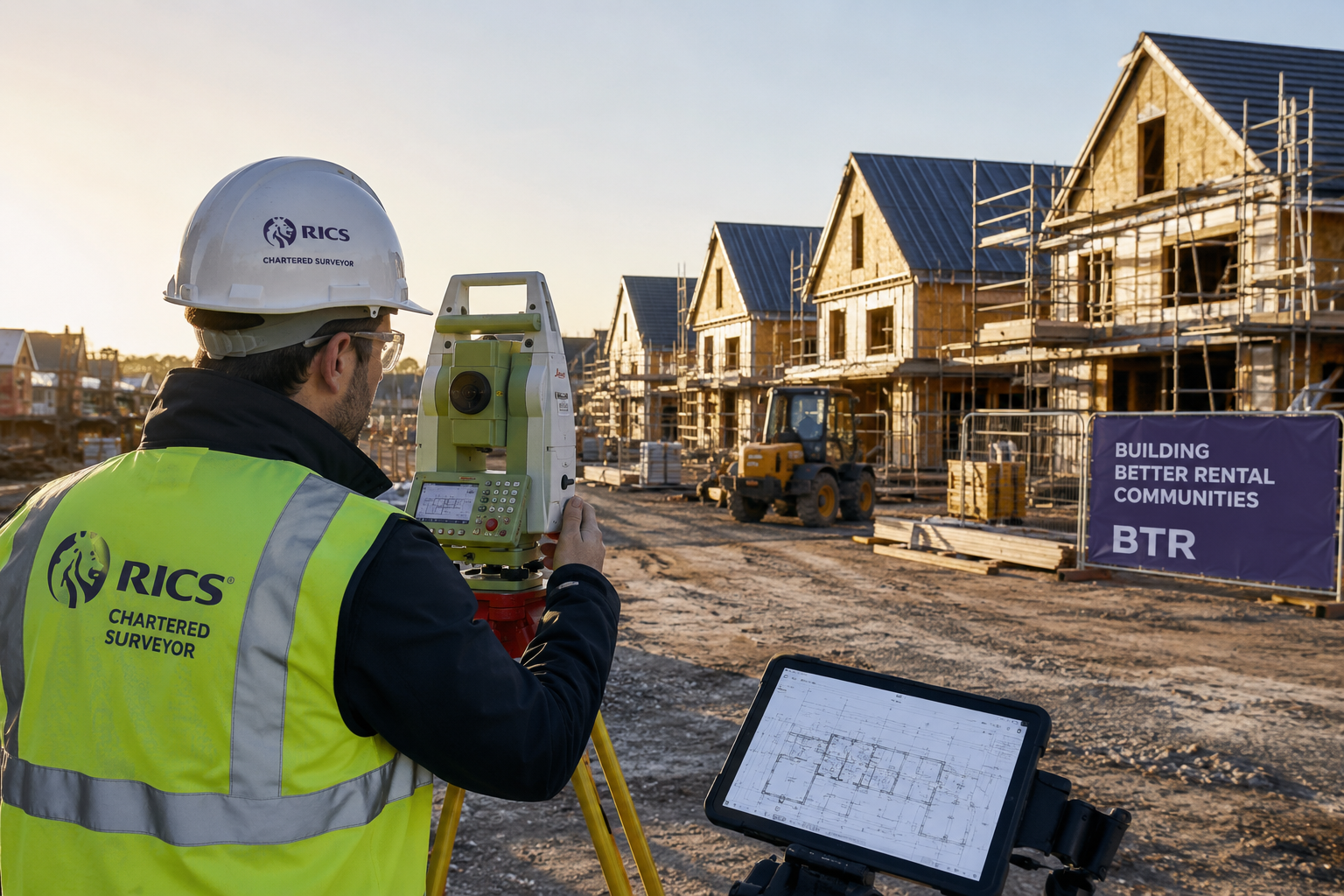
Why the 2026 Housing Boom Is Driving BTR Growth
The numbers behind the 2026 housing market tell a compelling story. BTR development has consistently outpaced historical highs over the past three years, with single-family rental (SFR) communities — purpose-built neighborhoods where every home is designed for long-term tenancy — emerging as the dominant product type. [4]
Several forces are converging at once:
- 🏠 Homeownership affordability remains stretched, pushing more households into the rental market for longer periods. [9]
- 📈 Institutional investment in BTR has surged, with major funds treating rental housing as a core asset class. [3]
- 🏗️ Supply-side pressures are easing slightly in 2026 as new pipeline projects reach delivery, but demand continues to outstrip completions in most regions. [7]
- 🌍 Planning policy shifts in the UK and internationally are actively encouraging purpose-built rental schemes in high-growth corridors. [2]
"Build-to-rent is no longer a niche product — it is the mainstream response to a structural housing deficit that no single policy lever can fix." [6]
For surveyors, this translates directly into a multi-year pipeline of work. Every BTR scheme — whether a 50-unit urban block or a 500-home master-planned community — requires professional surveying input at multiple stages.
What Makes BTR Surveying Different From Traditional Residential Work?
Standard residential surveying typically focuses on a single property transaction: a buyer wants to know the condition of a home before purchase. BTR surveying operates at a completely different scale and with a different set of objectives.
Scale and Uniformity
A master-planned BTR community might contain hundreds of near-identical homes. This creates both an efficiency opportunity and a risk: defects that affect one unit often affect many. A thorough stock condition survey across an entire BTR portfolio identifies systemic issues — such as consistent damp problems in a particular house type or recurring structural concerns in a specific build phase — before they become expensive liabilities.
Amenity Infrastructure
Unlike traditional housing estates, BTR communities are defined by their amenities: gyms, co-working spaces, communal gardens, concierge services, and shared parking. Each of these elements requires its own compliance and structural assessment. Surveyors must evaluate not just the residential units but the full amenity offer, including:
| Amenity Type | Key Surveying Consideration |
|---|---|
| Gym / fitness suite | Structural loading, ventilation compliance |
| Co-working hub | Fire egress, electrical certification |
| Communal gardens | Drainage, boundary definition |
| Parking structures | Structural integrity, EV charging infrastructure |
| Swimming pool | Waterproofing, mechanical plant condition |
Ongoing Asset Management
BTR landlords hold assets for the long term. Unlike a developer who builds and sells, a BTR operator needs to maintain hundreds of homes to a consistent standard over decades. This means structural surveys and periodic condition assessments are not a one-off event — they are a recurring operational requirement.
Surveying for Build-to-Rent Communities: Opportunities Amid the 2026 Housing Boom — Key Service Areas
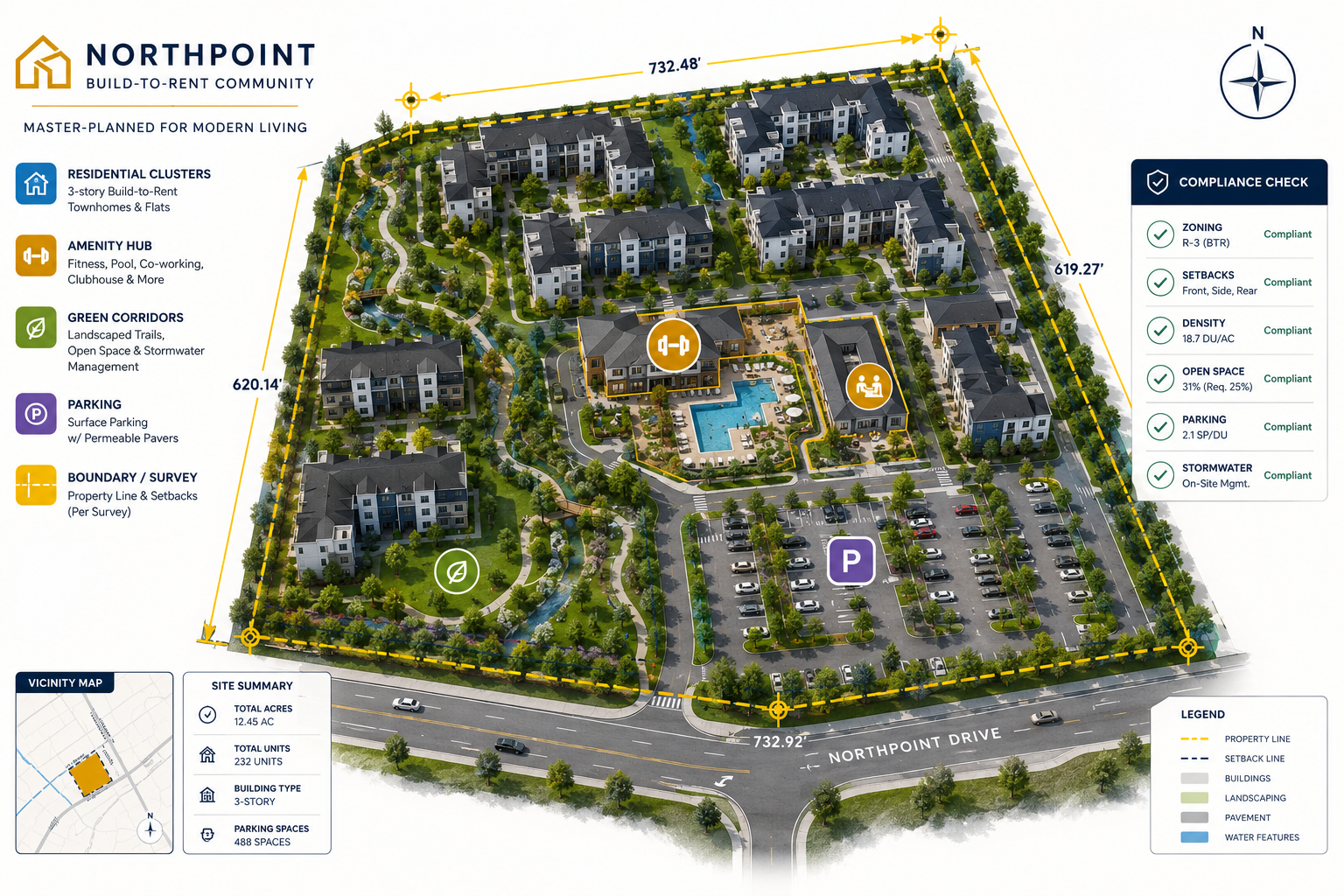
The scope of surveying work within the BTR sector spans the entire development and asset management lifecycle. Here is a breakdown of the most important service areas in 2026.
1. 🗺️ Site Analysis and Boundary Surveys
Before a single foundation is laid, surveyors are needed to define exactly what land is available, where boundaries sit, and whether the site is suitable for the intended scheme. Boundary surveys are particularly important in BTR development because master-planned communities often involve multiple land parcels assembled over time, creating complex title and boundary questions.
Site analysis also covers:
- Topographical surveys to understand drainage and ground levels
- Contamination risk assessments on brownfield sites
- Rights of way and easements that could affect the layout
2. 🏗️ Structural and Building Surveys
For BTR developers acquiring existing buildings for conversion, or for investors purchasing completed BTR schemes, a detailed RICS building survey is essential. This provides a thorough assessment of the structure, fabric, and services of the buildings, highlighting defects that could affect value or require capital expenditure.
A Level 3 RICS building survey is typically appropriate for:
- Older conversions being repositioned as BTR
- Large mixed-use BTR schemes with commercial ground floors
- Any scheme where structural complexity warrants the highest level of scrutiny
3. 📋 Stock Condition Surveys
For operational BTR portfolios, the stock condition survey is arguably the most commercially important surveying tool available. It provides a systematic assessment of every element of every unit — roofs, windows, kitchens, bathrooms, mechanical and electrical systems — and projects forward maintenance costs over a 5, 10, or 30-year horizon.
This data directly informs:
- Capital expenditure planning for asset managers
- Insurance reinstatement valuations for risk management
- Rent-setting decisions based on the quality and condition of the stock
4. 💰 RICS Valuations for BTR Assets
BTR assets are valued differently from owner-occupied housing. Their value is derived primarily from the income they generate — rental income, net operating income, and yield — rather than comparable sales. RICS-qualified valuers with BTR experience understand how to apply the investment method of valuation correctly, taking into account occupancy rates, void periods, management costs, and lease structures.
Accurate valuations are needed for:
- Acquisition due diligence
- Refinancing and loan security
- Portfolio reporting to institutional investors
Understanding valuation costs upfront helps developers and investors budget correctly for the professional fees involved.
5. 📝 Rent Reviews
BTR communities with commercial ground floors — retail, food and beverage, gym operators — will have commercial leases that include periodic rent reviews. Surveyors specialising in rent reviews play a key role in ensuring that the rental income from these spaces reflects current market conditions, protecting the long-term income profile of the asset.
6. 🔍 Damp and Structural Defect Surveys
High-density BTR construction, particularly where timber frame or modular construction methods are used, can be vulnerable to damp ingress and thermal bridging if not built to specification. Damp surveys and subsidence surveys provide early warning of problems that, if left unaddressed, could affect large numbers of units simultaneously.
Compliance, Planning, and the Regulatory Landscape in 2026
BTR development in 2026 operates within an increasingly complex regulatory environment. Surveyors must be familiar with:
- Building Regulations Part L (energy efficiency) — BTR schemes face tighter fabric performance requirements than ever before, and surveyors play a role in compliance verification.
- Fire safety compliance — post-Grenfell legislation has fundamentally changed how multi-storey BTR blocks are assessed, inspected, and certified.
- Affordable housing requirements — many BTR planning consents include a proportion of affordable or discounted market rent (DMR) units, which require separate valuation and compliance tracking.
- EPC requirements — rental properties must meet minimum energy performance standards, and surveyors are often involved in assessing and advising on upgrade pathways.
"The most successful BTR operators in 2026 are those who treat compliance not as a cost to minimise but as a quality signal to market." [2]
For developers navigating party wall issues during construction — a common challenge on urban BTR sites adjacent to existing buildings — specialist advice is essential. Understanding party wall obligations and serving the correct notices protects both the developer and neighbouring owners.
Surveying for Build-to-Rent Communities: Opportunities Amid the 2026 Housing Boom — The Surveyor's Commercial Opportunity
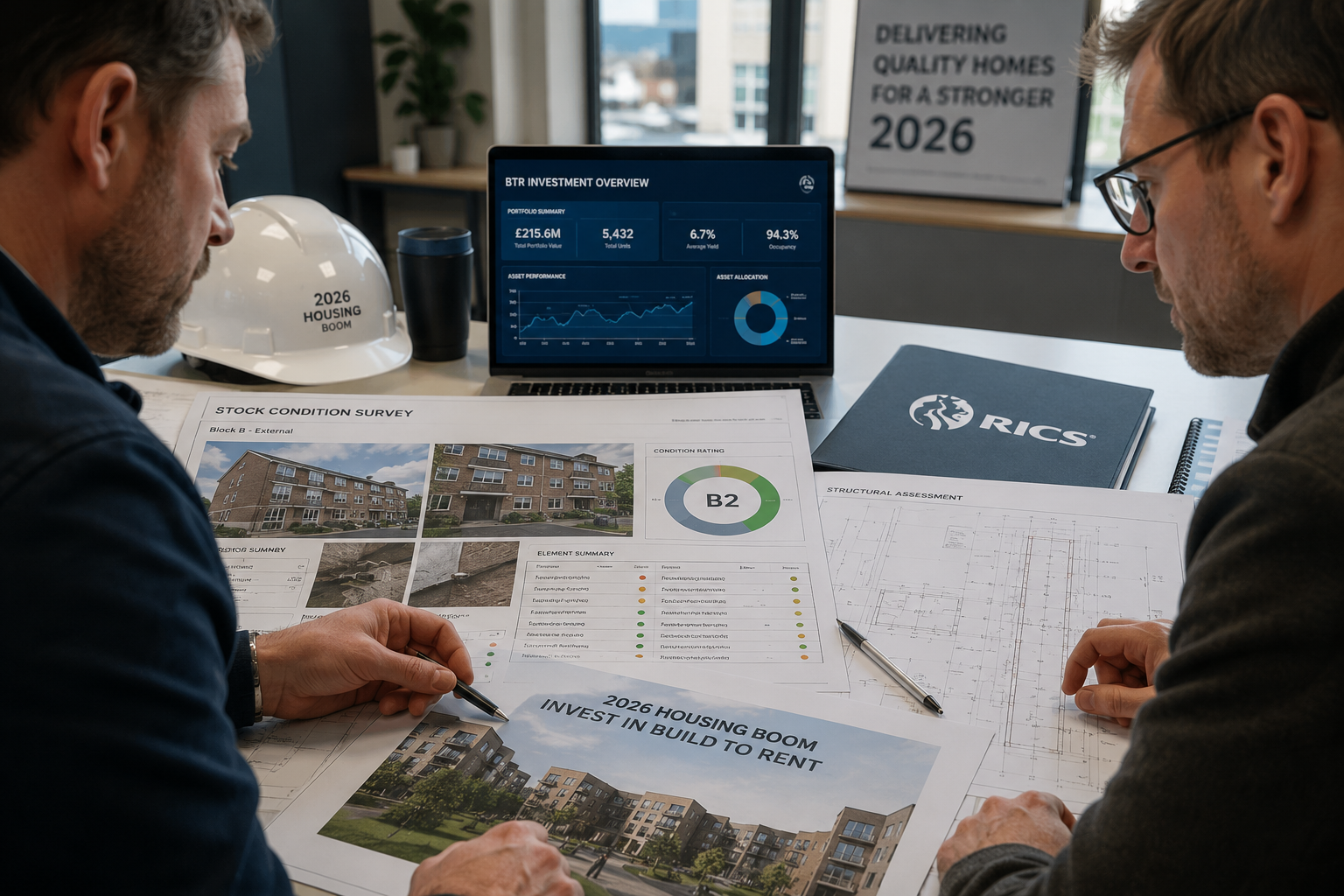
The commercial case for surveyors to specialise in BTR is strong and getting stronger. Here is why:
Repeat and Recurring Revenue
Unlike one-off residential transactions, BTR clients — institutional landlords, real estate investment trusts (REITs), and specialist BTR operators — need surveying services repeatedly and at scale. A single client relationship with a BTR operator managing 2,000 homes can generate more consistent revenue than hundreds of individual homebuyer survey instructions.
Higher-Value Instructions
BTR schemes command higher professional fees than standard residential surveys because of their complexity, scale, and the commercial stakes involved. Survey pricing for BTR-related work reflects the specialist knowledge required and the liability exposure involved.
Geographic Concentration
BTR development in 2026 is concentrated in specific high-growth markets — major cities, commuter belt towns, and regeneration zones. Surveyors with strong local market knowledge in these areas are particularly well-positioned. Firms operating across London and the South East, for example, are seeing significant BTR pipeline activity across multiple sub-markets. [5]
Diversification of Services
A surveying firm that can offer the full BTR lifecycle service — from pre-acquisition due diligence through to ongoing stock condition monitoring and rent review advice — is far more valuable to a BTR client than a firm that offers only one service. This creates a strong incentive for surveying practices to build cross-disciplinary BTR capability.
Practical Steps for Surveyors Entering the BTR Market
For surveyors looking to capitalise on surveying for build-to-rent communities amid the 2026 housing boom, the following steps provide a clear starting point:
-
Develop BTR-specific knowledge — understand how BTR assets are valued, financed, and managed. The investment method of valuation, net operating income analysis, and yield metrics are fundamental.
-
Build relationships with BTR developers and operators — attend industry events, join relevant RICS working groups, and engage with BTR-focused investment platforms. [5]
-
Offer stock condition surveys as a gateway service — this is often the first service a BTR operator needs and provides a natural entry point for a broader relationship.
-
Understand planning and compliance requirements — surveyors who can advise on BTR-specific planning conditions, affordable housing obligations, and building regulations compliance add significant value beyond pure condition assessment.
-
Invest in technology — BTR operators expect digital deliverables: structured data outputs, integration with asset management platforms, and drone-assisted surveys for large-scale site analysis.
-
Consider project management capability — BTR developers often need a single professional point of contact who can coordinate multiple workstreams. Offering project management services alongside surveying strengthens the overall proposition.
Conclusion: Seizing the BTR Surveying Opportunity in 2026
The convergence of institutional capital, housing demand, and planning policy has made 2026 a defining year for build-to-rent development. [6] For the surveying profession, this is not background noise — it is a structural shift that is reshaping the market for professional services.
Surveying for build-to-rent communities: opportunities amid the 2026 housing boom demands a broader skill set, a longer-term client mindset, and a genuine understanding of how BTR assets are created, operated, and valued. Surveyors who develop this expertise now will be well-positioned to serve one of the most active and well-funded sectors in the property market for years to come.
✅ Actionable Next Steps
- Commission a stock condition survey on any BTR portfolio to establish a baseline condition record and forward maintenance plan.
- Engage a RICS-qualified valuer with BTR experience for acquisition, refinancing, or portfolio reporting purposes.
- Review party wall obligations on any BTR site adjacent to existing structures before construction begins.
- Audit EPC ratings across the portfolio and identify units that require energy performance upgrades to meet 2026 regulatory requirements.
- Speak to a specialist surveying firm about a tailored BTR service package that covers the full development and asset management lifecycle.
For expert guidance on any aspect of BTR surveying — from initial site assessment to ongoing portfolio management — explore the full range of RICS building surveys and professional services available to developers, investors, and operators in 2026.
References
[1] Build To Rent Communities Set To Dominate In 2026 – https://www.boostnoi.com/blog/build-to-rent-communities-set-to-dominate-in-2026
[2] Building The Future How Build To Rent Is Reshaping Housing In 2026 – https://informaconnect.com/building-the-future-how-build-to-rent-is-reshaping-housing-in-2026/
[3] The Growing Case For Build To Rent – https://www.cushmanwakefield.com/en/united-states/insights/the-growing-case-for-build-to-rent
[4] Build To Rent Btr Development Continues To Outpace Historical Highs – https://arbor.com/blog/build-to-rent-btr-development-continues-to-outpace-historical-highs/
[5] Build To Rent Investment Opportunities 2026 – https://www.catalystcp.com/build-to-rent-investment-opportunities-2026/
[6] Why Build To Rent Is Shaping The Housing Market In 2026 – https://www.matthews.com/insights/why-build-to-rent-is-shaping-the-housing-market-in-2026
[7] Build Rent Special Report Supply Side Pressures Ease 2026 – https://www.northmarq.com/insights/research/build-rent-special-report-supply-side-pressures-ease-2026
[9] Welcome To 2026 The Great Housing Reset – https://www.rentastic.io/blog/welcome-to-2026-the-great-housing-reset