Nearly one in five UK homebuyers who commission a building survey discover defects serious enough to affect the agreed purchase price — yet the science of how those defects translate into a revised valuation figure remains poorly understood by buyers, sellers, and even some practitioners. Valuing properties with unresolved building defects: how surveyors adjust for risk, repair, and market resistance is one of the most technically demanding tasks a chartered surveyor faces in 2026, requiring a careful blend of cost analysis, comparable evidence, and professional judgement.
This guide unpacks the methodology surveyors use, explains the critical difference between cost of cure, stigma, and market resistance, and shows why getting the adjustment wrong — in either direction — can have serious financial and legal consequences.
Key Takeaways 📋
- Cost of cure is not the same as market deduction — a £30,000 repair bill does not automatically reduce value by £30,000.
- Stigma is the additional, often invisible, discount buyers apply beyond repair costs, and it can be significant for defects like subsidence or Japanese knotweed.
- Market resistance describes how certain defects make a property harder to sell, not just cheaper — affecting liquidity as much as price.
- RICS-registered valuers must follow Red Book Global Standards when reflecting defects in formal valuations, ensuring consistency and accountability.
- Unresolved defects carry greater uncertainty than resolved ones, and surveyors must reflect that uncertainty — not just the known repair cost.
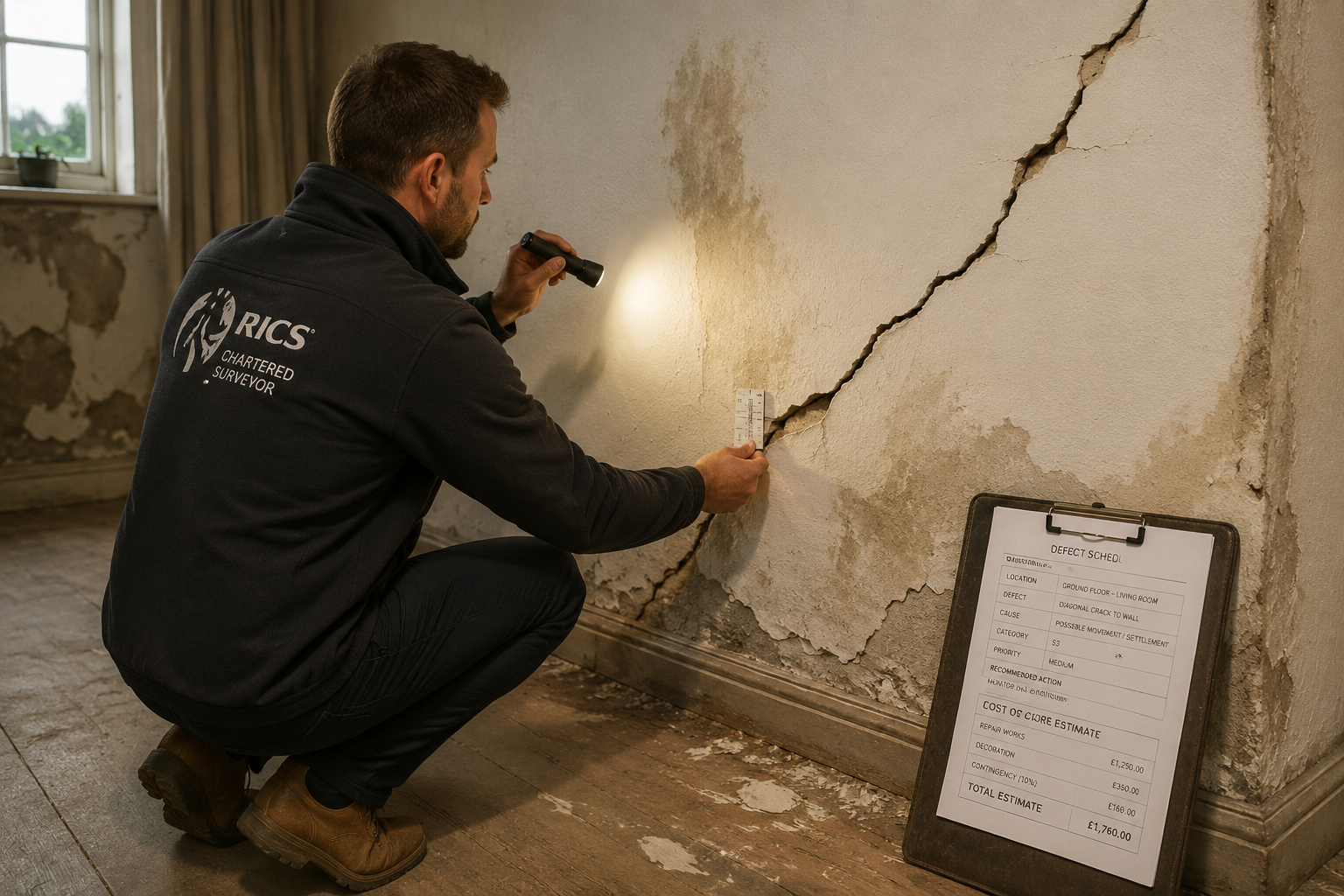
Understanding the Core Challenge in Valuing Properties with Unresolved Building Defects
When a defect remains unresolved at the point of valuation, the surveyor faces a fundamental problem: the full extent of the issue may not yet be known. A crack in a wall could be cosmetic settlement or the early sign of progressive subsidence. Rising damp could be a failed DPC or evidence of a more serious drainage failure. Roof deterioration might require patch repairs or a full replacement.
This uncertainty is not a reason to avoid making a valuation adjustment — it is precisely why one is needed.
The Three Pillars of Defect-Related Valuation Adjustment
Surveyors working on RICS building surveys and valuations typically structure their thinking around three distinct but overlapping concepts:
| Concept | Definition | Example |
|---|---|---|
| Cost of Cure | The estimated cost to repair or remediate the defect | £15,000 to underpin a corner of a foundation |
| Stigma | Residual value loss beyond repair costs due to buyer perception | 5–15% additional deduction after subsidence repair |
| Market Resistance | Difficulty selling, reduced buyer pool, extended marketing time | Japanese knotweed, cladding issues, or flooding history |
Each of these requires different evidence and different methodology. A surveyor who conflates them — or ignores one entirely — risks producing a valuation that is either too generous to the seller or unfairly punitive to them.
Cost of Cure: The Starting Point, Not the Finish Line
Cost of cure is the most straightforward component. It represents what a competent contractor would charge to bring the defect to an acceptable standard. Surveyors typically derive this from:
- Published cost data (e.g., BCIS schedule of rates)
- Contractor quotes obtained by the client
- Professional experience of similar repairs in the local market
However, cost of cure is not automatically deducted pound-for-pound from the market value. Several factors complicate the calculation:
- 🔧 Contingency: Unresolved defects carry risk of hidden additional work. A 10–25% contingency uplift is common.
- 🏗️ Consequential damage: Repairing the primary defect may reveal secondary issues (e.g., fixing a leaking roof may expose rotten joists).
- ⏳ Disruption costs: Buyers factor in the cost of temporary accommodation, storage, or lost rental income during works.
- 📉 Profit and risk: A buyer taking on a defective property expects a return for the risk they are absorbing.
For a specific defect report or a full Level 3 survey, the surveyor should quantify these elements as clearly as possible, even where ranges rather than precise figures are appropriate.
Stigma: The Hidden Discount That Cost of Cure Cannot Capture
"Even after a perfect repair, some defects leave a permanent mark on value. That mark is stigma — and it is real, measurable, and legally recognised."
Stigma is perhaps the most misunderstood concept in defect valuation. It represents the additional value loss that persists even after a defect has been fully remediated, driven by buyer psychology and market perception rather than physical condition.
When Does Stigma Apply?
Not every defect attracts stigma. Minor defects — a cracked render, a dripping tap, a dated kitchen — are repaired and forgotten. Stigma tends to attach to defects that:
- Carry long-term uncertainty (e.g., historic subsidence, even where treated)
- Are difficult to insure (e.g., properties previously affected by flooding)
- Have reputational or legal baggage (e.g., properties with unresolved cladding issues under the Building Safety Act)
- Involve invasive species such as Japanese knotweed, where mortgage lenders remain cautious
The quantum of stigma is determined primarily by market evidence — comparable sales of properties with similar histories versus unaffected equivalents. Where evidence is thin, surveyors must exercise professional judgement and document their reasoning carefully.
Stigma in Practice: Subsidence as a Case Study
Consider a 1930s semi-detached house that suffered subsidence five years ago. The underpinning was completed, a 10-year structural warranty was obtained, and the property has been monitored without further movement. The cost of cure is, in effect, zero — the work is done.
Yet in many markets, this property will still achieve 5–15% less than an identical undamaged neighbour. Why?
- Mortgage lenders may require specialist reports, adding friction to the transaction
- Buildings insurance premiums are higher, reducing affordability
- Future buyers will face the same disclosure obligations
- Some buyers simply won't purchase a property with a subsidence history, shrinking the buyer pool
A structural survey or subsidence survey can help quantify the current risk, but the valuer must then translate that risk assessment into a market-based figure — which requires comparable evidence, not just engineering opinion.

Market Resistance: When a Defect Affects Saleability, Not Just Price
Market resistance is distinct from both cost of cure and stigma. It describes a situation where a defect — or the uncertainty surrounding it — reduces the pool of willing buyers rather than simply reducing the price any given buyer would pay.
This distinction matters enormously in practice. A property with severe market resistance may:
- Require extended marketing periods (affecting investment value calculations)
- Be unmortgageable in its current state, limiting buyers to cash purchasers
- Attract only developers or investors rather than owner-occupiers, who typically pay less
- Become unsaleable at any price until the defect is resolved or disclosed
Common Defects That Trigger Market Resistance in 2026
| Defect Type | Primary Impact | Typical Buyer Pool Reduction |
|---|---|---|
| EWS1 cladding failures | Unmortgageable | Severe — cash buyers only |
| Japanese knotweed (active) | Lender restrictions | Moderate to severe |
| Structural movement (active) | Insurance/mortgage issues | Moderate |
| Unresolved damp | Survey-triggered renegotiation | Mild to moderate |
| Roof failure | Mortgage retention risk | Mild |
| Drainage defects | Hidden consequential risk | Mild |
For damp surveys and roof surveys, the surveyor's role is not just to identify the defect but to communicate its likely impact on the transaction — including whether a lender is likely to impose a retention or refuse to lend at all.
How Surveyors Reflect Defects in Formal Valuations
The RICS Red Book Framework
Formal valuations prepared by RICS-registered valuers must comply with RICS Valuation — Global Standards (the Red Book). This framework requires valuers to:
- Identify and describe all material defects known or observed
- Quantify the impact on market value with supporting reasoning
- State assumptions made where information is incomplete
- Flag special assumptions where the valuation is prepared on a hypothetical basis (e.g., "assuming the defect is remediated")
The Red Book does not prescribe a formula for defect deductions — it requires evidence-based professional judgement. This is why two valuers may reach different figures for the same property, and why the quality of comparable evidence is so important.
The Comparable Sales Method
The most robust approach to valuing properties with unresolved building defects is to find comparable sales of similarly affected properties and compare them to sales of unaffected equivalents. The percentage difference provides the market-derived adjustment.
In practice, this evidence is often scarce. Defective properties sell less frequently, and their sale prices are not always publicly attributed to specific defects. Surveyors therefore frequently rely on a combination of:
- 🏠 Direct comparables (where available)
- 📊 General market adjustment percentages derived from published research
- 🔍 Contractor quotes and cost schedules
- 💬 Discussions with local agents about buyer appetite
The key discipline is to document the reasoning clearly. A valuation that simply states "deduction of £25,000 for damp" without explanation is professionally inadequate and potentially indefensible if challenged.
Special Assumptions and "Subject To" Valuations
Sometimes a client needs two figures: the value as is (with the defect) and the value assuming the defect is remediated. This is common in:
- Mortgage valuations where a lender wants to understand potential recovery value
- Matrimonial or probate valuations where a fair division of assets is needed
- Litigation support where the cost of the defect is in dispute
The difference between these two figures — sometimes called the "as repaired premium" — is not simply the cost of repair. It includes stigma, market resistance adjustments, and any residual uncertainty.
Valuing Properties with Unresolved Building Defects: Practical Guidance for Buyers and Sellers
For Buyers 🏡
- Commission a Level 3 Building Survey before exchanging contracts on any older or visibly imperfect property. A RICS Level 3 building survey provides the most comprehensive assessment of defects and their implications.
- Request contractor quotes for any defects identified — these strengthen any renegotiation and provide the surveyor with cost-of-cure evidence.
- Ask the surveyor to comment on value impact explicitly. Many survey reports describe defects without quantifying their effect on price.
- Do not assume cost of cure equals price reduction — understand that stigma and market resistance may justify a larger deduction than the repair bill alone.
For Sellers 🏠
- Resolve defects before marketing where possible. A resolved defect with documentation (warranties, completion certificates) is worth significantly more than an unresolved one.
- Obtain a specific defect report before listing if there is a known issue — this demonstrates transparency and can prevent a buyer's survey from derailing the sale.
- Be cautious about over-pricing a defective property. Market resistance means the buyer pool is smaller, and an inflated asking price will simply extend the marketing period.
For Lenders and Solicitors ⚖️
- Ensure valuation instructions clearly state whether the valuation is required as is or on a special assumption basis.
- Where a defect is identified post-instruction, request a revised valuation rather than assuming the original figure remains valid.
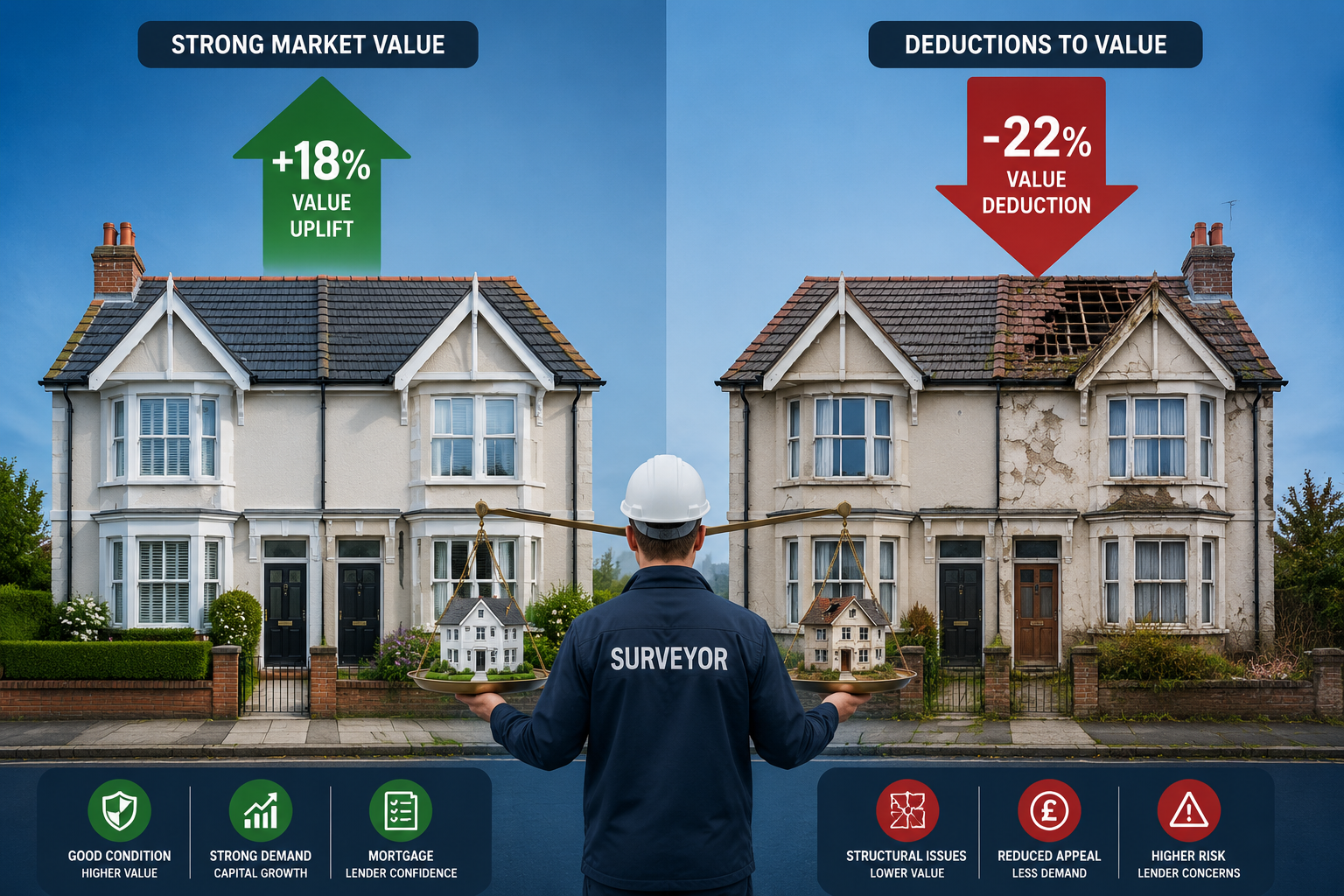
Common Mistakes in Defect Valuation — and How to Avoid Them
Even experienced practitioners can fall into traps when valuing properties with unresolved building defects. The most common errors include:
❌ Over-relying on cost of cure alone — ignoring stigma and market resistance produces valuations that are too high.
❌ Applying a blanket percentage deduction without market evidence — "I always deduct 10% for subsidence" is not a defensible methodology.
❌ Failing to reflect uncertainty — where the full extent of a defect is unknown, the valuation should reflect a range or include a clear caveat.
❌ Conflating the surveyor's role with the valuer's role — a building surveyor identifies and describes defects; a valuer translates them into market value impact. These are related but distinct disciplines.
❌ Ignoring the buyer's perspective — value is ultimately set by the market. A surveyor who focuses only on technical repair costs without considering how buyers actually respond to a defect will produce an unreliable figure.
Conclusion: Getting Defect Valuations Right in 2026
Valuing properties with unresolved building defects: how surveyors adjust for risk, repair, and market resistance is not a mechanical process — it demands rigorous evidence gathering, clear professional reasoning, and an honest appraisal of both the physical condition and the market's reaction to it.
The three-part framework of cost of cure, stigma, and market resistance provides a structured way to approach these valuations without either overstating or understating the impact of a defect. Each component requires different evidence and different methodology, and all three must be considered together to reach a defensible, market-reflective figure.
Actionable Next Steps ✅
- If buying a property with known defects, commission a RICS Level 3 building survey and ask explicitly for commentary on value impact.
- If selling a defective property, obtain a specific defect report and contractor quotes to demonstrate transparency and support your asking price.
- If requiring a formal valuation, work with RICS-registered valuers who understand the distinction between cost of cure, stigma, and market resistance.
- If in dispute over a defect's value impact, consider engaging a surveyor with expert witness experience who can prepare a defensible, court-ready valuation report.
- Review survey pricing and options to find the right level of inspection for your specific property and circumstances.
Getting the valuation right protects buyers from overpaying, sellers from under-pricing, and lenders from under-secured lending. In a market where building defects are increasingly common and increasingly complex, that precision has never mattered more.