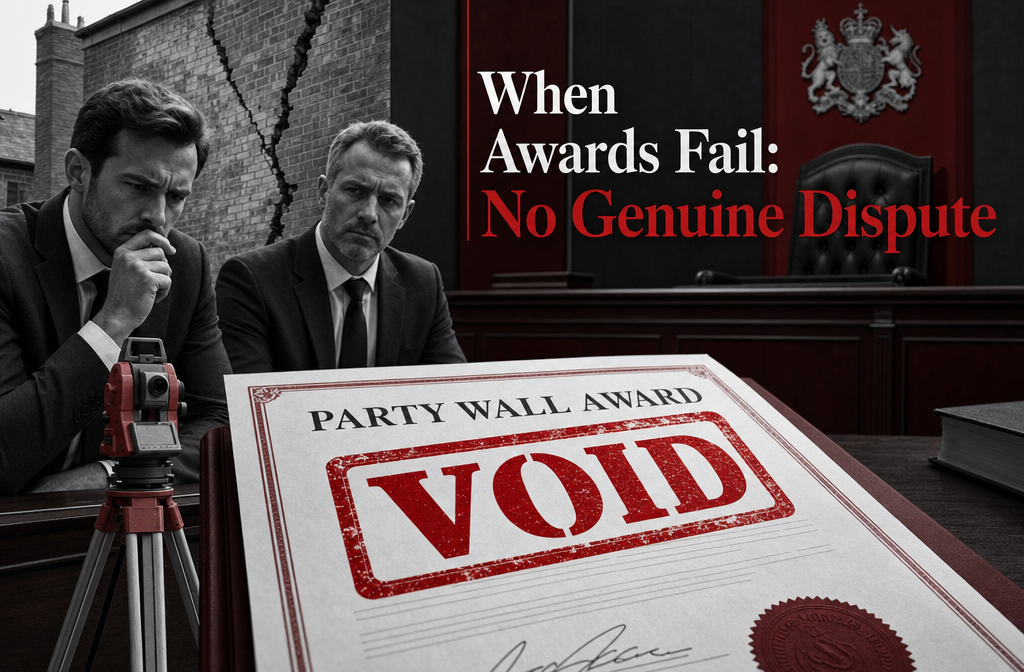
Nearly one in five party wall awards that reach formal challenge are overturned on jurisdictional grounds — not because the surveyor got the technical details wrong, but because the legal foundation for making the award was absent from the start. This uncomfortable reality has driven RICS to launch a sweeping consultation on its draft 8th edition party wall guidance in April 2026, targeting the precise procedural failures that have left surveyors, building owners, and adjoining owners exposed to costly legal disputes. [1]
Strengthening Jurisdiction in Party Wall Awards: RICS 8th Edition Lessons from Challenged Cases and Prevention Strategies sits at the heart of this update — drawing directly on cases where awards collapsed and translating those lessons into actionable professional standards. Understanding why awards fail, and how the new guidance closes those gaps, is now essential reading for every practising party wall surveyor.
Key Takeaways 📌
- Jurisdiction is the foundation: An award made without a genuine dispute or proper appointment is legally void, regardless of its technical quality.
- The 8th edition directly addresses challenged cases: RICS has specifically updated guidance to tackle circumstances where no genuine dispute existed between parties. [3]
- Personal and statutory appointments are non-negotiable: Surveyor independence from client instruction is a core principle reinforced throughout the new draft. [3]
- Third Surveyor procedures have been clarified: Enhanced guidance reduces the risk of procedural errors that trigger jurisdictional challenges.
- Prevention beats litigation: Standardised templates for appointments, notices, and awards are the most cost-effective tools surveyors have.
Why Party Wall Awards Get Challenged: The Jurisdiction Problem
Before exploring what the 8th edition fixes, it is worth understanding what breaks. Party wall awards are statutory instruments — they derive their authority from the Party Wall etc. Act 1996. Strip away the statutory foundation, and the award is nothing more than a piece of paper.
Courts have consistently held that jurisdiction under the Act depends on three conditions being met:
- A valid notice must have been served correctly.
- A genuine dispute must exist (or be deemed to exist) between the parties.
- Surveyors must be properly appointed in accordance with the Act.
When any of these conditions is absent, the award is ultra vires — beyond the surveyor's legal power to make. [3]
The "No Genuine Dispute" Problem
One of the most damaging categories of challenged awards involves situations where no genuine dispute existed between the building owner and the adjoining owner. [3] This might sound unusual — why would surveyors proceed to an award if the parties were not actually in dispute?
The answer often lies in commercial pressure. Some surveyors, under instruction from building owners, have proceeded through the full award process even when the adjoining owner had raised no substantive objection. The result is an award that a court can — and sometimes does — set aside entirely.
💬 "A party wall surveyor's appointment is personal and statutory, and must remain independent of client instruction." — RICS Draft 8th Edition Guidance [3]
This principle matters enormously. A surveyor who allows a building owner to drive the process toward an award the parties did not need has compromised both their independence and the award's validity.
If you are unsure whether a dispute genuinely exists in your situation, reviewing what constitutes a party wall dispute is a useful starting point before any formal process begins.
RICS 8th Edition: Key Changes That Strengthen Jurisdiction
The draft 8th edition consultation, running across April and May 2026, seeks input from surveyors, legal professionals, dispute resolution practitioners, and other stakeholders involved in party wall matters in England and Wales. [1] [2] It represents a comprehensive update to the 7th edition, with several targeted changes designed to prevent the jurisdictional failures seen in challenged cases. [3]
1. Reinforcing the Personal and Statutory Nature of Appointments
The 8th edition makes explicit what good practitioners already knew: a surveyor's appointment under the Act is personal and statutory. It cannot be delegated, transferred, or overridden by client instruction. [3]
This has practical implications:
| Scenario | Old Guidance Clarity | 8th Edition Clarity |
|---|---|---|
| Client instructs surveyor to proceed without dispute | Ambiguous | Explicitly prohibited |
| Surveyor replaced mid-process by building owner | Unclear | Addressed with procedural steps |
| Fee arrangement creates financial pressure | Limited guidance | Strengthened fee practice rules |
2. Revised Letters of Appointment and Terms of Engagement
New standardised templates for letters of appointment and terms of engagement are a headline feature of the 8th edition. [3] These templates are designed to establish clarity from the very outset about:
- The surveyor's statutory role and independence
- The limits of client instruction
- The conditions under which an award can lawfully be made
- Fee arrangements that do not compromise independence
For surveyors working on loft conversion party wall matters — one of the most common trigger points for disputes — these templates provide a clear framework that reduces the risk of a later jurisdictional challenge.
3. Updated Award Template
The draft introduces an updated award template to ensure consistent, legally sound documentation of party wall determinations. [3] A well-structured award template serves multiple purposes:
- ✅ Forces surveyors to confirm jurisdiction before proceeding
- ✅ Documents the existence of a genuine dispute
- ✅ Records proper notice service
- ✅ Captures the basis for each determination
This is particularly important where damage to property in party wall works becomes a later point of contention — a clear, well-documented award is far harder to challenge.
4. Enhanced Third Surveyor Procedures
The Third Surveyor role is one of the most misunderstood — and misused — elements of the party wall process. The 8th edition provides enhanced guidance on when and how the Third Surveyor appointment should occur, reducing the procedural errors that have triggered jurisdictional disputes. [3]
Key clarifications include:
- When referral to the Third Surveyor is mandatory vs. discretionary
- How the Third Surveyor's jurisdiction is established
- Procedural steps to avoid the Third Surveyor's award being challenged on the same grounds as primary awards
5. Notice Service Standards
Proper service of notices is the gateway to jurisdiction. The 8th edition updates guidance on service of notices to address procedural compliance issues that have undermined awards. [3]
Common notice failures that have led to challenged awards include:
- Serving notice on the wrong party (e.g., a tenant rather than the freeholder)
- Incorrect notice periods
- Failure to identify the correct type of notice for the works proposed
- Notice served after works have already commenced
For neighbours dealing with situations where no party wall notice has been served, or where a neighbour is carrying out works without a party wall agreement, understanding these notice requirements is equally important.
6. Strengthened Fee Practices Guidance
Financial pressure is a real and underacknowledged driver of jurisdictional overreach. The 8th edition strengthens guidance on fee practices to prevent conflicts of interest and ensure surveyors maintain independence from financial pressures that might compromise jurisdiction decisions. [3]
This includes guidance on:
- Fee structures that do not incentivise unnecessary awards
- Transparency in fee disclosure to all parties
- Handling situations where a building owner attempts to control fees to influence outcomes
7. Enhanced Appendices and Public Engagement
The 8th edition includes enhanced appendices providing clearer guidance on procedural requirements, alongside strengthened standards for public engagement — setting professional expectations for how surveyors communicate with all parties involved. [3]
Prevention Strategies: Bulletproofing Your Practice in 2026
The lessons from challenged awards, combined with the 8th edition's new framework, point toward a clear set of prevention strategies that every party wall surveyor should embed into their practice. Strengthening Jurisdiction in Party Wall Awards: RICS 8th Edition Lessons from Challenged Cases and Prevention Strategies is not just a theoretical exercise — it is a practical toolkit.
Pre-Appointment Checklist 🗂️
Before accepting any party wall appointment, surveyors should confirm:
- A valid notice has been (or will be) served correctly
- The works proposed fall within the scope of the Act
- There is a genuine dispute, or the conditions for a deemed dispute are properly met
- The appointment is being made in accordance with Section 10 of the Act
- Fee arrangements are transparent and do not create conflicts of interest
The Schedule of Condition: A Jurisdictional Safeguard
A thorough schedule of condition prepared before works begin does more than protect against damage claims — it demonstrates that the surveyor has properly engaged with the adjoining owner's position. This engagement is evidence that the process was conducted with genuine regard for all parties, strengthening the award's defensibility.
For detailed guidance on best practice, the schedule of condition guidance resource provides a practical framework that aligns with the 8th edition's standards.
Documenting the Dispute
If an award is ever challenged, the surveyor's file is the first thing a court will examine. Best practice documentation includes:
| Document | Purpose |
|---|---|
| Notice service records | Proves valid jurisdiction trigger |
| Correspondence log | Evidences genuine dispute |
| Appointment letter (8th edition template) | Confirms statutory independence |
| Meeting notes | Records surveyor's independent reasoning |
| Award (8th edition template) | Legally sound determination |
When to Decline an Appointment
The 8th edition's emphasis on personal and statutory independence creates a professional obligation that some surveyors may find uncomfortable: sometimes the right answer is to decline an appointment. [3]
Circumstances where declining is appropriate include:
- The building owner is pressuring the surveyor to proceed without a genuine dispute
- Fee arrangements create an unacceptable conflict of interest
- The works do not actually fall within the Act's scope
- Notice has not been properly served and the building owner refuses to rectify this
Declining in these circumstances is not a commercial failure — it is professional integrity in action. Surveyors who proceed under pressure risk not only the award being set aside, but also regulatory and reputational consequences.
Expert Witness Considerations
When awards are challenged, surveyors may find themselves called upon as expert witnesses. The quality of the original file — built on the 8th edition's procedural standards — is the surveyor's best defence. An expert witness who can point to a process that followed every procedural requirement is in a far stronger position than one defending ad hoc decisions.
The Broader Context: Why This Matters for Property Owners
The consequences of a challenged party wall award extend far beyond the surveyor's professional standing. For building owners, a void award means:
- Works may need to stop pending a fresh process
- Costs escalate as legal fees mount and programmes slip
- Relationships deteriorate with adjoining owners
For adjoining owners, a void award can mean losing the protections they were entitled to — including compensation for damage and proper oversight of works affecting their property.
Understanding what happens if you do not have a party wall agreement illustrates the risks that flow from a process that was never properly established in the first place.
The RICS chartered building surveyor credential exists precisely to signal that a professional has the training, ethical framework, and procedural knowledge to navigate these complexities correctly.
Conclusion: Building Awards That Stand Up
The RICS 8th edition consultation launched in April 2026 is a direct response to a pattern of failures that has damaged confidence in the party wall process. [1] By addressing the root causes — disputed jurisdiction, absence of genuine disputes, compromised surveyor independence, and procedural notice failures — the new guidance gives practitioners the tools to build awards that are legally robust from the first step to the last. [3]
Actionable next steps for surveyors in 2026:
- Review the draft 8th edition guidance and engage with the consultation process before it closes.
- Audit your current appointment letters and terms of engagement against the new standardised templates.
- Update your pre-appointment checklist to include explicit confirmation of genuine dispute and proper notice service.
- Strengthen your file documentation to evidence independent reasoning at every stage.
- Revisit your fee arrangements to ensure they cannot be characterised as creating a conflict of interest.
- Train on Third Surveyor procedures using the enhanced 8th edition guidance.
For property owners, the message is equally clear: engage a qualified, RICS-accredited party wall surveyor who understands these requirements. The cost of getting it right at the start is always lower than the cost of defending — or rebuilding — a challenged award.
References
[1] Rics Launches Consultation On Updated Party Wall Practice Guidance – https://www.rics.org/news-insights/rics-launches-consultation-on-updated-party-wall-practice-guidance
[2] Rics Launches Consultation On Party Wall Guidance – https://thenegotiator.co.uk/news/regulation-law-news/rics-launches-consultation-on-party-wall-guidance/
[3] Rics Opens Consultation On Party Wall Guidance Update – https://www.propertywire.com/news/uk/rics-opens-consultation-on-party-wall-guidance-update/
[4] Party Wall Dispute – https://onlinearchitecturalservices.com/party-wall-dispute/