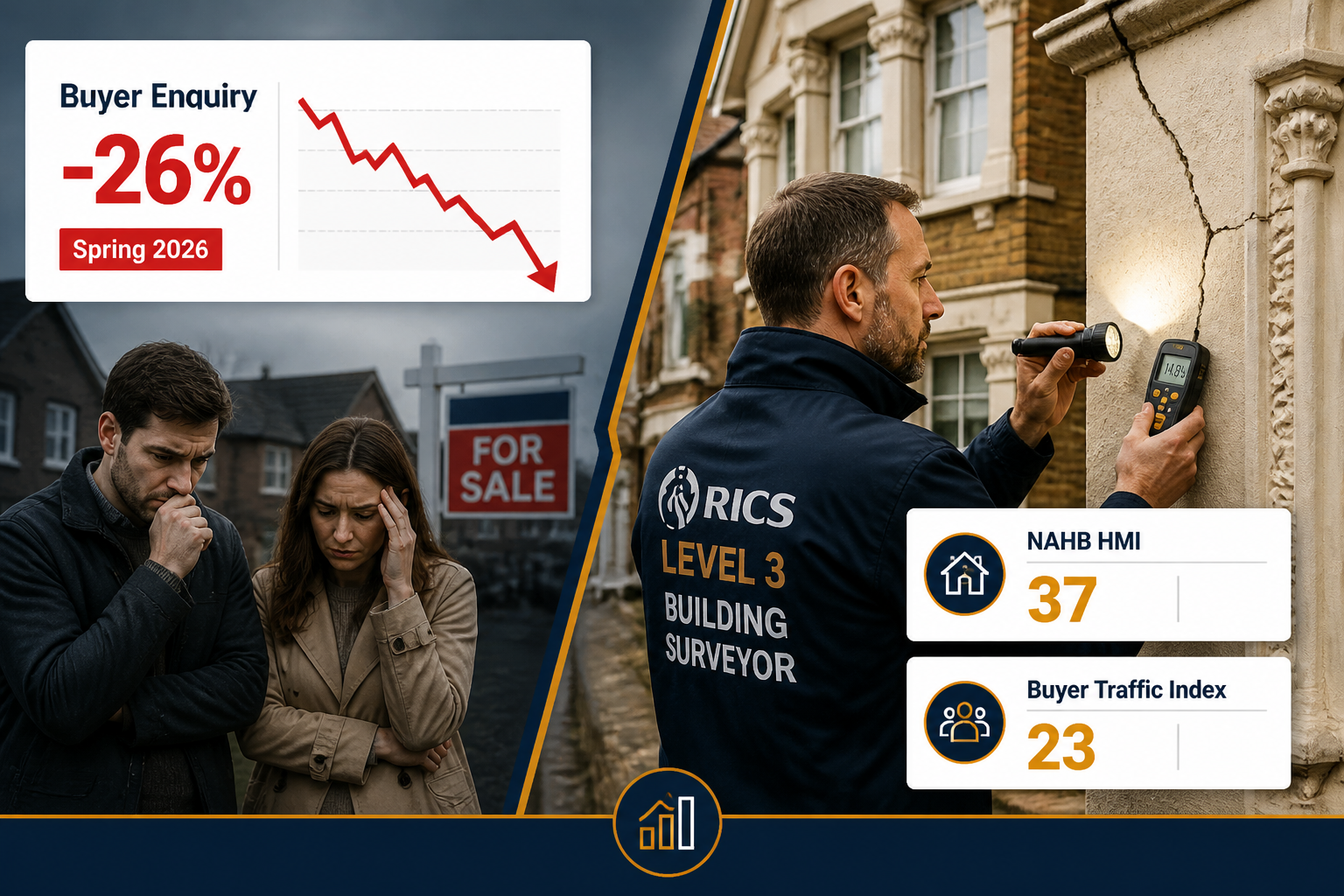
Buyer traffic in the housing market hit a gauge reading of just 23 in January 2026 — one of the lowest prospective-buyer engagement levels recorded in recent years — while future sales expectations dropped below the critical 50-point breakeven threshold for the first time since September [2]. That single data cluster tells surveyors everything they need to know about the spring 2026 landscape: caution is not a mood, it is a market condition. Understanding how Building Surveys in Cautious Spring 2026 Markets: Level 3 Protocols to Counter -26% Buyer Enquiry Decline can protect both buyers and transactions is now an essential professional competency, not an optional add-on.
Key Takeaways 📋
- Buyer enquiry volumes have fallen sharply entering spring 2026, with the NAHB/Wells Fargo Housing Market Index at 37 and prospective buyer traffic at 23 [2].
- Level 3 Building Surveys (Full Structural Surveys) provide the defect certainty that cautious buyers need before committing in a soft market.
- Regional divergence is significant — Southern and Western markets are weakest, while some Northern markets show inventory recovery, requiring localised survey strategies.
- Surveyors who communicate defect risk clearly become transaction enablers, not deal-breakers, in low-confidence markets.
- Updated 2026 survey standards have raised the bar on what surveyors must observe and report, making protocol compliance more important than ever [4].
Why Spring 2026 Is a Surveyor's Market, Not a Seller's
The phrase "spring bounce" has long described the seasonal uptick in property activity that follows winter. In 2026, that bounce has been muted by a convergence of structural headwinds. The NAHB/Wells Fargo Housing Market Index fell to 37 in January 2026, with all three subindices — current sales, future sales, and buyer traffic — declining simultaneously [2]. Builder confidence has eroded not because properties are undesirable, but because affordability constraints and economic uncertainty have made buyers hesitant to commit.
💬 "The 2026 market is navigating demand uncertainty, with builders and buyers alike taking a cautious approach to strategy." [1]
This caution creates a paradox for property professionals. On one hand, fewer enquiries mean fewer instructions. On the other hand, the buyers who are active are more risk-averse than ever, making thorough due diligence — particularly a full Level 3 building survey — not just desirable but essential to completing transactions.
The -26% Buyer Enquiry Decline: What the Numbers Mean
The reported -26% decline in buyer enquiries reflects a broader pattern of demand withdrawal. When the HMI buyer traffic gauge sits at 23 — well below the neutral reading of 50 — it signals that potential purchasers are window-shopping rather than transacting [2]. Several factors drive this:
| Factor | Impact on Buyer Behaviour |
|---|---|
| Elevated mortgage rates | Reduces purchasing power, extends decision timelines |
| Affordability concerns | Pushes buyers toward smaller properties or different regions |
| Economic uncertainty | Increases risk aversion, demands stronger due diligence |
| Rising inventory in select markets | Gives buyers more choice, reducing urgency to commit |
Notably, 66 of the nation's 200 largest housing markets now have more active inventory than pre-pandemic February 2019 levels — a stark contrast to February 2022 when zero markets exceeded that threshold [5]. More choice means buyers can afford to be selective, and selective buyers demand better information.
Building Surveys in Cautious Spring 2026 Markets: Level 3 Protocols Explained
A Level 3 Building Survey — also known as a Full Structural Survey — is the most comprehensive inspection available under RICS guidelines. It is the gold standard for buyers purchasing older properties, non-standard construction, or any building where structural integrity is a concern. In a market defined by caution, it is the instrument that converts hesitation into informed decision-making.
What Level 3 Protocols Cover
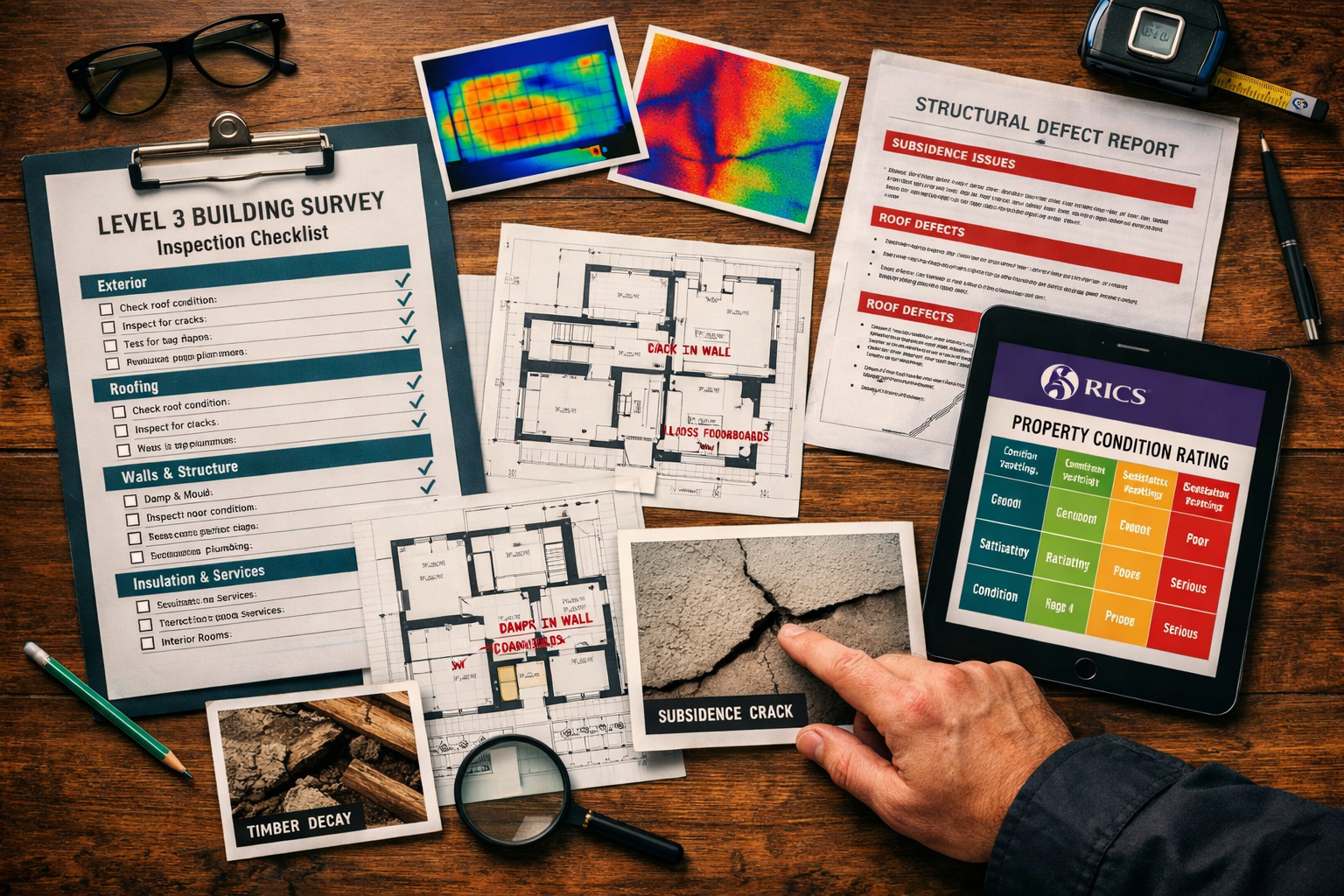
A properly executed Level 3 survey goes far beyond a visual inspection. Key protocol elements include:
- 🔍 Structural assessment — foundations, load-bearing walls, roof structure, and floor joists
- 💧 Damp and moisture analysis — rising damp, penetrating damp, and condensation mapping
- 🧱 Defect identification and grading — condition ratings (1, 2, or 3) with clear remediation guidance
- ⚠️ Hidden defect investigation — lifting inspection hatches, probing suspect areas, reviewing drainage
- 📋 Legal and planning flags — extensions without consent, boundary anomalies, and party wall considerations
- 🌿 Environmental risks — subsidence indicators, Japanese knotweed, flood risk proximity
For properties where subsidence is a concern, Level 3 protocols require surveyors to examine soil movement indicators, crack patterns, and drainage proximity with particular rigour. Similarly, older properties may require an asbestos survey as a parallel instruction, especially where pre-1999 construction materials are present.
Updated 2026 Standards: What Has Changed
The American Land Title Association and National Society of Professional Surveyors released new minimum standard requirements effective February 23, 2026, replacing the 2021 standards [4]. The most significant addition is Table A Item 20, which requires surveyors to provide opinions on significant observations — such as potential encroachments — when requested, while carefully avoiding legal opinions on ownership [4].
In the UK context, RICS continues to evolve its Home Survey Standard, and the spirit of these changes aligns: surveyors must be more explicit, not less, about what they observe and what it means for the buyer. In a cautious market, vague reporting is a liability. Clear, graded defect communication is a professional asset.
Why Level 3 Outperforms Level 2 in a Soft Market
A HomeBuyer Survey (Level 2) remains appropriate for newer, standard-construction properties in good condition. However, in a market where buyers are already nervous, the limitations of a Level 2 report can become transaction risks:
- Fewer areas inspected
- Less detail on defect causes and remediation costs
- Reduced ability to support price renegotiation
When a buyer discovers a significant defect after exchange — one that a Level 3 survey would have flagged — the result is not just financial loss. It is a complete erosion of confidence in the transaction process. Surveyors who recommend the appropriate survey level protect their clients and their own professional reputation.
Regional Divergence and Localised Survey Strategy
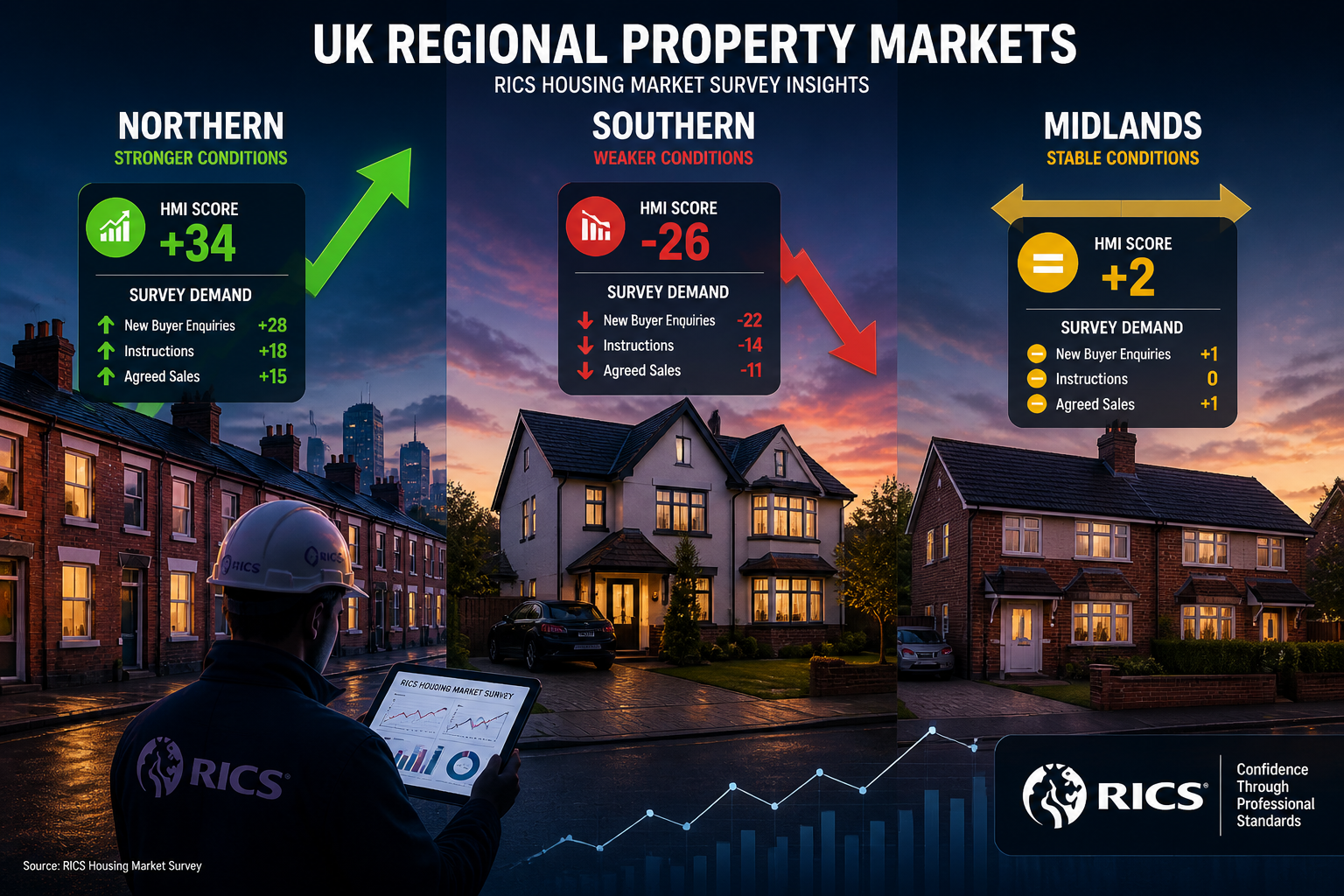
Not all markets are experiencing the -26% buyer enquiry decline equally. Regional variation is one of the defining characteristics of the spring 2026 landscape. The South's regional HMI score dropped to 35, the West matched it at 35, while the Northeast held at 45 and the Midwest at 43 [2]. This divergence demands localised survey strategy, not a one-size-fits-all approach.
Matching Survey Depth to Market Conditions
In markets where inventory has recovered above pre-pandemic levels [5], buyers hold genuine negotiating power. A thorough Level 3 survey in these markets serves a dual purpose:
- Defect certainty — confirming what the buyer is actually purchasing
- Negotiation leverage — providing documented evidence to support price reductions or repair requests
In tighter markets where supply remains constrained, the survey still matters enormously — but the communication of findings shifts. Surveyors must help buyers understand which defects are deal-breakers versus which are manageable maintenance items, enabling informed decisions rather than panic withdrawals.
The Role of Specialist Reports in Cautious Markets
Level 3 protocols frequently trigger the need for specialist investigations. In spring 2026 markets, the most commonly required add-ons include:
- Structural engineering assessments for properties with significant cracking or alteration history — see structural engineering services
- Damp surveys for older properties with suspected penetrating or rising damp — damp survey guidance provides a useful framework
- Specific defect reports where a single element — a chimney stack, a flat roof, a bay window — requires focused analysis via a specific defect report
- Drone surveys for inaccessible roof areas, particularly on larger or complex properties — drone survey capabilities have become increasingly standard
Each specialist report adds cost, but in a market where buyers are already cautious, incomplete information is the greater risk. A buyer who proceeds without full defect knowledge in a soft market has no price support cushion if problems emerge post-completion.
How Surveyors Can Counter the Buyer Enquiry Decline Professionally
The -26% drop in buyer enquiries is not just a market statistic — it is a professional challenge. Surveyors who adapt their practice to the psychology and practicalities of cautious buyers will maintain instruction volumes. Those who do not will feel the decline acutely.
Communicating Value in Uncertain Times
Housing analysts project that 2026 will see a shift from speculative demand to fundamental drivers like household formation and employment stability [3]. This means buyers are making longer-term, more considered decisions. They need surveyors who communicate in plain language, explain the implications of defects clearly, and provide realistic remediation cost ranges.
Practical steps surveyors can take:
✅ Use condition ratings consistently — RICS condition ratings (1, 2, 3) give buyers an immediate risk hierarchy
✅ Provide cost estimate ranges — even indicative figures help buyers assess affordability of repairs
✅ Distinguish urgent from non-urgent defects — not everything rated 2 requires immediate action
✅ Follow up reports with brief calls — a 10-minute conversation after report delivery dramatically improves buyer comprehension and confidence
✅ Flag legal and planning issues proactively — party wall matters, boundary uncertainties, and consent gaps need early identification; party wall guidance is a valuable resource for buyers navigating these issues
Pricing Strategy for Survey Instructions
Transparent, accessible pricing is particularly important when buyer budgets are under pressure. Surveyors should ensure their survey pricing is clearly communicated upfront, with a breakdown of what each level includes. In a market where buyers are scrutinising every cost, opaque pricing creates friction that can push an instruction elsewhere.
💬 "Measured expansion — not speculative growth — will define the housing market's next phase in 2026." [3]
This measured environment rewards surveyors who position themselves as trusted advisors rather than transactional service providers. The buyer who feels supported through a cautious purchase is far more likely to refer friends, return for future surveys, and leave positive reviews.
Building Surveys in Cautious Spring 2026 Markets: Level 3 Protocols as a Transaction Enabler
A common misconception is that a thorough survey — particularly one that uncovers significant defects — kills transactions. In reality, the opposite is true in a soft market. When a Level 3 survey identifies problems and quantifies them clearly, it gives all parties a basis for renegotiation rather than withdrawal.
Consider the transaction flow in a cautious market:
- Buyer makes offer, subject to survey
- Level 3 survey identifies £15,000 of remediation work (damp, roof repairs, structural crack monitoring)
- Surveyor provides clear condition ratings and cost ranges
- Buyer uses report to negotiate £12,000 reduction in purchase price
- Transaction proceeds — both parties have certainty
Without the Level 3 survey, the buyer either proceeds blindly (high risk) or withdraws from uncertainty (transaction lost). The survey is not a barrier — it is the mechanism that makes cautious buyers feel safe enough to commit.
Conclusion: Turning Market Caution Into Professional Opportunity
The spring 2026 property market is defined by restraint. With buyer enquiries down by as much as 26%, builder sentiment at 37 on the HMI, and future sales expectations barely holding above breakeven [2], the temptation for surveyors might be to wait for conditions to improve. That would be a strategic error.
Cautious markets create the strongest case for Level 3 building surveys. When buyers are risk-averse, they need more information, not less. When transactions are fragile, defect certainty is the stabilising force. When regional markets diverge — as they clearly are in 2026 — localised expertise and clear communication become competitive differentiators.
Actionable Next Steps for Surveyors and Buyers in Spring 2026:
- Buyers: Commission a Level 3 building survey for any property that is older, non-standard, or shows visible signs of wear — the cost is minimal compared to post-completion surprises.
- Surveyors: Review your report templates against updated 2026 standards [4] and ensure condition ratings, cost ranges, and defect priorities are communicated in plain language.
- Both parties: Understand that a thorough survey in a soft market is a transaction enabler, not a deal-breaker — it provides the certainty that cautious buyers need to proceed.
- Agents and conveyancers: Recommend specialist follow-up reports — from specific defect reports to subsidence surveys — early in the process to avoid late-stage surprises.
- Get a quote: For buyers ready to proceed, requesting a survey quote is the logical first step toward informed, confident property ownership in 2026.
The market will not wait for confidence to return on its own. Surveyors who apply rigorous Level 3 protocols, communicate findings with clarity, and position themselves as advisors rather than inspectors will not just survive the -26% buyer enquiry decline — they will define the professional standard that the recovery is built upon.
References
[1] Survey Reveals Demand Uncertainty Is Changing 2026 Homebuilding Strategy – https://www.housingwire.com/articles/survey-reveals-demand-uncertainty-is-changing-2026-homebuilding-strategy/
[2] Builder Sentiment Loses Ground At Start Of 2026 – https://www.nahb.org/news-and-economics/press-releases/2026/01/builder-sentiment-loses-ground-at-start-of-2026
[3] Measured Expansion Expected To Define The Housing Markets Next Phase In 2026 – https://www.mortgage-underwriters.org/mortgage-underwriting-news/2026/1/20/measured-expansion-expected-to-define-the-housing-markets-next-phase-in-2026
[4] Nsps Land Title – https://www.parkerpoe.com/news/2026/02/key-takeaways-from-the-2026-alta/nsps-land-title
[5] 66 Housing Markets Above Key Inventory Threshold Giving Homebuyers Some Power – https://www.resiclubanalytics.com/p/66-housing-markets-above-key-inventory-threshold-giving-homebuyers-some-power