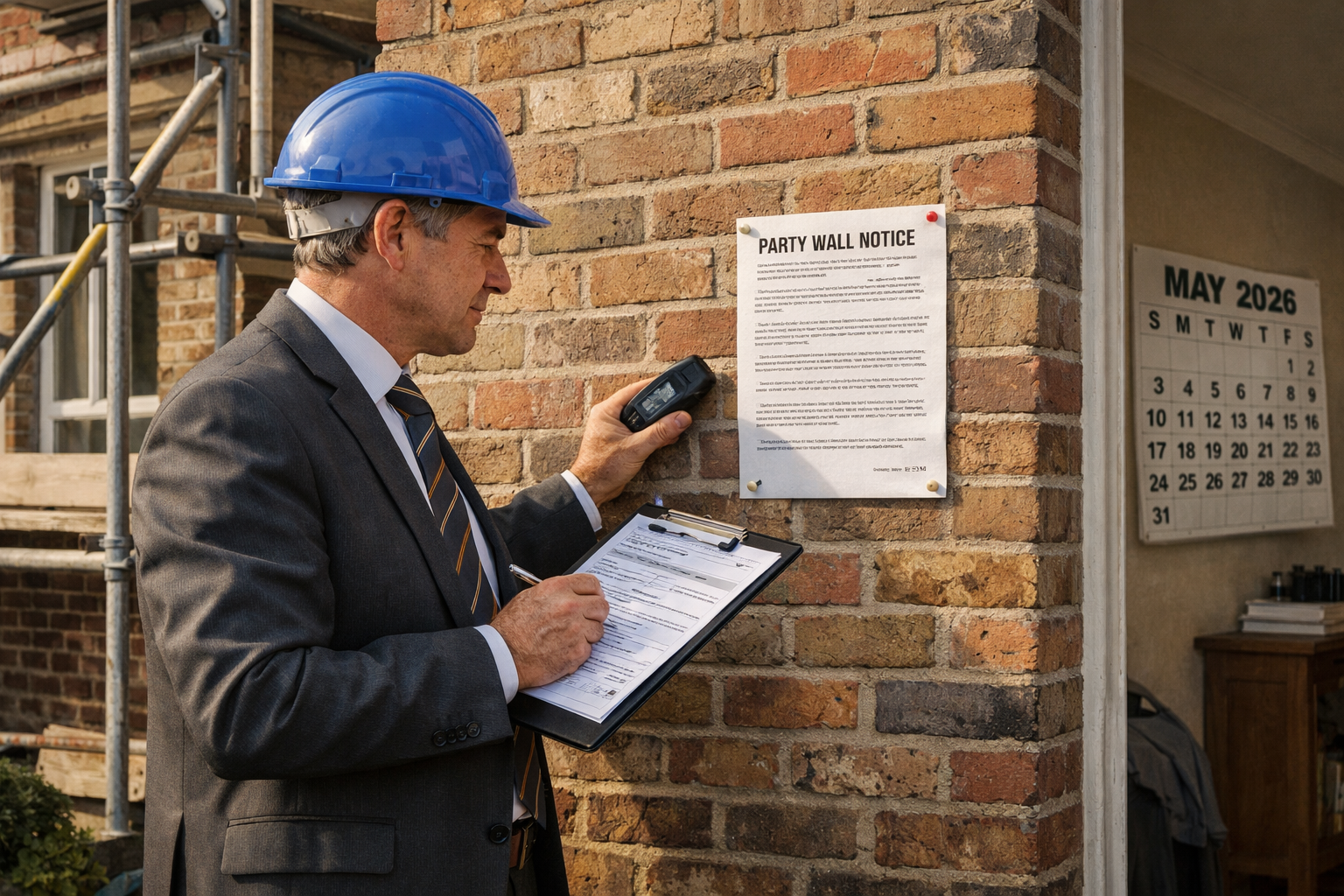
Over 11 million private renters in England now benefit from fundamentally stronger protections — and that shift is forcing landlords to rethink not just tenancy management, but the mechanics of carrying out building works on occupied rental properties. The Party Wall Implications of Renters' Rights Act May 2026: Survey Protocols for Landlord Improvement Works Post-Section 21 Abolition represent one of the most underappreciated compliance challenges facing the private rented sector (PRS) right now. From 1 May 2026, the abolition of Section 21 no-fault evictions means tenants can no longer be removed simply to facilitate renovation programmes — and that changes everything about how party wall procedures must be planned and executed [2].
Key Takeaways 📋
- Section 21 is abolished from 1 May 2026, meaning landlords cannot evict tenants to carry out improvement works without a valid Section 8 ground [2].
- Party Wall Act 1996 obligations remain unchanged — notices, awards, and schedules of condition are still legally required for qualifying works [5].
- Tenants on rolling Assured Periodic Tenancies now have stronger standing to challenge disruptive building works, making pre-work documentation more critical than ever.
- Survey protocols must now account for tenant notification as a distinct step alongside neighbour notification under the Party Wall Act.
- Database registration of tenancies (a new RRA 2026 requirement) creates a paper trail that intersects directly with party wall award records.
How the Renters' Rights Act 2026 Reshapes the Landlord's Position
The Renters' Rights Act (RRA) came into force on 1 May 2026, abolishing Assured Shorthold Tenancies (ASTs) and replacing them with rolling Assured Periodic Tenancies [2]. This is not a minor administrative change. Under the old regime, a landlord planning a major loft conversion or rear extension could serve a Section 21 notice, wait out the notice period, and begin works on a vacant property. That option is now gone.
Landlords who wish to regain possession must now rely on Section 8 grounds under an expanded list introduced by the RRA [2]. None of those grounds specifically cover "landlord wants to renovate." The closest available ground — that the landlord intends to redevelop — carries strict conditions and is not a straightforward route.
"The abolition of Section 21 means that occupied properties are now the default reality for landlords carrying out improvement works. Party wall procedures must be designed around that reality."
This creates a new operational landscape:
| Pre-May 2026 Position | Post-May 2026 Position |
|---|---|
| Serve Section 21, vacant possession, then renovate | Must work around occupied tenancy |
| Party wall notices served to neighbours only | Party wall process must consider tenant occupancy |
| Tenant disruption manageable via short tenancy | Tenant has indefinite rolling tenancy rights |
| No formal database registration | Tenancy registered on new PRS database [6] |
The PRS database, introduced under the RRA, requires landlords to register tenancies. This creates a formal, searchable record that intersects with party wall award documentation — particularly relevant when disputes arise about whether proper notice was given and to whom [6].
Understanding the Party Wall Act 1996 in an Occupied PRS Context
The Party Wall etc. Act 1996 governs works to shared walls, boundary walls, and excavations near neighbouring buildings in England and Wales [5]. It has not been amended by the RRA — its obligations remain exactly as they were. What has changed is the context in which those obligations must be met.
What Works Trigger Party Wall Notices?
Common landlord improvement works that trigger the Act include:
- 🏠 Loft conversions involving work to a shared party wall — see our guide on loft conversions and party wall obligations
- 🧱 Damp proof course insertion along a party wall — relevant guidance available on party wall insulation and damp works
- ⛏️ Foundation excavations within 3 metres of a neighbour's structure — covered by the Party Wall 3-metre rule
- 🔧 Chimney and stack works on shared structures — see party wall shared chimneys guidance
- 🏗️ Rear extensions requiring new foundations near boundaries
None of these works are exempt simply because the building owner is a landlord rather than an owner-occupier. The Act applies equally.
The Three Notice Types
- Party Structure Notice — for works directly to a party wall or party fence wall
- Line of Junction Notice — for building a new wall at or astride the boundary
- Three Metre Notice / Six Metre Notice — for excavations near neighbouring foundations [5]
Each notice must be served on adjoining owners — and here is where the RRA 2026 creates a critical new dimension.
Party Wall Implications of Renters' Rights Act May 2026: Survey Protocols for Landlord Improvement Works Post-Section 21 Abolition in Practice
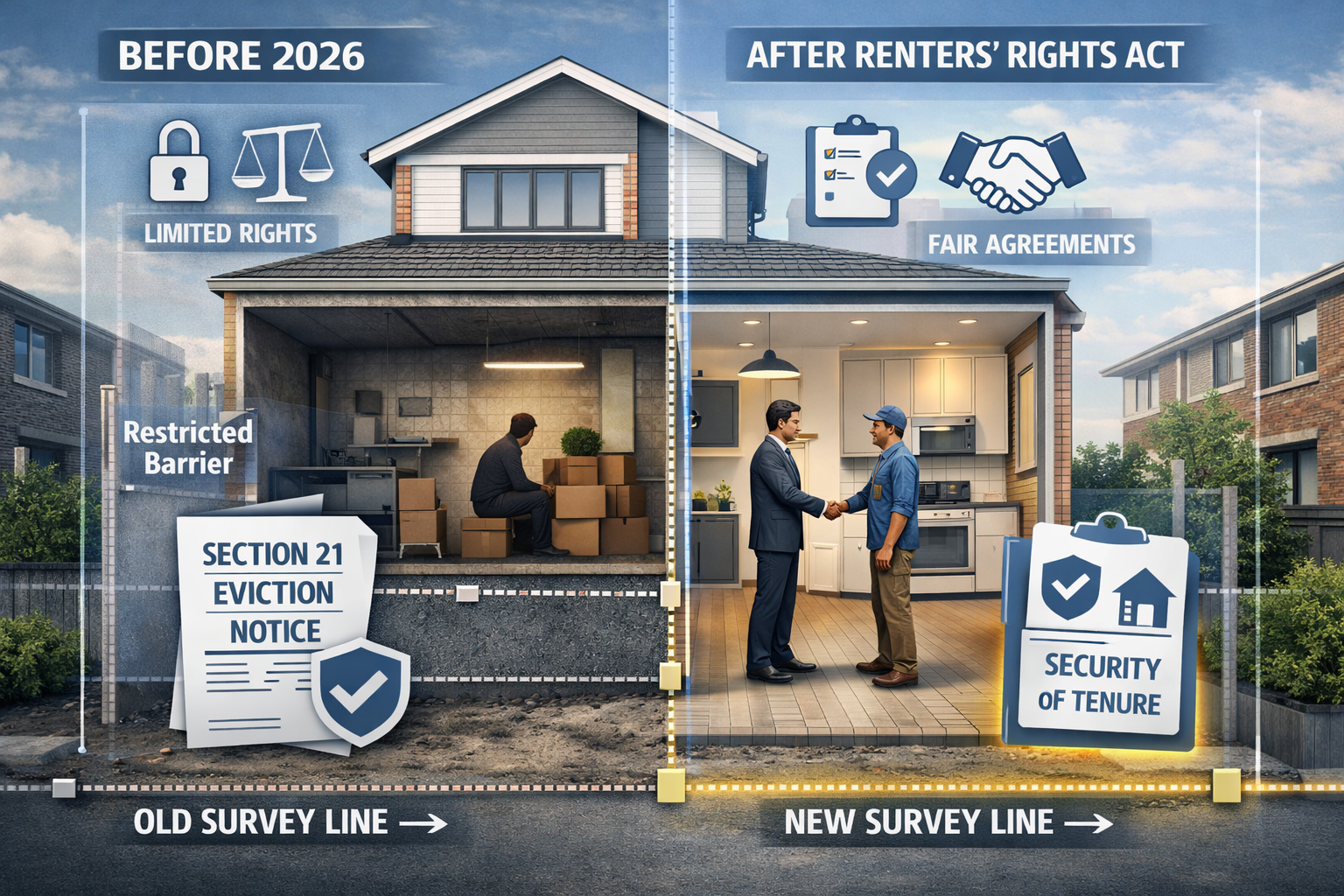
The practical intersection of the RRA and the Party Wall Act creates a layered compliance requirement. Here is how survey protocols must adapt.
Step 1: Identify All Parties — Including Tenants as Stakeholders
Under the Party Wall Act, notices are served on adjoining owners. However, the RRA has elevated the legal standing of tenants in ways that make ignoring their position during works legally and practically risky.
Tenants on rolling Assured Periodic Tenancies:
- Cannot be easily moved out to facilitate works [2]
- Have the right to quiet enjoyment of the property under common law
- Can raise complaints that feed into the new Private Rented Sector Ombudsman established by the RRA [6]
- Are registered on the PRS database, creating a formal record of their occupancy [6]
Best practice in 2026: Before serving any party wall notice, landlords should document the tenant's occupancy status, the nature of proposed works, and the likely disruption. This is not a legal requirement under the Party Wall Act — but it is sound risk management under the RRA framework.
Step 2: Serve Party Wall Notices Correctly and Early
Notices must be served at least one month before works begin (two months for party structure works in some cases). Given that tenants now have indefinite tenure, landlords cannot rely on a gap between tenancies to carry out works. Notices must therefore be planned around the occupied property.
A party wall surveyor should be engaged early to:
- Confirm which notices are required
- Draft and serve notices correctly
- Manage the response period and any dissent
If the adjoining property is also a rental, the adjoining owner (the landlord next door) remains the party to the notice — not their tenant. However, if the adjoining property is owner-occupied, the owner-occupier is the adjoining owner.
Step 3: Prepare a Schedule of Condition
A Schedule of Condition is a photographic and written record of the adjoining property's condition before works begin [5]. In the post-RRA environment, this document takes on additional importance.
Why? Because:
- Tenants in adjoining properties may raise damage claims that are harder to dismiss under the new ombudsman framework
- The PRS database record means occupancy and timing are verifiable
- Disputes are more likely to be formally escalated rather than resolved informally
A thorough schedule of condition should cover all areas of the adjoining property likely to be affected, with timestamped photography and a signed agreement from the adjoining owner.
Step 4: Obtain a Party Wall Award Where Required
If the adjoining owner dissents (or fails to respond within 14 days, which counts as dissent), a Party Wall Award must be obtained. This is a formal document setting out:
- The works to be carried out
- The method and timing of works
- Access rights
- Security for expenses
The Award is binding on both parties — and in 2026, it should also reference the tenant occupancy context, particularly regarding working hours and noise restrictions that protect tenants' quiet enjoyment rights.
Step 5: Register and Cross-Reference with the PRS Database
The RRA's PRS database requirement [6] means that landlords must register their tenancies. When party wall works are planned, the database record should be cross-referenced to ensure:
- The correct landlord is identified as the building owner for notice purposes
- Any management company or agent acting on the landlord's behalf is properly authorised
- The timeline of works does not conflict with any pending Section 8 proceedings
This cross-referencing step is new in 2026 and reflects the more bureaucratically complex environment landlords now operate in [3].
Party Wall Implications of Renters' Rights Act May 2026: Survey Protocols for Landlord Improvement Works Post-Section 21 Abolition — Common Pitfalls

❌ Pitfall 1: Assuming Works Can Proceed Without a Notice Because the Property Is Tenanted
The Party Wall Act applies regardless of occupancy. A landlord carrying out a loft conversion on a tenanted property still needs to serve notice on the adjoining owner. Failure to do so can result in an injunction stopping works mid-project — a costly outcome. For a full overview of what's involved, see our party wall guide.
❌ Pitfall 2: Confusing Tenant Notification with Party Wall Notice
Informing a tenant about upcoming works is a courtesy and a legal obligation under the tenancy agreement's quiet enjoyment clause — but it is not a substitute for serving a formal Party Wall Notice on the adjoining owner. These are two separate processes.
❌ Pitfall 3: Underestimating Dispute Risk Post-RRA
Before May 2026, a dissatisfied tenant could be removed relatively quickly. Now, a tenant who is disrupted by building works has a much stronger platform to raise formal complaints. Understanding what a party wall dispute involves — and how to avoid one — is essential reading for any landlord planning works in 2026.
❌ Pitfall 4: Ignoring the Cost Implications of Delays
Party wall disputes cause project delays. Delays on an occupied rental property mean disruption costs, potential rent reductions, and possible ombudsman complaints. The cost of party wall procedures is far lower than the cost of a disputed project on an occupied property. Investing in proper survey protocols upfront is the economical choice.
What Landlords Should Do Right Now in 2026
The combination of the RRA's tenant protections and the unchanged Party Wall Act obligations creates a compliance environment that rewards preparation. Here is a practical checklist:
Before Planning Works:
- Confirm tenancy status and register on PRS database [6]
- Identify all works that may trigger the Party Wall Act [5]
- Engage a chartered surveyor experienced in both party wall and PRS matters
- Review the tenancy agreement for quiet enjoyment and access provisions
During the Notice Period:
- Serve correct notices to all adjoining owners
- Inform tenant(s) of proposed works in writing
- Commission a schedule of condition for adjoining properties
- Obtain a Party Wall Award if any dissent is received
During Works:
- Adhere strictly to the Award's working hours and methods
- Maintain a works diary with daily photographic records
- Keep communication channels open with tenants and adjoining owners
After Works:
- Carry out a post-works condition survey
- Retain all documentation for a minimum of six years
- Update the PRS database record if tenancy terms have changed [6]
Conclusion: Preparation Is the Only Viable Strategy
The Party Wall Implications of Renters' Rights Act May 2026: Survey Protocols for Landlord Improvement Works Post-Section 21 Abolition are not theoretical — they are live compliance challenges affecting every landlord who plans to improve, extend, or significantly repair a tenanted property that shares a wall or boundary with a neighbour.
The abolition of Section 21 has removed the landlord's traditional escape route of vacant possession [2]. The PRS database has created a more transparent, auditable record of tenancies [6]. And the Party Wall Act continues to impose strict procedural obligations that cannot be bypassed regardless of occupancy status [5].
Actionable next steps:
- Audit your portfolio — identify all properties where improvement works are planned in the next 12 months and assess which trigger Party Wall Act obligations.
- Engage a qualified surveyor early — ideally before any design or planning work begins, so that party wall timelines are built into the project programme.
- Understand the new tenant protections — review the RRA's provisions and ensure your tenancy management practices are fully compliant before works begin [2][6].
- Document everything — in the post-RRA environment, a comprehensive paper trail is not optional. It is the difference between a smooth project and a costly dispute.
Landlords who treat party wall survey protocols as an afterthought in 2026 will find themselves exposed to delays, disputes, and financial losses that were entirely preventable. The law has changed. Survey practice must change with it.
References
[1] Selling A Rental Property In 2026 How The New Renters Rights Bill Affects You – https://www.gorvinsresidential.com/selling-a-rental-property-in-2026-how-the-new-renters-rights-bill-affects-you/
[2] Major Parts Renters Rights Act Set Take Effect – https://www.pinsentmasons.com/out-law/news/major-parts-renters-rights-act-set-take-effect
[3] Alerts Realestate Impacts Of The Renters Rights Act – https://www.goodwinlaw.com/en/insights/publications/2026/01/alerts-realestate-impacts-of-the-renters-rights-act
[5] Party Wall Agreement – https://hoa.org.uk/advice/guides-for-homeowners/i-am-improving/party-wall-agreement/
[6] Renters Rights Act Overview For Tenants – https://www.gov.uk/guidance/renters-rights-act-overview-for-tenants
[7] Existing Tenancies Renters Rights Act – https://www.nrla.org.uk/resources/renters-rights/existing-tenancies-renters-rights-act