Over 60% of property disputes now involve some form of algorithmically generated valuation data — yet until March 2026, no binding professional standard existed to govern how that data could be presented in court. That gap has now closed. The intersection of Expert Witness Roles Under New RICS AI Standards 2026: CPR Protocols for Tech-Enhanced Valuation Evidence represents one of the most significant shifts in surveying practice in a generation, reshaping how RICS-regulated professionals prepare, validate, and defend AI-assisted evidence under Civil Procedure Rules (CPR) Part 35.
This article unpacks what the new RICS Responsible Use of Artificial Intelligence standard means for surveyors acting as expert witnesses, how CPR Part 35 obligations interact with tech-enhanced valuation methods, and what practical steps professionals must take to remain compliant and credible in 2026 and beyond. [1]
Key Takeaways 📌
- The March 2026 RICS AI standard is now mandatory for all RICS members and regulated firms, directly affecting how AI-generated valuation evidence is prepared and presented in court.
- CPR Part 35 duties remain paramount — an expert witness's primary obligation is to the court, not the instructing party, regardless of the tools used to generate evidence.
- AI-assisted valuation data must be independently validated before inclusion in expert witness reports; reliance on unverified algorithmic outputs can undermine admissibility.
- Transparency and auditability are the two non-negotiable pillars of compliant tech-enhanced expert evidence under the new framework.
- Surveyors face new competency obligations — using AI tools without understanding their limitations is itself a professional conduct risk under updated RICS guidance.

Understanding the March 2026 RICS AI Standard and Its Courtroom Implications
What the New Standard Actually Requires
The RICS "Responsible Use of Artificial Intelligence in Surveying Practice" standard, effective 2026, establishes binding obligations for all RICS members and regulated firms. [4] It is not advisory guidance — it carries the same professional weight as the Red Book or the Surveyors Acting as Expert Witnesses professional standard.
At its core, the standard requires that:
- AI tools must be used transparently, with clear disclosure of which outputs are machine-generated versus professionally verified.
- Members must understand the limitations of any AI system they deploy — using a tool without comprehending its methodology is a competency failure.
- Outputs must be auditable, meaning the surveyor can explain and defend the data trail behind any AI-generated figure.
- Human professional judgement must remain the final layer — AI assists; it does not replace the qualified expert's opinion.
For surveyors preparing expert witness reports, this creates a layered compliance obligation that sits on top of existing CPR Part 35 duties.
Why This Matters More in Litigation Than in Standard Practice
In standard valuation practice, a minor methodological inconsistency might result in a revised report. In litigation, the same inconsistency can destroy the credibility of an entire case. Courts apply a higher standard of scrutiny to expert evidence, and opposing counsel will probe every assumption, data source, and algorithmic input.
💬 "The expert's duty to the court overrides any obligation to the person from whom the expert has received instructions or by whom the expert is paid." — CPR Part 35.3 [3]
This principle becomes especially sharp when AI tools are involved. If a valuation figure derives from an Automated Valuation Model (AVM) that the expert cannot fully explain, the court may discount or reject it entirely. The 2026 RICS AI standard effectively codifies what good practice already demanded: know your tools as well as you know your subject matter.
CPR Part 35 Protocols and AI-Assisted Valuation Evidence
The Core Tension Between Algorithmic Efficiency and Legal Admissibility
CPR Part 35 governs expert evidence in civil proceedings in England and Wales. It requires experts to:
- Provide an independent, objective opinion on matters within their expertise.
- State the facts and assumptions on which their opinion is based.
- Identify any range of opinion on the matter and give reasons for their own view.
- Summarise conclusions clearly and accessibly for a non-specialist judge.
AI-generated valuation data creates friction at every one of these points. Automated Valuation Models process thousands of comparable transactions using weighted algorithms — but those weightings are often proprietary. An expert who presents an AVM output without interrogating its methodology cannot honestly certify that they understand the basis of the figure they are presenting. [3]
A Practical Framework for CPR-Compliant AI Evidence
The following framework helps surveyors bridge the gap between AI efficiency and CPR compliance:
| Step | Action Required | CPR/RICS Obligation |
|---|---|---|
| 1. Tool Selection | Choose AI/AVM tools with transparent, auditable methodologies | RICS AI Standard 2026 [4] |
| 2. Data Validation | Cross-reference AI outputs against manual comparables | CPR 35 — basis of opinion |
| 3. Limitation Disclosure | Document known weaknesses in the AI model used | CPR 35 — range of opinion |
| 4. Expert Override | Apply professional judgement where AI output is anomalous | RICS AI Standard 2026 [4] |
| 5. Report Transparency | Clearly label which figures are AI-assisted vs. independently verified | CPR 35 — facts and assumptions |
| 6. Peer Review | Where possible, have methodology reviewed before submission | RICS Expert Witness Standard [1] |
This structured approach ensures that tech-enhanced valuation evidence meets both the letter and spirit of CPR Part 35 obligations.
The Conditional Fee Alert and AI Bias Risks
A February 2024 RICS alert flagged that surveyors acting as experts must be especially vigilant about conflicts of interest, including those arising from conditional fee arrangements. [3] This warning has new relevance in the AI context: if an expert habitually uses a particular AVM platform — perhaps one with commercial ties to their firm — that relationship must be disclosed. Algorithmic bias is a real risk, and courts are becoming more sophisticated in identifying it.
For RICS valuations that may later be challenged in court, the choice of AI tool is therefore not merely a technical decision — it is a professional integrity decision.
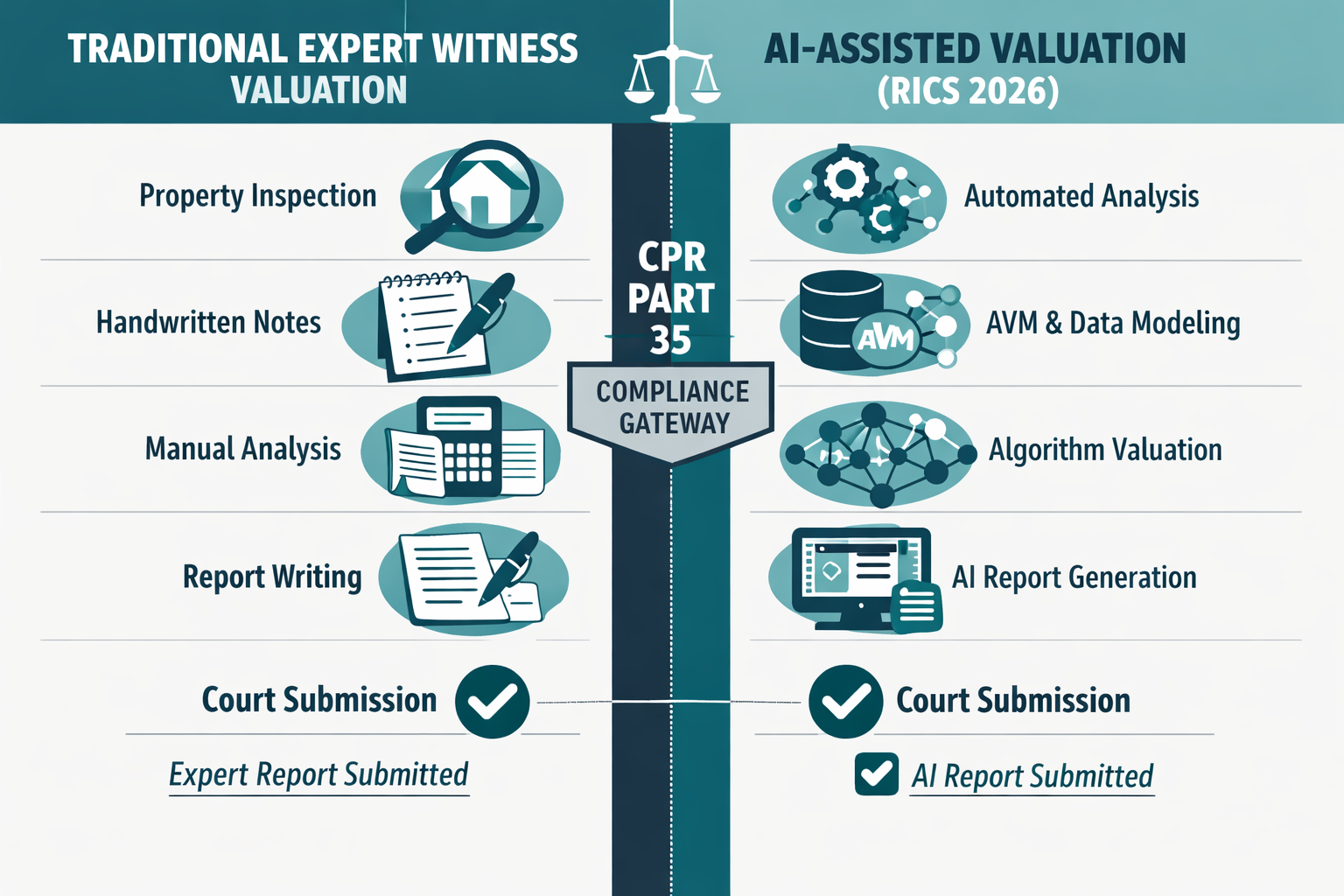
Expert Witness Roles Under New RICS AI Standards 2026: CPR Protocols for Tech-Enhanced Valuation Evidence in Practice
The Changing Competency Profile of the Expert Witness
The traditional expert witness in property disputes was valued primarily for their market knowledge, inspection experience, and professional judgement. Those qualities remain essential. But the 2026 RICS AI standard adds a new dimension: technological literacy.
Surveyors who cannot explain how an AVM derives its output, or who cannot identify when machine-learning comparables are statistically unreliable, are now professionally exposed. The RICS Expert Witness Accreditation Service provides a framework for demonstrating competency [2], and it is reasonable to expect that AI literacy will become an increasingly weighted criterion in accreditation assessments.
Key competency areas now expected of AI-using expert witnesses include:
- ✅ Understanding AVM methodology and confidence intervals
- ✅ Ability to identify training data biases in automated comparable selection
- ✅ Knowledge of when AI outputs should be overridden or supplemented
- ✅ Capacity to explain algorithmic processes in plain language to a court
- ✅ Awareness of data protection obligations when using AI tools on client property data
Preparing AI-Assisted Expert Reports: Step-by-Step
When preparing an expert witness report that incorporates AI-assisted valuation data, the following structure is recommended:
1. Methodology Section (Mandatory)
Describe every tool used, including AI platforms, AVMs, or machine-learning comparables databases. State the version, the date of data extraction, and any known limitations.
2. Data Sources Appendix
Attach or reference all raw data inputs. If an AVM was used, include the confidence score and the comparable set it drew upon. Courts increasingly expect this level of transparency.
3. Professional Judgement Narrative
Explain explicitly where the expert's own analysis diverges from or confirms the AI output. This is the critical section — it demonstrates that the expert is not simply a conduit for algorithmic outputs.
4. Limitations Statement
Under CPR Part 35, experts must acknowledge the limits of their expertise and the limits of their evidence. For AI-assisted reports, this includes acknowledging any uncertainty bands in the algorithmic output.
5. Statement of Truth
The CPR-required statement of truth applies to the entire report, including its AI-assisted components. Signing this statement while relying on unvalidated AI data is a serious professional and legal risk.
Specific Valuation Contexts Where AI Evidence Is Most Contested
Certain valuation types attract particularly intense scrutiny when AI tools are involved:
- Matrimonial valuations — where parties have strong incentives to challenge opposing expert figures, AI-generated comparables are frequently attacked on methodology grounds.
- Probate valuations — HMRC's own valuation methodology may differ from AVM outputs, creating direct evidential conflict.
- Right to Buy valuations — statutory valuation frameworks may not align with AVM assumptions, requiring careful manual adjustment.
- Commercial property valuations — AI tools trained predominantly on residential data can produce unreliable outputs for commercial assets.
- Shared ownership valuations — the complexity of staircasing calculations means AI outputs require particular scrutiny.
In each of these contexts, the expert witness must be prepared to defend not just their conclusion but their entire methodological chain — including every AI-assisted step within it.
Integrity, Impartiality, and the New Technology Landscape
Independence Cannot Be Outsourced to an Algorithm
One of the most important principles reinforced by the updated RICS expert witness standard is that independence is a personal professional obligation — it cannot be delegated to a tool. [1] When an expert presents AI-generated valuation data, they are endorsing that data as their own professional opinion. If the algorithm is biased, the expert is responsible for failing to detect and correct that bias.
This creates a clear professional duty: validate before you rely. Every AI-generated figure in an expert report should be tested against the expert's own market knowledge and, where possible, against manually selected comparables.
The Role of RICS Accreditation in Building Court Credibility
The RICS Expert Witness Accreditation Service provides formal recognition of surveyors who meet the required standards of competency, independence, and procedural knowledge. [2] In 2026, accreditation increasingly signals not just traditional expertise but also the capacity to handle modern technology-enhanced evidence responsibly.
Courts and legal teams are beginning to treat RICS accreditation as a baseline expectation rather than a differentiator. Surveyors who combine accreditation with demonstrable AI literacy are positioned as the most credible expert witnesses in property disputes.
Practical Compliance Checklist for 2026 🗂️
Before submitting any AI-assisted expert witness report, surveyors should confirm:
- All AI tools used are disclosed by name and version
- Methodology is explained in non-technical language accessible to a judge
- AI outputs have been cross-validated against manual comparables
- Confidence intervals and known limitations are stated
- No undisclosed commercial relationships exist with AI tool providers
- Professional judgement has been applied and documented at every decision point
- The report complies with both CPR Part 35 and the 2026 RICS AI Standard
- A statement of truth has been signed with full understanding of its scope
For surveyors seeking a comprehensive understanding of what RICS-certified experts assess during property inspections, the RICS certified experts property inspection guide provides useful context on the physical evidence layer that should underpin any valuation, AI-assisted or otherwise.
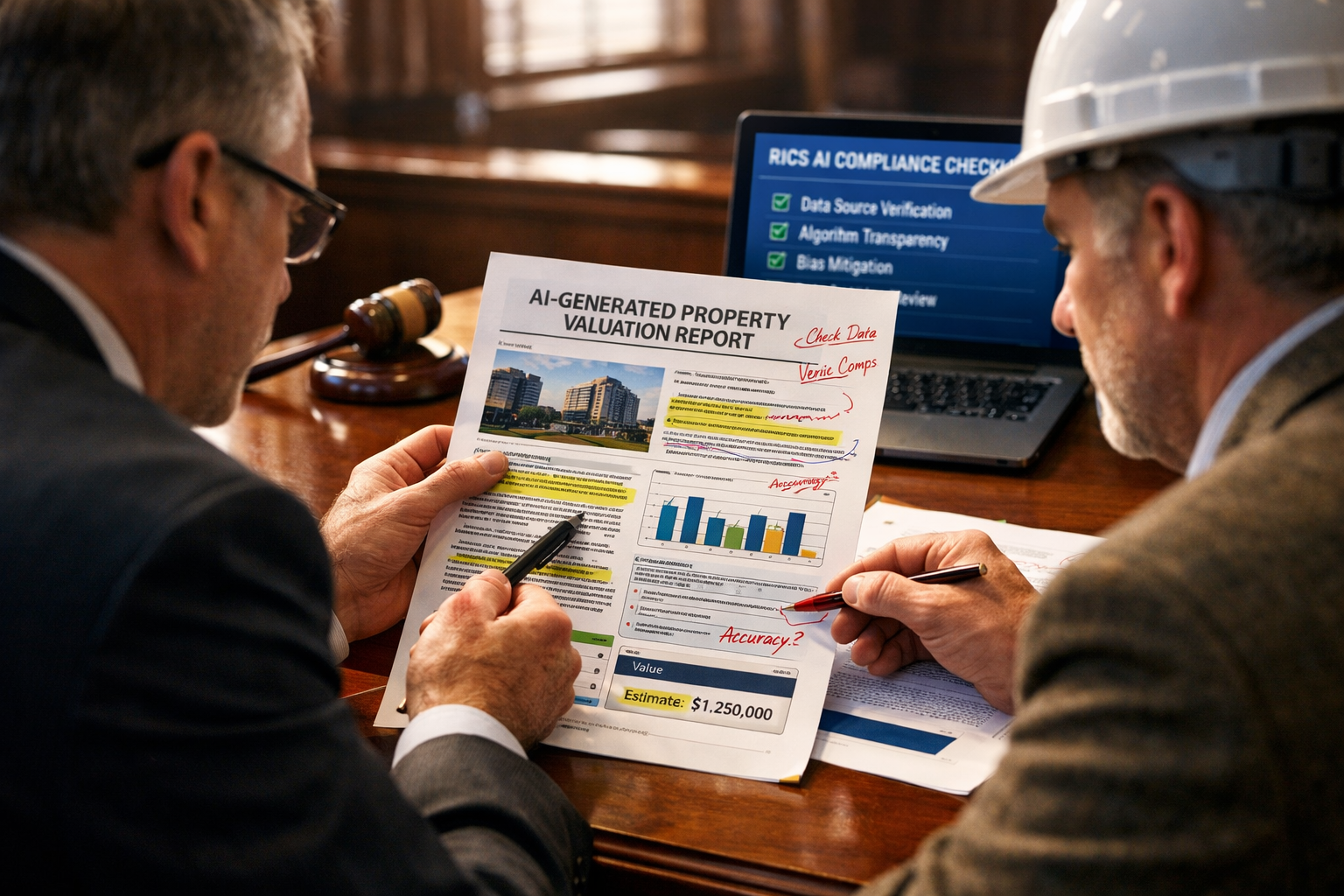
Conclusion: Actionable Next Steps for Surveyors in 2026
The convergence of Expert Witness Roles Under New RICS AI Standards 2026: CPR Protocols for Tech-Enhanced Valuation Evidence is not a future challenge — it is the present reality of professional practice. The March 2026 RICS AI standard has drawn a clear line: surveyors who use AI tools in litigation-facing work must understand, validate, and transparently disclose every algorithmic input in their reports.
The courts have not changed their expectations of expert witnesses. What has changed is the complexity of the tools experts now use — and the professional obligation to master them.
Actionable next steps for surveyors:
- Audit your current AI tools — identify which platforms you use, understand their methodology, and document their limitations before the next instruction arrives.
- Update your report templates — build in mandatory methodology, data sources, and limitations sections that meet both CPR Part 35 and the 2026 RICS AI standard.
- Pursue or renew RICS accreditation — the Expert Witness Accreditation Service [2] provides the formal framework to demonstrate your competency to courts and instructing solicitors.
- Invest in AI literacy training — technical understanding of AVM methodology is now a professional competency requirement, not optional continuing professional development.
- Seek peer review — before submitting complex AI-assisted reports, have the methodology reviewed by a colleague with relevant expertise.
- Stay current with RICS guidance updates — the 2026 AI standard is likely to evolve as technology advances; monitoring RICS publications is a professional obligation. [1]
The surveyors who thrive in this new landscape will be those who treat AI as a powerful tool to be mastered and disclosed — not a black box to be relied upon without question.
References
[1] Surveyors Acting As Expert Witnesses – https://www.rics.org/profession-standards/rics-standards-and-guidance/sector-standards/dispute-resolution-standards/surveyors-acting-as-expert-witnesses
[2] Expert Witness Accreditation Service – https://www.rics.org/dispute-resolution-service/panel-of-experts/expert-witness-accreditation-service
[3] Expert Witness Duties Responsibilities – https://ww3.rics.org/uk/en/journals/built-environment-journal/expert-witness-duties-responsibilities.html
[4] Rics Ai Standards In Building Surveys 2026 Practical Protocols For Level 3 Assessments And Risk Detection – https://nottinghillsurveyors.com/blog/rics-ai-standards-in-building-surveys-2026-practical-protocols-for-level-3-assessments-and-risk-detection