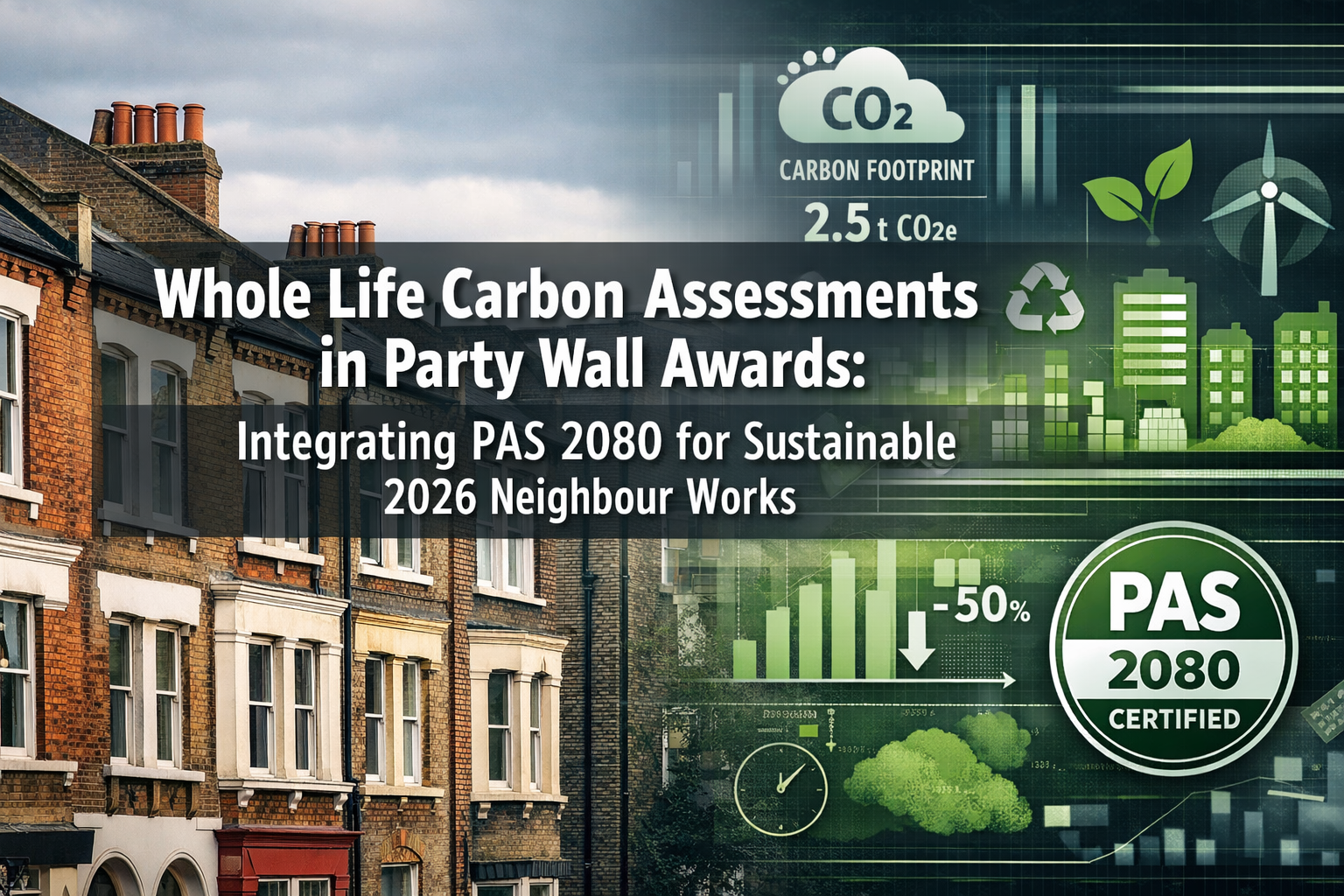
The construction sector accounts for nearly 40% of global carbon emissions, yet most party wall surveyors still approve neighbour works without considering their environmental footprint. As the UK government released comprehensive whole life carbon (WLC) management guidance in March 2026, aligning with PAS 2080:2023 standards, a critical question emerges: how can professionals embed carbon assessments into the traditionally procedural world of party wall awards?
Whole Life Carbon Assessments in Party Wall Awards: Integrating PAS 2080 for Sustainable 2026 Neighbour Works represents a paradigm shift in how surveyors approach residential construction disputes and neighbour notifications. This integration addresses the urgent need to reduce carbon emissions across all building activities, including the thousands of loft conversions, extensions, and structural alterations that require party wall agreements each year.
Key Takeaways
- PAS 2080:2023 provides a structured framework for managing carbon emissions throughout the entire lifecycle of building projects, now applicable to residential neighbour works
- The 2026 UK Government guidance mandates consideration of whole life carbon from concept through decommissioning for infrastructure projects, setting precedent for residential applications
- Party wall surveyors can embed carbon clauses into awards using practical checklists that specify low-carbon materials and construction methods
- Whole life carbon assessments measure both embodied and operational emissions, creating comprehensive environmental profiles for neighbour works
- Net zero 2050 targets require action now, with party wall procedures offering an overlooked opportunity to reduce construction sector emissions
Understanding Whole Life Carbon in the Context of Party Wall Works
Whole life carbon (WLC) encompasses all greenhouse gas emissions associated with a building throughout its entire existence—from raw material extraction and manufacturing (embodied carbon) through construction, operation, maintenance, and eventual demolition or deconstruction.[5] Unlike operational carbon, which focuses solely on energy use during occupancy, WLC provides a complete environmental picture.
For party wall works, this distinction matters significantly. A typical loft conversion might involve:
- Embodied carbon from steel beams, concrete, bricks, insulation materials, and timber
- Construction phase emissions from machinery, transport, and waste
- Operational carbon from heating, cooling, and lighting the new space
- End-of-life carbon from future demolition or adaptation
The PAS 2080:2023 standard, developed by the British Standards Institution (BSI) and the Institution of Civil Engineers (ICE), offers a globally applicable framework for managing these emissions systematically.[1] Updated from its 2016 predecessor, the 2023 version emphasizes nature-based solutions and whole-systems decarbonization—concepts that translate effectively to residential construction.
Why Party Wall Surveyors Should Care About Carbon
Traditional party wall award guidance focuses on protecting adjoining owners' interests through structural integrity, noise mitigation, and damage prevention. However, the environmental impact of approved works has remained largely unaddressed.
Three compelling reasons demand change:
-
Regulatory trajectory: The UK government's March 2026 guidance integrates WLC principles into the HM Treasury Project Business Case process, signaling future regulatory requirements.[2]
-
Professional duty: RICS members face increasing expectations to consider sustainability in all professional activities, including party wall appointments.
-
Client demand: Property owners increasingly seek environmentally responsible construction approaches, creating competitive advantage for surveyors who can demonstrate carbon-conscious practice.
PAS 2080:2023 Framework for Neighbour Works
The PAS 2080 standard operates on six core principles that surveyors can adapt to party wall scenarios:[3]
The Six Principles Applied to Party Wall Projects
| PAS 2080 Principle | Application to Party Wall Works |
|---|---|
| 1. Manage WLC from the outset | Include carbon considerations in initial party wall notices and pre-commencement discussions |
| 2. Evaluate options systematically | Compare carbon impacts of alternative construction methods during award negotiations |
| 3. Design for optimum WLC outcomes | Specify low-carbon materials and techniques in award schedules |
| 4. Collaborate across disciplines | Engage structural engineers, architects, and sustainability consultants early |
| 5. Measure and report WLC | Document carbon assessments in schedules of condition and final awards |
| 6. Validate and learn | Review actual carbon performance post-construction for continuous improvement |
Implementing PAS 2080 in Practice
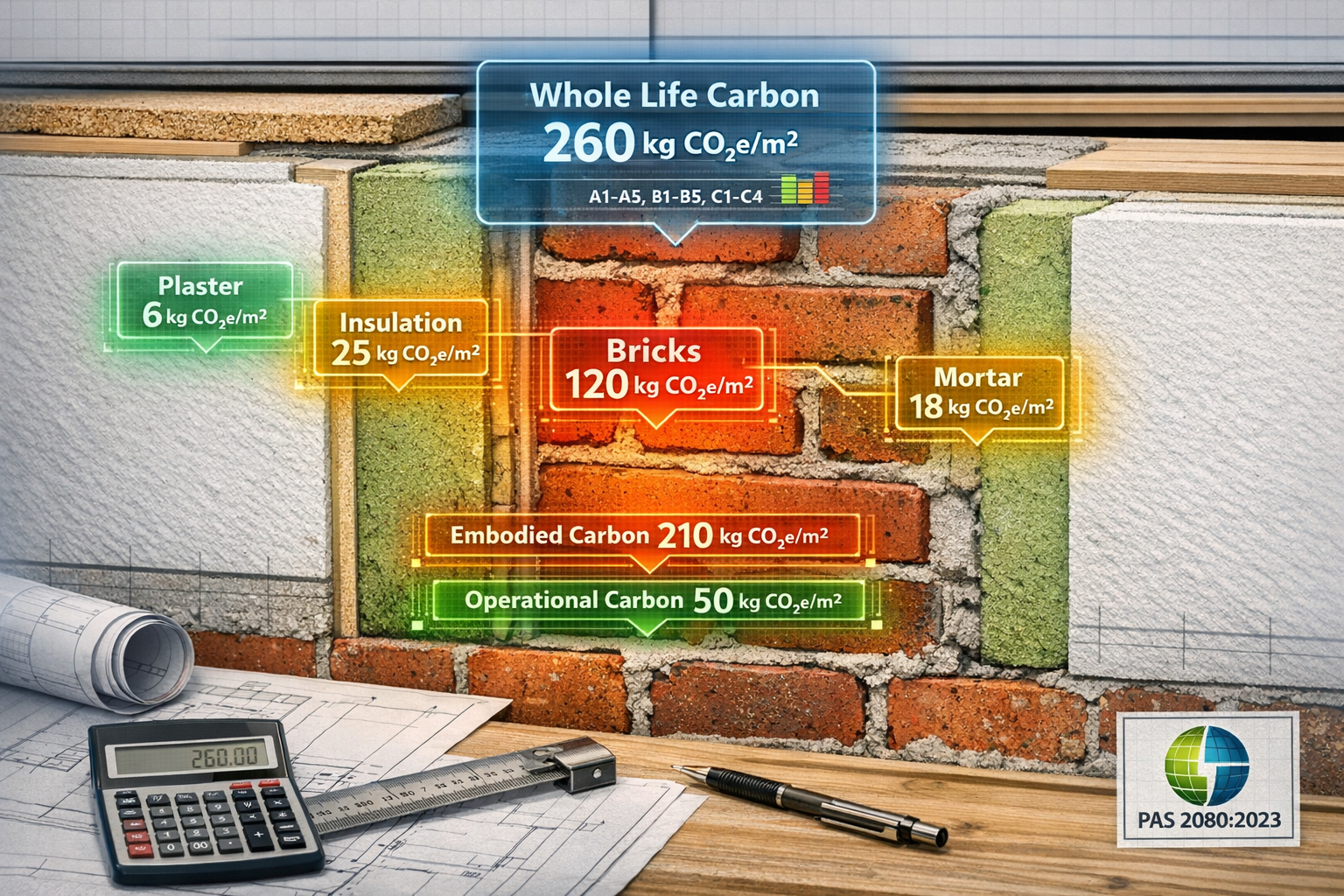
The 2026 UK Government guidance emphasizes carbon considerations from early concept through design, construction, operation, and end-of-life phases.[2] For party wall surveyors, this translates into specific procedural modifications:
At Notice Stage:
- Request basic carbon information alongside structural drawings
- Identify opportunities for material substitution (e.g., timber instead of steel where structurally viable)
- Discuss low-carbon alternatives with building owners
During Award Preparation:
- Include carbon reduction clauses in the award document
- Specify preferred materials with lower embodied carbon
- Set targets for construction waste reduction
- Require carbon reporting at project completion
Post-Construction:
- Verify material choices matched award specifications
- Document actual carbon performance for future reference
- Update professional knowledge based on outcomes
Practical Checklists for Low-Carbon Party Wall Awards
Integrating whole life carbon assessments into party wall procedures requires practical tools that surveyors can implement immediately. The following checklists address common neighbour works scenarios.
✅ Low-Carbon Material Selection Checklist
When reviewing proposed works for loft conversions or extensions:
Structural Elements:
- Prioritize engineered timber over steel beams where load requirements permit
- Specify recycled steel content (minimum 90%) if steel is necessary
- Consider glulam (glued laminated timber) for longer spans
- Evaluate reclaimed structural elements from salvage yards
- Request Environmental Product Declarations (EPDs) for major materials
Masonry and Blockwork:
- Specify low-carbon concrete blocks (incorporating recycled aggregates or GGBS cement replacement)
- Consider lime mortar instead of cement mortar for lower embodied carbon
- Evaluate hempcrete or other bio-based alternatives for non-structural walls
- Source bricks locally to reduce transport emissions
- Prioritize reclaimed bricks where aesthetically acceptable
Insulation Materials:
- Compare embodied carbon of insulation options (wood fiber, sheep's wool, recycled plastic vs. mineral wool or foam)
- Balance embodied carbon against thermal performance benefits
- Avoid high-GWP (Global Warming Potential) blowing agents in foam insulation
- Specify minimum recycled content percentages
- Consider bio-based insulation materials
Finishes and Fixtures:
- Specify low-VOC paints and finishes
- Prioritize FSC-certified timber for joinery
- Consider reclaimed or recycled flooring materials
- Evaluate product lifecycle and durability
- Request manufacturer carbon data where available
✅ Award Documentation Checklist
Essential clauses for embedding carbon considerations into party wall awards:
Preamble Section:
- State commitment to minimizing whole life carbon impact
- Reference PAS 2080:2023 principles
- Acknowledge UK net zero 2050 targets
Specification Clauses:
- "All structural steel shall contain minimum 90% recycled content with supporting certification"
- "Concrete mixes shall incorporate minimum 30% GGBS or PFA cement replacement where structurally appropriate"
- "Timber products shall be FSC-certified or equivalent with documented chain of custody"
- "Insulation materials shall be selected considering both thermal performance and embodied carbon, with preference for bio-based alternatives"
Construction Management Clauses:
- "The Building Owner shall implement a Site Waste Management Plan targeting 90% diversion from landfill"
- "Construction vehicles and machinery shall meet current emission standards"
- "Material deliveries shall be consolidated to minimize transport movements"
- "Demolition materials shall be assessed for reuse or recycling before disposal"
Reporting Requirements:
- "The Building Owner shall provide carbon assessment documentation within 30 days of completion"
- "Material substitutions during construction require surveyor approval with carbon impact justification"
- "Final report shall include actual material quantities and carbon calculations"
✅ Carbon Calculation Simplified Checklist
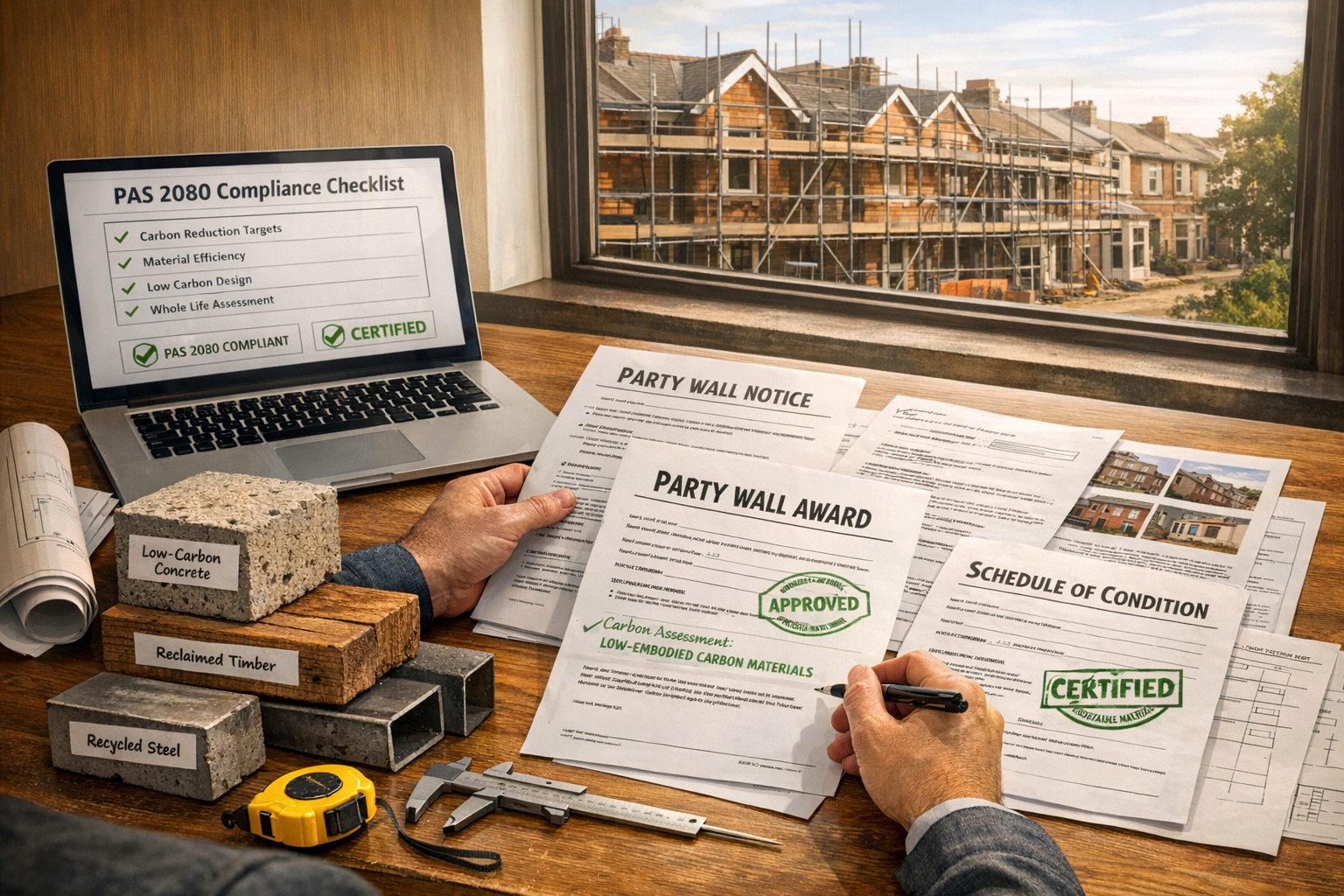
For surveyors without specialized carbon assessment software, this simplified approach provides reasonable estimates:
Step 1: Quantify Materials
- Measure quantities of major materials (concrete, steel, timber, bricks, insulation)
- Record material specifications and sources
- Document any reclaimed or recycled content
Step 2: Apply Carbon Factors
- Use ICE Database carbon factors (freely available online)
- Apply factors to material quantities (e.g., kg CO₂e per kg of material)
- Calculate total embodied carbon for each material category
Step 3: Assess Transport
- Estimate transport distances for major materials
- Apply transport emission factors (typically 0.1 kg CO₂e per tonne-km)
- Add to embodied carbon totals
Step 4: Estimate Construction Phase
- Estimate construction duration and machinery use
- Apply standard factors for construction activities (typically 5-10% of embodied carbon)
- Include waste disposal emissions
Step 5: Compare Alternatives
- Calculate carbon for baseline specification
- Recalculate for low-carbon alternatives
- Document percentage reduction achieved
Integrating WLC with Existing Party Wall Procedures
The beauty of whole life carbon assessments lies in their compatibility with established party wall processes. Surveyors need not abandon proven procedures; rather, they enhance them with environmental considerations.
Alignment with The Party Wall etc. Act 1996
The Act requires building owners to serve notice and obtain consent (or resolve disputes through awards) for specific works. Nothing in carbon assessment protocols conflicts with these statutory requirements. Instead, WLC integration occurs within the existing framework:
Section 1 (New Building on Line of Junction):
When new walls are constructed on boundary lines, material selection directly impacts carbon footprint. Awards can specify low-carbon materials without affecting legal rights or structural adequacy.
Section 2 (Works to Existing Party Walls):
Alterations, underpinning, or strengthening works offer opportunities for carbon-conscious material choices. For instance, when underpinning requires concrete, specifying low-carbon concrete blends reduces environmental impact without compromising structural performance.
Section 6 (Excavations Near Party Walls):
Excavation notices and associated foundation works represent significant carbon sources. Awards can address this through material specifications and construction method requirements.
Avoiding Common Pitfalls
When implementing whole life carbon assessments in party wall awards, surveyors should avoid these mistakes:
❌ Overcomplicating the process: Start with simple material substitutions rather than attempting comprehensive lifecycle assessments immediately
❌ Ignoring structural requirements: Carbon reduction must never compromise safety or structural integrity
❌ Creating unenforceable clauses: Ensure carbon-related award provisions are specific, measurable, and practically enforceable
❌ Neglecting cost implications: Acknowledge that some low-carbon alternatives may increase initial costs (though often with lifecycle savings)
❌ Failing to consult specialists: Complex projects benefit from early engagement with sustainability consultants or carbon assessment professionals
When to Involve Specialist Carbon Assessors
Most routine party wall works—single-story extensions, loft conversions, minor alterations—can incorporate basic carbon considerations through material selection checklists without specialist input. However, certain scenarios warrant professional carbon assessment:
- Major structural works involving significant quantities of concrete or steel
- Projects where building owners specifically request carbon neutrality or certification
- Complex multi-phase developments affecting multiple properties
- Works where carbon assessment might inform dispute resolution
- Projects seeking BREEAM, Passivhaus, or similar environmental certifications
The Business Case for Carbon-Conscious Party Wall Practice
Beyond environmental ethics, integrating whole life carbon assessments offers tangible professional benefits:
Competitive Differentiation
As sustainability awareness grows, property owners increasingly value professionals who demonstrate environmental competence. Surveyors who can articulate carbon implications and offer low-carbon alternatives distinguish themselves in competitive markets.
Risk Mitigation
Future regulatory requirements seem inevitable given the UK's net zero 2050 commitment. Developing carbon assessment capabilities now positions practices ahead of regulatory curves, avoiding rushed adaptation later.
Enhanced Professional Reputation
RICS and other professional bodies increasingly emphasize sustainability in continuing professional development (CPD) requirements. Demonstrating carbon-conscious practice enhances professional standing and may become expected rather than exceptional.
Client Value Addition
Providing carbon assessments adds measurable value to party wall services. Clients gain documentation supporting their own sustainability goals, potentially valuable for property marketing, planning applications, or corporate reporting.
Cost Savings Identification
Whole life carbon assessments often reveal cost-saving opportunities. For example, specifying reclaimed materials may reduce both carbon and costs, while improving insulation reduces operational carbon and energy bills.
Overcoming Implementation Barriers
Despite clear benefits, several barriers impede widespread adoption of whole life carbon assessments in party wall practice:
Knowledge Gaps
Many surveyors lack training in carbon assessment methodologies. Solutions include:
- Targeted CPD courses on PAS 2080 and WLC assessment
- Collaboration with sustainability consultants on initial projects to build capability
- Use of simplified tools and checklists (like those provided in this article) for basic assessments
- Participation in industry working groups developing party wall sustainability guidance
Time Constraints
Carbon assessments require additional time during already tight project schedules. Mitigation strategies:
- Integrate carbon considerations into existing workflows rather than treating them as separate tasks
- Use digital tools that automate carbon calculations from material quantities
- Focus on high-impact decisions (structural materials, insulation) rather than attempting comprehensive assessments
- Build carbon assessment time into fee structures from project outset
Resistance from Building Owners
Some building owners may resist carbon requirements, perceiving them as unnecessary complications or cost increases. Effective responses:
- Frame carbon reduction as value addition rather than restriction
- Highlight potential cost savings from material efficiency and waste reduction
- Explain regulatory trajectory and future-proofing benefits
- Provide clear, simple options rather than complex technical requirements
- Emphasize alignment with property value trends and buyer preferences
Uncertainty About Legal Standing
Surveyors may question whether carbon-related clauses in awards are legally enforceable. Key considerations:
- Awards can specify materials and methods within reasonable bounds without exceeding statutory authority
- Carbon clauses should be framed as specifications rather than absolute requirements
- Include flexibility provisions allowing substitutions with surveyor approval
- Consult legal advisors on specific clause wording for complex projects
- Document carbon considerations in award reasoning to demonstrate reasonableness
Case Study: Low-Carbon Loft Conversion Award
To illustrate practical application, consider a typical loft conversion requiring party wall procedures:
Project: Two-story Victorian terrace, loft conversion with hip-to-gable extension, new steel beam supporting party wall
Traditional Approach:
- Specify 254×146 UC37 steel beam
- Standard concrete padstones
- Conventional mineral wool insulation
- No carbon considerations in award
Carbon-Conscious Approach:
- Evaluate glulam beam alternative (40% embodied carbon reduction)
- If steel required, specify 95% recycled content
- Specify low-carbon concrete for padstones (30% GGBS replacement)
- Compare insulation options: wood fiber vs. mineral wool
- Include waste management requirements
- Document carbon reduction in award
Outcome:
- 35% reduction in embodied carbon for structural elements
- Minimal cost increase (2-3%)
- Enhanced award documentation
- Client satisfaction with environmental consideration
- Professional development for surveyor
This example demonstrates that meaningful carbon reductions are achievable within standard party wall procedures without extraordinary effort or expense.
Future Directions: Party Wall Practice in a Net Zero World
As the UK progresses toward its 2050 net zero target, party wall practice will inevitably evolve. Several trends seem likely:
Regulatory Integration
Future revisions to Building Regulations may incorporate whole life carbon limits, making carbon assessment mandatory rather than voluntary for all construction works, including those requiring party wall agreements.
Digital Tools Evolution
Software platforms are emerging that integrate carbon calculations with building information modeling (BIM) and project management tools, making carbon assessment increasingly automated and accessible.[7][8]
Professional Standards Development
RICS and other professional bodies are likely to develop specific guidance on carbon considerations in party wall practice, potentially making carbon assessment a standard competency requirement.
Client Expectations Shift
As environmental awareness grows, clients will increasingly expect surveyors to address carbon impacts proactively, making carbon-conscious practice a competitive necessity rather than a differentiator.
Material Innovation
Ongoing development of low-carbon construction materials will expand options available to surveyors, making carbon reduction easier and more cost-effective over time.
Resources for Continued Learning
Surveyors seeking to develop carbon assessment capabilities can access numerous resources:
- PAS 2080:2023 Standard: Available from BSI, provides comprehensive framework for carbon management in infrastructure (applicable to building projects)
- RICS Whole Life Carbon Assessment Guidance: Professional practice guidance specific to built environment professionals[6]
- ICE Carbon Database: Free online resource providing embodied carbon factors for common construction materials
- UK Government WLC Management Guidance: Published March 2026, offers best practice frameworks aligned with PAS 2080[2]
- Carbon Trust PAS 2080 Resources: Training, tools, and certification programs for carbon management[3]
Additionally, engaging with sustainability-focused professional networks and attending relevant CPD events builds knowledge and connects surveyors with specialists for collaboration.
Conclusion
Whole Life Carbon Assessments in Party Wall Awards: Integrating PAS 2080 for Sustainable 2026 Neighbour Works represents both an environmental imperative and a professional opportunity. The construction sector's substantial carbon footprint demands action across all project scales, including the thousands of residential neighbour works governed by party wall procedures each year.
The PAS 2080:2023 framework, reinforced by the UK Government's March 2026 whole life carbon guidance, provides surveyors with structured methodologies for embedding carbon considerations into established party wall processes. Through practical checklists, material selection protocols, and enhanced award documentation, surveyors can meaningfully reduce the environmental impact of neighbour works without abandoning proven procedures or compromising structural adequacy.
The barriers to implementation—knowledge gaps, time constraints, client resistance—are surmountable through targeted professional development, workflow integration, and clear communication of value. Early adopters position themselves advantageously as regulatory requirements inevitably tighten and client expectations evolve.
Actionable Next Steps
For surveyors ready to integrate whole life carbon assessments into party wall practice:
- Complete PAS 2080 awareness training through RICS, Carbon Trust, or equivalent providers
- Adopt the material selection checklist from this article for your next party wall project
- Collaborate with a sustainability consultant on one project to build practical experience
- Develop standard carbon clauses for inclusion in award templates
- Track carbon considerations in project documentation to demonstrate professional development
- Engage with industry discussions on sustainability in party wall practice
- Consider specialist carbon assessment for complex projects requiring detailed analysis
The transition to carbon-conscious party wall practice need not be overwhelming. Starting with simple material substitutions and gradually expanding carbon assessment capabilities allows surveyors to develop competence progressively while delivering immediate environmental benefits.
As the built environment sector confronts climate challenges, every construction decision matters—including those made in party wall awards. By integrating whole life carbon assessments into neighbour works, surveyors contribute meaningfully to the UK's net zero ambitions while enhancing professional practice and client value.
The question is no longer whether to consider carbon in party wall procedures, but how quickly professionals can develop the capabilities to do so effectively. The frameworks exist, the guidance is available, and the imperative is clear. The time for action is now.
For assistance with party wall matters that incorporate sustainability considerations, or to discuss how carbon assessments can enhance your project, get a quote from experienced professionals who understand both traditional party wall procedures and emerging environmental requirements.
References
[1] Pas 2080 Standard Implementation – https://www.tunley-environmental.com/en/insights/pas-2080-standard-implementation
[2] Uk Government Whole Life Carbon Management Guidance – https://circularecology.com/news/uk-government-whole-life-carbon-management-guidance
[3] Pas 2080 Carbon Management In Infrastructure – https://www.carbontrust.com/what-we-do/assurance-and-labelling/pas-2080-carbon-management-in-infrastructure
[4] Specification For Managing Building And Infrastructure Whole Of Life Carbon Pas 2080 – https://groundlevelalliance.org/resource/specification-for-managing-building-and-infrastructure-whole-of-life-carbon-pas-2080/
[5] Whole Life Carbon Assessment Wlca – https://blue-marble.co.uk/sustainability-guides/whole-life-carbon-assessment-wlca/
[6] Whole Life Carbon Assessment – https://www.rics.org/profession-standards/rics-standards-and-guidance/sector-standards/construction-standards/whole-life-carbon-assessment
[7] Advanced Data Platforms Integrate Whole Life Carbon Building Information Tools Assessments And – https://www.horizon-europe.gouv.fr/advanced-data-platforms-integrate-whole-life-carbon-building-information-tools-assessments-and
[8] Capture Pas 2080 Data Through Everyday Workflows Use Operations – https://wholelifecarbon.com/article/capture-pas-2080-data-through-everyday-workflows-use-operations