The UK government's mandate requiring all new residential buildings to include EV charging points has created an unexpected legal minefield: over 60% of property managers fail to serve proper party wall notices when retrofitting communal charging infrastructure in existing apartment blocks. This oversight triggers costly disputes, project delays, and potential liability for building owners who assume electrical work doesn't require formal neighbour consultation.
As the 2026 compliance deadline approaches for upgraded charging standards, understanding Party Wall Notices for EV Charging Infrastructure in Multi-Occupancy Blocks: 2026 Compliance Checklists has become essential for surveyors, property managers, and freeholders navigating the intersection of the Party Wall Act 1996 and modern electrical infrastructure requirements.
This comprehensive guide provides step-by-step procedures for serving valid notices, managing adjoining owner dissent, and drafting compliant awards under current RICS best practices—ensuring your EV charging project proceeds smoothly whilst protecting all parties' legal rights.
Key Takeaways
- Party wall notices are legally required when installing EV charging infrastructure that involves work to shared walls, foundations, or electrical systems crossing property boundaries in multi-occupancy blocks
- The 2026 compliance framework introduces stricter electrical standards (ISO 15118) and metering requirements that affect party wall award specifications
- Proper notice serving procedures must follow a strict 14-day timeline, with specific documentation requirements for electrical work descriptions
- RICS-approved surveyors play a crucial role in minimising disputes by drafting comprehensive awards that address technical specifications, access rights, and damage compensation
- Regional variations in building codes and EV infrastructure mandates require location-specific compliance checklists beyond standard party wall procedures
Understanding Party Wall Act Requirements for EV Charging Projects
The Party Wall Act 1996 governs building work affecting shared structures between properties. Whilst many assume it only applies to structural alterations, electrical installations for EV charging frequently trigger party wall obligations that property managers overlook.
When EV Charging Work Requires Party Wall Notices
EV charging infrastructure installations in multi-occupancy blocks typically require party wall notices under three specific scenarios:
Section 1 notices apply when constructing new walls at boundaries for standalone charging stations or electrical enclosures. This includes any freestanding structure housing charging equipment or electrical distribution panels positioned on or astride the boundary line between properties[2].
Section 2 notices become necessary when working on existing party walls—the most common scenario for apartment blocks. Installing electrical conduits, cable runs, or mounting equipment on shared walls requires formal notification. Even seemingly minor work like drilling through party walls to route charging cables constitutes notifiable work.
Section 6 notices cover excavation work within three or six metres of neighbouring structures. Underground cable trenching for charging infrastructure, particularly when installing ground-mounted charging stations or connecting to external electrical supplies, often falls within these distance thresholds.
The Critical 14-Day Notice Period
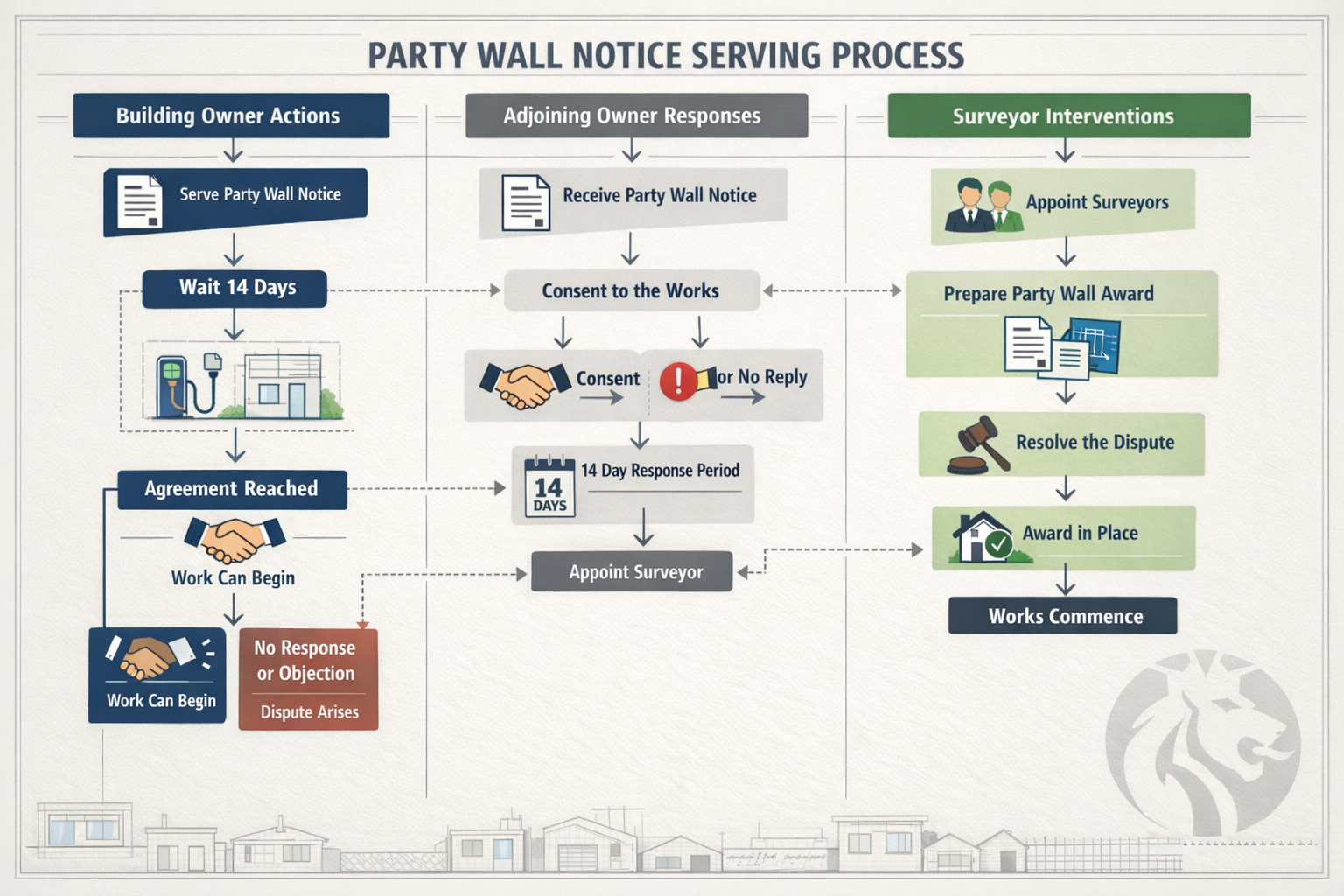
The Party Wall Act mandates a minimum 14-day notice period before commencing work. For EV charging projects, this timeline presents specific challenges:
Building owners must serve notices describing the proposed work in sufficient detail for adjoining owners to understand the scope. Generic descriptions like "electrical work" prove inadequate—notices should specify cable routing, wall penetrations, equipment mounting locations, and any structural modifications[2].
The notice must include:
- ✅ Precise description of charging equipment specifications
- ✅ Detailed drawings showing cable routes through party walls
- ✅ Installation methodology and access requirements
- ✅ Proposed start date (allowing the full 14-day period)
- ✅ Building owner's contact details and surveyor information
Adjoining owners have three response options within the 14-day window:
- Consent in writing to the proposed work (allowing immediate commencement)
- Dissent or fail to respond (triggering the surveyor appointment process)
- Request modifications to the work specification (requiring negotiation)
Understanding these requirements helps property managers avoid the most common pitfall: starting work before receiving formal consent or appointing surveyors. For guidance on proper notice procedures, consult our detailed party wall consent resource.
Common Mistakes That Invalidate Notices
Property managers frequently invalidate their party wall notices through these errors:
Insufficient technical detail: Describing work as "installing EV chargers" without specifying wall penetrations, cable routes, or structural modifications fails the adequacy test. Notices must enable adjoining owners to understand exactly what work affects shared structures.
Incorrect service methods: Hand-delivering notices without obtaining signed receipts, or using standard post instead of recorded delivery, creates disputes about whether valid service occurred. The 14-day period only begins when the adjoining owner actually receives the notice.
Missing or incomplete drawings: Technical drawings must clearly show the relationship between proposed work and party walls. Schematic diagrams without scale or accurate positioning prove insufficient for formal notices.
Premature commencement: Beginning work during the 14-day notice period—even with verbal neighbour agreement—breaches statutory requirements. Written consent must be received, or surveyors appointed, before any work starts.
For situations where notices weren't properly served, our guide on no party wall notice served explains remediation procedures and potential consequences.
2026 Compliance Standards for EV Charging Infrastructure
The 2026 regulatory landscape introduces significant technical requirements affecting how EV charging installations must be specified in party wall awards. Property managers need to understand these updated standards when preparing notices and working with surveyors.
ISO 15118 and V2G Capability Requirements
The ISO 15118 standard becomes increasingly relevant in 2026, particularly for communal charging installations in multi-occupancy blocks. This protocol enables vehicle-to-grid (V2G) communication, allowing EVs to return power to the building's electrical system during peak demand periods[3].
Party wall awards must now address:
- Bidirectional charging equipment specifications that meet ISO 15118 compliance
- Smart metering infrastructure capable of tracking both consumption and grid return
- Communication protocols between charging stations and building management systems
- Electrical capacity reservations for future V2G implementation even if not immediately installed
V2G-capable chargers require more complex electrical connections through party walls, including:
| Component | Standard Requirement | Party Wall Consideration |
|---|---|---|
| Power cables | Higher gauge for bidirectional flow | Larger conduit penetrations through walls |
| Communication wiring | Ethernet or fibre optic | Separate cable runs requiring additional wall access |
| Safety disconnects | Accessible isolation switches | Potential mounting on party walls requiring consent |
| Monitoring equipment | Real-time metering | Data cable routing through shared structures |
Regional Building Code Variations
Different jurisdictions impose varying requirements that affect party wall specifications for EV infrastructure:
North American Standards: The National Electrical Code (NEC/NFPA 70) mandates specific electrical safety requirements for multi-dwelling units. In regions like California, Title 24 requires new multi-family buildings to provide EV-capable parking spaces, with specific percentages varying by building size[4].
Vancouver requires 100% of parking spaces in new multi-unit residential buildings (MURBs) to be EV-ready, meaning electrical infrastructure must be designed to accommodate future charging station installation[4]. This forward-planning requirement affects how party wall awards specify conduit sizing and electrical capacity allocation.
UK Building Regulations: Part S of the Building Regulations 2021 requires new residential buildings with parking to include charging points. For existing buildings undergoing major renovation, similar provisions may apply, affecting the scope of party wall work required.
Indian CEA Regulations: Public charging stations must comply with Central Electricity Authority metering and data reporting requirements, including specific technical standards for electrical safety and grid connectivity[1]. Multi-occupancy blocks offering semi-public charging face similar obligations.
Electrical Capacity and Safety Standards
Party wall awards for EV charging projects must specify electrical work complying with current safety codes:
Load calculations: Modern EV chargers draw 7-22kW for residential installations. Awards should specify:
- Maximum simultaneous charging capacity
- Load management systems preventing circuit overload
- Future capacity reservations for additional charging points
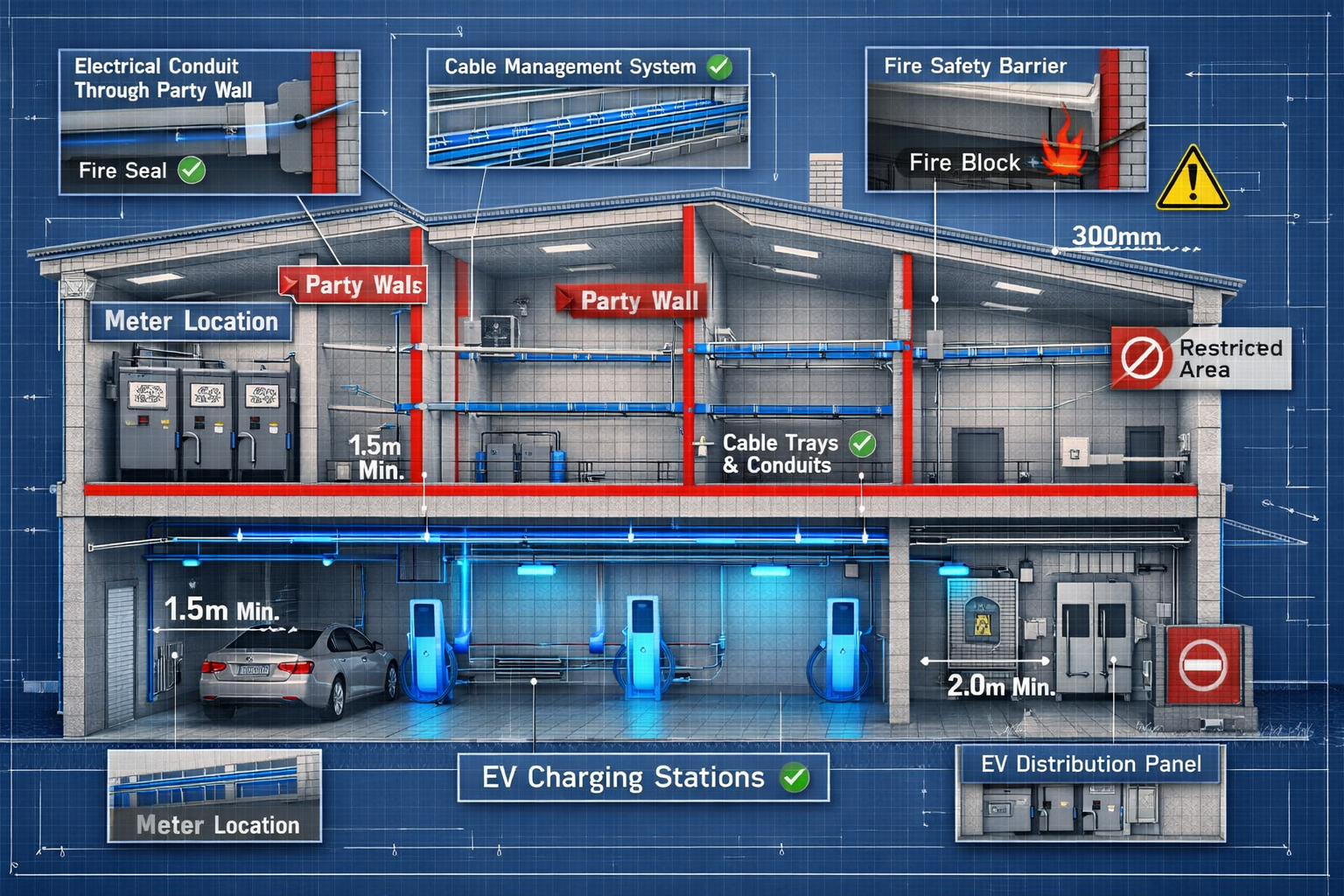
Fire safety requirements: Electrical installations penetrating fire-rated party walls require:
- 🔥 Fire-stopping materials around cable penetrations
- 🔥 Intumescent seals maintaining wall fire ratings
- 🔥 Accessible inspection points for ongoing compliance verification
- 🔥 Documentation of fire safety measures in the award
Accessibility standards: Charging infrastructure must meet accessibility requirements, particularly for communal installations serving multiple residents. Awards should address:
- Equipment mounting heights
- Clear access zones around charging stations
- Cable management preventing trip hazards
- Signage and user interface accessibility
For comprehensive guidance on managing electrical work through party walls, review our party wall FAQ covering common technical scenarios.
Metering and Data Requirements
The 2026 compliance framework emphasizes transparent energy usage tracking, particularly for shared charging infrastructure:
Individual metering: Each charging point should have separate metering enabling:
- Accurate cost allocation to individual residents
- Usage tracking for billing purposes
- Consumption data for grid management
- Compliance reporting to regulatory authorities
In India, public charging stations must provide real-time data to the National e-Mobility Portal, including availability status, pricing, and energy consumption[1]. Similar requirements may emerge in other jurisdictions for semi-public charging in multi-occupancy blocks.
Sub-metering infrastructure: Party wall awards should specify:
- Meter locations and access arrangements
- Data communication infrastructure
- Responsibility for meter reading and billing
- Dispute resolution procedures for metering accuracy
Property managers should consult local building control authorities and electrical contractors to ensure party wall specifications align with current compliance requirements for their specific jurisdiction[2].
Step-by-Step Guide: Serving Valid Party Wall Notices for EV Charging Infrastructure in Multi-Occupancy Blocks
Successfully navigating Party Wall Notices for EV Charging Infrastructure in Multi-Occupancy Blocks: 2026 Compliance Checklists requires methodical attention to procedural requirements. This section provides actionable guidance for property managers and building owners.
Phase 1: Pre-Notice Preparation and Documentation
Before serving formal notices, thorough preparation prevents delays and disputes:
1. Commission a technical survey: Engage a qualified electrical engineer and party wall surveyor to jointly assess:
- Existing party wall locations and construction types
- Proposed cable routing through shared structures
- Electrical capacity and connection points
- Structural implications of equipment mounting
- Access requirements during installation
2. Prepare comprehensive drawings: Technical documentation should include:
- Site plan showing all affected properties
- Elevation drawings marking party wall locations
- Detailed cable routing diagrams with wall penetration points
- Equipment mounting specifications with fixings detail
- Cross-sections showing relationship between charging infrastructure and party walls
3. Identify all adjoining owners: For multi-occupancy blocks, this includes:
- Owners of flats sharing walls with installation areas
- Freeholders if different from building managers
- Leaseholders in affected units
- Owners of commercial premises if mixed-use building
4. Obtain preliminary quotes: Cost estimates help adjoining owners understand project scale and enable surveyors to draft realistic compensation provisions.
Phase 2: Drafting and Serving Notices
The notice itself must contain specific information to satisfy statutory requirements:
Notice content checklist:
✅ Building owner details: Full legal names and addresses of all building owners initiating the work
✅ Adjoining owner details: Complete identification of all parties receiving notices
✅ Work description: Detailed specification including:
- "Installation of EV charging infrastructure serving [X] parking spaces"
- "Cable routing through party wall between [Property A] and [Property B] at [specific location]"
- "Wall penetrations of [diameter] at [height] above ground level"
- "Equipment mounting requiring [number] fixings into party wall"
- "Electrical conduit installation along party wall surface"
✅ Technical drawings: Attached plans showing work scope and party wall relationship
✅ Proposed start date: Allowing minimum 14-day notice period
✅ Surveyor nomination: Building owner may nominate their surveyor or invite adjoining owner to appoint their own
Service methods: Use recorded delivery or hand-delivery with signed receipt. Retain proof of service for all notices—this becomes critical if disputes arise.
For complex installations affecting multiple properties, consider serving notices in phases, addressing the most critical party wall work first whilst planning subsequent phases.
Phase 3: Managing Adjoining Owner Responses
After serving notices, three scenarios commonly occur:
Scenario A: Written Consent Received
When adjoining owners consent in writing within 14 days:
- ✅ Retain consent letters with project documentation
- ✅ Confirm consent covers all specified work
- ✅ Verify any conditions attached to consent
- ✅ Proceed with installation following approved specifications
Scenario B: Dissent or Non-Response
This triggers the surveyor appointment process:
- Building owner appoints surveyor: Select an RICS-qualified party wall surveyor experienced with electrical infrastructure projects
- Adjoining owner appoints surveyor: They have 10 days to nominate their own surveyor or agree to the building owner's surveyor acting for both parties
- Agreed surveyor: If both parties consent, a single surveyor can act impartially for both sides, reducing costs
- Two surveyors: If parties appoint separate surveyors, those surveyors jointly select a third surveyor to resolve any disagreements
Scenario C: Conditional Consent or Modification Requests
Adjoining owners may consent subject to conditions:
- Specific working hours to minimize disturbance
- Additional protective measures during installation
- Enhanced reinstatement specifications
- Ongoing access for inspection
Evaluate whether conditions are reasonable and negotiate acceptable terms before proceeding.
Phase 4: The Party Wall Award Process
When surveyors are appointed, they prepare a formal party wall award governing the work:
Award components for EV charging projects:
📋 Scope of works: Detailed technical specification of all work affecting party walls, incorporating electrical standards and safety requirements
📋 Schedule of condition: Photographic and written record of party wall condition before work commences, enabling accurate damage assessment
📋 Access rights: Specified times and methods for building owner's contractors to access adjoining properties for inspection or work
📋 Working hours: Permitted times for noisy or disruptive work, typically 8am-6pm weekdays
📋 Protective measures: Requirements for dust sheets, protective barriers, or temporary supports during installation
📋 Insurance provisions: Confirmation of building owner's liability insurance covering party wall work
📋 Compensation provisions: Procedures for addressing damage, including inspection protocols and repair specifications
📋 Dispute resolution: Process for handling disagreements during work execution
📋 Cost allocation: Who bears surveyor fees (typically the building owner) and how costs are apportioned
Timeline expectations: Award preparation typically takes 2-4 weeks after surveyor appointment, depending on project complexity and schedule of condition requirements.
The award becomes legally binding once served on both parties. Work must proceed according to award specifications—deviations require formal variation agreements.
For detailed guidance on award requirements and interpretation, consult our party wall award guidance resource.
Phase 5: During Installation Compliance
Once work commences, ongoing compliance protects all parties:
Regular inspections: Surveyors should inspect at critical stages:
- Before wall penetration work begins
- During cable installation through party walls
- Upon completion of electrical work
- After reinstatement of affected areas
Documentation: Contractors should maintain:
- Daily work logs noting party wall interactions
- Photographic records of work progression
- Compliance certificates for electrical installations
- Any variations from approved specifications
Communication: Keep adjoining owners informed of:
- Work schedule updates
- Any unexpected issues affecting party walls
- Completion milestones
- Final inspection arrangements
Damage protocols: If damage occurs:
- Immediately notify surveyors and adjoining owners
- Photograph damage and surrounding areas
- Obtain repair quotes from qualified contractors
- Execute repairs to match pre-existing condition
- Arrange final inspection confirming satisfactory reinstatement
Phase 6: Post-Completion Procedures
After installation completes:
Final inspections: Surveyors conduct comprehensive inspection comparing:
- Current party wall condition against schedule of condition
- Completed work against award specifications
- Reinstatement quality and completeness
Certification: Obtain and distribute:
- Electrical installation certificates (required by building regulations)
- Party wall completion confirmation from surveyors
- Building control sign-off for charging infrastructure
- Insurance documentation for installed equipment
Dispute resolution: If disagreements arise about damage or compliance:
- Refer to award dispute resolution procedures
- Consider mediation before formal legal action
- Document all communications and evidence
- Consult specialist party wall solicitors if necessary
Understanding the complete process for Party Wall Notices for EV Charging Infrastructure in Multi-Occupancy Blocks: 2026 Compliance Checklists enables property managers to anticipate challenges and maintain positive neighbour relations throughout complex installations.
RICS Best Practices for Minimising Disputes in Apartment Blocks
The Royal Institution of Chartered Surveyors (RICS) provides professional standards that help prevent conflicts when installing EV charging infrastructure in multi-occupancy buildings. Implementing these practices significantly reduces dispute likelihood.
Early Stakeholder Engagement
Pre-notice consultation: Before serving formal party wall notices, conduct informal discussions with affected residents:
- 🤝 Explain the project benefits (property value enhancement, sustainability credentials, resident convenience)
- 🤝 Address concerns about noise, disruption, or visual impact
- 🤝 Demonstrate compliance with building regulations and safety standards
- 🤝 Provide realistic timelines and disruption expectations
This preliminary engagement often secures voluntary cooperation, streamlining the formal notice process.
Resident information sessions: For large apartment blocks, organize group presentations covering:
- Legal requirements and party wall obligations
- Technical specifications and safety measures
- Installation timeline and phasing
- Cost allocation and funding arrangements
- Long-term maintenance responsibilities
Transparent Cost Communication
Financial concerns frequently trigger party wall disputes. RICS best practice recommends:
Clear cost breakdowns: Provide detailed estimates showing:
- Surveyor fees and how they're allocated
- Installation costs and responsibility
- Potential damage compensation provisions
- Ongoing maintenance cost sharing
For guidance on typical expenses, review our cost of party wall procedures resource.
Funding transparency: Explain how project costs are distributed:
- Service charge allocation methods
- Individual versus collective responsibility
- Grant funding or government incentive availability
- Long-term cost recovery through usage fees
Selecting Experienced Surveyors
Appointing surveyors with specific EV infrastructure experience proves invaluable:
Technical competence: Look for surveyors who understand:
- Electrical installation requirements and safety standards
- Building regulations applicable to EV charging
- Fire safety implications of cable penetrations
- Structural considerations for equipment mounting
Dispute resolution skills: Experienced surveyors proactively address potential conflicts by:
- Drafting comprehensive awards anticipating common issues
- Facilitating communication between building and adjoining owners
- Proposing practical solutions balancing competing interests
- Maintaining impartiality when acting as agreed surveyor
Professional accreditation: Verify surveyors hold:
- RICS membership (MRICS or FRICS)
- Professional indemnity insurance
- Relevant continuing professional development in party wall matters
Comprehensive Schedule of Condition
Disputes about damage often arise from inadequate pre-work documentation:
Photographic evidence: Surveyors should capture:
- Wide-angle views showing overall party wall condition
- Close-up images of existing cracks, stains, or defects
- Adjacent finishes and decorative elements
- Existing electrical installations or services
Written descriptions: Supplement photographs with detailed notes describing:
- Construction materials and finishes
- Existing defects with measurements
- General condition ratings
- Any pre-existing damage or deterioration
Shared documentation: Provide copies to all parties before work commences, obtaining written acknowledgment of accuracy.
Proactive Communication Protocols
Establishing clear communication channels prevents misunderstandings:
Designated contacts: Appoint specific individuals responsible for:
- Receiving and responding to adjoining owner queries
- Coordinating surveyor access
- Managing contractor communications
- Addressing complaints or concerns
Regular updates: Provide scheduled progress reports:
- Weekly email updates during active work periods
- Advance notice of particularly disruptive activities
- Prompt notification of schedule changes
- Completion milestone confirmations
Accessible information: Make project documentation readily available:
- Digital copies of party wall awards
- Contact details for surveyors and contractors
- Complaint procedures and escalation paths
- Relevant building regulation approvals
Minimizing Installation Disruption
Practical measures reduce neighbour frustration:
Phased installation: Break work into manageable phases:
- Complete work affecting specific party walls before moving to others
- Schedule noisy activities during mid-day periods
- Avoid work during holidays or weekends unless agreed
Protective measures: Implement comprehensive protection:
- Dust barriers sealing work areas
- Floor protection in access routes
- Vibration monitoring for sensitive equipment
- Noise mitigation where practical
Quality contractors: Select installers with:
- Proven experience in occupied buildings
- Professional conduct standards
- Appropriate insurance coverage
- References from similar projects
Post-Installation Relationship Management
Maintaining positive relationships after completion prevents future conflicts:
Thorough reinstatement: Ensure all affected areas are restored to pre-work condition or better:
- Professional decoration matching existing finishes
- Complete removal of installation debris
- Repair of any incidental damage
- Final cleaning of affected areas
Follow-up inspections: Arrange post-completion reviews:
- Joint walk-through with adjoining owners
- Address any concerns about reinstatement quality
- Confirm satisfaction with completed work
- Document final condition for future reference
Ongoing communication: Maintain relationships through:
- Sharing maintenance schedules for charging infrastructure
- Providing usage guidance for new installations
- Addressing any subsequent issues promptly
- Demonstrating continued commitment to neighbour interests
Implementing these RICS best practices transforms party wall procedures from potential conflict triggers into opportunities for collaborative problem-solving, ensuring successful EV charging infrastructure deployment in multi-occupancy blocks.
For additional guidance on party wall matters, explore our comprehensive party wall resource centre.
2026 Compliance Checklist: Essential Documentation and Procedures
Property managers implementing Party Wall Notices for EV Charging Infrastructure in Multi-Occupancy Blocks: 2026 Compliance Checklists require systematic documentation to demonstrate regulatory compliance and protect against future disputes.
Pre-Installation Documentation Checklist
Legal and Regulatory Documents:
- ✅ Title deeds confirming building ownership and boundaries
- ✅ Lease agreements identifying freeholder and leaseholder responsibilities
- ✅ Existing building regulation approvals
- ✅ Planning permission (if required for external charging infrastructure)
- ✅ Building insurance policy confirming coverage for electrical work
- ✅ Professional indemnity insurance for appointed surveyors
Technical Specifications:
- ✅ Electrical capacity assessment confirming adequate supply
- ✅ Load calculation demonstrating compliance with NEC/IET wiring regulations
- ✅ Equipment specifications showing ISO 15118 compliance (where applicable)
- ✅ Fire safety assessment for cable penetrations through fire-rated walls
- ✅ Accessibility compliance documentation
- ✅ Metering and billing system specifications
Party Wall Specific Documents:
- ✅ Formal party wall notices served on all adjoining owners
- ✅ Proof of service for all notices (signed receipts or delivery confirmations)
- ✅ Written consents from adjoining owners (if obtained)
- ✅ Surveyor appointment letters
- ✅ Schedule of condition with photographs and descriptions
- ✅ Party wall award signed by all parties
Installation Phase Compliance Tracking
Contractor Documentation:
- ✅ Contractor qualifications and certifications
- ✅ Method statements for work affecting party walls
- ✅ Risk assessments addressing party wall considerations
- ✅ Insurance certificates (public liability and professional indemnity)
- ✅ Daily work logs recording party wall interactions
Inspection Records:
- ✅ Pre-commencement surveyor inspection reports
- ✅ Progress inspection records at critical stages
- ✅ Photographic evidence of work progression
- ✅ Compliance certificates for electrical installations
- ✅ Building control inspection sign-offs
Communication Logs:
- ✅ Records of all communications with adjoining owners
- ✅ Responses to queries or complaints
- ✅ Schedule change notifications
- ✅ Incident reports (if any issues arise)
Post-Completion Documentation
Final Certification:
- ✅ Electrical Installation Certificate (EIC) from qualified electrician
- ✅ Building control completion certificate
- ✅ Party wall surveyor's final inspection report
- ✅ Confirmation of satisfactory reinstatement
- ✅ As-built drawings showing final installation configuration
Operational Documents:
- ✅ User manuals for charging equipment
- ✅ Maintenance schedules and procedures
- ✅ Emergency contact information
- ✅ Metering and billing system documentation
- ✅ Warranty certificates for installed equipment
Compliance Evidence:
- ✅ ISO 15118 compliance certification (if applicable)
- ✅ Regional building code compliance documentation
- ✅ Accessibility standards compliance confirmation
- ✅ Fire safety certification for wall penetrations
- ✅ Insurance policy updates reflecting new installations
Regional Compliance Variations
Different jurisdictions require additional documentation:
UK-Specific Requirements:
- Part S Building Regulations compliance evidence
- Electrical installation certificate complying with BS 7671 (18th Edition)
- CDM regulations compliance (for notifiable projects)
North American Requirements:
- NEC Article 625 compliance documentation
- Local permit approvals and final inspections
- ADA accessibility compliance certification
- Title 24 compliance (California) or equivalent regional standards[4]
Indian Requirements:
- CEA technical standards compliance
- Metering equipment type approval
- Grid connectivity approvals
- Data reporting system integration confirmation[1]
Digital Documentation Systems
Modern compliance management benefits from digital systems:
Cloud-based repositories: Store all documentation in accessible, secure platforms:
- Version-controlled document management
- Automated backup and disaster recovery
- Role-based access for stakeholders
- Audit trails tracking document access and modifications
Mobile inspection apps: Enable real-time compliance tracking:
- On-site photograph capture with GPS tagging
- Digital checklists ensuring consistent inspections
- Instant report generation and distribution
- Integration with project management systems
For comprehensive project planning guidance, review the EV infrastructure planning checklist[6] which complements party wall procedures.
Ongoing Compliance Maintenance
Post-installation compliance requires periodic review:
Annual documentation review:
- Update insurance policies reflecting current equipment value
- Verify maintenance records demonstrate proper care
- Confirm metering systems maintain accuracy
- Review and update emergency procedures
Periodic inspections:
- Annual electrical safety testing
- Party wall condition monitoring
- Equipment functionality verification
- Fire safety system checks
Regulatory updates monitoring:
- Track changes to building regulations
- Monitor updates to electrical standards
- Review evolving EV charging requirements
- Update procedures to maintain compliance
Maintaining comprehensive documentation throughout the project lifecycle protects building owners, satisfies regulatory requirements, and provides evidence of proper party wall procedures if disputes arise.
Conclusion
Successfully implementing Party Wall Notices for EV Charging Infrastructure in Multi-Occupancy Blocks: 2026 Compliance Checklists requires careful attention to legal procedures, technical standards, and neighbour relations. The intersection of party wall legislation with rapidly evolving EV infrastructure requirements creates complexity that property managers must navigate systematically.
Key principles for successful project delivery include:
Procedural rigor: Serving proper party wall notices with comprehensive technical specifications prevents delays and disputes. The 14-day notice period, detailed work descriptions, and appropriate surveyor appointments form the foundation of compliant installations.
Technical competence: Understanding 2026 compliance standards—including ISO 15118 requirements, regional building codes, and electrical safety regulations—ensures party wall awards specify appropriate technical requirements for modern charging infrastructure.
Stakeholder collaboration: Early engagement with adjoining owners, transparent communication, and RICS best practices minimize conflicts and facilitate cooperative problem-solving throughout complex installations.
Comprehensive documentation: Maintaining detailed records from pre-installation planning through post-completion certification protects all parties and demonstrates regulatory compliance.
Next Steps for Property Managers
If you're planning EV charging infrastructure installation in a multi-occupancy block:
-
Engage qualified professionals early: Appoint an experienced party wall surveyor and electrical engineer before serving notices. Their expertise prevents costly mistakes and streamlines the approval process.
-
Conduct preliminary assessments: Commission technical surveys identifying all party wall implications, electrical capacity requirements, and compliance obligations specific to your jurisdiction.
-
Prepare comprehensive documentation: Develop detailed specifications, technical drawings, and cost estimates before serving formal notices.
-
Consult stakeholders proactively: Discuss plans with adjoining owners informally before formal notice service, addressing concerns and building cooperative relationships.
-
Follow systematic procedures: Use the checklists and guidance provided in this article to ensure no critical steps are overlooked.
For expert assistance with party wall matters related to EV charging infrastructure, consider consulting qualified chartered surveyors who understand both party wall legislation and modern electrical infrastructure requirements.
The transition to electric vehicle infrastructure represents a significant opportunity to enhance property value and sustainability credentials. By properly managing party wall obligations, property managers can deliver these benefits whilst maintaining positive neighbour relations and full regulatory compliance throughout 2026 and beyond.
References
[1] Cea Regulations For Public Ev Charging Stations What You Should Know – https://bolt.earth/blog/cea-regulations-for-public-ev-charging-stations-what-you-should-know
[2] Ev Charger Compliance Checklist Property Managers – https://cyberswitching.com/ev-charger-compliance-checklist-property-managers/
[3] Charging In 2026 New Rules And Realities For Tesla Owners In The U.s. And Europe – https://www.teslaacessories.com/blogs/news/charging-in-2026-new-rules-and-realities-for-tesla-owners-in-the-u.s.-and-europe
[4] Murbs And Ev Charging Laws Understanding Legal Landscape – https://goelectricave.com/blogs/news/murbs-and-ev-charging-laws-understanding-legal-landscape
[5] Ev Charging Installation Checklist Template – https://sitemate.com/templates/quality/forms/ev-charging-installation-checklist-template/
[6] Project Planning Checklist – https://www.transportation.gov/rural/ev/toolkit/ev-infrastructure-planning/project-planning-checklist