
Landlords planning extension works on Private Rented Sector (PRS) properties now face a regulatory collision: the Party Wall etc. Act 1996 demands timely neighbor notifications and structural safeguards, while the Renters' Rights Act 2026—effective 1 May 2026—eliminates fixed-term tenancies and bans Section 21 "no fault" evictions. This convergence creates unprecedented complexity for Party Wall Implications of Renters' Rights Act 2026: Survey Protocols for PRS Extension Works Amid Tenant Protections, forcing chartered surveyors to navigate overlapping timelines where traditional eviction-for-renovation strategies no longer apply. With civil penalties reaching £40,000 for non-compliance and mandatory PRS Database registration starting late 2026, understanding the intersection of these frameworks has become critical for property professionals.
Key Takeaways
- 🏗️ Dual compliance requirement: Party wall works must satisfy both Party Wall Act 1996 notice protocols and Renters' Rights Act 2026 tenant protection provisions simultaneously
- ⏰ Timeline conflicts: Traditional party wall notice periods (1-2 months) now intersect with new tenant termination rights (2 months' notice) and abolished Section 21 evictions
- 📋 Enhanced documentation: Schedule of condition surveys must account for occupied tenancies, with tenant cooperation protocols embedded in party wall award procedures
- 💰 Financial penalties: Non-compliance with either framework triggers substantial fines (£7,000-£40,000) and potential possession order barriers under mandatory PRS Database registration
- 🤝 Surveyor role evolution: Party wall surveyors must now coordinate tenant rights, landlord renovation timelines, and neighbor protections within a single compliant framework
Understanding the Regulatory Intersection for PRS Extension Works
The Renters' Rights Act 2026 fundamentally transforms tenancy structures across England's private rental sector. From 1 May 2026, all new tenancies default to periodic agreements, eliminating fixed-term contracts and the controversial Section 21 "no fault" eviction mechanism[1][2]. Tenants gain the right to terminate tenancies with just two months' notice, while landlords face significantly restricted grounds for possession—none of which accommodate routine renovation works without substantial justification[2].
This legislative shift directly impacts how landlords approach extension projects requiring party wall agreements. Previously, landlords could issue Section 21 notices to secure vacant possession before commencing disruptive building works. Under the new regime, landlords must demonstrate specific grounds for possession under Schedule 1 of the Act, with renovation-related grounds requiring either property sale, landlord occupation, or substantial redevelopment that cannot proceed with tenants in situ[4].
Key Tenancy Reforms Affecting Building Works
The 2026 Act introduces several provisions that complicate traditional party wall procedures:
| Reform Element | Implementation Date | Impact on Party Wall Works |
|---|---|---|
| Abolition of Section 21 | 1 May 2026 | Cannot evict for routine renovations |
| Periodic tenancies only | 1 May 2026 | No fixed-term planning certainty |
| Tenant 2-month notice right | 1 May 2026 | Unpredictable vacancy timing |
| PRS Database registration | Late 2026 | Compliance prerequisite for possession |
| Advance rent ban (>1 month) | 1 May 2026 | Limited financial leverage |
| Rental bidding prohibition | 1 May 2026 | Cannot incentivize early departure |
For party wall surveyors, these changes necessitate proactive tenant engagement strategies rather than relying on possession orders to facilitate works. The traditional sequence—serve party wall notice, secure vacant possession, commence works—must now accommodate occupied tenancies throughout the construction period.
Party Wall Implications of Renters' Rights Act 2026: Notice Requirements and Timing Conflicts
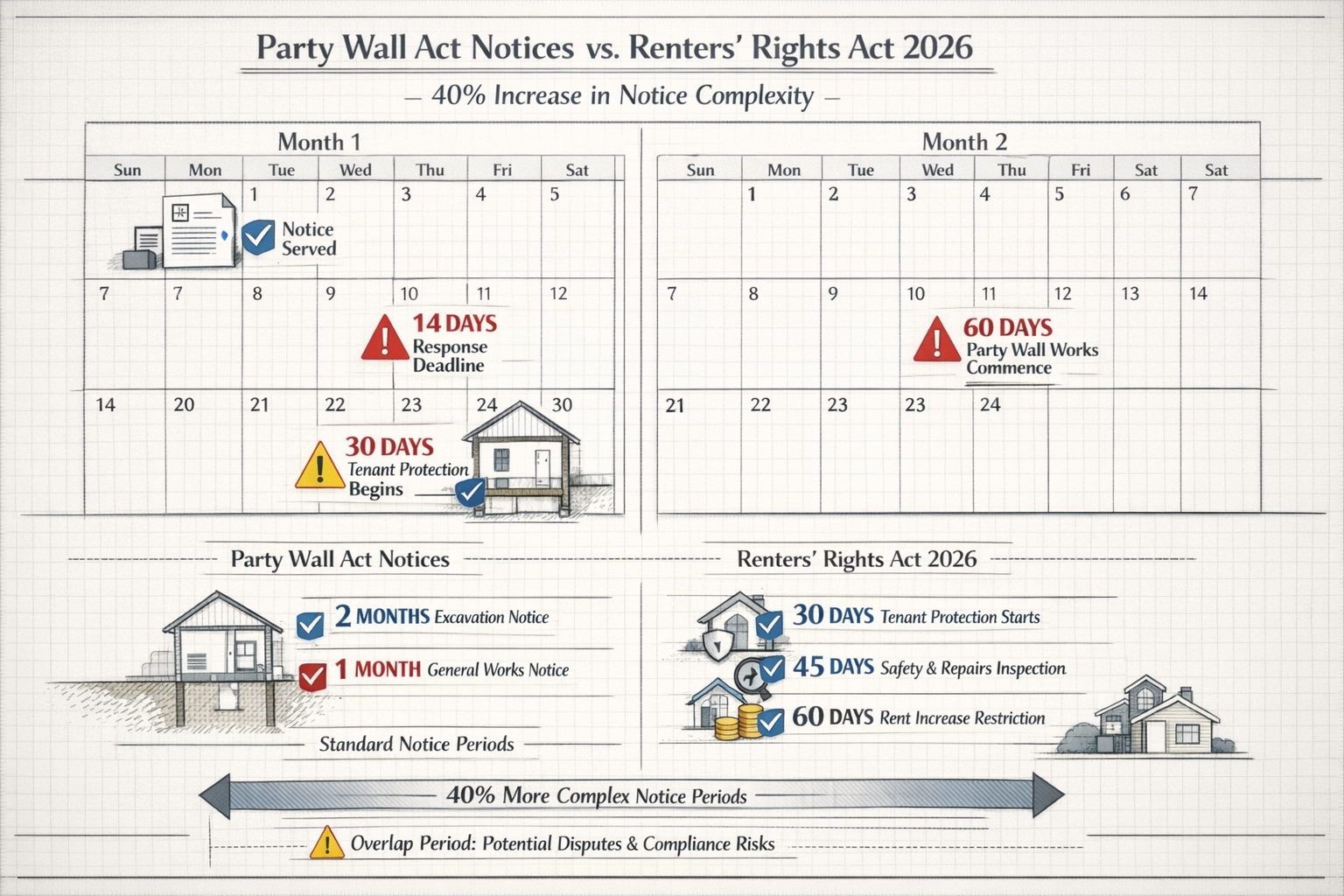
The Party Wall etc. Act 1996 establishes specific notice periods for building works affecting shared structures. Landlords must serve written notice to adjoining owners at least one month before starting most party wall works, or two months for excavations within three meters of neighboring structures[6]. These timelines were designed for straightforward neighbor-to-neighbor scenarios, not the complex landlord-tenant-neighbor triangulation now required under the Renters' Rights Act 2026.
Navigating Overlapping Notice Periods
Consider a typical PRS extension scenario: a landlord plans a rear extension on a mid-terrace property, requiring party wall notices to both adjoining neighbors and excavation work near the foundation line. Under pre-2026 protocols, the sequence was straightforward:
- Month 0: Serve Section 21 notice to tenant (2 months)
- Month 2: Tenant vacates; serve party wall notices to neighbors
- Month 3-4: Appoint surveyors, prepare party wall award
- Month 4: Commence works with vacant possession
Post-May 2026, this linear approach collapses. Without Section 21, landlords cannot guarantee vacant possession for works. The Party Wall Implications of Renters' Rights Act 2026: Survey Protocols for PRS Extension Works Amid Tenant Protections demand a fundamentally different approach:
✅ Compliant 2026 Protocol:
- Month 0: Consult tenant about planned works; assess cooperation likelihood
- Month 0: Simultaneously serve party wall notices to neighbors (cannot delay for vacancy)
- Month 1-2: Negotiate party wall agreement or appoint surveyors
- Month 2: Prepare schedule of condition including tenant-occupied spaces
- Month 3: Issue party wall award with tenant access provisions
- Month 3+: Commence works with tenant in situ OR negotiate tenant departure incentive
This parallel processing approach eliminates the luxury of sequential planning. Party wall surveyors must now assume works will proceed with tenants present and structure awards accordingly.
Tenant Cooperation as a Critical Variable
The success of party wall procedures under the new framework hinges on tenant cooperation. Unlike neighbors who have statutory obligations under the Party Wall Act, tenants have no legal duty to facilitate landlord renovations beyond reasonable access provisions in their tenancy agreements. The Renters' Rights Act 2026 strengthens tenant security, potentially emboldening tenants to refuse cooperation with disruptive works[3].
Practical strategies for securing tenant cooperation include:
- 🏠 Early consultation: Engage tenants before serving formal party wall notices to assess willingness to accommodate works
- 💷 Financial incentives: Offer rent reductions during construction periods (permissible under the Act's rent increase controls)
- 📅 Flexible scheduling: Structure works to minimize disruption during tenant-preferred hours
- 📝 Written agreements: Formalize access arrangements and disruption compensation in supplementary tenancy agreements
- 🔄 Temporary relocation: Offer alternative accommodation for high-disruption phases (though costly)
Where tenant cooperation proves impossible, landlords face the difficult decision of either abandoning renovation plans or pursuing possession under the limited grounds available—a process that now requires PRS Database registration and can trigger substantial delays[2].
Survey Protocols for PRS Extension Works: Schedule of Condition Adaptations
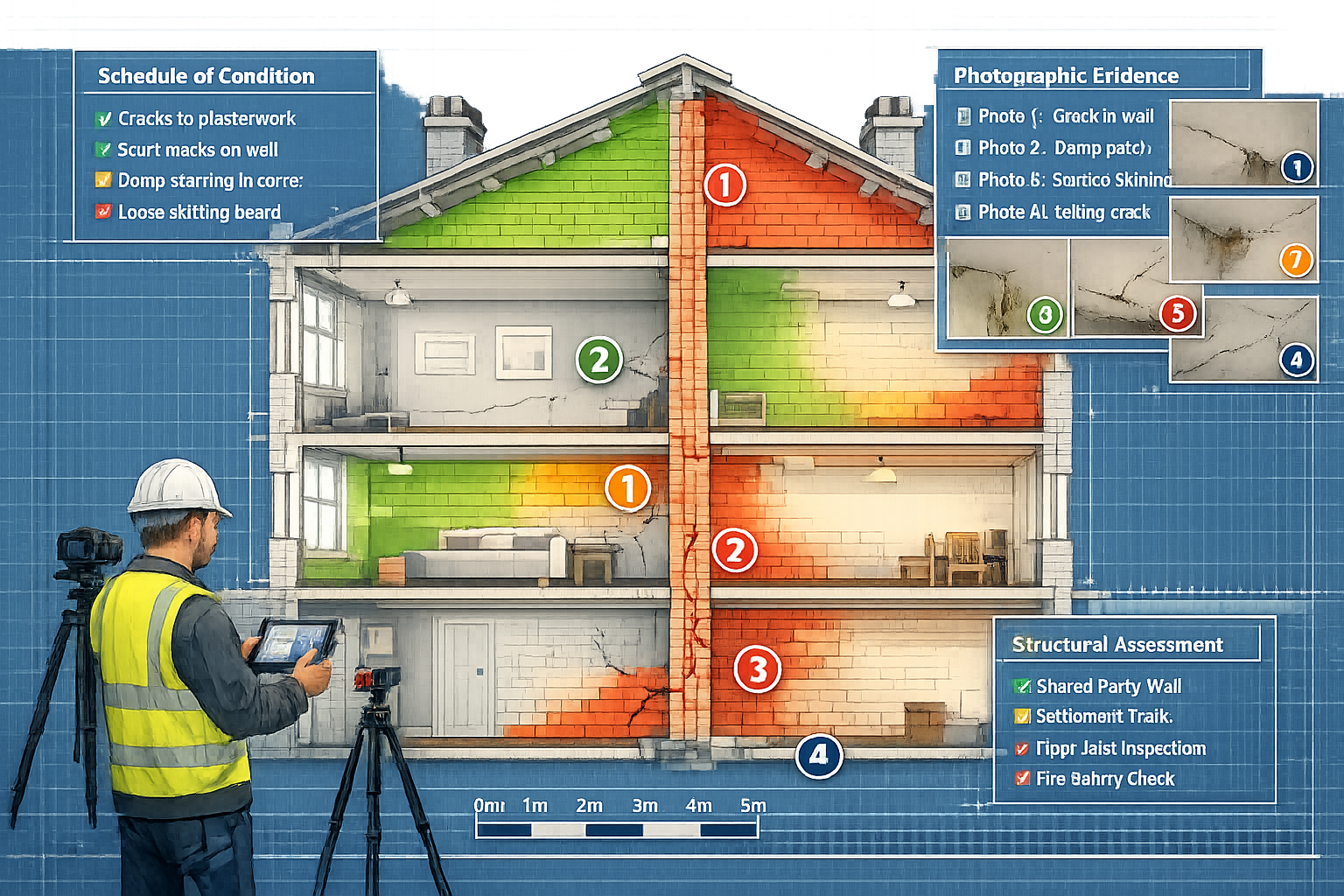
The schedule of condition represents the cornerstone of party wall protection, documenting the pre-works state of adjoining properties to establish a baseline for damage claims. Traditional schedules focus exclusively on structural elements—walls, foundations, ceilings, and external fabric. However, Party Wall Implications of Renters' Rights Act 2026: Survey Protocols for PRS Extension Works Amid Tenant Protections require expanded documentation that accounts for occupied tenancies.
Enhanced Schedule of Condition Requirements
When preparing schedules of condition for PRS properties under the new regulatory framework, surveyors must incorporate additional considerations:
🔍 Structural Documentation (Traditional Elements):
- Crack mapping of party walls and adjoining structures
- Foundation condition assessment
- External facade condition with photographic evidence
- Ceiling and floor level measurements
- Drainage system condition
🏘️ Tenancy-Specific Documentation (2026 Additions):
- Tenant notification records: Evidence that tenants were informed of survey purpose and party wall works
- Access agreements: Documented consent for surveyor entry and photographic evidence
- Interior condition: Expanded documentation of tenant-occupied spaces that may experience disruption
- Chattels exclusion: Clear demarcation between structural elements and tenant belongings
- Disruption baseline: Pre-works assessment of noise, dust, and access conditions
This enhanced approach serves dual purposes: protecting neighbors under the Party Wall Act while creating an evidence trail that demonstrates landlord compliance with tenant protection obligations under the Renters' Rights Act 2026.
Addressing Tenant Access Challenges
Securing tenant cooperation for schedule of condition surveys presents unique challenges. Unlike the statutory right to serve party wall notices on neighbors, landlords have only contractual access rights to tenant-occupied properties, typically limited to "reasonable notice" provisions (usually 24-48 hours)[3].
Best practices for tenant access during schedule preparation:
- Advance written notice: Provide minimum 7 days' notice for initial survey, explaining party wall obligations and tenant protections
- Flexible scheduling: Offer multiple appointment options to accommodate tenant availability
- Surveyor credentials: Provide tenant with surveyor's RICS credentials and professional indemnity insurance details
- Scope limitation: Clearly define which rooms require access and estimated survey duration
- Tenant presence: Allow tenant to be present during survey to address concerns immediately
- Photographic consent: Obtain explicit written consent for interior photography, with assurances about data protection
Where tenants refuse access for schedule preparation, landlords face significant complications. The party wall award cannot be finalized without baseline documentation, yet the Renters' Rights Act 2026 provides no mechanism to compel tenant cooperation for landlord-initiated renovations[4]. In extreme cases, this may constitute grounds for possession under Schedule 1, Ground 6 (persistent breach of tenancy obligations), though this route involves tribunal proceedings and substantial delays.
Compliant Party Wall Award Procedures Under Tenant Protection Frameworks
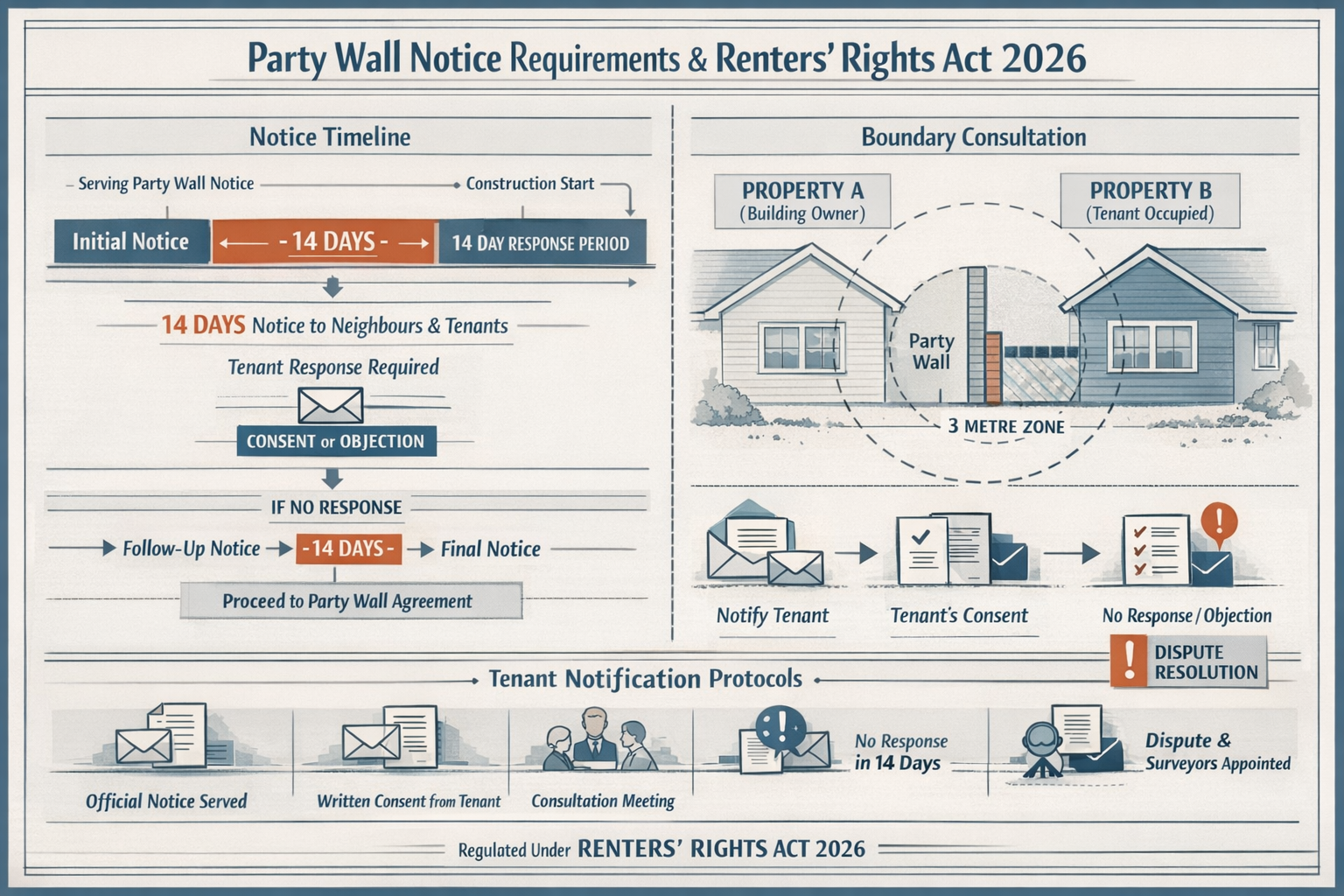
The party wall award serves as the legal document authorizing building works and establishing safeguards for affected parties. Under traditional procedures, awards focus exclusively on the building owner-neighbor relationship. The Party Wall Implications of Renters' Rights Act 2026: Survey Protocols for PRS Extension Works Amid Tenant Protections require awards to address a three-way relationship: landlord (building owner), tenant (occupier), and neighbor (adjoining owner).
Structuring Awards for Occupied PRS Properties
Modern party wall awards for PRS extension works must incorporate provisions that satisfy both Party Wall Act 1996 requirements and Renters' Rights Act 2026 tenant protections:
📋 Standard Award Components:
- Description of proposed works with technical drawings
- Schedule of condition for adjoining properties
- Working hours and noise limitations
- Access arrangements for monitoring
- Dispute resolution procedures
- Surveyor fee allocation
🏠 Enhanced PRS-Specific Provisions:
Tenant Notification Protocols:
- Requirement for landlord to provide tenants with copy of party wall award
- Minimum notice periods for commencement of disruptive work phases
- Tenant complaint escalation procedures
- Regular progress updates to tenant
Disruption Mitigation Measures:
- Maximum daily noise level thresholds (typically 75dB for residential areas)
- Restricted working hours (e.g., 8am-6pm Monday-Friday, 9am-1pm Saturday)
- Dust suppression requirements with specific protocols for shared ventilation systems
- Vibration monitoring where excavation affects occupied spaces
- Temporary facility provisions if tenant bathrooms/kitchens become inaccessible
Compensation Frameworks:
- Rent reduction schedules tied to disruption severity (e.g., 20% reduction during high-impact phases)
- Alternative accommodation provisions for extreme disruption periods
- Damage compensation procedures for tenant belongings (separate from structural schedule of condition)
Access and Security:
- Site security measures to prevent unauthorized access to tenant areas
- Key holding arrangements and contractor identification protocols
- Privacy protections for ground-floor/accessible tenant spaces adjacent to works
Surveyor Appointment Strategies
When neighbors dissent to party wall works (or fail to respond within 14 days), the Party Wall Act requires surveyor appointment to resolve disputes and prepare the award[6]. The Renters' Rights Act 2026 adds complexity to this process when PRS properties are involved.
Three surveyor appointment models:
- Agreed Surveyor: Single surveyor acts for both parties (most cost-effective)
- Two Surveyors: Each party appoints their own surveyor; surveyors jointly prepare award
- Three Surveyors: Two party-appointed surveyors plus independent third surveyor (rare, for complex disputes)
For PRS properties, the agreed surveyor model offers significant advantages under the new regulatory framework. A single surveyor can efficiently balance landlord renovation objectives, neighbor protections, and tenant rights without the adversarial dynamics that can emerge in two-surveyor arrangements. However, this requires selecting a surveyor with specific expertise in both party wall procedures and residential tenancy law—a combination that may be challenging to source[8].
Key qualifications for PRS party wall surveyors in 2026:
- ✅ RICS membership with party wall specialism
- ✅ Current knowledge of Renters' Rights Act 2026 provisions
- ✅ Experience with occupied property surveys and tenant liaison
- ✅ Professional indemnity insurance covering both party wall and tenancy disputes
- ✅ Familiarity with PRS Database requirements and compliance protocols
Risk Mitigation Strategies for Landlords and Building Professionals
The convergence of party wall obligations and enhanced tenant protections creates substantial compliance risks for PRS landlords. Civil penalties under the Renters' Rights Act 2026 range from £7,000 for minor breaches to £40,000 for serious violations, including failure to register with the PRS Database before seeking possession[2]. These penalties stack on top of existing party wall dispute costs and potential obstruction claims from neighbors.
Pre-Works Risk Assessment Framework
Before initiating party wall procedures for PRS extension works, landlords should conduct comprehensive risk assessments addressing:
🔴 High-Risk Scenarios:
- Tenant has history of complaints or disputes with landlord
- Proposed works involve substantial structural intervention (excavations, beam installations)
- Multiple tenancies in building with varying cooperation levels
- Neighbors have previously objected to building works in area
- Property located in conservation area with additional planning constraints
🟡 Medium-Risk Scenarios:
- Long-term tenant with strong security of tenure under new Act
- Works require access to tenant-occupied spaces multiple times
- Shared services (drainage, heating) require temporary disruption
- Building contains vulnerable tenants (elderly, disabled, families with young children)
🟢 Lower-Risk Scenarios:
- Vacant property or tenant planning departure within 6 months
- External-only works with minimal interior disruption
- Cooperative tenant with written agreement to facilitate works
- Simple party wall works (minor wall repairs, non-structural modifications)
For high-risk scenarios, landlords may need to reconsider project viability or pursue alternative approaches such as delaying works until natural tenant turnover or redesigning projects to minimize party wall implications.
Financial Planning and Contingency Budgets
The Party Wall Implications of Renters' Rights Act 2026: Survey Protocols for PRS Extension Works Amid Tenant Protections significantly increase project costs beyond traditional construction budgets. Landlords should allocate contingency funds for:
| Cost Category | Traditional Budget | 2026+ Budget | Increase Factor |
|---|---|---|---|
| Party wall surveyor fees | £800-£1,500 | £1,200-£2,500 | +50% (tenant liaison time) |
| Schedule of condition | £300-£600 | £500-£1,000 | +67% (enhanced documentation) |
| Rent reduction compensation | £0 | £500-£2,000/month | New cost |
| Legal advice (tenancy) | £0 | £1,000-£3,000 | New cost |
| Alternative accommodation | £0 | £3,000-£8,000 | New cost (if required) |
| Compliance penalties (risk) | £0 | £7,000-£40,000 | New risk exposure |
These additional costs must be factored into return-on-investment calculations for PRS extension projects. In many cases, the enhanced expense and complexity may render marginal projects financially unviable under the new regulatory framework.
Documentation and Evidence Trails
Robust documentation provides the best defense against both party wall disputes and Renters' Rights Act compliance challenges. Essential records include:
- 📧 All tenant communications: Email chains, meeting notes, and written agreements regarding works
- 📸 Comprehensive photographic evidence: Pre-works condition, ongoing progress, and completion states
- 📝 Party wall notice service records: Proof of delivery to all affected parties with date stamps
- 🏗️ Contractor credentials: Insurance certificates, licenses, and safety compliance documentation
- 💰 Financial records: Rent reduction calculations, compensation payments, and surveyor fee invoices
- ⚖️ Legal consultations: Written advice on compliance with both Party Wall Act and Renters' Rights Act
This documentation serves multiple purposes: defending against neighbor claims under party wall procedures, demonstrating compliance with tenant protection obligations, and providing evidence for PRS Database registration requirements[2].
Practical Case Study: Rear Extension on Mid-Terrace PRS Property
To illustrate compliant protocols, consider a realistic scenario:
Property Details:
- Mid-terrace Victorian house in Greater Manchester
- Two self-contained flats (ground floor and first floor)
- Both flats occupied under assured shorthold tenancies
- Landlord plans single-story rear extension affecting party wall with No. 42
Compliant Procedure Timeline:
Month 1:
- Landlord consults both tenants about planned extension, assesses cooperation
- Ground floor tenant (directly affected) agrees to facilitate works; first floor tenant neutral
- Landlord serves party wall notice to neighbor at No. 42
- Landlord engages party wall surveyor with PRS expertise
Month 2:
- Neighbor at No. 42 consents to works; agreed surveyor appointed
- Surveyor conducts schedule of condition at No. 42 and both tenant-occupied flats
- Ground floor tenant granted 48 hours' notice for survey access; present during inspection
- Surveyor documents both structural elements and tenant-specific disruption baseline
Month 3:
- Party wall award prepared incorporating tenant protection provisions
- Award specifies working hours (8am-6pm weekdays), noise limits (75dB), and dust suppression
- Rent reduction of 15% agreed for ground floor flat during 8-week construction period
- All parties (landlord, neighbor, both tenants) receive copies of award
Month 4-5:
- Extension works proceed with contractor adhering to award conditions
- Weekly progress updates provided to ground floor tenant
- Minor issue with dust suppression addressed within 24 hours of tenant complaint
- Surveyor conducts mid-works inspection to verify compliance
Month 6:
- Works completed; final inspection confirms no damage to No. 42
- Ground floor flat returned to normal use; rent restored to full amount
- Post-completion schedule of condition confirms no actionable damage
- All documentation filed for PRS Database registration
This case demonstrates how Party Wall Implications of Renters' Rights Act 2026: Survey Protocols for PRS Extension Works Amid Tenant Protections can be successfully navigated through proactive planning, transparent communication, and professional surveyor involvement.
Conclusion: Adapting Party Wall Practice for the New PRS Landscape
The Renters' Rights Act 2026 represents the most significant transformation of private rental regulation in decades, with profound implications for how party wall procedures operate in PRS properties. The abolition of Section 21 evictions and strengthening of tenant security fundamentally disrupts traditional approaches to renovation planning, forcing landlords and surveyors to develop new protocols that balance competing interests.
Key principles for success:
- Parallel processing: Initiate party wall procedures and tenant consultations simultaneously rather than sequentially
- Enhanced documentation: Expand schedule of condition protocols to address occupied tenancies and tenant-specific concerns
- Cooperative frameworks: Structure party wall awards with tenant protection provisions embedded from inception
- Financial realism: Budget for substantially higher costs including rent reductions, professional fees, and compliance risks
- Professional expertise: Engage surveyors with dual competency in party wall procedures and residential tenancy law
For building professionals, the Party Wall Implications of Renters' Rights Act 2026: Survey Protocols for PRS Extension Works Amid Tenant Protections demand continuous professional development and adaptation of established practices. Surveyors who successfully integrate these frameworks will find themselves in high demand as landlords navigate the complexities of renovation projects in the post-2026 landscape.
Actionable next steps for landlords planning PRS extension works:
✅ Conduct pre-works risk assessment evaluating tenant cooperation likelihood and project viability under new constraints
✅ Engage specialist surveyors with demonstrated expertise in both party wall procedures and Renters' Rights Act compliance
✅ Consult tenants early to assess willingness to accommodate works and identify potential concerns before formal notices
✅ Budget comprehensively for enhanced costs including surveyor fees, rent reductions, and compliance contingencies
✅ Document meticulously to create evidence trails satisfying both party wall and tenancy law requirements
✅ Register with PRS Database in late 2026 to maintain eligibility for possession proceedings if renovation-related grounds become necessary
✅ Review existing tenancy agreements to ensure access provisions and works facilitation clauses remain enforceable under new Act
The intersection of party wall law and enhanced tenant protections creates complexity, but also opportunity for professionals who master these overlapping frameworks. By treating tenant rights as integral to party wall procedures rather than obstacles to be circumvented, surveyors and landlords can deliver compliant, efficient renovation projects that respect all stakeholders' legitimate interests. For additional guidance on party wall procedures, consult our comprehensive party wall resources or contact a qualified chartered surveyor specializing in PRS properties.
References
[1] Alerts Realestate Impacts Of The Renters Rights Act – https://www.goodwinlaw.com/en/insights/publications/2026/01/alerts-realestate-impacts-of-the-renters-rights-act
[2] The Renters Rights Act And Its Impact On Single Family Rental – https://www.shoosmiths.com/perspectives/stories/articles/the-renters-rights-act-and-its-impact-on-single-family-rental
[3] Renters Rights Act 2025 Unforeseen Dangers For Joint Tenants – https://www.russell-cooke.co.uk/news-and-insights/news/renters-rights-act-2025-unforeseen-dangers-for-joint-tenants
[4] The Renters Rights Act What S Changing What It Means For Landlords And How To Mitigate Risks – https://www.kennedyslaw.com/en/thought-leadership/article/2026/the-renters-rights-act-what-s-changing-what-it-means-for-landlords-and-how-to-mitigate-risks/
[5] Renters Rights Act 2025 Key Implications Living Sector Lenders – https://natlawreview.com/article/renters-rights-act-2025-key-implications-living-sector-lenders
[6] Party Wall Agreement – https://hoa.org.uk/advice/guides-for-homeowners/i-am-improving/party-wall-agreement/
[7] Renters Rights Act Implementation Roadmap Now Published – https://www.hoganlovells.com/en/publications/renters-rights-act-implementation-roadmap-now-published
[8] Renters Rights Bill Future Of Valuations – https://www.terracottaproperty.com/blog/renters-rights-bill-future-of-valuations