The surveying profession stands at a transformative crossroads. As artificial intelligence reshapes how property professionals assess buildings, evaluate risks, and deliver client services, a critical question emerges: How can surveyors harness AI's power without compromising the professional judgment and ethical standards that define their practice? With the Royal Institution of Chartered Surveyors (RICS) launching its landmark global standard on responsible AI use—now mandatory since March 9, 2026—surveyors worldwide have a comprehensive framework for navigating this technological revolution while maintaining client trust and professional integrity.
Responsible AI Integration in Building Surveys: RICS Standards and Ethical Practice in 2026 represents more than regulatory compliance; it's a fundamental shift in how property professionals approach technology adoption. The new standard establishes clear boundaries, mandatory knowledge requirements, and governance protocols that ensure AI serves as a tool for enhancement rather than replacement of professional expertise.
Key Takeaways
- 🎯 Mandatory Compliance: RICS's global AI standard became mandatory for all members and regulated firms on March 9, 2026, establishing the first comprehensive framework for responsible AI use in surveying practice
- 📊 Material Impact Framework: The standard applies only to AI outputs with material impact on service delivery, requiring written documentation of impact assessments and risk evaluations
- 🛡️ Professional Accountability: Surveyors remain fully accountable for all work outputs, must demonstrate AI literacy, and apply professional skepticism to AI-generated results
- 📋 Governance Requirements: Firms must implement clear policies, risk registers, due diligence procedures, and transparent client communication protocols
- 🔄 Optional Adoption: AI use remains voluntary, but compliance with all standard requirements is mandatory when firms choose to integrate AI tools
Understanding the RICS AI Standard: Scope and Implementation
The RICS Professional Standard on Responsible Use of AI in Surveying Practice marks a watershed moment for the global surveying profession. Published in September 2025 following extensive consultation and becoming mandatory on March 9, 2026, this standard addresses the rapid integration of AI across valuation, construction, infrastructure, and land services.[1]
What Makes This Standard Different
Unlike previous guidance documents, this standard carries mandatory compliance requirements for all RICS members and RICS-regulated firms worldwide. The standard's global reach reflects RICS's recognition that AI technology transcends geographical boundaries, requiring consistent ethical frameworks across jurisdictions.[1]
The standard has received positive responses both nationally and internationally, with industry observers noting it will support members in effectively and responsibly using AI while building client and public confidence.[2] For property professionals seeking guidance on maintaining professional standards, understanding why choosing an RICS chartered building surveyor matters becomes even more critical in the AI era.
Key Sectors Covered
The standard's scope encompasses multiple surveying disciplines:
- Valuation Services: AI-assisted property valuations and market analysis
- Construction Surveying: Building assessment, defect identification, and project monitoring
- Infrastructure Projects: Large-scale development planning and risk assessment
- Land Services: Boundary surveys, topographical analysis, and site evaluation
Each sector faces unique AI integration challenges, from RICS valuations requiring market data interpretation to drainage surveys utilizing image recognition technology.
The Material Impact Framework: When Does the Standard Apply?
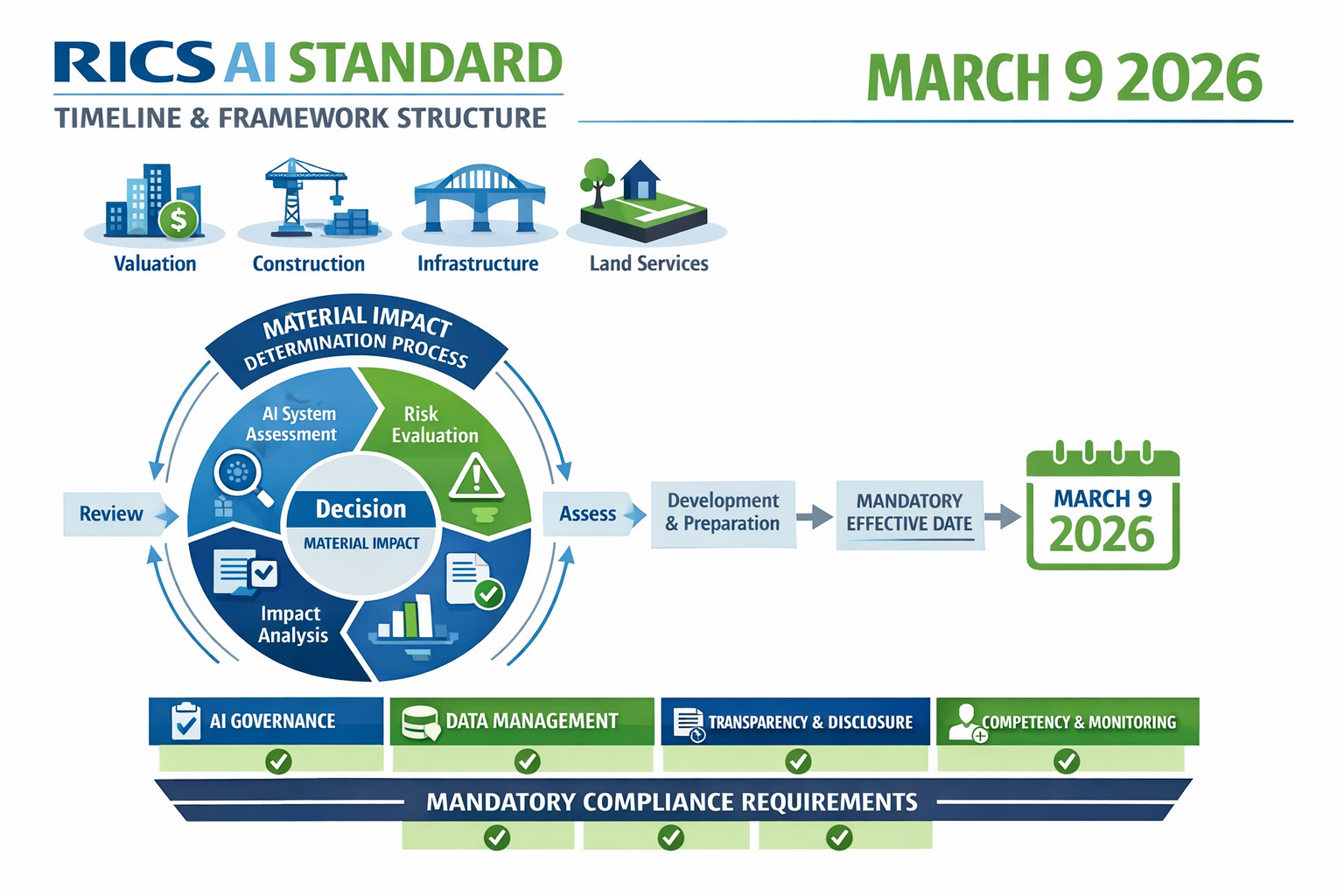
One of the most significant aspects of Responsible AI Integration in Building Surveys: RICS Standards and Ethical Practice in 2026 is the material impact determination framework. This framework provides clarity on when AI use triggers compliance obligations.
Defining Material Impact
The standard applies only to AI outputs that have material impact on service delivery, defined as outputs capable of influencing service delivery outcomes.[2] This threshold-based approach recognizes that not all AI applications carry equal significance.
Material Impact Examples:
✅ AI-generated property valuations used in mortgage decisions
✅ Automated defect detection informing building condition reports
✅ Predictive maintenance algorithms guiding repair recommendations
✅ Risk assessment models affecting project feasibility studies
Non-Material Impact Examples:
❌ Administrative scheduling tools
❌ Basic document formatting software
❌ Simple calculation spreadsheets
❌ Email management systems
Documentation Requirements
When AI outputs have material impact, surveyors must create written records determining whether AI use meets this threshold.[2] This documentation serves multiple purposes:
- Compliance Evidence: Demonstrates adherence to standard requirements
- Risk Management: Identifies potential liability exposures
- Quality Control: Establishes audit trails for professional work
- Client Transparency: Supports informed consent discussions
The Regulatory Tribunal maintains final authority to determine if AI use had material impact on service delivery, emphasizing the importance of thorough documentation.[3]
Mandatory Knowledge Requirements for Surveyors
Responsible AI Integration in Building Surveys: RICS Standards and Ethical Practice in 2026 establishes clear competency baselines that all surveyors using AI must meet. These requirements ensure professionals understand both AI capabilities and limitations.
Core Knowledge Areas
Surveyors utilizing AI tools must demonstrate understanding of:
1. AI Types and Their Limitations
Different AI technologies serve different purposes. Machine learning algorithms excel at pattern recognition but may struggle with unprecedented scenarios. Natural language processing tools can extract information from documents but may misinterpret context. Computer vision systems identify visual defects but require extensive training data.
Understanding these distinctions helps surveyors select appropriate tools for specific tasks, whether conducting RICS homebuyer surveys or performing dilapidation surveys.
2. Hallucination Risks
AI hallucinations—instances where systems generate plausible but incorrect information—pose significant risks in surveying practice.[2] A valuation model might produce confident price estimates based on non-existent comparable properties. An image recognition system might identify structural defects that don't exist.
"Surveyors must assess the reliability of AI outputs and remain accountable for all work, applying professional skepticism and expertise."[1]
3. Bias Risks in AI Systems
AI systems inherit biases from their training data. Historical valuation data might reflect discriminatory pricing patterns. Image datasets might underrepresent certain property types or construction methods. Predictive models might systematically undervalue properties in specific neighborhoods.
Recognizing these bias risks is essential for professionals conducting chartered surveyor assessments across diverse property portfolios.
4. Data Usage and Data Risks
AI systems require data—often substantial amounts. Surveyors must understand:
- Data privacy regulations affecting client information
- Intellectual property rights in training datasets
- Data security protocols preventing unauthorized access
- Data quality requirements ensuring reliable outputs
Training and Continuous Learning
The standard doesn't prescribe specific training programs but establishes competency expectations. Firms should implement:
📚 Structured onboarding for new AI tools
📚 Regular updates on AI capabilities and limitations
📚 Case study reviews examining AI successes and failures
📚 Cross-disciplinary learning from other AI-using professions
Governance and Risk Management Requirements
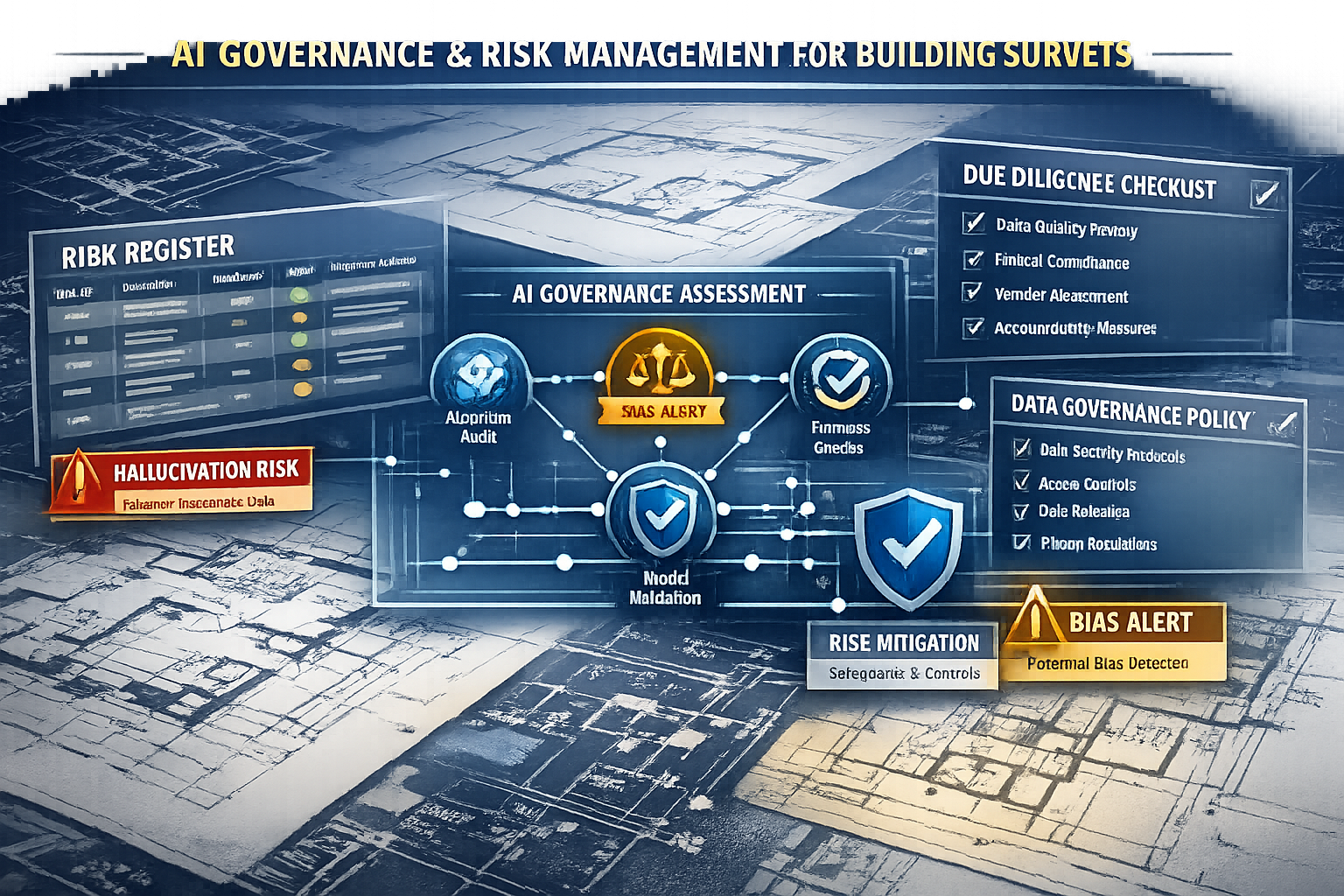
Effective governance structures form the backbone of Responsible AI Integration in Building Surveys: RICS Standards and Ethical Practice in 2026. The standard mandates that firms implement comprehensive policies and procedures before deploying AI systems.
Essential Governance Components
Risk Registers
Firms must create and maintain risk registers documenting potential AI-related risks.[1] These registers should identify:
- Technical risks: System failures, data corruption, algorithmic errors
- Professional risks: Misinterpretation of outputs, over-reliance on automation
- Ethical risks: Bias amplification, privacy violations, transparency failures
- Reputational risks: Client dissatisfaction, regulatory sanctions, market perception
Due Diligence Procedures
Before deploying any AI system, firms must conduct written system governance assessments.[2] This due diligence includes:
- Vendor evaluation: Assessing AI provider credentials and track records
- Technical validation: Testing system accuracy against known benchmarks
- Compatibility assessment: Ensuring integration with existing workflows
- Risk-benefit analysis: Weighing potential advantages against identified risks
Clear Data Policies
The standard requires explicit policies governing:
- Data collection: What information AI systems may access
- Data storage: Where and how long data is retained
- Data sharing: Which third parties receive data access
- Data deletion: When and how data is permanently removed
These policies prove particularly important for sensitive work like boundary surveys or monitoring surveys involving confidential client information.
System Governance Assessment Steps
RICS-regulated firms using AI must record in writing specific governance assessment steps before deployment.[2] A comprehensive assessment typically includes:
Step 1: Purpose Definition
Clearly articulate why the AI system is needed and what specific problems it will solve.
Step 2: Alternative Evaluation
Consider non-AI solutions and document why AI represents the optimal approach.
Step 3: Capability Verification
Test the system's performance against representative scenarios from actual practice.
Step 4: Limitation Identification
Document known weaknesses, edge cases, and situations where the system may fail.
Step 5: Oversight Protocol Establishment
Define how human professionals will review and validate AI outputs.
Step 6: Incident Response Planning
Create procedures for addressing AI errors, client complaints, or system failures.
Professional Judgment and Accountability in the AI Era
Perhaps the most critical principle underlying Responsible AI Integration in Building Surveys: RICS Standards and Ethical Practice in 2026 is the primacy of professional judgment. The standard unequivocally establishes that surveyors remain fully accountable for all work outputs, regardless of AI involvement.[1]
The Professional Skepticism Requirement
Surveyors must apply professional skepticism to AI-generated results, questioning outputs rather than accepting them uncritically. This approach mirrors the skepticism expected in traditional surveying practice but requires additional considerations:
- Verification protocols: Cross-checking AI outputs against independent sources
- Anomaly investigation: Examining unexpected or counterintuitive results
- Contextual evaluation: Assessing whether outputs align with local market conditions
- Comparative analysis: Benchmarking AI results against professional experience
When conducting snagging reports or roof surveys, this skepticism ensures AI-identified issues receive proper professional validation.
Reliability Assessment Frameworks
The standard requires surveyors to assess the reliability of AI outputs before incorporating them into professional work.[1] Effective reliability assessment considers:
Technical Reliability Factors
- Accuracy rates: Historical performance metrics for the AI system
- Training data quality: Relevance and representativeness of datasets
- Update frequency: How often the system incorporates new information
- Validation methodology: Testing procedures used by system developers
Contextual Reliability Factors
- Task appropriateness: Whether the AI system suits the specific application
- Data availability: Sufficient input information for reliable outputs
- Precedent existence: Whether similar cases exist in training data
- Complexity level: Sophistication required for the professional judgment
Maintaining Human Oversight
AI should augment, not replace, professional expertise. Effective human oversight includes:
🔍 Initial review: Examining AI outputs for obvious errors or inconsistencies
🔍 Detailed validation: Comparing AI results with independent professional analysis
🔍 Client discussion: Explaining AI's role in service delivery
🔍 Documentation: Recording how AI outputs influenced final conclusions
For complex assignments like structural engineering assessments or asbestos surveys, this oversight becomes even more critical.

Transparency and Client Communication
Responsible AI Integration in Building Surveys: RICS Standards and Ethical Practice in 2026 places significant emphasis on transparent client communication regarding AI use. This transparency builds trust and enables informed decision-making.
Disclosure Requirements
The standard mandates clear communication with clients covering:
AI Procurement Transparency
Clients should understand:
- Which AI tools the surveyor will use
- Why these tools were selected
- What alternatives were considered
- What costs AI use adds or saves
Output Reliability Assurance
Surveyors must explain:
- How AI outputs are validated
- What limitations the AI system has
- What professional oversight occurs
- What accuracy levels clients can expect
Influence Disclosure
Transparency requires explaining:
- Which aspects of the report AI influenced
- How significantly AI affected conclusions
- What human judgment supplemented AI outputs
- Where professional expertise overrode AI recommendations
Informed Consent Protocols
Before using AI tools, surveyors should obtain client consent through:
- Written disclosure: Documenting AI use in engagement letters
- Opportunity for questions: Allowing clients to seek clarification
- Alternative options: Offering non-AI service delivery where feasible
- Opt-out mechanisms: Respecting client preferences against AI use
This approach aligns with broader professional standards governing which survey clients need for different property scenarios.
Communication Best Practices
Effective client communication about AI should:
✅ Use plain language avoiding technical jargon
✅ Provide concrete examples of AI applications
✅ Address common concerns about automation
✅ Emphasize professional accountability for all outputs
✅ Highlight quality improvements AI enables
Practical Implementation: AI Tools in Modern Building Surveys
Understanding how Responsible AI Integration in Building Surveys: RICS Standards and Ethical Practice in 2026 applies to specific surveying activities helps professionals implement compliant workflows.
AI Applications Across Survey Types
Different survey types benefit from different AI applications:
| Survey Type | AI Applications | Compliance Considerations |
|---|---|---|
| Homebuyer Surveys | Defect detection, comparable property analysis, risk prediction | Material impact determination, output validation, client disclosure |
| Building Surveys | Thermal imaging analysis, structural assessment, maintenance forecasting | Professional oversight, reliability assessment, documentation requirements |
| Valuation Services | Automated valuation models, market trend analysis, comparable selection | Bias risk management, data quality verification, professional judgment application |
| Condition Surveys | Image recognition, deterioration tracking, repair prioritization | Accuracy verification, limitation acknowledgment, human validation |
Emerging Workflow Platforms
New workflow platforms are beginning to integrate structured data capture and compliance checks to support surveyors in meeting the standard's requirements.[4] These platforms typically offer:
- Automated documentation: Recording AI use and impact assessments
- Compliance checklists: Ensuring all standard requirements are met
- Risk flagging: Identifying potential issues requiring additional review
- Audit trails: Maintaining comprehensive records for regulatory purposes
Case Study: AI-Assisted Property Valuation
Consider a surveyor conducting a residential valuation using AI tools:
Step 1: Material Impact Assessment
Document that the AI-generated valuation estimate will materially impact the client's purchase decision.
Step 2: System Selection
Choose a validated automated valuation model (AVM) with documented accuracy rates for the property type and location.
Step 3: Data Input
Provide comprehensive property characteristics, recent comparable sales, and local market conditions.
Step 4: Output Review
Critically examine the AI-generated valuation, comparing it with professional judgment and market knowledge.
Step 5: Adjustment Application
Apply professional adjustments for factors the AI may not adequately consider (unique features, condition variations, market nuances).
Step 6: Client Communication
Disclose AI use, explain how it influenced the final valuation, and document the professional oversight applied.
Step 7: Documentation
Record the entire process, including AI system details, outputs, professional adjustments, and rationale.
This approach ensures compliance while leveraging AI's analytical capabilities to enhance service quality.
Voluntary Adoption: Balancing Innovation and Tradition
An important aspect of Responsible AI Integration in Building Surveys: RICS Standards and Ethical Practice in 2026 is that AI adoption remains entirely optional. Members and RICS-regulated firms are not required to use AI but must comply with all requirements if they choose to utilize it.[2]
The Case for AI Integration
Surveyors considering AI adoption often cite several advantages:
⚡ Efficiency Gains
AI can process vast datasets quickly, identifying patterns and anomalies that might take humans considerably longer to detect.
📊 Enhanced Analysis
Machine learning algorithms can analyze thousands of comparable properties simultaneously, providing comprehensive market insights.
🎯 Improved Accuracy
For specific tasks like thermal imaging analysis or crack measurement, AI tools can deliver consistent, precise results.
💰 Cost Effectiveness
Automation of routine tasks can reduce service delivery costs, potentially making professional surveys more accessible.
The Case for Traditional Methods
Other professionals prefer traditional approaches, emphasizing:
🧠 Human Expertise
Professional judgment developed over years of practice cannot be replicated by algorithms.
🤝 Client Relationships
Personal interaction and contextual understanding remain central to quality service delivery.
⚖️ Liability Concerns
Avoiding AI eliminates risks associated with system failures or algorithmic errors.
🔒 Data Security
Traditional methods avoid potential data breaches or privacy violations associated with AI systems.
Finding the Right Balance
Most surveying practices will likely adopt a hybrid approach, using AI for specific tasks while maintaining traditional methods for others. This balanced strategy might involve:
- Using AI for initial data analysis while relying on professional judgment for final conclusions
- Employing AI tools for routine surveys while using traditional methods for complex or unique properties
- Integrating AI gradually, starting with low-risk applications before expanding to more critical functions
Regulatory Enforcement and Future Developments
As Responsible AI Integration in Building Surveys: RICS Standards and Ethical Practice in 2026 becomes embedded in professional practice, understanding enforcement mechanisms and potential future developments becomes important.
Regulatory Oversight
The RICS Regulatory Tribunal maintains authority over standard compliance, with powers to:
- Investigate complaints regarding AI misuse
- Determine material impact in disputed cases
- Impose sanctions for non-compliance
- Provide guidance on standard interpretation
Potential Sanctions
Non-compliance with the standard can result in:
⚠️ Formal warnings for minor infractions
⚠️ Fines proportionate to violation severity
⚠️ Practice restrictions limiting AI use
⚠️ Suspension of RICS membership
⚠️ Expulsion for serious or repeated violations
Evolving Standards
The AI landscape changes rapidly, and the standard will likely evolve accordingly. Potential future developments include:
- Technology-specific guidance for emerging AI applications
- Sector-specific requirements tailored to valuation, construction, or land services
- International harmonization with other professional bodies' AI standards
- Enhanced training requirements as AI capabilities expand
Surveyors should monitor RICS communications for updates and participate in consultation processes shaping future standards.
Building Client Trust Through Responsible AI Use
Ultimately, Responsible AI Integration in Building Surveys: RICS Standards and Ethical Practice in 2026 aims to build and maintain client and public confidence in AI-assisted surveying services.[2]
Trust-Building Strategies
Surveyors can strengthen client trust by:
🔓 Proactive Transparency
Voluntarily disclosing AI use even when not explicitly required, demonstrating commitment to openness.
📖 Educational Approach
Helping clients understand AI capabilities and limitations, positioning the surveyor as a knowledgeable guide.
🛡️ Quality Guarantees
Offering assurances that professional oversight ensures AI outputs meet the same quality standards as traditional work.
📞 Accessible Communication
Remaining available to answer client questions about AI use and address any concerns.
Addressing Common Client Concerns
Clients often express concerns about AI use in professional services:
Concern: "Will AI replace the surveyor's expertise?"
Response: AI serves as a tool that enhances, not replaces, professional judgment. The surveyor remains fully responsible for all work outputs and applies expertise to validate AI results.
Concern: "How accurate is AI-generated information?"
Response: AI accuracy varies by application. We use only validated systems with documented performance records and apply professional oversight to ensure reliability.
Concern: "What happens if the AI makes a mistake?"
Response: Professional indemnity insurance covers all work outputs, regardless of whether AI was involved. The surveyor's accountability doesn't diminish with AI use.
Concern: "Is my data secure when you use AI?"
Response: We implement strict data governance policies, use only reputable AI providers, and comply with all data protection regulations.
Conclusion
Responsible AI Integration in Building Surveys: RICS Standards and Ethical Practice in 2026 represents a landmark development in the surveying profession. By establishing clear mandatory requirements for AI use while preserving professional judgment and accountability, the standard provides a robust framework for navigating technological transformation.
The standard's emphasis on material impact assessment, mandatory knowledge requirements, comprehensive governance, and transparent client communication ensures that AI serves as a tool for professional enhancement rather than a replacement for expertise. With the standard now in effect since March 9, 2026, surveyors worldwide have clear guidance for integrating AI responsibly into their practice.
Actionable Next Steps
For surveyors and firms seeking to implement the standard effectively:
- Conduct an AI audit: Review all current and planned AI applications to determine which have material impact on service delivery
- Develop governance frameworks: Create written policies covering risk management, due diligence, and system oversight
- Invest in training: Ensure all team members understand AI types, limitations, hallucination risks, and bias concerns
- Establish documentation protocols: Implement systems for recording AI use, impact assessments, and reliability evaluations
- Review client communications: Update engagement letters and disclosure materials to address AI transparency requirements
- Monitor developments: Stay informed about standard interpretations, enforcement actions, and emerging best practices
The integration of AI into building surveys offers tremendous opportunities for enhanced efficiency, improved accuracy, and better client service. By adhering to RICS standards and maintaining ethical practice, surveyors can harness these benefits while preserving the professional integrity that defines their profession.
Whether conducting comprehensive building surveys, specialized valuations, or any other professional service, responsible AI integration positions surveyors to meet evolving client needs while upholding the highest professional standards.
References
[1] Rics Launches Landmark Global Standard On Responsible Use Of Ai In Surveying – https://www.rics.org/news-insights/rics-launches-landmark-global-standard-on-responsible-use-of-ai-in-surveying
[2] Ai Responsible Use Standard – https://ww3.rics.org/uk/en/journals/construction-journal/ai-responsible-use-standard.html
[3] Responsible Use Of Ai – https://www.rics.org/profession-standards/rics-standards-and-guidance/conduct-competence/responsible-use-of-ai
[4] Rics Ai Standard 2026 – https://fieldhive.app/blog/rics-ai-standard-2026