{"cover":"Professional landscape format (1536×1024) hero image featuring bold text overlay 'Certainty and Risk Mitigation in 2026 Building Surveys' in extra large 72pt white sans-serif font with subtle dark shadow and semi-transparent navy overlay box, positioned in upper third center. Background shows modern UK property transaction scene with chartered surveyor in high-visibility vest examining building exterior with tablet and thermal imaging camera, Victorian terraced houses visible, professional documentation visible on digital screen. Color scheme: navy blue, white, orange safety accents. Magazine cover aesthetic, editorial quality, high contrast, conveys professionalism and technical expertise in property assessment","content":["Detailed landscape format (1536×1024) image showing split-screen composition: left side displays traditional paper-based building survey report with handwritten notes and basic sketches on clipboard, right side shows modern 2026 digital survey interface on tablet with AI-powered defect detection overlays, thermal imaging heat maps in red and blue gradient, 3D building model with highlighted risk areas, data visualization charts showing confidence scores. Professional surveyor hands holding both formats for comparison. Clean, modern aesthetic with technology emphasis, blues and whites dominant, orange risk indicators, conveys evolution from reactive to predictive assessment methodology","Detailed landscape format (1536×1024) professional photograph of UK property transaction meeting scene: estate agent, mortgage lender representative, buyer, and RICS chartered surveyor around modern conference table reviewing comprehensive Level 3 Building Survey report on large monitor. Screen displays detailed defect documentation with high-resolution photographs, cost estimates in clear tables, risk categorization matrix with traffic light system (red, amber, green indicators), timeline projections. Participants show confident, reassured expressions. Modern office setting with glass walls, natural light, professional atmosphere. Document clarity and stakeholder confidence emphasized through composition and lighting","Detailed landscape format (1536×1024) image showing construction technology integration in building surveys: drone with camera hovering near Victorian property roofline capturing detailed imagery, surveyor on ground operating controller while viewing real-time footage on tablet, IoT moisture sensors embedded in wall showing wireless connectivity signals, AI dashboard on laptop screen displaying predictive analytics for structural issues, supply chain monitoring interface showing material availability data. Modern UK residential street setting, mix of traditional architecture and cutting-edge technology, professional equipment prominent, blues, greys, and technology accent colors, conveys 2026 innovation in risk assessment and transaction confidence"]"}

The UK property market in 2026 faces a pivotal challenge: buyers, sellers, and lenders demand unprecedented levels of certainty before committing to transactions. With economic volatility, rising construction costs, and heightened awareness of hidden defects, the traditional building survey has evolved from a simple inspection into a sophisticated risk mitigation tool. Certainty and Risk Mitigation in 2026 Building Surveys: Addressing Industry Demand for Transaction Confidence represents not just a service evolution, but a fundamental shift in how property professionals deliver value in an increasingly risk-averse marketplace.
Industry professionals across the UK property sector are prioritizing certainty and reduced transaction risk in 2026. Building surveyors can differentiate by emphasizing data-driven assessments, standardized protocols, and defect documentation that reduce buyer and lender uncertainty. This transformation reflects broader construction industry trends, where 71% of construction executives express optimism about industry direction while simultaneously navigating macroeconomic headwinds and regulatory pressures.[5]
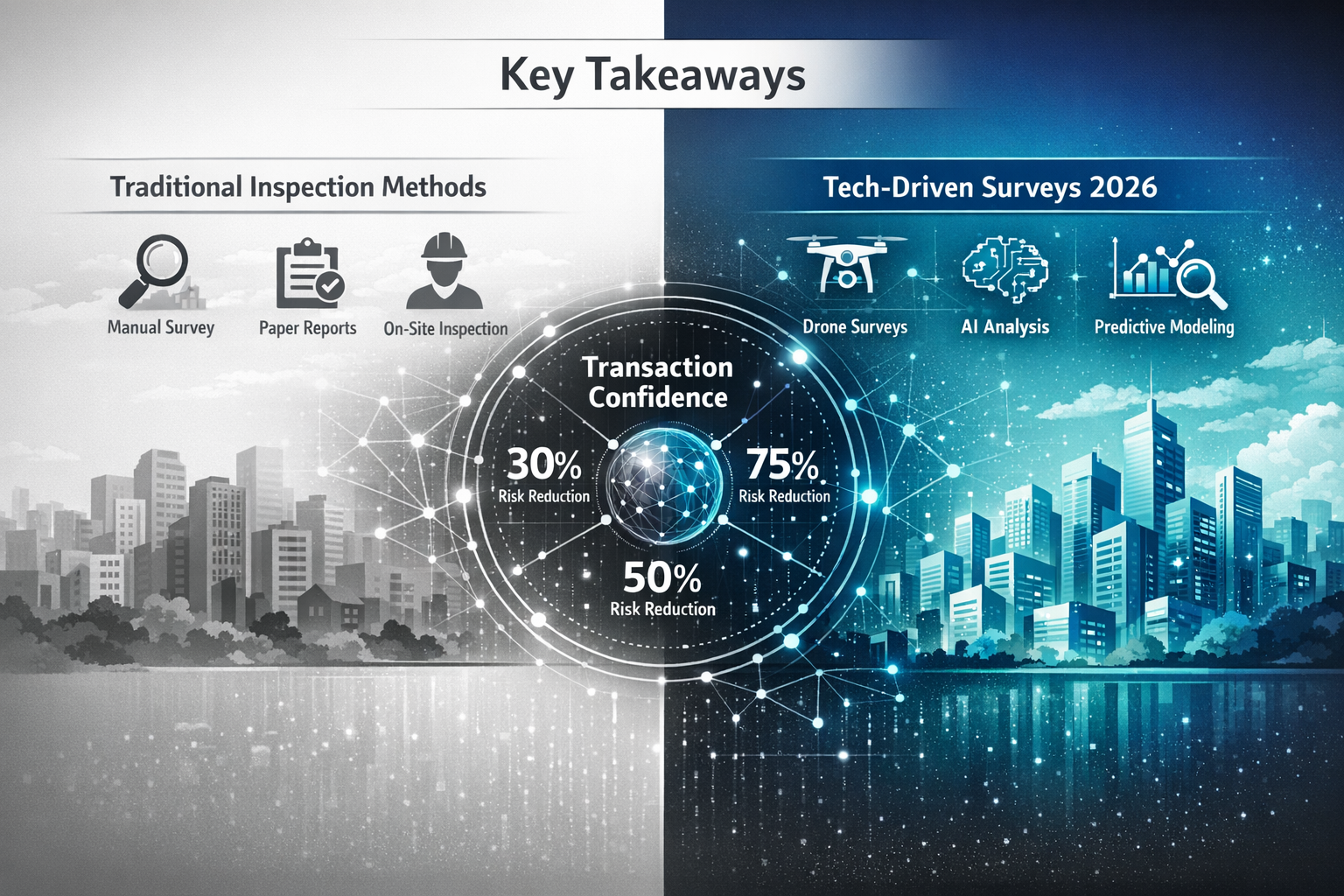
Key Takeaways
✅ Predictive technology integration: AI-powered forecasting and IoT sensors enable earlier risk visibility, flagging potential issues weeks before they impact property transactions.
✅ Standardized risk documentation: Comprehensive defect categorization with clear cost implications provides buyers and lenders with actionable confidence metrics.
✅ Real-time data validation: Modern building surveys incorporate thermal imaging, moisture detection, and structural monitoring that deliver measurable certainty rather than subjective opinions.
✅ Transaction acceleration: Enhanced survey protocols reduce negotiation delays by providing unambiguous evidence, supporting faster completion timelines.
✅ Regulatory compliance assurance: Systematic assessment frameworks ensure properties meet evolving building safety standards and lender requirements.
The Evolution of Building Surveys: From Reactive Inspection to Proactive Risk Management
Traditional Survey Limitations in High-Stakes Transactions
For decades, building surveys operated primarily as reactive documentation exercises—surveyors would inspect visible elements, note obvious defects, and provide cautious recommendations wrapped in liability-limiting language. This approach served its purpose in stable markets with predictable property conditions, but 2026's transaction environment demands far more sophisticated risk assessment.
The traditional model created several critical gaps:
- Limited defect prediction: Inspections captured current conditions but offered minimal insight into future deterioration patterns
- Subjective risk assessment: Severity ratings varied significantly between surveyors, creating uncertainty rather than resolving it
- Incomplete cost visibility: Repair estimates lacked the granularity needed for confident budgeting decisions
- Delayed issue discovery: Problems often emerged only after purchase completion, eroding buyer confidence
The 2026 Paradigm: Data-Driven Certainty
Modern RICS Building Surveys Level 3 now incorporate predictive analytics and continuous monitoring capabilities that transform uncertainty into measurable risk profiles. Construction firms are transitioning from reactive to predictive management using wearables, computer vision, drones, and robotics that identify workplace exposure in real time across jobsites.[2]
This technological integration extends directly to building survey practice:
| Traditional Approach | 2026 Enhanced Methodology |
|---|---|
| Visual inspection only | Multi-sensor data capture (thermal, moisture, structural) |
| Point-in-time assessment | Trend analysis with historical data comparison |
| Subjective condition ratings | Quantified risk scores with confidence intervals |
| Generic repair recommendations | Detailed specification with supplier-verified costs |
| Paper-based reporting | Interactive digital platforms with live updates |
Chartered surveyors now leverage the same predictive technologies reshaping the broader construction sector. AI platforms track supplier reliability, logistics congestion, pricing signals, and regional disruption indicators, enabling faster sourcing decisions and more reliable procurement planning.[2] When applied to building surveys, these capabilities translate into precise material cost forecasting and realistic repair timeline projections that eliminate the guesswork traditionally plaguing property transactions.
"The shift from subjective assessment to quantified risk scoring represents the most significant evolution in building survey practice in three decades. Clients don't want opinions—they want measurable certainty backed by verifiable data."
Certainty and Risk Mitigation in 2026 Building Surveys: Technology Integration and Standardized Protocols
AI-Powered Defect Detection and Risk Forecasting
Artificial intelligence systems are now flagging equipment, labor, weather, and supply risks weeks before they impact delivery, with continuous monitoring of cost, schedule, safety, and supply signals to support earlier response.[2] This capability directly addresses one of the most persistent challenges in property transactions: the discovery of unexpected defects after survey completion.
Modern chartered surveyors deploy AI-enhanced inspection tools that:
🔍 Analyze thousands of property images to identify defect patterns invisible to human inspection alone
📊 Compare current conditions against regional datasets to predict deterioration rates specific to property age, construction type, and local environmental factors
⚠️ Generate risk probability scores for major building systems (roofing, foundations, damp-proofing, electrical, plumbing) with confidence intervals
💰 Provide dynamic cost estimates that adjust automatically based on current material prices and contractor availability
This technology integration doesn't replace professional surveyor expertise—it amplifies it. The combination of experienced judgment and data-driven validation creates a level of transaction confidence previously unattainable in residential and commercial property markets.

Standardized Risk Classification Frameworks
Certainty and Risk Mitigation in 2026 Building Surveys: Addressing Industry Demand for Transaction Confidence requires consistent, universally understood risk communication. The industry has moved toward standardized classification systems that eliminate ambiguity:
Category 1 – No Action Required: Defects requiring no immediate work or ongoing maintenance only, with less than 0.5% probability of significant deterioration within 5 years.
Category 2 – Repairs Needed: Defects requiring future repair or replacement, but not urgent, with cost estimates provided in three scenarios (conservative, expected, optimistic) and recommended action timeline.
Category 3 – Urgent Action: Defects requiring immediate attention, either due to safety concerns or risk of rapid deterioration, with detailed specification for remediation and consequences of delayed action clearly quantified.
This framework extends across specialized assessments including damp surveys, roof surveys, and subsidence surveys, ensuring consistent risk communication regardless of survey scope or property type.
IoT Integration and Continuous Monitoring
By 2026, sensors, wearables, and connected equipment are shifting from optional add-ons to essential policy and contractual requirements to improve safety, reduce risk, and capture real-time project insights.[4] This transformation affects building surveys in two critical ways:
Pre-transaction monitoring: Properties listed for sale increasingly feature installed sensor networks that provide prospective buyers with months of historical data on moisture levels, temperature fluctuations, structural movement, and environmental conditions. This data enriches survey assessments with trend analysis rather than relying solely on single-visit observations.
Post-survey validation: Advanced RICS Building Surveys now include optional sensor installation recommendations, allowing new owners to monitor identified risk areas continuously. This creates an ongoing relationship between surveyor and client, with periodic data review confirming that predicted deterioration patterns align with actual conditions.
The integration of IoT technology addresses a fundamental limitation of traditional surveys: the snapshot problem. A single inspection visit captures conditions at one moment, potentially missing cyclical issues (seasonal damp, temperature-dependent structural movement, intermittent drainage problems) that only manifest under specific conditions.
Building Survey Protocols That Deliver Measurable Transaction Confidence
Comprehensive Documentation Standards
The demand for transaction confidence has elevated documentation quality from "adequate description" to "forensic evidence." Modern building survey reports function as comprehensive risk registers rather than simple defect lists, incorporating:
📸 High-resolution photographic evidence with precise location tagging, scale references, and multiple angles for each identified defect
📐 Dimensional measurements using laser scanning technology to document structural issues with millimeter precision
🔬 Laboratory analysis results for material samples (timber moisture content, masonry salt contamination, concrete carbonation, paint lead content) with certified testing protocols
📋 Regulatory compliance verification against current Building Regulations, fire safety standards, energy performance requirements, and accessibility guidelines
🔗 Third-party validation through specialist sub-contractor assessments for electrical systems, heating installations, drainage networks, and structural elements requiring engineering analysis
This documentation depth transforms surveys from subjective opinions into defensible evidence that withstands scrutiny from buyers, sellers, lenders, and legal representatives throughout the transaction process.
Cost Certainty and Budget Planning Integration
One of the most significant sources of transaction anxiety involves repair cost uncertainty. Buyers struggle to assess whether a property represents good value when faced with vague recommendations like "the roof will require attention in the medium term" or "damp-proofing works are advisable."
Certainty and Risk Mitigation in 2026 Building Surveys: Addressing Industry Demand for Transaction Confidence demands precise cost intelligence. Leading commercial building surveys and residential assessments now include:
- Itemized repair specifications with material quantities, labor hour estimates, and equipment requirements
- Three-scenario costing (conservative, expected, optimistic) reflecting market volatility and specification options
- Supplier-verified pricing through direct integration with construction material databases and contractor networks
- Timeline projections showing when repairs become urgent and how delayed action affects costs
- Financing options analysis comparing immediate repair versus negotiated price reduction strategies
This financial clarity enables buyers to make confident purchase decisions backed by realistic budget projections rather than fearful speculation about unknown future costs.

Lender Confidence and Mortgage Approval Acceleration
Mortgage lenders represent critical stakeholders in the transaction confidence equation. Their risk assessment directly determines loan approval, valuation figures, and lending terms. Traditional surveys often created friction in the mortgage process through ambiguous findings that triggered additional investigations, delayed completions, or reduced loan-to-value ratios.
Enhanced survey protocols specifically address lender requirements:
Structural integrity certification: Clear statements regarding load-bearing capacity, foundation stability, and structural safety that align with lender risk frameworks rather than hedged surveyor language.
Defect materiality assessment: Explicit categorization of whether identified issues affect property value, mortgageability, or insurance availability—the three factors lenders prioritize above all others.
Remediation feasibility confirmation: Verification that identified repairs are technically achievable within reasonable timeframes and budgets, preventing lender concerns about properties requiring specialized or prohibitively expensive interventions.
Comparable property analysis: Contextualization of defects against regional norms, demonstrating whether issues are exceptional (requiring price adjustment) or typical for property age and type (acceptable within market expectations).
This lender-focused approach complements comprehensive RICS Home Survey and RICS Homebuyer Surveys Level 2 protocols, ensuring that survey outputs directly support rather than obstruct the mortgage approval process.
Risk Mitigation Strategies: From Survey Findings to Transaction Completion
Negotiation Framework and Price Adjustment Protocols
Survey findings inevitably trigger negotiations between buyers and sellers. The quality of survey documentation directly influences negotiation efficiency and outcome fairness. Vague findings create protracted disputes; precise evidence enables swift resolution.
Effective risk mitigation strategies include:
Defect-adjusted valuation models: Quantified price reduction calculations based on repair costs, inconvenience factors, and market impact of disclosed defects, providing objective negotiation starting points.
Retention agreements: Structured approaches where purchase price proceeds are held in escrow pending completion of agreed remediation works, protecting both parties while enabling transaction completion.
Warranty solutions: Integration with specialist insurance products that cover specific identified risks (subsidence monitoring, historic structural repairs, non-standard construction materials), transferring risk from buyer to insurer.
Phased completion structures: Transaction frameworks allowing initial completion with contractual obligations for seller-funded repairs within defined timeframes, suitable for occupied properties where immediate access is problematic.
These structured approaches transform survey findings from deal-breakers into manageable negotiation points, maintaining transaction momentum while ensuring appropriate risk allocation between parties.
Specialized Assessment Integration
Complex properties require specialized expertise beyond general building survey scope. Certainty and Risk Mitigation in 2026 Building Surveys: Addressing Industry Demand for Transaction Confidence often necessitates coordinated multi-disciplinary assessment:
- Structural engineering analysis for properties with visible movement, unusual construction, or proposed alterations
- Environmental contamination testing for sites with industrial history or adjacent pollution sources
- Heritage building assessment for listed properties requiring conservation-compliant approaches
- Energy performance optimization evaluating retrofit potential and regulatory compliance pathways
- Boundary and title verification confirming legal ownership of structures and land parcels
Understanding survey pricing structures helps clients budget appropriately for comprehensive assessment packages that address all material risks rather than accepting false economy through limited-scope inspections.
Post-Survey Action Planning and Timeline Management
Survey delivery represents the beginning, not the end, of the risk mitigation process. Effective surveyors provide actionable roadmaps that guide clients from findings to resolution:
Immediate action items (0-30 days): Safety-critical repairs, temporary protective measures, and urgent investigations requiring specialist input before transaction completion.
Short-term priorities (1-6 months): Essential maintenance, weather-dependent repairs, and works best completed while property is vacant or during specific seasons.
Medium-term planning (6-24 months): Significant refurbishment projects, system replacements, and improvement works that benefit from detailed planning and competitive tendering.
Long-term considerations (2-10 years): Major capital expenditure items (roof replacement, repointing, window renewal) requiring financial planning and lifecycle management strategies.
This temporal framework transforms overwhelming defect lists into manageable action plans, reducing buyer anxiety and supporting informed decision-making throughout property ownership.
Industry Standards and Professional Differentiation in 2026
RICS Accreditation and Quality Assurance
The Royal Institution of Chartered Surveyors (RICS) maintains rigorous professional standards that directly address transaction confidence requirements. Choosing RICS Chartered Building Surveyors provides multiple assurance layers:
✔️ Mandatory professional indemnity insurance protecting clients against negligent advice or missed defects
✔️ Continuing professional development requirements ensuring surveyors maintain current knowledge of building pathology, construction technology, and regulatory changes
✔️ Standardized reporting frameworks creating consistency and comparability across different surveyor practices
✔️ Complaints and dispute resolution procedures providing recourse when service quality falls short of professional standards
✔️ Ethical conduct obligations preventing conflicts of interest and ensuring client interests receive priority
This professional infrastructure directly supports Certainty and Risk Mitigation in 2026 Building Surveys: Addressing Industry Demand for Transaction Confidence by establishing minimum competency thresholds and accountability mechanisms that protect transaction participants.
Emerging Specializations and Niche Expertise
As building survey practice becomes more sophisticated, specialist expertise increasingly differentiates service providers. Emerging specializations include:
Non-standard construction assessment: Properties built with unconventional materials (timber frame, concrete systems, steel frame) require specialized knowledge to evaluate properly and secure mortgage approval. Understanding non-standard construction challenges helps buyers avoid financing obstacles.
Heritage and conservation surveys: Listed buildings and properties in conservation areas demand expertise in traditional construction methods, appropriate repair techniques, and regulatory compliance pathways.
Commercial and mixed-use properties: Multi-occupancy buildings, retail premises, and commercial spaces require understanding of business use implications, regulatory compliance, and investment value factors beyond residential considerations.
Climate resilience assessment: Evaluating flood risk, overheating potential, energy efficiency, and climate adaptation requirements increasingly influences property value and insurability.
Technology-enhanced inspection: Drone surveys, thermal imaging, moisture mapping, and 3D scanning require specialized equipment operation skills and data interpretation expertise.
Competitive Differentiation Through Enhanced Service Delivery
Building surveyors seeking to capture market share in 2026's competitive environment differentiate through value-added service elements that exceed basic inspection requirements:
📱 Digital client portals: Interactive platforms allowing clients to access reports, view photographic evidence, track recommended actions, and communicate with surveyors throughout the transaction process.
🎥 Video walkthroughs: Recorded property tours with narrated defect explanations, helping remote buyers and family advisors understand findings more effectively than written reports alone.
📊 Comparative market analysis: Contextualization of findings against similar properties, helping buyers assess whether identified issues justify price adjustments or represent normal conditions for property type.
🔄 Post-purchase support: Follow-up consultations after completion, contractor recommendation services, and periodic check-ins to verify that predicted deterioration patterns align with actual conditions.
💼 Integrated transaction services: Coordination with conveyancers, mortgage brokers, and contractors to streamline the entire purchase process rather than operating in isolation.
These enhanced service models reflect broader construction industry trends where client relationship management and digital engagement increasingly determine competitive success alongside technical competency.
Future Outlook: Evolving Standards and Regulatory Developments
Building Safety Act Implications
The UK's Building Safety Act continues to reshape property transaction requirements, particularly for multi-occupancy residential buildings. Survey protocols must now address:
- Fire safety compliance verification including cladding assessments, compartmentation integrity, and means of escape adequacy
- Building safety certificate status confirming regulatory compliance for higher-risk buildings
- Historical building control approval documentation verifying that past alterations received appropriate permissions
- Ongoing maintenance and inspection regimes assessing whether building owners maintain adequate safety management systems
These requirements extend traditional survey scope significantly, creating additional transaction complexity that professional surveyors must navigate while maintaining service efficiency and cost-effectiveness.
Climate Disclosure and Energy Performance Requirements
Environmental regulations increasingly influence property transactions. Enhanced survey protocols address:
Energy Performance Certificate (EPC) implications: Analysis of current ratings, improvement pathways, and regulatory compliance timelines as minimum standards rise toward net-zero targets.
Climate risk disclosure: Flood risk, coastal erosion, ground stability, and extreme weather vulnerability assessments that affect insurance availability and long-term property value.
Retrofit potential evaluation: Assessment of practical and economic feasibility for energy efficiency improvements, renewable energy installation, and low-carbon heating system conversion.
Embodied carbon considerations: For environmentally conscious buyers, evaluation of building materials, construction methods, and lifecycle sustainability factors beyond operational energy consumption.
These evolving requirements demonstrate that Certainty and Risk Mitigation in 2026 Building Surveys: Addressing Industry Demand for Transaction Confidence extends beyond traditional structural and condition assessment into broader sustainability and regulatory compliance domains.
Technology Adoption Trajectories
Construction industry technology trends provide clear indicators of building survey evolution:
Modular construction improves cost predictability: Firms using modular methods report time savings of up to 50 percent on certain build phases, with improved cost control through reduced material waste and weather dependencies.[1] As modular and modern methods of construction become more prevalent, surveyors require specialized knowledge to assess these non-traditional building types appropriately.
Supply chain resilience strengthened through data monitoring: Real-time tracking of material availability, pricing volatility, and logistics constraints enables more accurate repair cost forecasting and timeline projections.[2]
Autonomous inspection technologies: Drone surveys, robotic crawlers for confined spaces, and AI-powered image analysis reduce inspection time while improving defect detection consistency and documentation quality.
These technological advances will continue reducing survey costs while improving output quality, making comprehensive professional assessments accessible to broader market segments and further elevating transaction confidence expectations.
Conclusion: Delivering Transaction Confidence Through Professional Excellence
Certainty and Risk Mitigation in 2026 Building Surveys: Addressing Industry Demand for Transaction Confidence represents far more than incremental service improvement—it reflects fundamental transformation in how property professionals deliver value in risk-averse markets. The integration of predictive technology, standardized protocols, and comprehensive documentation creates measurable confidence that traditional survey approaches could never achieve.
For buyers, enhanced survey methodologies provide clear-eyed property assessment that supports confident purchase decisions backed by quantified risk profiles and realistic cost projections. For sellers, comprehensive documentation demonstrates property condition transparently, reducing negotiation friction and supporting fair valuations. For lenders, standardized risk classification and defect materiality assessment accelerates mortgage approval while protecting loan security.
The construction industry's broader embrace of AI-powered forecasting, IoT monitoring, and data-driven decision-making demonstrates that these approaches deliver tangible value beyond theoretical promise. As 71% of construction executives express optimism about industry direction,[5] that confidence stems directly from enhanced visibility, predictability, and control that modern technology enables.
Actionable Next Steps
For property buyers and sellers seeking transaction confidence:
- Engage RICS-qualified surveyors with demonstrated expertise in technology-enhanced assessment methodologies and comprehensive reporting protocols
- Request detailed cost intelligence including itemized repair specifications with three-scenario pricing rather than accepting vague recommendations
- Prioritize properties with existing monitoring data where available, leveraging historical trend information to validate survey findings
- Integrate specialist assessments for complex issues rather than relying on general survey scope for specialized technical matters
- Utilize survey findings proactively in negotiations, employing structured frameworks for price adjustment or retention agreements based on quantified evidence
For building surveyors seeking competitive differentiation:
- Invest in technology infrastructure including thermal imaging, moisture detection, drone capabilities, and digital reporting platforms
- Develop standardized risk classification frameworks that provide clients with clear, actionable intelligence rather than ambiguous findings
- Build specialist expertise in emerging areas including non-standard construction, heritage buildings, climate resilience, and building safety compliance
- Create value-added service packages incorporating post-survey support, contractor coordination, and ongoing monitoring recommendations
- Establish lender relationships by demonstrating how enhanced protocols accelerate mortgage approval and reduce transaction friction
The evolution of building surveys from reactive inspection to proactive risk management positions professional surveyors as essential transaction facilitators rather than optional service providers. In markets demanding unprecedented certainty, those who deliver measurable confidence through data-driven assessment, standardized protocols, and comprehensive documentation will capture increasing market share while advancing industry professionalism.
The future of property transactions depends on trusted intelligence, verified evidence, and quantified risk assessment—precisely the capabilities that define excellence in 2026 building survey practice.
References
[1] Construction Trends 2026 Protect Margins Reduce Risk – https://starcsystems.com/blog/construction-trends-2026-protect-margins-reduce-risk/
[2] How Construction Firms Are Proactively Mitigating Risk – https://cmicglobal.com/resources/article/How-Construction-Firms-are-Proactively-Mitigating-Risk
[4] 2026 Construction Trends 25 Experts Share Insights – https://www.autodesk.com/blogs/construction/2026-construction-trends-25-experts-share-insights/
[5] Global Construction Survey 2025 2026 – https://kpmg.com/cn/en/insights/2026/03/global-construction-survey-2025-2026.html