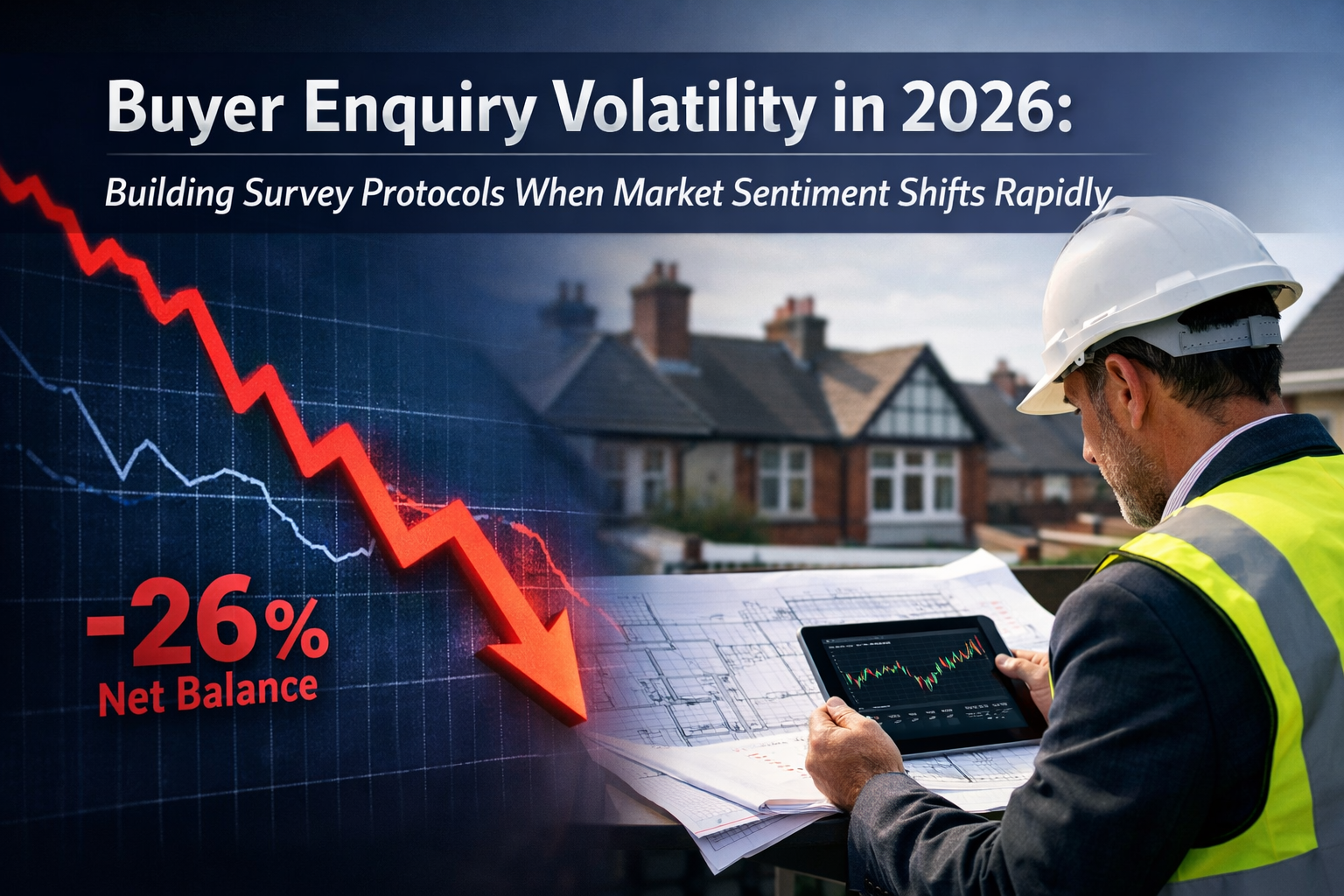
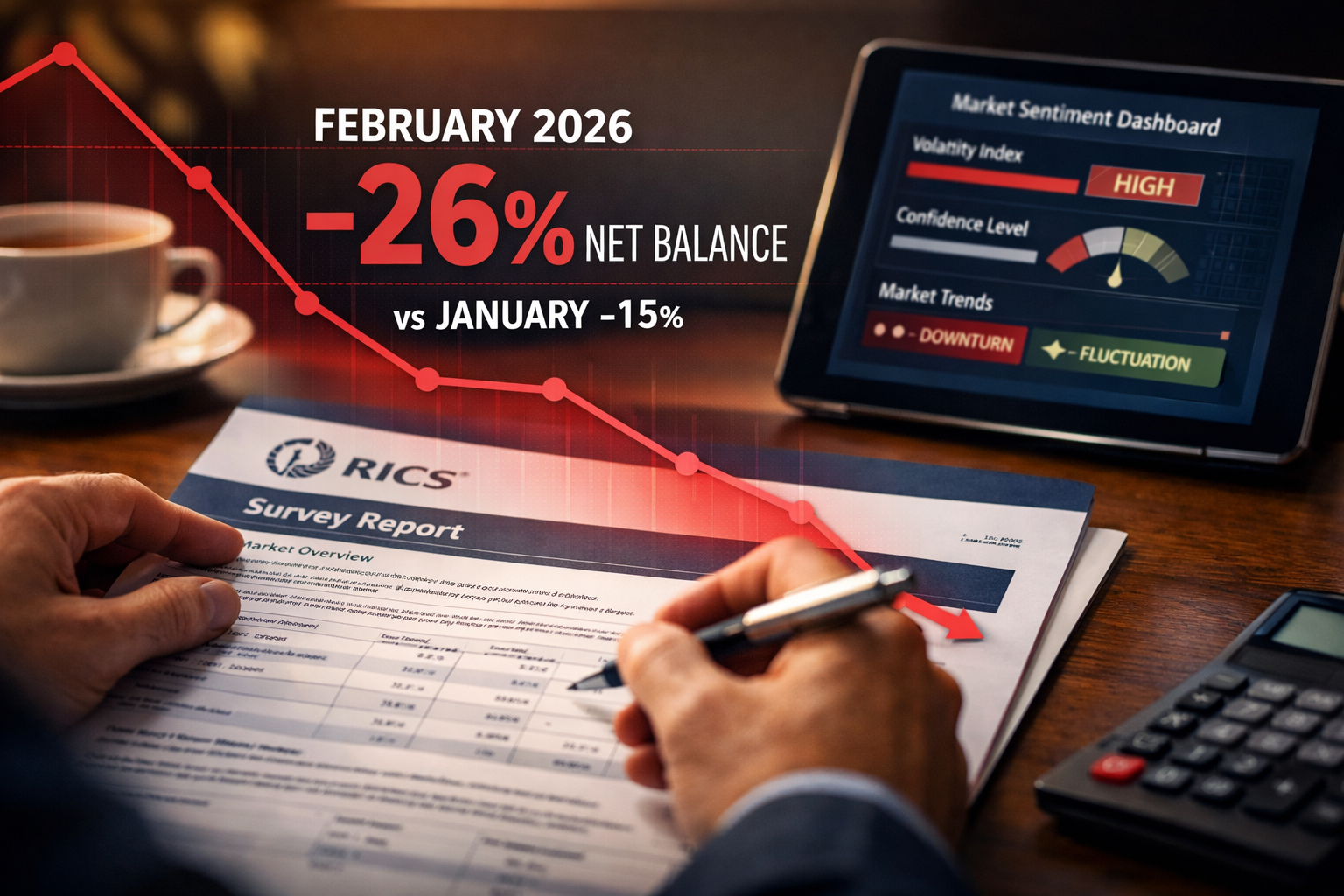
The property market in 2026 has entered uncharted territory. Recent RICS data reveals buyer enquiries plummeted to a -26% net balance in February 2026, a sharp decline from -15% in January. This dramatic shift signals more than a seasonal dip—it represents a fundamental challenge for surveyors navigating Buyer Enquiry Volatility in 2026: Building Survey Protocols When Market Sentiment Shifts Rapidly. As market confidence wavers and economic uncertainty deepens, chartered surveyors must fundamentally rethink how they assess properties, communicate findings, and serve clients in an environment where sentiment can shift overnight.
The volatility affecting property markets isn't isolated. Institutional investors forecast a 74% probability of broader market corrections, with extreme volatility expected across stocks, bonds, and currency[4]. This structural uncertainty—driven by climate change, geopolitical tensions, and economic pressures—requires surveyors to develop resilient protocols that remain effective regardless of market conditions[1].
Key Takeaways
- 📉 Buyer enquiries dropped to -26% net balance in February 2026, marking a significant deterioration in market sentiment that demands immediate protocol adjustments
- 🔄 Market volatility is structural, not cyclical, requiring surveyors to build permanent flexibility into assessment and communication frameworks
- 📊 Enhanced data collection and real-time market intelligence are now essential components of professional survey protocols
- 💬 Transparent, frequent communication helps maintain client confidence during periods of rapid sentiment shifts
- 🛡️ Multi-scenario risk assessment protects both surveyors and clients from unexpected market corrections
Understanding Buyer Enquiry Volatility in 2026: The New Market Reality
The Scale of Current Market Uncertainty
The property market's current volatility reflects broader economic turbulence affecting multiple sectors. The construction industry projects only 2.0% growth in non-residential spending for 2026, constrained by policy shifts and supply chain disruptions[2]. More concerning, tariffs on imported materials threaten to increase direct construction costs by 5-10%, with copper prices surging over 40% in 2025 alone[2].
For surveyors, these economic headwinds translate into unpredictable buyer behavior. When enquiries can drop 11 percentage points in a single month, traditional survey protocols—designed for stable markets—become inadequate. Homebuilders themselves report that demand uncertainty is fundamentally reshaping their land strategy and capital planning[3].
Why This Volatility Differs from Previous Cycles
Unlike cyclical downturns that eventually revert to mean, 2026's volatility is "structural and baked into the system"[1]. Several converging factors create persistent unpredictability:
- Climate-related risks affecting property valuations and insurance availability
- Escalating liability pressures including "nuclear verdicts" exceeding $10 million[1]
- Geopolitical instability now ranking as the top concern among institutional investors (49%)[4]
- Labor market pessimism with over 50% of risk leaders expecting weaker employment conditions[5]
This structural nature means surveyors cannot simply "wait out" the volatility. Instead, they must embed flexibility and rapid response capabilities into their core operating procedures.
The Impact on Survey Demand and Client Expectations
When buyer enquiries decline sharply, survey demand naturally follows. However, the clients who do proceed with building surveys or RICS HomeRuyer surveys arrive with heightened anxiety and elevated expectations.
These clients typically:
- Demand more detailed risk assessments and worst-case scenarios
- Request faster turnaround times to capitalize on fleeting opportunities
- Seek explicit guidance on whether to proceed with purchases
- Expect surveyors to contextualize findings within current market conditions
- Require more frequent communication throughout the assessment process
Meeting these expectations requires fundamental protocol adjustments that balance thoroughness with agility.
Building Adaptive Survey Protocols for Volatile Markets
Enhanced Data Collection and Market Intelligence Integration
Modern survey protocols must incorporate real-time market intelligence alongside traditional property assessment. This means surveyors need access to:
Essential Data Streams:
| Data Category | Key Metrics | Update Frequency |
|---|---|---|
| Market Sentiment | RICS buyer enquiry balance, transaction volumes | Monthly |
| Economic Indicators | Interest rates, inflation, construction costs | Weekly |
| Local Market Conditions | Area-specific demand, comparable sales | Daily |
| Material Costs | Copper, steel, timber pricing trends | Weekly |
| Insurance Availability | Coverage gaps, premium trends | Quarterly |
Integrating this data requires "analytics and a more connected risk operating model"[1] that allows surveyors to contextualize physical property conditions within broader market dynamics.
For example, when conducting a structural survey that identifies £15,000 in necessary repairs, the surveyor should now also assess:
- Whether current material cost inflation might increase that estimate by 5-10%[2]
- If the property's location faces emerging climate risks affecting insurability
- How comparable properties are performing in the current volatile market
- Whether the repair timeline might be extended due to labor market constraints[5]
Flexible Communication Frameworks for Rapid Sentiment Shifts
Communication protocols must now accommodate three distinct scenarios:
- Stable periods – Standard reporting timelines and formats
- Moderate volatility – Enhanced commentary on market context, expedited preliminary findings
- Extreme volatility – Real-time updates, scenario planning, frequent client touchpoints
"Risk leaders require data, analytics and a more connected risk operating model to understand exposure, assess alternatives, and build long-term resilience in response to converging volatility."[1]
This principle applies equally to surveyors serving anxious property buyers. Consider implementing:
✅ Preliminary findings calls within 48 hours of site inspection
✅ Market context briefings explaining how current volatility affects the property
✅ Scenario-based recommendations outlining options under different market conditions
✅ Post-report consultation to address questions as market conditions evolve
Surveyors operating across regions—from chartered surveyors in London to chartered surveyors in Hertfordshire—should tailor communication frequency to local market volatility levels.
Multi-Scenario Risk Assessment Methodologies
Traditional survey reports present findings as static assessments. In volatile markets, surveyors must adopt multi-scenario frameworks that acknowledge uncertainty:
Scenario 1: Market Stabilization 🟢
Property condition findings, standard repair recommendations, typical timeline expectations
Scenario 2: Continued Volatility 🟡
Adjusted cost estimates reflecting material inflation, extended timelines, insurance considerations
Scenario 3: Market Correction 🔴
Impact on property value, negotiation leverage, potential for deferred maintenance
This approach mirrors strategies used by institutional investors who now expect extreme volatility across asset classes[4]. By presenting multiple scenarios, surveyors help clients make informed decisions regardless of how market conditions evolve.
Implementing Buyer Enquiry Volatility Protocols: Practical Steps for Surveyors
Adapting Assessment Procedures for Uncertain Markets
When market sentiment shifts rapidly, survey procedures must balance thoroughness with efficiency. The goal is maintaining professional standards while acknowledging clients' urgency during volatile periods.
Priority Assessment Framework:
🔴 Critical (Immediate Assessment Required)
- Structural integrity issues affecting safety
- Damp and water ingress with potential for rapid deterioration
- Subsidence or settlement concerns
- Roof condition and weatherproofing
- Essential services functionality
🟡 Important (Standard Timeline)
- Cosmetic repairs and updates
- Energy efficiency improvements
- Minor maintenance items
- Upgrade opportunities
🟢 Deferred (Can Be Addressed Post-Purchase)
- Aesthetic enhancements
- Non-urgent improvements
- Future-proofing considerations
This prioritization helps clients understand what demands immediate attention versus what can wait—crucial information when buyer confidence is fragile and decision-making windows are narrow.
For commercial building surveys, this framework becomes even more critical as business clients face their own operational volatility and need clear risk hierarchies.
Technology Integration for Real-Time Market Responsiveness
Modern surveyors must leverage technology to maintain agility during volatile periods:
Essential Technology Stack:
- Digital survey platforms enabling real-time note-taking and photo documentation
- Cloud-based reporting systems allowing instant draft sharing with clients
- Market data integrations providing live construction cost and material pricing
- Client portals facilitating transparent communication and document access
- Mobile inspection tools including drone surveys for rapid comprehensive assessment
These tools enable surveyors to compress timelines without sacrificing quality—essential when buyers need to make rapid decisions before market conditions deteriorate further.
Building Client Trust Through Transparent Volatility Communication
The most successful surveyors in 2026 are those who acknowledge uncertainty rather than pretending it doesn't exist. Clients appreciate honesty about market conditions and how they might affect property decisions.
Effective volatility communication includes:
📱 Regular market updates – Brief emails or messages when significant market shifts occur
📊 Data-driven context – Showing clients the RICS enquiry data, local transaction volumes, and trend analysis
🎯 Clear recommendations – Explicit guidance on whether to proceed, negotiate, or reconsider
⚖️ Balanced perspectives – Presenting both risks and opportunities in current conditions
🔄 Follow-up availability – Remaining accessible as clients process information and market conditions evolve
This approach builds lasting client relationships that extend beyond individual transactions. When surveyors demonstrate they understand market dynamics and genuinely prioritize client interests, they earn referrals and repeat business even during challenging periods.
Diversifying Service Offerings to Match Market Conditions
Just as institutional investors are advised to "diversify carrier panels and pursue multi-year agreements"[1] to hedge against volatility, surveyors should diversify their service mix to maintain stability during enquiry fluctuations.
Complementary services that remain in demand during volatile periods:
- Subsidence surveys for properties with specific concerns
- Drainage surveys addressing critical infrastructure
- Asbestos surveys required for older properties
- RICS valuations for refinancing and estate planning
- Dilapidation surveys for commercial lease obligations
These specialized services often maintain steadier demand because they're driven by legal requirements, maintenance necessities, or regulatory compliance rather than discretionary purchase decisions.

Regional Considerations: Adapting Protocols Across Different Markets
Geographic Volatility Variations
Buyer enquiry volatility doesn't affect all regions equally. Surveyors must recognize that market sentiment in South East London may differ significantly from conditions in Surrey or Buckinghamshire.
Factors creating regional volatility differences:
- Local employment conditions – Areas with diverse employment bases show more resilience
- Transport infrastructure – Regions with strong connectivity maintain steadier demand
- Housing stock characteristics – Areas with newer, energy-efficient properties face less climate-related concern
- Economic diversity – Regions dependent on single industries experience greater volatility
- Development pipeline – Areas with substantial new construction face different supply-demand dynamics
Surveyors operating across multiple regions should develop location-specific protocol variations that reflect these differences. What works for chartered surveyors in Chelsea may require adjustment for chartered surveyors in Harrow.
Urban Versus Suburban Market Dynamics
The volatility patterns differ markedly between urban and suburban markets in 2026:
Urban Markets (London, Manchester city centers):
- Higher transaction volumes create more data points for assessment
- Greater price sensitivity to interest rate changes
- More diverse buyer profiles (investors, first-time buyers, downsizers)
- Faster sentiment shifts due to concentrated market attention
Suburban Markets (Home Counties, outer regions):
- Lower transaction volumes amplify individual sale impacts
- Greater emphasis on space and family-oriented features
- More stable buyer demographics but smaller buyer pools
- Slower sentiment shifts but potentially deeper corrections
Surveyors should adjust their survey protocols based on these dynamics, with urban properties requiring more frequent market context updates and suburban properties needing deeper comparable analysis due to limited transaction data.
Long-Term Resilience: Preparing for Sustained Volatility
Building Organizational Capabilities for Ongoing Uncertainty
Since market volatility is structural rather than cyclical[1], surveying practices must develop permanent capabilities rather than temporary adjustments:
Essential organizational investments:
- Continuous market intelligence systems – Subscriptions to data services, RICS reports, economic forecasting
- Staff training programs – Regular updates on market conditions, communication skills, scenario planning
- Technology infrastructure – Cloud systems, mobile tools, client portals that enable rapid response
- Flexible resource allocation – Ability to scale capacity up or down based on enquiry fluctuations
- Strategic partnerships – Relationships with specialists who can provide rapid consultation on complex issues
These investments transform volatility from a threat into a competitive advantage. Practices that can respond quickly and effectively to market shifts will capture market share from less adaptable competitors.
Professional Development for Volatile Market Expertise
Surveyors themselves need new competencies beyond traditional technical skills:
Critical skills for 2026 and beyond:
🎓 Economic literacy – Understanding how macroeconomic factors affect property markets
📊 Data interpretation – Analyzing market trends and translating them into actionable insights
💬 Advanced communication – Explaining complex, uncertain situations to anxious clients
🔮 Scenario planning – Developing multiple outcome pathways and probability assessments
🤝 Consultative selling – Positioning surveys as risk management tools rather than compliance requirements
Professional bodies like RICS should develop specialized training addressing these competencies, recognizing that technical property assessment skills alone are insufficient in structurally volatile markets.
Client Education as Risk Management
Educated clients make better decisions and experience less anxiety during volatile periods. Surveyors should invest in proactive client education through:
- Market briefing newsletters explaining current conditions and implications
- Educational content on websites and social media addressing common concerns
- Pre-survey consultations setting realistic expectations about market uncertainty
- Post-survey debriefings ensuring clients understand findings in market context
- Resource libraries providing access to market data, trend analysis, and decision frameworks
This educational approach positions surveyors as trusted advisors rather than transactional service providers—a critical distinction when clients face difficult decisions in uncertain markets.
Conclusion: Thriving Through Buyer Enquiry Volatility in 2026
The dramatic decline in buyer enquiries to -26% net balance in February 2026 represents more than a challenging market moment—it signals a fundamental shift requiring surveyors to reimagine their protocols, communication strategies, and value propositions. Buyer Enquiry Volatility in 2026: Building Survey Protocols When Market Sentiment Shifts Rapidly isn't just about surviving turbulent conditions; it's about developing resilient practices that deliver exceptional client value regardless of market sentiment.
The evidence is clear: volatility is structural, driven by climate change, geopolitical instability, and economic pressures that won't resolve quickly[1]. Institutional investors expect continued extreme volatility across asset classes[4], and construction markets face sustained headwinds from material cost inflation and policy uncertainty[2]. Property markets cannot remain insulated from these broader forces.
Surveyors who will thrive in this environment are those who:
✅ Integrate real-time market intelligence into traditional property assessment
✅ Communicate transparently about uncertainty rather than pretending it doesn't exist
✅ Provide multi-scenario analysis helping clients make informed decisions
✅ Leverage technology to maintain quality while increasing responsiveness
✅ Diversify service offerings to maintain stability during enquiry fluctuations
✅ Invest in continuous professional development addressing new competencies
Actionable Next Steps
For Individual Surveyors:
- Subscribe to RICS market intelligence reports and economic forecasting services
- Implement preliminary findings calls within 48 hours of site inspections
- Develop scenario-based reporting templates for your practice
- Schedule monthly reviews of local market conditions and adjust protocols accordingly
- Invest in mobile survey technology enabling real-time client updates
For Survey Practices:
- Establish formal market monitoring procedures with designated responsibility
- Create communication protocols for different volatility levels
- Develop staff training programs addressing economic literacy and scenario planning
- Build strategic partnerships with specialists for rapid consultation
- Implement client education initiatives positioning your practice as market experts
For Clients:
- Engage surveyors early in the purchase process to understand current market dynamics
- Request scenario-based analysis addressing multiple potential market outcomes
- Maintain regular communication with your surveyor as conditions evolve
- Consider complementary assessments like drainage surveys or structural engineering reviews for comprehensive risk assessment
- View surveys as risk management investments rather than compliance expenses
The property market of 2026 demands more from surveyors than technical competence alone. It requires market intelligence, communication excellence, technological sophistication, and genuine partnership with clients navigating uncertainty. Those who embrace these challenges will not only survive the current volatility but emerge as indispensable advisors in an increasingly complex property landscape.
The -26% buyer enquiry balance isn't just a statistic—it's a call to action for the entire surveying profession to evolve, adapt, and deliver the sophisticated guidance that 2026's property market demands.
References
[1] 2026 Pnc Outlook Navigating Volatility Unlocking Growth – https://www.aon.com/en/insights/articles/2026-pnc-outlook-navigating-volatility-unlocking-growth
[2] Construction Market Outlook 2026 – https://www.gallagherbassett.com/-/media/files/gallagher-bassett/us/news-and-insights/construction-market-outlook-2026.pdf
[3] Survey Reveals Demand Uncertainty Is Changing 2026 Homebuilding Strategy – https://www.housingwire.com/articles/survey-reveals-demand-uncertainty-is-changing-2026-homebuilding-strategy/
[4] Institutional Outlook – https://www.im.natixis.com/en-us/insights/investor-sentiment/2025/institutional-outlook
[5] Economic Volatility Dominates 2026 Emerging Risks As Ai Looms Long Term – https://riskandinsurance.com/economic-volatility-dominates-2026-emerging-risks-as-ai-looms-long-term/