The renovation boom sweeping across the UK in 2026 has created unprecedented demand for party wall services. As homeowners rush to extend, convert, and modernize their properties, the need for bulletproof party wall awards has never been more critical. Yet many surveyors still draft awards that crumble under scrutiny, leading to costly disputes, enforcement challenges, and professional liability claims.
Drafting Enforceable Party Wall Awards: RICS Best Practices for 2026 High-Volume Renovations requires a sophisticated understanding of both legal frameworks and practical construction realities. With regulatory reforms driving increased activity and neighbors more aware of their rights than ever before, surveyors must elevate their documentation standards to meet contemporary demands. This comprehensive guide explores the essential elements of creating awards that withstand challenge, protect all parties, and facilitate smooth project completion.
Key Takeaways
✅ Comprehensive documentation including detailed schedules of condition, photographic evidence, and precise technical specifications forms the foundation of enforceable awards
✅ Strict timeline compliance with the 2-month notice period and 14-day response window prevents procedural challenges that can invalidate entire awards
✅ RICS professional standards require surveyors to maintain quasi-judicial impartiality while delivering technically sound, legally defensible documentation
✅ Clear dispute resolution mechanisms built into award structures provide pathways for addressing conflicts without resorting to costly litigation
✅ Regular post-completion inspections and condition monitoring ensure compliance and provide evidence for resolving damage claims
Understanding the Legal Framework for Party Wall Awards in 2026
The Party Wall etc. Act 1996 remains the cornerstone legislation governing party wall matters across England and Wales in 2026. However, the interpretation and application of this framework has evolved significantly through case law and professional guidance updates. Understanding these nuances is essential for drafting effective party wall documentation.
The Three Types of Notifiable Works
Party wall procedures apply to three distinct categories of construction work:
- Section 1 Works: Building new walls on the boundary line between properties
- Section 2 Works: Alterations, repairs, or modifications to existing party walls and structures
- Section 6 Works: Excavations within three or six meters of neighboring structures (governed by the 3-metre rule)
Each category requires different notice formats and triggers distinct procedural requirements. Awards must clearly identify which sections apply and address the specific requirements for each work type.
RICS Professional Standards and Accountability
The Royal Institution of Chartered Surveyors (RICS) sets rigorous standards for party wall surveyors operating in 2026. Members must comply with RICS Rules of Conduct and can be held accountable for incompetence or bad faith, even when acting in their quasi-judicial capacity as appointed surveyors[1].
This professional accountability extends beyond simple technical competence. Surveyors must demonstrate:
- Impartiality when appointed by both parties or as the Third Surveyor
- Technical expertise in construction methods and structural implications
- Legal knowledge of procedural requirements and statutory obligations
- Communication skills to facilitate agreement between parties
- Documentation precision to create enforceable, unambiguous awards
The consequences of substandard work have intensified in 2026, with increased scrutiny from both professional bodies and the courts. Understanding what constitutes a party wall dispute helps surveyors anticipate and prevent common pitfalls.
Essential Components of Drafting Enforceable Party Wall Awards: RICS Best Practices for 2026 High-Volume Renovations
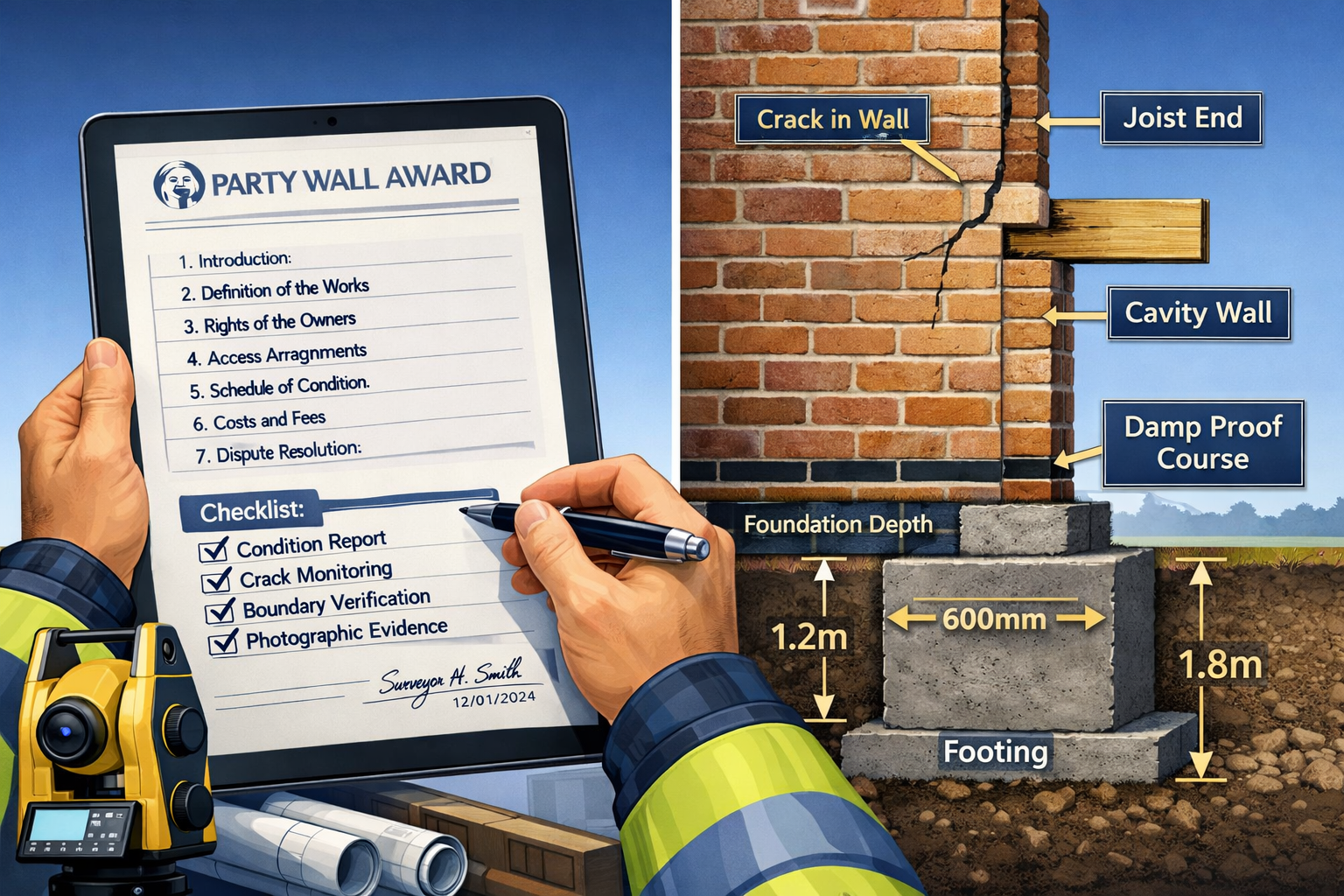
Creating awards that withstand legal challenge requires meticulous attention to specific components. Each element serves a distinct purpose in establishing rights, obligations, and remedies for all parties involved.
Comprehensive Property Inspections and Condition Recording
The foundation of any enforceable award begins with thorough property inspections. Party wall surveys must include inspections of both adjoining properties, not merely the building owner's side[1]. This bilateral approach provides:
- Baseline evidence for future damage claims
- Structural context for assessing work impacts
- Photographic documentation establishing pre-work conditions
- Technical data informing construction methodology decisions
A robust schedule of condition should document:
| Component | Documentation Required |
|---|---|
| Structural Elements | Cracks, settlement, wall alignment, foundation condition |
| Finishes | Plasterwork, decorations, flooring, ceiling condition |
| Services | Visible pipes, cables, heating systems, drainage |
| External Features | Boundary walls, paving, landscaping, outbuildings |
| Photographic Evidence | Timestamped images with clear reference points |
The schedule must be sufficiently detailed to distinguish between pre-existing conditions and damage to property during party wall works. Vague descriptions create enforcement difficulties when disputes arise.
Precise Technical Specifications and Work Descriptions
Awards must contain unambiguous descriptions of proposed works, including:
- Construction methods and sequencing
- Materials specifications and quality standards
- Structural support measures during works
- Access requirements and working hours
- Duration estimates with reasonable completion timelines
Avoid generic language like "appropriate methods will be used." Instead, specify: "Underpinning will be executed using mass concrete fill in 1-meter sequential bays, with 7-day curing periods between adjacent sections."
This precision serves multiple purposes:
✔️ Limits scope creep by defining exactly what is authorized
✔️ Facilitates compliance monitoring with clear performance standards
✔️ Reduces interpretation disputes between parties
✔️ Provides enforcement benchmarks if works deviate from agreement
For complex projects like loft conversions or work involving shared chimneys, technical specifications become even more critical to enforceability.
Clear Rights, Obligations, and Remedies
Enforceable awards explicitly define what each party can and cannot do. This includes:
Building Owner Obligations:
- Provide reasonable notice of work commencement
- Execute works in accordance with award specifications
- Minimize disruption and maintain site safety
- Bear costs as allocated in the award
- Restore any damage caused by works
Adjoining Owner Rights:
- Access for inspection at reasonable times
- Notification of significant deviations from approved methods
- Compensation for proven damage
- Right to appoint surveyors to monitor compliance
- Remedies if building owner breaches award terms
Surveyor Responsibilities:
- Monitor work progress and compliance
- Resolve disputes arising during execution
- Certify completion and condition restoration
- Document any variations or additional works
The award should specify remedy mechanisms for breach, including inspection rights, work suspension provisions, and compensation calculation methods.
Timeline Compliance and Procedural Requirements for 2026 Awards

Procedural defects represent the most common cause of unenforceable awards. Even technically perfect documentation fails if statutory timelines and notice requirements are not meticulously followed.
The Two-Month Notice Requirement
Neighbors must receive written notice at least two months before construction begins[1]. This timeline is mandatory for most party wall works, with limited exceptions. The notice must:
- Clearly identify the proposed works
- Specify the intended start date
- Describe the nature and extent of works
- Include relevant plans and specifications
- Identify the building owner and property address
⚠️ Common Pitfall: Counting two months from notice preparation rather than service. The clock starts when the adjoining owner receives the notice, not when it's drafted or posted.
The 14-Day Response Window
Upon receiving notice, adjoining owners have 14 days to consent or dissent[1]. This period is strictly calculated and cannot be extended unilaterally. During this window:
- Consent allows works to proceed without formal award
- Dissent triggers the surveyor appointment process
- No response is deemed dissent after 14 days expire
Surveyors must carefully document response dates and maintain evidence of service. When no party wall notice is served or timelines are violated, the entire process may need restarting.
Documentation and Service Requirements
Proper service of notices and awards is essential for enforceability. Best practices in 2026 include:
- Multiple service methods: Hand delivery with signed receipt, recorded delivery post, and email confirmation
- Proof of service: Maintain delivery receipts, postal tracking, and photographic evidence
- Clear addressing: Ensure notices reach all relevant adjoining owners, including tenants with qualifying interests
- Complete documentation: Include all referenced plans, specifications, and supporting documents
For high-volume renovation projects, establishing systematic service protocols prevents procedural failures that invalidate awards. Understanding the cost of party wall procedures helps building owners budget appropriately for proper documentation.
Award Finalization and Service
Once surveyors agree on award terms, the document must be:
- Signed by all appointed surveyors (or the Third Surveyor if applicable)
- Served on both building and adjoining owners within reasonable timeframes
- Accompanied by explanatory documentation clarifying rights and obligations
- Filed with supporting evidence including schedules of condition and technical specifications
The award becomes enforceable upon proper service to all parties. However, enforceability depends on substantive compliance with both procedural and technical requirements.
Drafting Enforceable Party Wall Awards: RICS Best Practices for 2026 High-Volume Renovations – Dispute Prevention and Resolution
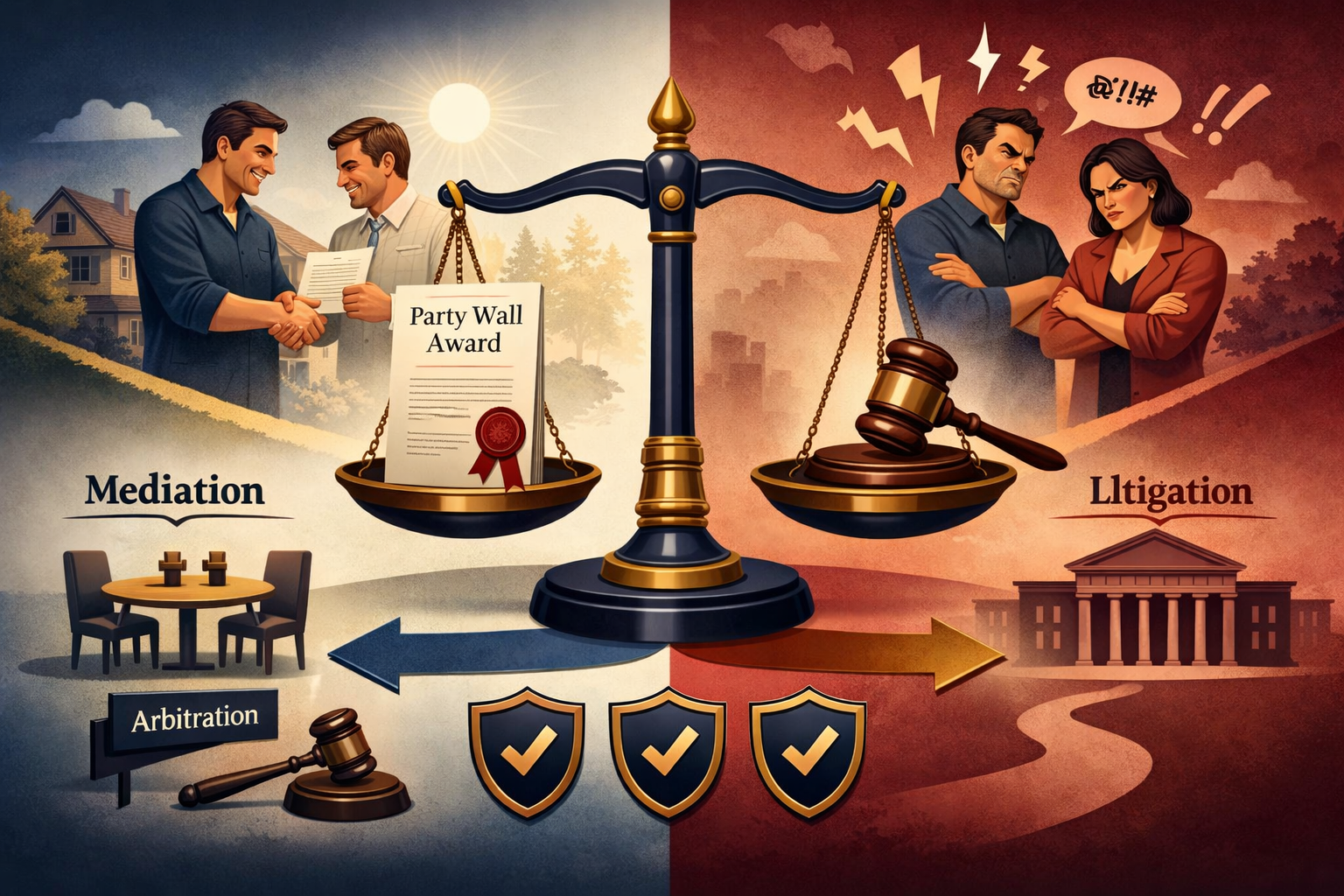
Even well-drafted awards face implementation challenges. Building dispute resolution mechanisms into award structures prevents minor disagreements from escalating into costly litigation.
Built-In Dispute Resolution Clauses
Modern awards should include tiered resolution procedures:
Level 1: Direct Communication
- Require parties to discuss concerns before formal escalation
- Establish communication protocols and response timeframes
- Document all correspondence for future reference
Level 2: Surveyor Mediation
- Empower appointed surveyors to resolve interpretation disputes
- Define surveyor authority to make binding determinations
- Establish site meeting protocols for addressing concerns
Level 3: Third Surveyor Determination
- Specify circumstances triggering Third Surveyor involvement
- Define scope of Third Surveyor authority
- Establish binding nature of Third Surveyor decisions
Level 4: Legal Proceedings
- Preserve rights to court enforcement as final remedy
- Specify jurisdiction and applicable procedures
- Address cost allocation for dispute resolution
This structured approach encourages early resolution while preserving legal remedies for serious breaches.
Monitoring and Compliance Verification
Enforceable awards include provisions for ongoing monitoring:
- Regular site inspections by appointed surveyors
- Progress reporting to adjoining owners
- Deviation notification requirements for methodology changes
- Photographic documentation of work stages
- Completion certification confirming award compliance
When neighbors carry out works without party wall agreement, these monitoring provisions become critical for enforcement.
Damage Claims and Compensation Mechanisms
Awards must address how damage claims are assessed and resolved:
Assessment Process:
- Notification of suspected damage within specified timeframes
- Joint inspection by appointed surveyors
- Comparison against baseline schedule of condition
- Determination of causation and responsibility
- Quantification of repair costs
Compensation Framework:
- Direct repair: Building owner rectifies damage to adjoining owner's satisfaction
- Financial compensation: Payment for proven damage based on surveyor assessment
- Betterment adjustments: Accounting for improvements beyond original condition
- Time limits: Deadlines for claiming damage after work completion
Clear damage provisions reduce disputes and facilitate swift resolution when issues arise. Detailed schedule of condition guidance helps establish baseline evidence.
Enforcement Mechanisms for Non-Compliance
When building owners breach award terms, adjoining owners need clear enforcement pathways:
Informal Remedies:
- Written notices identifying specific breaches
- Reasonable cure periods for corrective action
- Surveyor-mediated compliance discussions
Formal Remedies:
- Injunctive relief to halt non-compliant works
- Court orders requiring specific performance
- Damages for losses caused by breaches
- Cost recovery for enforcement proceedings
Awards should explicitly preserve these remedies while encouraging informal resolution first.
Cost Allocation and Financial Provisions in 2026 Awards
Financial clarity prevents disputes and ensures enforceability. Awards must comprehensively address cost responsibilities:
Standard Cost Allocation Principles
The Party Wall Act establishes default cost allocation rules:
- Building owner bears costs for works they desire
- Shared costs for works benefiting both properties
- Adjoining owner contributions only for improvements they request
- Surveyor fees typically borne by building owner unless adjoining owner acts unreasonably
Awards should explicitly confirm these allocations and address edge cases specific to the project.
Surveyor Fee Provisions
Transparent fee arrangements prevent disputes:
- Hourly rates or fixed fees clearly specified
- Scope of services covered by quoted fees
- Additional work provisions and approval processes
- Payment terms and invoicing schedules
- Dispute resolution for fee disagreements
Professional surveyors should provide fee estimates before appointment and maintain detailed time records supporting invoices.
Security and Indemnity Requirements
For high-risk projects, awards may include:
- Performance bonds ensuring work completion
- Insurance requirements covering potential damage
- Indemnity provisions protecting adjoining owners from loss
- Escrow arrangements for disputed amounts
These protections enhance enforceability by ensuring resources exist to remedy breaches.
Technology and Documentation Standards for 2026
Modern party wall practice increasingly leverages technology to improve documentation quality and enforceability:
Digital Documentation Tools
- Photographic apps with GPS tagging and timestamps
- 3D scanning for precise condition recording
- Cloud storage ensuring document preservation
- Digital signatures expediting award execution
- Project management platforms tracking timelines and compliance
These tools enhance evidence quality while improving efficiency in high-volume renovation environments.
Data Protection and Privacy Considerations
Awards and supporting documentation contain sensitive information requiring careful handling:
- GDPR compliance for personal data processing
- Secure storage of photographic and inspection records
- Access controls limiting document distribution
- Retention policies balancing evidence preservation with privacy rights
Professional surveyors must implement robust data management practices protecting client confidentiality while maintaining enforceability.
Professional Development and Continuing Competence
The evolving landscape of party wall practice in 2026 demands ongoing professional development:
RICS Continuing Professional Development (CPD)
Party wall surveyors should pursue CPD in:
- Legal updates reflecting case law developments
- Technical training on modern construction methods
- Dispute resolution skills for effective mediation
- Documentation standards incorporating best practices
- Technology proficiency using modern survey tools
Regular CPD ensures surveyors maintain the competence required for drafting enforceable awards.
Professional Networks and Knowledge Sharing
Engagement with professional communities enhances practice quality:
- Pyramus & Thisbe Club for party wall specialists
- RICS Building Surveying groups sharing guidance updates
- Regional surveyor networks discussing local precedents
- Online forums addressing practical challenges
These networks provide valuable insights into emerging issues and effective solutions.
Conclusion
Drafting Enforceable Party Wall Awards: RICS Best Practices for 2026 High-Volume Renovations requires mastery of legal frameworks, technical construction knowledge, and meticulous documentation practices. As renovation activity continues surging across the UK, the demand for bulletproof awards that protect all parties while facilitating project completion has never been greater.
The essential elements of enforceable awards include:
🏗️ Comprehensive property inspections with detailed schedules of condition establishing baseline evidence
📋 Precise technical specifications clearly defining authorized works and construction methods
⏰ Strict timeline compliance respecting statutory notice periods and response windows
⚖️ Built-in dispute resolution mechanisms preventing escalation and facilitating swift resolution
💰 Clear cost allocation and financial provisions preventing payment disputes
Surveyors who embrace RICS professional standards, maintain technical competence through ongoing development, and leverage modern documentation tools position themselves to deliver awards that withstand challenge and serve their clients effectively.
Actionable Next Steps
For building owners planning renovations:
- Engage qualified RICS surveyors early in project planning
- Budget adequately for comprehensive party wall procedures
- Maintain open communication with neighbors throughout the process
For adjoining owners receiving notices:
- Seek independent professional advice before consenting
- Ensure appointed surveyors have relevant expertise
- Participate actively in condition recording and monitoring
For surveyors drafting awards:
- Implement systematic documentation protocols ensuring nothing is overlooked
- Stay current with RICS guidance updates and case law developments
- Build comprehensive template libraries incorporating best practices
- Invest in technology tools enhancing evidence quality and efficiency
The renovation boom of 2026 presents both opportunities and challenges for party wall practitioners. Those who master the art and science of drafting enforceable awards will thrive in this high-volume environment while protecting the interests of all parties and upholding professional standards that maintain public confidence in the party wall framework.
For additional guidance on specific aspects of party wall practice, explore resources on RICS building surveys and structural surveys that complement party wall procedures in comprehensive property assessments.
References
[1] Party Wall Legislation And Procedure – https://www.rics.org/profession-standards/rics-standards-and-guidance/sector-standards/building-surveying-standards/party-wall-legislation-and-procedure