
The landscape of property valuation disputes has transformed dramatically in 2026. As the Bank of England implements successive interest rate cuts, mortgage affordability has improved substantially—but this shift has created a new battleground for property valuations. When buyers, sellers, and lenders disagree on property values influenced by changing affordability metrics, expert witness valuations become the cornerstone of resolution. Understanding how to navigate Expert Witness Valuations in 2026 Mortgage Affordability Disputes: RICS Protocols for Falling Rates is now essential for surveyors providing tribunal evidence.
The falling rate environment has created unique challenges. A property valued at £450,000 in late 2024 when mortgage rates peaked at 5.8% may now command £485,000 with rates at 3.9%—but was the original valuation flawed, or has genuine market appreciation occurred? These questions increasingly end up before tribunals, arbitrators, and courts, where expert witness testimony determines outcomes worth hundreds of thousands of pounds.
Key Takeaways
✅ Updated RICS Standards: The 5th Edition Expert Witness Standard (2025) introduces new requirements for AI use, digital evidence, and enhanced independence protocols that directly impact mortgage affordability dispute cases.[1]
✅ Rate-Driven Valuation Complexity: Bank of England rate cuts in 2026 have created significant regional divergences in property values, requiring expert witnesses to demonstrate clear methodological separation between affordability improvements and genuine market appreciation.
✅ Tribunal Duty Primacy: Expert witnesses must prioritize their duty to the tribunal over client interests, with strengthened conflict of interest disclosure requirements and fee structure guidance to protect professional independence.[1]
✅ Methodological Rigor: Courts prefer expert witnesses who employ multiple valuation approaches, document temporal market conditions, and provide transparent comparable property analysis that accounts for changing financing costs.
✅ Regional Market Variations: Expert witness valuations must address significant geographical disparities, with affordability-driven price increases varying from 3-4% in saturated markets to 12-15% in previously constrained regions.
Understanding Expert Witness Valuations in 2026 Mortgage Affordability Disputes
The Changing Landscape of Property Valuation Disputes
Mortgage affordability disputes have become increasingly common as interest rates fluctuate. When the Bank of England raised rates aggressively through 2022-2024, property values stagnated or declined in many regions. Now, with rates falling throughout 2025-2026, the reverse phenomenon is occurring—but not uniformly across all markets.
Expert witnesses in these disputes must navigate complex questions:
- Did the original valuation accurately reflect market conditions at the time?
- How much of the subsequent value change represents genuine market movement versus affordability-driven demand?
- Were comparable properties appropriately selected given the financing environment?
- What role did regional market dynamics play in valuation accuracy?
The role of RICS-certified valuers has expanded beyond simple property assessment to include sophisticated economic analysis and tribunal-quality evidence preparation.
The 2025 RICS Expert Witness Standard Update
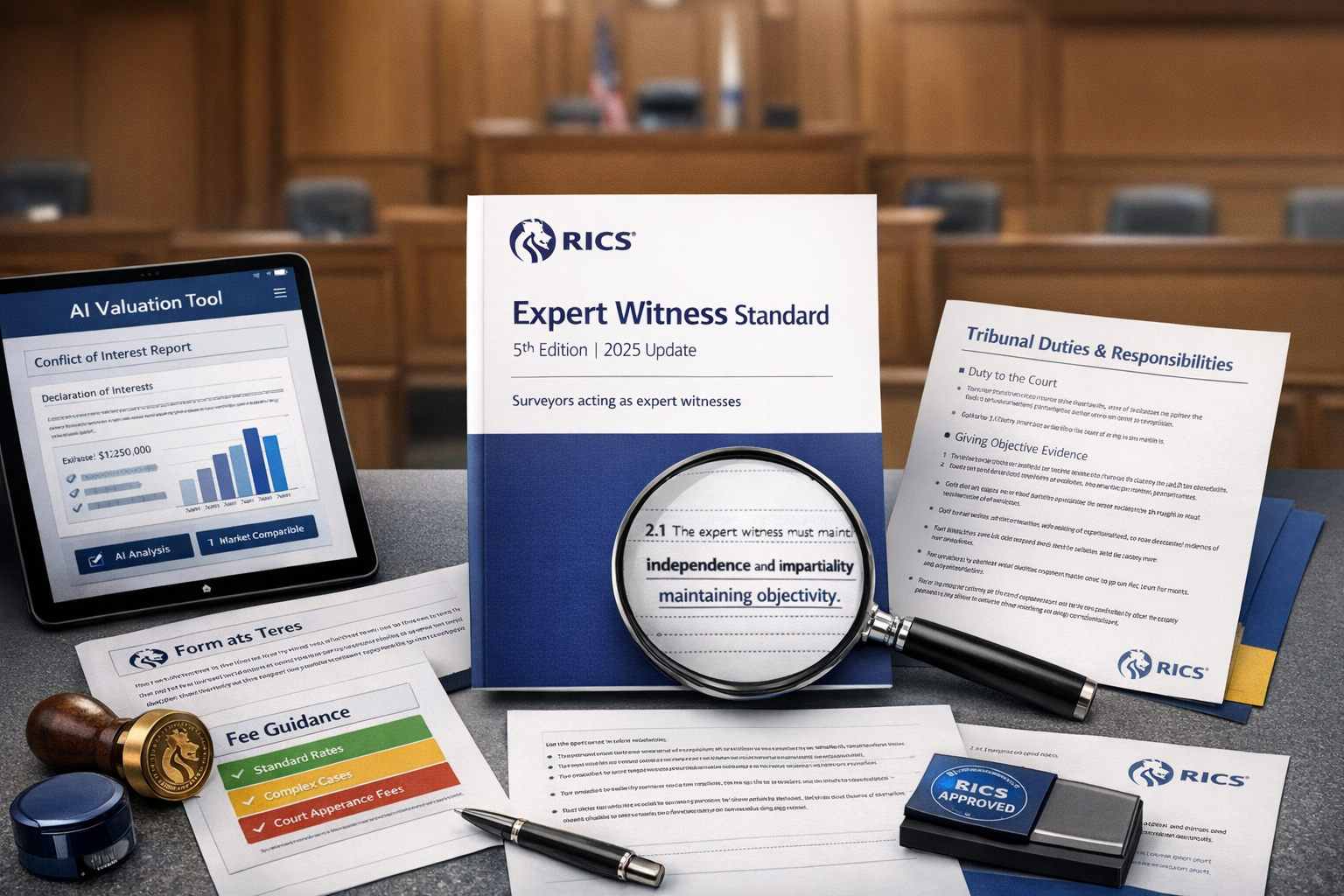
In August 2025, RICS launched a comprehensive consultation for the 5th Edition of its professional standard on "Surveyors acting as expert witnesses"—the first major update since 2014.[1] This timing proves particularly significant for mortgage affordability disputes emerging in 2026.
Key updates include:
🔹 AI and Digital Evidence Integration: New provisions address the use of artificial intelligence in valuation analysis, automated comparable property selection, and digital evidence presentation.[1]
🔹 Enhanced Independence Requirements: Strengthened protocols for identifying and disclosing conflicts of interest, particularly relevant when valuers have prior relationships with lending institutions or property developers.[1]
🔹 Fee Structure Guidance: Clear guidance on conditional and deferred fees to protect professional independence—critical when clients dispute valuations that affect significant financial interests.[1]
🔹 Tribunal Duty Primacy: Reinforced principle that the expert's primary duty is to the tribunal, not the instructing party, requiring all reports and evidence to be independent, unbiased, and within the surveyor's demonstrated expertise.[1]
For surveyors providing expert evidence in mortgage affordability disputes, these updated standards create both obligations and protections. The emphasis on independence is particularly relevant when lenders challenge valuations that now appear conservative given improved affordability conditions.
Regional Market Divergences in 2026
One of the most complex aspects of Expert Witness Valuations in 2026 Mortgage Affordability Disputes: RICS Protocols for Falling Rates involves accounting for dramatic regional variations. The falling rate environment has not lifted all markets equally.
Regional Performance Patterns:
| Region | Rate Impact (2024-2026) | Affordability Improvement | Price Movement |
|---|---|---|---|
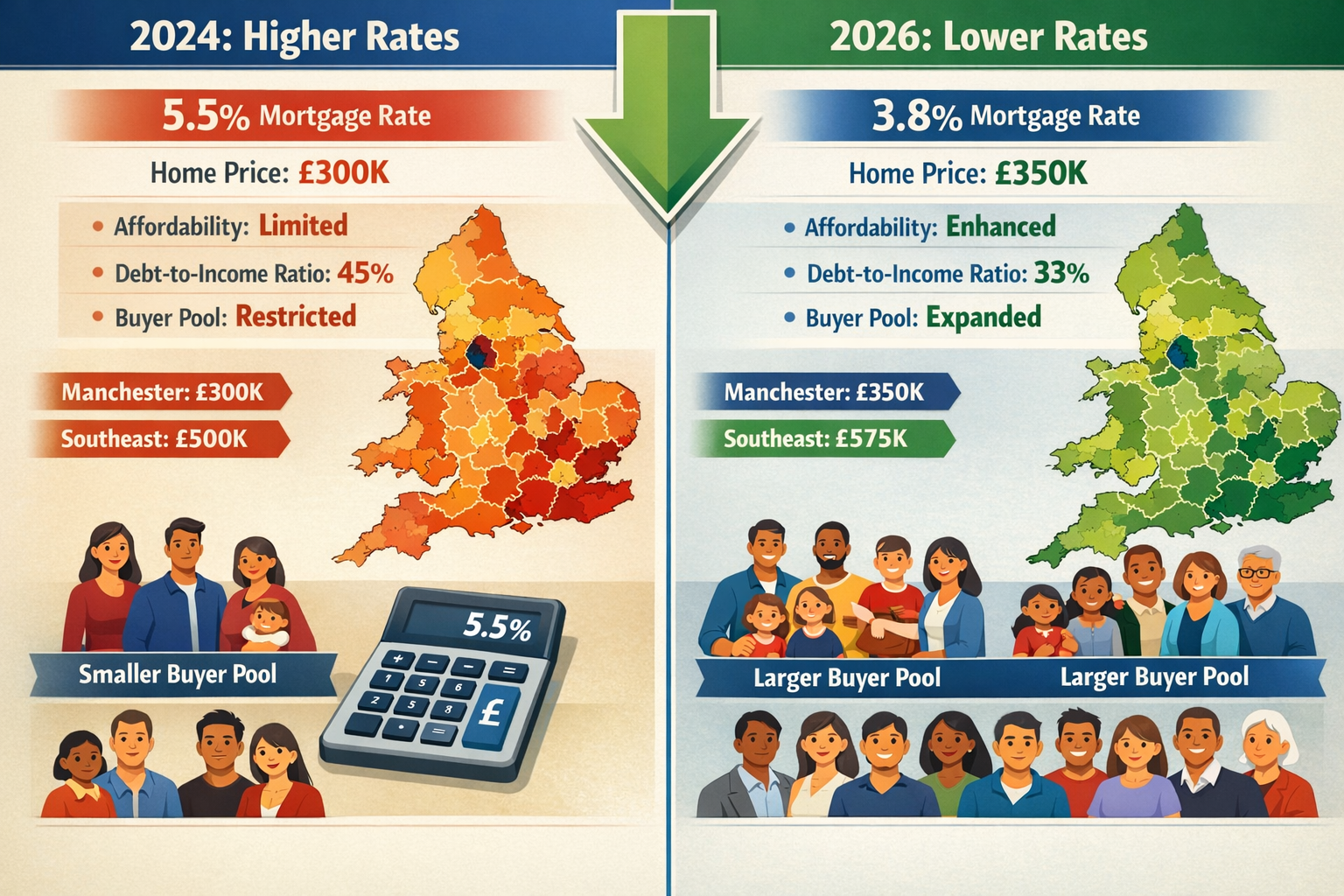
| Greater Manchester | High | 18-22% increase in buyer pool | +8-11% |
| Southeast England | Moderate | 12-15% increase in buyer pool | +4-6% |
| London Prime Central | Low | 5-8% increase in buyer pool | +2-3% |
| Northern England | Very High | 25-30% increase in buyer pool | +12-15% |
| Southwest Coastal | High | 20-24% increase in buyer pool | +9-13% |
Expert witnesses must demonstrate understanding of these regional dynamics when providing evidence. A valuation that appeared accurate in Manchester in 2024 may now seem significantly conservative, while a London valuation from the same period might require minimal adjustment.
Understanding factors of valuation becomes crucial when explaining to tribunals why identical percentage rate reductions produce different market outcomes across regions.
RICS Protocols for Expert Witness Valuations in Falling Rate Environments
Methodological Requirements for Affordability-Influenced Valuations
When providing expert evidence in mortgage affordability disputes, RICS protocols require surveyors to employ rigorous, defensible methodologies that separate affordability improvements from other market factors.
Court-Preferred Valuation Approaches:
1. Temporal Comparable Analysis 📊
Expert witnesses should provide comparable property evidence from multiple time periods, demonstrating how similar properties performed both before and after rate changes. This approach helps tribunals understand whether value changes reflect genuine market appreciation or purely affordability-driven demand.
2. Affordability-Adjusted Valuation Models
These models calculate theoretical property values based on buyer purchasing power at different interest rates, holding other factors constant. By comparing actual market values to affordability-adjusted theoretical values, experts can identify whether markets are responding proportionally to rate changes.
3. Multi-Method Triangulation
RICS standards emphasize using multiple valuation approaches to validate conclusions.[5] In affordability disputes, this typically includes:
- Comparable sales method with temporal adjustments
- Income/investment method (for buy-to-let properties)
- Residual valuation method (for development properties)
- Affordability-indexed method
4. Regional Market Normalization
Expert witnesses must demonstrate how local market conditions differ from national trends, providing context for valuation conclusions that may appear anomalous when viewed in isolation.
The updated RICS valuation standards emphasize the importance of considering extreme or unusual market conditions when preparing expert evidence.[4] The rapid rate environment changes of 2024-2026 certainly qualify as such conditions, requiring enhanced explanation and documentation.
Documentation Standards for Expert Reports
The 5th Edition Expert Witness Standard introduces enhanced documentation requirements particularly relevant to mortgage affordability disputes.[1] Expert reports must now include:
✅ Clear Statement of Independence: Explicit confirmation that the expert's duty is to the tribunal, not the instructing party, with disclosure of any relationships that might affect perceived independence.
✅ Methodology Transparency: Detailed explanation of valuation approaches used, including why specific methods were selected and how they account for changing affordability conditions.
✅ Assumption Documentation: Clear statement of all assumptions made, particularly regarding:
- Interest rate scenarios considered
- Buyer pool demographics and financing capacity
- Regional market conditions and trends
- Comparable property selection criteria
✅ Limitation Acknowledgment: Honest discussion of valuation uncertainty, data limitations, and factors that might affect conclusion reliability.
✅ Digital Evidence Protocols: If AI or automated tools were used in comparable property selection or market analysis, full disclosure of these tools and their limitations.[1]
For surveyors preparing RICS valuations, these documentation requirements represent a significant elevation in professional standards, but they also provide stronger defensibility when evidence is challenged.
Addressing Common Challenges in Affordability Dispute Evidence
Challenge 1: Temporal Valuation Accuracy ⏰
One of the most common disputes involves whether a valuation was accurate at the time it was conducted, even if subsequent rate changes have altered market conditions. Expert witnesses must carefully distinguish between:
- Valuation error: The original assessment failed to reflect market conditions that existed at the time
- Market movement: Subsequent genuine changes in property values due to altered economic conditions
- Affordability shift: Changes in buyer purchasing power that affect demand but may not represent fundamental value changes
Challenge 2: Comparable Property Selection
With rapidly changing market conditions, selecting truly comparable properties becomes more complex. Expert witnesses should:
- Use properties sold within narrow time windows (ideally 3-6 months)
- Adjust for financing conditions prevailing at each comparable's sale date
- Consider whether comparables reflect typical buyer financing or cash purchases
- Account for new-build premium variations as affordability changes
Challenge 3: Lender Valuation Conflicts
Many disputes arise when lender valuations (often conducted for mortgage valuation purposes) differ from independent valuations. Expert witnesses must understand that lender valuations serve different purposes and may incorporate additional risk factors.
Challenge 4: Regional Market Knowledge
Tribunals increasingly expect expert witnesses to demonstrate deep regional market knowledge. Generic national trend analysis is insufficient—experts must show familiarity with local market dynamics, planning constraints, infrastructure developments, and demographic patterns.
Surveyors providing expert evidence should maintain comprehensive market intelligence for their regions, potentially including commercial property valuation data that can inform residential market analysis.
Practical Guidance for Surveyors Providing Expert Evidence
Preparing for Expert Witness Appointments
The transition to expert witness work requires different skills than standard valuation practice. RICS offers expert witness training courses specifically designed to prepare surveyors for tribunal work.[3]
Essential Preparation Steps:
1. Verify Competence and Expertise 🎓
The updated RICS standard emphasizes that experts should only provide evidence within their true area of expertise.[1] For mortgage affordability disputes, this means:
- Demonstrated experience with residential property valuation in the relevant region
- Understanding of mortgage market dynamics and financing impacts on property values
- Familiarity with tribunal procedures and evidence presentation
- Track record of valuation work during varying interest rate environments
2. Establish Independence
Before accepting an expert witness appointment, surveyors must:
- Conduct thorough conflict checks against all parties involved
- Disclose any prior professional relationships with instructing parties
- Ensure fee arrangements protect independence (avoiding success-based or contingent fees)
- Confirm ability to provide objective evidence even if unfavorable to the instructing party
3. Understand the Dispute Context
Expert witnesses should thoroughly review:
- The original valuation report and methodology
- Market conditions prevailing at the valuation date
- Subsequent market movements and their causes
- Specific points of disagreement between parties
- Tribunal or court requirements for evidence format
4. Gather Comprehensive Market Data
Building a robust evidence base requires:
- Comparable sales data covering periods before, during, and after rate changes
- Regional market reports and trend analysis
- Mortgage availability and pricing data for relevant periods
- Planning and development information affecting local markets
- Economic indicators specific to the region
Structuring Expert Reports for Maximum Impact
Well-structured expert reports significantly increase the weight tribunals assign to evidence. The following structure aligns with RICS protocols and court preferences:
Executive Summary
Concise statement of instructions received, key conclusions, and valuation opinion (typically 1-2 pages)
Statement of Independence and Expertise
Formal declaration of duty to tribunal, qualifications, relevant experience, and any potential conflicts
Instructions and Context
Clear statement of what the expert was asked to do, documents reviewed, and scope of investigation
Factual Background
Objective description of the property, transaction history, and dispute circumstances
Methodology
Detailed explanation of valuation approaches used, why they were selected, and how they account for changing market conditions
Market Analysis
Comprehensive review of market conditions at relevant dates, including:
- Interest rate environment and mortgage availability
- Regional market performance and trends
- Comparable property analysis with temporal adjustments
- Affordability metrics and buyer pool analysis
Valuation Opinion
Clear statement of valuation conclusion with supporting evidence and reasoning
Assumptions and Limitations
Transparent discussion of any assumptions made and factors that might affect conclusion reliability
Declaration
Formal statement confirming compliance with RICS standards and expert witness duties
For surveyors working on specialized valuations like Help to Buy schemes or shared ownership properties, additional complexity arises as these programs have their own affordability dynamics that may differ from conventional mortgage markets.
Presenting Evidence in Tribunal Settings
The courtroom or arbitration setting presents unique challenges for surveyors more accustomed to preparing written reports.
Key Presentation Principles:
💼 Maintain Professional Demeanor
- Dress formally and professionally
- Address the tribunal respectfully
- Remain calm and composed under cross-examination
- Avoid defensive or argumentative responses
💼 Communicate Clearly
- Use plain language accessible to non-surveyors
- Explain technical concepts with analogies when helpful
- Provide visual aids (charts, maps, photographs) to support testimony
- Avoid jargon unless necessary, and define terms when used
💼 Acknowledge Limitations
- Admit when questions fall outside your expertise
- Be honest about uncertainty in valuations
- Acknowledge reasonable alternative viewpoints
- Distinguish between facts, assumptions, and opinions
💼 Support Opinions with Evidence
- Reference specific comparable properties
- Cite market data and authoritative sources
- Explain reasoning transparently
- Demonstrate how conclusions were reached
💼 Respond to Challenges Professionally
- Listen carefully to questions before responding
- Take time to consider complex questions
- Correct any errors in your evidence if identified
- Maintain objectivity even when your opinion is challenged
The enhanced professional standards introduced in the 5th Edition Expert Witness Standard provide additional protection for surveyors who maintain these principles, as they demonstrate clear compliance with RICS requirements.[1]
Fee Structures and Professional Protection
The updated RICS guidance on expert witness fees addresses a critical area of professional risk.[1] Inappropriate fee arrangements can compromise independence and undermine the credibility of expert evidence.
Acceptable Fee Structures:
✅ Hourly or Daily Rates: Standard professional charging based on time spent
✅ Fixed Fees: Agreed fees for specific deliverables (report preparation, tribunal attendance)
✅ Retainer Arrangements: Ongoing availability agreements for multiple matters
Prohibited Fee Structures:
❌ Contingent Fees: Payment dependent on case outcome
❌ Success Bonuses: Additional payment if client prevails
❌ Percentage-Based Fees: Fees calculated as percentage of disputed amount
The prohibition on contingent fees is particularly important in mortgage affordability disputes, where the financial stakes may be substantial. Surveyors should establish clear fee agreements in writing before accepting expert witness appointments, ensuring fees are paid regardless of whether the evidence supports the instructing party's position.
Regional Considerations for Expert Witness Valuations in 2026
Manchester and Northwest England Market Dynamics
The Manchester property market exemplifies the complex dynamics expert witnesses must navigate in 2026. The region has experienced significant affordability-driven price appreciation as falling rates have expanded the buyer pool.
Key Manchester Market Factors:
🏘️ Strong Regeneration Impact: Major infrastructure projects (HS2 connections, Northern Powerhouse initiatives) have created genuine value appreciation independent of affordability changes
🏘️ Buy-to-Let Concentration: High proportion of investor purchases means affordability changes affect both owner-occupier and investor demand differently
🏘️ First-Time Buyer Sensitivity: Significant first-time buyer market segment makes this region particularly responsive to mortgage rate changes
🏘️ Commuter Belt Expansion: Improved affordability has extended the viable commuter radius, affecting valuations in previously peripheral areas
Expert witnesses working in Manchester should demonstrate familiarity with these local factors when explaining valuation conclusions. Generic national market analysis will not satisfy tribunal requirements for regional expertise.
For surveyors seeking to establish credibility in Manchester markets, maintaining current knowledge through local property inspection practices and regional market intelligence is essential.
Southeast England and London Considerations
The Southeast England and London markets present different challenges for expert witnesses in affordability disputes.
Distinctive Southeast Characteristics:
- Price Ceiling Effects: Many properties already at or near affordability limits even with reduced rates
- International Buyer Influence: Significant cash buyer segment less affected by UK mortgage rate changes
- Micro-Market Variations: Extreme localization means comparable properties must be very precisely selected
- Leasehold Complexities: High proportion of leasehold properties introduces additional valuation factors
In these markets, expert witnesses must demonstrate why affordability improvements may have produced smaller percentage price increases than in other regions. Tribunals may be skeptical of evidence suggesting minimal rate impact, requiring particularly robust comparable analysis.
Emerging Markets and Development Areas
Areas undergoing significant development or regeneration present unique challenges for expert witness valuations in the current rate environment.
Expert witnesses should consider:
- Temporal Development Impact: Separating value appreciation from infrastructure improvements versus affordability changes
- New-Build Premium Variations: How rate changes affect the premium buyers pay for new construction
- Speculative Element: The role of anticipated future development in current valuations
- Planning Risk: How planning uncertainties affect value independent of financing costs
For properties in development areas, expert witnesses may need to employ reinstatement valuation methodologies alongside traditional comparable approaches to provide comprehensive evidence.
Future Outlook: Expert Witness Valuations Beyond 2026
Anticipated Market Developments
As we progress through 2026, several trends will likely affect expert witness valuations in mortgage affordability disputes:
📈 Continued Rate Volatility
Bank of England policy remains responsive to inflation and economic conditions, suggesting continued rate adjustments that will create ongoing valuation disputes.
📈 Enhanced Data Analytics
Improved property data platforms and AI-assisted comparable selection will raise tribunal expectations for evidence sophistication.[1]
📈 Regional Divergence
Economic recovery patterns suggest continued variation in regional market performance, requiring increasingly localized expertise.
📈 Regulatory Changes
Potential mortgage market reforms and lending standard adjustments may create new categories of affordability disputes.
Professional Development for Expert Witnesses
Surveyors seeking to establish or maintain expert witness practices should prioritize:
✨ Continuous Market Intelligence: Systematic tracking of regional property markets, mortgage conditions, and economic indicators
✨ Technical Skill Development: Proficiency with modern valuation tools, data analysis software, and evidence presentation technologies
✨ Legal Knowledge: Understanding of tribunal procedures, evidence rules, and expert witness obligations
✨ Communication Skills: Ability to explain complex valuation concepts clearly to non-technical audiences
✨ Professional Networking: Relationships with legal professionals, other expert witnesses, and industry specialists
RICS continues to develop resources for expert witnesses, including updated training programs that address the specific challenges of providing evidence in rapidly changing market conditions.[3]
Maintaining Professional Standards
The enhanced requirements introduced in the 5th Edition Expert Witness Standard represent a permanent elevation in professional expectations.[1] Surveyors providing expert evidence must commit to:
- Ongoing Compliance: Regular review of RICS standards and guidance
- Quality Assurance: Internal review processes for expert reports and evidence
- Independence Protection: Rigorous conflict checking and fee structure compliance
- Continuous Learning: Staying current with market developments, legal precedents, and methodological advances
"The expert witness's primary duty is to the tribunal, not to the client. This fundamental principle must guide every aspect of evidence preparation and presentation, particularly in high-stakes mortgage affordability disputes where financial pressures may be substantial."
Conclusion
Expert Witness Valuations in 2026 Mortgage Affordability Disputes: RICS Protocols for Falling Rates represent a specialized and increasingly important area of surveying practice. As Bank of England rate cuts continue to reshape property markets, disputes over valuations influenced by changing affordability will proliferate. Surveyors providing expert evidence in these matters must navigate complex methodological challenges while maintaining the enhanced professional standards introduced in the 5th Edition Expert Witness Standard.
The key to success lies in rigorous methodology, transparent documentation, and unwavering commitment to independence. Expert witnesses must demonstrate deep regional market knowledge, employ multiple valuation approaches, and clearly separate affordability-driven demand changes from genuine market appreciation. The updated RICS protocols provide both framework and protection for surveyors who maintain these standards.
Actionable Next Steps
For surveyors seeking to develop or enhance expert witness capabilities:
-
Complete RICS Expert Witness Training: Enroll in accredited training programs to develop tribunal-specific skills.[3]
-
Review Updated Standards: Thoroughly study the 5th Edition Expert Witness Standard and integrate new requirements into practice protocols.[1]
-
Develop Regional Expertise: Build comprehensive market intelligence for your geographic area, including mortgage market dynamics and affordability trends.
-
Establish Quality Processes: Implement internal review procedures for expert reports, ensuring compliance with RICS documentation standards.
-
Build Professional Network: Develop relationships with legal professionals, fellow expert witnesses, and specialist consultants who can support complex cases.
-
Maintain Independence: Review fee structures and client relationships to ensure full compliance with independence requirements.
The falling rate environment of 2026 creates both challenges and opportunities for expert witnesses. Those who master the intersection of valuation methodology, regional market dynamics, and professional standards will find themselves well-positioned to provide high-quality evidence that serves tribunals, supports justice, and upholds the reputation of the surveying profession.
For surveyors considering whether expert witness work aligns with their practice, remember that this specialization requires dedication to continuous learning, comfort with adversarial settings, and absolute commitment to objectivity. When these elements align, expert witness practice offers professionally rewarding work that makes a genuine contribution to dispute resolution and market transparency.
References

[1] Rics Launches Global Consultation On Updated Expert Witness Standard – https://www.rics.org/news-insights/rics-launches-global-consultation-on-updated-expert-witness-standard
[2] Building Survey Quality Standards 2026 Navigating Rics Updates And Enhanced Home Inspection Requirements – https://nottinghillsurveyors.com/blog/building-survey-quality-standards-2026-navigating-rics-updates-and-enhanced-home-inspection-requirements
[3] Expert Witness Training Courses – https://www.rics.org/dispute-resolution-service/training-qualification-accreditations/expert-witness-training-courses
[4] Real Estate Valuation Extreme Conditions – https://ww3.rics.org/uk/en/journals/property-journal/real-estate-valuation-extreme-conditions.html
[5] Valuation Standards – https://www.rics.org/profession-standards/rics-standards-and-guidance/sector-standards/valuation-standards