As the UK accelerates toward its net-zero carbon targets in 2026, homeowners are increasingly investing in renewable energy technologies like solar panels and heat pumps. However, many property owners overlook a critical legal requirement: Party Wall Notices for 2026 Renewable Energy Projects: Solar and Heat Pump Installations on Shared Boundaries. Installing these green technologies on or near shared property lines triggers specific obligations under the Party Wall etc. Act 1996, and failing to comply can result in costly disputes, project delays, and legal complications.
This comprehensive guide provides step-by-step instructions for navigating party wall requirements when installing solar panels and heat pumps on shared boundaries, ensuring your green retrofit project proceeds smoothly while maintaining positive neighbor relations.
Key Takeaways
- 🏠 Solar panels and heat pumps installed on shared walls, roofs, or near boundaries require formal party wall notices under the Party Wall etc. Act 1996
- 📋 Property owners must serve notices at least two months before starting work, allowing neighbors time to consent or appoint surveyors
- ⚖️ Party wall agreements for renewable energy projects are evolving in 2026 to accommodate green retrofits alongside traditional building work[3]
- 💷 Building owners typically cover all surveyor costs, including their neighbor's surveyor fees, making budgeting essential
- ✅ Proper compliance protects against future disputes and ensures your renewable energy investment remains legally sound
Understanding Party Wall Notices for 2026 Renewable Energy Projects: Solar and Heat Pump Installations on Shared Boundaries

What Are Party Wall Notices?
A party wall notice is a formal legal document served to adjoining property owners when planned construction work affects a shared wall, boundary, or structure. The Party Wall etc. Act 1996 governs these requirements across England and Wales, protecting both building owners and their neighbors during construction projects.
While traditionally associated with extensions, loft conversions, and basement excavations, party wall legislation increasingly applies to renewable energy installations in 2026. Solar panel installations on shared or party walls require Party Wall Act compliance, including notification of neighbors and obtaining their consent[2].
Why Renewable Energy Projects Trigger Party Wall Requirements
Several scenarios involving solar panels and heat pumps activate party wall obligations:
Solar Panel Installations:
- Mounting panels on a shared roof structure
- Installing panels that overhang a boundary line
- Drilling fixings into party walls for support brackets
- Adding weight loads to shared structural elements
- Running electrical conduits through party walls
Heat Pump Installations:
- Positioning outdoor units near party walls or boundaries
- Excavating foundations within three meters of a neighbor's structure
- Creating vibration or structural stress on shared walls
- Installing ground source heat pump loops near boundaries
- Mounting equipment on external party walls
Recent 2026 guidance indicates that party wall agreements for property expansions should accommodate renewable energy integration, specifically mentioning solar PV and heat pump installations alongside smart building technology deployment[3].
The Legal Framework for Green Retrofits on Shared Boundaries
The Party Wall etc. Act 1996 and Renewable Energy
The Party Wall etc. Act 1996 establishes three main types of work requiring notices:
- Building on the Line of Junction (Section 1) – New walls built directly on a boundary line
- Work to Existing Party Structures (Section 2) – Modifications, repairs, or additions to shared walls
- Excavation Near Neighboring Buildings (Section 6) – Digging within specified distances of adjoining properties
For renewable energy projects, Section 2 work most commonly applies when installing solar panels on shared roofs or mounting heat pumps on party walls. Section 6 becomes relevant for ground source heat pump installations requiring excavation.
Building Regulations and Planning Permission
Party wall notices operate separately from building regulations approval and planning permission. Property owners must comply with all three requirements for renewable energy installations:
| Requirement | Solar Panels | Air Source Heat Pumps | Ground Source Heat Pumps |
|---|---|---|---|
| Party Wall Notice | If on shared structure | If near boundary/party wall | If excavating near boundary |
| Building Regulations | Usually exempt for retrofits[2] | Required | Required |
| Planning Permission | Often permitted development[2] | Usually permitted development | May be required |
Building regulations for solar panels typically exempt retrofit installations on existing buildings, though structural calculations may be needed for shared roofs[2]. Understanding these party wall consent requirements helps avoid regulatory complications.
2026 Updates to Party Wall Guidance
The renewable energy sector has seen significant regulatory evolution in 2026. While the core Party Wall Act remains unchanged, professional guidance now explicitly addresses green retrofit scenarios. Party wall agreements are being updated to accommodate renewable energy systems, with specific provisions for solar PV and heat pump installations[3].
This updated guidance recognizes that:
- Renewable energy installations have unique structural considerations compared to traditional building work
- Noise and vibration from heat pumps require specific assessment protocols
- Electrical safety near party walls demands additional precautions
- Future maintenance access must be addressed in agreements
Step-by-Step Guide: Serving Party Wall Notices for Renewable Energy Projects
Step 1: Determine If You Need to Serve Notice (2-3 Weeks Before Project Start)
Before proceeding with solar or heat pump installation, assess whether your project triggers party wall requirements:
Assessment Checklist:
- ✅ Will panels or equipment be mounted on a shared wall or roof?
- ✅ Will installation require drilling into party structures?
- ✅ Will equipment be positioned within one meter of a boundary?
- ✅ Will excavation occur within three meters of a neighbor's building?
- ✅ Will the installation add significant weight to shared structures?
If you answer "yes" to any question, you likely need to serve party wall notices. Consulting a qualified party wall surveyor at this stage prevents costly mistakes. For complex projects, consider reviewing our party wall FAQ for additional guidance.
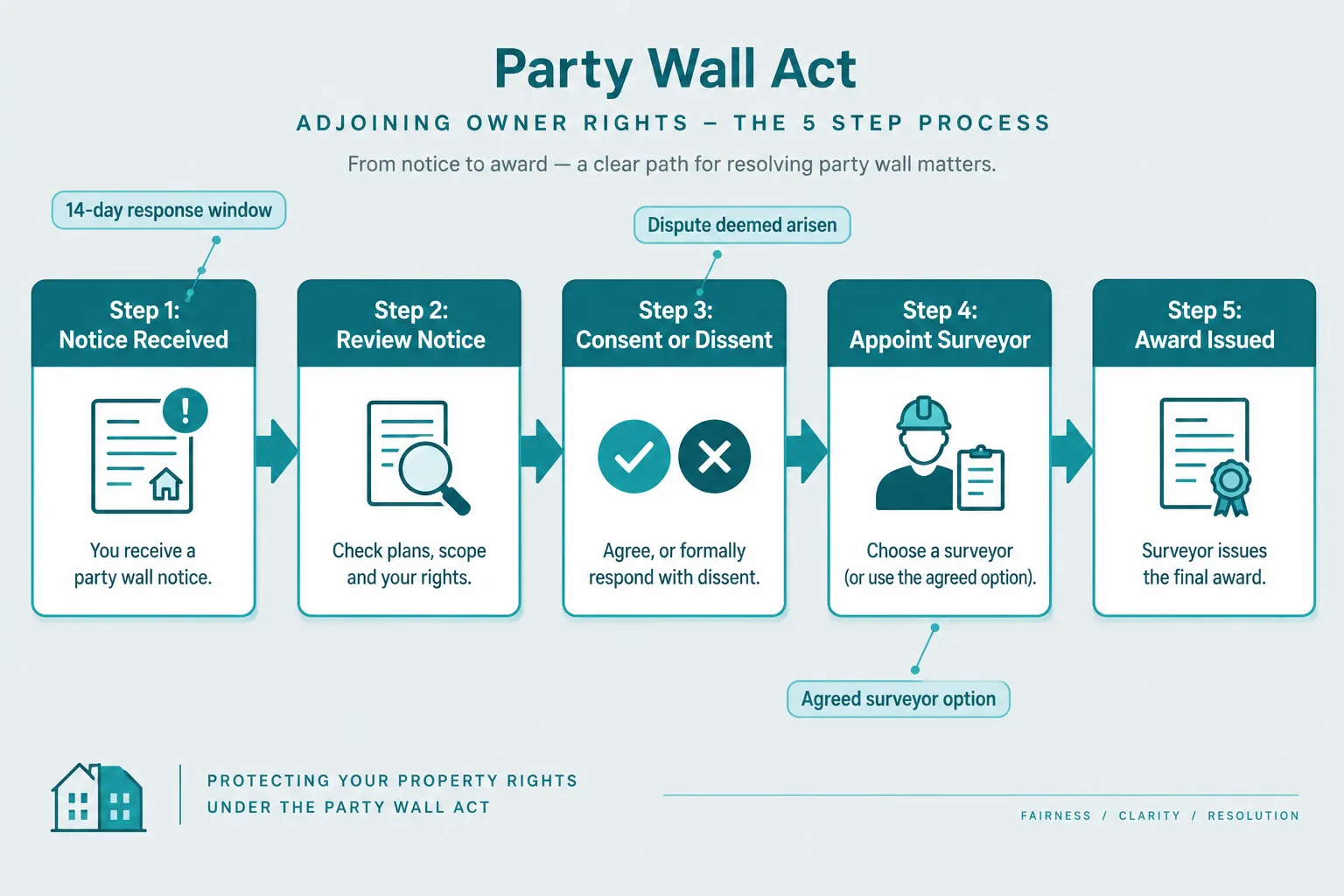
Step 2: Prepare and Serve Formal Notices (Minimum 2 Months Before Work)
Party wall notices must be served at least two months before work begins for Section 2 work (existing party structures) or one month for Section 1 work (new walls on boundaries).
Notice Content Requirements:
Your notice must include:
- Building owner's name and address
- Adjoining owner's name and address (your neighbor)
- Detailed description of proposed work (solar panel installation, heat pump mounting, etc.)
- Drawings and specifications showing equipment location, mounting methods, and structural impacts
- Proposed start date for installation
- Statement of rights explaining the neighbor's options
Serving Methods:
Notices can be served by:
- Hand delivery with signed acknowledgment
- Recorded delivery post
- Through a party wall surveyor (recommended)
Sample Notice Language for Solar Panels:
"Notice is hereby given that [Building Owner Name] of [Address] intends to install solar photovoltaic panels on the shared roof structure at [Property Address]. The work involves mounting 12 solar panels weighing approximately 240kg total on the south-facing roof slope, with mounting brackets secured to shared roof joists. Installation will require drilling fixings through the party wall at roof level. Work is scheduled to commence on [Date, minimum 2 months ahead]."
Step 3: Neighbor Response Period (14 Days)
After receiving your notice, your neighbor has 14 days to respond with one of three options:
Option 1: Consent ✅
Your neighbor provides written consent to the proposed work. This is the simplest outcome, allowing you to proceed without formal surveyor involvement. However, even with consent, documenting the property's pre-work condition through a schedule of condition remains advisable.
Option 2: Dissent ⚖️
Your neighbor objects to the work or doesn't respond within 14 days (silence equals dissent). This triggers the party wall award process, requiring surveyor appointment.
Option 3: Counter-Notice 📝
Your neighbor consents but requests additional protective measures, modifications to the work plan, or specific conditions. This often leads to negotiated agreements.
Step 4: Appoint Party Wall Surveyors (If Required)
When neighbors dissent or don't respond, the Party Wall Act requires appointing surveyors to create a party wall award – a legally binding document governing the work.
Surveyor Appointment Options:
- Agreed Surveyor – Both parties jointly appoint one impartial surveyor (most cost-effective)
- Two Surveyors – Each party appoints their own surveyor, who then select a third surveyor if needed
- Third Surveyor – Acts as arbitrator if the two appointed surveyors disagree
Surveyor Responsibilities:
Party wall surveyors will:
- Inspect both properties and document existing conditions
- Assess structural impacts of the renewable energy installation
- Determine necessary protective measures
- Draft the party wall award with specific work conditions
- Resolve disputes between building and adjoining owners
- Monitor work progress and address concerns
Cost Considerations:
The building owner (you) typically pays all surveyor fees, including:
- Your own surveyor's fees: £700-£1,500
- Neighbor's surveyor's fees: £700-£1,500
- Third surveyor's fees (if required): £1,000-£2,000
- Award preparation costs: £500-£1,000
For renewable energy projects, budget £1,500-£4,000 for surveyor costs depending on project complexity. Understanding potential damage to property in party wall scenarios helps justify this investment.
Step 5: Party Wall Award Preparation (4-6 Weeks)
Surveyors prepare a detailed party wall award document containing:
Standard Award Components:
- Description of proposed work with technical specifications
- Schedule of condition documenting both properties' current state with photographs
- Protective measures required during installation (dust sheets, vibration monitoring, etc.)
- Working hours permitted for installation
- Access rights for surveyors and contractors
- Insurance requirements for contractors
- Dispute resolution procedures
- Cost allocation for surveyor fees
Renewable Energy-Specific Provisions:
Modern awards for solar and heat pump installations should address:
- Structural load calculations for solar panel arrays on shared roofs
- Noise level limits for heat pump operation (typically 42dB at boundary)
- Vibration monitoring protocols during and after installation
- Electrical safety measures for cables near party walls
- Future maintenance access arrangements
- Decommissioning responsibilities if equipment is later removed
Step 6: Execute Work According to Award Terms
Once the party wall award is finalized and signed, installation can proceed under the specified conditions:
Compliance Requirements:
- ✅ Only commence work on or after the agreed start date
- ✅ Adhere strictly to working hours (typically 8am-6pm weekdays)
- ✅ Implement all protective measures outlined in the award
- ✅ Allow surveyor access for inspections
- ✅ Document work progress with photographs
- ✅ Address neighbor concerns promptly through surveyors
- ✅ Complete work within agreed timeframes
Installer Briefing:
Ensure your renewable energy contractor understands:
- Party wall award requirements and restrictions
- Permitted working methods and hours
- Surveyor inspection schedules
- Neighbor communication protocols
- Documentation requirements
Step 7: Post-Installation Compliance and Documentation
After completing your solar or heat pump installation:
Final Surveyor Inspection:
Party wall surveyors conduct a final inspection comparing the completed work against:
- Original party wall award specifications
- Pre-work schedule of condition
- Structural integrity of party walls
- Any neighbor concerns raised during installation
Damage Assessment:
If installation caused any damage to the neighbor's property, the award typically requires the building owner to fund repairs. This might include:
- Cracks in plasterwork from vibration
- Roof tile displacement
- Damage to shared guttering or drainage
- Electrical interference issues
Award Completion:
Surveyors issue a completion certificate confirming:
- Work was executed according to award terms
- No unresolved damage exists
- All protective measures were implemented
- The project complies with the Party Wall Act
Retain all party wall documentation permanently with your property deeds, as future owners may need this information.
Special Considerations for Different Renewable Energy Technologies
Solar Panel Installations on Shared Boundaries
Solar photovoltaic systems present unique party wall challenges:
Roof-Mounted Systems:
When installing panels on a shared roof structure (common in semi-detached and terraced properties):
- Structural load assessment is critical – solar arrays typically add 15-20kg per square meter
- Roof penetrations for mounting brackets must be properly sealed to prevent water ingress affecting both properties
- Shading impacts on neighbor's panels (if they have existing solar) may require consideration
- Maintenance access arrangements should be formalized for future panel cleaning or repairs
Wall-Mounted Systems:
Less common but sometimes used for vertical solar installations:
- Requires drilling directly into party walls
- Must ensure structural integrity isn't compromised
- Consider aesthetic impacts on neighbor's property
- Address potential future removal and wall repair
Electrical Safety:
Solar installations involve high-voltage DC systems. Party wall awards should specify:
- Cable routing away from party wall voids where possible
- Isolation procedures during emergency situations
- Labeling requirements for cables in shared spaces
Similar considerations apply to other party wall insulation projects involving building fabric modifications.
Air Source Heat Pump Installations
Air source heat pumps (ASHPs) create specific party wall considerations beyond structural concerns:
Noise and Vibration:
ASHPs generate operational noise (typically 40-60 decibels), which can cause neighbor disputes:
- Position units at least 1 meter from boundaries where possible
- Install acoustic barriers or enclosures if closer placement is necessary
- Specify operating hours in party wall awards (some neighbors request night-time restrictions)
- Use anti-vibration mounting pads to prevent structural transmission
Visual Impact:
External heat pump units are visible and may affect neighbor property values:
- Discuss screening options (fencing, planting) in party wall negotiations
- Consider color matching to minimize visual intrusion
- Document sight line impacts in schedules of condition
Excavation Requirements:
Some ASHP installations require:
- Foundation pads within 3 meters of neighbor's property (triggers Section 6 notices)
- Drainage connections potentially affecting shared systems
- Underground electrical feeds crossing or near boundaries
For projects involving significant excavation, review excavation notice for party wall requirements.
Ground Source Heat Pump Systems
Ground source heat pumps (GSHPs) involve extensive excavation, creating complex party wall scenarios:
Borehole Systems:
Vertical boreholes (typically 50-150 meters deep) may:
- Affect underground water courses impacting both properties
- Require access easements if drilling equipment must cross boundaries
- Create vibration during drilling that could damage party walls
- Involve long-term ground temperature changes affecting neighbor's foundations
Horizontal Loop Systems:
Shallow trenches (1-2 meters deep) for horizontal ground loops:
- Often fall within 3 meters of neighbor's structures (Section 6 work)
- May affect shared drainage systems
- Could impact tree roots on boundary lines
- Require restoration of shared garden boundaries
Party Wall Award Provisions for GSHPs:
Awards should specify:
- Maximum excavation depths and distances from boundaries
- Ground stability monitoring protocols
- Restoration requirements for shared boundaries
- Long-term monitoring of neighbor's property for settlement
- Insurance coverage for subsidence risks
Cost Recovery and Financial Considerations

Who Pays for What?
The Party Wall Act establishes clear cost allocation principles for renewable energy projects:
Building Owner Responsibilities (You):
- ✅ All surveyor fees (yours, neighbor's, and third surveyor if needed)
- ✅ Award preparation costs
- ✅ Schedule of condition documentation
- ✅ Any damage repairs to neighbor's property
- ✅ Protective measures during installation
- ✅ Structural reinforcement if required
Adjoining Owner Responsibilities (Neighbor):
Generally none, unless they request work beyond what's necessary for your project.
Budgeting for Party Wall Costs
When planning renewable energy installations on shared boundaries, include these costs:
| Cost Category | Typical Range (2026) | Notes |
|---|---|---|
| Party wall surveyor fees | £1,500-£4,000 | Varies with project complexity |
| Schedule of condition | £300-£800 | Often included in surveyor fees |
| Legal advice (if disputes arise) | £1,000-£5,000+ | Hopefully avoidable |
| Structural reinforcement | £500-£3,000 | If shared structures need strengthening |
| Damage repairs | £200-£2,000+ | Depends on issues arising |
| Total party wall costs | £2,000-£8,000+ | Add to renewable energy installation budget |
Maximizing Return on Investment
Despite these additional costs, party wall compliance protects your renewable energy investment:
Financial Protection:
- Prevents costly legal disputes that could exceed £10,000
- Avoids forced removal of improperly installed equipment
- Maintains property value (non-compliant installations can affect sales)
- Protects against future neighbor claims
Long-Term Benefits:
- Solar panels typically pay back installation costs within 8-12 years
- Heat pumps reduce energy bills by 30-50% compared to gas boilers
- Both technologies increase property values by 3-7% on average
- Proper documentation facilitates future property sales
Common Pitfalls and How to Avoid Them
Mistake 1: Assuming Permitted Development Means No Party Wall Notice
Many homeowners incorrectly believe that if renewable energy installations qualify as "permitted development" (not requiring planning permission), they also avoid party wall requirements.
Reality: Planning permission and party wall notices are completely separate legal requirements. Solar panels and heat pumps often qualify as permitted development but still trigger party wall obligations when installed on shared structures[2].
Solution: Always assess party wall requirements independently of planning status.
Mistake 2: Serving Inadequate Notices
Generic or vague party wall notices frequently cause problems:
Common Notice Deficiencies:
- Missing technical specifications for equipment
- No drawings showing exact installation locations
- Inadequate description of structural impacts
- Incorrect notice periods (too short)
- Failure to explain neighbor's rights clearly
Solution: Use a qualified party wall surveyor to prepare and serve notices, ensuring all legal requirements are met. Reviewing loft conversions party wall examples can provide useful templates.
Mistake 3: Starting Work Before Award Completion
Some contractors pressure homeowners to begin installation before the party wall award is finalized, especially during busy installation seasons.
Risks:
- Neighbor can seek court injunctions stopping work
- Invalidates insurance coverage for party wall damage
- Surveyor fees continue accruing during delays
- May constitute trespass if work affects neighbor's property
Solution: Never commence work until:
- Neighbor provides written consent, OR
- Party wall award is signed by all parties
Mistake 4: Ignoring Noise Concerns for Heat Pumps
Heat pump noise is the leading cause of renewable energy neighbor disputes in 2026:
Prevention Strategies:
- Conduct pre-installation noise assessments showing predicted sound levels
- Include noise limits in party wall awards (typically 42dB at boundary)
- Install acoustic barriers or enclosures proactively
- Position units as far from neighbor's windows/gardens as possible
- Consider quiet operation modes during evening hours
Solution: Address noise concerns explicitly in party wall negotiations rather than waiting for complaints after installation.
Mistake 5: Inadequate Schedule of Condition
Rushed or incomplete pre-work condition surveys create disputes about installation damage:
Comprehensive Schedules Should Include:
- High-resolution photographs of all potentially affected areas
- Detailed written descriptions of existing defects
- Measurements of existing cracks or settlement
- Documentation of shared roof/wall condition
- Video walkthroughs of interior spaces
Solution: Invest in professional photographic surveys before work begins. This protects both you and your neighbor by establishing clear baseline conditions.
Aligning Renewable Energy Projects with Net-Zero Goals
The UK's 2026 Net-Zero Trajectory
The UK government has set ambitious targets for decarbonizing residential heating and electricity:
- 600,000 heat pump installations annually by 2028 (up from ~55,000 in 2022)
- Solar capacity expansion to support grid decarbonization
- Retrofit acceleration for existing housing stock
- Planning streamlining for renewable technologies[1]
These policy drivers mean party wall notices for renewable energy projects will become increasingly common in 2026 and beyond. Surveyors, solicitors, and installers must develop expertise in this specialized area.
Policy Support for Green Retrofits
Several 2026 initiatives support renewable energy installations:
Financial Incentives:
- Boiler Upgrade Scheme providing £7,500 grants for heat pump installations
- Smart Export Guarantee paying for surplus solar electricity exported to the grid
- VAT reductions on energy-saving materials (5% rate for qualifying installations)
Regulatory Streamlining:
- Simplified permitted development rights for solar and heat pumps
- Building regulations exemptions for many retrofit solar installations[2]
- Updated guidance acknowledging renewable energy in party wall agreements[3]
These supportive policies should theoretically simplify renewable installations, but party wall requirements remain unchanged, creating a regulatory gap that catches many homeowners unprepared.
Balancing Individual Rights with Collective Climate Goals
Party wall legislation balances two important principles:
- Property owners' rights to improve their homes and reduce carbon emissions
- Neighbors' rights to protect their property from damage and nuisance
Best Practice Approach:
Frame renewable energy party wall discussions around mutual benefits:
- "This solar installation will increase both our property values"
- "Heat pump installations are becoming standard, maintaining neighborhood desirability"
- "Proper party wall procedures protect both properties from future issues"
- "We're both contributing to the UK's net-zero targets"
Many neighbors respond positively when renewable energy projects are presented as forward-thinking investments rather than impositions.
Working with Professionals: Surveyors, Installers, and Legal Advisors
Choosing a Qualified Party Wall Surveyor
Not all surveyors have experience with renewable energy installations. Look for:
Essential Qualifications:
- RICS membership (Royal Institution of Chartered Surveyors)
- Specific party wall expertise (ideally FPWS – Faculty of Party Wall Surveyors)
- Renewable energy project experience (ask for examples)
- Local knowledge of your property type and area
Questions to Ask Prospective Surveyors:
- How many solar/heat pump party wall awards have you prepared?
- What's your typical timeline from notice to award completion?
- How do you handle noise concerns for heat pump installations?
- What are your fee structures and payment terms?
- Can you provide references from similar projects?
Consider surveyors with broader expertise in structural surveys who understand building performance implications.
Selecting Renewable Energy Installers
Your installer should understand party wall requirements:
Installer Selection Criteria:
- MCS certification (Microgeneration Certification Scheme) – mandatory for government incentives
- Party wall awareness – ask if they've worked on shared boundary properties
- Insurance coverage – minimum £5 million public liability
- Warranty provisions – typically 5-10 years for equipment, 1-2 years for installation
- References – especially from terraced or semi-detached property installations
Red Flags:
- ⚠️ Installers who dismiss party wall requirements as "unnecessary"
- ⚠️ Pressure to start work before awards are finalized
- ⚠️ Reluctance to coordinate with party wall surveyors
- ⚠️ No experience with shared boundary installations
When to Seek Legal Advice
Most renewable energy party wall matters resolve through standard surveyor procedures, but legal advice becomes valuable when:
- Neighbors threaten injunctions to prevent installation
- Disputes arise over surveyor appointments or awards
- Complex boundary ownership questions exist
- Previous property alterations have unclear legal status
- Significant financial stakes justify legal protection
Solicitors specializing in property and construction law can provide strategic guidance, though their involvement typically adds £1,500-£5,000 to project costs.
Future-Proofing Your Renewable Energy Installation

Documentation for Future Property Sales
Proper party wall compliance creates valuable documentation for future property transactions:
Essential Records to Maintain:
- Original party wall notices and neighbor responses
- Complete party wall award with all schedules and drawings
- Schedule of condition (before and after photographs)
- Surveyor inspection reports and completion certificates
- Installer certifications and warranties
- Building regulations compliance certificates
- MCS certificates for renewable energy equipment
Why This Matters:
Future buyers' solicitors will request party wall documentation during conveyancing. Missing records can:
- Delay or derail property sales
- Reduce property values by 2-5%
- Create legal liability for non-compliant work
- Require retrospective party wall awards (expensive and complex)
Maintenance Access Arrangements
Renewable energy systems require ongoing maintenance:
Solar Panels:
- Cleaning every 1-2 years to maintain efficiency
- Inverter replacement after 10-15 years
- Panel replacement after 25-30 years
Heat Pumps:
- Annual servicing (similar to boiler maintenance)
- Refrigerant checks every 1-2 years
- Component replacement every 10-15 years
Party Wall Implications:
If maintenance requires accessing neighbor's property or working on shared structures, address this in the original party wall award:
- Specify reasonable access rights for maintenance
- Define notice periods for routine servicing
- Establish protocols for emergency repairs
- Consider future technology upgrades
Technology Evolution and Upgrading
Renewable energy technology advances rapidly. Your 2026 installation may need upgrading by 2035:
Future-Proofing Strategies:
- Install mounting systems with capacity for additional solar panels
- Size electrical infrastructure for potential battery storage additions
- Position heat pumps allowing for future unit replacement
- Document all structural reinforcement for future reference
Party wall awards should ideally include provisions for "like-for-like replacement" of renewable energy equipment, avoiding the need for new notices when replacing failed components.
Conclusion
Party Wall Notices for 2026 Renewable Energy Projects: Solar and Heat Pump Installations on Shared Boundaries represent a critical but often overlooked aspect of green retrofit planning. While the UK accelerates toward net-zero carbon targets, homeowners must navigate the intersection of environmental ambition and traditional property law.
The key to successful renewable energy installations on shared boundaries lies in proactive compliance, professional guidance, and neighbor cooperation. By serving proper party wall notices, appointing qualified surveyors, and addressing concerns transparently, property owners can install solar panels and heat pumps while maintaining positive neighbor relations and legal compliance.
Your Action Plan for Party Wall Compliance
Before Starting Your Renewable Energy Project:
- Assess party wall requirements 3-4 months before planned installation
- Consult a qualified party wall surveyor to review your specific situation
- Budget £2,000-£8,000 for party wall costs in addition to installation expenses
- Prepare comprehensive notices with detailed specifications and drawings
- Serve notices at least 2 months before your planned start date
- Engage constructively with neighbors framing the project positively
- Select MCS-certified installers experienced with shared boundary properties
- Document everything with photographs and written records
- Complete party wall awards before commencing any work
- Maintain all documentation permanently with your property deeds
The Bigger Picture
As renewable energy installations become standard in UK housing, party wall procedures will evolve to accommodate these technologies more efficiently. The 2026 guidance updates recognizing solar and heat pump installations in party wall agreements represent important progress[3].
However, the fundamental principle remains unchanged: protecting both building owners' rights to improve their properties and neighbors' rights to prevent damage and nuisance. Proper party wall compliance achieves both objectives while supporting the UK's critical transition to net-zero carbon emissions.
For personalized guidance on your specific renewable energy project, consider consulting with experienced party wall surveyors who understand both traditional building law and modern green technology requirements. The investment in professional advice typically saves significantly more in prevented disputes, delays, and legal complications.
Ready to start your renewable energy project? Get a quote from qualified surveyors who can guide you through the party wall process while supporting your net-zero ambitions.
References
[1] Energy Regulatory Update Uk January – https://www.dlapiper.com/en-us/insights/publications/energy-act/2026/energy-regulatory-update-uk-january
[2] Solar Panel Building Regulations – https://www.renewableenergyhub.co.uk/main/solar-panels/solar-panel-building-regulations
[3] Party Wall Agreements For Office Retrofit Expansions 2026 Navigating Underpriced London Market Recovery – https://nottinghillsurveyors.com/blog/party-wall-agreements-for-office-retrofit-expansions-2026-navigating-underpriced-london-market-recovery
[4] Building Safety Act 2026 Key Developments And What To Expect – https://www.rwkgoodman.com/info-hub/building-safety-act-2026-key-developments-and-what-to-expect/