
The rental property landscape is shifting dramatically as 2026 unfolds. With vacancy rates stabilizing after years of extreme tightness and construction patterns creating potential supply shortfalls, landlords and property investors face a critical juncture. Preparing Building Surveyors for 2026 Rental Demand Surge: Surveys for High-Yield Tenant Markets has become essential for maximizing returns while managing risks in an increasingly complex market environment.
The national vacancy rate for purpose-built rental apartments reached 3.1% in 2025, up from 2.2% in 2024[3]. While this represents a loosening from the historically tight conditions of 2022-2024, regional variations tell a more nuanced story. Vancouver's vacancy rose to 3.7% in 2025—the highest in over 30 years—while Victoria reached 3.3%, the highest since 1999[4]. These shifts demand a strategic approach to property acquisition and maintenance, with comprehensive building surveys serving as the foundation for informed investment decisions.
Key Takeaways
✅ Vacancy stabilization requires strategic positioning: With rental markets loosening after years of constraint, thorough condition assessments help landlords identify properties that can command premium rents and maintain high occupancy.
✅ Construction slowdowns create future opportunities: Weakening housing starts and project cancellations signal potential supply shortfalls within 2-3 years, making well-surveyed existing properties increasingly valuable[2].
✅ Comprehensive surveys mitigate risk and maximize yields: Detailed RICS building surveys identify hidden defects that could erode rental income, while highlighting value-add opportunities that boost returns.
✅ Regional market dynamics demand localized expertise: Vacancy rates and rental growth vary significantly by location, requiring surveyors to understand local market conditions when assessing investment potential.
✅ Proactive maintenance planning protects long-term profitability: Survey findings enable landlords to budget for repairs strategically, avoiding emergency expenses that impact cash flow and tenant satisfaction.
Understanding the 2026 Rental Market Landscape
The Shift from Extreme Tightness to Stabilization
The rental market has undergone a remarkable transformation over the past few years. The extremely tight conditions that characterized 2022-2024 have given way to more balanced market dynamics. Purpose-built rental stock increased by 10% in 2024, with continued development focused on transit-oriented and row/low-rise housing due to affordability constraints[1].
However, this apparent abundance masks emerging challenges. Rent growth has slowed across Canada, with rental rates flattening or declining slightly in markets with significant new completions[1][5]. For landlords, this means the days of automatic rent increases are ending. Properties must now compete on quality, location, and condition to maintain occupancy and justify premium pricing.
Regional Variations Create Opportunities
Not all markets are experiencing the same trends. While some cities see rising vacancies, others remain tight. Understanding these regional differences is crucial for building surveyors assessing properties for investment potential.
| Market | 2025 Vacancy Rate | Year-over-Year Change | Market Condition |
|---|---|---|---|
| Vancouver | 3.7% | +1.5% | Loosening significantly |
| Victoria | 3.3% | +1.1% | Moderating |
| National Average | 3.1% | +0.9% | Stabilizing |
| Select Urban Markets | <2.5% | Minimal change | Still tight |
These variations mean that surveyors must consider local market conditions when evaluating properties. A commercial building survey in a tight market might prioritize different factors than one in an oversupplied area.
Emerging Supply Risks and Investment Implications
Despite current stabilization, housing starts have weakened in key urban markets, particularly high-rise supply. Project cancellations are creating potential supply shortfalls within 2-3 years[2]. This presents a significant opportunity for investors who acquire and properly maintain existing rental properties.
Building surveyors play a pivotal role in identifying properties that can weather market cycles and capitalize on future supply constraints. Properties with solid structural integrity, modern systems, and minimal deferred maintenance will command premium rents when supply tightens again.
Preparing Building Surveyors for 2026 Rental Demand Surge: Strategic Survey Approaches
Comprehensive Condition Assessments for Rental Properties
Traditional building surveys focus on identifying defects for owner-occupiers. However, rental property surveys require a different lens—one that evaluates condition through the dual perspectives of immediate habitability and long-term yield optimization.
A thorough building survey for rental properties should assess:
🏢 Structural integrity and longevity: Foundation condition, roof systems, load-bearing walls, and structural frames that impact long-term maintenance costs
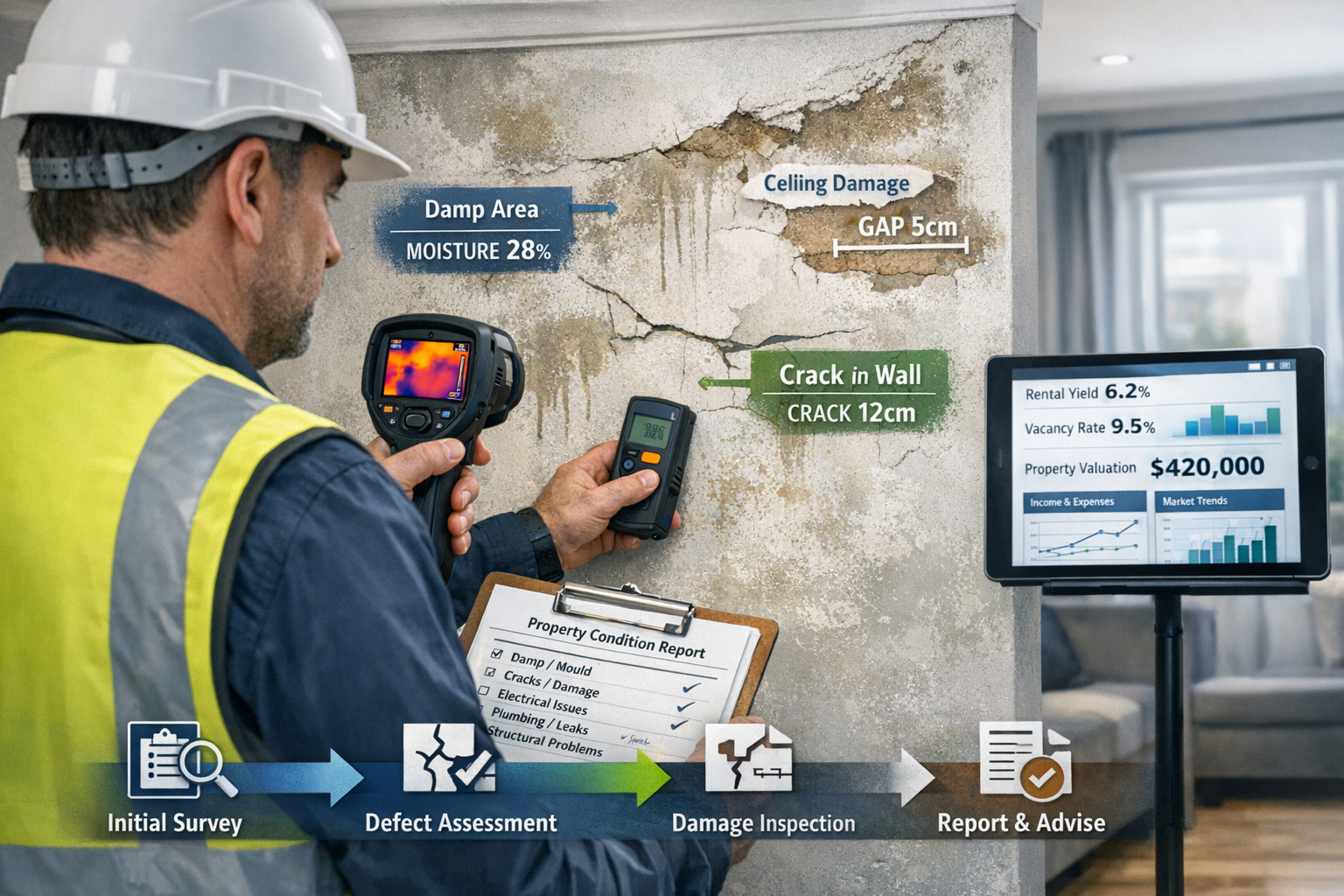
💧 Building envelope performance: Water ingress risks, damp issues, insulation quality, and weatherproofing that affect tenant comfort and energy costs
⚡ Systems and services condition: Electrical, plumbing, heating, and ventilation systems that directly impact tenant satisfaction and regulatory compliance
🔒 Safety and compliance status: Fire safety systems, gas safety, electrical certification, and building code compliance that protect landlords from liability
🎨 Cosmetic condition and marketability: Interior finishes, fixtures, and aesthetic elements that influence rental rates and tenant quality
Identifying High-Yield Opportunities Through Defect Analysis
Not all defects are created equal when evaluating rental properties. Savvy surveyors distinguish between value-destroying defects that require immediate attention and value-add opportunities that can enhance yields with strategic investment.
Critical defects requiring immediate remediation:
- Structural movement or subsidence requiring subsidence surveys
- Damp penetration causing health hazards
- Electrical systems posing fire or shock risks
- Roof failures leading to water damage
- Heating system failures affecting habitability
Strategic improvement opportunities:
- Outdated kitchens and bathrooms that could justify rent premiums when upgraded
- Energy efficiency improvements reducing operating costs and attracting eco-conscious tenants
- Space optimization through layout modifications
- Cosmetic enhancements with high ROI
- Additional amenities increasing marketability
A specific defect survey can provide targeted analysis of particular concerns, helping investors understand remediation costs and potential return on investment.
Multi-Unit and HMO Survey Considerations
Properties with multiple rental units or Houses in Multiple Occupation (HMOs) require specialized survey approaches. These properties generate higher yields but come with increased regulatory requirements and maintenance complexity.
Key survey considerations for multi-unit properties:
📋 Individual unit assessments: Each rental unit requires evaluation for condition, compliance, and marketability
🔧 Common area infrastructure: Shared systems, hallways, entrances, and amenities that impact all tenants
⚖️ Regulatory compliance: HMO licensing requirements, fire safety standards, room size regulations, and amenity ratios
💰 Maintenance forecasting: Coordinated repair schedules that minimize tenant disruption while controlling costs
The schedule of condition reporting becomes particularly valuable for multi-unit properties, establishing baseline conditions that protect landlords during tenant turnover.
Maximizing Rental Yields Through Survey-Informed Strategies
Preventive Maintenance Planning Based on Survey Findings
The most profitable rental properties aren't those requiring no maintenance—they're those where maintenance is strategically planned and executed based on comprehensive survey intelligence.
Survey findings enable landlords to:
Prioritize repairs by urgency and ROI: Address critical safety issues immediately while scheduling cosmetic improvements to coincide with tenant turnover, minimizing vacancy periods.
Budget accurately for capital expenses: Anticipate major system replacements (roofs, boilers, windows) years in advance, avoiding financial surprises that strain cash flow.
Negotiate purchase prices effectively: Use survey findings to justify price reductions or negotiate seller-funded repairs before acquisition.
Plan value-add renovations: Identify improvements that justify rent increases, ensuring renovation costs are recovered through enhanced yields.
A detailed homebuyer survey adapted for investment purposes provides the foundation for these strategic decisions, transforming survey costs into investment intelligence.
Risk Mitigation Through Comprehensive Documentation
Thorough survey documentation protects landlords from disputes, liability claims, and unexpected expenses. In an era of increasing tenant rights and regulatory scrutiny, comprehensive records are invaluable.
Survey documentation should include:
📸 Photographic evidence: Time-stamped images of all significant defects, system conditions, and property features
📊 Detailed condition ratings: Standardized assessments enabling objective comparison across properties and tracking deterioration over time
💵 Repair cost estimates: Professional estimates for identified defects, supporting budget planning and investment analysis
📝 Compliance status reports: Documentation of building code compliance, safety certifications, and regulatory requirements
This documentation proves particularly valuable during dilapidation surveys at lease end, protecting landlords from unwarranted damage claims.
Leveraging Technology for Enhanced Survey Accuracy
Modern surveying technology enables more accurate assessments and better investment decisions. Building surveyors preparing for the 2026 rental demand surge should incorporate:
🚁 Drone surveys for roof and facade inspection: Drone surveys provide safe, comprehensive assessment of difficult-to-access areas without expensive scaffolding
🌡️ Thermal imaging for hidden defects: Identifies insulation gaps, moisture intrusion, and heat loss invisible to visual inspection
📱 Digital reporting platforms: Enable real-time documentation, instant photo uploads, and collaborative review with investors and contractors
📐 3D scanning and modeling: Creates precise property records supporting space planning and renovation design
These technologies don't replace professional judgment but enhance the surveyor's ability to identify issues and communicate findings effectively to investors.
Survey Types and Pricing for Rental Investment Properties
Choosing the Right Survey Level
Different investment scenarios require different survey depths. Understanding when to deploy each survey type optimizes cost versus information value.
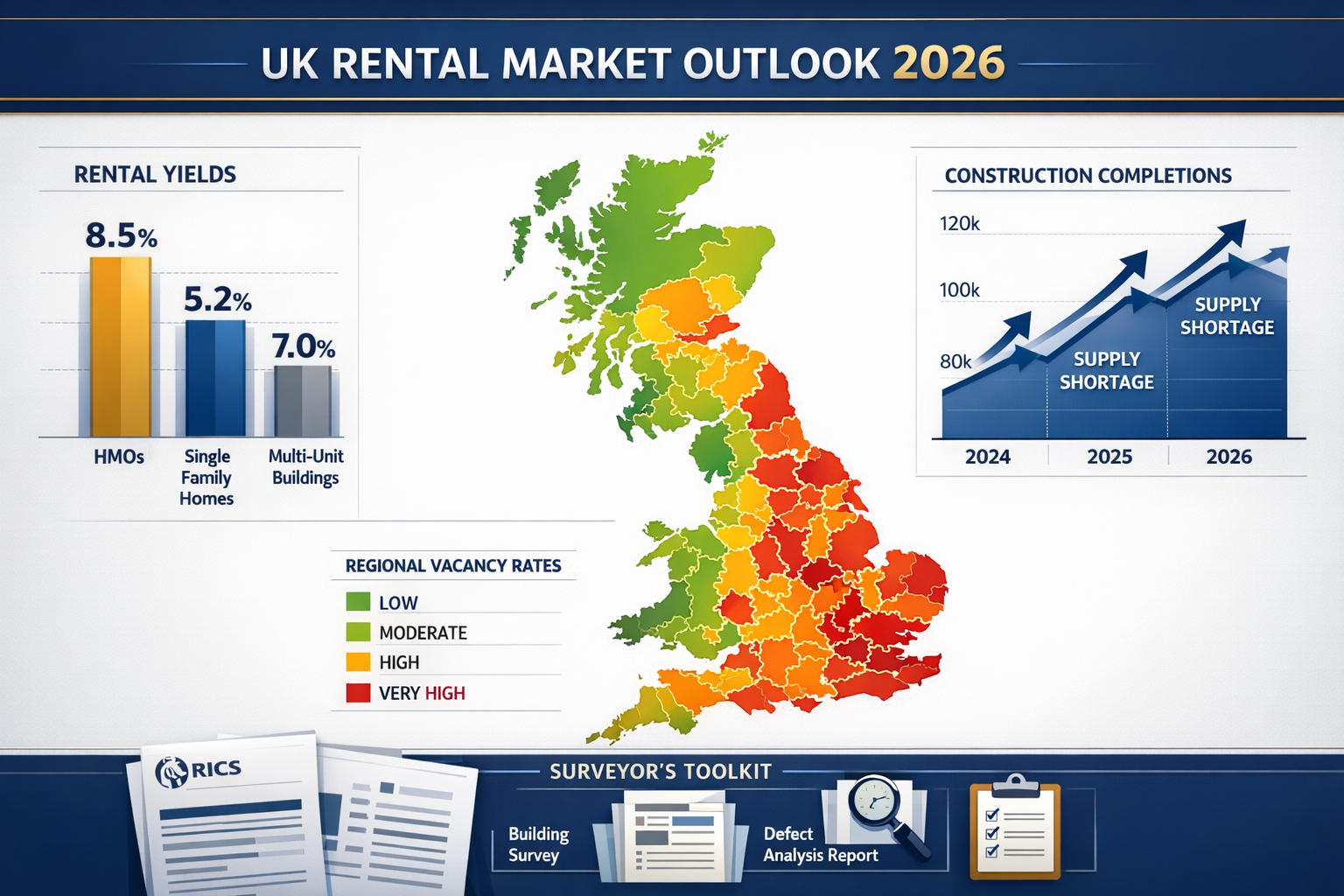
RICS Level 2 Homebuyer Survey: Suitable for relatively modern rental properties (post-1980s) in apparent good condition. Provides overview of condition with flagged concerns requiring further investigation. RICS Homebuyer Surveys Level 2 offer good value for straightforward acquisitions.
RICS Level 3 Building Survey: Essential for older properties, those with visible defects, or high-value acquisitions where comprehensive understanding justifies additional cost. Provides detailed analysis of all accessible elements.
Specialist surveys: Properties with specific concerns may require targeted assessments:
- Roof surveys for properties with visible roof issues
- Structural engineering assessments for properties with movement or alterations
- Asbestos surveys for pre-2000 buildings undergoing renovation
Investment Analysis Integration
The most valuable surveys don't just identify defects—they integrate findings with investment analysis, helping buyers understand true acquisition costs and potential returns.
Survey-informed investment metrics include:
💷 Adjusted purchase price: Market value minus repair costs and value-add investment required
📈 Yield calculations: Projected rental income relative to total acquisition and improvement costs
⏱️ Payback periods: Time required to recover renovation investments through enhanced rents
🎯 Risk-adjusted returns: Expected returns accounting for identified risks and potential future issues
Understanding survey pricing helps investors budget appropriately while recognizing that survey costs represent a small fraction of total investment—typically 0.1-0.3% of property value—while potentially saving 5-10% through informed negotiation and planning.
Regional Surveyor Selection
Market knowledge matters. Surveyors familiar with local construction methods, common defects, regulatory requirements, and market conditions provide more valuable insights than generalists.
When selecting surveyors for rental properties in specific markets, consider local expertise:
- Chartered surveyors in London understand Victorian and Edwardian property challenges unique to the capital
- Regional specialists recognize area-specific issues like subsidence patterns, local building materials, and climate-related concerns
- Local surveyors maintain relationships with specialist contractors, facilitating accurate repair cost estimates
Determining which survey you need depends on property characteristics, investment strategy, and risk tolerance—factors that qualified surveyors can help evaluate during initial consultation.
Future-Proofing Rental Portfolios Through Strategic Surveying
Anticipating Regulatory Changes
The rental sector faces increasing regulation around energy efficiency, safety standards, and tenant protections. Forward-thinking surveys assess current compliance while anticipating future requirements.
Key regulatory trends affecting rental properties:
⚡ Energy Performance Certificate (EPC) requirements: Minimum ratings may increase, requiring proactive improvement of insulation, heating systems, and renewable energy integration
🔥 Enhanced fire safety standards: Particularly for multi-unit buildings, requiring upgraded detection systems, escape routes, and fire-resistant construction
♿ Accessibility requirements: Evolving standards for disabled access may affect common areas and individual units
🌱 Sustainability mandates: Carbon reduction targets may drive requirements for green technologies and sustainable materials
Surveys that identify compliance gaps and improvement pathways help landlords stay ahead of regulatory changes rather than scrambling to meet new requirements.
Portfolio Optimization Through Comparative Analysis
Investors with multiple properties benefit from standardized survey approaches enabling portfolio-wide comparison and strategic resource allocation.
Portfolio-level survey strategies include:
📊 Standardized condition ratings: Consistent assessment criteria across all properties enabling objective comparison
🗓️ Synchronized maintenance scheduling: Coordinating major works across properties for contractor efficiency and bulk purchasing advantages
💰 Strategic divestment decisions: Identifying underperforming properties with excessive maintenance requirements for potential sale
🎯 Acquisition targeting: Using portfolio analysis to identify gaps and optimal expansion opportunities
This systematic approach transforms individual property surveys into portfolio intelligence, supporting data-driven investment decisions.
Building Surveyor-Investor Partnerships
The most successful rental property investors develop ongoing relationships with trusted surveyors rather than treating surveys as one-time transactions.
Long-term surveyor partnerships provide:
🤝 Institutional knowledge: Surveyors familiar with your portfolio provide context and track property condition evolution over time
⚡ Rapid response capability: Established relationships enable quick assessments when acquisition opportunities arise or urgent issues emerge
💡 Proactive advice: Trusted surveyors alert investors to emerging issues, market trends, and improvement opportunities
📉 Preferential pricing: Volume relationships often yield cost efficiencies while maintaining quality
These partnerships become particularly valuable as the 2026 rental market evolves, providing investors with expert guidance through changing conditions.
Conclusion
Preparing Building Surveyors for 2026 Rental Demand Surge: Surveys for High-Yield Tenant Markets represents more than a tactical response to current market conditions—it's a strategic imperative for investors seeking sustainable returns in an evolving landscape. With vacancy rates stabilizing after years of extreme tightness, construction activity creating potential future supply gaps, and regulatory requirements increasing, comprehensive building surveys have become essential tools for risk management and yield optimization.
The rental market transformation underway in 2026 rewards investors who understand property condition deeply, plan maintenance strategically, and position their assets to capitalize on emerging supply constraints. Building surveyors equipped with modern technology, local market knowledge, and investment-focused analysis provide the intelligence foundation for these successful strategies.
Actionable Next Steps
For landlords and property investors preparing for the 2026 rental market:
1️⃣ Commission comprehensive surveys before acquisition: Never purchase rental property without professional assessment, regardless of apparent condition or market pressure
2️⃣ Develop portfolio-wide maintenance strategies: Use survey findings to create multi-year capital expenditure plans that protect and enhance asset values
3️⃣ Establish surveyor relationships: Build ongoing partnerships with qualified professionals who understand your investment strategy and local markets
4️⃣ Integrate survey findings with investment analysis: Ensure condition assessments inform purchase decisions, pricing negotiations, and yield projections
5️⃣ Stay ahead of regulatory changes: Use surveys to identify compliance gaps and plan proactive improvements before requirements become mandatory
6️⃣ Leverage technology for competitive advantage: Embrace modern surveying tools that provide deeper insights and better documentation
The rental properties that thrive in 2026 and beyond will be those backed by thorough professional assessment, strategic maintenance planning, and informed investment decisions. Building surveyors prepared to deliver this comprehensive intelligence will become indispensable partners in rental property success.
References

[1] Canada Markets To Watch – https://www.pwc.com/us/en/industries/financial-services/asset-wealth-management/real-estate/emerging-trends-in-real-estate-pwc-uli/canada/canada-markets-to-watch.html
[2] 2026 Canada Rental Market Trend Report – https://liv.rent/blog/rent-reports/2026-canada-rental-market-trend-report/
[3] Canadas Rental Market Overview For 2025 And Going Into 2026 – https://www.wehaveamortgageforthat.com/index.php/blog/post/333/canadas-rental-market-overview-for-2025-and-going-into-2026
[4] Average Rent Canada 2026 – https://www.neobanc.com/articles/average-rent-canada-2026
[5] 2026 Real Estate Market Summary Transitioning To The Future – https://www.doanegrantthornton.ca/insights/2026-real-estate-market-summary-transitioning-to-the-future/