


The northern regions of England are experiencing an unprecedented construction surge in 2026, with residential and commercial developments transforming cityscapes from Manchester to Newcastle. This explosive growth has triggered a corresponding rise in party wall disputes, creating urgent demand for qualified expert witnesses who can navigate the complex intersection of technical assessment, legal frameworks, and dispute resolution. Expert Witness Preparation for Party Wall Disputes in Northern Construction Boom 2026 has become essential knowledge for surveyors, construction professionals, and legal practitioners operating in this dynamic environment.
As construction activity intensifies across northern England, property owners find themselves embroiled in conflicts over shared walls, boundary issues, and structural concerns. The role of the expert witness has never been more critical—or more scrutinized. Understanding how to prepare effectively for this responsibility can mean the difference between successful dispute resolution and protracted legal battles.
Key Takeaways
- 🏗️ Northern construction activity is projected to grow significantly through 2026, driving increased party wall disputes requiring expert witness testimony
- 📋 Comprehensive preparation includes mastering Party Wall Act 1996 legislation, gathering technical evidence, and understanding RICS professional standards
- ⚖️ Expert witnesses must maintain strict impartiality while providing clear, evidence-based opinions that courts and tribunals can rely upon
- 📊 Documentation quality directly impacts case outcomes—photographic evidence, structural assessments, and detailed reports form the foundation of credible testimony
- 🎯 Following RICS best practices and established protocols ensures professional credibility and reduces liability exposure for expert witnesses
Understanding the Northern Construction Boom Context
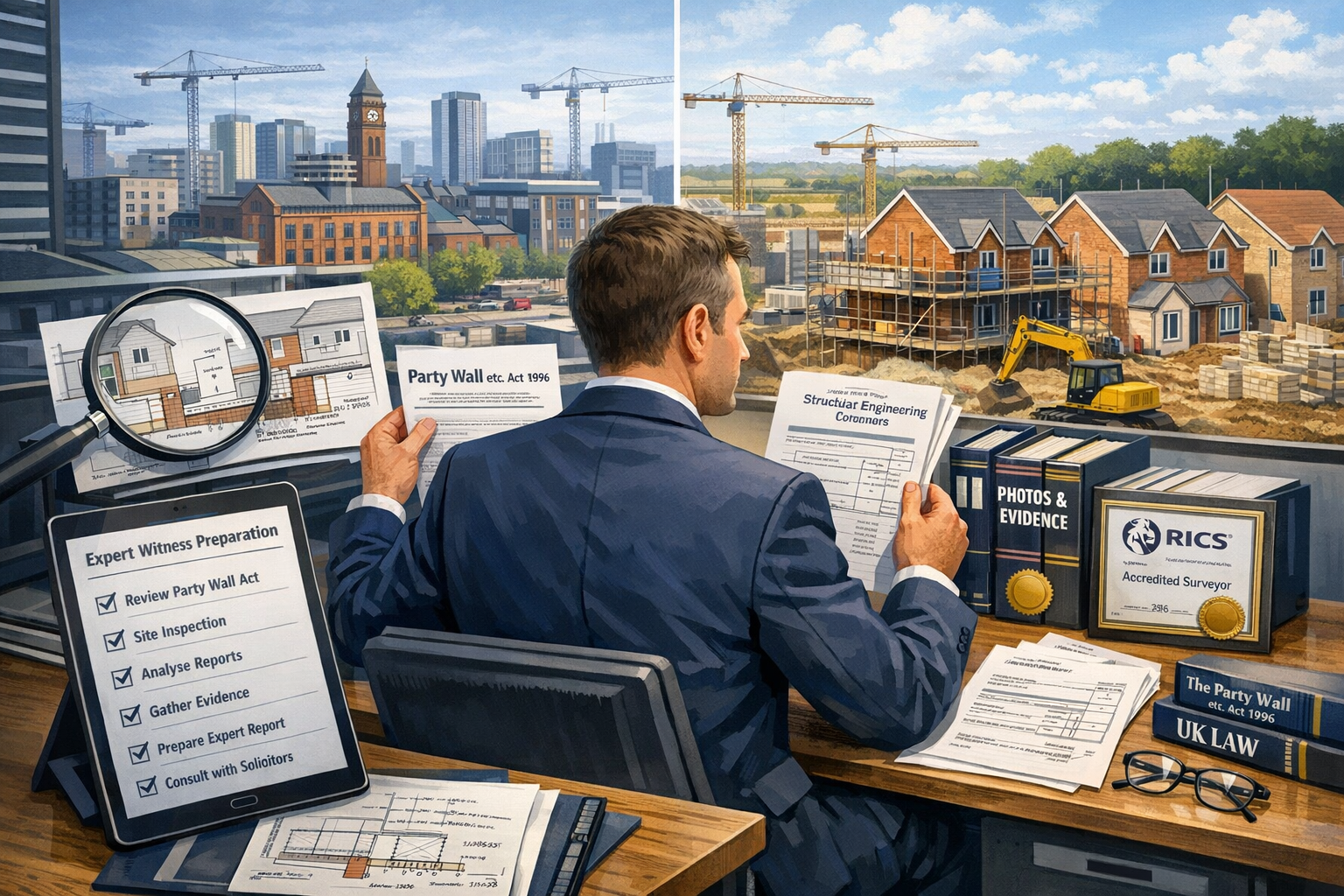
The construction landscape across northern England has transformed dramatically in 2026. According to industry forecasts, the northern regions are experiencing substantial growth in both residential and commercial sectors [1]. This expansion reflects government initiatives to rebalance regional development, increased infrastructure investment, and growing demand for urban regeneration projects.
Regional Growth Patterns
The construction boom manifests differently across northern cities:
- Manchester and Greater Manchester: High-density residential developments and commercial office conversions
- Leeds and West Yorkshire: Mixed-use developments combining retail, residential, and office spaces
- Liverpool: Waterfront regeneration and heritage building conversions
- Newcastle and Tyneside: Urban renewal projects and student accommodation expansion
This concentrated development activity inevitably increases the frequency of works affecting party walls, particularly in terraced housing areas and urban centers where properties share structural elements.
Impact on Party Wall Disputes
Industry data suggests that construction disputes, including party wall matters, have risen proportionally with development activity [2]. Several factors contribute to this trend:
Common Dispute Triggers:
- Excavation works within three meters of neighboring properties
- Structural alterations to shared walls
- New building construction on boundary lines
- Loft conversions affecting party walls
- Basement extensions requiring underpinning
The complexity of these disputes demands expert witnesses who understand both technical construction matters and the legal framework governing party wall procedures. For professionals seeking to understand their obligations, reviewing party wall award guidance provides essential context.
The Expert Witness Role in Party Wall Disputes
An expert witness serves a fundamentally different function than a party wall surveyor acting for either the building owner or adjoining owner. While party wall surveyors advocate for their appointing parties' interests, expert witnesses owe their primary duty to the court or tribunal, providing impartial, evidence-based opinions.
Key Responsibilities
Primary Duties Include:
- Providing Independent Assessment: Evaluating technical evidence without bias toward either party
- Educating the Court: Explaining complex construction concepts in accessible language
- Offering Professional Opinion: Drawing conclusions based on evidence, experience, and industry standards
- Maintaining Objectivity: Resisting pressure from instructing parties to modify opinions
"The expert witness's duty to the court overrides any obligation to the party who has engaged them. This fundamental principle ensures the integrity of the judicial process." — RICS Practice Statement on Expert Witness Evidence
Qualifications and Credentials
For Expert Witness Preparation for Party Wall Disputes in Northern Construction Boom 2026, appropriate qualifications are non-negotiable:
Essential Credentials:
- ✅ RICS chartered status (ideally in Building Surveying)
- ✅ Substantial experience in party wall matters (minimum 5-10 years recommended)
- ✅ Expert witness training or accreditation
- ✅ Professional indemnity insurance with expert witness coverage
- ✅ Continuing professional development in relevant areas
Professionals can enhance their credibility by maintaining expert witness credentials and staying current with industry developments.
Step-by-Step Expert Witness Preparation Process
Effective preparation distinguishes competent expert witnesses from exceptional ones. The following systematic approach ensures thorough readiness for party wall dispute cases.
Step 1: Initial Case Assessment and Acceptance
Before accepting an expert witness appointment, conduct rigorous due diligence:
Conflict Check Protocol:
- Review all parties involved for previous professional relationships
- Verify no conflicts with current or recent appointments
- Confirm independence from all parties to the dispute
- Document the conflict checking process
Competency Evaluation:
- Assess whether the case falls within your area of expertise
- Identify any specialized knowledge requirements
- Determine if additional technical consultants are needed
- Confirm availability for the likely case timeline
Step 2: Document Review and Evidence Gathering
Comprehensive documentation forms the foundation of credible expert testimony.
Essential Documents to Review:
| Document Category | Specific Items | Purpose |
|---|---|---|
| Legal Documentation | Party wall notices, awards, agreements | Establish procedural compliance |
| Technical Records | Structural surveys, engineering reports | Assess technical claims |
| Photographic Evidence | Pre-work, during-work, post-work photos | Document conditions and changes |
| Correspondence | Letters, emails between parties | Understand dispute history |
| Planning Documents | Building control approvals, planning permissions | Verify regulatory compliance |
When reviewing cases involving specific issues like obstructions in party walls, ensure you obtain complete documentation of the affected structures.
Step 3: Site Inspection and Technical Assessment
Physical inspection provides irreplaceable insights that documents alone cannot convey.
Site Visit Best Practices:
🔍 Pre-Visit Preparation:
- Schedule access with all relevant parties
- Prepare inspection checklist based on dispute issues
- Bring appropriate measuring and documentation equipment
- Review site plans and historical records
🔍 During Inspection:
- Photograph all relevant conditions systematically
- Take detailed measurements of affected areas
- Note construction methods and materials
- Document any safety concerns or urgent issues
- Interview parties if appropriate (maintaining impartiality)
🔍 Post-Visit Documentation:
- Organize photographs with clear labeling
- Create detailed site notes while observations are fresh
- Identify any additional information needed
- Flag areas requiring specialist assessment
For cases involving excavation near party walls, understanding the 3-metre rule is essential during site assessment.
Step 4: Technical Analysis and Opinion Formation
Transform gathered evidence into professional opinions through systematic analysis.
Analysis Framework:
- Identify the Technical Questions: What specific issues must your expert opinion address?
- Evaluate the Evidence: What does the physical and documentary evidence demonstrate?
- Apply Relevant Standards: Which building regulations, British Standards, or industry practices apply?
- Consider Alternative Explanations: Could the observed conditions have different causes?
- Form Conclusions: What professional opinions can you support with evidence?
Common Technical Issues in Party Wall Disputes:
- Structural damage allegedly caused by neighboring works
- Adequacy of temporary support during construction
- Compliance with Party Wall Act notice requirements
- Reasonableness of proposed works or protective measures
- Causation of cracks, settlement, or other defects
Step 5: Report Preparation
The expert witness report serves as your primary communication tool to the court or tribunal.
Report Structure (RICS Compliant):
1. Introduction and Qualifications
- Your professional background and expertise
- Relevant experience with similar cases
- Statement of expert witness duties
2. Instructions and Scope
- Who instructed you and when
- Questions you've been asked to address
- Any limitations on your investigation
3. Executive Summary
- Brief overview of key findings
- Main conclusions (detailed later in report)
4. Background and Context
- Description of the properties involved
- Summary of the dispute
- Timeline of relevant events
5. Site Inspection Findings
- Detailed observations from site visits
- Photographic evidence with commentary
- Measurements and technical data
6. Technical Analysis
- Application of relevant standards and regulations
- Evaluation of competing claims
- Discussion of technical issues
7. Professional Opinion
- Clear statements of your expert conclusions
- Reasoning supporting each opinion
- Acknowledgment of any uncertainties
8. Statement of Truth
- Confirmation of expert witness duties
- Declaration that opinions are honestly held
- Signature and date
Pro Tip: Use clear, jargon-free language wherever possible. When technical terms are necessary, provide brief explanations. Remember that judges and tribunal members may not have construction backgrounds.
Step 6: Pre-Hearing Preparation
The days before a hearing or trial require focused preparation.
Final Preparation Checklist:
✅ Document Review:
- Re-read your expert report thoroughly
- Review all evidence documents again
- Study any opposing expert reports
- Identify potential areas of cross-examination
✅ Legal Coordination:
- Meet with instructing solicitors or barristers
- Understand the overall case strategy
- Clarify which aspects of your evidence are most critical
- Discuss potential questions and how to address them
✅ Practical Arrangements:
- Confirm hearing date, time, and location
- Prepare professional appearance and attire
- Organize all documents in easily accessible format
- Bring multiple copies of key exhibits
✅ Mental Preparation:
- Review expert witness duties and obligations
- Practice maintaining composure under pressure
- Prepare to admit limitations or uncertainties honestly
- Focus on clarity and helpfulness rather than advocacy
Navigating the Hearing or Trial
When the hearing day arrives, expert witnesses must balance technical expertise with effective communication.
Giving Evidence-in-Chief
Your instructing party's legal representative will first question you to establish your evidence.
Best Practices:
- Speak clearly and at a measured pace
- Address answers to the judge or tribunal panel
- Refer to your report when needed, but avoid reading verbatim
- Use visual aids or diagrams to clarify complex points
- Maintain professional demeanor throughout
Handling Cross-Examination
Cross-examination tests the robustness of your opinions and your credibility.
Effective Cross-Examination Strategies:
🎯 Listen Carefully: Ensure you understand each question before answering
🎯 Answer Directly: Respond to the specific question asked, then expand if necessary
🎯 Admit Limitations: Acknowledge if something falls outside your expertise or if you're uncertain
🎯 Stay Calm: Maintain composure even if questions seem aggressive or repetitive
🎯 Correct Mischaracterizations: Politely clarify if your evidence is misrepresented
🎯 Avoid Defensiveness: Remember that challenging questions test evidence quality, not personal worth
Common Cross-Examination Tactics:
| Tactic | Purpose | How to Handle |
|---|---|---|
| Repetitive questioning | Seek inconsistencies | Provide consistent answers calmly |
| Hypothetical scenarios | Test opinion boundaries | Answer honestly about limitations |
| Credential challenges | Undermine expertise | Confidently state qualifications without arrogance |
| Document confrontation | Highlight overlooked evidence | Acknowledge and incorporate if relevant |
| Opinion comparison | Create doubt through differences with opposing experts | Explain reasoning for your conclusions |
Expert Conferencing and Joint Statements
In many party wall disputes, courts encourage or require expert witnesses to meet and identify areas of agreement and disagreement.
Joint Statement Process:
- Pre-Meeting Preparation: Review opposing expert's report and identify key differences
- Without Prejudice Discussion: Meet to discuss technical issues openly
- Agreement Identification: Document matters where experts agree
- Disagreement Clarification: Clearly articulate remaining differences and reasons
- Joint Statement Production: Create formal document for court outlining consensus and disputes
This process often narrows issues significantly, saving court time and sometimes facilitating settlement.
RICS Best Practices for Expert Witnesses in 2026
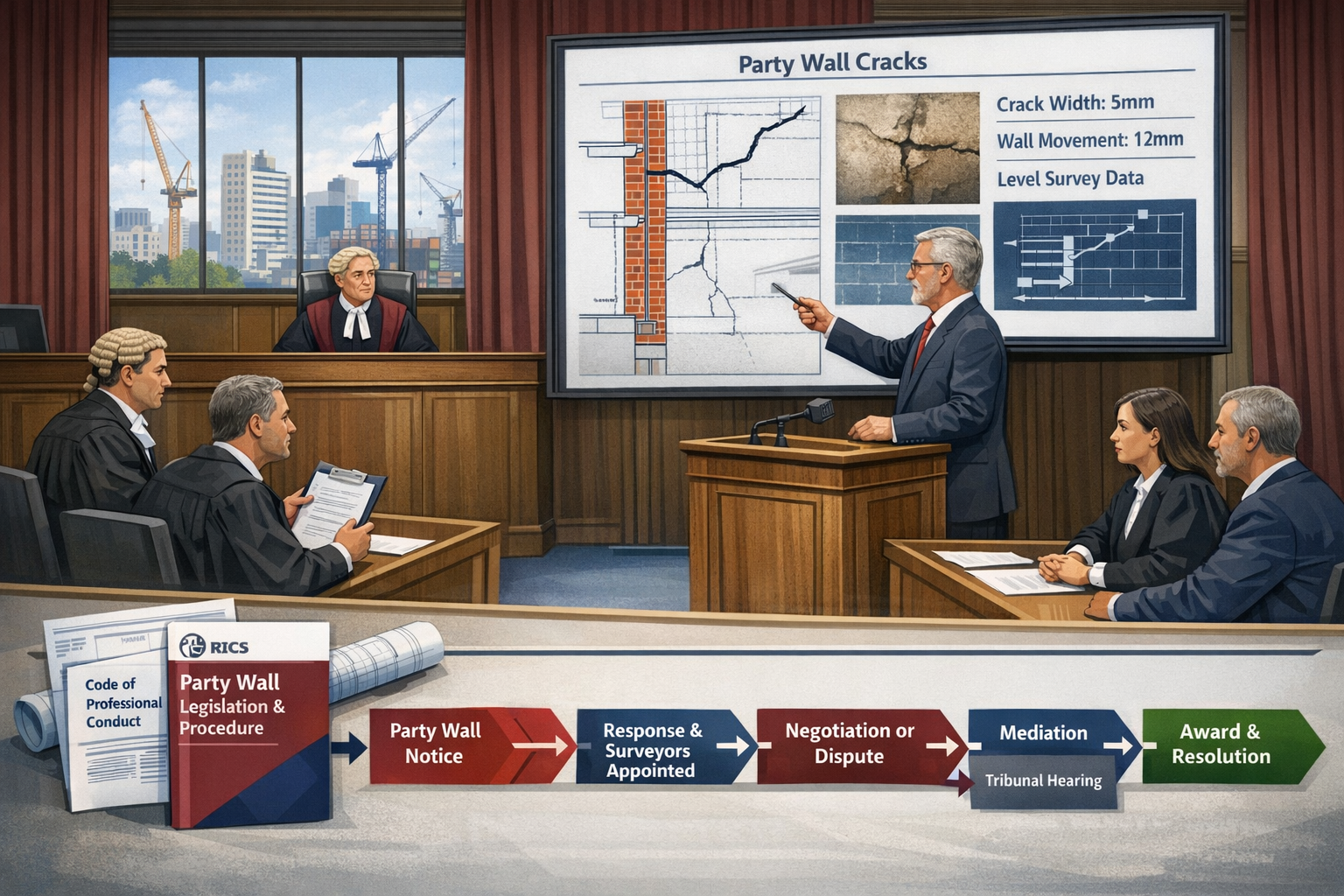
The Royal Institution of Chartered Surveyors (RICS) provides comprehensive guidance for members acting as expert witnesses. Adherence to these standards is essential for Expert Witness Preparation for Party Wall Disputes in Northern Construction Boom 2026.
Professional Conduct Standards
Core RICS Principles:
📌 Independence: Maintain complete objectivity regardless of who instructs you
📌 Integrity: Provide honest opinions even when unfavorable to instructing party
📌 Competence: Only accept cases within your area of expertise
📌 Transparency: Disclose any factors that might affect your independence
📌 Compliance: Follow all relevant practice statements and guidance notes
Continuing Professional Development
The construction industry evolves constantly, requiring expert witnesses to maintain current knowledge.
Essential CPD Areas for 2026:
- Updates to Party Wall Act interpretation and case law
- New building regulations and technical standards
- Emerging construction methods and materials
- Changes to expert witness procedural rules
- Regional construction trends and practices
Insurance and Risk Management
Adequate professional indemnity insurance is crucial for expert witness work.
Insurance Considerations:
- Verify coverage specifically includes expert witness activities
- Ensure policy limits are appropriate for potential claim values
- Understand any exclusions or conditions
- Maintain continuous coverage without gaps
- Keep detailed records of all expert witness appointments
Case Studies: Expert Witness Preparation in Action
Real-world examples illustrate how effective preparation impacts party wall dispute outcomes.
Case Study 1: Basement Extension Dispute in Manchester
Background: A terraced property owner in Manchester undertook a basement extension requiring excavation within two meters of the adjoining property. The neighbor claimed the works caused structural damage including cracking to internal walls and external brickwork.
Expert Witness Preparation:
- Conducted detailed pre-work and post-work photographic comparison
- Reviewed structural engineering calculations for temporary support
- Inspected both properties thoroughly, documenting all cracks with measurements
- Analyzed soil conditions and excavation methodology
- Consulted historical records showing pre-existing movement
Outcome: The expert witness identified that some cracking pre-dated the basement works (evidenced by historical survey reports), while other damage was directly attributable to inadequate temporary support during excavation. The clear, evidence-based analysis enabled a negotiated settlement with appropriate remedial works.
Key Lesson: Thorough documentation of pre-existing conditions is essential. When neighbors carry out works, understanding what happens when a neighbour is carrying out works without party wall agreement helps frame the legal context.
Case Study 2: Shared Chimney Removal in Leeds
Background: A property owner removed a shared chimney stack without proper party wall procedures, leading to water ingress and structural concerns for the adjoining property.
Expert Witness Preparation:
- Examined the remaining chimney structure and weatherproofing
- Assessed compliance with Party Wall Act notification requirements
- Evaluated structural implications of chimney removal
- Reviewed building control documentation
- Photographed water damage and traced ingress routes
Outcome: The expert witness provided clear evidence that the chimney removal was executed without proper party wall procedures and resulted in actionable damage. The report recommended specific remedial measures and weatherproofing solutions.
Key Lesson: Understanding specialized party wall issues like party wall shared chimneys enables targeted, authoritative expert opinions.
Case Study 3: Loft Conversion Impact in Newcastle
Background: A loft conversion involving party wall modifications allegedly caused damage to the adjoining property's roof structure and internal ceilings.
Expert Witness Preparation:
- Inspected loft spaces in both properties
- Reviewed structural engineering designs for party wall modifications
- Assessed workmanship quality and compliance with approved plans
- Documented ceiling cracks with detailed measurements and photographs
- Consulted with structural engineer on loading calculations
Outcome: The expert witness determined that while the party wall works were properly designed, poor workmanship during construction caused vibration damage to the adjoining property. The clear distinction between design adequacy and execution quality helped resolve the dispute.
Key Lesson: Expert witnesses must distinguish between design deficiencies and construction defects—each has different implications for liability and remediation.
Common Pitfalls and How to Avoid Them
Even experienced professionals can encounter challenges in expert witness work. Awareness of common mistakes helps prevent them.
Pitfall 1: Advocacy Rather Than Objectivity
The Problem: Becoming an advocate for the instructing party rather than maintaining independence.
How to Avoid:
- Regularly remind yourself that your duty is to the court
- Write reports assuming the opposing party will read them
- Acknowledge evidence that doesn't support your instructing party
- Resist pressure to modify opinions to suit case strategy
Pitfall 2: Inadequate Documentation
The Problem: Failing to gather or preserve sufficient evidence to support opinions.
How to Avoid:
- Create comprehensive photographic records
- Take detailed contemporaneous notes during inspections
- Maintain organized files of all reviewed documents
- Document your reasoning process, not just conclusions
Pitfall 3: Overstepping Expertise Boundaries
The Problem: Offering opinions on matters outside your area of competence.
How to Avoid:
- Clearly define the scope of your expertise in reports
- Recommend additional specialists when needed
- Acknowledge limitations honestly
- Focus on areas where you have genuine expertise
Pitfall 4: Poor Communication
The Problem: Using excessive jargon or failing to explain technical concepts clearly.
How to Avoid:
- Write for an intelligent lay audience
- Define technical terms when first used
- Use visual aids to clarify complex points
- Test report clarity with non-technical readers
Pitfall 5: Insufficient Preparation for Cross-Examination
The Problem: Being unprepared for challenging questions or document confrontation.
How to Avoid:
- Thoroughly review all case documents before hearings
- Anticipate potential challenges to your opinions
- Practice answering difficult questions
- Meet with legal team to discuss likely cross-examination areas
Emerging Trends in Party Wall Expert Witness Work
The landscape of expert witness work continues to evolve, particularly in the context of the 2026 northern construction boom.
Digital Evidence and Technology
Modern expert witness work increasingly incorporates technological tools:
Technology Applications:
- 📱 3D Scanning: Creating precise digital models of affected structures
- 📱 Drone Photography: Documenting roof and elevation conditions safely
- 📱 Moisture Mapping: Using thermal imaging to identify water ingress
- 📱 Structural Monitoring: Installing sensors to track movement over time
- 📱 Digital Evidence Management: Organizing and presenting evidence electronically
Remote Hearings and Virtual Evidence
The shift toward remote proceedings affects expert witness preparation and presentation.
Considerations for Virtual Hearings:
- Ensure reliable technology setup and backup systems
- Prepare digital exhibits in easily shareable formats
- Practice screen-sharing technical diagrams
- Maintain professional appearance and environment
- Test audio and video quality in advance
Sustainability and Modern Construction Methods
The 2026 construction boom includes increased focus on sustainable building practices, requiring expert witnesses to understand:
- Modern methods of construction (MMC)
- Energy efficiency retrofits affecting party walls
- Sustainable materials and their properties
- Green building standards and their party wall implications
For cases involving newer construction approaches, familiarity with non-standard construction becomes valuable.
Regulatory Changes and Case Law Development
Party wall law continues to develop through case precedents and regulatory updates.
Staying Current:
- Monitor relevant court decisions and their implications
- Follow RICS updates to party wall guidance
- Participate in professional forums and discussion groups
- Attend specialized training on party wall law developments
- Subscribe to construction law publications
Building Your Expert Witness Practice
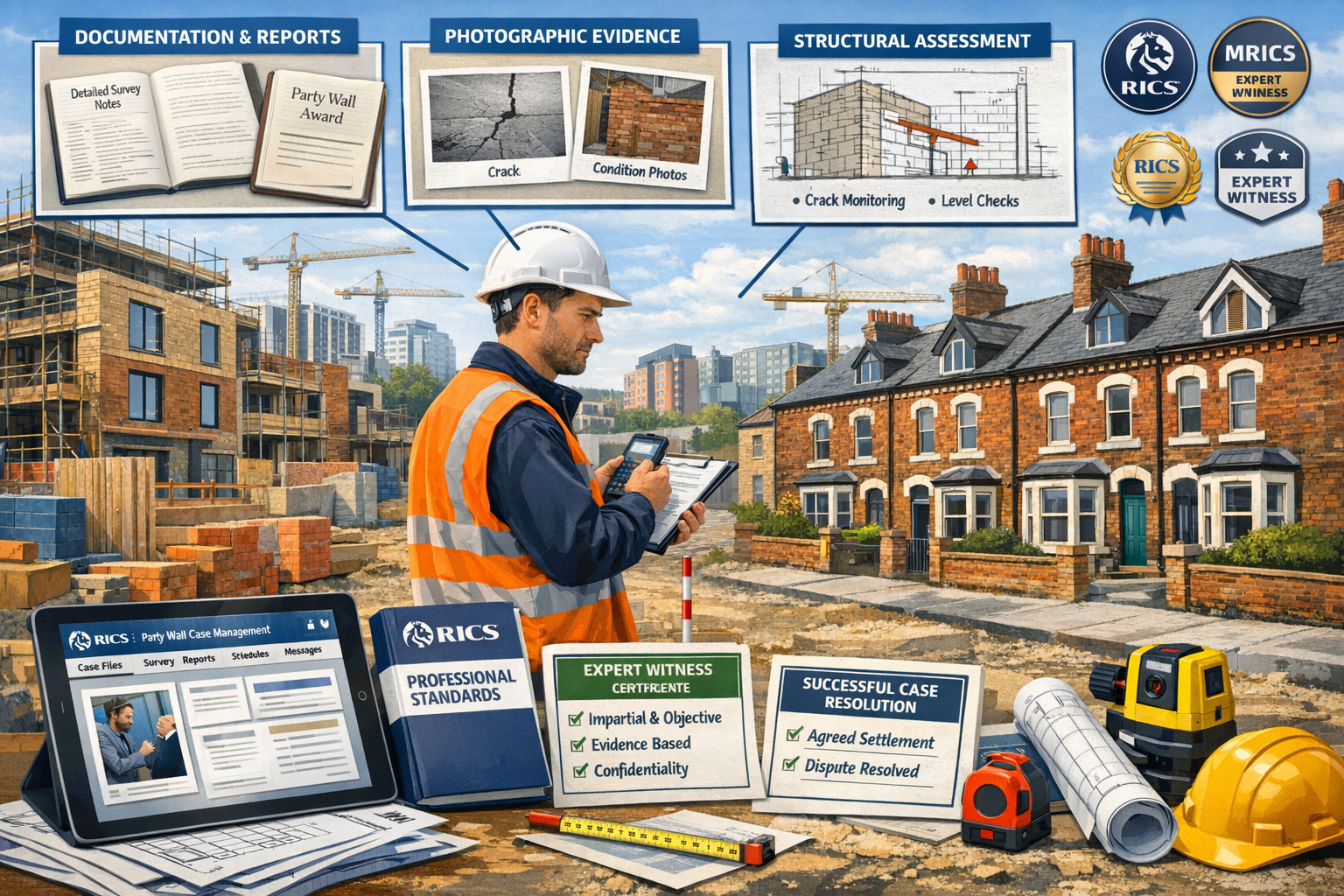
For surveyors seeking to develop expertise in party wall dispute resolution, strategic career development is essential.
Developing Expertise
Career Development Pathway:
Years 1-5: Build foundation
- Gain broad party wall surveying experience
- Act as appointed surveyor in straightforward cases
- Develop technical assessment skills
- Build knowledge of Party Wall Act procedures
Years 5-10: Deepen specialization
- Handle increasingly complex party wall matters
- Undertake expert witness training
- Begin accepting expert witness appointments in simpler cases
- Develop report writing and presentation skills
Years 10+: Establish authority
- Build reputation for expertise in specific party wall issues
- Take on complex, high-value disputes
- Contribute to professional guidance development
- Mentor junior professionals
Marketing Your Expert Witness Services
Establishing credibility as an expert witness requires strategic positioning.
Effective Marketing Approaches:
✅ Professional Profile Development:
- Maintain detailed CV highlighting relevant experience
- Document significant cases (respecting confidentiality)
- Obtain testimonials from instructing solicitors
- Publish articles or speak at professional events
✅ Networking and Relationships:
- Build relationships with construction law firms
- Participate in professional associations
- Attend legal and surveying conferences
- Maintain visibility in relevant professional circles
✅ Online Presence:
- Create professional website with expert witness credentials
- Maintain updated LinkedIn profile
- Share insights on party wall matters (appropriately)
- Demonstrate thought leadership in the field
Ethical Considerations
Maintaining the highest ethical standards protects both your professional reputation and the integrity of the dispute resolution process.
Ethical Imperatives:
⚖️ Conflict Management: Rigorously screen for conflicts and decline appointments when independence is questionable
⚖️ Fee Arrangements: Ensure fees are not contingent on case outcomes
⚖️ Confidentiality: Protect sensitive information from all cases
⚖️ Honest Reporting: Never modify opinions to favor instructing parties
⚖️ Continuous Competence: Maintain skills and knowledge through ongoing development
Conclusion
Expert Witness Preparation for Party Wall Disputes in Northern Construction Boom 2026 demands a sophisticated blend of technical expertise, legal understanding, and professional integrity. As construction activity continues to surge across northern England, the demand for qualified expert witnesses will only intensify. Those who master the preparation process—from initial case assessment through hearing testimony—position themselves as invaluable resources in resolving complex property disputes.
The key to excellence lies in systematic preparation: thorough evidence gathering, rigorous technical analysis, clear communication, and unwavering objectivity. By following RICS best practices, maintaining current knowledge of construction methods and legal developments, and approaching each case with meticulous attention to detail, expert witnesses serve the essential function of helping courts and tribunals reach just, evidence-based decisions.
Actionable Next Steps
For professionals seeking to enhance their expert witness capabilities:
-
Assess Your Readiness: Evaluate whether you have sufficient experience and qualifications to act as an expert witness in party wall disputes
-
Invest in Training: Complete formal expert witness training programs recognized by RICS or legal professional bodies
-
Build Your Knowledge Base: Stay current with Party Wall Act case law, construction standards, and regional development trends
-
Develop Your Network: Establish relationships with construction law firms and other professionals in the dispute resolution field
-
Start Strategically: Begin with simpler cases to build experience and confidence before taking on complex, high-value disputes
-
Maintain Standards: Commit to the highest professional and ethical standards in every appointment
-
Seek Mentorship: Learn from experienced expert witnesses who can provide guidance and insights
The northern construction boom of 2026 presents both challenges and opportunities. For those prepared to meet the exacting standards of expert witness work, it offers the chance to make meaningful contributions to fair dispute resolution while building a rewarding professional practice.
For additional guidance on party wall matters and expert witness services, explore our comprehensive resources on expert witness work and related surveying services.
References
[1] What Does 2025 Data Reveal About Uk Construction In 2026 – https://constructionmanagement.co.uk/what-does-2025-data-reveal-about-uk-construction-in-2026/
[2] Construction Growth By 2027 Impact On Construction Industry Jobs Uk – https://www.atkinssearch.co.uk/insights/construction-growth-by-2027-impact-on-construction-industry-jobs-uk/









