


The property market landscape across the United Kingdom is experiencing a remarkable transformation in 2026, with Northern England emerging as the standout performer in a market characterized by stark regional divergence. While Southern regions continue to grapple with affordability challenges and stagnant growth, the Northern England Valuation Surge 2026: RICS Strategies for 5-7% Price Growth in Buy-to-Let and Residential represents a fundamental shift in investment opportunities and valuation approaches. This comprehensive analysis explores the strategic frameworks RICS-accredited surveyors are deploying to navigate this dynamic market environment.
The latest RICS UK Residential Market Survey reveals that the North West and North of England are reporting prices on an upward trajectory, with these regions showing improved conditions compared to Southern areas[1][3]. This regional outperformance demands sophisticated valuation strategies that account for local market dynamics, institutional investor demand, and the evolving regulatory landscape affecting both buy-to-let and residential sectors.
Key Takeaways
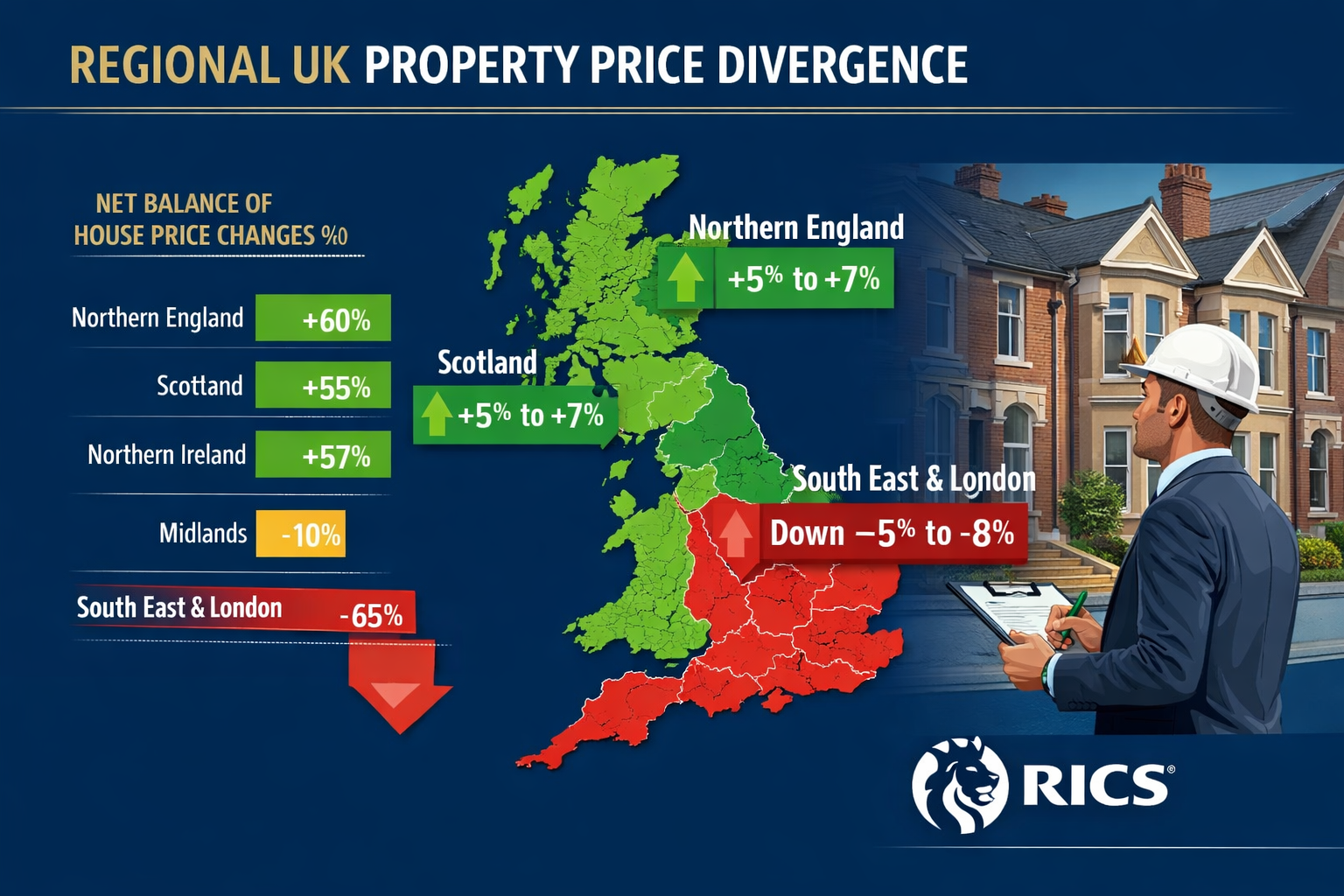
📊 Regional Price Divergence: Northern England, Scotland, and Northern Ireland are experiencing upward price trajectories with projected 5-7% growth, significantly outperforming London and the South East[1][3][4]
📈 Market Sentiment Improving: 43% of RICS survey respondents anticipate higher prices over the year ahead, marking the most positive outlook since February 2025[1]
🏘️ Buy-to-Let Supply Constraints: Landlord instructions remain firmly negative at -30% net balance, creating rental price pressures with 28% of respondents expecting rental increases[1]
💼 Institutional Interest Growing: Professional investors are increasingly targeting Northern markets due to superior yields and growth potential compared to saturated Southern markets[4]
🔍 Valuation Precision Critical: Accurate RICS Red Book valuations are essential for capturing regional nuances and ensuring proper asset pricing in rapidly appreciating markets
Understanding the Northern England Valuation Surge 2026: RICS Strategies for 5-7% Price Growth in Buy-to-Let and Residential
The Regional Divergence Phenomenon
The United Kingdom's property market in 2026 presents a tale of two markets—one struggling with affordability constraints in the South, and another experiencing robust growth in the North. This divergence isn't merely a temporary fluctuation but represents a structural shift in how property values are distributed across the nation.
According to the latest RICS data, Northern regions are significantly outperforming London, the South East, South West, and East Anglia, which continue to lag the national average due to affordability challenges[1]. The net balance for house prices over the past three months stood at -10%, improving steadily from a low of -19% in October 2025, indicating tentative stabilization at the national level[1][3].
However, this national figure masks the remarkable performance of Northern England, where surveyors anticipate 3-5% appreciation during 2026, with some submarkets potentially reaching 7% growth[4]. This outperformance creates unique challenges and opportunities for property valuers who must accurately capture local market dynamics.
Key Drivers of Northern Growth
Several interconnected factors are fueling the Northern England Valuation Surge 2026:
🏢 Affordability Advantage: Northern properties offer significantly better value compared to Southern counterparts, with average prices in Manchester and Liverpool remaining 40-60% below London equivalents for comparable properties.
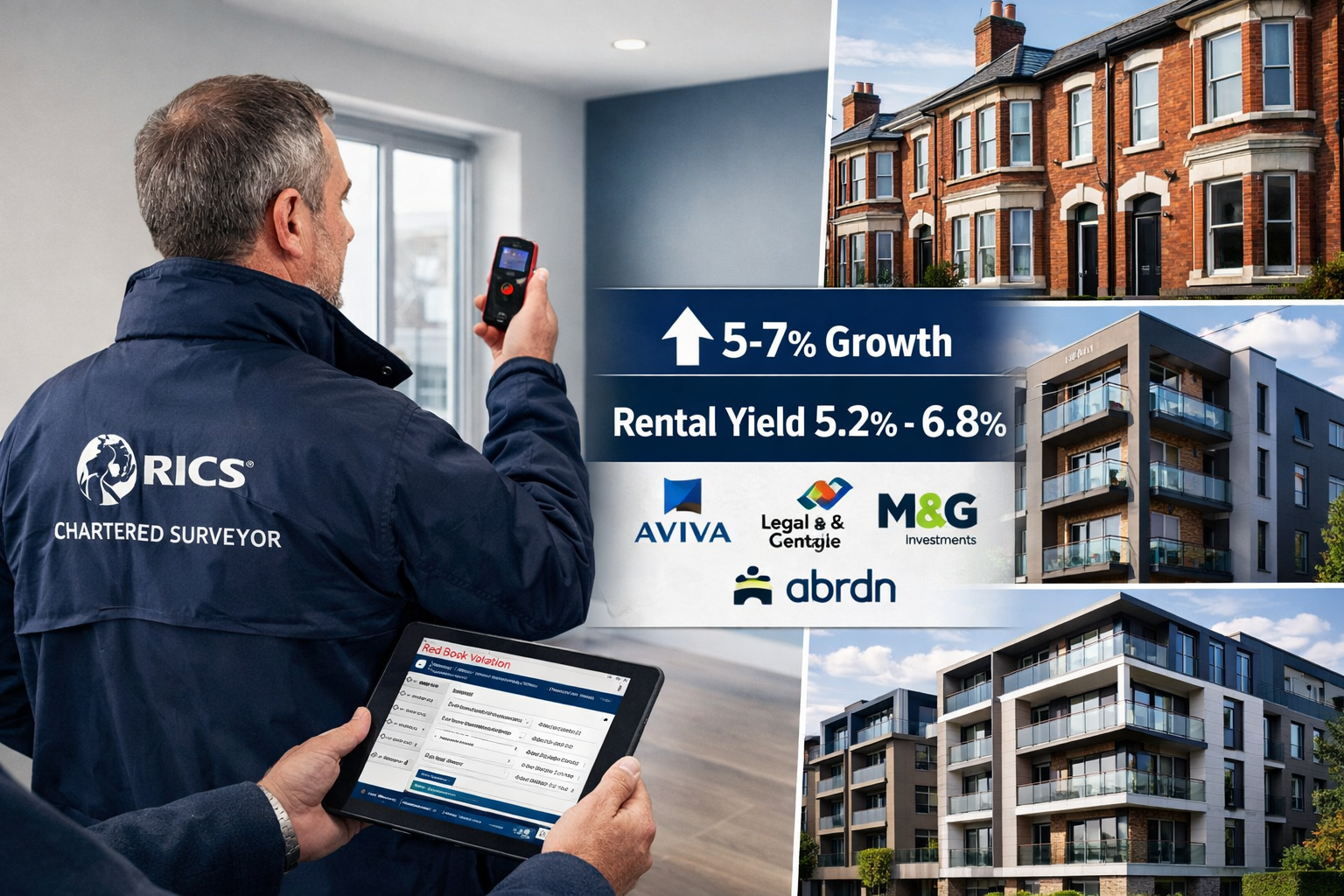
💰 Yield Compression in the South: Buy-to-let investors are increasingly looking northward as rental yields in London and the South East have compressed to 3-4%, while Northern cities offer 5-7% gross yields.
🚄 Infrastructure Investment: Major transport projects including Northern Powerhouse Rail and HS2 extensions are enhancing connectivity and driving long-term value appreciation.
👥 Demographic Shifts: Remote work flexibility has enabled professionals to relocate from expensive Southern cities to more affordable Northern locations without sacrificing career opportunities.
🎓 University Cities: Strong student populations in Manchester, Liverpool, Leeds, and Newcastle create stable rental demand and support buy-to-let fundamentals.
For property professionals seeking to obtain accurate valuations in this dynamic environment, understanding these drivers is essential. A RICS valuation surveyor can obtain a Red Book valuation on your property in Manchester that properly accounts for these regional factors.
Market Sentiment Indicators
The improvement in market sentiment provides crucial context for valuation strategies. New buyer enquiries have shown consistent improvement, with the net balance rising to -15% in January, up from -21% in December and -29% in November, signaling easing downward pressure[1].
More significantly, agreed sales momentum has strengthened, with the latest net balance reaching -9%, the least negative reading since June 2025[1]. This suggests that Northern markets are transitioning from stabilization to growth phases more rapidly than national averages would indicate.
| Metric | November 2025 | December 2025 | January 2026 | Trend |
|---|---|---|---|---|
| New Buyer Enquiries | -29% | -21% | -15% | ⬆️ Improving |
| Agreed Sales | -15% | -12% | -9% | ⬆️ Improving |
| House Price Balance | -19% | -12% | -10% | ⬆️ Improving |
| 12-Month Sales Expectations | +28% | +32% | +35% | ⬆️ Strengthening |
The forward-looking indicators are particularly encouraging. The net balance for twelve-month sales expectations reached +35%, the strongest reading since December 2024, contrasting sharply with near-term caution (+4%)[1]. This suggests that market participants, including professional surveyors, anticipate sustained improvement throughout 2026.
RICS Valuation Strategies for Northern England's Buy-to-Let Sector
Navigating Supply Constraints and Rental Growth
The buy-to-let sector in Northern England presents unique valuation challenges in 2026, primarily driven by severe supply constraints. Landlord instructions remain firmly negative, with a net balance of -30%, reflecting ongoing supply constraints despite the Renters Rights Act[1].
This supply-demand imbalance has created upward pressure on rental prices, with 28% of RICS respondents expecting rental prices to rise in the near term, up from 16% previously[1][3]. For valuers, this environment requires careful consideration of:
📊 Rental Growth Projections: Traditional valuation models may underestimate future rental income potential in supply-constrained markets. RICS-accredited surveyors are increasingly incorporating higher rental growth assumptions (3-5% annually) when valuing Northern buy-to-let properties.
🔄 Void Period Adjustments: With tenant demand edging higher in the three months to January, ending two consecutive quarters of flat or negative readings[1], void periods are shortening. Valuation models should reflect reduced vacancy assumptions.
💼 Institutional Investor Benchmarks: Professional investors are establishing presence in Northern markets, creating new comparable evidence at potentially higher price points than traditional landlord transactions.
Red Book Valuation Methodology for Buy-to-Let Assets
When conducting RICS Help to Buy valuations or standard buy-to-let assessments, RICS-accredited surveyors in Northern England are employing enhanced methodologies:
Investment Method Refinements:
- Yield Compression Assumptions: As institutional capital flows into Northern markets, capitalization rates are compressing. Valuers must carefully analyze comparable investment sales to determine appropriate yields, which may be 25-50 basis points lower than historical norms.
- Rental Evidence Weighting: Greater emphasis on recent letting evidence (within 3 months) rather than 6-12 month historical data, given rapidly changing rental dynamics.
- Quality Adjustments: Premium properties with modern specifications, energy efficiency, and professional management are achieving yield compression faster than standard stock.
Comparable Selection Criteria:
The Northern England Valuation Surge 2026: RICS Strategies for 5-7% Price Growth in Buy-to-Let and Residential requires more rigorous comparable selection:
-
Geographic Precision: Micro-location matters more than ever. Comparables should be within 0.5 miles for urban areas, with adjustments for transport links, amenities, and neighborhood quality.
-
Transaction Timing: In appreciating markets, comparables older than 3 months require upward adjustment of approximately 1-1.5% per quarter.
-
Buyer Profile: Distinguish between institutional purchases, professional landlord acquisitions, and owner-occupier transactions, as these create different price points.
-
Tenure Considerations: Leasehold properties require careful analysis of ground rent, service charges, and remaining lease term—factors that institutional investors scrutinize heavily.
For professionals requiring detailed assessment of buy-to-let portfolios, understanding valuation costs is essential for budgeting purposes.
Regulatory Impact on Valuations
The evolving regulatory landscape significantly affects buy-to-let valuations in 2026:
Energy Performance Certificate (EPC) Requirements: Properties below EPC rating C face potential obsolescence risk. Valuers must:
- Apply discounts of 10-15% for properties rated D or below
- Consider improvement costs to achieve compliance
- Assess landlord willingness to invest versus exit strategies
Renters Rights Act Implications: New tenant protections affect:
- Rental growth assumptions (potential caps on increases)
- Management cost projections (increased compliance burden)
- Void period expectations (longer notice periods may increase turnover time)
Licensing Schemes: Selective and additional licensing in cities like Manchester, Liverpool, and Leeds creates:
- Direct compliance costs (£500-1,000 annually)
- Indirect costs for property improvements
- Potential supply restrictions benefiting compliant properties
"The Northern England buy-to-let market in 2026 rewards professional, compliant landlords with quality stock. Valuations must reflect the growing premium for properties that meet or exceed regulatory standards while accounting for the obsolescence risk of non-compliant assets." — RICS Valuation Standards
Residential Valuation Approaches for the Northern England Valuation Surge 2026: RICS Strategies for 5-7% Price Growth
Owner-Occupier Market Dynamics
The owner-occupier segment in Northern England exhibits distinct characteristics requiring tailored valuation approaches. With 43% of survey respondents anticipating higher prices over the year ahead—the most positive outlook since February 2025[1][3]—valuers must balance current market evidence with forward-looking growth expectations.
First-Time Buyer Demand: Northern England's affordability advantage is attracting significant first-time buyer activity:
- Average property prices in key Northern cities remain within reach for median-income households
- Government schemes like Help to Buy continue supporting entry-level purchases
- Mortgage affordability has improved with recent interest rate stabilization
For first-time buyers utilizing government assistance, obtaining a professional RICS Help to Buy valuation ensures compliance with scheme requirements and accurate market pricing.
Family Housing Premium: Detached and semi-detached properties with gardens are commanding particular premiums:
- Post-pandemic space preferences remain influential
- School catchment areas create localized price variations of 15-20%
- Suburban locations with good transport links outperforming city centers
New Build vs. Existing Stock: The valuation gap between new builds and existing properties is narrowing in Northern markets:
- New build premiums have reduced from 15-20% to 8-12% as existing stock quality improves
- Buyers increasingly value character features in Victorian and Edwardian properties
- Energy efficiency retrofits in older properties reducing the new build advantage
Comparative Method Refinements
The traditional comparative method remains the cornerstone of residential valuation, but the Northern England Valuation Surge 2026: RICS Strategies for 5-7% Price Growth in Buy-to-Let and Residential necessitates methodological enhancements:
Time Adjustments in Appreciating Markets:
When markets are rising at 5-7% annually, time adjustments become critical:
- Monthly adjustment factor: approximately 0.4-0.6%
- Quarterly adjustment factor: approximately 1.25-1.75%
- Six-month adjustment factor: approximately 2.5-3.5%
Quality Scoring Systems:
RICS surveyors are implementing more sophisticated quality scoring to ensure like-for-like comparisons:
| Factor | Weight | Scoring Range | Impact on Value |
|---|---|---|---|
| Property Condition | 25% | 1-10 | ±5-15% |
| Location Quality | 30% | 1-10 | ±10-20% |
| Specification/Features | 20% | 1-10 | ±5-10% |
| Energy Efficiency | 15% | 1-10 | ±3-8% |
| Outdoor Space | 10% | 1-10 | ±2-5% |
Micro-Market Analysis: Northern cities exhibit significant intra-urban variation:
- Manchester: Ancoats and Northern Quarter achieving 8-10% growth versus 3-5% in outer suburbs
- Liverpool: Baltic Triangle and Georgian Quarter outperforming by 3-4 percentage points
- Leeds: City center apartments appreciating faster than suburban family homes
- Newcastle: Quayside developments commanding premiums of 20-25% over comparable city locations
Valuation for Specific Transaction Types
Different transaction types require tailored approaches within the Northern England context:
Matrimonial Valuations: In divorce proceedings, accurate property valuation is crucial. Matrimonial valuations must reflect current market conditions while considering:
- Forced sale scenarios potentially reducing values by 5-10%
- Time-to-sell expectations in current market conditions
- Costs of sale and associated transaction expenses
Shared Ownership Schemes: The growing popularity of shared ownership in Northern cities requires specialized knowledge. Valuation of shared ownership properties must account for:
- Staircasing provisions and future purchase options
- Rent on the retained equity portion
- Resale restrictions and eligible purchaser limitations
Capital Gains Tax Valuations: Property investors realizing gains need accurate historical valuations. Valuation for capital gains tax purposes requires:
- Retrospective market analysis to establish acquisition values
- Improvement expenditure documentation and impact assessment
- Current market value determination for disposal calculations
Right to Buy Valuations: Social housing tenants exercising purchase rights require Right to Buy valuations that:
- Reflect open market value without tenant occupation
- Consider property condition and required improvements
- Account for discount entitlements and maximum price restrictions
Survey Integration with Valuation
Comprehensive property assessment combines valuation with condition analysis. Understanding the relationship between mortgage valuations and surveys is essential:
RICS Level 2 Homebuyer Survey: The RICS Homebuyer Survey Level 2 provides:
- Market valuation assessment
- Condition rating for key elements
- Identification of urgent defects affecting value
- Legal issues and essential repairs
RICS Level 3 Building Survey: For older or complex properties, a RICS Building Survey Level 3 offers:
- Comprehensive condition assessment
- Detailed defect analysis and repair cost estimates
- Valuation implications of identified issues
- Long-term maintenance planning
The Northern England housing stock includes significant proportions of Victorian and Edwardian properties requiring careful structural assessment. Defects discovered during surveys can materially impact valuations, with major structural issues potentially reducing values by 10-20% or more.
Strategic Implementation: Maximizing Accuracy in Northern England Valuations
Data Sources and Market Intelligence
Accurate valuations depend on comprehensive market intelligence. RICS-accredited surveyors in Northern England are leveraging:
Primary Data Sources:
- Land Registry Price Paid Data: Transaction evidence with 2-3 month lag
- Rightmove and Zoopla Asking Prices: Leading indicators of market sentiment
- Local Estate Agent Intelligence: Real-time market feedback and buyer behavior insights
- Auction Results: Particularly relevant for investment properties and distressed sales
Secondary Research:
- RICS UK Residential Market Survey: Monthly sentiment and trend analysis[1][3]
- Regional Economic Indicators: Employment, wage growth, and demographic trends
- Planning and Development Pipelines: Future supply affecting long-term values
- Transport Infrastructure Projects: Connectivity improvements driving appreciation
Institutional Investor Activity: Monitoring large-scale acquisitions provides valuable market signals:
- Build-to-rent developments establishing new rental benchmarks
- Portfolio acquisitions by REITs and pension funds
- International investor interest in Northern cities
Risk Assessment and Adjustment Factors
The Northern England Valuation Surge 2026: RICS Strategies for 5-7% Price Growth in Buy-to-Let and Residential requires careful risk assessment:
Market Risk Factors:
- Interest Rate Sensitivity: Northern buyers typically have higher loan-to-value ratios, making the market more sensitive to rate changes
- Economic Dependency: Regional economic performance affects employment and buyer confidence
- Supply Pipeline: New development completions potentially moderating growth in specific submarkets
Property-Specific Risk Factors:
- Tenure Issues: Leasehold properties with onerous terms or short remaining leases
- Construction Type: Non-standard construction affecting mortgageability
- Environmental Concerns: Flood risk, contamination, or other environmental constraints
- Planning Restrictions: Conservation areas, listed building status, or restrictive covenants
Regulatory Risk Factors:
- EPC Requirements: Future minimum standards affecting older properties
- Building Safety: Post-Grenfell regulations affecting apartment buildings
- Rental Sector Regulation: Licensing requirements and tenant protection legislation
Valuation Reporting Standards
RICS Red Book compliance ensures professional standards and client protection. A comprehensive Manchester valuation report should include:
Essential Report Components:
- Executive Summary: Clear statement of value, property details, and valuation date
- Property Description: Comprehensive details of accommodation, construction, and condition
- Tenure and Tenancy: Legal interests, lease terms, and occupational arrangements
- Market Analysis: Local market conditions, trends, and comparable evidence
- Valuation Approach: Methodology explanation and assumptions
- Limitations and Assumptions: Scope restrictions and reliance factors
- Conclusions: Final opinion of value with supporting rationale
Comparable Evidence Presentation:
Effective presentation of comparable evidence enhances credibility:
- Minimum 3-5 comparable transactions
- Detailed adjustment explanations
- Photographic evidence where appropriate
- Clear timeline showing transaction dates
- Adjustment grid demonstrating value derivation
Professional Indemnity Considerations:
In appreciating markets, valuation accuracy becomes increasingly scrutinized:
- Conservative valuations may disadvantage clients in competitive bidding
- Optimistic valuations create lender risk and professional liability
- Balanced approach requires robust methodology and documentation
Working with valuers registered with the RICS ensures professional standards, insurance coverage, and regulatory compliance.
Technology Integration in Valuation Practice
Modern valuation practice increasingly incorporates technology:
Automated Valuation Models (AVMs):
- Useful for initial estimates and portfolio screening
- Limited accuracy in heterogeneous Northern housing stock
- Should complement rather than replace professional judgment
Geographic Information Systems (GIS):
- Mapping comparable evidence and market trends
- Analyzing location factors and accessibility
- Identifying micro-market boundaries and characteristics
Digital Inspection Tools:
- Laser measuring devices for accurate floor area assessment
- Thermal imaging for energy efficiency evaluation
- Drone photography for roof and external condition assessment
- 360-degree photography for comprehensive documentation
Data Analytics Platforms:
- Trend analysis and predictive modeling
- Comparable evidence databases
- Market sentiment indicators
- Rental yield calculators
Quality Assurance and Peer Review
Maintaining valuation accuracy in dynamic markets requires robust quality assurance:
Internal Review Processes:
- Senior surveyor review of significant valuations
- Methodology consistency checks across similar properties
- Comparable evidence verification
- Assumption reasonableness testing
External Validation:
- Benchmarking against market transactions post-valuation
- Peer review for complex or high-value properties
- Lender feedback on valuation accuracy
- Client outcome tracking (successful sales at or near valuation)
Continuing Professional Development:
RICS members must maintain current knowledge through:
- Regular market condition updates
- Regulatory change awareness
- Methodology enhancement training
- Technology adoption and digital skills development
For those seeking to understand why to choose an RICS chartered building surveyor, the combination of professional standards, ongoing education, and quality assurance processes provides significant value.
Investment Strategies Leveraging the Northern England Valuation Surge 2026
Institutional Investor Approaches
Professional investors are deploying sophisticated strategies to capitalize on Northern England's growth trajectory:
Build-to-Rent (BTR) Developments:
- Purpose-built rental communities with professional management
- Targeting 5-6% net yields with 3-5% annual appreciation
- Focus on city center locations with strong transport links
- Amenity-rich developments attracting professional tenants
Portfolio Acquisition Strategies:
- Bulk purchases of 10-50 properties achieving economies of scale
- Targeting areas with strong fundamentals: employment growth, infrastructure investment, university presence
- Refurbishment programs to improve EPC ratings and rental income
- Professional management platforms reducing void periods and maximizing returns
Value-Add Opportunities:
Institutional investors are identifying properties with enhancement potential:
- Conversion of commercial buildings to residential use
- Subdivision of large properties into HMOs or apartments
- Extension and reconfiguration of existing housing stock
- Energy efficiency improvements unlocking rental growth
Private Investor Considerations
Individual investors can also benefit from the Northern England Valuation Surge 2026: RICS Strategies for 5-7% Price Growth in Buy-to-Let and Residential:
Entry-Level Investment Strategy:
- Target Areas: Identify up-and-coming neighborhoods before institutional capital arrives
- Property Type: Two-bedroom apartments or terraced houses with strong rental demand
- Financing: Maximize leverage while maintaining sustainable debt service coverage
- Management: Consider professional management to ensure compliance and maximize occupancy
Portfolio Diversification:
- Geographic Spread: Diversify across multiple Northern cities to reduce concentration risk
- Tenant Mix: Combine professional, student, and family housing for income stability
- Asset Types: Mix of apartments and houses, new builds and refurbished period properties
Tax Efficiency Strategies:
- Corporate Structures: Limited company ownership for higher-rate taxpayers
- Capital Allowances: Claiming available allowances on fixtures and fittings
- Mortgage Interest Relief: Structuring to optimize available tax relief
- Capital Gains Planning: Strategic disposal timing and principal private residence relief utilization
Exit Strategy Planning
Successful investment requires clear exit planning:
Hold Period Considerations:
- Short-term (1-3 years): Capital appreciation focus, higher transaction cost impact
- Medium-term (3-7 years): Balanced income and growth, optimal for current market conditions
- Long-term (7+ years): Income focus with inflation protection, lower transaction frequency
Market Timing Indicators:
Monitoring signals for optimal exit timing:
- Yield Compression: When rental yields fall below target returns
- Market Sentiment Peaks: RICS survey indicators showing excessive optimism
- Regulatory Changes: Adverse legislative developments affecting returns
- Personal Circumstances: Life events or portfolio rebalancing needs
Disposal Methods:
- Private Treaty Sale: Maximum price achievement in stable or rising markets
- Auction: Speed and certainty, typically 10-15% discount to private treaty
- Portfolio Sale: Bulk disposal to institutional buyers, potential premium for scale
- Tenant Purchase: Sitting tenant sales at potential discount but reduced marketing time
Future Outlook: Sustaining the Northern England Valuation Surge Beyond 2026
Long-Term Growth Drivers
The Northern England property market's positive trajectory appears sustainable based on structural factors:
Economic Rebalancing:
- Government leveling-up initiatives directing investment to Northern regions
- Corporate relocations and regional office expansions
- Technology sector growth in Manchester, Leeds, and Newcastle
- Advanced manufacturing and logistics sector expansion
Demographic Trends:
- Internal migration from expensive Southern regions
- Young professional attraction to vibrant Northern cities
- International student populations supporting rental markets
- Aging population creating demand for retirement and downsizer properties
Infrastructure Investment:
- Northern Powerhouse Rail: Transforming connectivity between major cities
- HS2 Extensions: Reducing journey times to London and enhancing accessibility
- Local Transport Improvements: Tram extensions, bus rapid transit, and cycling infrastructure
- Digital Infrastructure: Fiber broadband and 5G deployment supporting remote work
Sustainability Transition:
Northern cities are investing in green infrastructure:
- Low emission zones encouraging residential development in city centers
- Retrofit programs improving existing housing stock energy efficiency
- Renewable energy installations reducing operating costs
- Green space enhancement improving quality of life and property values
Potential Headwinds and Mitigation Strategies
Despite positive fundamentals, valuers must consider potential challenges:
Economic Uncertainty:
- Risk: National or global economic downturn affecting employment and buyer confidence
- Mitigation: Focus on locations with diversified economic bases and strong fundamentals
Interest Rate Volatility:
- Risk: Rising rates reducing affordability and buyer demand
- Mitigation: Conservative lending assumptions and stress testing investment returns
Oversupply in Specific Submarkets:
- Risk: Excessive new development saturating specific areas
- Mitigation: Careful monitoring of planning pipelines and absorption rates
Regulatory Changes:
- Risk: Additional landlord obligations or tenant protections reducing returns
- Mitigation: Professional management, quality properties exceeding minimum standards
Climate and Environmental Risks:
- Risk: Flood risk, subsidence, or other environmental factors affecting specific properties
- Mitigation: Thorough due diligence, appropriate insurance, and risk-adjusted valuations
Professional Development for Valuers
Maintaining expertise in this dynamic environment requires ongoing professional development:
Technical Skills Enhancement:
- Advanced comparable analysis techniques
- Statistical modeling and data analytics
- Sustainability and energy efficiency assessment
- Technology integration and digital tools
Market Knowledge Development:
- Regular market visits and local intelligence gathering
- Relationship building with estate agents, developers, and investors
- Attendance at property conferences and networking events
- Subscription to market research and data services
Regulatory Compliance:
- RICS Red Book updates and implementation
- Building safety legislation and implications
- Energy efficiency regulations and requirements
- Data protection and client confidentiality
For comprehensive property assessment combining valuation with condition analysis, professionals should consider obtaining a RICS home survey that addresses both market value and physical condition.
Conclusion: Capitalizing on the Northern England Valuation Surge 2026

The Northern England Valuation Surge 2026: RICS Strategies for 5-7% Price Growth in Buy-to-Let and Residential represents a significant opportunity for investors, homebuyers, and property professionals. The confluence of affordability advantages, infrastructure investment, demographic shifts, and economic rebalancing creates a compelling case for sustained growth in Northern markets.
Key Success Factors for navigating this environment include:
✅ Rigorous Valuation Methodology: Employing RICS Red Book standards with appropriate adjustments for appreciating markets
✅ Local Market Intelligence: Developing deep knowledge of specific Northern cities and micro-markets
✅ Comprehensive Risk Assessment: Identifying and quantifying property-specific and market-wide risks
✅ Technology Integration: Leveraging data analytics and digital tools to enhance accuracy
✅ Regulatory Compliance: Ensuring properties meet current and anticipated standards
✅ Professional Standards: Working with RICS-accredited surveyors who maintain current knowledge and skills
The evidence from RICS surveys demonstrates that market participants are increasingly confident about Northern England's prospects, with 43% anticipating higher prices and sales expectations reaching their strongest levels in over a year[1][3]. This sentiment, combined with fundamental drivers of growth, suggests the current upward trajectory can be sustained through 2026 and beyond.
Actionable Next Steps
For property investors, buyers, and professionals looking to capitalize on this market:
-
Obtain Professional Valuations: Engage RICS-accredited surveyors for accurate market assessments that account for regional dynamics and growth trajectories
-
Conduct Thorough Due Diligence: Invest in comprehensive surveys and condition assessments to identify value-add opportunities and avoid costly surprises
-
Monitor Market Indicators: Track RICS survey data, transaction volumes, and rental market trends to inform timing decisions
-
Build Local Networks: Develop relationships with estate agents, property managers, and other market participants for real-time intelligence
-
Plan for Regulation: Ensure properties meet or exceed current standards, particularly regarding energy efficiency and safety requirements
-
Consider Professional Management: Especially for buy-to-let investments, professional management ensures compliance and maximizes returns
-
Maintain Flexibility: Market conditions evolve; retain the ability to adjust strategies based on changing circumstances
The Northern England property market in 2026 offers compelling opportunities for those who approach it with professional rigor, comprehensive analysis, and strategic planning. By implementing RICS-compliant valuation strategies and maintaining awareness of market dynamics, investors and homebuyers can successfully navigate this period of regional outperformance and position themselves for sustained success.
Whether acquiring a first home, building a buy-to-let portfolio, or providing professional valuation services, the principles outlined in this analysis provide a framework for informed decision-making in one of the UK's most dynamic property markets. The combination of attractive valuations, strong fundamentals, and positive sentiment creates a rare alignment of factors supporting continued growth in Northern England's residential and investment property sectors.
References
[1] Uk Resi Survey Jan 2026 Report Shows Early Signs Market Recovery Despite Caution – https://www.rics.org/news-insights/uk-resi-survey-jan-2026-report-shows-early-signs-market-recovery-despite-caution
[2] Uk Economy Property Update February 2026 – https://www.rics.org/content/dam/ricsglobal/documents/market-surveys/uk-economy-property-update-february-2026.pdf
[3] Uk Residential Market Survey January 2026 – https://www.rics.org/content/dam/ricsglobal/documents/market-surveys/uk-residential-market-survey/UK-Residential-Market-Survey_January-2026.pdf
[4] Valuation Strategies For Northern Uk Price Surge Surveyor Tactics In Scotland Northern Ireland And North England 2026 – https://nottinghillsurveyors.com/blog/valuation-strategies-for-northern-uk-price-surge-surveyor-tactics-in-scotland-northern-ireland-and-north-england-2026
[5] housingtoday.co.uk – https://www.housingtoday.co.uk/news/rics-hails-early-signs-of-housing-market-improvement-in-latest-survey/5140683.article









