


The UK property market stands at a critical juncture in 2026, where energy efficiency is no longer a secondary consideration but a fundamental determinant of property value, marketability, and regulatory compliance. Building Surveys for Retrofit Projects: EPC Upgrades and RICS Quality Standards in 2026's Efficiency Drive represent the convergence of evolving government policy, professional surveying standards, and market demand for sustainable housing solutions. With the October 2026 launch of reformed Energy Performance Certificates introducing four separate performance metrics, property professionals must adapt their assessment protocols to meet unprecedented technical and regulatory complexity.
Following the insights shared at recent industry summits on quality in retrofit, surveyors now face the challenge of delivering comprehensive pre-purchase assessments that evaluate not just structural integrity, but energy performance potential, retrofit feasibility, and compliance pathways. This transformation reflects improving market sentiment toward energy-efficient properties and growing buyer awareness of long-term running costs and environmental impact.
Key Takeaways
🔑 New EPC metrics from October 2026 introduce separate ratings for Fabric Performance, Heating System, Energy Cost, and Smart Readiness, fundamentally changing how building surveys assess energy efficiency potential[1].
🏗️ Fabric-first retrofit strategy becomes policy priority as standalone insulation performance metrics expose properties relying on heating system upgrades to mask poor building envelopes[1].
📊 Heat Transfer Coefficient (HTC) measurement provides evidence-based performance validation for retrofit interventions, supporting targeted investment decisions and lender confidence[6].
🏛️ Listed building EPC exemption removed, expanding compliance obligations across heritage properties and requiring specialized survey approaches for sensitive retrofit planning[1].
⚡ RICS quality standards establish professional benchmarks for retrofit survey protocols, including thermal imaging, moisture assessment, and regulatory compliance verification as standard practice[7].
Understanding the 2026 EPC Reform and Its Impact on Building Surveys for Retrofit Projects
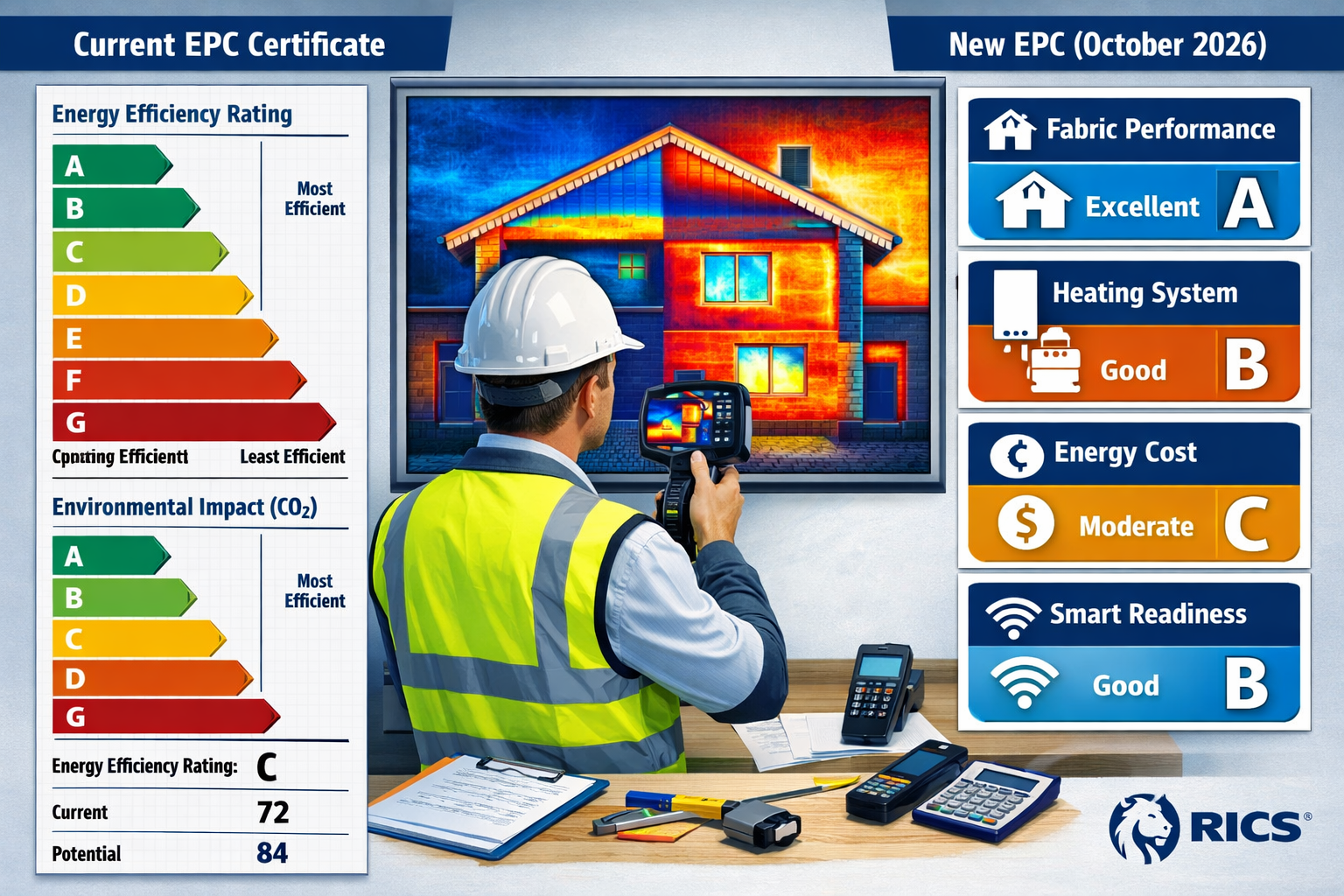
The Structural Shift from Single to Multi-Metric Assessment
The October 2026 EPC reform represents the most significant change to energy performance assessment since the certificates were introduced. Moving away from the familiar single alphabetical rating (A-G), the new system displays four distinct headline metrics[1]:
- Fabric Performance: Building envelope efficiency independent of heating system
- Heating System: Efficiency and carbon intensity of installed heating
- Energy Cost: Transparency on affordability and running expenses
- Smart Readiness: Integration capability with smart meters and flexible tariffs
This multi-dimensional approach fundamentally alters how building surveys must evaluate properties. Surveyors can no longer rely on composite scores that may obscure critical deficiencies. A property with an efficient heat pump might previously have achieved a respectable overall rating despite having poorly insulated walls and single-glazed windows. Under the 2026 framework, that same property will display a poor Fabric Performance rating that immediately signals substantial retrofit investment requirements[1].
For buyers commissioning surveys in 2026, this transparency creates both opportunity and risk. Properties with strong fabric performance but outdated heating systems represent straightforward upgrade paths, while those with fundamental envelope deficiencies face more complex and expensive interventions.
Expanded Regulatory Coverage and Compliance Triggers
The reform extends EPC requirements across previously exempt property categories, creating new compliance obligations that commercial building surveys must address:
| Property Type | Previous Status | 2026 Requirement |
|---|---|---|
| Listed Buildings | Exempt from EPC | Must produce valid EPC when marketed, sold, or let[1] |
| HMO Properties | Individual room basis | Whole-building EPC required when any single room is rented[1] |
| Holiday Lets | Exempt if guests pay utilities | EPC required regardless of energy bill responsibility[1] |
| Point of Marketing | EPC before completion | Valid EPC must be commissioned at point of marketing[1] |
These expanded requirements mean that surveyors must now consider heritage conservation constraints alongside energy efficiency improvements, particularly when assessing listed buildings where traditional construction methods and protected features limit intervention options[1].
The Fabric-First Policy Priority
The standalone Fabric Performance metric enshrines fabric-first retrofit strategy as government policy[1]. This approach prioritizes improvements to the building envelope—insulation, glazing, air tightness—before addressing heating system upgrades. The rationale is straightforward: reducing heat demand through better fabric performance makes any subsequent heating system more efficient and cost-effective.
For building surveyors, this policy shift requires enhanced assessment capabilities. Traditional structural surveys focused on defects, stability, and maintenance requirements. Modern retrofit-oriented surveys must additionally evaluate:
✅ Thermal performance of existing walls, roofs, and floors
✅ Air leakage pathways and ventilation adequacy
✅ Glazing efficiency and window replacement feasibility
✅ Moisture risk from proposed insulation interventions
✅ Heritage sensitivity of fabric improvements
Thermal imaging has transitioned from specialist add-on to standard practice, providing visual evidence of heat loss patterns that guide retrofit prioritization[7].
RICS Quality Standards for Building Surveys in Retrofit Assessment
Professional Standards and Survey Protocols
The Royal Institution of Chartered Surveyors (RICS) provides the professional framework ensuring consistent, high-quality building surveys across the industry. For retrofit-focused assessments in 2026, RICS standards establish baseline expectations for survey scope, methodology, and reporting.
RICS chartered building surveyors bring critical professional competencies to retrofit assessment:
🔍 Technical Expertise: Understanding of building pathology, construction methods, and material performance across diverse property types and ages.
📋 Regulatory Knowledge: Current awareness of building regulations, planning constraints, EPC requirements, and compliance pathways.
⚖️ Professional Indemnity: Insurance coverage protecting clients against survey errors or omissions.
🎓 Continuing Professional Development: Ongoing training in emerging technologies, assessment methods, and regulatory changes.
The RICS Home Survey Standard establishes three survey levels, with Level 3 Building Surveys providing the comprehensive assessment necessary for retrofit project planning. These detailed inspections examine all accessible areas of the property, identify defects and their causes, and provide guidance on necessary repairs and maintenance.
Integrating Energy Performance into Structural Assessment
Modern building surveys for retrofit projects must seamlessly integrate traditional structural assessment with energy performance evaluation. This dual-focus approach requires surveyors to consider how proposed energy efficiency interventions might affect building fabric and vice versa.
Critical integration points include:
Moisture and Condensation Risk: Adding insulation to solid walls or roofs can alter vapor diffusion patterns, potentially creating condensation problems if not properly designed. Surveyors must assess existing moisture levels and ventilation adequacy before recommending insulation upgrades.
Structural Loading: External wall insulation adds weight to building facades, while roof insulation may require additional structural support. Structural surveys must evaluate load-bearing capacity before specifying retrofit interventions.
Hidden Defects: Insulation installations can conceal existing defects like damp penetration or timber decay. Comprehensive pre-retrofit surveys identify and address these issues before they become inaccessible.
Heritage Considerations: Listed buildings and properties in conservation areas face planning restrictions on visible alterations. Surveyors must identify sympathetic retrofit solutions that preserve character while improving performance.
Thermal Imaging and Diagnostic Technologies
Thermal imaging cameras have become essential tools for retrofit-focused building surveys, revealing heat loss patterns invisible to visual inspection[7]. These infrared images identify:
🌡️ Insulation gaps in walls, roofs, and floors
🌡️ Air leakage points around windows, doors, and service penetrations
🌡️ Thermal bridging through structural elements
🌡️ Moisture intrusion showing as cold spots on internal surfaces
When combined with traditional survey techniques, thermal imaging provides compelling visual evidence supporting retrofit investment decisions. Buyers can see exactly where their property is losing heat and prioritize improvements accordingly.
Beyond thermal imaging, modern retrofit surveys may incorporate:
- Moisture meters for detecting damp in walls and timbers
- Air pressure testing to quantify infiltration rates
- U-value measurements confirming actual thermal performance
- Thermal modeling software predicting post-retrofit performance
Heat Transfer Coefficient Testing and Performance Validation
Understanding HTC Measurement
Heat Transfer Coefficient (HTC) testing represents a significant advancement in retrofit performance validation. Unlike theoretical calculations based on assumed material properties, HTC measurement provides empirical data on actual building performance[6].
The process involves measuring heat loss from the entire building under controlled conditions, producing a single metric (measured in watts per Kelvin) that quantifies overall thermal performance. Lower HTC values indicate better insulation and air tightness.
Key advantages of HTC testing include:
📊 Baseline Performance: Establishes pre-retrofit performance for comparison
📊 Targeted Intervention: Identifies which improvements will deliver maximum benefit
📊 Post-Works Verification: Confirms that retrofit interventions achieved expected results
📊 Lender Confidence: Provides evidence supporting retrofit financing decisions
For building surveys supporting retrofit projects, recommending baseline HTC testing enables evidence-based decision-making. Rather than relying on generic assumptions about insulation performance, property owners receive specific data about their building's actual heat loss characteristics[6].
Evidence-Based Retrofit Planning
The combination of comprehensive building surveys, thermal imaging, and HTC measurement creates a robust evidence base for retrofit planning. This data-driven approach helps property owners prioritize interventions based on:
Cost-Effectiveness: Which improvements deliver the greatest energy savings per pound invested?
Technical Feasibility: What constraints does the existing building fabric impose on retrofit options?
Regulatory Compliance: Which interventions are necessary to meet minimum EPC requirements?
Performance Certainty: What level of improvement can realistically be achieved?
Post-retrofit HTC measurement provides proof of performance improvement, supporting warranty claims, subsidy applications, and resale value arguments. This verification step is increasingly expected by lenders financing retrofit work and buyers purchasing recently upgraded properties[6].
Navigating Building Surveys for Retrofit Projects: EPC Upgrades and RICS Quality Standards in 2026's Efficiency Drive
Pre-Purchase Survey Considerations for Buyers
For property buyers in 2026, commissioning the right survey at the right time has become more complex but also more valuable. The new EPC metrics provide transparency on energy performance, but comprehensive building surveys reveal the practical feasibility and cost of achieving improvements.
Essential questions buyers should ask:
❓ What is the property's Fabric Performance rating and what improvements are needed to achieve Band C or better?
❓ Are there structural or moisture issues that must be addressed before insulation can be installed?
❓ Do heritage designations or planning constraints limit retrofit options?
❓ What is the realistic cost range for achieving desired EPC improvements?
❓ Are there hidden defects that retrofit work might conceal?
Choosing an RICS chartered surveyor ensures professional competence in addressing these questions. The surveyor's report should provide clear guidance on retrofit feasibility, identify potential complications, and offer realistic cost estimates for necessary improvements.
Survey Timing and the Point-of-Marketing Requirement
The 2026 reform introduces a critical timing change: EPCs must now be commissioned at the point of marketing rather than before completion[1]. This accelerated timeline affects both sellers and buyers.
For sellers, engaging surveyors early in the marketing process ensures compliance and may identify quick wins that improve the property's EPC rating before listing. Simple improvements like loft insulation upgrades or heating system controls can shift ratings and enhance marketability.
For buyers, the point-of-marketing requirement means EPCs should be available during initial property viewings. However, the EPC alone doesn't reveal retrofit complexity or cost. Commissioning an independent building survey remains essential for understanding the full picture.
Smart buyers in 2026 are requesting retrofit-focused surveys that specifically address:
- Current EPC performance and improvement pathways
- Structural suitability for proposed interventions
- Moisture risk assessment for insulation upgrades
- Heritage and planning constraint analysis
- Cost estimates for achieving target EPC ratings
Addressing Non-Standard Construction and Special Cases
Certain property types present particular challenges for retrofit assessment and require specialized surveying expertise:
Non-Standard Construction: Properties built using systems like concrete panels, steel frames, or timber frames require specialist knowledge to assess retrofit options safely. Some construction types have limited insulation options or require specific approaches to avoid moisture problems.
Listed Buildings: With the removal of the EPC exemption for heritage properties[1], surveyors must balance conservation requirements with energy efficiency improvements. Sympathetic retrofit solutions might include secondary glazing rather than replacement windows, or breathable insulation materials compatible with traditional construction.
Houses in Multiple Occupation: The new whole-building EPC requirement for HMOs[1] means surveyors must consider the property as a complete unit rather than individual rooms. This affects fire safety, means of escape, and ventilation strategies for retrofit interventions.
Properties with Existing Issues: Buildings with subsidence, damp problems, or structural movement require remediation before retrofit work can proceed. Comprehensive surveys identify these issues and sequence interventions appropriately.
Practical Implementation: Survey Protocols for Retrofit Projects
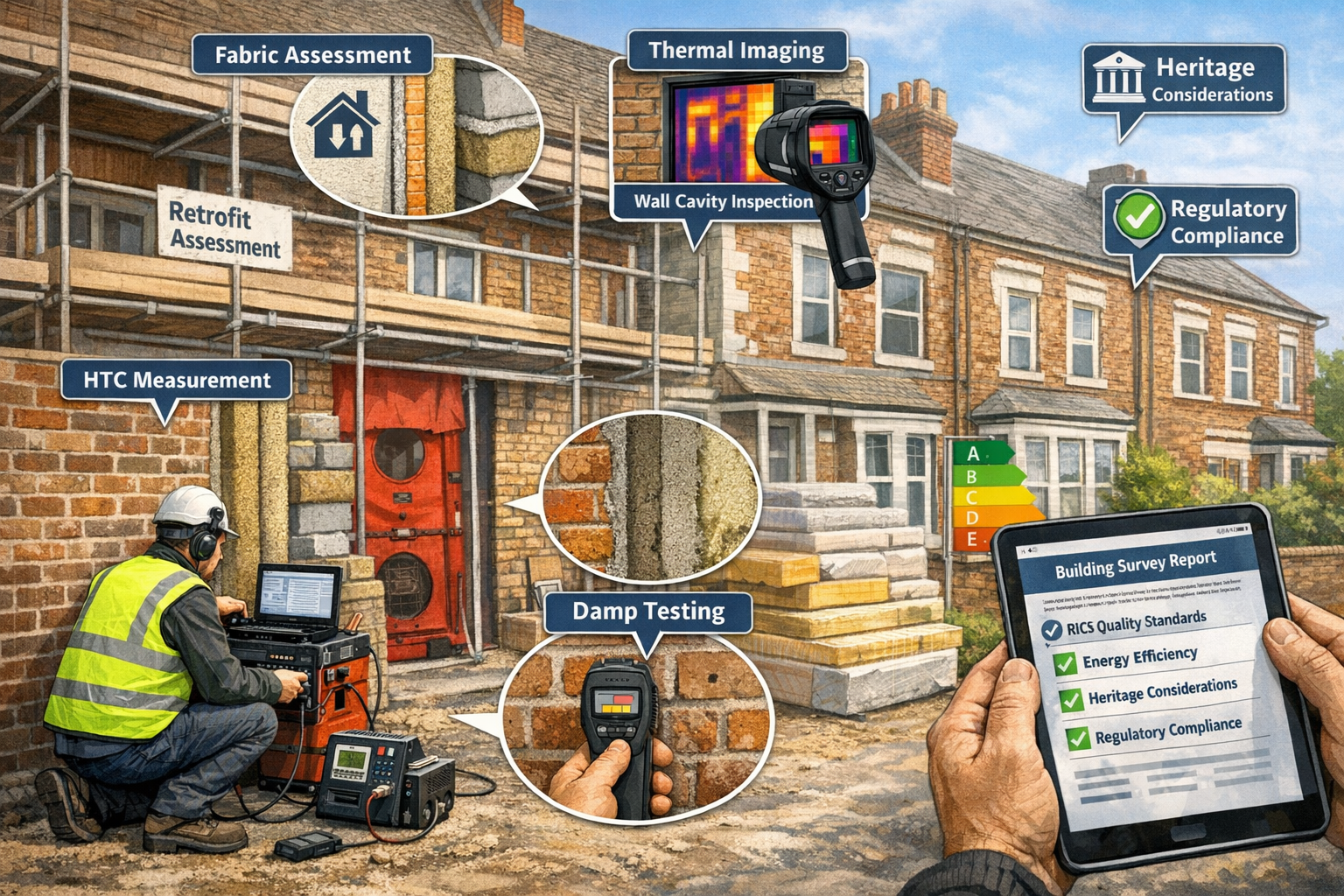
Comprehensive Survey Scope for Energy Efficiency Assessment
A retrofit-focused building survey in 2026 should encompass both traditional structural assessment and specialized energy performance evaluation. The following protocol represents current best practice:
Stage 1: Desktop Research and Preparation
- Review existing EPC certificates and historical ratings
- Examine planning history and conservation designations
- Research original construction methods and typical defects
- Identify relevant building regulations and compliance requirements
Stage 2: External Inspection
- Visual assessment of building envelope condition
- Thermal imaging of external walls, roof, and windows
- Identification of air leakage pathways and thermal bridges
- Assessment of structural suitability for external insulation
- Evaluation of access for retrofit work
Stage 3: Internal Inspection
- Room-by-room condition assessment
- Thermal imaging of internal surfaces
- Moisture meter testing of walls and floors
- Ventilation adequacy evaluation
- Heating system efficiency assessment
- Identification of hidden voids suitable for insulation
Stage 4: Roof and Loft Spaces
- Roof survey including structural condition
- Existing insulation depth and condition
- Ventilation arrangements and condensation risk
- Structural capacity for additional insulation loading
Stage 5: Below-Ground Assessment
- Foundation type and condition
- Floor construction and insulation opportunities
- Damp-proof course effectiveness
- Drainage condition affecting moisture risk
Stage 6: Specialist Testing (where appropriate)
- HTC measurement for baseline performance
- Air pressure testing to quantify infiltration
- Asbestos survey before invasive work
- Electrical and heating system efficiency assessment
Reporting Standards and Client Communication
RICS standards require clear, accessible reporting that enables informed decision-making. For retrofit-focused surveys, reports should include:
Executive Summary: High-level overview of property condition, EPC performance, and recommended retrofit pathway with cost estimates.
Detailed Findings: Room-by-room condition assessment with photographic evidence and thermal imaging where relevant.
Retrofit Recommendations: Prioritized list of interventions with:
- Expected EPC rating improvement
- Estimated cost ranges
- Technical feasibility assessment
- Regulatory compliance implications
- Moisture and structural risk considerations
Regulatory Compliance Section: Analysis of current and future EPC requirements, planning constraints, building regulation compliance pathways, and heritage considerations.
Cost-Benefit Analysis: Comparison of different retrofit scenarios showing:
- Capital investment required
- Annual energy cost savings
- Payback periods
- Impact on property value and marketability
Risk Assessment: Identification of potential complications including hidden defects, structural limitations, moisture risks, and planning restrictions.
Effective communication extends beyond the written report. Professional surveyors should be available to discuss findings, answer questions, and provide guidance on selecting contractors and managing retrofit projects.
Building Surveys for Retrofit Projects: EPC Upgrades and RICS Quality Standards in 2026's Efficiency Drive – Market Context
Improving Market Sentiment Toward Energy Efficiency
The UK property market in 2026 shows markedly improved sentiment toward energy-efficient homes compared to previous years. Several factors drive this shift:
Regulatory Pressure: Minimum EPC requirements for rental properties and anticipated future standards for owner-occupied homes create urgency around improvements.
Energy Cost Awareness: Recent energy price volatility has heightened buyer awareness of running costs. The new Energy Cost metric on EPCs makes this transparent at point of purchase[1].
Mortgage Incentives: Some lenders offer preferential rates for energy-efficient properties, while others require retrofit plans for poor-performing homes.
Climate Consciousness: Growing environmental awareness among buyers, particularly younger demographics, makes energy efficiency a positive selling point.
Government Support: Various grant schemes and subsidy programs reduce the capital cost of retrofit interventions, improving investment returns.
This improved sentiment creates opportunity for property owners willing to invest in fabric improvements. Comprehensive building surveys help identify the most cost-effective pathway to enhanced performance and marketability.
The Role of Professional Expertise in Complex Retrofits
The increasing technical and regulatory complexity of retrofit projects necessitates professional expertise throughout the process[4]. Property owners face challenges including:
🔧 Technical Complexity: Understanding which interventions suit specific building types and construction methods
🔧 Regulatory Navigation: Complying with building regulations, planning requirements, and EPC standards
🔧 Contractor Selection: Identifying competent installers with appropriate qualifications and insurance
🔧 Quality Assurance: Ensuring work meets specifications and delivers expected performance
🔧 Performance Verification: Confirming that completed work achieves predicted energy savings
RICS chartered surveyors provide independent professional advice throughout this process, from initial assessment through post-completion verification. Their role extends beyond survey reporting to include:
- Specification development for retrofit interventions
- Contractor tender evaluation and selection support
- Project monitoring and quality assurance
- Snagging and defect identification
- Performance testing and verification
This comprehensive professional support reduces risk, ensures quality outcomes, and provides confidence to property owners, lenders, and subsequent purchasers.
Quality in Retrofit: Industry Standards and Best Practice
Recent industry summits on quality in retrofit have emphasized the importance of professional standards, installer competence, and performance verification. The retrofit sector has historically suffered from inconsistent quality, with some installations failing to deliver predicted energy savings or creating unintended problems like condensation and mold.
Key quality principles emerging from industry consensus include:
Whole-House Approach: Considering the building as a system rather than implementing isolated interventions that may interact negatively.
Fabric-First Priority: Addressing building envelope performance before upgrading heating systems to maximize efficiency and minimize system sizing.
Moisture Management: Careful assessment of ventilation, condensation risk, and moisture transport to avoid creating problems through well-intentioned improvements.
Professional Oversight: Independent survey and verification by qualified professionals separate from installation contractors.
Performance Measurement: Pre- and post-retrofit testing to confirm that interventions deliver expected benefits.
Installer Competence: Using contractors with appropriate qualifications, certifications, and insurance coverage.
Building surveys conducted to RICS standards embody these quality principles, providing the independent professional assessment necessary for successful retrofit outcomes.
Future-Proofing Properties: Long-Term Retrofit Planning
Anticipating Future Regulatory Requirements
While the October 2026 EPC reform represents the immediate regulatory landscape, property owners and surveyors must anticipate future tightening of standards. Government policy direction suggests:
📈 Minimum EPC Band C for rental properties within the next decade
📈 Owner-occupied standards potentially following rental requirements
📈 Enhanced new-build standards raising expectations for existing stock
📈 Carbon pricing mechanisms making inefficient properties increasingly expensive to operate
Building surveys in 2026 should therefore assess not just current compliance but future-proofing potential. Properties that can readily achieve Band B or A performance through feasible interventions represent better long-term investments than those with fundamental limitations.
Phased Retrofit Strategies
For many properties, achieving optimal energy performance requires substantial investment that may not be immediately affordable. Professional building surveys can identify phased retrofit strategies that:
✅ Prioritize interventions delivering maximum benefit per pound invested
✅ Sequence work logically to avoid rework or incompatible interventions
✅ Achieve incremental EPC improvements maintaining marketability
✅ Spread capital investment over manageable timeframes
✅ Take advantage of grant funding as programs become available
A typical phased approach might include:
Phase 1 (Immediate): Low-cost, high-impact interventions like loft insulation top-up, draught-proofing, heating controls upgrade.
Phase 2 (1-3 years): Medium-cost fabric improvements like cavity wall insulation, window upgrades, floor insulation.
Phase 3 (3-5 years): Major interventions like solid wall insulation, heating system replacement, renewable energy integration.
This phased approach makes retrofit achievable while maintaining property usability and managing cash flow. Building survey reports should outline these pathways clearly, enabling informed long-term planning.
Smart Readiness and Future Technologies
The new Smart Readiness metric on 2026 EPCs[1] reflects growing importance of integration with smart meters, flexible tariffs, and demand response systems. Properties equipped for smart technology can:
⚡ Optimize energy consumption based on time-of-use pricing
⚡ Integrate with renewable generation and battery storage
⚡ Participate in grid balancing services
⚡ Provide occupants with real-time consumption feedback
Building surveys should assess smart readiness potential, including:
- Adequate electrical infrastructure for smart devices
- Heating system compatibility with smart controls
- Space and services for future battery storage
- Broadband connectivity for smart home systems
As the energy system evolves toward greater electrification and renewable integration, smart-ready properties will command premium values and lower operating costs.
Case Studies: Building Survey Approaches for Different Property Types
Victorian Terraced Housing
Victorian terraces represent a substantial portion of UK housing stock and present characteristic retrofit challenges:
Typical Issues Identified in Building Surveys:
- Solid brick walls with no cavity for insulation
- Single-glazed sash windows in varying condition
- Suspended timber floors with minimal insulation
- Loft spaces with inadequate or settled insulation
- Aging heating systems with poor controls
- Moisture penetration through aging brickwork
Retrofit Survey Recommendations:
- Internal or external wall insulation (subject to planning)
- Secondary glazing or sympathetic replacement windows
- Floor insulation using breathable materials
- Loft insulation upgrade to 300mm
- Heating system upgrade with zoned controls
- Damp-proof course renewal where necessary
Special Considerations:
- Conservation area restrictions on external alterations
- Moisture management with solid wall insulation
- Preserving character features like original windows
- Party wall considerations for insulation work
Post-War Semi-Detached Properties
Post-war semi-detached houses often feature cavity wall construction offering straightforward retrofit opportunities:
Typical Survey Findings:
- Unfilled cavity walls suitable for insulation
- Original single-glazed windows requiring replacement
- Adequate loft space for insulation upgrade
- Concrete or suspended floors with insulation potential
- Aging heating systems approaching replacement
Retrofit Pathway:
- Cavity wall insulation (quick, cost-effective improvement)
- Window replacement with high-performance glazing
- Loft insulation to current standards
- Heating system upgrade to condensing boiler or heat pump
- Solar PV installation where roof orientation suitable
Advantages:
- Straightforward interventions with proven performance
- Good return on investment with moderate capital cost
- Achievable pathway to EPC Band B or A
Listed Buildings and Heritage Properties
The removal of the EPC exemption for listed buildings[1] creates new challenges requiring specialist surveying expertise:
Survey Approach:
- Detailed assessment of heritage significance and protected features
- Identification of sympathetic retrofit solutions
- Liaison with conservation officers on acceptable interventions
- Breathable material specification for traditional construction
Appropriate Interventions:
- Secondary glazing preserving original windows
- Breathable insulation materials (wood fiber, sheep's wool)
- Discreet external insulation on non-principal elevations
- Heating system upgrades in non-visible locations
- Renewable energy where visually acceptable
Limitations:
- Restrictions on external appearance alterations
- Requirement for listed building consent
- Higher costs for specialist materials and methods
- Potentially lower achievable EPC ratings
Professional building surveys for heritage properties require understanding of both conservation principles and energy efficiency techniques to identify acceptable solutions.
Selecting the Right Surveyor for Retrofit Assessment
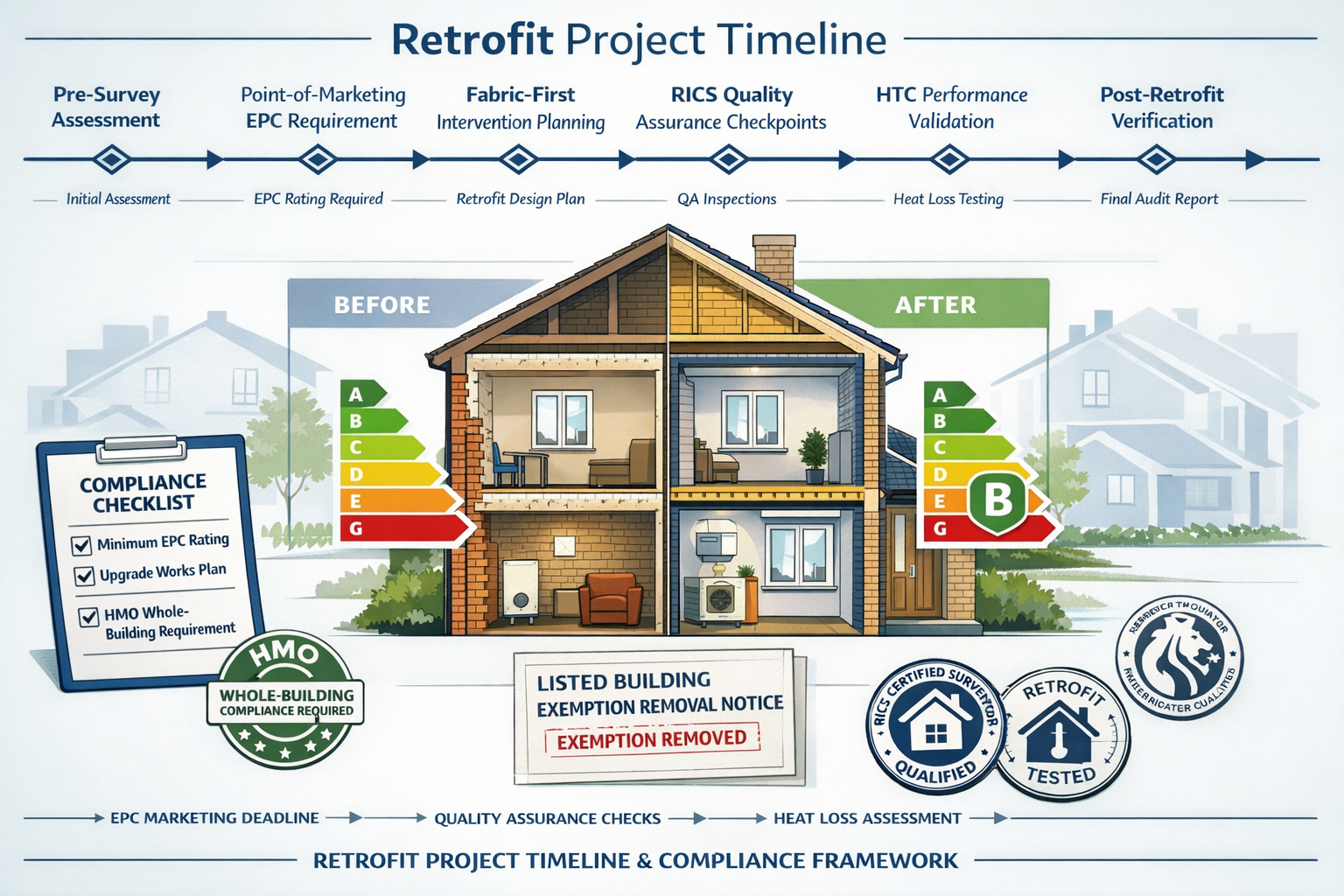
Professional Qualifications and Expertise
Not all building surveyors possess equal expertise in retrofit assessment. Property owners should seek professionals with:
🎓 RICS Chartered Status: Ensuring professional standards, continuing development, and indemnity insurance
🎓 Retrofit Specialization: Demonstrated experience in energy efficiency assessment and retrofit project support
🎓 Thermal Imaging Certification: Competence in infrared thermography and heat loss analysis
🎓 Building Pathology Knowledge: Understanding of defects, moisture behavior, and construction methods
🎓 Regulatory Awareness: Current knowledge of EPC requirements, building regulations, and planning constraints
Comparing different types of survey helps identify the appropriate level of inspection for specific property circumstances. For retrofit planning, Level 3 Building Surveys typically provide the necessary detail and analysis.
Questions to Ask Prospective Surveyors
When selecting a surveyor for retrofit-focused assessment, consider asking:
❓ What experience do you have with retrofit assessment and energy efficiency surveys?
❓ Do you use thermal imaging as standard practice?
❓ Can you provide examples of previous retrofit survey reports?
❓ How do you address the new 2026 EPC metrics in your assessments?
❓ What is your approach to heritage properties and conservation areas?
❓ Can you provide cost estimates for recommended interventions?
❓ Do you offer post-retrofit verification services?
❓ What professional indemnity insurance coverage do you carry?
Professional surveyors should provide clear answers demonstrating relevant expertise and transparent pricing for their services.
Understanding Survey Costs and Value
Building survey costs vary based on property size, complexity, location, and scope of inspection. Retrofit-focused surveys with thermal imaging typically command premium pricing compared to basic structural surveys, reflecting the additional expertise and equipment required.
However, this investment delivers substantial value:
💰 Informed Purchase Decisions: Understanding true retrofit costs before committing to purchase
💰 Negotiation Leverage: Using survey findings to negotiate price reductions or seller contributions
💰 Targeted Investment: Prioritizing improvements delivering maximum return
💰 Risk Mitigation: Identifying problems before they become expensive failures
💰 Future-Proofing: Planning long-term compliance with evolving standards
The cost of a comprehensive building survey represents a small fraction of total property value and retrofit investment, while providing essential information for successful outcomes.
Conclusion: Embracing Building Surveys for Retrofit Projects in 2026's Efficiency Drive
The convergence of reformed EPC metrics, RICS quality standards, and market demand for energy-efficient properties has elevated building surveys from simple condition assessments to comprehensive retrofit planning tools. Building Surveys for Retrofit Projects: EPC Upgrades and RICS Quality Standards in 2026's Efficiency Drive represent essential professional services for buyers, sellers, and property owners navigating the transition to low-carbon housing.
The October 2026 introduction of four separate EPC metrics—Fabric Performance, Heating System, Energy Cost, and Smart Readiness—provides unprecedented transparency on building performance while exposing properties with poor envelope efficiency[1]. This policy shift toward fabric-first retrofit strategy aligns with building physics principles and creates clear pathways for sustainable improvement.
RICS chartered surveyors bring critical professional expertise to this complex landscape, combining traditional building pathology knowledge with modern energy assessment techniques. Thermal imaging, HTC measurement, and moisture risk evaluation have transitioned from specialist services to standard practice for retrofit-focused surveys[6][7].
Actionable Next Steps
For property buyers, sellers, and owners seeking to navigate 2026's efficiency drive:
1. Commission Comprehensive Building Surveys Early: Engage RICS chartered surveyors with retrofit expertise during property search or before listing for sale. Early assessment enables informed decisions and realistic planning.
2. Request Retrofit-Specific Reporting: Ensure survey scope includes thermal imaging, energy performance evaluation, and retrofit feasibility analysis with cost estimates.
3. Understand the New EPC Metrics: Familiarize yourself with the four separate ratings and what they reveal about property performance and improvement potential.
4. Plan Phased Interventions: Work with surveyors to develop realistic, sequenced retrofit strategies that spread investment over manageable timeframes while achieving incremental improvements.
5. Prioritize Fabric-First Approaches: Focus initial investment on building envelope improvements—insulation, glazing, air tightness—before upgrading heating systems.
6. Verify Performance Post-Retrofit: Consider HTC testing or other verification methods to confirm that completed work delivers expected energy savings and EPC improvements.
7. Engage Professional Expertise Throughout: Utilize RICS surveyors for initial assessment, specification development, contractor selection support, and post-completion verification.
The improving market sentiment toward energy efficiency creates opportunity for property owners willing to invest in fabric improvements. Professional building surveys provide the foundation for successful retrofit projects, identifying cost-effective pathways to enhanced performance, regulatory compliance, and long-term value.
As regulatory requirements continue tightening and energy costs remain significant, properties with strong fabric performance and clear retrofit pathways will command premium values and superior marketability. The investment in comprehensive professional surveys delivers returns through informed decision-making, targeted interventions, and confidence in outcomes.
The 2026 efficiency drive represents not just regulatory compliance but fundamental transformation of the UK housing stock toward sustainability and resilience. Building surveys conducted to RICS quality standards provide the essential professional foundation for navigating this transformation successfully.
References
[1] 2026 Epc Reform Technical Update – https://buildingenergyexperts.co.uk/resources/2026-epc-reform-technical-update/
[2] Mass Deployment Energy Efficiency Retrofits Multifamily Homes California – https://www.energy.ca.gov/publications/2025/mass-deployment-energy-efficiency-retrofits-multifamily-homes-california
[3] Looking Back At 2025 And What 2026 Holds For Green Building Design And The Built Environment – https://www.gbuild.co.uk/post/looking-back-at-2025—and-what-2026-holds-for-green-building-design-and-the-built-environment
[4] What You Need To Know About Renewable Technology Retrofit Projects – https://syntegragroup.com/2026/02/what-you-need-to-know-about-renewable-technology-retrofit-projects/
[5] 2026 Existing Buildings Incentive Updates – https://blog.energytrust.org/2026-existing-buildings-incentive-updates/
[6] Measuring The Invisible Htc And The Future Of Retrofit – https://stroma.com/latest-news/measuring-the-invisible-htc-and-the-future-of-retrofit/
[7] Building Surveys For Energy Performance Certificates In 2026 Navigating Epc Upgrades And Retrofit Mandates For Uk Buyers – https://nottinghillsurveyors.com/blog/building-surveys-for-energy-performance-certificates-in-2026-navigating-epc-upgrades-and-retrofit-mandates-for-uk-buyers
[8] Epc Reform – https://nationalretrofithub.org.uk/resource/epc-reform/
[9] Six Steps To Ensure The Warm Homes Plan Succeeds – https://constructionmanagement.co.uk/six-steps-to-ensure-the-warm-homes-plan-succeeds/









