


The property surveying landscape in 2026 stands at a critical intersection where consumer protection, environmental sustainability, and technological innovation converge. As RICS advances its comprehensive review of home survey standards and emphasizes environmental sustainability through its revised CPD framework[1][2], chartered surveyors find themselves uniquely positioned to lead the charge in improving Energy Performance Certificate (EPC) ratings across the UK housing stock. Building Survey Upgrades for EPC Compliance: Retrofit Strategies Post-RICS Quality Standards 2026 represents not just a regulatory requirement, but a transformative opportunity for the profession to deliver measurable value in an era of climate accountability and rising energy costs.
The strengthening initiatives for home surveys now emphasize consumer insights and technology integration[4], creating a perfect storm of opportunity for surveyors to expand their service offerings beyond traditional defect identification. With thermal imaging, moisture detection, and digital reporting platforms becoming standard tools, the modern surveyor can provide comprehensive retrofit roadmaps that transform properties from energy-inefficient liabilities into compliant, cost-effective assets.
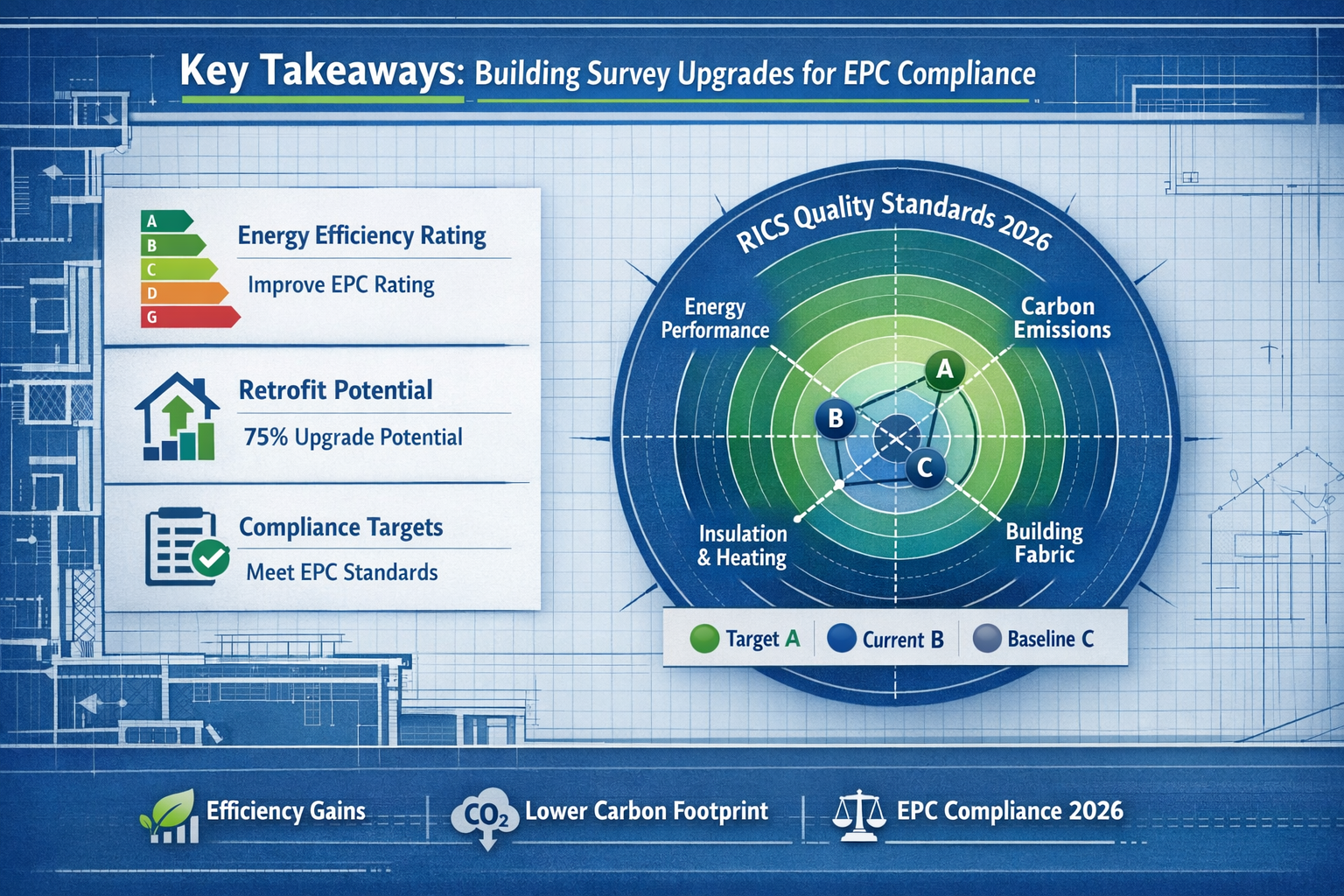
Key Takeaways
- 🏗️ RICS quality standards updates in 2026 prioritize clearer requirements and consumer-focused reporting, creating opportunities for surveyors to integrate EPC improvement strategies into standard survey outputs
- 📊 Thermal imaging and digital assessment tools enable surveyors to identify specific retrofit opportunities with precision, supporting evidence-based recommendations for EPC band improvements
- 💡 Retrofit strategies must be property-specific, considering building age, construction type, and existing defects identified during comprehensive building surveys
- ⚡ Environmental sustainability is now a core professional development focus under the revised RICS CPD framework, positioning surveyors as essential advisors in the energy transition[1]
- 📈 Visual reporting and consumer insights strengthen the surveyor's role in translating technical findings into actionable upgrade pathways that property owners can understand and implement
Understanding the 2026 RICS Quality Standards Framework
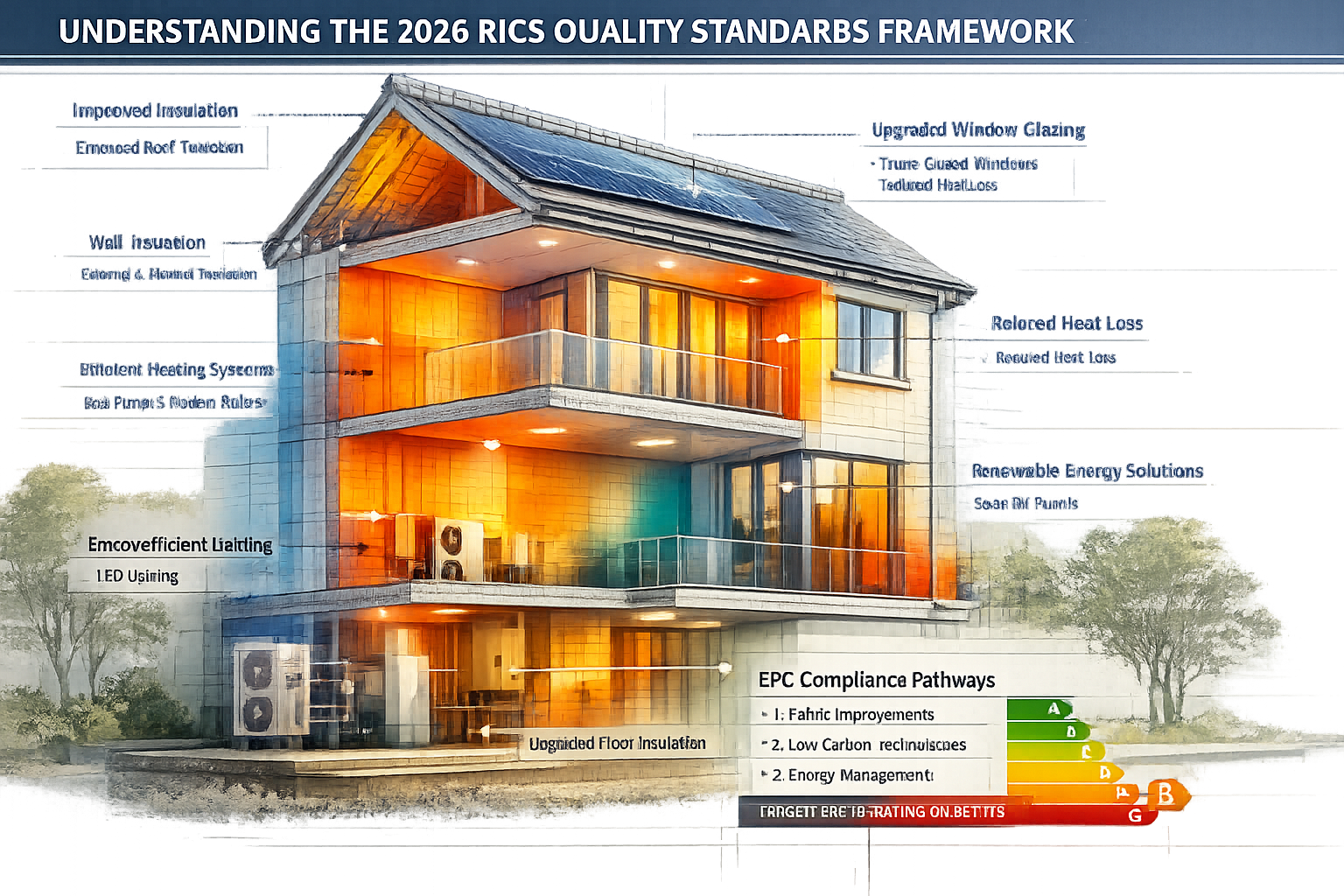
The evolution of RICS standards in 2026 represents a significant shift toward consumer-centric surveying that balances technical rigor with accessibility. The ongoing review of the Home Survey Standard 2nd Edition has incorporated extensive feedback from practitioners and consumers alike, with a clear mandate for "clearer and more concise requirements"[4]. This refinement process, overseen by member-led professional panels before regulatory approval, signals RICS's commitment to maintaining the highest professional standards while adapting to contemporary market needs.
The Environmental Sustainability Imperative
Perhaps most significantly, the revised RICS CPD framework effective January 2026 explicitly emphasizes "environmental sustainability" as a key professional development area[1][2]. This institutional prioritization reflects the profession's recognition that surveyors must evolve from passive observers of building condition to active participants in the UK's net-zero transition. For practitioners conducting RICS building surveys, this means integrating energy efficiency considerations into every inspection and report.
The framework's focus on sustainability learning creates a professional expectation that chartered surveyors possess the knowledge to:
- Identify thermal performance deficiencies during standard inspections
- Recommend evidence-based retrofit interventions aligned with EPC improvement pathways
- Understand the interplay between traditional building defects and energy efficiency measures
- Communicate complex technical information to diverse stakeholder audiences
Consumer Insights and Technology Integration
The strengthening initiatives for home surveys place significant emphasis on technology integration and consumer insights[4]. This dual focus recognizes that modern property transactions demand both sophisticated technical assessment and clear, actionable communication. For Building Survey Upgrades for EPC Compliance: Retrofit Strategies Post-RICS Quality Standards 2026, this translates to several practical applications:
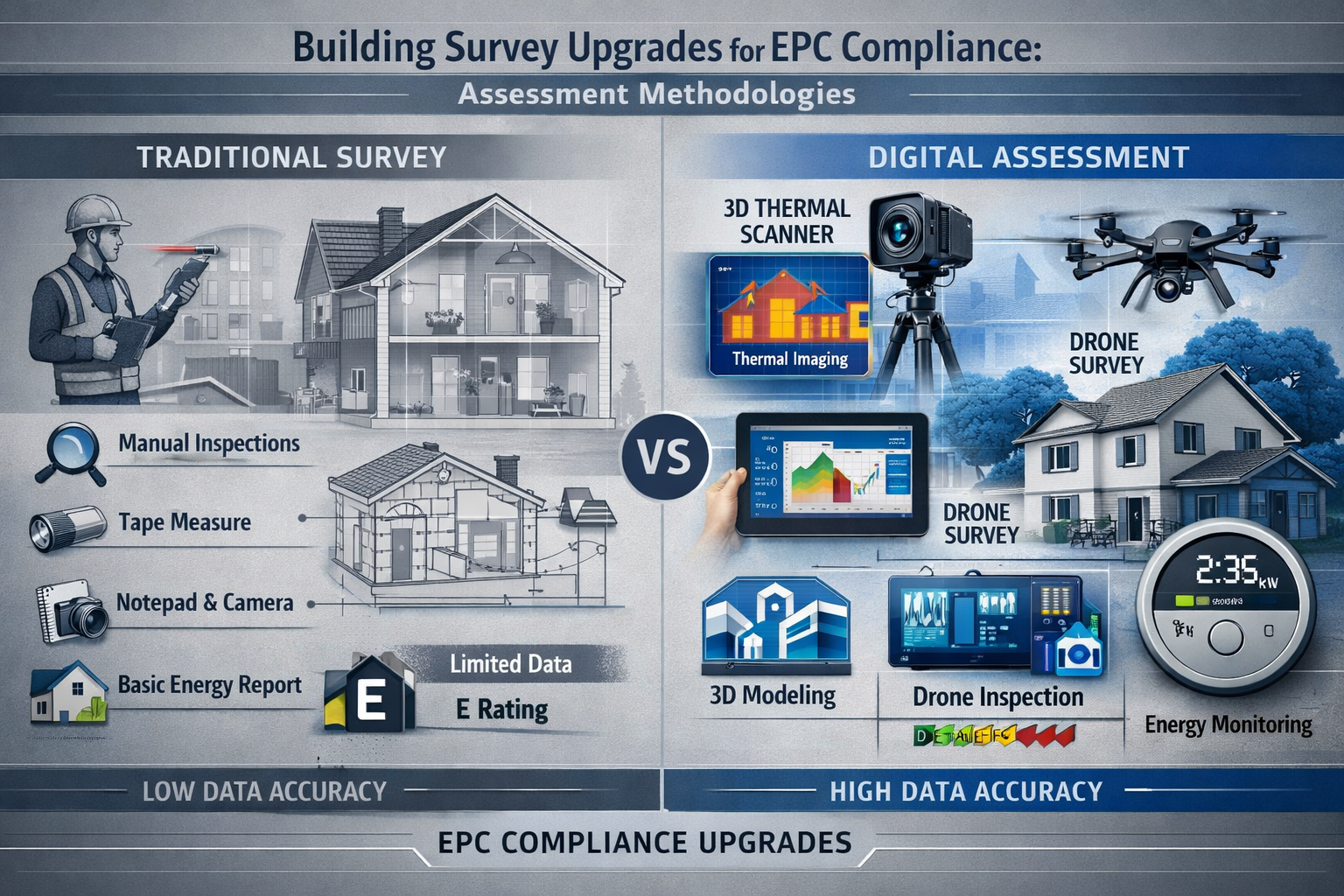
Visual Documentation: High-resolution photography, thermal imaging, and moisture mapping create compelling visual evidence that supports retrofit recommendations. When a RICS Building Surveys Level 3 inspection identifies heat loss through single-glazed windows, thermal imaging provides undeniable proof that resonates with property owners far more effectively than text descriptions alone.
Digital Reporting Platforms: Interactive reports that allow clients to click through sections, view embedded videos of thermal assessments, and access linked resources for retrofit grants and funding schemes transform the traditional survey from a static document into a dynamic planning tool.
Data-Driven Recommendations: Integration of EPC databases, local retrofit installer directories, and cost estimation tools enables surveyors to provide comprehensive upgrade pathways rather than generic suggestions.
Building Survey Upgrades for EPC Compliance: Assessment Methodologies
Effective retrofit strategies begin with comprehensive assessment. The modern building survey must extend beyond identifying structural defects to encompass a holistic evaluation of thermal performance, air tightness, and energy systems. This expanded scope aligns perfectly with the consumer-focused direction of RICS standards, as property owners increasingly seek surveyors who can provide integrated advice rather than siloed technical reports.
Integrating EPC Considerations into Standard Surveys
When conducting a comprehensive building survey, chartered surveyors should systematically evaluate elements that directly impact EPC ratings:
| Building Element | Survey Assessment | EPC Impact | Retrofit Opportunity |
|---|---|---|---|
| Roof & Loft | Insulation depth, condition, coverage | High – typically 25% heat loss | Upgrade to 270mm+ mineral wool, spray foam for complex spaces |
| Walls | Construction type, cavity presence, existing insulation | High – 35% heat loss in uninsulated properties | Cavity wall insulation, external/internal wall insulation |
| Windows & Doors | Glazing type, frame material, condition | Moderate – 20% heat loss | Secondary glazing, replacement with A-rated units |
| Heating System | Boiler age, efficiency rating, controls | High – direct energy consumption | Condensing boiler upgrade, heat pump feasibility, smart controls |
| Ventilation | Air tightness, draught sources | Moderate – affects heating demand | Draught-proofing, controlled ventilation with heat recovery |
| Floors | Construction, insulation presence | Moderate – 15% heat loss | Suspended floor insulation, solid floor insulation |
This systematic approach ensures that every standard survey provides a foundation for EPC improvement planning. When surveyors identify a property with single-glazed windows during a routine inspection, the report should note not only the condition and remaining service life but also the potential EPC band improvement achievable through replacement.
Advanced Diagnostic Techniques
Building Survey Upgrades for EPC Compliance: Retrofit Strategies Post-RICS Quality Standards 2026 demands sophisticated diagnostic capabilities that go beyond visual inspection:
Thermal Imaging Surveys: Infrared thermography reveals hidden deficiencies invisible to the naked eye. Cold spots indicating missing insulation, thermal bridging at junctions, and air infiltration pathways all become apparent through thermal assessment. When integrated into a Level 3 building survey, thermal imaging transforms the surveyor's ability to provide targeted retrofit recommendations.
Moisture and Condensation Analysis: Many retrofit measures, particularly insulation upgrades, can exacerbate moisture problems if not properly specified. Damp surveys using electronic moisture meters and hygrometers help surveyors identify properties where ventilation improvements must accompany insulation works to prevent interstitial condensation and mould growth.
Air Tightness Testing: While not typically part of standard surveys, understanding air leakage rates helps prioritize draught-proofing interventions. Surveyors can recommend follow-up air tightness testing for properties where significant infiltration is suspected, providing clients with quantified data to support investment decisions.
U-Value Calculations: For properties with unusual construction or where existing insulation is suspected but not confirmed, surveyors with appropriate training can estimate thermal transmittance (U-values) to inform retrofit specifications. This technical capability elevates the survey from descriptive to prescriptive, offering specific performance targets for upgrade works.
Property-Specific Retrofit Planning
One size does not fit all in retrofit strategy. The age, construction type, and existing condition of a property fundamentally determine which interventions are appropriate, cost-effective, and likely to achieve EPC compliance goals.
Pre-1919 Traditional Construction: Solid wall properties present particular challenges and opportunities. External wall insulation (EWI) typically offers superior thermal performance but alters appearance significantly, while internal wall insulation (IWI) preserves external aesthetics at the cost of internal floor area. Surveyors must assess structural capacity to support EWI systems and identify heritage considerations that might constrain options.
Inter-War Properties (1919-1945): Many properties from this era feature cavity walls that may or may not be insulated. Survey inspection of air bricks, weep holes, and wall thickness helps determine cavity presence and suitability for retrofit cavity wall insulation. Where cavities are already filled, the surveyor's role shifts to verifying installation quality and identifying any resultant defects.
Post-War and Modern Properties (1945-Present): These properties often have some existing insulation but may benefit from upgrades to current standards. Loft insulation depth, boiler efficiency, and glazing quality become primary focus areas. Surveyors should also assess potential for renewable technology integration, such as solar photovoltaic panels or air source heat pumps.
Listed Buildings and Conservation Areas: Properties with heritage designations require particularly sensitive retrofit approaches. Surveyors must understand the interplay between conservation requirements and energy efficiency, recommending measures that improve performance without compromising historic fabric. Secondary glazing, breathable insulation materials, and discreet renewable installations often represent the optimal balance.
Retrofit Strategies Post-RICS Quality Standards 2026: Implementation Pathways
Translating survey findings into actionable retrofit strategies requires surveyors to bridge the gap between technical assessment and practical implementation. The strengthened RICS quality standards emphasize clear communication and consumer insights[4], making this translation function increasingly central to professional practice.
Prioritizing Interventions for Maximum EPC Impact
Not all retrofit measures deliver equal returns on investment or EPC band improvements. Surveyors should guide clients toward interventions that offer the greatest impact relative to cost and disruption:
High-Impact, Lower-Cost Measures:
- ✅ Loft insulation upgrade (£300-£500 for typical property, potential 1-2 EPC band improvement)
- ✅ Draught-proofing and air sealing (£200-£400, improves thermal comfort and reduces heating demand)
- ✅ Heating controls upgrade including thermostatic radiator valves and smart thermostats (£300-£600)
- ✅ Low-energy lighting conversion to LED throughout (£100-£300)
Medium-Impact, Moderate-Cost Measures:
- 🔶 Cavity wall insulation (£500-£1,500 for typical property, potential 1-2 band improvement if previously uninsulated)
- 🔶 Hot water cylinder insulation and pipework lagging (£150-£400)
- 🔶 Secondary glazing installation (£400-£800 per window, preserves original windows while improving thermal performance)
- 🔶 Condensing boiler replacement (£2,000-£3,500, significant efficiency improvement from older non-condensing models)
High-Impact, Higher-Cost Measures:
- 🔷 External or internal wall insulation (£8,000-£22,000 depending on property size and system, potential 2-3 band improvement)
- 🔷 Complete window and door replacement with A-rated units (£5,000-£15,000, potential 1-2 band improvement)
- 🔷 Solar photovoltaic installation (£5,000-£8,000, improves EPC rating and reduces running costs)
- 🔷 Air source heat pump system (£10,000-£18,000, transformative for properties without gas connection)
When conducting commercial building surveys or residential assessments, surveyors should present these options in a phased approach that allows property owners to prioritize based on budget, urgency, and long-term plans for the property.
Addressing Defects Before Retrofit Implementation
A critical aspect of Building Survey Upgrades for EPC Compliance: Retrofit Strategies Post-RICS Quality Standards 2026 involves ensuring that existing defects are remediated before energy efficiency measures are installed. Failing to address underlying problems can result in wasted investment, accelerated deterioration, and potential health hazards.
Moisture-Related Defects: Properties with rising damp, penetrating damp, or condensation issues must have these problems resolved before insulation works proceed. Installing cavity wall insulation in a property with active penetrating damp can trap moisture within the wall structure, leading to accelerated decay and potential structural damage. Surveyors should clearly sequence remedial works before retrofit measures in their recommendations.
Structural Issues: Subsidence surveys may reveal movement or structural instability that must be addressed before external wall insulation systems are installed. The additional weight and altered load distribution of EWI can exacerbate existing structural problems if not properly accounted for.
Roof Defects: Roof surveys identifying failing roof coverings, damaged timbers, or inadequate ventilation must result in repairs before loft insulation is upgraded. Increasing insulation depth without addressing roof defects can lead to accelerated deterioration of roof timbers through condensation.
Ventilation Inadequacy: Properties with poor ventilation that already experience condensation and mould growth require ventilation improvements alongside or before insulation upgrades. The surveyor's role includes identifying this sequencing requirement and explaining to clients why addressing ventilation is not optional but essential to successful retrofit.
Leveraging Technology for Enhanced Retrofit Recommendations
The 2026 emphasis on technology integration[4] creates opportunities for surveyors to deliver unprecedented value in retrofit planning:
Digital Twin Modeling: Advanced surveyors can create digital building models that simulate the impact of various retrofit combinations on energy performance. These models allow clients to visualize different upgrade scenarios and understand predicted EPC improvements before committing to expenditure.
Thermal Imaging Reporting: Embedding thermal images directly into survey reports with annotated explanations transforms abstract concepts like "thermal bridging" into concrete visual evidence. A thermal image showing heat streaming through an uninsulated loft hatch communicates the problem far more effectively than text alone.
Cost-Benefit Analysis Tools: Integration of cost databases and energy savings calculators enables surveyors to provide clients with projected payback periods for different retrofit measures. A recommendation to install cavity wall insulation becomes far more compelling when accompanied by data showing a 5-7 year payback period based on current energy prices.
Grant and Funding Integration: Surveyors who maintain current knowledge of available retrofit grants, local authority schemes, and energy company obligations can provide clients with immediate pathways to funding. Including this information in survey reports transforms the document from a problem statement into a solution roadmap.
Coordinating with Retrofit Specialists
While surveyors identify opportunities and recommend strategies, implementation typically requires coordination with specialized contractors. The surveyor's role extends to:
Specification Development: Providing detailed specifications for recommended works ensures that contractors understand the required standards and that clients receive consistent quotes for like-for-like work.
Contractor Vetting: Recommending appropriately certified installers (PAS 2030, TrustMark, etc.) protects clients from poor-quality installations that may fail to deliver promised EPC improvements.
Post-Installation Verification: Offering follow-up inspection services to verify that retrofit works have been completed to specification and that predicted EPC improvements have been achieved provides clients with quality assurance and professional peace of mind.
This coordinating role positions chartered surveyors as the client's advocate throughout the retrofit journey, from initial assessment through completed works and performance verification.
Practical Case Studies: EPC Band Improvements Through Strategic Surveys
Real-world examples illustrate how Building Survey Upgrades for EPC Compliance: Retrofit Strategies Post-RICS Quality Standards 2026 translates into measurable outcomes:
Case Study 1: Victorian Terrace (EPC Band E to C)
Property: 1890s mid-terrace, solid brick construction, original sash windows, outdated heating system
Survey Findings:
- No loft insulation (thermal imaging revealed significant heat loss through roof)
- Solid 9-inch brick walls with no insulation
- Single-glazed sash windows in poor condition
- 20-year-old non-condensing boiler
- Minimal draught-proofing
- Current EPC rating: Band E (42 points)
Recommended Phased Retrofit Strategy:
Phase 1 (Budget: £2,500):
- Loft insulation to 270mm depth
- Draught-proofing to all windows and external doors
- Heating controls upgrade with smart thermostat
- LED lighting throughout
- Predicted improvement: Band D (55 points)
Phase 2 (Budget: £8,500):
- Secondary glazing to all windows (preserving original sashes)
- Condensing boiler replacement
- Hot water cylinder upgrade with improved insulation
- Predicted improvement: Band C (69 points)
Phase 3 (Future consideration: £14,000):
- Internal wall insulation to party walls and external walls
- Solar photovoltaic installation
- Predicted improvement: Band B (82 points)
Outcome: The property owner implemented Phases 1 and 2 over 18 months, achieving Band C compliance. Annual heating costs reduced by approximately 35%, and the property's market value increased due to improved EPC rating.
Case Study 2: 1930s Semi-Detached (EPC Band D to B)
Property: 1935 semi-detached, cavity wall construction, mixture of original and replacement windows
Survey Findings:
- Cavity walls with no insulation (confirmed through borescope inspection)
- Loft insulation present but only 100mm depth
- Mix of single and double glazing
- 12-year-old condensing boiler in good condition
- Current EPC rating: Band D (58 points)
Recommended Targeted Retrofit Strategy (Budget: £4,200):
- Cavity wall insulation installation
- Loft insulation top-up to 270mm
- Replacement of remaining single-glazed windows with A-rated double glazing
- Solar photovoltaic panels (4kW system)
- Predicted improvement: Band B (81 points)
Outcome: All measures implemented simultaneously during a planned refurbishment period. The property achieved Band B rating, with the solar PV system providing additional financial returns through electricity generation. The surveyor's thermal imaging had identified specific areas of heat loss that guided contractor focus during installation.
Case Study 3: Post-War Flat (EPC Band F to C)
Property: 1960s purpose-built flat, concrete construction, electric storage heating
Survey Findings:
- Solid concrete walls with no insulation
- Minimal loft access (top floor flat with limited roof space)
- Original single-glazed metal windows
- Inefficient electric storage heaters
- Current EPC rating: Band F (38 points)
Recommended Retrofit Strategy (Budget: £11,500):
- Internal wall insulation to external walls (limited options for external work in flatted building)
- Complete window replacement with A-rated UPVC double glazing
- Replacement of storage heaters with modern panel heaters and smart controls
- Investigation of communal heating system upgrade (coordinated with building management)
- Predicted improvement: Band C (70 points)
Outcome: The flat owner implemented individual measures while lobbying the building management for communal heating improvements. Individual measures achieved Band D, with further improvement to Band C expected once communal heating upgraded. The surveyor's detailed specific defect report on the existing heating system provided evidence for the management company to support the communal upgrade.
Regulatory Context and Future-Proofing Strategies
Understanding the regulatory landscape helps surveyors position retrofit recommendations within the broader context of evolving compliance requirements. While specific EPC minimum standards for rental properties already exist (Band E minimum for most tenancies), the direction of travel clearly points toward more stringent requirements in the coming years.
Current EPC Regulatory Framework
Private Rental Sector: Since April 2020, landlords have been unable to let properties with an EPC rating below Band E unless a valid exemption applies. This baseline requirement has driven significant retrofit activity, with surveyors playing a crucial role in identifying cost-effective pathways to compliance.
Social Housing: Registered providers face additional requirements under the Social Housing White Paper, with expectations of achieving higher EPC standards (Band C by 2030 for most properties where practical).
Owner-Occupied Properties: Currently no mandatory EPC requirements for owner-occupiers, though this may change as the UK pursues net-zero targets. Surveyors should advise clients of potential future requirements to encourage proactive upgrades.
Future-Proofing Through Strategic Upgrades
Building Survey Upgrades for EPC Compliance: Retrofit Strategies Post-RICS Quality Standards 2026 should anticipate likely regulatory developments:
Anticipating Band C Requirements: While not yet mandatory for all properties, surveyors should present Band C as the practical target for most retrofit strategies. Properties achieving Band C now will be well-positioned for likely future regulatory changes and will enjoy enhanced marketability.
Heat Pump Readiness: As the UK transitions away from fossil fuel heating, properties should be assessed for heat pump suitability. This includes evaluating insulation levels (heat pumps operate most efficiently in well-insulated properties), space for external units, and electrical supply capacity. Surveyors who identify heat pump readiness in their reports provide valuable forward-looking advice.
Renewable Integration: Space and orientation suitable for solar photovoltaic panels, potential for solar thermal systems, and feasibility of battery storage all represent future-proofing opportunities that surveyors should note during inspections.
Fabric-First Approach: Prioritizing building fabric improvements (insulation, glazing, air tightness) over heating system upgrades creates a foundation that remains valuable regardless of future heating technology changes. A well-insulated property will benefit from reduced energy demand whether heated by gas, electricity, or future technologies.
Professional Development and Competency Building
The revised RICS CPD framework's emphasis on environmental sustainability[1] creates both an obligation and an opportunity for chartered surveyors to develop retrofit expertise. Building competency in Building Survey Upgrades for EPC Compliance: Retrofit Strategies Post-RICS Quality Standards 2026 requires structured learning across multiple domains:
Essential Knowledge Areas
Building Physics Fundamentals: Understanding heat transfer, thermal bridging, condensation risk, and air movement enables surveyors to make informed recommendations rather than relying on generic checklists.
Retrofit Technology Options: Familiarity with available insulation materials, glazing specifications, heating systems, and renewable technologies allows surveyors to match solutions to specific property characteristics.
Heritage and Traditional Building Considerations: Specialized knowledge of breathable materials, moisture management in traditional construction, and conservation principles ensures appropriate recommendations for older properties.
Regulatory and Standards Framework: Current knowledge of Building Regulations Part L, EPC methodology, Trustmark standards, and relevant British Standards supports compliant recommendations.
Funding and Financial Mechanisms: Understanding available grants, energy company obligations, green mortgages, and retrofit financing options enables surveyors to provide holistic advice that addresses the "how to pay for it" question that often blocks implementation.
Practical Skills Development
Thermal Imaging Competency: Training in thermographic inspection techniques, image interpretation, and reporting ensures that thermal surveys deliver actionable insights rather than just colorful pictures.
Moisture Investigation: Advanced moisture meter use, understanding of different moisture measurement technologies, and interpretation of readings in various materials supports accurate diagnosis.
Report Writing for Retrofit: Developing clear, client-focused reporting that translates technical findings into prioritized action plans with cost estimates and predicted outcomes.
Specification Writing: Ability to produce detailed specifications for recommended works that contractors can price accurately and execute to required standards.
Continuing Professional Development Resources
The RICS CPD framework requires members to undertake learning activities that maintain and develop professional competence[1]. For surveyors focusing on retrofit and EPC compliance, relevant CPD activities include:
- Attending conferences and seminars on building performance and retrofit technology
- Completing online courses on thermal imaging, building physics, and energy assessment
- Participating in webinars on regulatory updates and funding mechanisms
- Reading technical publications on retrofit case studies and emerging technologies
- Engaging with manufacturer training on specific retrofit products and systems
- Collaborating with retrofit specialists to understand practical implementation challenges
This commitment to ongoing learning ensures that surveyors remain at the forefront of retrofit practice and can provide clients with current, evidence-based advice.
Integrating EPC Compliance into Survey Service Offerings
Forward-thinking surveying practices are repositioning their services to explicitly address EPC compliance and retrofit planning. This strategic shift recognizes that clients increasingly seek integrated advice rather than siloed technical reports.
Enhanced Survey Products
EPC-Enhanced Building Surveys: Standard RICS Building Surveys Level 3 augmented with thermal imaging, EPC improvement analysis, and costed retrofit recommendations. This integrated product delivers both traditional defect identification and forward-looking energy efficiency guidance in a single comprehensive report.
Retrofit Feasibility Studies: Standalone assessments for property owners specifically seeking to improve EPC ratings, whether for rental compliance, market positioning, or energy cost reduction. These focused studies provide detailed analysis of current performance, multiple retrofit scenarios with cost-benefit analysis, and implementation sequencing.
Pre-Purchase EPC Advisory: Services designed for prospective purchasers who want to understand the retrofit investment required to achieve specific EPC targets before committing to purchase. This advisory service helps buyers make informed decisions and negotiate purchase prices that reflect required upgrade costs.
Post-Retrofit Verification: Follow-up inspections and thermal imaging to verify that recommended works have been completed to specification and are performing as predicted. This quality assurance service protects clients' investments and provides documentary evidence of improvement.
Marketing and Client Communication
Positioning surveying practices as retrofit advisors requires clear communication of expanded capabilities:
Website Content: Dedicated pages explaining retrofit services, case studies demonstrating successful EPC improvements, and educational content about energy efficiency create visibility for these services.
Client Education Materials: Guides, checklists, and explanatory videos help clients understand the retrofit process and the surveyor's role within it.
Professional Networking: Building relationships with retrofit installers, energy assessors, and grant administrators creates referral networks and enables comprehensive client service.
Testimonials and Case Studies: Documented examples of successful retrofit projects, with before-and-after EPC ratings and client testimonials, build credibility and demonstrate value.
Overcoming Common Challenges in Retrofit Survey Practice
Implementing Building Survey Upgrades for EPC Compliance: Retrofit Strategies Post-RICS Quality Standards 2026 in practice presents several challenges that surveyors must navigate:
Challenge 1: Balancing Aspiration with Affordability
The Issue: Comprehensive retrofit to Band A or B may be technically feasible but financially unrealistic for many property owners. Surveyors must balance ideal outcomes with practical constraints.
The Solution: Present retrofit strategies in phased approaches with clear prioritization. Identify "quick wins" that deliver maximum impact for minimum investment, followed by medium-term and long-term measures. Provide cost-benefit analysis that helps clients make informed decisions about which measures to implement based on their specific circumstances and timeframes.
Challenge 2: Coordinating Traditional Defect Repair with Energy Upgrades
The Issue: Properties requiring significant remedial works may need defects addressed before or during retrofit implementation, creating complex sequencing and budget challenges.
The Solution: Develop integrated remediation and retrofit specifications that address both issues efficiently. For example, if external repointing is required, this presents an ideal opportunity to install external wall insulation simultaneously, sharing scaffolding costs and minimizing disruption.
Challenge 3: Heritage and Conservation Constraints
The Issue: Listed buildings and properties in conservation areas face restrictions on external alterations that can limit retrofit options.
The Solution: Develop expertise in heritage-appropriate retrofit measures, including breathable insulation materials, secondary glazing systems, and discreet renewable installations. Build relationships with conservation officers to understand local interpretation of regulations and identify acceptable approaches.
Challenge 4: Unintended Consequences of Retrofit
The Issue: Poorly specified retrofit measures can create new problems, particularly moisture-related issues from increased air tightness without adequate ventilation.
The Solution: Adopt a whole-building approach that considers the interaction between different building elements. Always assess ventilation adequacy when recommending insulation upgrades, and specify appropriate ventilation improvements where needed. Use moisture risk analysis tools to identify potential condensation issues before they occur.
Challenge 5: Keeping Current with Evolving Technology
The Issue: Retrofit technology, materials, and best practices evolve rapidly, making it challenging for surveyors to maintain current knowledge across all relevant areas.
The Solution: Engage with the RICS CPD framework's emphasis on environmental sustainability[1] through structured learning programs. Join professional networks focused on building performance and retrofit, attend industry events, and develop relationships with specialist consultants who can provide technical support for complex cases.
The Surveyor's Role in the UK's Net-Zero Transition
Building Survey Upgrades for EPC Compliance: Retrofit Strategies Post-RICS Quality Standards 2026 positions chartered surveyors as essential participants in the UK's journey toward net-zero carbon emissions. The Committee on Climate Change estimates that approximately 29 million homes require retrofit by 2050 to meet climate targets—a massive undertaking that demands professional expertise at every stage.
Strategic Importance of Survey-Led Retrofit
Evidence-Based Decision Making: Surveyors provide the foundational assessment that enables property owners to make informed retrofit decisions. Without accurate diagnosis of current performance and identification of specific deficiencies, retrofit investments risk being misdirected toward measures that deliver minimal benefit.
Quality Assurance: Professional survey standards ensure that retrofit recommendations are appropriate for specific properties, accounting for construction type, existing condition, and heritage considerations. This quality assurance function protects property owners from inappropriate interventions that could damage buildings or fail to deliver promised improvements.
Consumer Protection: The RICS quality standards emphasis on consumer insights[4] ensures that survey reports communicate complex technical information in accessible language, enabling property owners to understand their options and make confident decisions.
Market Transformation: As EPC ratings increasingly influence property values and marketability, surveyors who integrate energy efficiency assessment into standard practice help normalize retrofit as an essential aspect of property ownership and transaction.
Broader Professional Impact
The integration of retrofit expertise into surveying practice creates several positive outcomes for the profession:
Enhanced Professional Relevance: Surveyors who provide forward-looking retrofit advice demonstrate value beyond traditional defect identification, positioning the profession as essential to contemporary property ownership.
Expanded Service Offerings: Retrofit-related services create new revenue streams and deepen client relationships, as property owners return for implementation support and post-retrofit verification.
Professional Satisfaction: Contributing meaningfully to climate mitigation and helping clients reduce energy costs provides purpose beyond commercial considerations, enhancing professional satisfaction and retention.
Thought Leadership: Surveyors with retrofit expertise can contribute to policy development, standard-setting, and public education, elevating the profession's profile and influence.
Conclusion: Embracing the Retrofit Opportunity
The convergence of strengthened RICS quality standards, enhanced focus on environmental sustainability through the revised CPD framework[1][2], and growing market demand for energy-efficient properties creates an unprecedented opportunity for chartered surveyors. Building Survey Upgrades for EPC Compliance: Retrofit Strategies Post-RICS Quality Standards 2026 represents not merely a technical specialization but a fundamental evolution in how surveyors serve clients and contribute to society.
The path forward requires commitment to professional development, investment in appropriate technology and tools, and a willingness to expand traditional service boundaries. Surveyors who embrace this evolution will find themselves uniquely positioned to deliver measurable value in an era where energy performance directly impacts property values, rental compliance, and occupant comfort.
Actionable Next Steps for Surveying Professionals
-
Invest in Technology: Acquire thermal imaging equipment and moisture detection tools, and develop competency in their use through structured training programs.
-
Enhance Knowledge: Engage with the RICS CPD framework's environmental sustainability focus[1] through targeted learning on building physics, retrofit technology, and EPC methodology.
-
Develop Reporting Templates: Create standardized report sections that integrate EPC improvement recommendations into existing survey formats, ensuring consistent delivery of retrofit advice.
-
Build Professional Networks: Establish relationships with retrofit installers, energy assessors, and grant administrators to support comprehensive client service.
-
Market Enhanced Services: Communicate retrofit capabilities through website content, case studies, and client education materials that position the practice as a retrofit advisor.
-
Seek Feedback and Iterate: Engage with clients who have implemented retrofit recommendations to understand outcomes, refine advice, and develop compelling case studies.
-
Contribute to Professional Development: Share knowledge through professional networks, contribute to RICS consultations on standards development, and mentor colleagues developing retrofit expertise.
The future of building surveying lies at the intersection of traditional technical expertise and forward-looking sustainability advice. Surveyors who successfully navigate this evolution will not only build thriving practices but will contribute meaningfully to the UK's net-zero transition—one property at a time.
For property owners seeking comprehensive assessment that addresses both current condition and future energy performance, engaging RICS chartered building surveyors with retrofit expertise provides the integrated advice necessary for informed decision-making in 2026 and beyond. The investment in professional survey services delivers returns through optimized retrofit strategies, avoided costly mistakes, and confidence in the pathway to improved energy performance and EPC compliance.
References
[1] Revised Cpd Framework Effective 2026 New App – https://www.rics.org/news-insights/revised-cpd-framework-effective-2026-new-app
[2] Update From Justin Young Rics Ceo February 2026 – https://www.rics.org/news-insights/update-from-justin-young-rics-ceo-february-2026
[3] The New Rics Service Charge Standard What It Is And Changes For 2026 – https://www.stevens-bolton.com/insights/102miag/the-new-rics-service-charge-standard-what-it-is-and-changes-for-2026/
[4] Home Survey Standard 2nd Edition A Progress Update – https://www.rics.org/news-insights/home-survey-standard-2nd-edition-a-progress-update









