
As Scotland experiences a remarkable surge in property transactions and construction activity in 2026, the complexities surrounding party wall matters have never been more critical. With robust house price momentum and intensifying urban development across Edinburgh, Glasgow, and beyond, property owners and developers face mounting challenges in navigating party wall protocols. Party Wall Challenges in Scotland's 2026 Construction Uptick: Surveying Best Practices Amid Rising Activity represents a pivotal concern for surveyors, developers, and homeowners alike as the nation's construction sector scales to meet unprecedented demand. 🏗️
The confluence of regulatory changes, increased building activity, and evolving surveying standards has created a landscape where understanding party wall procedures is essential for project success. Scotland's unique legal framework—distinct from England's Party Wall Act 1996—requires specialized knowledge and careful attention to detail as construction projects multiply across both urban centers and rural communities.
Key Takeaways
- Construction activity in Scotland has intensified significantly in 2026, creating increased demand for professional party wall surveying services and heightened risk of boundary disputes
- Scottish party wall procedures differ substantially from English regulations, requiring specialized knowledge of the Building (Scotland) Act 2003 and common law principles
- Proactive surveying protocols and comprehensive schedules of condition are essential to prevent costly disputes and project delays in today's active construction environment
- Professional party wall surveyors play a critical role in mediating between neighbors, documenting pre-construction conditions, and ensuring regulatory compliance
- Early engagement and clear communication between building owners and adjoining property owners significantly reduce conflict and facilitate smoother construction projects
Understanding Scotland's Construction Landscape in 2026

The Current Construction Boom
Scotland's construction sector has entered a period of remarkable growth in 2026, driven by multiple converging factors. Industry analysts report that the sector must deliver "sustainable scale" rather than merely scaling up operations [6]. This distinction highlights the need for quality, compliance, and proper procedures—including party wall protocols—as development accelerates.
Key drivers of the 2026 construction uptick include:
- 📈 Strong housing market momentum with sustained price growth
- 🏘️ Urban regeneration projects in major Scottish cities
- 🌱 Government initiatives supporting affordable housing development
- 🔄 Renovation and extension activity in established neighborhoods
- 🏢 Commercial property development responding to economic recovery
The Scottish construction sector faces significant regulatory developments in 2026, with new building standards and compliance requirements taking effect [5]. These changes intersect directly with party wall considerations, as surveyors must navigate evolving frameworks while managing increased workloads.
Regional Variations and Hotspots
Construction activity varies considerably across Scotland's regions. Edinburgh and Glasgow continue to experience the most intensive development, with terraced properties and semi-detached homes creating numerous party wall scenarios. Aberdeen's market shows resilience, while rural areas see growing renovation activity as homeowners invest in existing properties.
Urban development patterns creating party wall challenges:
| Region | Primary Activity | Party Wall Risk Level |
|---|---|---|
| Edinburgh | Urban infill, conversions | Very High |
| Glasgow | Regeneration, extensions | High |
| Aberdeen | Renovations, commercial | Medium-High |
| Rural Scotland | Extensions, barn conversions | Medium |
This geographic distribution means that surveying professionals must adapt their approaches to different property types, ownership structures, and local building traditions while maintaining consistent best practices.
Party Wall Frameworks: Scotland's Unique Legal Position
How Scottish Law Differs from England
A critical distinction that confounds many property owners is that Scotland does not have equivalent legislation to England's Party Wall etc. Act 1996. Instead, Scottish party wall matters are governed by the Building (Scotland) Act 2003, common law principles, and the Title Conditions (Scotland) Act 2003.
This fundamental difference means that Scottish property owners cannot rely on the statutory framework that provides clear procedures south of the border. Instead, they must navigate:
- Common law rights and obligations regarding shared walls
- Title deed provisions that may specify maintenance responsibilities
- Building standards compliance under Scottish regulations
- Neighborly notification requirements under the Building (Scotland) Act 2003
- Civil remedies for damage or interference with property rights
The absence of a comprehensive statutory framework makes professional surveying guidance even more valuable. Without prescribed procedures for serving notices or appointing surveyors, disputes can escalate quickly if not managed proactively. Understanding what constitutes a party wall dispute becomes essential for all parties involved.
Building (Scotland) Act 2003 Requirements
Under Section 23 of the Building (Scotland) Act 2003, building owners must provide reasonable notice to neighbors before starting work that might affect adjoining properties. While less prescriptive than English legislation, this requirement creates important obligations:
✅ Minimum 14 days' written notice for proposed building work
✅ Description of the proposed work and its potential impact
✅ Opportunity for neighbors to raise concerns before commencement
✅ Documentation of the notification process for future reference
The 2026 regulatory landscape includes ongoing reviews of fire safety and building standards compliance [7], which intersect with party wall considerations when work affects structural elements or fire separation between properties.
Common Law Principles and Property Rights
Scottish common law recognizes several key principles affecting party walls:
Support rights: Property owners have a natural right to support from adjoining land and buildings. Any work that undermines this support may constitute actionable damage.
Non-interference: Owners must not interfere with their neighbor's property rights, including causing damage, excessive noise, or structural instability.
Nuisance prevention: Construction work must not create unreasonable nuisance to adjoining owners, requiring careful planning and execution.
These principles create a framework where professional surveying becomes invaluable for documenting conditions, assessing risks, and providing expert guidance on compliance.
Party Wall Challenges in Scotland's 2026 Construction Uptick: Surveying Best Practices
Pre-Construction Assessment Protocols
The foundation of successful party wall management lies in thorough pre-construction assessment. As construction activity intensifies in 2026, surveyors report increased demand for comprehensive condition surveys that document the state of adjoining properties before work begins.
Essential pre-construction steps include:
- Comprehensive visual inspection of all potentially affected structures
- Photographic documentation of existing conditions, defects, and finishes
- Structural assessment of party walls, foundations, and supporting elements
- Identification of existing defects to distinguish pre-existing issues from construction damage
- Consultation with structural engineers for complex excavation or underpinning work
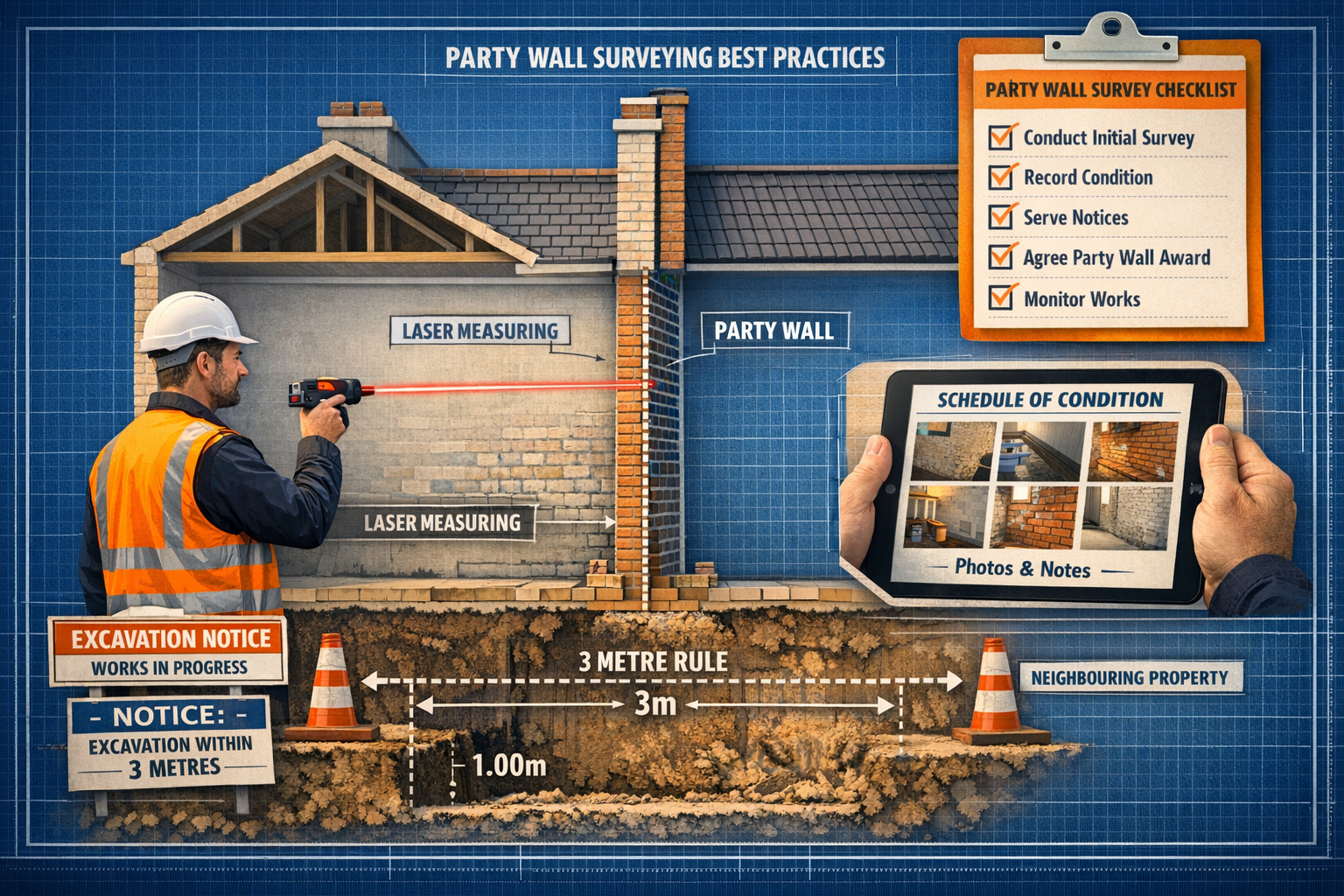
A detailed schedule of condition serves as crucial evidence if disputes arise later. This document should include:
- 📸 Dated photographs of all relevant areas
- 📝 Written descriptions of existing conditions
- 📏 Measurements and technical specifications
- 🗺️ Floor plans showing proximity to proposed work
- ⚠️ Notation of pre-existing cracks, settlement, or defects
Professional surveyors emphasize that investing time in comprehensive pre-construction documentation pays dividends by preventing disputes and providing clear evidence of baseline conditions.
The 3-Metre Rule and Excavation Considerations
While Scotland lacks the formal "3-metre rule" found in English party wall legislation, similar principles apply when excavation work occurs near adjoining properties. The 3-metre rule concept remains relevant for assessing risk and determining notification requirements.
Excavation risk factors requiring careful assessment:
- Depth of excavation relative to adjoining foundations
- Soil type and stability characteristics
- Proximity to party walls or boundary structures
- Groundwater conditions and drainage patterns
- Historic settlement or movement in existing structures
When excavation work is planned within 3 metres of an adjoining building, best practice dictates:
🔍 Detailed foundation investigation to understand existing support conditions
📋 Formal notification to adjoining owners with technical details
👷 Engineering assessment of temporary works requirements
📊 Monitoring protocols to detect any movement during construction
🛡️ Insurance verification to protect all parties against potential damage
An excavation notice should provide comprehensive information about the proposed work, even though Scottish law doesn't mandate the same formal process as English legislation.
Structural Work on Party Walls
Work directly affecting party walls presents the highest risk of disputes and requires meticulous planning. Common scenarios in Scotland's 2026 construction boom include:
Loft conversions requiring party wall alterations for fire separation or structural support
Extensions that tie into or load existing party walls
Chimney work affecting shared chimney structures
Damp-proofing requiring insertion of membranes or chemical treatments
Structural repairs to deteriorated party wall elements
For each type of work, surveyors must assess:
- Structural implications for both properties
- Fire safety compliance under Scottish building standards
- Sound insulation requirements
- Access requirements and temporary works
- Sequencing to minimize disruption
The intensification of construction activity in 2026 means that multiple properties in a terrace may undergo work simultaneously, creating complex coordination challenges that require professional surveying expertise.
Professional Surveying Standards and Qualifications
RICS Standards and Guidance
The Royal Institution of Chartered Surveyors (RICS) provides professional standards that guide party wall surveying practice, even in Scotland where statutory frameworks differ from England. RICS-qualified surveyors bring essential expertise to party wall matters through:
Professional competence: Demonstrated knowledge of construction, structures, and property law
Ethical standards: Impartial advice serving the interests of all parties
Technical expertise: Understanding of building pathology, structural behavior, and defect diagnosis
Dispute resolution skills: Mediation and negotiation to prevent escalation
Engaging a chartered building surveyor provides assurance of professional standards and accountability. While the link references Manchester, the principles of RICS qualification apply equally to Scottish practice.
The Role of the Party Wall Surveyor in Scotland
In the absence of statutory appointment procedures, Scottish party wall surveyors typically operate under common law principles and contractual arrangements. Their role encompasses:
🔎 Independent assessment of proposed work and potential impacts
📄 Documentation of existing conditions and agreed procedures
⚖️ Impartial advice to both building and adjoining owners
🤝 Negotiation of access arrangements and working methods
📋 Award preparation documenting agreed terms and conditions
🔍 Monitoring of work to ensure compliance with agreements
The surveyor acts as a technical expert and mediator, helping parties understand their rights and obligations while facilitating construction progress. This role becomes increasingly valuable as construction activity intensifies and the potential for disputes multiplies.
Appointing Agreed Surveyors vs. Individual Surveyors
Scottish practice allows flexibility in surveyor appointment arrangements:
Agreed Surveyor Approach: Both parties appoint a single surveyor who acts impartially to serve both interests. This approach offers:
- Cost efficiency through shared fees
- Streamlined decision-making
- Reduced formality and complexity
- Faster resolution of issues
Individual Surveyor Approach: Each party appoints their own surveyor, who then work together to prepare agreed documentation. This provides:
- Independent representation for each party
- Checks and balances in decision-making
- Greater formality and documentation
- Third surveyor availability if disagreements arise
The choice depends on the complexity of work, the relationship between neighbors, and the level of concern about potential impacts. For straightforward projects with cooperative neighbors, an agreed surveyor often suffices. Complex projects or strained relationships may warrant individual appointments.
Documentation and Award Preparation
Essential Elements of a Party Wall Award
While not statutorily required in Scotland, preparing a formal party wall award provides valuable protection for all parties. Drawing on English precedent and best practice, a comprehensive award should include:
Preamble section:
- Parties' names and property addresses
- Description of proposed work
- Appointment details for surveyors
- Legal basis for the award
Technical specifications:
- Detailed scope of permitted work
- Working hours and access arrangements
- Protection measures for adjoining property
- Materials and methods specifications
Condition documentation:
- Reference to schedule of condition
- Agreed baseline for assessing damage
- Photographic evidence appendices
Rights and obligations:
- Access rights and limitations
- Notice requirements for variations
- Insurance and indemnity provisions
- Dispute resolution procedures
Cost provisions:
- Fee responsibility allocation
- Payment terms for surveyor fees
- Procedures for additional work
For guidance on preparing comprehensive awards, surveyors can reference party wall award guidance that outlines best practices.
Schedules of Condition: Best Practices for 2026
The schedule of condition represents the most critical protective document in party wall matters. As construction activity surges in 2026, surveyors emphasize enhanced documentation standards:
Photography protocols:
- High-resolution digital images with embedded metadata
- Multiple angles of each room and external elevation
- Close-up shots of existing defects or concerns
- Video walkthroughs for comprehensive records
- Cloud storage with timestamped backups
Written descriptions:
- Room-by-room narrative of conditions
- Specific notation of cracks with measurements
- Description of finishes, fixtures, and fittings
- Assessment of overall maintenance condition
- Professional observations on structural adequacy
Technical measurements:
- Crack width gauges and monitoring points
- Level readings for floors and ceilings
- Plumb measurements for walls
- Moisture readings in potentially affected areas
Appendices and supporting information:
- Floor plans with photograph locations marked
- Previous survey reports if available
- Title deed extracts showing ownership
- Correspondence regarding the proposed work
The schedule should be agreed and signed by all parties before work commences, creating an unambiguous baseline for assessing any subsequent damage claims.
Managing Disputes and Damage Claims
Prevention Through Communication
The most effective dispute resolution is dispute prevention. Surveyors working in Scotland's active 2026 construction environment emphasize proactive communication strategies:
Early engagement: Contact adjoining owners as soon as work is contemplated, not when contractors are ready to start
Clear explanations: Provide accessible descriptions of proposed work without excessive technical jargon
Realistic timescales: Set accurate expectations for duration and disruption
Regular updates: Maintain communication throughout the project
Responsive approach: Address concerns promptly and respectfully
Many disputes arise from misunderstandings or poor communication rather than genuine conflicts of interest. Professional surveyors facilitate dialogue and help parties understand each other's perspectives.
When Damage Occurs: Assessment Protocols
Despite careful planning, construction damage sometimes occurs. When adjoining owners report concerns, systematic assessment is essential:
Immediate response steps:
- Acknowledge the report and arrange prompt inspection
- Photograph the reported damage comprehensively
- Compare current condition to schedule of condition
- Assess whether damage relates to the construction work
- Determine if work should be suspended pending investigation
Technical investigation:
- Structural engineer assessment for serious concerns
- Crack monitoring to determine if movement is ongoing
- Soil investigation if settlement is suspected
- Review of construction methods and temporary works
- Consultation with contractors on procedures used
Causation analysis:
- Temporal relationship between work and damage
- Mechanism by which work could cause observed effects
- Alternative explanations for the condition
- Pre-existing defects versus new damage
- Expert opinion on probability of causation
Understanding damage to property in party wall contexts helps surveyors navigate these challenging situations professionally.
Resolution Mechanisms and Remediation
When damage is confirmed as construction-related, prompt remediation protects relationships and limits costs:
Remediation hierarchy:
- Immediate stabilization if structural safety is compromised
- Temporary repairs to prevent deterioration or weather ingress
- Monitoring period to confirm movement has ceased
- Permanent repairs to restore original condition
- Redecoration to match pre-existing finishes
Cost recovery:
- Building owner typically bears responsibility for construction damage
- Insurance claims may be appropriate for significant damage
- Surveyor fees for damage assessment and oversight
- Betterment considerations if repairs improve original condition
Documentation:
- Detailed damage reports with photographic evidence
- Repair specifications and methodology
- Contractor quotations and final costs
- Completion certificates and guarantees
- Final agreement releasing parties from further claims
Professional surveyors play a crucial role in ensuring fair outcomes that restore damaged property while avoiding excessive claims or betterment disputes.
Cost Considerations in Party Wall Matters
Surveyor Fees and Expense Allocation
Understanding the cost of party wall procedures helps property owners budget appropriately for 2026 projects. Typical fee structures include:
Agreed surveyor fees (when one surveyor serves both parties):
- £800-£1,500 for straightforward residential projects
- £1,500-£3,000 for complex work or multiple properties
- £3,000+ for commercial projects or extensive works
Individual surveyor fees (when each party appoints separately):
- Building owner's surveyor: £1,000-£2,500
- Adjoining owner's surveyor: £800-£2,000
- Third surveyor (if required): £1,500-£3,500
Additional costs:
- Schedule of condition preparation: £500-£1,200
- Structural engineer consultations: £800-£2,500
- Monitoring and inspection visits: £200-£400 per visit
- Dispute resolution or mediation: £1,500-£5,000+
In Scotland, fee allocation typically follows the principle that the building owner (the party proposing work) bears the reasonable costs of party wall procedures. This includes surveyor fees for both parties, as the adjoining owner should not be out of pocket for protecting their property rights.
Budgeting for Party Wall Compliance in 2026
As construction costs rise and activity intensifies, comprehensive budgeting for party wall compliance prevents project delays and financial surprises:
Budget allocation recommendations:
- Include 2-3% of construction value for party wall procedures on terraced properties
- Allow 1-2% for semi-detached properties with shared walls
- Budget higher percentages (3-5%) for complex excavation or structural work
- Include contingency for potential damage remediation (1-2% of project value)
Cost-benefit analysis:
While party wall procedures represent additional expense, they provide substantial value:
- Prevention of costly disputes and litigation
- Protection against damage claims
- Professional documentation of conditions
- Facilitation of necessary access
- Risk mitigation through expert oversight
Property developers and homeowners undertaking significant projects in 2026 should view party wall compliance as essential project infrastructure rather than optional expense.
Technology and Innovation in Party Wall Surveying
Digital Documentation Tools
The surveying profession has embraced digital tools that enhance documentation quality and efficiency:
Photographic technology:
- 360-degree cameras capturing complete room environments
- Drone photography for external elevations and roof conditions
- Thermal imaging identifying hidden defects or moisture issues
- Photogrammetry creating 3D models from photographs
Documentation platforms:
- Cloud-based systems for secure document storage and sharing
- Digital signature capabilities for remote award execution
- Collaborative platforms allowing real-time updates
- Mobile apps for on-site data capture and annotation
Analysis tools:
- Crack monitoring software tracking movement over time
- Structural analysis programs assessing load impacts
- BIM (Building Information Modeling) integration for complex projects
- AI-assisted defect identification and classification
These technologies improve documentation quality while reducing time requirements, making professional surveying more accessible and cost-effective.
Monitoring and Remote Surveillance
Continuous monitoring provides early warning of construction impacts:
Automated monitoring systems:
- Crack gauges with digital readouts and data logging
- Tilt sensors detecting structural movement
- Vibration monitors measuring construction impacts
- Settlement monitoring for excavation projects
Remote surveillance:
- Time-lapse cameras documenting construction progress
- Live video feeds for adjoining owner reassurance
- Automated alerts when movement thresholds are exceeded
- Cloud-based data access for all parties
These systems provide objective evidence of construction impacts and enable rapid response if problems develop, reducing dispute risk in Scotland's busy 2026 construction environment.
Regional Considerations Across Scotland

Edinburgh's Unique Challenges
Edinburgh's World Heritage status and concentration of historic terraced properties create specific party wall challenges:
Conservation area requirements: Additional approvals and restrictions on methods
Listed building considerations: Specialized techniques for historic structures
Sandstone deterioration: Common defects requiring careful assessment
Georgian and Victorian terraces: Complex shared ownership structures
The capital's strong property market and active renovation sector mean surveyors must balance heritage preservation with modern living standards.
Glasgow's Urban Regeneration Context
Glasgow's ongoing regeneration creates party wall scenarios in transitional neighborhoods:
Tenement properties: Scotland's distinctive multi-story shared buildings with complex common ownership
Mixed-use developments: Commercial and residential interfaces requiring careful management
Regeneration areas: Varying property conditions and investment levels
Community consultation: Engagement requirements in sensitive areas
The city's construction boom requires surveyors familiar with tenement law and communal property management.
Rural and Small-Town Considerations
Scotland's rural areas present different party wall challenges:
Agricultural conversions: Barn and steading transformations affecting adjoining properties
Stone construction: Traditional building methods requiring specialist knowledge
Access limitations: Remote locations complicating surveyor visits and monitoring
Community relationships: Closer-knit communities where disputes have broader impacts
Rural surveyors must adapt urban party wall principles to countryside contexts while respecting local building traditions and community dynamics.
Frequently Asked Questions About Party Wall Challenges
What happens if you don't have a party wall agreement in Scotland?
Without formal party wall agreements, Scottish property owners rely on common law protections and neighborly cooperation. However, proceeding without proper notification and documentation creates significant risks:
- Adjoining owners may seek court interdicts to halt work
- Damage claims become more difficult to defend without baseline documentation
- Relationships deteriorate due to perceived disrespect or lack of consultation
- Project delays occur while disputes are resolved
- Legal costs escalate if litigation becomes necessary
Understanding what happens if you do not have a party wall agreement helps property owners appreciate the value of proactive engagement.
How long does the party wall process take in 2026?
Timescales vary based on project complexity and neighbor cooperation:
Straightforward projects: 4-6 weeks from initial contact to agreed documentation
Complex projects: 8-12 weeks for detailed assessments and negotiations
Disputed matters: 3-6 months or longer if formal dispute resolution is required
In Scotland's busy 2026 construction environment, early engagement is essential to avoid project delays. Surveyors recommend initiating party wall procedures at the planning stage rather than waiting for building warrant approval.
Can adjoining owners prevent construction work?
Scottish law recognizes property rights but generally does not allow neighbors to prevent reasonable development:
Adjoining owners cannot:
- Arbitrarily refuse consent to necessary work
- Demand unreasonable conditions or payments
- Indefinitely delay reasonable projects
Adjoining owners can:
- Require proper notification and consultation
- Insist on protective measures and monitoring
- Seek compensation for actual damage
- Challenge work that violates their property rights
Professional surveying helps balance these interests, facilitating legitimate construction while protecting neighbor rights.
What types of work require party wall procedures?
In Scotland, party wall considerations apply to:
✅ Work directly affecting party walls (cutting, removing, rebuilding)
✅ Excavation within 3 metres of adjoining foundations
✅ Loft conversions requiring party wall alterations
✅ Extensions tying into or loading party walls
✅ Underpinning or foundation work near boundaries
✅ Chimney work affecting shared structures
✅ Installation of damp-proof courses in party walls
For comprehensive guidance on scenarios requiring party wall attention, property owners can review party wall FAQs covering common situations.
Looking Ahead: Party Wall Practice Beyond 2026
Regulatory Evolution and Reform Proposals
Scotland's construction sector continues evolving, with potential regulatory changes affecting party wall practice:
Building standards review: Ongoing assessments of compliance frameworks may introduce new notification requirements [7]
Fire safety enhancements: Post-Grenfell reforms affecting party wall fire separation standards
Climate change adaptations: Retrofit requirements creating new party wall scenarios
Digital planning: Electronic systems potentially streamlining notification processes
Surveyors must stay current with regulatory developments to provide accurate guidance as frameworks evolve. The Law Society of Scotland highlights numerous regulatory developments taking effect in 2026 [5], emphasizing the dynamic nature of the legal landscape.
Professional Development and Training
The intensification of construction activity creates demand for qualified party wall surveyors. Professional development priorities include:
Technical competencies:
- Structural assessment and building pathology
- Scottish property law and common law principles
- Dispute resolution and mediation skills
- Digital documentation and monitoring technologies
Continuing professional development:
- RICS-accredited party wall courses
- Scottish-specific legal framework training
- Practical workshops on complex scenarios
- Ethics and professional conduct updates
The surveying profession must expand capacity to meet 2026's heightened demand while maintaining quality standards and professional integrity.
Sustainability and Party Wall Practice
Scotland's ambitious climate targets intersect with party wall considerations as properties undergo energy efficiency retrofits:
Insulation projects: External and internal wall insulation affecting party walls
Heat pump installations: Ground source systems requiring excavation near boundaries
Solar panel arrays: Roof work potentially affecting shared structures
Ventilation systems: Penetrations through party walls for heat recovery
Sustainable construction methods require party wall surveyors to understand new technologies and their implications for adjoining properties. The construction sector's focus on "sustainable scale" [6] extends to party wall practice, emphasizing quality procedures that support environmental objectives.
Conclusion: Navigating Party Wall Challenges Successfully
Scotland's construction sector stands at a pivotal moment in 2026, with robust activity creating both opportunities and challenges. Party Wall Challenges in Scotland's 2026 Construction Uptick: Surveying Best Practices Amid Rising Activity represents a critical consideration for everyone involved in property development, from major developers to individual homeowners planning extensions.
The absence of comprehensive statutory frameworks in Scotland makes professional surveying expertise even more valuable. By engaging qualified surveyors early, documenting conditions thoroughly, and maintaining open communication with neighbors, property owners can navigate party wall matters successfully while protecting relationships and investments.
Actionable Next Steps for Property Owners
For those planning construction projects in Scotland's active 2026 market:
-
Engage professional surveyors early in the planning process, before finalizing designs or appointing contractors
-
Notify adjoining owners promptly with clear, accessible information about proposed work and its potential impacts
-
Invest in comprehensive schedules of condition to document baseline property conditions and protect against unfounded damage claims
-
Budget appropriately for party wall procedures as essential project infrastructure, not optional expense
-
Maintain communication throughout the project, providing updates and responding promptly to neighbor concerns
-
Consider insurance coverage for potential party wall disputes and damage claims
-
Seek specialist advice for complex projects involving excavation, structural alterations, or historic properties
Final Thoughts
The construction uptick transforming Scotland in 2026 brings vitality to communities, enhances housing stock, and supports economic growth. By approaching party wall matters professionally and proactively, the industry can deliver this growth while maintaining the neighborly cooperation that characterizes Scottish communities.
Professional surveying provides the technical expertise, impartial guidance, and documentation necessary to balance development rights with property protection. As construction activity continues intensifying, investing in proper party wall procedures represents not just legal prudence but good neighborliness—a foundation for sustainable development that benefits all stakeholders.
Whether undertaking a modest home extension or a major urban development, understanding and addressing party wall challenges ensures projects proceed smoothly, relationships remain positive, and Scotland's built environment evolves responsibly into the future. 🏴
For property owners seeking professional guidance on party wall matters, consulting with RICS-qualified surveyors experienced in Scottish practice provides the expertise necessary to navigate 2026's complex construction landscape successfully.
References
[1] Meeting Of Parliament 08 01 2026 – https://www.parliament.scot/chamber-and-committees/official-report/search-what-was-said-in-parliament/meeting-of-parliament-08-01-2026?meeting=16776&iob=143326
[2] Scottish Planning In 2026 What Is On The Horizon – https://www.burges-salmon.com/our-thinking/scottish-planning-in-2026-what-is-on-the-horizon/
[3] Befs Bulletin 389 A Busy Start To 2026 – https://www.befs.org.uk/latest/bulletins/befs-bulletin-389-a-busy-start-to-2026/
[4] Zander Muego Trends Shaping The Construction Sector In 2026 – https://www.scottishconstructionnow.com/articles/zander-muego-trends-shaping-the-construction-sector-in-2026
[5] Looking Ahead To Key Scottish Regulatory Developments Due In 2026 – https://www.lawscot.org.uk/members/journal-hub/articles/looking-ahead-to-key-scottish-regulatory-developments-due-in-2026/
[6] Scaling Up Isnt Enough Why Construction Must Deliver Sustainable Scale In 2026 – https://projectscot.com/2026/01/scaling-up-isnt-enough-why-construction-must-deliver-sustainable-scale-in-2026/
[7] Scottish Building Regulations Fire Safety Review Compliance Call Evidence – https://www.gov.scot/publications/scottish-building-regulations-fire-safety-review-compliance-call-evidence/
[8] Looking Ahead For Real Estate Scotland February 2026 – https://www.shoosmiths.com/perspectives/stories/articles/looking-ahead-for-real-estate-scotland-february-2026