The real estate landscape is experiencing a seismic shift in 2026, with certain metropolitan markets emerging as clear frontrunners for investment and development opportunities. Surveying the Top 10 Real Estate Markets of 2026: Site Selection Strategies for Dallas-Fort Worth, Miami, Houston, and Beyond reveals critical insights that professional surveyors, developers, and investors need to navigate this dynamic environment. According to PwC's latest rankings, Dallas-Fort Worth has claimed the top position for both commercial and homebuilding prospects, signaling unprecedented growth potential in the South Central region[4]. Understanding what makes these markets attractive—from site characteristics and development pressures to unique surveying challenges—is essential for anyone involved in property acquisition, development, or investment strategy.
The convergence of favorable demographics, business-friendly regulations, and infrastructure expansion has created a perfect storm of opportunity in markets like Dallas-Fort Worth, Miami, Houston, and several other metropolitan areas. For surveyors and site selection professionals, this means adapting methodologies to address the specific challenges these high-growth markets present, from rapid development timelines to complex zoning considerations.
Key Takeaways
- 🏆 Dallas-Fort Worth ranks #1 for 2026 across both commercial and homebuilding prospects, with closings projected to increase 15% and inventory reaching record levels in spring 2026[4][5]
- 📊 South Central region dominates with one-third of the region's markets ranking in the top 20, including Houston at #5 and Nashville close behind[4]
- 📈 Inventory surge signals market shift with 7,700 new listings in a single January week and 7,107 price decreases indicating buyer leverage and seller recalibration[2]
- 💰 Median home prices stabilizing around $355,000 in DFW, creating improved affordability while multiple mixed-use developments launch across the region[1]
- 🔍 Site selection requires specialized surveying to address development pressures, zoning complexities, and infrastructure demands unique to these high-growth markets
Understanding the 2026 Real Estate Market Rankings
The Rise of Dallas-Fort Worth to the Top Position
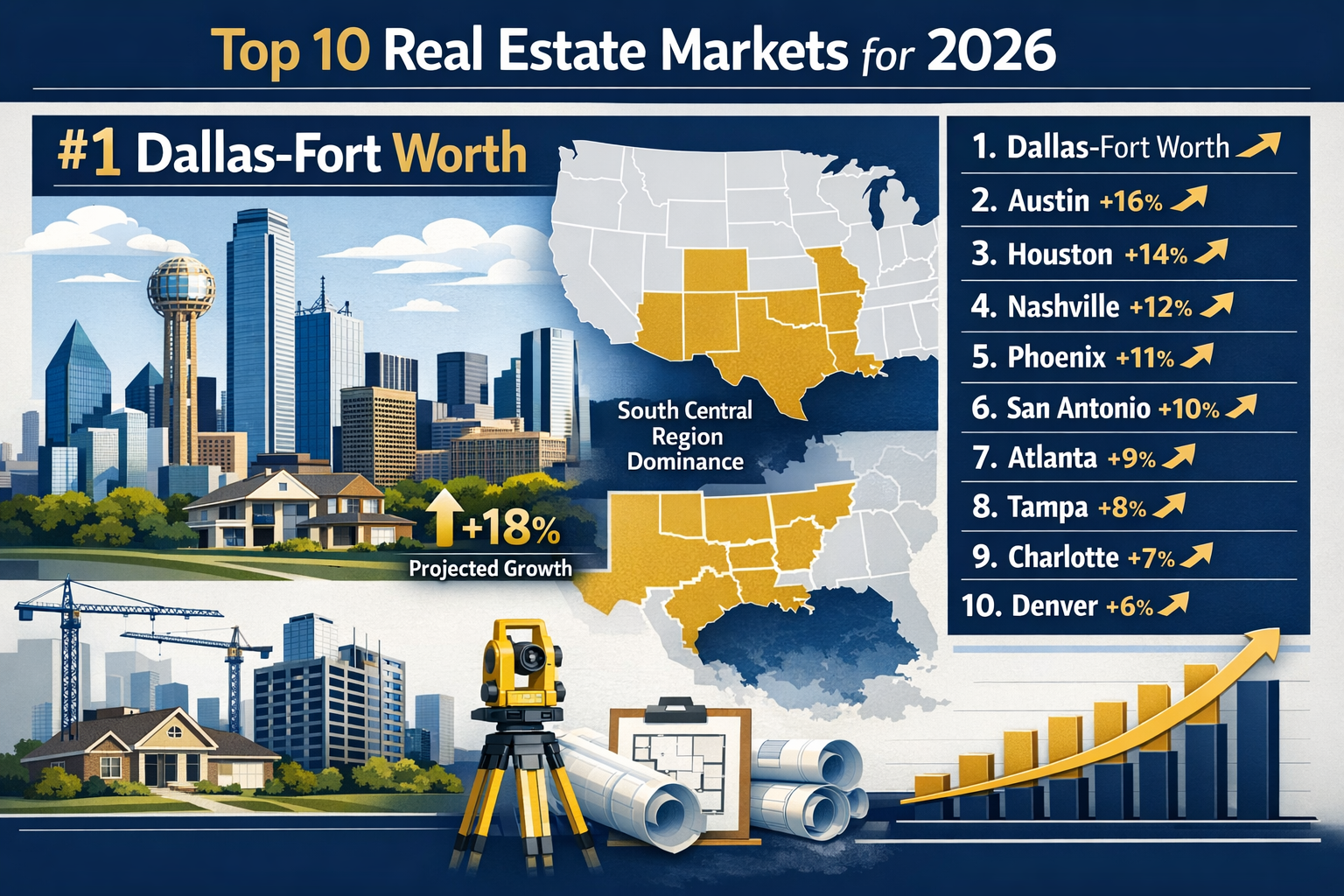
Dallas-Fort Worth's ascension to the #1 position for 2026 represents more than just statistical achievement—it reflects fundamental market strengths that surveyors and developers must understand when evaluating potential sites. Described as "a perennial favorite for real estate investors and developers," DFW received strong net buy recommendations particularly for retail and industrial property types[4].
The market fundamentals driving this ranking include:
Population Growth and Economic Expansion 🌆
The DFW metroplex continues attracting both businesses and residents at an unprecedented rate. This demographic surge creates sustained demand across all property sectors, from residential subdivisions to commercial centers and industrial parks. For surveyors, this means increased workload in building surveys and property assessments as development accelerates.
Infrastructure Investment
Major transportation corridors, airport expansions, and utility infrastructure improvements support continued development. Site selection professionals must thoroughly evaluate access to these critical systems when assessing parcels for development potential.
Business-Friendly Environment
Texas's regulatory framework and tax structure attract corporate relocations and expansions, driving demand for office, industrial, and supporting residential development. This creates opportunities but also challenges for surveyors navigating multiple jurisdictions with varying requirements.
The South Central Region's Market Dominance
The South Central region's remarkable performance—with one-third of its 12 markets ranking among the top 20 overall—demonstrates regional economic vitality beyond any single metropolitan area[4]. Houston, despite slipping from #3 in 2025 to #5 in 2026, remains a powerhouse market, while Nashville continues its strong performance.
This regional concentration of high-performing markets creates unique considerations for surveying professionals:
| Market | 2026 Ranking | Key Strengths | Surveying Considerations |
|---|---|---|---|
| Dallas-Fort Worth | #1 | Diversified economy, population growth | High development velocity, complex zoning |
| Houston | #5 | Energy sector, port access | Flood plain analysis, subsidence monitoring |
| Nashville | Top 10 | Entertainment industry, migration | Topographic challenges, rapid urbanization |
Understanding these market-specific characteristics enables surveyors to anticipate challenges and prepare appropriate methodologies. For instance, Houston's subsidence issues require specialized monitoring surveys that might not be as critical in other markets.
Beyond the South Central: Other Top Markets for 2026
While the South Central region dominates, other markets deserve attention for their unique opportunities and surveying requirements. Miami, Jersey City, and Brooklyn each present distinct characteristics that influence site selection strategies.
Miami's Coastal Development Pressures 🌊
Miami's continued growth faces unique challenges including sea-level rise considerations, hurricane risk assessments, and complex coastal regulations. Surveyors working in this market must incorporate environmental risk analysis and specialized structural surveys that account for coastal conditions.
Jersey City and Brooklyn's Urban Density
These markets represent infill development and redevelopment opportunities in highly urbanized environments. Site selection here requires expertise in dilapidation surveys, party wall considerations, and navigating complex municipal approval processes.
Surveying the Top 10 Real Estate Markets of 2026: Critical Site Characteristics
Dallas-Fort Worth Market Dynamics and Site Selection Factors
The DFW market's projected 15% increase in closings for 2026 signals robust transaction activity that demands thorough site evaluation[5]. Understanding current market conditions helps surveyors and developers make informed decisions about timing and location.
Inventory Surge and Market Implications
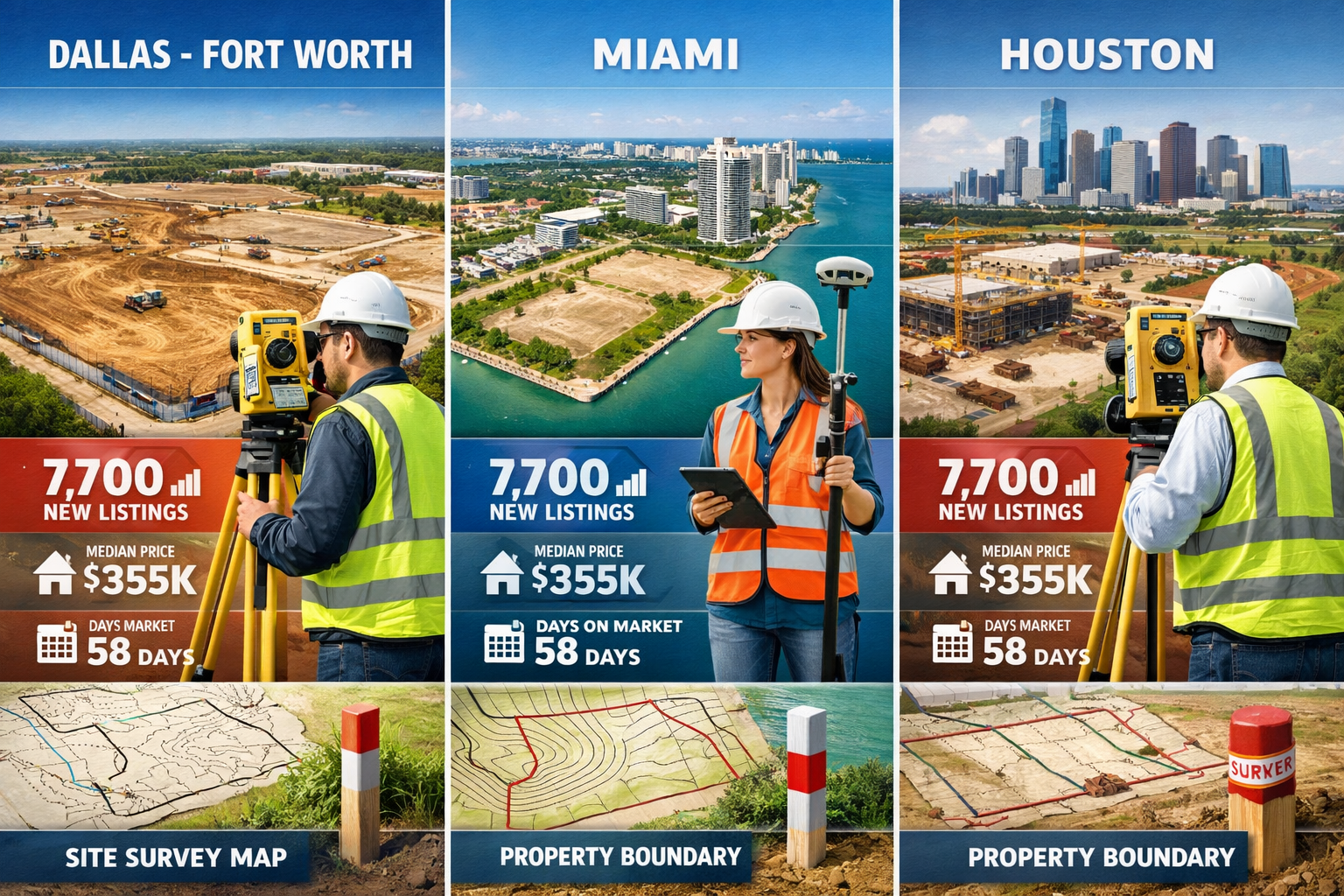
January 2026 witnessed an extraordinary influx of 7,700 new listings during a single week (January 12-18), providing buyers with significantly expanded options compared to late 2025[2]. This inventory surge has profound implications for site selection:
- Increased Buyer Leverage: With more options available, buyers can be more selective about location, condition, and price
- Extended Decision Timelines: Days on market extended to 58 days in January 2026, up from 52 days in December 2025[3]
- Price Recalibration: A remarkable 7,107 price decreases occurred in January 2026—nearly matching new listings—while only 853 price increases were recorded[2]
For surveyors, this market dynamic means clients may request multiple property assessments before committing to a purchase. Understanding which survey you need becomes crucial for providing cost-effective yet comprehensive analysis.
County-Level Price Variations
DFW's median home sales price hovers around $355,000 as of January 2026, but significant county-level variations exist[1]:
- Rockwall County: $430,831 (highest median)
- Tarrant County: $340,000 (more affordable option)
- Most areas: Year-over-year price declines from COVID-era peaks
These price differentials reflect varying site characteristics, including school districts, employment centers, infrastructure access, and development restrictions. Comprehensive site analysis must account for these localized factors when evaluating investment potential.
Major Development Projects Launching in 2026
Multiple significant residential and mixed-use developments are launching across DFW in 2026 and beyond, creating surveying opportunities and competitive pressures[1]:
✅ The Auberge (Knox Henderson): 255 residential units, 250,000 sq ft office, 40,000 sq ft retail/restaurant
✅ Hi Line Square (Design District): Mixed-use development
✅ Jackson Road (Carrollton): Residential community
✅ The Cora (Anna): New residential development
✅ The Buckley (Plano): Residential project
✅ The Renegade (Denton): Mixed-use community
✅ Fields West (Frisco): Large-scale development
✅ Westside Village (Fort Worth): Community development
Each of these projects required extensive surveying work, from initial site analysis through construction monitoring. Understanding the scope and scale of competing developments helps inform site selection decisions for new projects.
Miami's Unique Surveying Challenges and Opportunities
Miami's position among the top 2026 markets comes with distinctive site selection considerations that differ significantly from inland markets like Dallas-Fort Worth. Coastal location, environmental regulations, and demographic trends create a complex landscape for surveyors and developers.
Coastal Risk Assessment
Any site evaluation in Miami must incorporate comprehensive coastal risk analysis:
- Sea-Level Rise Projections: Long-term viability assessment
- Storm Surge Vulnerability: Hurricane impact zones
- Flood Insurance Requirements: Financial feasibility considerations
- Building Code Compliance: Enhanced structural requirements
These factors require specialized expertise beyond standard homebuyer surveys, often necessitating environmental consultants and coastal engineering analysis.
High-Density Development Opportunities
Miami's limited geographic footprint drives vertical development and urban infill projects. Site selection in this environment requires:
- Thorough analysis of existing structures for redevelopment potential
- Zoning variance and density bonus opportunities
- Infrastructure capacity assessment (utilities, transportation)
- Community impact and approval process navigation
International Investment Influence
Miami's appeal to international investors creates unique market dynamics that influence site selection criteria, including proximity to cultural amenities, security considerations, and property management infrastructure.
Houston's Energy Sector Influence and Site Selection
Houston's #5 ranking for 2026, despite slipping from #3 in 2025, still represents substantial opportunity, particularly in industrial and commercial sectors tied to the energy industry[4]. Site selection in Houston requires understanding both traditional and emerging energy sector needs.
Industrial Site Requirements
Houston's port access and energy infrastructure create demand for specialized industrial sites with specific characteristics:
- Heavy Load Capacity: Foundation requirements for industrial equipment
- Utility Infrastructure: High-capacity electrical, water, and gas service
- Transportation Access: Rail, highway, and port connectivity
- Environmental Compliance: Historical use assessment and remediation potential
Surveyors evaluating industrial sites must conduct thorough stock condition surveys for existing facilities and comprehensive site analysis for greenfield development.
Subsidence and Foundation Considerations
Houston's geological characteristics, including subsidence from groundwater extraction, create unique surveying requirements:
"Houston's subsidence issues require ongoing monitoring and specialized foundation engineering that must be factored into site selection and development budgets."
Regular monitoring surveys may be necessary throughout the development and operational life of structures in affected areas.
Flood Plain Management
Recent flooding events have heightened awareness of flood risk in Houston. Site selection must include:
- FEMA flood zone designation verification
- Historical flooding data analysis
- Drainage infrastructure assessment
- Elevation and grading requirements
Site Selection Strategies Across Top 2026 Markets
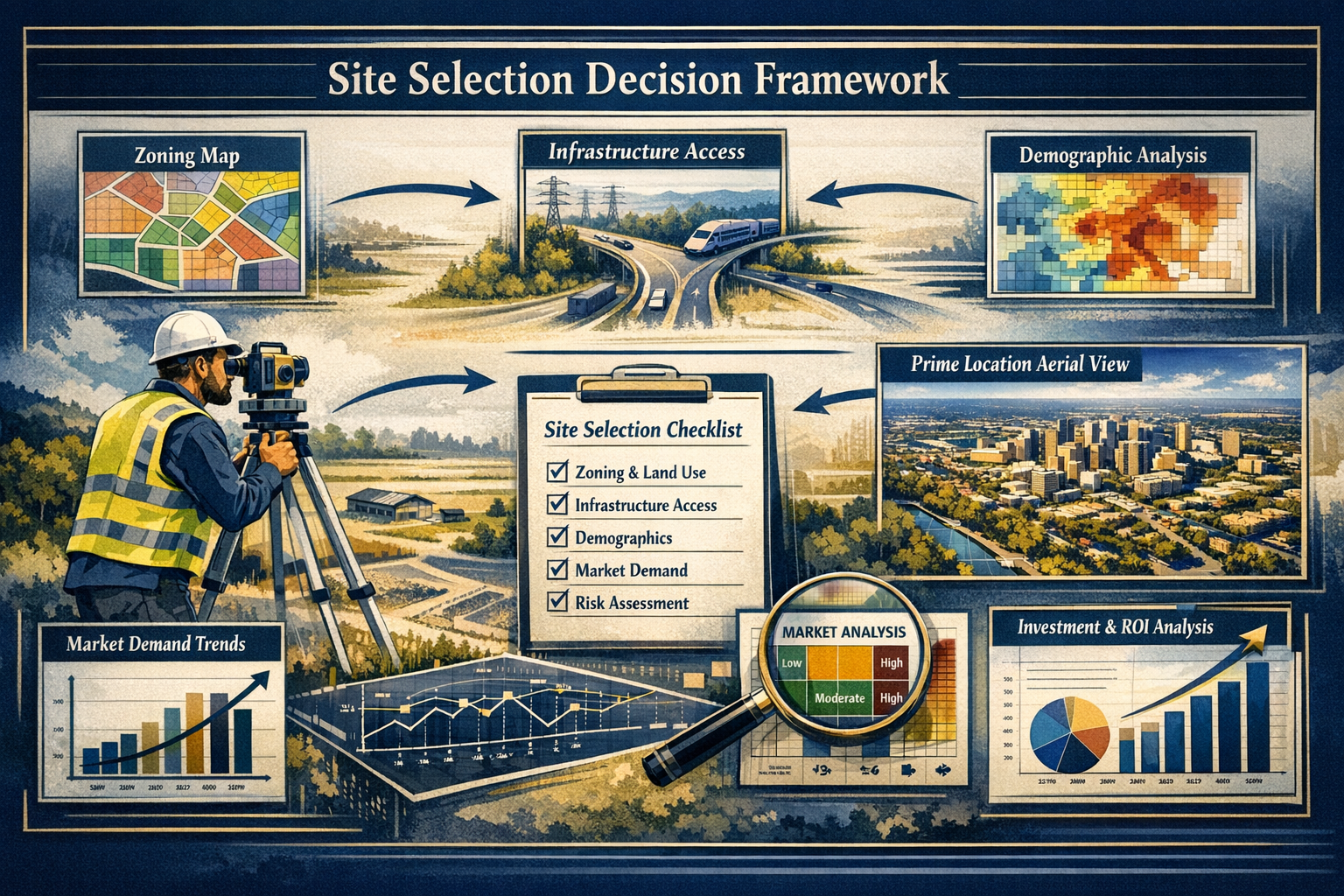
Essential Due Diligence Components
Regardless of which top market you're evaluating, comprehensive due diligence follows a systematic approach that professional surveyors must master. The complexity and stakes of development in these high-growth markets demand thorough investigation before committing capital.
Phase 1: Preliminary Site Assessment 🔍
Before investing in detailed surveys, conduct preliminary screening:
-
Zoning and Land Use Verification
- Current zoning designation
- Permitted uses and restrictions
- Variance or rezoning potential
- Overlay districts and special regulations
-
Title and Ownership Research
- Clear title verification
- Easements and encumbrances
- Access rights confirmation
- Boundary dispute history
-
Environmental Screening
- Phase I Environmental Site Assessment
- Historical use investigation
- Contamination indicators
- Protected species or wetlands presence
-
Utility and Infrastructure Availability
- Water and sewer capacity
- Electrical service adequacy
- Natural gas availability
- Telecommunications infrastructure
Phase 2: Comprehensive Survey and Analysis
Once preliminary screening confirms viability, commission detailed professional surveys. Comparing different types of survey helps determine the appropriate level of investigation for your specific needs.
Boundary Survey
Establishes precise property lines, identifies encroachments, and confirms legal descriptions. Essential for all property transactions and development planning.
Topographic Survey
Documents existing site conditions including:
- Elevation changes and contours
- Existing structures and improvements
- Vegetation and natural features
- Drainage patterns and water features
ALTA/NSPS Land Title Survey
Comprehensive survey meeting American Land Title Association and National Society of Professional Surveyors standards, typically required for commercial transactions and providing detailed information about boundaries, improvements, easements, and access.
Geotechnical Investigation
Subsurface exploration to determine:
- Soil composition and bearing capacity
- Groundwater levels and characteristics
- Foundation recommendations
- Excavation and grading considerations
Market-Specific Site Selection Criteria
While fundamental due diligence applies across all markets, each of the top 2026 markets has distinctive characteristics that influence site selection priorities.
Dallas-Fort Worth: Growth Trajectory Analysis
With spring 2026 expected to see record inventory levels—surpassing the 19,030 homes listed in spring 2025—timing and location selection become critical[1]. Site selection in DFW should prioritize:
Employment Center Proximity 💼
- Distance to major employment hubs
- Commute time analysis
- Future employment development plans
- Transit connectivity
School District Quality
Texas's strong emphasis on local school districts significantly influences residential demand. Sites in highly-rated districts command premium pricing and faster absorption.
Infrastructure Expansion Corridors
Identifying areas benefiting from planned highway expansions, utility improvements, or transit development provides competitive advantage.
Miami: Resilience and Lifestyle Factors
Site selection in Miami must balance lifestyle amenities with long-term resilience:
- Elevation and Flood Risk: Prioritize sites with higher elevation and lower flood risk
- Proximity to Amenities: Beach access, cultural institutions, dining and entertainment
- Transportation Access: Major highways, airport proximity, future transit plans
- Neighborhood Trajectory: Gentrification trends and investment patterns
Houston: Industrial and Commercial Optimization
For commercial and industrial site selection in Houston:
- Sector-Specific Clusters: Proximity to related businesses and suppliers
- Labor Force Access: Demographic analysis of available workforce
- Regulatory Environment: Municipal jurisdiction and permit processes
- Long-Term Viability: Energy transition considerations for future-proofing
Financial Analysis and Valuation Considerations
Understanding factors of valuation helps surveyors provide clients with comprehensive site assessment that goes beyond physical characteristics to financial viability.
Comparative Market Analysis
In markets experiencing rapid change like DFW—where 7,107 price decreases occurred in a single month—understanding current comparable sales is essential[2]. Key metrics include:
- Recent sales of similar properties
- Price per square foot trends
- Days on market comparisons
- Absorption rates by property type
Development Feasibility Analysis
Comprehensive financial modeling should include:
| Cost Category | Considerations |
|---|---|
| Land Acquisition | Purchase price, closing costs, holding costs |
| Site Preparation | Clearing, grading, utilities extension |
| Construction | Hard costs, contingencies, escalation |
| Soft Costs | Design, permits, surveys, legal, financing |
| Marketing & Sales | Commissions, advertising, model homes |
Risk Assessment and Mitigation
High-growth markets like the top 10 for 2026 offer significant upside but also carry risks:
- Market Timing Risk: Potential for oversupply or demand shifts
- Regulatory Risk: Zoning changes or new restrictions
- Environmental Risk: Contamination, natural hazards, climate change
- Construction Risk: Cost overruns, delays, labor shortages
Professional surveyors contribute to risk mitigation by providing accurate, comprehensive site information that enables informed decision-making.
Navigating Surveying Challenges in High-Growth Markets
Regulatory and Permitting Complexity
The top 2026 markets each have unique regulatory environments that surveyors must navigate effectively. Understanding local requirements prevents delays and unexpected costs.
Multi-Jurisdictional Considerations
Large metropolitan areas like DFW often involve multiple municipalities, each with distinct requirements:
- Building Codes: Varying standards across jurisdictions
- Zoning Regulations: Different permitted uses and development standards
- Permit Processes: Distinct application requirements and timelines
- Impact Fees: Variable fee structures affecting development costs
Environmental Permitting
Federal, state, and local environmental regulations may require:
- Wetlands delineation and permitting
- Endangered species surveys
- Stormwater management plans
- Air quality assessments (for certain developments)
Historic Preservation Requirements
Urban markets like Brooklyn and Jersey City may have historic district regulations affecting:
- Exterior modifications and new construction
- Demolition restrictions
- Design review processes
- Tax credit opportunities
Technology Integration in Modern Surveying
Advanced technology has transformed surveying practices, enabling more efficient and accurate site analysis in competitive markets where speed and precision matter.
Drone and Aerial Surveying 🚁
Unmanned aerial vehicles (UAVs) provide:
- Rapid site documentation
- Topographic data collection
- Progress monitoring for large developments
- Enhanced visualization for stakeholders
3D Laser Scanning and LiDAR
These technologies deliver:
- Precise as-built documentation
- Detailed topographic modeling
- Volume calculations
- Integration with BIM (Building Information Modeling)
GIS and Spatial Analysis
Geographic Information Systems enable:
- Multi-layered site analysis
- Demographic and market data visualization
- Infrastructure and utility mapping
- Environmental constraint identification
Mobile Data Collection
Field crews equipped with tablets and GPS-enabled devices achieve:
- Real-time data capture and verification
- Reduced transcription errors
- Faster deliverable production
- Enhanced collaboration with project teams
Managing Development Timeline Pressures
In fast-moving markets like DFW—where closings are projected to increase 15% in 2026—timeline pressure affects all project participants, including surveyors[5]. Strategies for managing these pressures include:
Early Engagement and Planning
Involve surveyors early in the site selection process to:
- Identify potential issues before commitment
- Establish realistic timelines
- Coordinate with other consultants
- Prepare for permitting requirements
Phased Survey Approach
Structure surveying work in phases aligned with decision points:
- Initial Screening: Basic boundary and title verification
- Preliminary Analysis: Topographic survey and environmental screening
- Detailed Investigation: Comprehensive ALTA survey and geotechnical study
- Construction Support: Staking, monitoring, and as-built documentation
Contingency Planning
Build flexibility into schedules to accommodate:
- Weather delays
- Unexpected site conditions
- Regulatory review timelines
- Stakeholder coordination needs
Investment and Development Opportunities in Top 2026 Markets
Residential Development Trends
The residential sector across top 2026 markets shows distinct patterns that inform site selection and development strategies.
Single-Family vs. Multi-Family Dynamics
Different markets show varying preferences:
Dallas-Fort Worth: Strong demand for both single-family homes in suburban locations and multi-family developments near employment centers. The median price of $355,000 positions DFW as more affordable than coastal markets, supporting continued single-family growth[1].
Miami: Higher land costs and density drive multi-family and mixed-use development, particularly in urban core and waterfront locations.
Houston: Diverse development including single-family master-planned communities, townhomes, and multi-family near major employment centers.
Build-to-Rent Communities
An emerging trend across top markets involves purpose-built rental communities offering:
- Professional management and amenities
- Flexibility for residents not ready to purchase
- Stable income streams for investors
- Lower resident turnover than traditional apartments
Affordability-Focused Development
With pending sales showing slight decline trends in DFW—from 7,300 in December 2025 to 7,150 in January 2026—affordability remains crucial[3]. Development strategies addressing affordability include:
- Smaller lot sizes and home footprints
- Attached product types (townhomes, duplexes)
- Value engineering without sacrificing quality
- Locations with lower land costs but good access
Commercial and Industrial Opportunities
Commercial and industrial development in top 2026 markets reflects economic diversification and changing business needs.
Industrial and Logistics Facilities 📦
E-commerce growth continues driving demand for:
- Last-mile distribution centers near population centers
- Large-scale fulfillment centers with highway access
- Cold storage and specialized facilities
- Flex space combining warehouse and office
Site selection for industrial development prioritizes:
- Transportation infrastructure access
- Utility capacity (especially electrical for automated facilities)
- Labor force availability
- Expansion potential
Office Space Evolution
Post-pandemic office dynamics influence site selection:
- Suburban Office Parks: Renewed interest in locations closer to residential areas
- Urban Core: Premium space with amenities and transit access
- Flex Space: Hybrid facilities accommodating changing work patterns
- Medical Office: Continued strong demand near healthcare facilities
Retail Transformation
DFW received strong net buy recommendations for retail property types[4], reflecting adaptation to changing consumer behavior:
- Mixed-Use Centers: Combining retail, dining, entertainment, and residential
- Experiential Retail: Spaces designed for activities and experiences
- Service-Oriented Tenants: Fitness, healthcare, personal services
- Grocery-Anchored Centers: Essential retail maintaining strong performance
Adaptive Reuse and Redevelopment
Urban markets among the top 10 for 2026 offer significant adaptive reuse opportunities, converting obsolete structures to new uses.
Office-to-Residential Conversions
Changing office demand creates opportunities to convert:
- Older office buildings with good bones but dated systems
- Buildings in residential-friendly locations
- Properties with favorable floor plates for residential layouts
Surveying for adaptive reuse requires specialized expertise in structural surveys to assess conversion feasibility and costs.
Industrial-to-Mixed-Use Transformations
Former industrial sites in gentrifying neighborhoods become:
- Mixed-use developments with retail, office, and residential
- Creative office space for tech and media companies
- Food halls and entertainment venues
- Arts and cultural facilities
Retail Repurposing
Obsolete retail formats transform into:
- Medical facilities and urgent care centers
- Fitness and wellness centers
- Educational facilities
- Last-mile distribution centers
Risk Management and Future-Proofing Site Selection
Climate Resilience Considerations
Long-term site viability increasingly depends on climate resilience, particularly in vulnerable markets like Miami and Houston.
Flood Risk Assessment and Mitigation 🌊
Comprehensive flood risk analysis should include:
- Current FEMA Flood Maps: Understanding existing designations
- Future Projections: Sea-level rise and increased precipitation patterns
- Historical Data: Actual flooding events beyond mapped zones
- Mitigation Strategies: Elevation, flood-resistant construction, drainage improvements
Heat and Drought Considerations
Southern markets face increasing heat and potential water constraints:
- Water Availability: Long-term supply and usage restrictions
- Landscape Requirements: Drought-tolerant landscaping and irrigation efficiency
- Energy Efficiency: Cooling costs and grid reliability
- Heat Island Effect: Urban design and tree canopy considerations
Storm Resilience
Hurricane-prone markets require enhanced construction standards:
- Wind resistance requirements
- Impact-resistant materials
- Backup power systems
- Insurance availability and costs
Market Cycle Awareness
Understanding market cycles helps time acquisitions and development appropriately, particularly important when surveying the top 10 real estate markets of 2026.
Current Cycle Position
DFW's market indicators suggest transition from seller's to buyer's market:
- Extended days on market (58 days in January 2026)[3]
- Widespread price reductions (7,107 decreases in one month)[2]
- Increasing inventory levels
- Declining pending sales
Strategic Timing Considerations
Market position influences site selection strategy:
Buyer's Market Advantages:
- More negotiating leverage on price and terms
- Extended due diligence periods
- Seller financing possibilities
- Reduced competition for prime sites
Seller's Market Challenges:
- Premium pricing
- Compressed timelines
- Multiple offers and competition
- Limited contingency acceptance
Counter-Cyclical Opportunities
Sophisticated investors may pursue:
- Land banking during downturns for future development
- Value-add acquisitions requiring repositioning
- Distressed property purchases
- Partnership opportunities with motivated sellers
Diversification and Portfolio Strategy
For investors and developers working across multiple top 2026 markets, diversification reduces risk and captures varied opportunities.
Geographic Diversification
Spreading investments across markets provides:
- Protection against localized economic downturns
- Exposure to different growth drivers
- Learning opportunities across regulatory environments
- Relationship building in multiple regions
Property Type Diversification
Balancing residential, commercial, and industrial assets:
- Reduces sector-specific risk
- Captures different economic cycles
- Provides varied cash flow characteristics
- Enables cross-sector insights
Development Stage Diversification
Maintaining projects at different stages:
- Land holdings (long-term appreciation)
- Active development (value creation)
- Stabilized assets (cash flow)
- Disposition candidates (capital recycling)
Professional Surveying Standards and Best Practices
RICS Standards and Professional Conduct
Maintaining professional standards ensures credibility and protects clients' interests when surveying properties in competitive markets. The Royal Institution of Chartered Surveyors (RICS) establishes global standards for surveying professionals.
Professional Competence Requirements
RICS chartered surveyors must demonstrate:
- Technical Knowledge: Understanding of surveying methodologies and technologies
- Practical Experience: Documented work across property types and situations
- Ethical Conduct: Adherence to professional standards and client service
- Continuing Education: Ongoing learning to maintain current expertise
Understanding why to choose an RICS chartered building surveyor helps clients appreciate the value of professional credentials.
Survey Report Standards
Professional survey reports should include:
- Executive Summary: Key findings and recommendations
- Property Description: Location, size, configuration, age, construction
- Condition Assessment: Systematic evaluation of all components
- Defect Identification: Description, location, severity, and implications
- Recommendations: Repair priorities, cost estimates, further investigation needs
- Limitations: Scope boundaries and areas not inspected
Professional Liability and Insurance
Surveyors must maintain adequate professional liability insurance protecting clients against:
- Errors and omissions in survey work
- Missed defects or conditions
- Inaccurate measurements or descriptions
- Negligent advice or recommendations
Ethical Considerations in Competitive Markets
High-stakes markets create pressure that can test professional ethics. Maintaining integrity protects both surveyors and clients.
Conflict of Interest Management
Surveyors must:
- Disclose any relationships with parties to transactions
- Avoid situations where objectivity may be compromised
- Decline engagements with actual or perceived conflicts
- Maintain independence from outcomes
Accurate and Unbiased Reporting
Professional obligations require:
- Reporting all material findings regardless of client preferences
- Avoiding pressure to minimize or exaggerate conditions
- Providing objective analysis without advocacy
- Documenting limitations and uncertainties
Confidentiality Protection
Surveyors handle sensitive information requiring:
- Secure data management and storage
- Limited disclosure only to authorized parties
- Protection of client proprietary information
- Compliance with privacy regulations
Continuing Education and Market Expertise
Staying current with market trends, technologies, and regulations enables surveyors to provide maximum value to clients navigating top 2026 markets.
Market-Specific Knowledge Development
Effective surveyors develop deep expertise in their markets:
- Local zoning and land use regulations
- Municipal permitting processes and timelines
- Regional construction practices and costs
- Market trends and economic drivers
- Environmental conditions and constraints
Technology Proficiency
Modern surveying requires ongoing technology skill development:
- CAD and design software
- GIS and spatial analysis tools
- Drone operation and photogrammetry
- 3D scanning and modeling
- Data management and reporting platforms
Professional Network Development
Building relationships enhances service delivery:
- Other consultants (engineers, architects, environmental specialists)
- Municipal officials and regulators
- Industry associations and peer groups
- Legal and financial professionals
- Contractors and developers
Conclusion: Strategic Positioning for Success in 2026's Top Markets
Surveying the Top 10 Real Estate Markets of 2026: Site Selection Strategies for Dallas-Fort Worth, Miami, Houston, and Beyond reveals a landscape rich with opportunity for informed investors, developers, and surveying professionals. Dallas-Fort Worth's #1 ranking, supported by projected 15% increases in closings and record spring inventory levels, exemplifies the growth potential across top markets[4][5]. The South Central region's dominance, with one-third of its markets ranking in the top 20, demonstrates sustained economic vitality that will drive development for years to come[4].
Success in these competitive markets requires more than identifying hot locations—it demands comprehensive site selection strategies incorporating:
✅ Thorough due diligence using professional surveys appropriate to property type and intended use
✅ Market-specific expertise understanding unique characteristics, regulations, and trends in each top market
✅ Technology integration leveraging advanced surveying tools for efficiency and accuracy
✅ Risk management addressing climate resilience, market cycles, and regulatory complexity
✅ Professional standards maintaining RICS credentials and ethical practices
The dramatic market shifts visible in DFW—7,700 new listings in a single week, 7,107 price decreases, and extended days on market—illustrate the dynamic nature of even the strongest markets[2][3]. These conditions create both challenges and opportunities for those equipped with comprehensive market intelligence and professional surveying expertise.
Actionable Next Steps
For investors and developers looking to capitalize on opportunities in the top 2026 markets:
-
Engage Professional Surveyors Early: Commission appropriate surveys before committing to acquisitions, understanding survey pricing and selecting the right level of investigation for your needs.
-
Develop Market-Specific Expertise: Build deep knowledge of target markets through research, local partnerships, and boots-on-the-ground experience.
-
Leverage Current Market Conditions: Take advantage of buyer-favorable conditions in markets like DFW where inventory has surged and sellers are recalibrating expectations.
-
Plan for Long-Term Resilience: Incorporate climate risk assessment, infrastructure planning, and regulatory trend analysis into site selection.
-
Build Professional Networks: Establish relationships with local surveyors, engineers, attorneys, and other professionals who can provide market intelligence and facilitate transactions.
-
Monitor Market Indicators: Track inventory levels, pricing trends, absorption rates, and economic drivers to time acquisitions and development appropriately.
-
Diversify Strategically: Spread risk across markets, property types, and development stages while building concentrated expertise in select markets.
The top real estate markets of 2026 offer substantial opportunities for those who approach site selection with professional rigor, comprehensive analysis, and strategic vision. Whether evaluating residential parcels in Dallas-Fort Worth's booming suburbs, commercial sites in Houston's energy corridor, or urban redevelopment opportunities in Miami, professional surveying provides the foundation for informed decision-making and successful development.
The convergence of favorable demographics, economic growth, and infrastructure investment in these top markets creates a compelling environment for real estate investment and development. By combining professional surveying expertise with market knowledge and strategic planning, investors and developers can identify and capitalize on the most promising opportunities while managing risks effectively.
As 2026 unfolds and these markets continue evolving, maintaining flexibility, staying informed about market conditions, and adhering to professional standards will separate successful projects from missed opportunities. The insights and strategies outlined in this comprehensive analysis of surveying the top 10 real estate markets of 2026 provide a roadmap for navigating these dynamic environments and achieving development success.
References
[1] Dallas Fort Worth Real Estate Market Update January 2026 – https://chrisfoxrealestate.com/blog/dallas-fort-worth-real-estate-market-update-january-2026
[2] Dallas Fort Worth Real Estate Market Update Inventory Swells And Buyers Pivot In Early 2026 – https://bluefuserealty.com/blog/dallas-fort-worth-real-estate-market-update-inventory-swells-and-buyers-pivot-in-early-2026
[3] Watch – https://www.youtube.com/watch?v=aLqGhhNXAzk
[4] Markets To Watch – https://www.pwc.com/us/en/industries/financial-services/asset-wealth-management/real-estate/emerging-trends-in-real-estate-pwc-uli/markets-to-watch.html
[5] Dallas Fort Worth Housing 2026 – https://www.housingwire.com/articles/dallas-fort-worth-housing-2026/