
}

The property surveying profession stands at a pivotal moment in 2026. Surveyors who once relied on separate systems for zoning maps, property boundaries, and utility locations now face a fundamental question: how can scattered datasets be transformed into unified intelligence that drives better decisions? GIS Integration in Property Surveying: Centralizing Data for Enhanced Analysis and Planning has evolved from an optional enhancement to essential infrastructure that determines whether firms remain competitive in an increasingly data-driven marketplace.
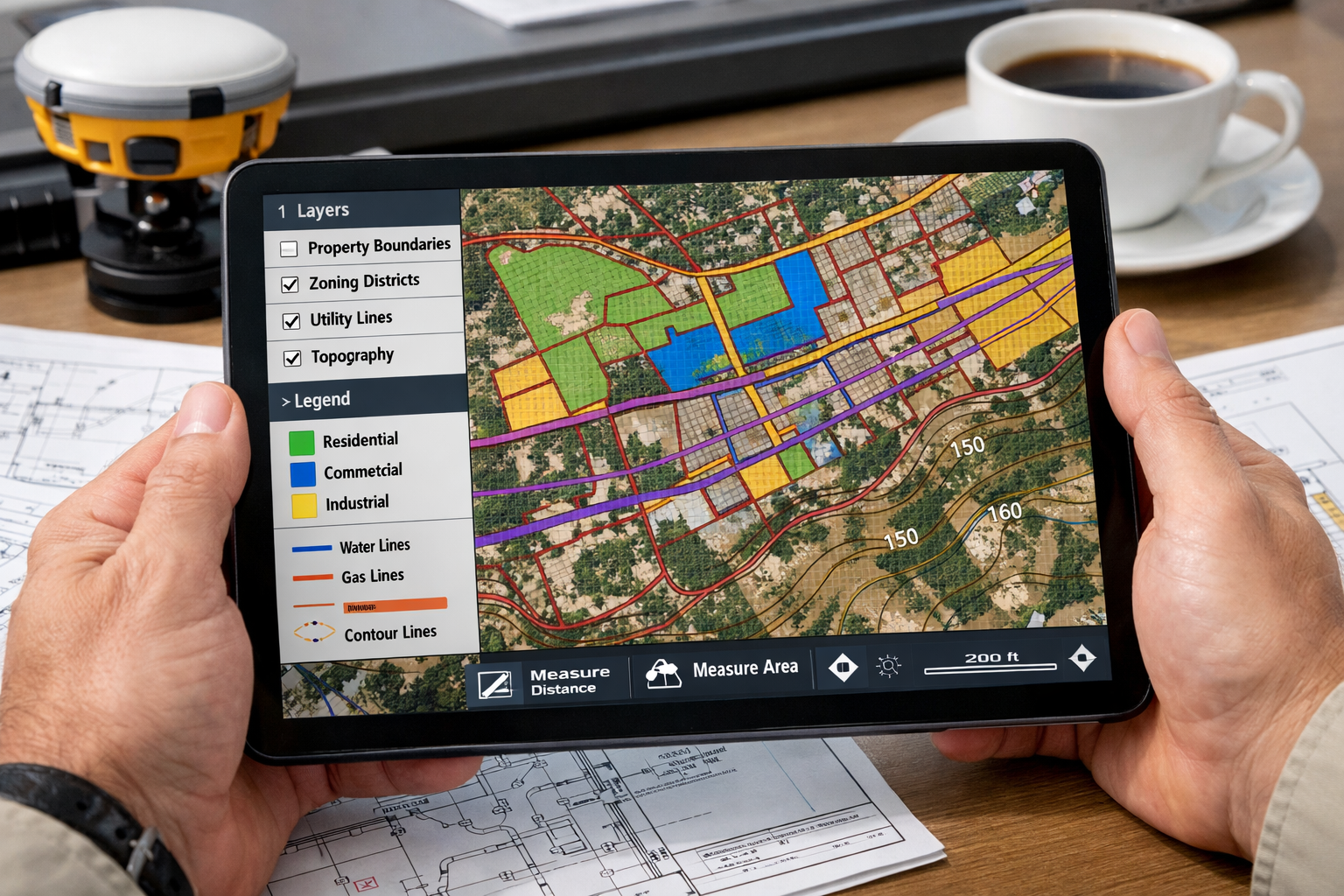
Geographic Information Systems (GIS) have revolutionized how surveyors capture, store, visualize, and analyze spatial data. By overlaying multiple datasets—including zoning information, property boundaries, utility networks, topographic features, and environmental constraints—within unified digital maps, GIS platforms eliminate the inefficiencies of fragmented data management [2]. This integration enables surveyors to identify patterns, detect conflicts, and generate insights that would remain invisible when examining datasets in isolation.
Key Takeaways
✅ Multi-layer data integration has become standard practice, allowing surveyors to overlay zoning, boundaries, utilities, and environmental data in single unified maps that eliminate separate systems [2]
✅ Reality capture technologies (LiDAR, 360° imagery, mobile mapping) are now directly integrated into GIS workflows, creating continuous data streams that support design, compliance, and asset management [1]
✅ Artificial intelligence and machine learning are built into major GIS platforms, automating classification tasks, pattern detection, and predictive modeling at scales impossible with manual analysis [3]
✅ Time-series analysis enables predictive planning by streaming historic geospatial layers into GIS systems, shifting focus from explaining past events to forecasting future conditions [1]
✅ Data governance and audit trails have become compliance requirements, with transparent documentation of data provenance, processing methods, and quality control essential for regulatory approval [1]
Understanding GIS Integration in Modern Property Surveying
What Geographic Information Systems Bring to Property Surveying
Geographic Information Systems represent far more than digital mapping software. At their core, GIS platforms function as sophisticated databases that link spatial features (points, lines, polygons) with descriptive attributes (ownership records, zoning classifications, construction dates, condition assessments). This fundamental architecture enables surveyors to ask questions that traditional paper maps and separate databases cannot answer efficiently.
When conducting commercial property surveying, professionals can query the GIS database to identify all properties within a specific zoning district that exceed a certain square footage, were built before 1980, and lie within 100 meters of a major utility corridor. The system returns results instantly, highlighting relevant parcels on the map while displaying their associated attributes in tabular format.
The power of GIS integration lies in its ability to:
🗺️ Visualize spatial relationships that remain hidden in spreadsheets and text documents
📊 Perform complex spatial analysis including buffer zones, overlay operations, and proximity calculations
🔄 Update centralized data that automatically refreshes across all connected applications and users
📈 Generate analytical reports combining spatial statistics with traditional tabular data
🔍 Identify conflicts and constraints before they become costly field problems
The Evolution from Optional Tool to Essential Infrastructure
The surveying profession has witnessed a dramatic shift in how GIS technology is perceived and deployed. What began as specialized software used by a few technically-oriented firms has transformed into mandatory infrastructure that shapes fundamental business operations [2].
In 2026, GIS adoption is no longer optional for firms seeking to remain competitive. Clients increasingly expect deliverables in GIS-compatible formats, regulatory agencies require submissions through GIS portals, and collaborative project teams demand real-time access to centralized spatial data. Firms that continue operating with disconnected systems face mounting inefficiencies, increased error rates, and diminished market relevance.
This evolution reflects broader trends across the built environment professions. Municipal planning departments, utility companies, transportation agencies, and environmental consultancies have standardized on GIS platforms as their primary data management infrastructure. Property surveyors who integrate seamlessly with these ecosystems deliver greater value and secure more favorable project roles.
Core Components of GIS Integration in Property Surveying: Centralizing Data for Enhanced Analysis and Planning
Multi-Layer Data Architecture: Building the Foundation
The fundamental advantage of GIS Integration in Property Surveying: Centralizing Data for Enhanced Analysis and Planning emerges from its multi-layer architecture. Rather than maintaining separate files for different data types, GIS platforms organize information into thematic layers that can be selectively displayed, analyzed, and combined.
Common data layers in property surveying GIS systems include:
| Layer Category | Typical Contents | Primary Applications |
|---|---|---|
| Property Boundaries | Parcel polygons, lot lines, easements, rights-of-way | Ownership verification, boundary disputes, subdivision planning |
| Zoning & Land Use | Zoning districts, overlay zones, permitted uses, density restrictions | Development feasibility, variance applications, compliance verification |
| Utilities | Water lines, sewer networks, electrical infrastructure, telecommunications | Conflict detection, service capacity analysis, infrastructure planning |
| Topography | Contour lines, elevation models, slope analysis, watershed boundaries | Grading design, drainage planning, flood risk assessment |
| Buildings & Structures | Building footprints, heights, construction dates, condition ratings | Asset management, space planning, maintenance scheduling |
| Environmental Constraints | Wetlands, floodplains, protected habitats, contaminated sites | Regulatory compliance, environmental impact assessment, site selection |
| Transportation | Roads, railways, pedestrian paths, traffic volumes, access points | Access analysis, traffic impact studies, connectivity planning |
| Imagery | Aerial photographs, satellite imagery, 360° street views, LiDAR point clouds | Visual context, change detection, measurement verification |
This layered approach enables surveyors to construct custom map views tailored to specific analytical questions. When evaluating a potential development site, a surveyor might display property boundaries, zoning districts, utility locations, and environmental constraints simultaneously, immediately identifying conflicts and opportunities that would require hours of cross-referencing using traditional methods.
Reality Capture Integration: From Field to GIS
One of the most significant developments in 2026 is the seamless integration of reality capture technologies directly into GIS workflows [1]. LiDAR scanning, 360° imagery, and mobile mapping are no longer treated as separate data collection methods that require extensive post-processing before integration. Instead, these technologies feed data directly into GIS platforms where they become immediately available for analysis, design, and collaboration.
Reality capture technologies now integrated into standard GIS workflows include:
📸 360° Imagery: High-resolution spherical photographs captured at regular intervals provide contextual clarity that aerial imagery and point clouds alone cannot deliver. When reviewing a property condition assessment, stakeholders can virtually "walk" the site, examining asset-level details and understanding spatial relationships with intuitive visual navigation [3].
🎯 LiDAR Point Clouds: Laser scanning produces millions of precisely measured points that capture building facades, terrain features, vegetation, and infrastructure with millimeter accuracy. These point clouds integrate directly into GIS platforms where automated classification algorithms identify objects, extract features, and populate asset databases [1].
🚗 Mobile Mapping Systems: Vehicle-mounted sensors combine GPS positioning, LiDAR scanning, and multi-camera imagery to rapidly capture corridor conditions along roads, railways, and utility networks. The resulting data streams continuously into GIS databases, establishing predictable update cycles for linear asset management [1].
Organizations are establishing repeatable capture schedules that treat reality capture as an ongoing data service rather than project-specific deliverables [1]. Municipal agencies schedule quarterly mobile mapping runs along major corridors. Facility managers commission annual LiDAR scans of critical infrastructure. Property portfolios maintain bi-annual 360° imagery updates for all holdings.
These scheduled captures create time-series datasets within GIS platforms that enable change detection, trend analysis, and predictive modeling. Instead of explaining what happened in the past, surveyors can forecast future conditions based on observed patterns [1].
Artificial Intelligence and Automated Classification
The integration of semantic AI directly into major GIS platforms represents a fundamental shift in how spatial data is processed and analyzed [3]. Machine learning algorithms that once required specialized expertise and custom programming are now embedded features accessible through standard interfaces.
AI-powered capabilities now standard in GIS platforms include:
🤖 Automated Object Classification: Algorithms trained on millions of examples automatically identify and classify features within LiDAR point clouds and imagery—distinguishing buildings from vegetation, identifying road signs, categorizing pavement conditions, and detecting utility infrastructure without manual intervention [3].
🔍 Pattern Detection: Machine learning models process massive datasets to identify spatial patterns, clustering similar features, detecting anomalies, and highlighting areas requiring investigation. These capabilities support everything from identifying properties with similar characteristics to detecting unauthorized land use changes [2].
📊 Predictive Modeling: By analyzing historical patterns and current conditions, AI algorithms generate predictions about future states—forecasting infrastructure deterioration, estimating property value trends, and modeling development impacts with quantified confidence levels [1].
⚠️ Defect Detection: Computer vision algorithms automatically identify potential defects in building facades, pavement surfaces, and infrastructure components, flagging items for human review and prioritizing inspection resources [3].
The practical impact of these AI capabilities extends beyond efficiency gains. Automated classification ensures consistency and repeatability that manual processes cannot match. When analyzing thousands of properties across a portfolio, AI-driven assessment applies identical criteria to every asset, eliminating the subjective variations inherent in human review.
Benefits of GIS Integration in Property Surveying: Centralizing Data for Enhanced Analysis and Planning
Enhanced Decision-Making Through Unified Data Access
The centralization of diverse datasets within integrated GIS platforms fundamentally improves decision quality across all phases of property surveying and development planning. When stakeholders access the same current, comprehensive information, decisions rest on shared understanding rather than competing interpretations of fragmented data.
Consider a typical scenario: A developer evaluating potential acquisition targets traditionally received separate reports from different consultants—a boundary survey from the land surveyor, zoning analysis from the planning consultant, utility capacity assessment from the civil engineer, and environmental constraints from the ecological specialist. Each report arrived in different formats, used different base maps, and required manual cross-referencing to identify conflicts.
With GIS Integration in Property Surveying: Centralizing Data for Enhanced Analysis and Planning, all parties work from a unified platform. The surveyor establishes accurate property boundaries as the foundational layer. The planner overlays current zoning and identifies applicable regulations. The engineer adds utility infrastructure and capacity data. The environmental specialist maps constraints and protected features. All layers reference the same coordinate system and update in real-time as new information becomes available.
This unified approach delivers measurable advantages:
✅ Faster identification of deal-breaking constraints before significant resources are committed
✅ Reduced conflicts and change orders during design and construction phases
✅ Improved stakeholder communication through shared visual references
✅ Better-informed negotiations supported by comprehensive spatial analysis
✅ Enhanced regulatory compliance through systematic constraint verification
Operational Efficiency and Cost Reduction
The efficiency gains from centralized GIS data management extend throughout surveying operations. Tasks that once required hours of manual effort—cross-referencing maps, calculating areas, identifying adjacent properties, verifying zoning compliance—become automated queries executed in seconds.
When conducting RICS building surveys, surveyors equipped with GIS-integrated mobile devices access comprehensive property information in the field. Historical survey data, previous inspection reports, utility locations, and regulatory constraints display on the same screen as current observations. This immediate access eliminates redundant measurements, reduces field time, and improves report accuracy.
Quantifiable efficiency improvements include:
⏱️ Reduced data collection time: Mobile GIS applications guide field crews to precise locations, display previous measurements for comparison, and capture observations directly into centralized databases
📉 Decreased error rates: Automated validation rules flag inconsistencies, coordinate system mismatches, and attribute errors before they propagate through project workflows
🔄 Eliminated duplicate data entry: Information captured once becomes immediately available across all applications, removing redundant transcription between systems
📊 Streamlined reporting: Automated report generation pulls current data from centralized GIS databases, producing standardized deliverables with consistent formatting and up-to-date content
💾 Reduced storage costs: Centralized data management eliminates redundant copies scattered across individual computers, network drives, and email archives
Improved Collaboration and Real-Time Progress Tracking
Modern GIS platforms function as collaboration hubs that enable multiple stakeholders to work simultaneously on shared datasets while maintaining data integrity through sophisticated version control and access permissions [4]. This collaborative capability transforms how surveying projects are executed, particularly for complex developments involving multiple disciplines.
Real-time collaboration features include:
👥 Multi-user editing: Team members simultaneously update different features or attributes within the same dataset, with changes immediately visible to all authorized users
💬 Integrated communication: Comments, markups, and discussion threads attach directly to spatial features, maintaining context and eliminating ambiguous email exchanges
📸 Visual progress documentation: Site photographs and 360° imagery captured throughout project execution link to specific locations and dates, creating visual timelines that document conditions and track progress [4]
🔔 Automated notifications: Stakeholders receive alerts when relevant data changes, new information becomes available, or assigned tasks require attention
🔐 Granular access control: Permissions systems ensure users can view, edit, or manage only the data layers appropriate to their roles
These collaboration capabilities prove particularly valuable when coordinating with chartered surveyors and valuers across different specializations. The building surveyor's condition assessment, the quantity surveyor's cost estimates, and the valuation surveyor's market analysis all reference the same spatial framework, ensuring consistency and facilitating integrated analysis.
Advanced Spatial Analysis Capabilities
Beyond basic data visualization and management, GIS platforms provide sophisticated analytical tools that enable surveyors to answer complex spatial questions and generate insights impossible with traditional methods.
Advanced spatial analysis techniques commonly applied in property surveying include:
🎯 Buffer Analysis: Automatically identifying all properties within specified distances of features such as transit stations, schools, hazardous facilities, or protected areas—essential for market analysis, regulatory compliance, and impact assessment
🔍 Overlay Analysis: Combining multiple data layers to identify locations meeting specific criteria—for example, finding parcels that are zoned for commercial use, exceed minimum size requirements, have adequate utility capacity, and lie outside flood zones
📏 Proximity Analysis: Calculating distances, identifying nearest features, and analyzing accessibility—supporting site selection, service area definition, and competitive positioning studies
📊 Density Analysis: Mapping concentrations of features or activities—useful for identifying development patterns, analyzing market saturation, and targeting acquisition strategies
🗺️ Viewshed Analysis: Determining what areas are visible from specific locations—critical for assessing view corridors, evaluating privacy concerns, and analyzing visual impacts
⛰️ Terrain Analysis: Calculating slopes, aspects, watersheds, and visibility from elevation models—essential for grading design, drainage planning, and environmental assessment
These analytical capabilities transform raw data into actionable intelligence. When evaluating development feasibility, surveyors can systematically identify and quantify constraints, compare alternative scenarios, and communicate findings through compelling visual representations that stakeholders immediately understand.
Implementation Strategies for GIS Integration in Property Surveying

Selecting Appropriate GIS Platforms and Tools
The GIS software market offers solutions ranging from enterprise platforms serving thousands of users across organizations to specialized applications focused on specific surveying tasks. Selecting appropriate tools requires careful consideration of current needs, growth trajectories, and integration requirements.
Major GIS platform categories include:
🏢 Enterprise GIS Systems: Comprehensive platforms (such as Esri ArcGIS, Bentley MicroStation, or Autodesk Civil 3D) that support organization-wide data management, advanced analysis, and extensive customization. These systems typically require significant investment in software licenses, hardware infrastructure, and staff training but provide maximum capability and scalability.
☁️ Cloud-Based GIS Services: Web-based platforms that eliminate local infrastructure requirements while providing access to powerful analytical tools and extensive data libraries. Cloud services offer subscription pricing, automatic updates, and easy collaboration but may raise data security and long-term cost considerations.
📱 Mobile GIS Applications: Field data collection tools optimized for tablets and smartphones that synchronize with centralized databases. Mobile apps enable efficient field workflows but require careful attention to offline capability, data validation, and synchronization protocols.
🎯 Specialized Surveying Software: Purpose-built applications that integrate GIS capabilities with surveying-specific functions such as traverse calculations, least squares adjustments, and construction layout. These tools provide familiar interfaces for surveyors but may offer limited analytical capabilities compared to full GIS platforms.
When conducting commercial property surveying projects, firms often employ hybrid approaches that combine enterprise GIS platforms for data management and analysis with specialized surveying software for field data collection and processing. The key requirement is seamless data exchange between systems through standard formats and automated workflows.
Data Migration and Quality Assurance
Transitioning from legacy data management systems to integrated GIS platforms represents a significant undertaking that requires systematic planning and rigorous quality control. The migration process involves far more than simply importing files into new software—it demands careful attention to coordinate systems, attribute standardization, topology validation, and metadata documentation.
Critical data migration considerations include:
📐 Coordinate System Standardization: Ensuring all datasets reference consistent coordinate systems and datum definitions. Mismatched projections create positional errors that undermine analytical accuracy and generate user confusion.
🔤 Attribute Normalization: Standardizing field names, data types, and coded values across datasets. Inconsistent attribute structures prevent automated analysis and complicate database queries.
✅ Topology Validation: Verifying that spatial features maintain proper geometric relationships—boundaries close properly, adjacent parcels share common edges, and overlapping features are intentional rather than errors.
📋 Metadata Creation: Documenting data sources, collection methods, accuracy specifications, and update frequencies. Comprehensive metadata enables users to assess data fitness for specific applications and satisfies regulatory documentation requirements [1].
🎯 Quality Control Workflows: Implementing systematic validation procedures that identify and correct errors before they propagate through analytical workflows. Automated validation rules flag common problems while manual review addresses complex issues requiring professional judgment.
Organizations should treat data migration as an opportunity to improve data quality rather than simply transferring existing problems into new systems. Investing effort in proper migration establishes a solid foundation that delivers long-term value through improved accuracy, reduced maintenance, and enhanced analytical capability.
Staff Training and Change Management
Technology implementation succeeds or fails based on user adoption. The most sophisticated GIS platform delivers no value if staff lack the skills or motivation to use it effectively. Successful GIS Integration in Property Surveying: Centralizing Data for Enhanced Analysis and Planning requires systematic attention to training, change management, and ongoing support.
Effective training strategies include:
👨🏫 Role-Based Curriculum: Tailoring training content to specific job functions rather than attempting to teach everyone everything. Field surveyors need different skills than office analysts, and executives require different capabilities than technical staff.
🎓 Progressive Skill Development: Building competency through structured progression from basic operations to advanced analysis. Initial training establishes fundamental concepts and essential workflows, while follow-up sessions introduce sophisticated techniques as users gain confidence.
💼 Project-Based Learning: Organizing training around real projects rather than abstract exercises. Users develop skills while accomplishing actual work, creating immediate value and demonstrating practical relevance.
🤝 Peer Mentoring: Pairing experienced users with those developing skills. Mentoring relationships provide ongoing support, encourage knowledge sharing, and build organizational capability beyond formal training sessions.
📚 Documentation and Resources: Maintaining accessible reference materials including workflow guides, video tutorials, and troubleshooting resources. Well-organized documentation enables self-service learning and reduces dependence on expert support.
Change management extends beyond technical training to address organizational culture and workflow redesign. Staff accustomed to established procedures may resist new approaches regardless of their technical merits. Successful implementations engage users early in planning processes, demonstrate clear benefits, celebrate early wins, and provide patient support through inevitable adjustment periods.
Emerging Trends Shaping GIS Integration in Property Surveying
High-Resolution National Basemaps and Automated Extraction
The availability of national basemaps at 5cm and 12.5cm resolution fundamentally changes what can be accomplished through automated feature extraction [1]. These high-resolution datasets provide sufficient detail for machine learning algorithms to identify individual buildings, vehicles, vegetation, and infrastructure components with remarkable accuracy.
Surveyors increasingly leverage these national datasets as foundational layers that reduce field data collection requirements. Rather than measuring every building footprint manually, automated extraction from high-resolution imagery provides initial geometry that field crews verify and refine. This hybrid approach dramatically reduces survey costs while maintaining required accuracy standards.
Applications of automated extraction include:
🏘️ Building Footprint Mapping: Automatically delineating building outlines, calculating floor areas, and identifying structural additions or modifications
🌳 Vegetation Management: Classifying tree species, measuring canopy coverage, and identifying vegetation encroaching on infrastructure
🚗 Asset Inventory: Cataloging street furniture, signage, parking spaces, and other features visible in high-resolution imagery
📏 Change Detection: Comparing imagery from different dates to identify new construction, demolitions, and land use changes
The combination of high-resolution basemaps with AI-powered extraction creates scalable workflows that enable property-level analysis across entire municipalities or regions—tasks that would be economically impossible using traditional manual methods.
Time-Series Analysis and Predictive Modeling
Organizations are systematically streaming historic geospatial layers into GIS systems because time-series data enables prediction of future conditions rather than merely explaining past events [1]. This shift from retrospective analysis to predictive modeling represents a fundamental evolution in how GIS supports planning and decision-making.
Time-series applications in property surveying include:
📈 Development Pattern Forecasting: Analyzing historical development trends to predict where growth will occur, informing infrastructure planning and land acquisition strategies
🏗️ Infrastructure Deterioration Modeling: Tracking asset condition over time to predict maintenance requirements, optimize replacement schedules, and budget capital improvements
💰 Property Value Trend Analysis: Examining historical valuation data in spatial context to identify emerging markets, predict appreciation patterns, and assess investment opportunities
🌊 Environmental Change Monitoring: Documenting shoreline erosion, vegetation changes, and land use transitions to support environmental management and regulatory compliance
The power of time-series analysis increases exponentially as datasets accumulate. A single year of data provides a snapshot. Five years reveal trends. Ten years enable robust statistical modeling that quantifies confidence intervals and identifies anomalies.
Firms establishing systematic data collection schedules today are building invaluable historical archives that will support increasingly sophisticated analysis in future years. This long-term perspective requires commitment to consistent methodologies, standardized formats, and comprehensive metadata documentation.
Integration with Building Information Modeling (BIM)
The convergence of GIS and Building Information Modeling (BIM) creates powerful capabilities for managing assets throughout their lifecycles [4]. While GIS excels at managing spatial relationships across broad geographic areas, BIM provides detailed three-dimensional models of individual buildings and infrastructure components. Integrating these complementary technologies enables seamless transitions between regional planning and facility-level design.
GIS-BIM integration supports:
🏙️ Urban Planning: Visualizing proposed developments in accurate geographic context, analyzing shadows and view impacts, and assessing infrastructure capacity
🏢 Facility Management: Linking detailed building models with property-level GIS data for comprehensive asset management spanning site conditions, building systems, and equipment inventories
🚧 Construction Management: Coordinating site logistics, tracking material deliveries, and monitoring progress against schedules using integrated spatial and temporal data
🔧 Maintenance Optimization: Combining GIS-based work order management with BIM-detailed component information for efficient maintenance planning and execution
Professional surveyors conducting RICS commercial building surveys increasingly deliver integrated GIS-BIM deliverables that serve both strategic portfolio management and tactical facility operations. This integration requires careful attention to data exchange standards, level of detail specifications, and coordination workflows.
Mobile-First Data Collection and Real-Time Synchronization
The evolution of mobile GIS applications has transformed field data collection from a disconnected activity requiring post-processing to real-time operations that immediately update centralized databases [4]. Modern mobile platforms provide full GIS functionality on rugged tablets and smartphones, enabling field crews to access comprehensive information, capture observations, and validate data quality while still on site.
Mobile GIS capabilities essential for modern surveying include:
📶 Offline Operation: Functioning fully when cellular connectivity is unavailable, with automatic synchronization when connections restore
📸 Integrated Media Capture: Linking photographs, videos, and audio recordings directly to spatial features with automatic geotagging and timestamp documentation
✏️ Sketch and Markup Tools: Creating field drawings, annotating maps, and documenting observations using intuitive touch interfaces
📋 Customizable Forms: Collecting structured attribute data through configurable forms with validation rules, conditional logic, and lookup lists
🎯 High-Accuracy Positioning: Connecting external GNSS receivers for centimeter-level positioning when required for boundary surveys or control establishment
Real-time synchronization enables immediate quality control that identifies problems while field crews remain on site and can efficiently collect additional information. This capability dramatically reduces costly return visits and improves deliverable quality by catching errors early in workflows.
Data Governance and Compliance Considerations
Establishing Data Quality Standards and Audit Trails
As GIS becomes essential infrastructure for regulatory compliance and legal documentation, data governance frameworks have evolved from optional best practices to mandatory requirements [1]. Planning authorities, insurance providers, and legal proceedings demand transparent documentation of data provenance, processing methods, and quality control procedures.
Comprehensive data governance addresses:
📊 Accuracy Specifications: Defining and documenting positional accuracy, attribute completeness, temporal currency, and logical consistency standards for each dataset
🔍 Quality Control Procedures: Implementing systematic validation workflows, documenting inspection results, and maintaining records of corrections and updates
📝 Metadata Standards: Creating comprehensive documentation describing data sources, collection methods, coordinate systems, and limitations
🔐 Access Controls: Establishing role-based permissions that ensure users can view, edit, or manage only appropriate data while maintaining audit trails of all modifications
⏰ Version Management: Preserving historical versions of datasets to support change analysis, regulatory compliance, and dispute resolution
Organizations conducting property certification work must maintain rigorous documentation that withstands regulatory scrutiny and legal challenges. GIS platforms that automatically capture edit histories, user identities, and timestamp information provide essential audit trails that manual systems cannot match.
Privacy and Data Security
Centralized GIS databases containing comprehensive property information create significant privacy and security responsibilities. Property ownership records, building valuations, infrastructure vulnerabilities, and personal information require protection from unauthorized access, accidental disclosure, and malicious exploitation.
Essential security measures include:
🔒 Encryption: Protecting data both in storage and during transmission using industry-standard encryption protocols
👤 Authentication: Implementing strong user authentication including multi-factor verification for sensitive systems
🛡️ Access Logging: Recording all data access and modification activities to detect unauthorized use and support forensic investigation
🔄 Backup Procedures: Maintaining secure, geographically distributed backups that enable recovery from equipment failures, natural disasters, or cyber attacks
📋 Compliance Frameworks: Adhering to relevant regulations including GDPR, data protection acts, and industry-specific requirements
Organizations must balance data accessibility that enables collaboration and analysis against security requirements that protect sensitive information. Well-designed systems provide granular controls that allow appropriate access while maintaining comprehensive security.
Practical Applications Across Surveying Specializations

Boundary and Cadastral Surveying
GIS integration transforms traditional boundary surveying by providing instant access to historical survey records, deed descriptions, and adjoining property information. When establishing property boundaries, surveyors query centralized GIS databases to retrieve previous surveys, identify potential conflicts, and verify consistency with official cadastral records.
GIS capabilities supporting boundary surveying include:
🗺️ Parcel Fabric Management: Maintaining topologically integrated cadastral datasets where parcels share common boundaries, ensuring geometric consistency and facilitating boundary adjustments
📜 Deed Research: Linking scanned historical documents directly to property parcels, enabling rapid access to chains of title and legal descriptions
⚠️ Conflict Identification: Automatically detecting overlapping claims, gaps between parcels, and inconsistencies between survey measurements and recorded dimensions
📐 Coordinate Geometry (COGO) Integration: Combining traditional surveying calculations with GIS visualization and database management
The ability to visualize boundary relationships spatially, overlay multiple historical surveys, and identify patterns across neighborhoods provides insights that sequential examination of individual deed descriptions cannot reveal. This comprehensive perspective supports more accurate boundary determinations and reduces disputes.
Valuation and Investment Analysis
Property valuers increasingly rely on GIS-based comparative analysis that systematically identifies comparable properties, analyzes market trends, and visualizes value patterns across geographic areas. Spatial analysis reveals relationships between property values and location factors including proximity to amenities, accessibility, neighborhood characteristics, and environmental features.
When conducting RICS valuations, professionals use GIS to:
💷 Identify Comparable Properties: Automatically selecting properties with similar characteristics within defined geographic areas, adjusting for differences in size, condition, and features
📊 Analyze Market Trends: Mapping sales prices, rental rates, and vacancy patterns to identify emerging markets and forecast value trajectories
🎯 Assess Location Value: Quantifying accessibility to transit, schools, employment centers, and amenities that influence property values
🌍 Evaluate Environmental Factors: Analyzing impacts of flood risk, contamination, noise, and other environmental conditions on property values
The integration of valuation data with comprehensive property characteristics and location factors enables more defensible valuations supported by systematic analysis rather than subjective judgment alone.
Infrastructure and Utility Surveying
Managing complex utility networks requires sophisticated data management that tracks thousands of components across extensive geographic areas. GIS platforms provide the essential infrastructure for utility asset management, enabling operators to document network topology, track maintenance histories, plan capital improvements, and respond efficiently to emergencies.
GIS applications in utility surveying include:
🔧 Asset Inventory: Cataloging pipes, cables, valves, transformers, and other components with attributes including age, material, capacity, and condition
🗺️ Network Topology: Maintaining connectivity relationships that enable tracing flows, identifying service areas, and analyzing system capacity
📅 Maintenance Management: Linking inspection records, repair histories, and condition assessments to specific assets for lifecycle planning
⚡ Outage Management: Rapidly identifying affected customers, dispatching repair crews, and coordinating restoration activities during service disruptions
Organizations conducting structural engineering assessments of utility infrastructure leverage GIS integration to visualize structural data in geographic context, prioritize inspection resources, and coordinate improvements across networks.
Overcoming Implementation Challenges
Addressing Legacy Data and System Integration
Most surveying firms possess valuable data accumulated over decades—historical surveys, project files, client records, and institutional knowledge embedded in various formats and storage systems. Successfully integrating this legacy information into modern GIS platforms requires systematic approaches that balance effort against value.
Strategies for legacy data integration include:
🎯 Prioritized Migration: Focusing initial efforts on high-value datasets that support current projects and strategic initiatives rather than attempting comprehensive migration of all historical data
🔄 Incremental Conversion: Converting legacy data progressively as projects require access, spreading effort over time and ensuring conversion quality through project-based validation
🔗 Reference Integration: Maintaining legacy systems in read-only mode while linking to GIS platforms through reference layers or hyperlinks that provide access without full conversion
📋 Metadata Documentation: Creating comprehensive records describing legacy data characteristics, limitations, and appropriate uses even when full conversion is not economically justified
Organizations should recognize that not all legacy data warrants conversion. Systematic evaluation of data value, conversion costs, and ongoing maintenance requirements enables informed decisions about which datasets justify integration investment.
Managing Costs and Demonstrating Return on Investment
GIS implementation requires significant investment in software licenses, hardware infrastructure, data development, and staff training. Securing necessary resources demands clear demonstration of return on investment through quantified benefits and realistic cost projections.
Approaches for demonstrating GIS value include:
💰 Efficiency Metrics: Documenting time savings from automated workflows, reduced field visits, and streamlined reporting processes
📈 Revenue Enhancement: Quantifying new service offerings, improved project win rates, and premium pricing for GIS-enabled deliverables
⚠️ Risk Reduction: Calculating avoided costs from reduced errors, fewer change orders, and improved regulatory compliance
🤝 Client Satisfaction: Measuring improved project delivery, enhanced collaboration, and strengthened client relationships
Organizations should establish baseline metrics before implementation and systematically track performance improvements to demonstrate actual rather than theoretical benefits. This data-driven approach supports ongoing investment and guides continuous improvement efforts.
Building Organizational Culture and Expertise
Technology implementation ultimately succeeds or fails based on people rather than software capabilities. Building organizational GIS expertise requires long-term commitment to professional development, knowledge sharing, and cultural change that values data-driven decision-making.
Strategies for building GIS culture include:
🏆 Executive Sponsorship: Securing visible leadership support that demonstrates organizational commitment and removes implementation barriers
👥 Champion Development: Identifying and empowering enthusiastic early adopters who demonstrate value, mentor colleagues, and drive adoption
🎓 Continuous Learning: Providing ongoing training opportunities including formal courses, conference attendance, and professional certification support
💡 Innovation Encouragement: Creating safe environments for experimentation where staff can explore new capabilities without fear of failure
📢 Success Communication: Systematically sharing wins, celebrating achievements, and demonstrating value to build momentum and sustain commitment
Organizations should recognize that cultural transformation requires patience and persistence. Meaningful change occurs over years rather than months, requiring sustained leadership attention and resource commitment.
Conclusion
GIS Integration in Property Surveying: Centralizing Data for Enhanced Analysis and Planning has evolved from optional enhancement to essential infrastructure that fundamentally shapes how modern surveying practices operate in 2026. The ability to overlay multiple datasets—including property boundaries, zoning regulations, utility networks, environmental constraints, and reality capture—within unified digital platforms eliminates the inefficiencies of fragmented data management while enabling analytical capabilities impossible with traditional methods [2].
The integration of reality capture technologies directly into GIS workflows, the embedding of artificial intelligence for automated classification and predictive modeling, and the establishment of time-series datasets for trend analysis represent transformative capabilities that are becoming standard practice rather than competitive advantages [1][3]. Organizations that systematically implement these technologies, invest in staff development, and establish robust data governance frameworks position themselves for sustained success in an increasingly data-driven marketplace.
Actionable Next Steps
For surveying firms seeking to advance their GIS integration capabilities, consider these concrete actions:
✅ Assess Current State: Conduct systematic evaluation of existing data assets, technology infrastructure, staff capabilities, and client requirements to establish baseline and identify priority improvement areas
✅ Develop Strategic Plan: Create multi-year roadmap addressing technology selection, data migration priorities, training requirements, and resource commitments with realistic timelines and measurable objectives
✅ Start Focused Pilot: Implement GIS integration on specific project type or client segment rather than attempting organization-wide transformation simultaneously, using pilot results to refine approaches before broader deployment
✅ Invest in Training: Commit resources to comprehensive staff development including formal training, professional certification, conference attendance, and ongoing learning opportunities
✅ Establish Data Governance: Implement systematic procedures for data quality control, metadata documentation, version management, and security that ensure long-term value and regulatory compliance
✅ Build Partnerships: Engage with technology vendors, industry associations, and peer organizations to access expertise, share knowledge, and stay current with evolving capabilities
✅ Measure and Communicate Value: Track quantified benefits including efficiency improvements, revenue enhancement, and risk reduction to demonstrate return on investment and sustain organizational commitment
The surveying profession stands at a pivotal moment where GIS Integration in Property Surveying: Centralizing Data for Enhanced Analysis and Planning determines competitive positioning and long-term viability. Firms that embrace this transformation systematically—investing in technology, developing capabilities, and transforming culture—will thrive in an environment where clients increasingly demand integrated spatial intelligence rather than traditional deliverables. Those that delay face mounting competitive disadvantages as the gap between leaders and laggards continues widening.
The question is no longer whether to integrate GIS capabilities, but how rapidly and effectively organizations can execute transformation that positions them for success in a data-driven future. The tools, technologies, and proven implementation approaches exist today. Success requires commitment, investment, and persistent execution guided by clear strategic vision and supported by comprehensive organizational development.
For professional guidance on implementing GIS-integrated surveying services tailored to your specific requirements, get a quote from experienced chartered surveyors who combine traditional expertise with advanced spatial technology capabilities.
References
[1] Geospatial Trends 2026 – https://www.getmapping.co.uk/geospatial-trends-2026/
[2] The Future Of Land Surveying Technology And Upcoming Trends In 2026 – https://metricop.com/blogs/land-surveying/the-future-of-land-surveying-technology-and-upcoming-trends-in-2026
[3] 6 Geospatial Trends To Watch In 2026 Insights From Intergeo 2025 – https://www.mosaic51.com/community/6-geospatial-trends-to-watch-in-2026-insights-from-intergeo-2025/
[4] Doubling Down On Digital – https://amerisurv.com/2026/02/01/doubling-down-on-digital/