
The surveying industry stands at a pivotal crossroads in 2026. For decades, professionals have relied on static PDF reports—documents that, once generated, become frozen snapshots of property conditions, measurements, and findings. These files are emailed, downloaded, printed, and stored, but they lack the dynamic capabilities that modern project teams demand. Cloud-Based Surveying Platforms: Moving Beyond Static PDFs to Collaborative Digital Workflows represents more than just a technological upgrade; it signals a fundamental transformation in how surveying professionals deliver value, engage with clients, and coordinate with project stakeholders.
Today's clients expect instant access to survey data, real-time updates, and seamless collaboration across multiple parties. Traditional PDF-based workflows simply cannot meet these expectations. When a structural engineer needs to reference specific measurements while on-site, when a project manager requires immediate clarification on a survey finding, or when multiple stakeholders need to review and comment on survey results simultaneously, static documents create bottlenecks and communication barriers.
Modern cloud platforms enable real-time file sharing, browser-based 3D visualization, and integrated team communication—fundamentally changing client expectations and project delivery methods. These platforms transform surveys from static deliverables into living, interactive documents that evolve throughout a project's lifecycle.
Key Takeaways
✅ Cloud-based surveying platforms eliminate version control chaos by providing single-source-of-truth documentation accessible to all authorized stakeholders simultaneously
✅ Real-time collaboration features including synchronized annotations, instant messaging, and multi-user editing reduce project delays and miscommunication by up to 40%
✅ Browser-based 3D visualization tools allow clients and team members to interact with survey data without specialized software, democratizing access to critical project information
✅ Integrated workflows connecting field data collection, automated report generation, and client portals streamline the entire surveying process from initial inspection to final delivery
✅ Enhanced security and compliance through cloud infrastructure provides better data protection than traditional email and file-sharing methods while maintaining complete audit trails
Understanding the Limitations of Traditional PDF-Based Surveying Workflows
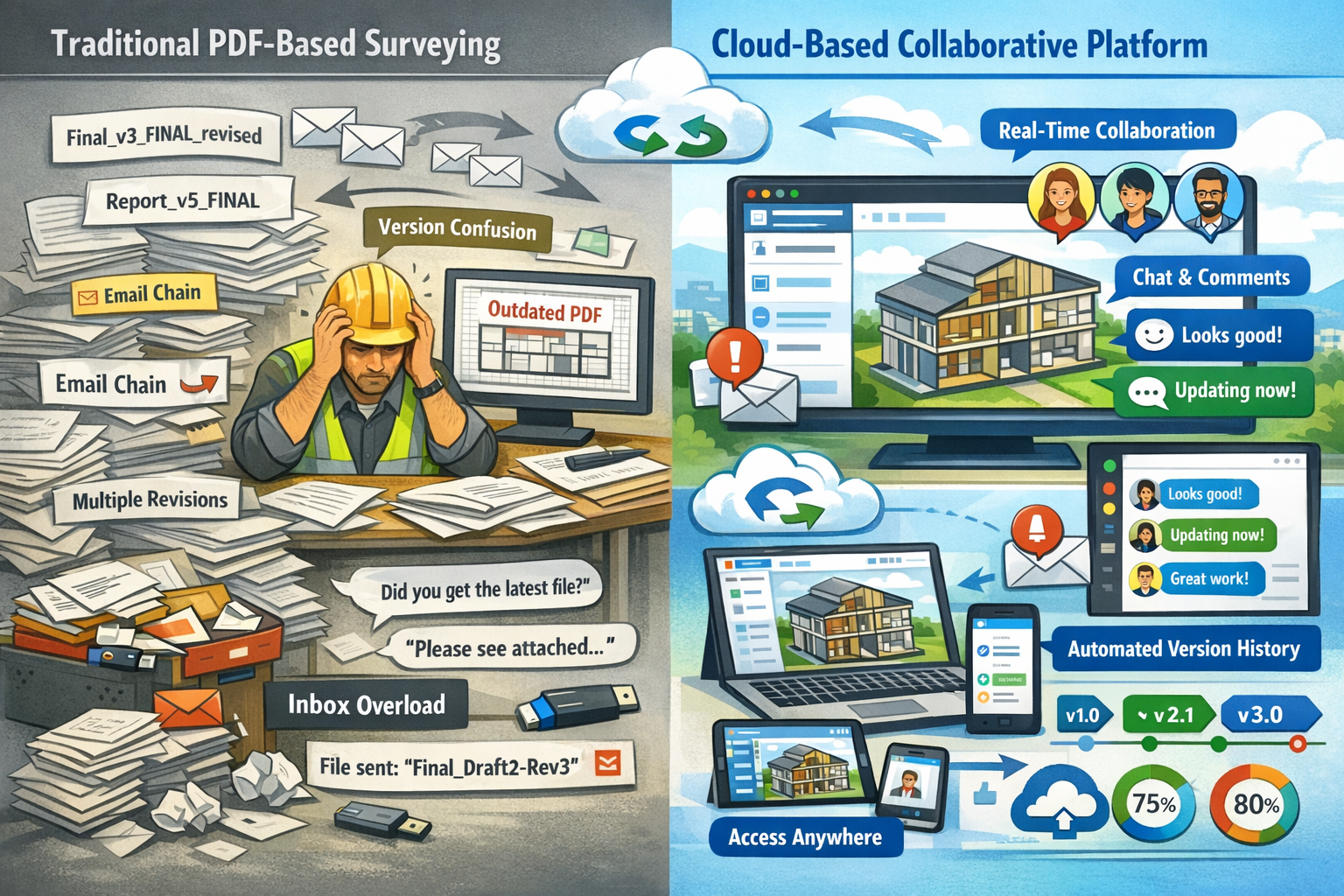
The PDF format revolutionized document sharing when it emerged in the 1990s, providing a universal standard for viewing and distributing formatted documents across different systems. For surveying professionals, PDFs offered a reliable way to package inspection findings, photographs, diagrams, and recommendations into a single deliverable. However, what once represented innovation has become a constraint in 2026's fast-paced, collaborative project environments.
The Version Control Nightmare
Anyone who has worked with traditional PDF-based survey reports knows the frustration of managing multiple versions. A typical scenario unfolds like this: the surveyor completes an initial RICS home survey and emails a PDF report to the client. The client forwards it to their contractor, who has questions about specific measurements. Meanwhile, the surveyor discovers an error requiring correction and issues a revised version. The contractor, working from the original version, makes decisions based on outdated information. The client's solicitor receives yet another version with additional comments.
Within days, multiple versions circulate among stakeholders, each labeled with increasingly desperate naming conventions: "Survey_Final.pdf," "Survey_Final_v2.pdf," "Survey_FINAL_REVISED.pdf," and the inevitable "Survey_USE_THIS_ONE.pdf." This version proliferation creates serious risks:
- Miscommunication and errors when team members reference different document versions
- Wasted time tracking down the "correct" version
- Legal liability when decisions are made based on superseded information
- Client frustration navigating conflicting information across multiple files
Limited Interactivity and Engagement
Static PDFs present information in a linear, passive format. Readers scroll through pages of text, photographs, and diagrams, but cannot interact meaningfully with the content. For complex surveys—particularly commercial building surveys involving multiple floors, systems, and defects—this limitation becomes problematic.
Consider a 150-page building survey report. A facilities manager needs to locate all references to HVAC system defects across the document. In a PDF, this requires manual searching, cross-referencing page numbers, and potentially missing critical information buried in different sections. The same user cannot easily filter findings by severity, location, or trade category without reading the entire document.
Furthermore, PDFs cannot accommodate the 3D visualization that modern surveying technology enables. Laser scanning and photogrammetry produce rich spatial data that, when flattened into 2D PDF pages, loses much of its value. Stakeholders cannot rotate models, measure distances interactively, or explore spatial relationships—capabilities that significantly enhance understanding and decision-making.
Communication Silos and Delayed Responses
Traditional PDF workflows create communication barriers that slow project progress. When a client has questions about survey findings, they must:
- Email the surveyor with their questions
- Wait for the surveyor to review the email and respond
- Potentially exchange multiple emails to clarify misunderstandings
- Schedule phone calls or meetings for complex discussions
- Receive updated information via new PDF attachments
This asynchronous, disconnected communication pattern introduces delays at every step. In contrast to modern schedule of condition reporting workflows that enable instant clarification, PDF-based processes can extend simple queries into multi-day exchanges.
The problem intensifies when multiple stakeholders need to collaborate. A typical property transaction might involve the buyer, seller, estate agent, solicitors, mortgage lender, contractor, and surveyor. Coordinating feedback and questions across this group via email and PDF attachments becomes exponentially complex, with information scattered across multiple inboxes and attachment folders.
Security and Compliance Concerns
While PDFs can be password-protected, they lack the sophisticated security controls that cloud platforms provide. Once a PDF is downloaded, the surveyor loses control over how it's shared, stored, or modified. Sensitive survey information might be:
- Forwarded to unauthorized recipients
- Stored on unsecured personal devices
- Uploaded to unencrypted file-sharing services
- Printed and left in unsecured locations
- Modified without detection or audit trails
For surveys involving sensitive information—such as matrimonial valuations or confidential commercial assessments—these security limitations create genuine risks. Organizations increasingly face regulatory requirements for data protection, and traditional PDF workflows struggle to demonstrate compliance with audit trails, access controls, and data retention policies.
How Cloud-Based Surveying Platforms Transform Collaborative Workflows
The migration to cloud-based platforms represents a paradigm shift in how surveying professionals work. According to recent industry research, organizations are increasingly abandoning legacy systems for cloud solutions, with security and collaboration capabilities driving adoption [3]. This transition fundamentally changes the surveying workflow from document-centric to data-centric, from asynchronous to real-time, and from isolated to collaborative.
Real-Time File Sharing and Access Control
Cloud platforms eliminate the email attachment paradigm entirely. Instead of sending survey reports as files, surveyors share access to living documents hosted in secure cloud environments. This seemingly simple change delivers profound benefits:
Single Source of Truth: All stakeholders access the same document simultaneously. When the surveyor updates information, everyone sees the changes instantly. Version confusion becomes impossible because only one version exists.
Granular Permissions: Surveyors control precisely who can view, comment on, or edit different sections of survey data. A contractor might receive access to defect descriptions and photographs but not valuation information. A client's solicitor might view the entire report but lack download permissions. These controls, impossible with PDF attachments, protect sensitive information while facilitating appropriate collaboration.
Access Revocation: When a stakeholder's involvement ends, their access can be immediately revoked. Unlike PDFs that remain on recipients' devices indefinitely, cloud-based access ensures information doesn't persist beyond its appropriate timeframe.
Device Flexibility: Stakeholders access survey information from any device with a web browser—desktop computers, tablets, or smartphones. This flexibility proves particularly valuable for structural surveys where contractors need on-site access to findings while working.
Browser-Based 3D Visualization Capabilities
Modern surveying increasingly incorporates advanced data capture technologies including laser scanning, drone photogrammetry, and thermal imaging. These technologies produce rich 3D datasets that traditional PDFs cannot adequately represent. Cloud platforms unlock the full value of this data through browser-based visualization tools that require no specialized software installation.
Interactive 3D Models: Stakeholders can rotate, zoom, and navigate through 3D representations of surveyed properties directly in their web browsers. This interactivity transforms understanding, particularly for complex buildings or sites. A facilities manager reviewing a commercial building survey can virtually "walk through" the building, examining roof conditions, structural elements, and building services in spatial context.
Layered Information: Cloud platforms enable surveyors to overlay different data types onto 3D models. Users can toggle between visual photography, thermal imaging, moisture mapping, and structural annotations, seeing how different conditions relate spatially. This layered approach provides insights impossible in static 2D documents.
Measurement Tools: Interactive measurement capabilities allow stakeholders to verify dimensions, calculate areas, and understand spatial relationships without requesting additional information from the surveyor. This self-service capability reduces back-and-forth communication while empowering clients to explore their survey data independently.
Annotation and Markup: Multiple users can add annotations, comments, and markup directly onto 3D models or 2D drawings. These annotations remain anchored to specific locations, creating a rich, contextualized discussion thread around particular features or defects. When a contractor questions a structural finding, they can place a comment directly on the relevant element, ensuring perfect clarity about the subject of discussion.
Integrated Team Communication and Collaboration
Perhaps the most transformative aspect of cloud-based surveying platforms is their integration of communication tools directly into the survey workflow. Rather than separating survey data (in PDFs) from discussion about that data (in emails), cloud platforms unite these functions in a single environment.
Contextual Commenting: Team members add comments directly to specific survey findings, photographs, or data points. These comments remain permanently associated with the relevant content, creating a complete discussion history accessible to all authorized participants. When reviewing a homebuyer survey, a client can ask about a particular defect by commenting directly on its description, and the surveyor receives an immediate notification with full context.
Real-Time Notifications: Cloud platforms notify relevant stakeholders instantly when new information is added, questions are posed, or updates are made. This immediacy eliminates the delays inherent in email-based communication, accelerating project timelines significantly.
Task Assignment and Tracking: Surveyors can assign specific tasks or follow-up actions to team members directly within the platform. A defect requiring immediate attention can be flagged and assigned to the appropriate contractor, with automatic reminders and progress tracking. This workflow integration ensures nothing falls through the cracks.
Video and Screen Sharing Integration: Advanced platforms incorporate video conferencing and screen sharing capabilities, enabling real-time collaborative review sessions. A surveyor can walk a client through findings via video call while both parties view and annotate the same survey data simultaneously. This capability proves particularly valuable for complex surveys or when stakeholders are geographically dispersed.
Audit Trails and Documentation: Every interaction—comments, edits, access events, and downloads—is automatically logged with timestamps and user attribution. This comprehensive audit trail provides accountability and documentation that email-based workflows cannot match, proving particularly valuable for expert witness scenarios or dispute resolution.
Automated Workflows and Integration Capabilities
Cloud platforms don't just digitize existing processes; they enable entirely new workflows that improve efficiency and reduce errors. Modern surveying platforms integrate with other business systems and automate repetitive tasks:
Field-to-Report Automation: Data captured during site inspections via mobile apps automatically populates report templates, eliminating manual transcription and associated errors. Photographs taken on-site are automatically organized, tagged, and inserted into appropriate report sections. Measurements from laser distance meters sync directly into survey documents.
Template Standardization: Organizations can create standardized templates ensuring consistency across all surveyors and projects. This standardization improves quality, reduces training time, and ensures compliance with professional standards like those required for RICS valuations.
Client Portal Integration: Automated notifications inform clients when surveys are complete, with direct links to access findings through branded client portals. This professional presentation enhances client experience while reducing administrative burden.
Integration with Project Management Tools: Cloud surveying platforms can integrate with broader project management systems, ensuring survey findings automatically flow into project timelines, task lists, and coordination platforms used by construction teams.
Analytics and Reporting: Aggregated data across multiple surveys enables organizational insights impossible with isolated PDF reports. Firms can analyze common defect patterns, track surveyor productivity, monitor project timelines, and identify training needs through comprehensive analytics dashboards.
Implementing Cloud-Based Surveying Platforms: Practical Considerations for 2026

While the benefits of cloud-based surveying platforms are compelling, successful implementation requires careful planning and consideration of several practical factors. Organizations transitioning from traditional PDF workflows in 2026 face both opportunities and challenges that demand strategic approaches.
Selecting the Right Platform for Your Practice
The surveying technology market has matured significantly, with numerous platforms offering varying capabilities, pricing models, and specializations. Selecting the appropriate platform requires evaluating several critical factors:
Feature Alignment: Different surveying specializations have distinct requirements. A practice focused on residential building surveys needs different capabilities than one specializing in dilapidations or party wall matters. Essential features to evaluate include:
- 3D visualization capabilities and compatibility with your data capture equipment
- Template flexibility for different survey types and reporting standards
- Mobile app functionality for field data collection
- Integration options with existing business systems (accounting, CRM, project management)
- Customization possibilities for branding and workflow adaptation
- Reporting outputs including traditional formats for clients who still require PDFs
Scalability and Performance: Cloud platforms must handle your current workload while accommodating growth. Consider:
- Storage capacity for photographs, 3D scans, and historical archives
- User licensing models and costs as your team expands
- Performance when handling large files or complex 3D models
- Concurrent user limits and collaboration capabilities
Security and Compliance: Given the sensitive nature of survey information, security cannot be compromised. Evaluate platforms based on:
- Data encryption both in transit and at rest
- Access controls and authentication methods (including multi-factor authentication)
- Compliance certifications relevant to your jurisdiction (GDPR, data protection regulations)
- Data residency and server locations
- Backup and disaster recovery capabilities
- Audit logging and compliance reporting features
Vendor Stability and Support: Cloud platforms represent long-term commitments. Assess vendors based on:
- Company track record and financial stability
- Customer support quality, availability, and response times
- Training resources and onboarding assistance
- Update frequency and feature development roadmap
- User community and peer support networks
Managing the Transition from PDF Workflows
Migrating from established PDF-based processes to cloud platforms requires change management that addresses both technical and human factors. Research indicates that while cloud migration momentum is growing, organizations face readiness gaps that must be addressed [1][2].
Phased Implementation: Rather than attempting wholesale transformation overnight, successful practices typically adopt phased approaches:
- Pilot Phase: Select a small team or specific survey type for initial implementation, allowing refinement of processes before broader rollout
- Parallel Running: Maintain PDF workflows alongside cloud processes initially, building confidence and identifying issues before full transition
- Gradual Expansion: Progressively extend cloud platform use to additional survey types, team members, and clients based on lessons learned
Team Training and Adoption: Technology succeeds only when people use it effectively. Comprehensive training programs should address:
- Technical skills for platform navigation, data entry, and feature utilization
- Workflow changes and new processes enabled by cloud capabilities
- Client communication about the new approach and its benefits
- Troubleshooting common issues and support resources
- Best practices for maximizing platform value
Client Communication and Expectations: Clients accustomed to receiving PDF reports via email need preparation for new delivery methods:
- Advance notification explaining the transition and its benefits
- Clear instructions for accessing cloud-based reports
- Continued PDF options for clients with specific requirements or constraints
- Highlighting advantages like real-time updates and interactive features
- Support availability for clients experiencing access difficulties
Data Migration and Historical Archives
Organizations typically possess extensive archives of historical surveys in PDF format. Determining how to handle this legacy data requires strategic decisions:
Selective Digitization: Rather than migrating entire archives, many practices digitize only:
- Active projects requiring ongoing reference or updates
- High-value properties likely to require future surveys
- Template examples demonstrating best practices
- Legal or compliance-required documents within retention periods
Metadata and Searchability: When migrating historical data, adding metadata significantly enhances value:
- Property addresses and unique identifiers
- Survey types and dates
- Key findings and defect categories
- Client information (where appropriate)
- Related documents and cross-references
This metadata transforms static archives into searchable, valuable knowledge bases supporting future work.
Hybrid Approaches: Many organizations maintain PDF archives in traditional document management systems while using cloud platforms exclusively for new surveys. This pragmatic approach avoids costly migration projects while capturing future benefits.
Cost Considerations and ROI Analysis
Cloud platform adoption involves financial considerations beyond simple subscription costs. Comprehensive cost-benefit analysis should examine:
Direct Costs:
- Platform subscription fees (typically per-user, per-month)
- Implementation and setup costs
- Training expenses
- Data migration costs
- Integration development for connecting with existing systems
Cost Savings:
- Reduced administrative time from eliminated version control issues and streamlined communication
- Decreased printing and physical storage costs
- Faster project completion enabling increased throughput
- Reduced errors and rework from improved collaboration and automation
- Lower IT infrastructure costs compared to maintaining on-premise servers
Revenue Enhancement:
- Premium pricing for enhanced service delivery and client experience
- Expanded service offerings enabled by new capabilities
- Increased client retention through superior collaboration and transparency
- Competitive differentiation attracting new clients
Research from 2026 indicates that 41% of enterprises rely on high-performance platforms to reduce operational costs [7], suggesting significant ROI potential for organizations that implement cloud solutions strategically.
Security, Privacy, and Professional Responsibility
Surveying professionals owe clients duties of confidentiality and data protection. Cloud platforms must support, not undermine, these professional obligations:
Data Protection Compliance: Ensure platforms comply with relevant regulations including GDPR and local data protection laws. This includes:
- Lawful basis for data processing
- Data subject rights including access, correction, and deletion
- Data retention policies and automated deletion
- Breach notification procedures and responsibilities
Client Consent and Transparency: Clients should understand how their data will be stored and accessed:
- Clear terms in engagement letters explaining cloud storage
- Opt-out options for clients with specific concerns
- Transparency about data locations and third-party access
- Control over who can access their survey information
Professional Indemnity Insurance: Confirm that cloud platform use doesn't affect professional indemnity coverage. Some policies may have specific requirements or exclusions related to data storage and cybersecurity.
Business Continuity: Cloud platforms should enhance, not threaten, business continuity:
- Data export capabilities ensuring you're never locked into a single vendor
- Offline access for situations where internet connectivity is unavailable
- Backup procedures independent of the platform vendor
- Exit strategies if you need to change platforms in the future
The Future of Surveying: Emerging Technologies and Evolving Expectations
As 2026 progresses, cloud-based surveying platforms continue evolving, incorporating emerging technologies that further transform the profession. Understanding these trends helps practices position themselves for future success while meeting increasingly sophisticated client expectations.
Artificial Intelligence and Automated Analysis
AI integration represents perhaps the most significant technological advancement in surveying platforms. Machine learning algorithms now assist surveyors in ways that dramatically improve efficiency and consistency:
Automated Defect Detection: AI systems trained on thousands of survey photographs can automatically identify common defects—dampness, cracking, roof damage, and structural issues—flagging them for surveyor review. While professional judgment remains essential, AI pre-screening accelerates inspections and ensures nothing is overlooked. Survey data indicates that 62% of enterprises now leverage AI functionality in their operations [7], reflecting the technology's growing maturity and reliability.
Predictive Maintenance Recommendations: By analyzing historical survey data and defect progression patterns, AI can predict when building elements are likely to require maintenance or replacement. This capability transforms surveys from reactive condition assessments into proactive asset management tools, adding significant value for clients with property portfolios.
Natural Language Processing: Advanced platforms use NLP to analyze survey text, automatically categorizing findings by severity, location, and trade, and generating executive summaries highlighting critical issues. This automation ensures consistency while freeing surveyors to focus on analysis rather than administrative formatting.
Comparative Analysis: AI systems can instantly compare current survey findings against previous surveys of the same property, highlighting changes and deterioration patterns that might otherwise be missed. This capability proves particularly valuable for roof surveys and ongoing condition monitoring.
Integration with Internet of Things (IoT) Sensors
The boundary between periodic surveys and continuous monitoring continues blurring as IoT sensors become more affordable and prevalent:
Environmental Monitoring: Sensors measuring temperature, humidity, and moisture levels provide continuous data between formal surveys. Cloud platforms integrate this sensor data with survey findings, creating comprehensive property condition profiles. When a moisture sensor detects elevated readings, the system can automatically alert relevant parties and reference related survey findings about potential water ingress.
Structural Health Monitoring: Advanced sensors monitor structural movement, vibration, and stress in real-time. For properties with known structural concerns identified during structural surveys, continuous monitoring provides early warning of deterioration requiring intervention.
Energy Performance: Smart meters and energy sensors provide detailed consumption data that surveyors can correlate with building fabric conditions, identifying improvement opportunities and validating recommendations.
Augmented Reality and Virtual Site Visits
AR technology transforms how surveyors work and how clients experience survey findings:
Field AR Assistance: Surveyors wearing AR glasses or using tablet-based AR see overlay information about building systems, previous survey findings, and measurement data while conducting inspections. This real-time information access improves thoroughness and efficiency.
Virtual Client Walkthroughs: Clients unable to attend inspections can experience virtual site visits through AR-enhanced recordings. The surveyor's perspective, complete with annotations and explanations, provides clients with unprecedented understanding of property conditions without requiring physical presence.
Defect Visualization: AR enables clients to visualize how defects might appear or progress. A structural crack's potential development, a roof's deterioration trajectory, or the impact of recommended repairs can be demonstrated through AR simulations anchored to actual survey data.
Blockchain for Verification and Provenance
Blockchain technology addresses challenges around survey authenticity, tampering, and historical documentation:
Immutable Records: Survey findings recorded on blockchain cannot be altered retroactively, providing definitive proof of conditions at specific times. This capability proves particularly valuable for party wall matters and schedules of condition where disputes about pre-existing conditions commonly arise.
Verification and Certification: Blockchain-based certification systems provide cryptographic proof that surveys were conducted by qualified professionals and haven't been modified since completion. This verification addresses concerns about fraudulent or altered survey documents.
Property History Integration: Blockchain enables creation of comprehensive, verifiable property histories incorporating all surveys, inspections, and maintenance records throughout a building's lifecycle. Future purchasers and surveyors can access complete, authenticated historical documentation.
Client Expectations and Service Differentiation
These technological capabilities fundamentally reshape client expectations. In 2026, clients increasingly expect:
Instant Access: Survey findings available immediately upon completion, accessible from any device
Interactive Exploration: Ability to navigate 3D models, filter findings, and explore data independently
Real-Time Communication: Direct, immediate dialogue with surveyors through integrated messaging
Ongoing Value: Surveys that provide continuing utility beyond initial delivery through updates, monitoring integration, and historical comparison
Transparency: Complete visibility into survey processes, methodologies, and data sources
Practices that embrace cloud-based platforms and emerging technologies position themselves to meet these expectations, differentiating their services and commanding premium fees. Conversely, those clinging to PDF-based workflows risk commoditization and client attrition as expectations evolve.
Sustainability and Environmental Considerations
Cloud-based workflows contribute to environmental sustainability in several ways:
Paper Reduction: Eliminating printed reports, photographs, and supporting documents significantly reduces paper consumption. A busy surveying practice might eliminate thousands of printed pages annually.
Travel Reduction: Virtual collaboration capabilities reduce the need for in-person meetings, decreasing transportation-related emissions. Cloud platforms enable effective remote collaboration that previously required physical presence.
Efficient Resource Utilization: Cloud infrastructure operated by specialized providers typically achieves better energy efficiency than distributed on-premise servers. Major cloud providers increasingly power their data centers with renewable energy.
Digital Preservation: Cloud storage eliminates the environmental impact of physical archive storage while providing superior preservation and accessibility of historical survey data.
For practices with environmental commitments or clients with sustainability requirements, cloud platforms support these objectives while delivering operational benefits.
Conclusion: Embracing the Digital Transformation of Surveying

The transition from static PDF reports to Cloud-Based Surveying Platforms: Moving Beyond Static PDFs to Collaborative Digital Workflows represents far more than a technological upgrade—it fundamentally redefines how surveying professionals create and deliver value. In 2026, the question is no longer whether to adopt cloud platforms, but how quickly and effectively practices can implement these transformative tools.
Traditional PDF workflows, while familiar and seemingly adequate, create friction at every stage of modern projects. Version control confusion, communication delays, limited interactivity, and security vulnerabilities undermine efficiency and client satisfaction. These limitations become increasingly untenable as client expectations evolve and project complexity increases.
Cloud-based platforms eliminate these constraints while enabling entirely new capabilities. Real-time collaboration, browser-based 3D visualization, integrated communication, and automated workflows transform surveys from static deliverables into dynamic, interactive tools that support decision-making throughout project lifecycles. The benefits extend across all stakeholders—surveyors work more efficiently, clients gain deeper understanding and faster access to information, and project teams coordinate more effectively.
The evidence is clear: organizations across industries are abandoning legacy systems for cloud solutions at record pace [3], driven by security, collaboration, and efficiency advantages. Cloud migration momentum continues building [1][2], with enterprises recognizing that digital transformation is essential for competitive positioning and operational excellence.
For surveying practices, successful cloud adoption requires strategic planning addressing platform selection, change management, team training, client communication, and data migration. While implementation challenges exist, the ROI—measured in time savings, error reduction, client satisfaction, and competitive differentiation—justifies the investment for practices of all sizes.
Looking forward, emerging technologies including AI, IoT integration, AR, and blockchain will further enhance cloud platform capabilities, creating additional opportunities for practices that establish digital foundations now. Client expectations will continue evolving, making cloud-based delivery increasingly standard rather than exceptional.
Actionable Next Steps
For surveying professionals ready to embrace this transformation:
-
Evaluate Current Workflows: Document existing processes, identifying pain points, inefficiencies, and client feedback related to PDF-based delivery
-
Research Platform Options: Investigate available cloud surveying platforms, requesting demonstrations and trial access to assess feature alignment with your practice needs
-
Calculate ROI: Develop comprehensive cost-benefit analysis considering subscription costs, implementation expenses, time savings, error reduction, and revenue enhancement potential
-
Plan Phased Implementation: Design realistic transition plan starting with pilot projects, progressively expanding based on lessons learned
-
Invest in Training: Allocate resources for comprehensive team training ensuring effective platform utilization and workflow adoption
-
Communicate with Clients: Develop client communication strategy explaining transition benefits and addressing potential concerns
-
Monitor and Optimize: Establish metrics for measuring platform impact, continuously refining workflows based on performance data and user feedback
The surveying profession stands at a transformative moment. Practices that embrace cloud-based platforms position themselves for sustainable success, delivering superior client experiences while improving operational efficiency. Those that delay risk competitive disadvantage as client expectations and industry standards evolve.
The future of surveying is collaborative, interactive, and cloud-based. The question is not whether your practice will make this transition, but when—and whether you'll lead or follow. The tools, technologies, and proven benefits exist today in 2026. The opportunity for transformation is now.
Whether you're conducting RICS commercial building surveys, homebuyer surveys, or specialized assessments, cloud platforms enhance every aspect of your service delivery. The investment in digital transformation pays dividends in client satisfaction, operational efficiency, and competitive positioning.
The transition from static PDFs to collaborative digital workflows represents the most significant evolution in surveying practice since the adoption of digital photography. Embrace this transformation, and position your practice for success in an increasingly digital, collaborative, and client-centric professional landscape.
References
[1] Rpi Consultants 2026 Infor Community Survey Reveals Growing Cloud Migration Ai Momentum And Readiness Gaps 302685342 – https://www.prnewswire.com/news-releases/rpi-consultants-2026-infor-community-survey-reveals-growing-cloud-migration-ai-momentum-and-readiness-gaps-302685342.html
[2] Community Survey Reveals Cloud Migration Progress Alongside Ai Adoption Gaps – https://erp.today/community-survey-reveals-cloud-migration-progress-alongside-ai-adoption-gaps/
[3] Springbrook Software 2026 Cybersecurity Survey Local Governments Abandoning Aging Legacy Systems For Cloud Security At Record Pace – https://springbrooksoftware.com/springbrook-software-2026-cybersecurity-survey-local-governments-abandoning-aging-legacy-systems-for-cloud-security-at-record-pace/
[7] Azul 2026 State Of Java Survey Report 62 Of Enterprises Now Leverage Java To Power Ai Functionality 41 Rely On High Performance Java Platforms To Reduce Cloud Compute Costs – https://vmblog.com/archive/2026/02/10/azul-2026-state-of-java-survey-report-62-of-enterprises-now-leverage-java-to-power-ai-functionality-41-rely-on-high-performance-java-platforms-to-reduce-cloud-compute-costs.aspx