Council Property Surveyor: Your Complete Guide to Local Authority Property Professionals
When a local council needs to assess the condition, value, or safety of its vast property portfolio, they turn to a specialized professional who understands both the technical and regulatory complexities of public sector real estate. A council property surveyor serves as the critical link between local government responsibilities and property management excellence, ensuring that public buildings, housing estates, and community facilities meet safety standards while providing value for taxpayers.
These specialized surveyors navigate a unique landscape where public accountability meets property expertise, making their role essential to the effective functioning of local government services across the United Kingdom.
Key Takeaways
- 🏛️ Council property surveyors are specialized professionals who manage, assess, and maintain local authority property portfolios, including housing, public buildings, and community facilities
- 📋 These surveyors require specific qualifications including RICS membership and understanding of public sector regulations, procurement processes, and social housing standards
- 💼 Career opportunities in council property surveying offer job security, competitive salaries ranging from £28,000 to £65,000+, and the satisfaction of serving the public interest
- 🔍 The role encompasses diverse responsibilities from condition surveys and valuations to project management and compliance monitoring
- 🎯 Council property surveyors play a vital role in ensuring public funds are spent efficiently while maintaining safe, suitable accommodation for communities
What Is a Council Property Surveyor?
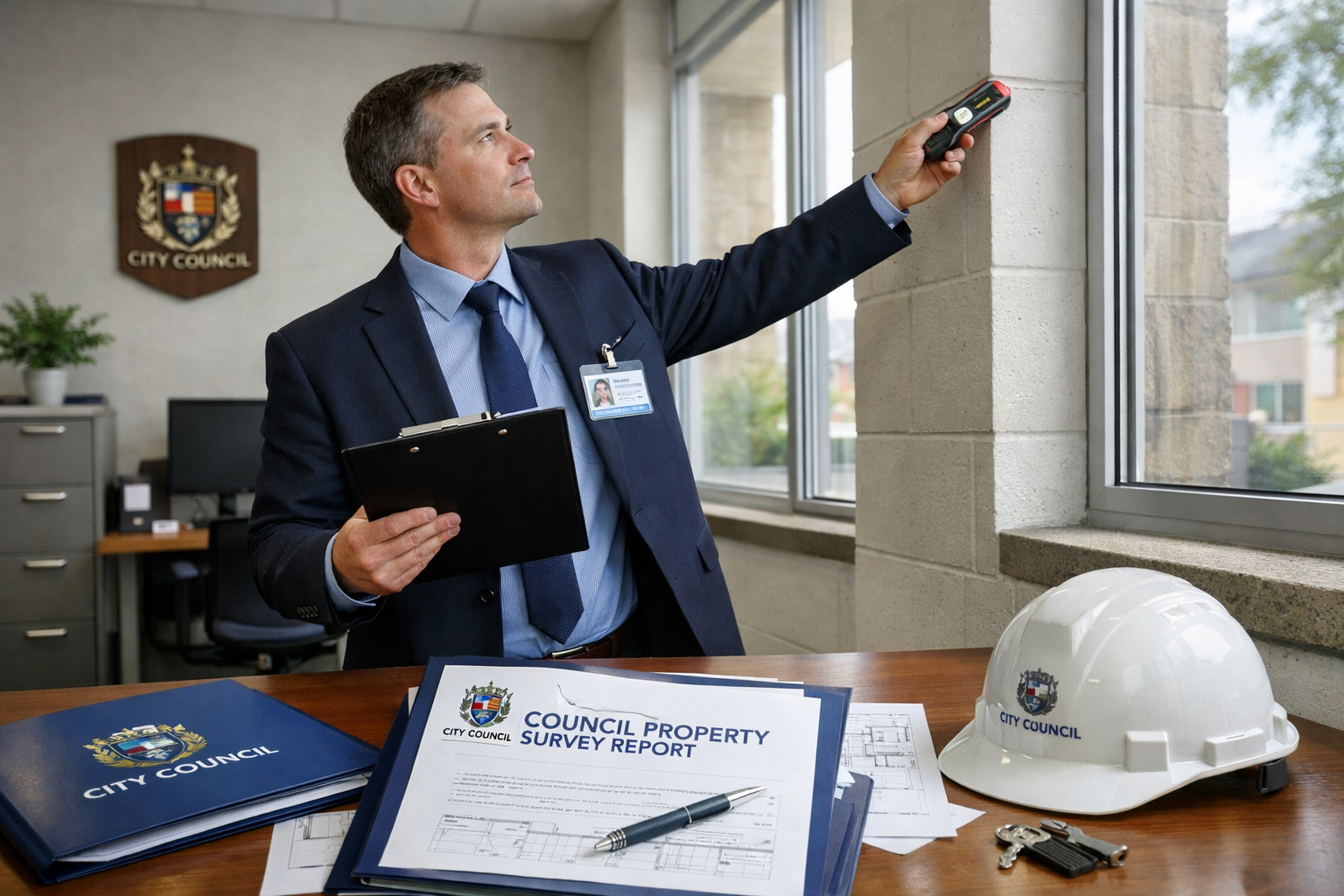
A council property surveyor is a qualified professional employed by or contracted to local government authorities to manage, assess, and maintain the council’s extensive property holdings. Unlike private sector surveyors who primarily serve individual clients or commercial interests, council surveyors work within the public sector framework, balancing technical expertise with public accountability.
These professionals handle everything from routine property inspections to complex redevelopment projects, ensuring that council-owned assets serve their communities effectively while representing good value for public money.
The Scope of Council Property Portfolios
Local authorities across the UK manage remarkably diverse property portfolios that require expert oversight:
Property Types Managed:
- Social housing estates and individual council homes
- Administrative buildings and town halls
- Schools, libraries, and community centers
- Parks facilities and recreational buildings
- Commercial properties leased to businesses
- Heritage buildings and conservation areas
The sheer scale of these portfolios means that council property surveyors must possess broad knowledge across multiple property types and uses. A surveyor might assess a Victorian-era town hall in the morning and inspect modern social housing developments in the afternoon.
Key Responsibilities of a Council Property Surveyor
The daily work of a council property surveyor encompasses numerous critical functions:
Assessment and Inspection Activities:
- Conducting condition surveys of council properties
- Identifying structural defects and maintenance requirements
- Assessing compliance with building regulations and safety standards
- Evaluating accessibility and disability accommodation
- Inspecting properties for health and safety hazards
Valuation and Financial Functions:
- Providing property valuations for acquisition, disposal, or accounting purposes
- Preparing cost estimates for repairs and improvements
- Advising on asset management strategies
- Contributing to budget planning and resource allocation
- Assessing compensation claims and insurance matters
Project Management Responsibilities:
- Overseeing refurbishment and modernization projects
- Managing contractor relationships and procurement processes
- Ensuring projects meet timelines and budget constraints
- Coordinating with architects, engineers, and other professionals
- Implementing energy efficiency and sustainability initiatives
Qualifications and Skills Required for Council Property Surveyors
Becoming a successful council property surveyor requires a combination of formal education, professional credentials, and practical competencies that distinguish this career path from general surveying roles.
Educational Requirements
Academic Foundation:
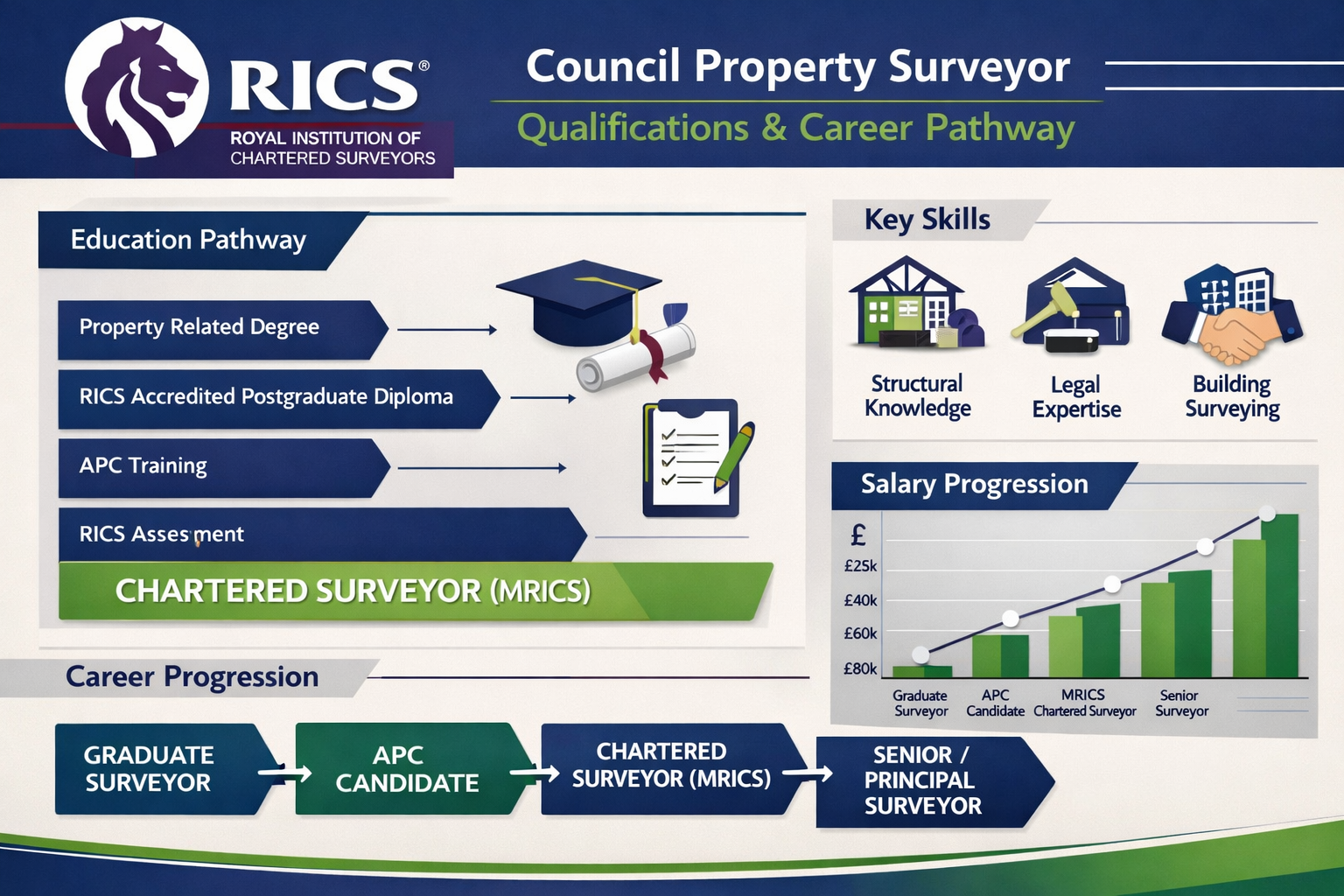
- Bachelor’s degree in surveying, building surveying, or related field
- RICS-accredited degree programs preferred
- Postgraduate qualifications in public sector management (advantageous)
- Continuing professional development (CPD) throughout career
Most council property surveyors hold degrees specifically designed to meet Royal Institution of Chartered Surveyors (RICS) standards. These programs combine theoretical knowledge with practical application, covering building technology, construction law, property management, and professional ethics.
Professional Certifications
Essential Credentials:
- RICS membership (AssocRICS or MRICS status)
- Chartered Surveyor designation highly valued
- Specialized certifications in building pathology or conservation
- Health and safety qualifications (NEBOSH or equivalent)
Working with RICS-registered valuers ensures that council property assessments meet professional standards and can withstand scrutiny in legal or financial contexts.
Technical and Soft Skills
Technical Competencies:
| Skill Area | Specific Requirements |
|---|---|
| Building Technology | Understanding of construction methods, materials, and building systems |
| Defect Diagnosis | Ability to identify structural issues, dampness, and deterioration |
| Regulatory Knowledge | Familiarity with building regulations, planning law, and housing standards |
| Valuation Techniques | Competence in various valuation methodologies |
| Technology Proficiency | CAD software, building information modeling (BIM), and property databases |
Interpersonal Skills:
- Communication abilities for reports, presentations, and stakeholder engagement
- Negotiation skills for contractor management and dispute resolution
- Problem-solving capacity for complex property challenges
- Ethical judgment for managing public resources responsibly
- Time management for balancing multiple projects and priorities
Understanding Public Sector Context
Council property surveyors must navigate unique aspects of local government work:
Public Sector Considerations:
- Procurement regulations and competitive tendering processes
- Freedom of Information Act compliance
- Political awareness and committee reporting structures
- Community engagement and public consultation requirements
- Equality, diversity, and social value obligations
This additional layer of complexity distinguishes council surveyors from their private sector counterparts, requiring awareness of how property decisions impact communities and public perception.
Career Path and Employment Opportunities
The career trajectory for a council property surveyor offers stability, progression opportunities, and the satisfaction of contributing to public service. Understanding the employment landscape helps aspiring professionals plan their career development effectively.
Entry-Level Positions
Starting Your Council Surveying Career:
- Graduate surveyor or trainee positions
- Assistant surveyor roles supporting senior professionals
- Apprenticeship schemes combining work and study
- Fixed-term project positions for specific initiatives
- Secondments from private sector surveying firms
Entry-level salaries typically range from £28,000 to £35,000 depending on location and council size. These positions provide invaluable experience in public sector processes while building technical competencies under supervision.
Mid-Career Advancement
Progression Opportunities:
- Senior surveyor roles with portfolio responsibilities
- Specialist positions (conservation, energy efficiency, social housing)
- Team leader or supervisor positions
- Project manager for major capital programs
- Technical advisor to senior management
Mid-career professionals can expect salaries between £38,000 and £52,000, with London and major metropolitan councils typically offering higher compensation. At this stage, surveyors develop expertise in specific property types or functional areas while managing increasingly complex projects.
Senior Leadership Roles
Executive Positions:
- Principal surveyor or chief surveyor
- Head of property services or estates management
- Director of asset management
- Strategic property advisor to council leadership
- Consultant roles advising multiple authorities
Senior positions command salaries from £55,000 to £75,000+, with executive roles potentially exceeding £80,000. These professionals shape strategic property policies, manage large teams, and influence major investment decisions affecting entire communities.
Alternative Career Pathways
Council property surveyors can leverage their experience for diverse opportunities:
Career Transitions:
- Moving to housing associations or social landlords
- Joining property consultancies specializing in public sector work
- Establishing independent surveying practices
- Teaching and training roles in higher education
- Policy positions in national government or regulatory bodies
The skills developed in council surveying transfer well to related fields, providing career flexibility and security.
The Council Property Surveyor’s Role in Different Contexts
The versatility of council property surveyors becomes evident when examining their contributions across various local authority functions. Each context presents unique challenges and requires adapted approaches.
Social Housing Management
Council surveyors play a crucial role in maintaining and improving social housing stock:
Housing-Specific Responsibilities:
- Conducting pre-acquisition surveys for council house purchases
- Assessing Right to Buy applications and determining market values
- Implementing decent homes standards across housing estates
- Managing void property inspections and turnaround schedules
- Addressing tenant-reported defects and disrepair claims
The social housing context requires particular sensitivity to tenant welfare while balancing financial constraints. Surveyors must prioritize safety-critical repairs while planning longer-term improvements that enhance living conditions.
Commercial Property Portfolio
Many councils maintain commercial property portfolios generating rental income:
Commercial Property Functions:
- Conducting lease renewals and rent reviews
- Assessing development opportunities for council-owned land
- Managing relationships with commercial tenants
- Evaluating investment property performance
- Advising on acquisitions and disposals for strategic purposes
These activities require understanding of commercial property markets, investment analysis, and business planning—skills that complement residential property expertise.
Heritage and Conservation
Councils often own historically significant buildings requiring specialized knowledge:
Conservation Responsibilities:
- Assessing condition of listed buildings and conservation areas
- Balancing preservation requirements with modern functionality
- Securing grant funding for heritage restoration projects
- Liaising with heritage organizations and conservation officers
- Implementing sympathetic repair techniques for historic fabric
This specialized area demands additional training in building conservation and understanding of heritage legislation, making it an attractive niche for surveyors with particular interests.
Community Facilities and Public Buildings
Council surveyors ensure that community spaces serve their intended purposes effectively:
Facility Management Functions:
- Assessing suitability of buildings for community use
- Planning accessibility improvements for inclusive access
- Managing energy efficiency upgrades to reduce carbon footprint
- Coordinating multi-use facility development
- Ensuring compliance with fire safety and health regulations
The community focus of this work provides direct connection to public benefit, as improvements directly enhance residents’ quality of life.
Challenges Facing Council Property Surveyors in 2026
The landscape for council property surveyors continues evolving, presenting both obstacles and opportunities that shape professional practice in the current environment.
Budget Constraints and Resource Limitations
Financial Pressures:
- Reduced capital budgets for property maintenance and improvements
- Competing priorities for limited public funds
- Pressure to demonstrate value for money in all decisions
- Deferred maintenance backlogs creating safety and quality concerns
- Need for creative solutions maximizing impact of available resources
Council surveyors must develop innovative approaches to property management, prioritizing interventions based on risk assessment and strategic importance while maintaining professional standards.
Regulatory and Compliance Demands
Increasing Regulatory Burden:
- Enhanced fire safety requirements following Grenfell tragedy
- Building safety legislation creating new inspection regimes
- Energy performance standards driving retrofit programs
- Accessibility regulations requiring property adaptations
- Data protection and information governance requirements
Staying current with evolving regulations requires continuous professional development and systematic approaches to compliance monitoring across large property portfolios.
Climate Change and Sustainability
Environmental Imperatives:
- Carbon reduction targets requiring property decarbonization
- Flood risk management and climate adaptation strategies
- Sustainable construction and circular economy principles
- Renewable energy integration in council buildings
- Biodiversity net gain requirements for developments
Council property surveyors increasingly function as sustainability advisors, balancing environmental objectives with financial realities and practical constraints.
Technology Integration
Digital Transformation:
- Implementing building information modeling (BIM) for asset management
- Adopting property management software and digital inspection tools
- Using data analytics for predictive maintenance planning
- Integrating geographic information systems (GIS) for portfolio visualization
- Balancing technology investment with traditional surveying skills
The profession is becoming increasingly technology-enabled, requiring surveyors to develop digital competencies alongside traditional technical knowledge.
Working with Professional Council Property Surveyors
Understanding how to engage effectively with council property surveyors benefits various stakeholders, from residents to contractors to fellow professionals.
For Residents and Tenants
Interacting with Council Surveyors:
- Reporting property defects through proper channels
- Understanding the surveyor’s role in repair prioritization
- Participating in property inspections and assessments
- Providing access for scheduled surveys and maintenance
- Escalating concerns through appropriate procedures
Residents should recognize that council surveyors balance individual needs against broader portfolio responsibilities, working within established policies and resource constraints.
For Contractors and Suppliers
Working with Council Procurement:
- Understanding public sector tendering processes
- Meeting quality standards and certification requirements
- Providing detailed specifications and transparent pricing
- Maintaining clear communication throughout projects
- Documenting work thoroughly for audit and compliance purposes
Contractors who understand the council surveyor’s accountability framework build stronger working relationships and secure repeat business.
For Property Professionals
Collaborative Relationships:
- Chartered surveyors in private practice often work alongside council surveyors on specific projects
- Understanding public sector timelines and decision-making processes
- Providing specialized expertise for complex assessments
- Maintaining professional standards in all interactions
- Recognizing the distinct pressures facing public sector colleagues
Private sector surveyors offering services such as valuation for probate or insurance reinstatement valuations may collaborate with council surveyors when council-owned properties are involved in estates or insurance claims.
The Future of Council Property Surveying
The profession continues evolving in response to societal changes, technological advances, and shifting government priorities. Understanding emerging trends helps current and aspiring council property surveyors prepare for future demands.
Emerging Specializations
Growing Areas of Focus:
- Climate resilience and adaptation planning
- Smart building technology and Internet of Things (IoT) integration
- Community wealth building and social value maximization
- Modular construction and modern methods of construction (MMC)
- Health and wellbeing in built environment design
These specializations offer opportunities for surveyors to develop distinctive expertise that adds value to council operations.
Changing Employment Models
Workforce Trends:
- Increased use of shared services between multiple councils
- Growth in outsourcing arrangements with private sector partners
- Flexible working arrangements and remote assessment capabilities
- Greater use of associate and consultant surveyors
- Emphasis on multidisciplinary teams addressing complex challenges
Employment patterns are diversifying, creating varied career options beyond traditional permanent council positions.
Professional Development Priorities
Skills for the Future:
- Data literacy and analytical capabilities
- Change management and transformation leadership
- Stakeholder engagement and community co-design
- Commercial acumen and investment appraisal
- Strategic thinking and long-term planning
Forward-thinking surveyors invest in developing these broader competencies alongside technical surveying skills, positioning themselves for leadership roles.
Policy Influences
Government Priorities Shaping the Profession:
- Levelling up agenda driving regeneration projects
- Net zero commitments requiring property decarbonization
- Building safety reforms creating new compliance frameworks
- Social housing quality standards raising expectations
- Devolution creating regional variations in property strategies
Council property surveyors must remain attuned to policy developments that influence their work, adapting practices to align with evolving government objectives.
Comparing Council and Private Sector Surveying
Understanding the distinctions between council property surveyor roles and private sector positions helps professionals make informed career decisions and appreciate each sector’s unique characteristics.
Key Differences
Comparative Analysis:
| Aspect | Council Property Surveying | Private Sector Surveying |
|---|---|---|
| Primary Objective | Public service and value for taxpayers | Profit generation and client satisfaction |
| Portfolio Diversity | Wide range of property types | Often specialized by sector |
| Decision-Making | Committee processes and political considerations | Commercial judgment and market responsiveness |
| Work Pace | Structured with established procedures | Can be faster-paced and deadline-driven |
| Job Security | Generally high with pension benefits | Variable depending on market conditions |
| Salary Potential | Moderate with structured progression | Higher ceiling but more variable |
| Public Scrutiny | Subject to FOI and public accountability | Limited to client relationships |
| Innovation Scope | Constrained by regulations and precedent | Greater freedom for creative solutions |
Advantages of Council Surveying
Benefits of Public Sector Work:
- ✅ Job stability and defined benefit pension schemes
- ✅ Work-life balance with structured hours
- ✅ Diverse experience across multiple property types
- ✅ Contribution to community wellbeing and social good
- ✅ Comprehensive training and professional development support
- ✅ Exposure to large-scale strategic projects
- ✅ Collaborative working environment with multidisciplinary teams
Advantages of Private Sector Surveying
Benefits of Commercial Practice:
- ✅ Higher earning potential and performance bonuses
- ✅ Faster career progression based on merit
- ✅ Specialization opportunities in niche markets
- ✅ Entrepreneurial possibilities and partnership tracks
- ✅ Exposure to cutting-edge technology and methods
- ✅ Direct client relationships and immediate feedback
- ✅ Greater flexibility in approach and methodology
Many surveyors move between sectors during their careers, gaining valuable perspective from each environment. The skills developed in council surveying—particularly around stakeholder management, complex project coordination, and regulatory compliance—transfer effectively to private practice, while private sector experience brings commercial awareness and efficiency focus to public sector roles.
How to Become a Council Property Surveyor
For those inspired to pursue this rewarding career path, understanding the practical steps toward becoming a council property surveyor provides a roadmap for success.
Educational Pathway
Academic Journey:
- Secondary Education: Focus on mathematics, sciences, and technical subjects
- University Degree: Pursue RICS-accredited surveying degree (3-4 years)
- Postgraduate Study: Consider specialized master’s programs (optional but advantageous)
- Professional Assessment: Complete RICS Assessment of Professional Competence (APC)
- Continuing Development: Engage in lifelong learning through CPD activities
Selecting an RICS-accredited program ensures that academic preparation aligns with professional requirements, streamlining the path to chartered status.
Gaining Relevant Experience
Building Your Profile:
- Seek vacation placements or internships with local authorities
- Apply for graduate training schemes specifically designed for council surveyors
- Volunteer for community projects involving property assessment
- Join professional organizations and attend networking events
- Develop a portfolio demonstrating practical surveying skills
Many councils offer structured graduate programs combining rotations through different departments with mentorship from experienced surveyors, providing comprehensive introduction to public sector property work.
Application Process
Securing Your First Position:
- Research councils with active recruitment programs
- Tailor applications to emphasize public service motivation
- Prepare for competency-based interviews focusing on values alignment
- Demonstrate understanding of local government structure and challenges
- Highlight transferable skills from previous experience
Council recruitment processes typically emphasize cultural fit and commitment to public service alongside technical competence, so applications should reflect genuine interest in serving communities.
Professional Development Plan
Continuing Growth:
- Set clear objectives for RICS chartership achievement
- Identify mentors within your organization
- Pursue specialized training in relevant areas
- Build networks across the public sector surveying community
- Consider secondments or project assignments for skill development
Successful council property surveyors take ownership of their professional development, actively seeking opportunities to expand their capabilities and contribute more effectively to their organizations.
Conclusion: The Vital Role of Council Property Surveyors
The council property surveyor occupies a unique and essential position at the intersection of technical expertise, public service, and community impact. These professionals ensure that local authorities can fulfill their property-related responsibilities effectively, maintaining safe and suitable accommodation for residents while stewarding public assets responsibly.
As the challenges facing local government evolve—from climate change adaptation to building safety compliance to digital transformation—the role of council property surveyors becomes increasingly strategic and influential. These professionals don’t simply assess buildings; they shape the physical infrastructure that supports community life, economic development, and social wellbeing.
For those considering this career path, council property surveying offers meaningful work with tangible impact, combining technical challenge with public purpose. The profession provides stability, diverse experience, and the satisfaction of knowing that your professional expertise directly benefits the communities you serve.
Next Steps
For Aspiring Council Property Surveyors:
- Research RICS-accredited degree programs at universities across the UK
- Contact local authority property departments to inquire about work experience opportunities
- Join student membership of RICS to access resources and networking
- Follow council property news and policy developments to understand the sector
- Connect with professional surveyors to learn about their career experiences
For Councils Seeking Surveying Expertise:
- Consider whether specialized external support could complement in-house capabilities
- Explore comprehensive assessment services for specific project needs
- Invest in professional development for existing surveying staff
- Review recruitment strategies to attract talented professionals to public service
- Learn more about professional surveying standards that should inform council property work
For Property Professionals:
- Understand the distinct context of council property work when collaborating with local authorities
- Recognize opportunities to support councils with specialized expertise
- Maintain awareness of public sector procurement processes and requirements
- Consider how your skills might contribute to public service objectives
The future of council property surveying is bright for those who embrace its unique challenges and opportunities. As communities continue to depend on well-managed public property portfolios, the demand for skilled, dedicated council property surveyors will only grow, ensuring this remains a rewarding and impactful career choice for years to come.