
Surveyor Social Housing: The Complete Guide to Property Assessment in 2026
When a social housing tenant notices cracks spreading across their living room wall, or when a housing association needs to value thousands of properties for their annual accounts, one professional stands between uncertainty and clarity: the surveyor social housing specialist. These experts form the backbone of the UK’s social housing sector, ensuring that millions of homes remain safe, properly valued, and fit for purpose.
The role of a surveyor social housing professional has never been more critical. With over 4 million social housing units across the UK requiring regular assessment, maintenance planning, and compliance checks, these specialists provide essential services that protect both residents and housing providers. From conducting Right to Buy valuations to identifying structural defects before they become dangerous, surveyors working in social housing combine technical expertise with a deep understanding of regulatory frameworks and community needs.
Key Takeaways
- 🏘️ Surveyor social housing professionals specialize in assessing, valuing, and maintaining properties owned by local authorities and housing associations
- 📋 Social housing surveyors must possess RICS qualifications and understand specific regulations including the Decent Homes Standard and Building Safety Act 2022
- 💰 Services range from Right to Buy valuations to stock condition surveys, with costs varying based on property type and assessment complexity
- 🔍 These specialists conduct critical inspections for damp, structural issues, fire safety compliance, and energy efficiency improvements
- 📈 Career opportunities in social housing surveying continue to expand in 2026, with competitive salaries reflecting the sector’s growing importance
What Is a Surveyor Social Housing Specialist?
A surveyor social housing professional is a qualified property expert who specializes in assessing, valuing, and managing residential properties within the social housing sector. Unlike general practice surveyors, these specialists possess detailed knowledge of the unique challenges, regulations, and standards that govern council housing, housing association properties, and affordable housing developments.
Core Responsibilities
Social housing surveyors perform a diverse range of functions that keep communities safe and properties well-maintained:
Property Assessment & Inspection
- Conducting comprehensive stock condition surveys across entire housing portfolios
- Identifying structural defects, damp issues, and safety hazards
- Assessing compliance with the Decent Homes Standard
- Evaluating fire safety measures following the Building Safety Act 2022
Valuation Services
- Performing Right to Buy valuations for tenants purchasing their homes
- Providing market valuations for housing association properties
- Conducting valuation for probate when social housing tenants pass away
- Delivering insurance reinstatement valuations for property portfolios
Strategic Planning
- Creating planned maintenance programmes based on property conditions
- Advising on energy efficiency improvements and retrofit projects
- Supporting new build developments and regeneration schemes
- Providing expert witness testimony in housing disputes
Qualifications and Expertise Required
Professional surveyors working in social housing typically hold:
| Qualification | Description | Importance |
|---|---|---|
| RICS Chartered Status | Full membership of Royal Institution of Chartered Surveyors | Essential for credibility and professional standards |
| Building Surveying Degree | BSc or MSc in Building Surveying or related field | Provides technical foundation |
| Social Housing Experience | Minimum 2-3 years in sector-specific work | Understanding of regulatory environment |
| CPD Training | Continuous professional development in fire safety, energy efficiency | Keeps knowledge current with 2026 regulations |
Many surveyors working with social housing providers are registered with the RICS, ensuring they adhere to strict professional and ethical standards.
Why Social Housing Requires Specialized Surveyors
The social housing sector presents unique challenges that demand specialist knowledge beyond general surveying skills. Surveyor social housing experts navigate a complex landscape of regulations, funding constraints, and social responsibilities that don’t apply to private sector property work.
Regulatory Complexity
Social housing operates under multiple regulatory frameworks:
✅ The Decent Homes Standard – Ensuring properties meet minimum quality requirements
✅ Building Safety Act 2022 – Enhanced fire safety and structural integrity requirements
✅ Energy Performance Certificate (EPC) Requirements – Meeting government targets for energy efficiency
✅ Homes (Fitness for Human Habitation) Act 2018 – Legal obligations for landlord responsibilities
✅ Social Housing Regulation Act 2023 – Consumer standards and tenant protections
A specialized surveyor understands how these regulations interact and can ensure housing providers remain compliant while managing costs effectively.
Unique Property Challenges
Social housing stock often presents specific technical challenges:
Age and Construction Type
Many social housing properties were built during the post-war period using non-traditional construction methods. Surveyors must recognize issues specific to:
- Pre-cast concrete systems (PRC houses)
- Steel frame constructions
- System-built properties
- High-rise tower blocks
Maintenance Backlogs
Years of underfunding have created significant maintenance backlogs across the sector. Surveyors must prioritize repairs based on safety, urgency, and available budgets.
Occupied Property Inspections
Unlike vacant properties, social housing surveyors typically inspect occupied homes, requiring excellent communication skills and sensitivity to residents’ circumstances.
Financial Considerations
Social housing providers operate with limited budgets and must demonstrate value for money. Surveyors help by:
- Identifying cost-effective repair solutions
- Planning preventative maintenance to avoid expensive emergency repairs
- Supporting funding applications with accurate condition data
- Providing valuation costs that reflect social housing market realities
Key Services Provided by Surveyor Social Housing Professionals
The scope of work undertaken by social housing surveyors extends far beyond simple property inspections. These professionals deliver comprehensive services that support housing providers in managing their assets effectively while ensuring tenant safety and satisfaction.
Stock Condition Surveys
Stock condition surveys form the foundation of effective asset management in social housing. These detailed assessments evaluate the current state of properties and predict future maintenance needs.
A comprehensive stock condition survey typically includes:
📊 Property Component Assessment
- Roof condition and remaining lifespan
- External walls, windows, and doors
- Heating systems and boiler efficiency
- Electrical installations and safety
- Plumbing and drainage systems
- Internal finishes and fixtures
📊 Compliance Checks
- Fire safety equipment and escape routes
- Electrical Installation Condition Reports (EICR)
- Gas safety certificates
- Asbestos management
- Legionella risk assessments
📊 Future Planning Data
- Estimated replacement costs for components
- Lifecycle planning for major elements
- Energy efficiency improvement opportunities
- Accessibility modifications needed
Right to Buy Valuations
The Right to Buy scheme allows eligible social housing tenants to purchase their homes at discounted prices. Surveyor social housing specialists conduct these valuations following strict RICS guidelines.
The Right to Buy valuation process involves:
- Market Value Assessment – Determining the property’s open market value as if sold with vacant possession
- Discount Calculation Support – Providing accurate valuations that allow correct discount application
- Shared Ownership Considerations – Valuing properties under shared ownership arrangements
- Appeals and Disputes – Supporting landlords or tenants in valuation disputes
Professional surveyors ensure these valuations are defensible, accurate, and compliant with government guidance, protecting both housing providers and tenants.
Damp and Structural Surveys
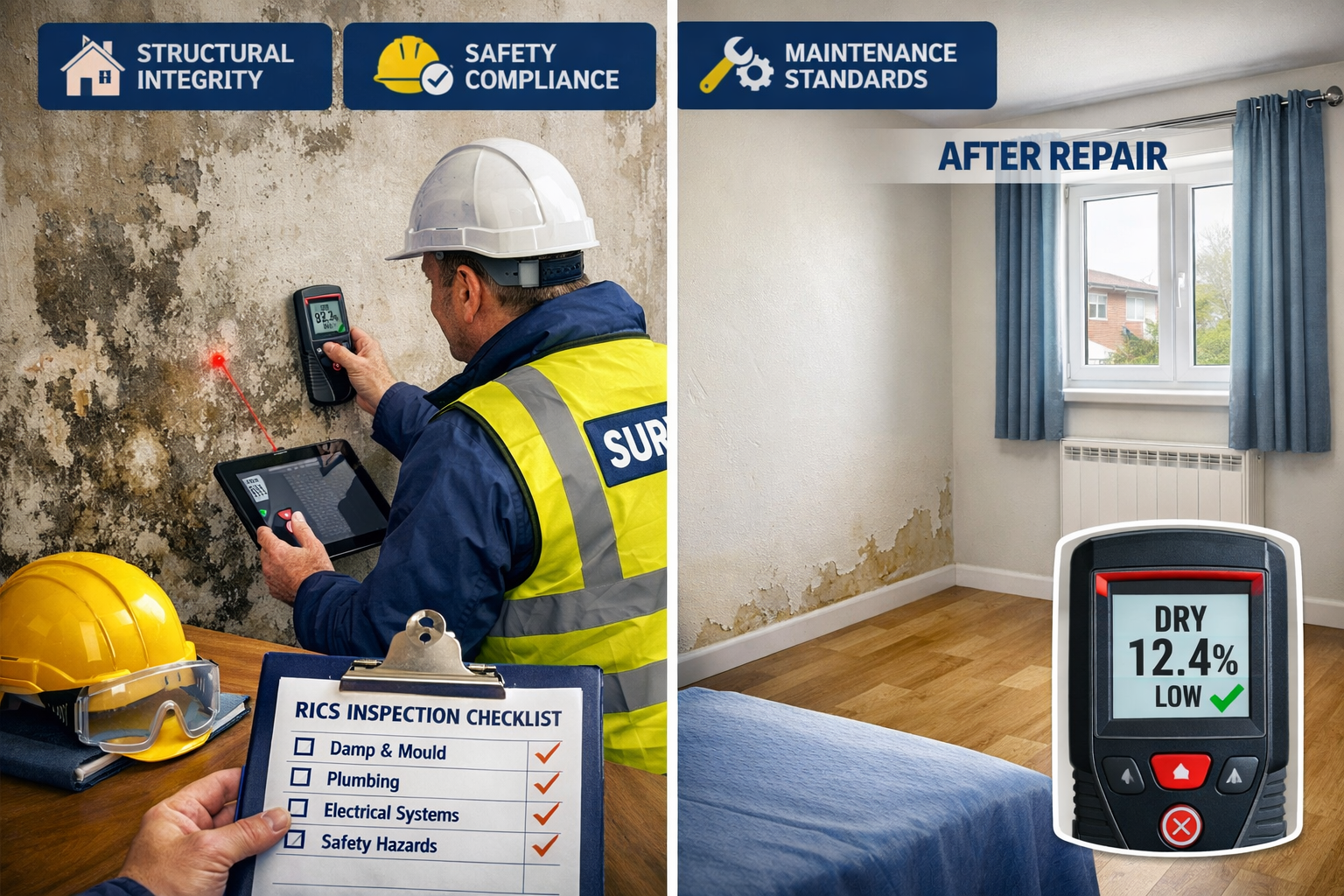
Damp and structural issues represent the most common complaints in social housing. Specialist surveyors identify causes, recommend solutions, and prevent minor issues from becoming major problems.
Common Issues Identified:
🔍 Rising Damp – Failed damp-proof courses requiring injection or replacement
🔍 Penetrating Damp – Roof leaks, failed pointing, or damaged render
🔍 Condensation Damp – Inadequate ventilation or heating systems
🔍 Structural Movement – Settlement, subsidence, or structural defects
🔍 Timber Defects – Rot, woodworm, or structural timber failure
These dilapidation surveys provide detailed reports with photographic evidence, cost estimates for repairs, and prioritization based on risk.
Energy Efficiency Assessments
With government targets requiring social housing to reach EPC Band C by 2030, energy efficiency assessments have become crucial. Surveyors evaluate current performance and recommend improvements such as:
- External wall insulation systems
- Roof and loft insulation upgrades
- Window and door replacements
- Heating system modernization
- Solar panel installations
- Ventilation improvements
These assessments support funding applications for retrofit programmes and help housing providers plan long-term investment strategies.
Fire Safety Inspections
Following the Grenfell Tower tragedy and subsequent legislation, fire safety inspections have become paramount. Social housing surveyors assess:
✓ External wall systems and cladding materials
✓ Fire doors and compartmentation
✓ Escape routes and signage
✓ Fire detection and alarm systems
✓ Emergency lighting
✓ Resident evacuation plans
These inspections ensure compliance with the Building Safety Act 2022 and protect residents from fire risks.
The Surveyor Social Housing Career Path in 2026
The demand for qualified surveyor social housing professionals continues to grow as the sector faces increasing regulatory requirements and investment in existing stock. For those considering this career path, 2026 offers excellent opportunities with clear progression routes and competitive remuneration.
Entry Routes and Qualifications
Academic Pathway
Most surveyors enter the profession through university education:
- Undergraduate Degree (3-4 years)
- BSc Building Surveying
- BSc Real Estate Management
- BSc Construction Management
- RICS-accredited programmes preferred
- Postgraduate Conversion (1-2 years)
- MSc Building Surveying for graduates from non-surveying backgrounds
- RICS-accredited conversion courses
- Assessment of Professional Competence (APC)
- 24-month structured training programme
- Workplace-based learning with mentor support
- Final assessment interview with RICS panel
- Achieves Chartered Surveyor status (MRICS)
Apprenticeship Route
Degree apprenticeships offer an alternative pathway, combining work experience with academic study:
- Earn while learning
- Employer-funded tuition
- Practical experience from day one
- Typically 4-5 years to qualification
Career Progression
The social housing surveying career ladder offers clear advancement opportunities:
Junior/Graduate Surveyor (£25,000-£32,000)
- Conducting property inspections under supervision
- Assisting with stock condition surveys
- Learning regulatory frameworks
- Working toward APC completion
Surveyor (£32,000-£42,000)
- Independent property assessments
- Right to Buy valuations
- Project management for small-scale works
- Tenant liaison and complaint resolution
Senior Surveyor (£42,000-£55,000)
- Managing complex projects
- Leading teams of junior surveyors
- Strategic asset management planning
- Budget responsibility
Principal Surveyor/Head of Property Services (£55,000-£75,000+)
- Departmental leadership
- Policy development
- Board-level reporting
- Strategic planning for entire portfolios
Essential Skills for Success
Beyond technical qualifications, successful social housing surveyors develop:
Technical Competencies
- Building pathology and defect diagnosis
- Construction technology and materials
- Contract administration
- Health and safety management
Interpersonal Skills
- Empathy and understanding of tenant circumstances
- Clear communication with non-technical stakeholders
- Conflict resolution and negotiation
- Cultural sensitivity and inclusivity
Business Acumen
- Budget management and cost control
- Project prioritization
- Risk assessment and mitigation
- Performance measurement and reporting
Employment Opportunities
Surveyor social housing professionals find employment across various organizations:
🏢 Local Authorities – Direct employment by councils managing housing stock
🏢 Housing Associations – Large and small registered providers
🏢 Arms-Length Management Organizations (ALMOs) – Council-owned companies managing housing
🏢 Private Surveying Firms – Consultancies specializing in social housing work
🏢 Maintenance Contractors – Companies delivering repairs and improvements
The sector’s stability, combined with the essential nature of the work, provides excellent job security even during economic uncertainty.
Choosing the Right Surveyor Social Housing Provider
For housing associations, local authorities, and tenants requiring surveying services, selecting the right professional is crucial. The quality of surveying work directly impacts property safety, financial decisions, and regulatory compliance.
Key Selection Criteria
Professional Accreditation
Always verify that surveyors hold appropriate qualifications:
- RICS Chartered status (MRICS or FRICS)
- Professional indemnity insurance
- Current CPD records
- Relevant sector experience
Reputable firms like Manchester Surveyors maintain transparent information about their team’s qualifications and expertise.
Sector-Specific Experience
General surveyors may lack the specialized knowledge required for social housing work. Look for:
- Demonstrated experience with housing associations or local authorities
- Knowledge of social housing regulations
- Understanding of funding mechanisms (grant applications, decent homes funding)
- Experience with similar property types and construction methods
Service Range and Capabilities
Consider whether the surveyor offers comprehensive services including:
| Service Type | Why It Matters |
|---|---|
| Stock Condition Surveys | Essential for asset management planning |
| Right to Buy Valuations | Statutory requirement for tenant purchases |
| Damp and Structural Surveys | Common issues requiring specialist diagnosis |
| Fire Safety Assessments | Critical compliance requirement |
| Energy Efficiency Surveys | Supporting retrofit programmes |
| Expert Witness Services | Legal disputes and tribunal cases |
Firms offering a full range of assessment types provide continuity and consistency across your property portfolio.
Technology and Reporting
Modern surveying practices utilize advanced technology:
- Thermal imaging cameras for damp detection
- Laser measuring equipment for accuracy
- Drone surveys for roof and high-level inspections
- Digital reporting systems with photographic evidence
- Asset management software integration
Turnaround Times and Responsiveness
In social housing, timely surveys can be critical:
- Emergency inspections for safety concerns
- Rapid Right to Buy valuations to meet statutory deadlines
- Quick turnaround for tenant complaints
- Flexible scheduling to minimize tenant disruption
Cost Transparency
Professional surveyors provide clear, upfront pricing:
- Detailed quotations before work commences
- Explanation of factors affecting valuation costs
- No hidden fees or unexpected charges
- Value for money, not just lowest price
Red Flags to Avoid
⚠️ Unqualified or Under-Qualified Practitioners – Always verify RICS membership
⚠️ Lack of Professional Indemnity Insurance – Essential protection for all parties
⚠️ Vague or Incomplete Reports – Professional surveys should be detailed and actionable
⚠️ Pressure Tactics or Rushed Decisions – Reputable firms allow time for consideration
⚠️ Unwillingness to Provide References – Established surveyors readily share testimonials
Questions to Ask Potential Surveyors
Before engaging a surveyor social housing specialist, ask:
- What is your specific experience with social housing properties?
- Are you RICS qualified and can you provide your membership number?
- What is your professional indemnity insurance coverage?
- Can you provide references from other housing providers?
- What is your typical turnaround time for reports?
- How do you handle urgent or emergency inspections?
- What technology do you use in your assessments?
- Can you explain your fee structure clearly?
- Do you offer ongoing support after report delivery?
- How do you stay current with changing regulations?
The Future of Surveyor Social Housing Services
The social housing sector stands at a crossroads in 2026, with significant challenges and opportunities shaping the future role of surveyors. Understanding these trends helps housing providers and professionals prepare for the evolving landscape.
Regulatory Evolution
Building Safety Act Implementation
The full implementation of the Building Safety Act 2022 continues to reshape surveying requirements:
- Enhanced competency requirements for surveyors working on higher-risk buildings
- Mandatory building safety case reports for residential buildings over 18 meters
- Increased scrutiny of fire safety measures and structural integrity
- Greater accountability for building safety risks
Consumer Standards Strengthening
The Social Housing Regulation Act 2023 has empowered tenants and increased landlord obligations:
- Proactive inspections to identify and address hazards
- Transparent reporting of property conditions to residents
- Faster response times to tenant complaints about property conditions
- Increased penalties for non-compliance
Technology Integration
Digital Surveying Tools
Modern surveyors increasingly rely on advanced technology:
🔧 Building Information Modeling (BIM) – Creating digital twins of properties for lifecycle management
🔧 Artificial Intelligence – Predicting maintenance needs and identifying patterns across portfolios
🔧 Mobile Survey Apps – Real-time data capture and instant report generation
🔧 Thermal Imaging – Non-invasive detection of insulation defects and moisture issues
🔧 Drone Technology – Safe, efficient inspection of roofs and high-level building elements
Data Analytics and Predictive Maintenance
Housing providers now use surveyor data to:
- Predict component failures before they occur
- Optimize maintenance budgets
- Identify systemic issues across property types
- Demonstrate compliance to regulators
Sustainability and Net Zero
The push toward net zero carbon emissions by 2050 creates significant work for social housing surveyors:
Retrofit Assessment and Planning
Surveyors evaluate properties for:
- Insulation improvements (walls, roofs, floors)
- Heating system replacements (heat pumps, district heating)
- Renewable energy installations (solar panels, battery storage)
- Ventilation upgrades to prevent condensation in airtight properties
Whole-Life Carbon Assessment
Beyond operational carbon, surveyors increasingly consider:
- Embodied carbon in repair materials
- Circular economy principles (repair vs. replace)
- Sustainable material specifications
- Lifecycle costing including environmental impact
Workforce Challenges
The sector faces a growing skills gap:
Recruitment Difficulties
- Aging workforce with experienced surveyors retiring
- Competition from private sector for qualified professionals
- Need for diversity in the surveying profession
- Limited awareness of social housing careers among graduates
Solutions Being Implemented
- Enhanced apprenticeship programmes
- Competitive salary packages
- Flexible working arrangements
- Investment in training and development
- Partnerships with universities
Investment and Funding
Government and sector investment creates opportunities:
Decent Homes Plus
Extended funding for bringing properties above minimum standards creates demand for:
- Comprehensive stock condition surveys
- Project specification and management
- Quality assurance inspections
Social Housing Decarbonization Fund
Billions allocated for energy efficiency improvements require:
- Pre-retrofit condition surveys
- Post-installation verification
- Performance monitoring
Conclusion: The Essential Role of Surveyor Social Housing Professionals
The surveyor social housing specialist occupies a unique and vital position in the UK’s housing landscape. These professionals serve as the guardians of property standards, ensuring that millions of social housing residents live in safe, decent, and energy-efficient homes. Their work extends far beyond simple property inspections—they provide the technical expertise, regulatory knowledge, and strategic insight that enables housing providers to manage their assets effectively while meeting increasingly stringent standards.
As we’ve explored throughout this guide, social housing surveying demands a specialized skill set combining technical building knowledge, regulatory expertise, financial acumen, and genuine commitment to social purpose. The sector faces significant challenges in 2026, from implementing new building safety requirements to achieving ambitious net zero targets, all while addressing historical maintenance backlogs with limited budgets.
Taking Action: Next Steps
For Housing Providers:
If you’re a housing association or local authority seeking surveying services, prioritize finding qualified professionals with demonstrated social housing experience. Request detailed proposals, check references, and ensure surveyors hold current RICS accreditation. Consider establishing long-term partnerships with surveying firms that understand your portfolio and can provide consistent, reliable service.
For Property Professionals:
Those considering a career in social housing surveying should pursue RICS-accredited qualifications and seek opportunities to gain sector-specific experience. The field offers job security, competitive salaries, and the satisfaction of making a tangible difference to communities. Invest in continuous professional development, particularly in emerging areas like building safety, energy efficiency, and digital surveying technologies.
For Tenants:
If you’re a social housing resident concerned about your property’s condition, understand that professional surveyors provide independent, expert assessment of issues. For those considering Right to Buy, ensure your landlord engages a qualified surveyor to provide an accurate, defensible valuation.
The future of social housing depends on skilled surveyors who can navigate complex regulations, leverage new technologies, and maintain unwavering focus on resident safety and satisfaction. Whether you’re seeking surveying services, considering a career in the field, or simply wanting to understand how social housing is maintained and valued, the expertise of specialist surveyors remains indispensable.
For comprehensive surveying services delivered by experienced professionals, contact qualified surveyors who understand the unique demands of the social housing sector. The right surveyor doesn’t just assess properties—they protect communities, enable informed decisions, and contribute to the essential mission of providing quality homes for all.