Nearly one in three party wall disputes escalates into a formal legal process — not because neighbours are unreasonable, but because the homeowner signed a builder contract before understanding their statutory obligations. Party wall risks with loft conversions and roof replacements represent one of the most overlooked areas of home improvement law in the UK, and the consequences of getting it wrong range from costly delays to injunctions, neighbour litigation, and repair bills that no standard building contract will cover.
This guide breaks down exactly what homeowners miss before the contracts are signed, why the Party Wall etc. Act 1996 matters more than most builders admit, and how proactive steps can protect both your project and your relationship with the people next door.
Key Takeaways 📌
- Signing a builder contract before serving valid Party Wall notices can expose you to injunctions, project stoppages, and neighbour legal costs.
- Most loft conversions in terraced or semi-detached homes trigger the Party Wall etc. Act 1996 — regardless of what your builder tells you informally.
- Chimney breast removals, steel beam insertions, and dormer construction near shared walls are high-risk works that require specific protective measures in writing.
- The building owner (you) pays for party wall surveyor fees, damage remediation, and any agreed compensation — costs rarely reflected in standard builder quotes.
- Notice periods of one to two months must be factored into your build programme before committing to a fixed start date with any contractor.
Understanding Party Wall Risks with Loft Conversions and Roof Replacements
Why Loft Conversions Almost Always Trigger the Act
A common misconception is that the Party Wall etc. Act 1996 only applies to major structural work. In reality, almost any standard loft conversion on a terraced or semi-detached property will involve at least one of the following notifiable works:
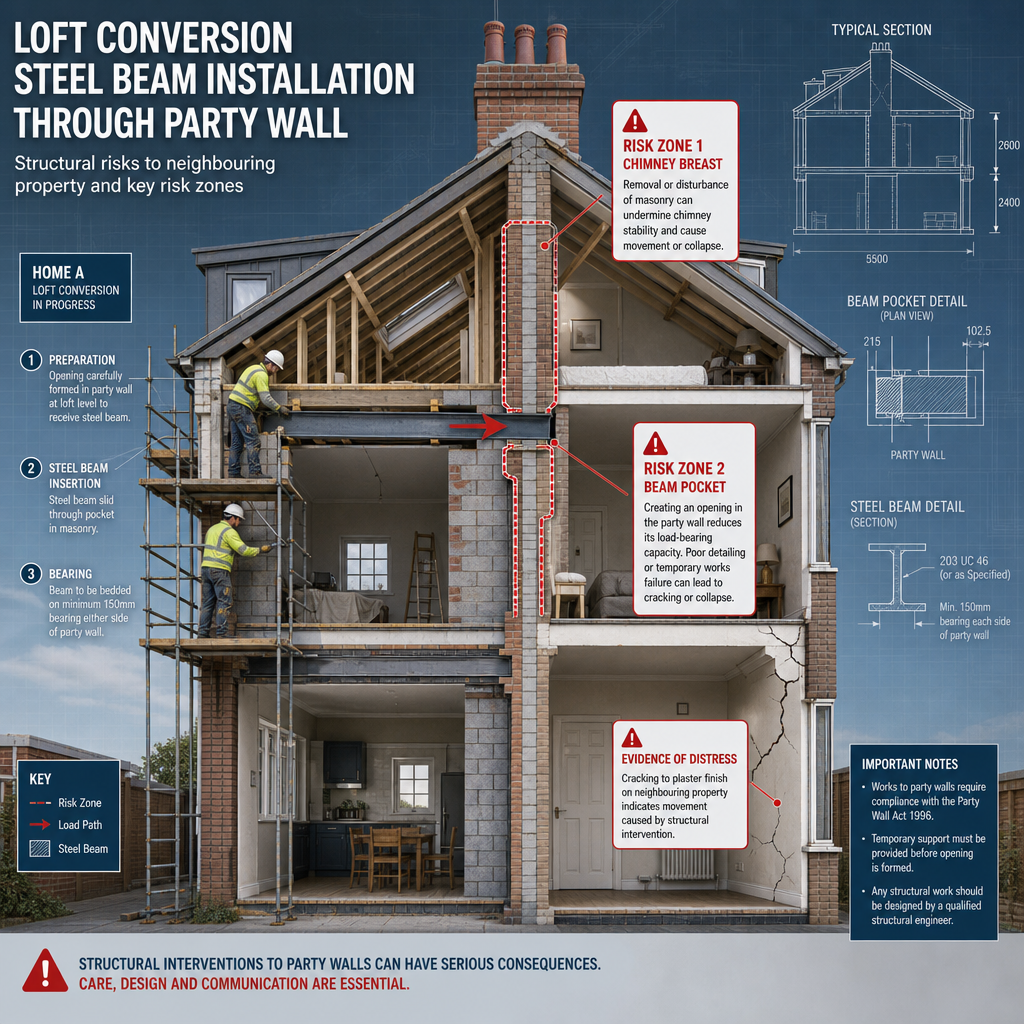
- Cutting into the party wall to insert steel beams (RSJs)
- Raising or thickening the party wall to form a dormer or hip-to-gable conversion
- Removing or altering a chimney breast that forms part of the party wall
- Excavating within 3–6 metres of a neighbouring foundation
If your property is not detached, there is a strong chance your loft conversion triggers the Act [3]. Even in buildings split into flats, separate notices may be required for each leaseholder and the freeholder — something builders rarely flag at quotation stage [3].
💬 "Many owners proceed on a builder's informal assurance that 'we've done loads round here, it's fine' — only to discover that each affected leaseholder should have been served with notices." — Collier Stevens [3]
For a detailed breakdown of how loft conversions interact with party wall law, see this guide on loft conversions and party wall obligations.
The Physical Damage Risks Surveyors See Most Often
Party wall risks with loft conversions and roof replacements are not just procedural — they are structural. The most commonly reported physical defects include:
| Risk Type | Typical Cause | Likely Affected Area |
|---|---|---|
| Ceiling/wall cracking | Steel beam insertion into older masonry | Neighbour's bedroom or landing |
| Water ingress | Poor flashing at dormer abutment | Neighbour's top-floor rooms |
| Dislodged roof tiles | Vibration during demolition | Neighbour's roof slope |
| Soot contamination | Chimney breast removal | Neighbour's carpets, gas appliances |
| Structural movement | Load path changes at chimney | Neighbour's chimney stack |
The degree of risk is strongly influenced by the robustness of the party wall, the quality of structural design, and whether the contractor has prepared detailed method statements before works begin [1]. Older, slender Victorian or Edwardian party walls are particularly vulnerable when steels are inserted or when heavy demolition occurs nearby.
Protective measures — such as temporary roof coverings, scaffold netting, polystyrene protection boards on neighbouring roof slopes, and dust/soot containment systems — should be specified in both the Party Wall Award and the building contract [1]. If they appear in the Award but not the contract, the builder has no contractual obligation to implement them.
A schedule of condition of the neighbour's property, prepared before works start, is essential. Without it, attributing any post-works damage to your project becomes a matter of dispute rather than fact.
What Homeowners Overlook Before Signing Builder Contracts
The Contractual Blind Spot That Costs Thousands
The most dangerous moment in any loft or roof project is the day a homeowner signs a builder contract without having first aligned it with their duties under the Party Wall etc. Act 1996. Standard builder contracts are written to protect the builder. They rarely address:
- Your statutory obligation to serve notices before work begins
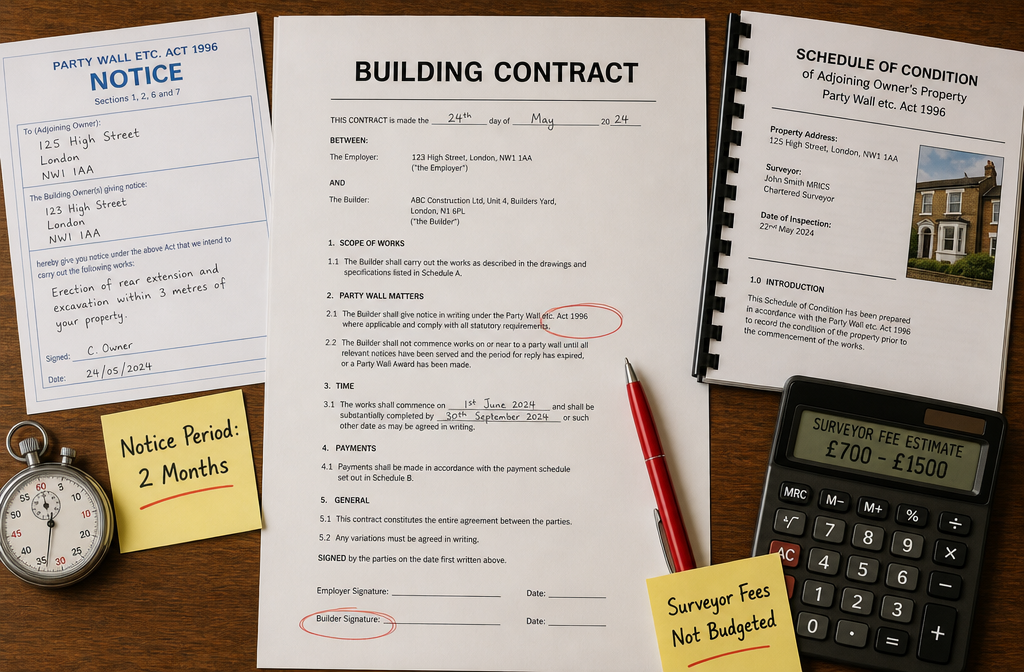
- The cost of party wall surveyors (typically £700–£1,500+ per surveyor, and potentially a third surveyor if there is a dispute) [4]
- Your liability to make good any damage to the adjoining property [4]
- Compensation obligations if you raise or enclose on a party wall your neighbour originally built [4]
- Working hours restrictions that a Party Wall Award may impose
If works involve cutting into the party wall for steels, raising the party wall for a dormer, removing a chimney breast, or excavating near a neighbour's foundations, a formal party wall notice — and, if there is dissent, a Party Wall Award — are legally required before work starts [2]. Failure to follow this procedure can halt works, expose you (not the builder) to injunctions, and make you liable for the neighbour's legal and repair costs [2].
For homeowners wanting professional oversight of these obligations, party wall services from a qualified surveyor provide the structured support needed from notice stage through to Award.
Notice Periods and Programme Sequencing
One of the most practically damaging oversights is committing to a fixed start date with a builder before allowing time for party wall procedures. The Act requires:
- ⏱️ Two months' notice for most loft-related works (beam insertion, raising party walls, dormer construction)
- ⏱️ One month's notice for adjacent excavation works
If a neighbour does not respond within 14 days, dissent is legally assumed — not consent [4]. Surveyors must then be appointed, and a Party Wall Award agreed, which can add several more weeks to the programme [2][5].
Starting work before the notice period and Award are complete can:
- Invalidate your insurance cover
- Give neighbours strong grounds for an injunction
- Expose you to claims for all costs incurred by the neighbour
💬 "You should not sign a fixed start date with a builder until you've allowed sufficient time for notices and potential surveyor negotiations." — Peter Barry Surveyors [5]
Invalid Notices: A Procedural Trap
There is no official government form for a Party Wall Notice. Many homeowners download templates or draft their own — and many of those notices are invalid because they omit:
- A full description of the proposed works
- The intended start date
- The correct legal name and address of the building owner
An invalid notice does not start the clock. It delays the entire process, potentially by weeks [4]. This is a risk that almost never appears in a builder's project timeline.
Chimney Breasts and Shared Chimneys: A Frequently Missed Trigger ⚠️
Chimney breast removals are among the highest-risk, most commonly overlooked party wall triggers. When a chimney breast is removed as part of a loft conversion, several serious risks arise [1]:
- Soot contamination: Disturbing a shared flue can send soot through the neighbour's chimney, contaminating carpets and gas appliances
- Structural load changes: Removing chimney supports alters load paths that may affect the neighbour's structure
- Damp and water ingress: Poor detailing at shared chimney flashings during roof replacement or dormer construction causes leaks
These works almost always trigger the Party Wall etc. Act 1996 and should not proceed without notices and a Party Wall Award that explicitly sets out temporary support requirements, dust and soot containment obligations, and making-good responsibilities [1].
For properties with shared chimney stacks, specialist guidance on party wall shared chimneys is strongly recommended before any roof or loft work begins.
Party Wall Risks with Loft Conversions and Roof Replacements: Protecting Your Position
What Neighbours Can and Cannot Do
A widely misunderstood point is that neighbours cannot use the Party Wall Act to simply veto a compliant loft conversion or roof replacement [4]. As long as correct notices are served and procedures followed, the project can proceed. However, neighbours can — and often do — legitimately:
- ✅ Appoint their own surveyor (at your cost)
- ✅ Require a detailed schedule of condition before works start
- ✅ Impose working hours restrictions
- ✅ Require specific protective measures (netting, boarding, temporary waterproofing)
- ✅ Insist on post-works inspections
For homeowners, this means anticipating these conditions and discussing them with your builder before signing is essential. If a Party Wall Award later imposes restrictions on working hours or requires protective scaffolding that was not priced, the builder will likely raise a variation claim — and you will pay for it.
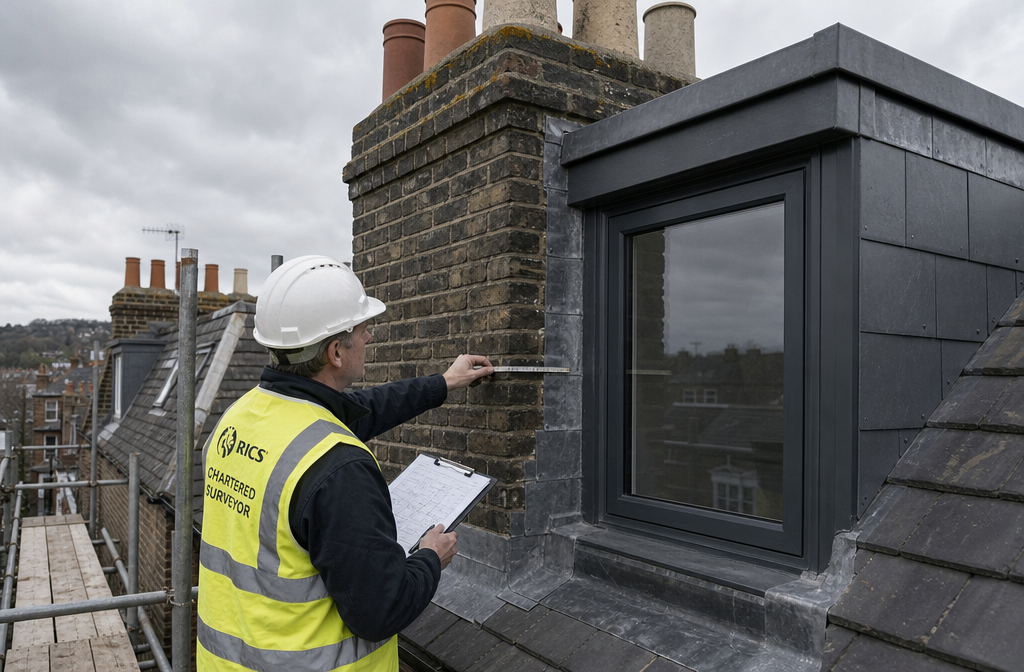
A roof survey prior to works can also establish the baseline condition of both your roof and any shared roof elements, providing valuable evidence if disputes arise later.
Roof Replacements: The Overhang Problem
For roof replacements carried out as part of loft projects, overhanging roofs, gutters, and fascia lines over the party wall boundary are a recurring flashpoint [9]. Common scenarios include:
- New loft roofs or fascia/soffit lines that slightly overhang the party wall
- Replacement gutters that discharge onto or across the boundary
- New flashings that trespass onto the neighbour's roof slope
These issues are almost never addressed in standard builder contracts. They are discovered after completion — when the neighbour demands alteration, often at significant cost. A pre-contract boundary check and a clear specification of roof edge details in the building contract can prevent this entirely.
Structural Design and Method Statements: Non-Negotiable Before Signing
Experts consistently warn that homeowners focus on builder references and price, but fail to demand structural design documentation and method statements in writing before signing contracts [1]. A Party Wall Award may mandate specific protective measures, but if those measures are not mirrored in the building contract and priced for, the contractor has no obligation to implement them on site.
Before signing any builder contract for a loft conversion or roof replacement near a party wall, insist on:
- A structural engineer's design for beam insertion and any chimney work
- A written method statement covering demolition sequence and neighbour protection
- Confirmation of temporary waterproofing and scaffold netting provisions
- Clarity on who is responsible for soot containment during chimney work
- A programme that includes the full party wall notice period
A structural survey or building survey of your own property before works begin can also identify vulnerabilities in the party wall that the structural design must address.
Insulation, Excavation, and Other Overlooked Triggers
Two further triggers that homeowners frequently miss:
Party wall insulation: Adding insulation to a party wall as part of a loft or roof project can trigger the Act if it involves cutting into or altering the wall. Guidance on party wall insulation explains the specific scenarios where notices are required.
Excavation near foundations: If the loft conversion involves any groundwork or underpinning within 3–6 metres of a neighbouring structure, an excavation notice for party wall is required with one month's notice — a step that is routinely missed when builders begin groundwork ahead of the main loft programme.
Conclusion: Act Before You Sign
Party wall risks with loft conversions and roof replacements are not abstract legal concerns — they are practical, financial, and structural risks that materialise on site when preparation has been skipped. The pattern is consistent: homeowners sign builder contracts, builders start work, neighbours take formal action, and the homeowner discovers they are legally and financially exposed in ways their contract does not cover.
Actionable Next Steps for Homeowners in 2026
- Before getting quotes: Identify every party wall, shared chimney, and boundary condition relevant to your project. Consult a qualified party wall surveyor early.
- Before signing a builder contract: Confirm that the programme includes the full two-month notice period. Do not commit to a fixed start date without it.
- At contract stage: Ensure the building contract reflects all protective measures that the Party Wall Award is likely to require — scaffold netting, temporary waterproofing, soot containment, and method statements.
- Budget realistically: Include party wall surveyor fees (£700–£1,500+ per surveyor), potential neighbour surveyor costs, and a contingency for making-good obligations.
- Commission a schedule of condition: Before any work begins, document the neighbour's property condition formally. This protects both parties.
- Get a roof survey: For any project involving roof replacement or dormer construction, a professional roof survey establishes baseline condition and identifies risks before they become disputes.
The Party Wall etc. Act 1996 exists to protect everyone — including you. Used correctly, it provides a clear framework that keeps projects moving and neighbours informed. Ignored, it becomes the most expensive oversight in your build programme.
References
[1] What Are The Risks Of Party Wall Damage From A Loft Conversion And What To Do To Reduce The Risk – https://arunassociates.co.uk/what-are-the-risks-of-party-wall-damage-from-a-loft-conversion-and-what-to-do-to-reduce-the-risk/
[2] How The Party Wall Affects Loft Conversions And Home Extensions – https://www.drawandplan.com/new-blog/2025/3/21/how-the-party-wall-affects-loft-conversions-and-home-extensions
[3] Planning A Loft Conversion Party Wall Agreements – https://collier-stevens.co.uk/advice-hub/party-wall/planning-a-loft-conversion-party-wall-agreements/
[4] Do You Need Party Wall Agreement Loft Conversion – https://www.myhomeextension.co.uk/do-you-need-party-wall-agreement-loft-conversion
[5] Loft Conversions And The Party Wall Act – https://www.peterbarry.co.uk/blog/loft-conversions-and-the-party-wall-act/
[9] New Loft Roof Overhanging Party Wall – https://www.diynot.com/diy/threads/new-loft-roof-overhanging-party-wall.382044/